TODAY. 11 year old boys and nukes in space.

Yeah – I’ve been reading about the awful threat of Russia sending its evil nuclear weapons up into space to destroy our benign satellites. Shock horror – we could lose TikTok coverage and our media focus on Taylor Swift!
Not to mention that it’s not a great idea to cause nuclear explosions in space, and spread toxic radioactive debris all over the place.
But – is it true?
Are the Russians that stupid?
or the North Koreans, or the Chinese ? Or anyone else that we’re scared of?
Well, they might be. Because. Here’s the rub. The biological development of the male does mean that they have a tendency towards aggression, and to develop inhibition rather late – say towards the age of 30. So the young teenage boys, on average, are a bit keener on risk-taking than they will be at later ages.
This aggression, competitive drive, and low fear of danger was probably useful way back when sabre-toothed tigers were the big threat. But not so useful now when other teenage boys can be a big threat.
The problem is – that risk-taking, competitive, aggressive teenager seems to still live and thrive within the men that are actually running things in our world.
They probably are not planning nuclear weapons to hit satellites, because even they see what a stupid idea that is. However, they’re surely organising all sorts of other ways to damage the satellites of “the other side”. Do you think for one moment that it’s only the Russians etc who are doing this? Of course the 11 year-old boys inside the psyche of the Western leaders are up to the same tricks, and probably leading the pack.
Spending watchdog launches investigation into Sellafield

National Audit Office to examine risks and costs at nuclear waste site in Cumbria
Anna Isaac and Alex Lawson, 16 Feb 24 https://www.theguardian.com/business/2024/feb/15/spending-watchdog-launches-investigation-into-sellafield—
Britain’s public spending watchdog has launched an investigation into risks and costs at Sellafield, the UK’s biggest nuclear waste dump.
The National Audit Office (NAO), which scrutinises the use of public funds, has announced it will examine whether the Cumbria site is managing and prioritising the risks and hazards of the site effectively as well as deploying resources appropriately and continuing to improve its project management.
The findings of its investigation are expected to be published this autumn.
Sellafield is Europe’s most toxic nuclear site and also one of the UK’s most expensive infrastructure projects, with the NAO estimating it could cost £84bn to maintain the site into the next century.
Last year, Nuclear Leaks, a Guardian investigation into activities at Sellafield, revealed problems with cybersecurity, a radioactive leak and a “toxic” workplace culture at the waste dump.
Predictions of the ultimate bill for the site, which holds about 85% of the UK’s nuclear waste, vary. It cost £2.5bn to run the site last year, and the government estimates it could ultimately take £263bn to manage the country’s ageing nuclear sites, of which Sellafield accounts for the largest portion.
The site employs about 11,000 people and is the world’s largest store of plutonium. It comprises more than 1,000 buildings, many of which were not created with the intention of becoming long-term storage facilities for radioactive material.
Sellafield is so expensive that the Office for Budget Responsibility, which monitors threats to the UK government’s finances, has warned that it and other legacy sites pose a “material source of fiscal risk” to the country.
The NAO previously examined activities at Sellafield in 2018. It found some aspects of project management had improved but that more needed to be done to get a grip on vast costs and risks.
Amyas Morse, the head of the NAO at that time, found that the Nuclear Decommissioning Authority (NDA), which is tasked with management of Sellafield, needed to improve its explanation of its progress so that parliament could hold it to account.
This challenge was underlined when the Guardian uncovered how a worsening leak from a huge silo of radioactive waste at Sellafield could pose a risk to the public.
The leak, from one of the “highest nuclear hazards in the UK” – a decaying building known as the Magnox swarf storage silo – is expected to continue for at least a further 30 years. This could have “potentially significant consequences” if it gathers pace, risking the contamination of groundwater, according to an official document.
This was just one of a catalogue of safety risks arising from ageing infrastructure at the site. A document sent to members of the Sellafield board in November 2022, and seen by the Guardian, raised widespread concerns about a degradation of safety across the site, warning of the “cumulative risk” from failings ranging from nuclear safety to asbestos and fire standards.
Responding to the issues late last year, a Sellafield spokesperson said: “The nature of our site means that until we complete our mission, our highest hazard facilities will always pose a risk.”
Sellafield is owned by the NDA, a quango sponsored and funded by the Department for Energy Security and Net Zero that is tasked with cleaning 17 sites across the UK.
The NDA said it had a “responsibility to deliver for the public, including on value for money”.
“We welcome this continued scrutiny and look forward to working with the NAO,” a spokesperson said.
Australian PM Albanese and 85 Other MPs Vote to End Assange Incarceration

“Enough is enough,” PM Albanese said.
By Diego Ramos , ScheerPost, 15 Feb24, https://scheerpost.com/2024/02/15/australian-pm-albanese-and-85-other-mps-vote-to-end-assange-incarceration/—
The Australian House of Representatives voted on Wednesday in favor of a motion supporting the end of Julian Assange’s incarceration and to bring him back to Australia. Among the supporters of the motion is Australian Prime Minister Anthony Albanese, who, regarding the long term prosecution and detention of Assange, declared, “enough is enough.”
In the motion introduced by MP Andrew Wilkie, the argument is made for the release of Assange from Belmarsh Prison in the UK and returned to Australia. This comes ahead of next week’s court ruling on Assange’s extradition appeal.
Wilkie said, “It will send a very powerful political signal to the British government and to the US government that the British government should not entertain the idea of Mr Assange being extradited to the US.”
86 members of the house of representatives, including Albanese, voted in favor of the motion; 42 members voted against it.
Wilkie, speaking to Parliament about Assange stated, “Surely this man has suffered enough. The matter must be brought to an end.”
Adam Bandt, member of Australian Parliament and leader of the Australian Greens, said, “…[T]his sets an incredibly chilling precedent for journalists in the future and for journalists’ ability to hold governments to account, to say uncomfortable things about governments … and to know that you can tell the truth without facing imprisonment and without facing a risk to your own life.”
If Assange’s appeal is rejected, he faces immediate extradition to the United States, where he would be set to face trial for various charges, including the release of confidential military records and diplomatic cables in 2010.
Wilkie said the vote demonstrated that Australia stood “as one,” on the Assange case and “[r]egardless of what you might think of Mr Assange, justice is not being served in this case now.”
Below is a transcript of the motion authored by MP Andrew Wilkie: [on original]
EDF’s setbacks weigh down the relaunch of nuclear power in Europe

Montel. EDF’s recent setbacks in its project to build two new generation EPR reactors in the United Kingdom darken the prospects for the revival of nuclear power in Europe, experts told Montel.
Montel) EDF's recent setbacks in its project to build two new generation EPR reactors in the United Kingdom darken the prospects for the revival of nuclear power in Europe, experts told Montel.

By: Muriel Boselli,  8 Feb 2024, https://montelnews.com/fr/news/1537158/les-revers-dedf-plombent-la-relance-du-nuclaire-en-europe-
A dispute between Paris and London over who should pay GBP 6-8 billion (in 2015 values) for new additional costs for the Hinkley Point C (HPC) project is tarnishing the image of the nuclear industry, at a time when nations European pro-nuclear companies seek to promote atomic energy in the fight against climate change, according to several experts.

Commissioning of the HPC project could be delayed by up to four years and completion costs are now expected to be between GBP31bn and £34bn, according to EDF announcements last month.

Hinkley's problems underline the "slow descent into hell" of the French nuclear industry, Jean-François Raux, former director of EDF and general delegate of the French Electricity Union (UFE), told Montel.

“I have fierce doubts about EDF's ability to build more reactors,” he said, highlighting the delays and additional costs of new construction in France, Finland and the United Kingdom.

Indeed, the start-up of the Flamanville EPR by mid-2024 was “very tense”, with EDF still having to submit compliance documents, the director of the Nuclear Safety Authority (ASN) declared last week. The project is already twelve years late.

According to a source close to the matter at EDF, the company could even withdraw from HPC, although this scenario is not the most likely. “The board of directors did not sign a blank check for Hinkley, it barely committed to financing the project for 2024,” he assures.

Threat to the relaunch of nuclear power
The French nuclear recovery program provides for the construction of six EPR2s in France at an estimated cost of EUR 52 billion. A first pair of reactors is planned at Penly, in the northwest of the country by 2035-2037.

However, these ambitions are threatened by difficulties encountered at the Hinkley site, experts said.

“The problem is that we will have to launch construction work on two European pressurized reactors at Penly, while we continue to inject billions into HPC,” estimated the source at EDF. “There will inevitably be plasters to wipe and skills to find,” he added, noting that the Penly EPRs will “inevitably encounter difficulties”.

Florence de Bonnafos, campaign manager at Greenpeace, agrees with these comments, believing that EDF's nuclear revival project is unrealistic given the latest cost estimates for the two HPC reactors.

“It’s still a bit complicated to make us believe that we will be able to build six reactors for the same budget as two reactors in Great Britain,” she said.

The schedule slip on the HPC project follows reports that EDF's Chinese partner CGN has pulled out of financing the project, leaving a gap of GBP1bn per year.

The issue could impact funding for the UK's other planned flagship nuclear project at Sizewell C, a joint venture between the UK government and CGN. EDF, in debt to the tune of EUR 65 billion, is expected to make a final investment decision next summer.

Political decisions
The subject of financing is at the heart of a standoff between the French and British governments, with Paris partly accusing the United Kingdom of having frozen its diplomatic relations with China.

Elsewhere, in the Czech Republic, where EDF has submitted a bid to build four reactors, officials could be tempted to choose Korean competitor KHNP, analysts said.

“The main problem is that the decisions taken are more political than industrial,” said the EDF source. “No one thought that we would do HPC and Flamanville in the given time. It was custard. »

In addition, Mr. Raux notes a lack of accountability within EDF. “In other sectors, when things go wrong, leaders are replaced,” he said.

This is the first part of a two-part article devoted to the prospects for nuclear development in the EU.
From Russia with nukes? Sifting facts from speculation about space weapon threat
“Nuclear weapons in space are a really, really dumb idea,” said Jessica West of Canadian non-profit Ploughshares, but experts note that with Russia, nothing can ever be fully ruled out.
By THERESA HITCHENSon February 15, 2024
https://breakingdefense.com/2024/02/russia-nuclear-weapon-space-mike-turner-threat-white-house/
WASHINGTON — In the 24 hours since a cryptic, but scary, warning from Ohio Rep. Mike Turner, the chair of the House Intelligence Committee, of a “serious national security threat,” mainstream and social media sites alike have been chock-a-block with breathless, and sometimes contradictory, speculation about what might be going on.
Even as other members of Congress and the White House sought to play down Turner’s statement, leaks began to fill the press that the situation involves some sort of Russian nuclear capability in orbit.
The New York Times today quoted officials “briefed on the matter” as saying that the Biden administration has “informed Congress and its allies in Europe about Russian advances on a new, space-based nuclear weapon designed to threaten America’s extensive satellite network.”
PBS News Hour, on the other hand, on Wednesday said that sources characterized the new weapon as a nuclear-powered satellite carrying an electronic warfare payload — which is a very different beast than a nuclear weapons-carry satellite — but today reported that it is unclear which of those two things is correct.
The most detail shared by the administration came in a press conference today, where White House spokesperson John Kirby confirmed that the threat in question is “related to an anti-satellite weapon that Russia is developing.” He also noted that it is not an “active capability that has been deployed,” and that “there is no immediate threat to anyone’s safety.” However, Kirby refrained from providing more specific details.
Moscow, predictably, has issued a blanket denial.
Whatever the exact nature of the new threat is, the White House and President Joe Biden are “taking it seriously,” Kirby said, with briefings planned to Congress, as well as allies and partners. Further, he said, the administration is undertaking “direct diplomatic engagement with Russia” on US concerns.
To be clear, any type of Russian on-orbit anti-satellite (ASAT) would be a bad thing. But all things considered, a nuclear weapon in space would be worse than a nuclear-powered satellite carrying a disruptive EW payload — although for a number of reasons much less likely to be what Moscow is up to.
Nuclear Weapons in Space: Been There, Done That
Yes, nuclear weapons have been detonated in space before, by both the Soviet Union and the US during the early days of the Cold War. The largest was done by the US in 1962. After a series of failed tests, the United States conducted the Starfish Prime experiment, setting off a 1.45 megaton nuke at an altitude of about 450 kilometers (about 280 miles) above sea level.
The blast created an electro-magnetic pulse and lingering radiation belts that ultimately killed eight of the 24 satellites that were then on orbit, including one owned by the United Kingdom, according to a 2022 report by the American Physical Society.
There are around 7,000 active satellites on orbit today, as well as 10 humans aboard the International Space Station and China’s Tiangong station. Thus, a nuclear explosion on orbit likely would create even more havoc than Starfish Prime — including, almost certainly, for Russia’s own assets.
“Nuclear weapons in space are a really, really dumb idea, first because they are banned, but also because they have immediate and long lasting indiscriminate effects on the space environment which means that everyone — including the deployer and its allies — is affected,” explained Jessica West of Canadian non-profit Ploughshares in an email.
The 1967 Outer Space Treaty, to which both Russia and the US are parties, was created by the United Nations precisely to ban nuclear weapons in space.
“Some people might say that Russia doesn’t care about this because its space capabilities are waning so it has a smaller stake in the game. But I don’t think that any state can aim for functionality let alone ‘great power’ without being able to exploit outer space. There are also easier (and currently legal) ways of having large scale effects on the space environment such as the use of destructive weapons and dirty bombs,” West added.
Todd Harrison of the American Enterprise Institute agreed.
“There is no need to place nukes in orbit. Keeping nukes on Earth atop ICBMs is less expensive, more flexible to operate, easier to upgrade and maintain, etc. But what if your intent is to use the nuke in space (e.g., an EMP blast)? It is still better to base it on the ground,” he told Breaking Defense in an email.
“Detonating nuclear weapons has also been banned by treaty since 1963, not that it would stop Russia from doing it,” he added. “But why did the US and USSR agree to this ban so long ago and stick to it for all these years? It’s because popping off a nuke in space creates a real mess that affects satellites indiscriminately.”
That said, it would be very hard to detect if any country decided to deploy a nuke on a satellites, said Henry Sokolski, executive director of the Nonproliferation Policy Education Center. He told Breaking Defense in an email today that this verification problem was one of the key findings of an unclassified wargame the center conducted last spring on the use of a nuclear weapon in low Earth orbit.
“My hunch is that nobody wants to admit that this is the case. It’s a pretty important point,” he added.
Nuke-Powered Satellite: Old Tech, New Use?
Several experts said that Russian development of an anti-satellite (ASAT) weapon being carried on a nuclear-powered satellite, one using a small nuclear reactor to generate on-board electricity, is a more likely scenario. This is because both NASA and Russia’s Space Agency Roscosmos, have used nuclear power for space systems in the past. Indeed, NASA’s famous Voyager spacecraft carry nuclear power generators.
“The advantage is that a nuclear power source gives you power all the time, instead of being dependent on solar arrays pointing at the sun and charging batteries,” Harrison said.
Russia in the 1970s launched a series of naval reconnaissance satellites, called RORSATs for Radar Ocean Reconnaissance Satellites, equipped with a small reactor. Infamously, one of them crashed into Canada’s Northwest Territories in 1978, scattering radioactive debris for miles. Thus, the UN has “adopted principles regarding the use of nuclear power sources in outer space,” West said, which focus on safety and peaceful uses.
Still, she noted that “obviously the use of nuclear anything in space is fraught with safety concerns, and when this is combined with a military capability, it adds on security concerns and fears that it could also be used as a nuclear weapon.”
Harrison explained that a nuclear power source could be used to operate a number of payloads capable of disabling satellites.
“A nuclear power source could be used for a lot of things, like powering a radio frequency jamming payload to block signals or a high-powered microwave payload that could potentially fry the circuits on a satellite. Both of these applications would make a lot of sense from space,” he said.
Secure World Foundation’s Brian Weeden, in a thread on X (formerly Twitter), said a nuke-powered EW satellite is likely what the Russians are working on — especially considering that there is evidence that they have been developing such a technology, as documented in a 2019 article in The Space Review. The satellite system in question, called Ekipazh, is being developed by KB Arsenal (or Arsenal Design Bureau) of St. Petersburg under a contract with the Ministry of Defense, the article asserts.
All that said, Harrison said that it is also possible that some other non-nuclear capability is at play.
“Of course, all of the speculation could be completely wrong and it could be some other type of counterspace weapon. Russia has tested crazy things in the past, like firing a machine gun in space,” he said.
“But until we know more, and knowing Russia’s history of ASAT weapon development and testing, it is certainly something to be concerned about. Our economy and military are heavily dependent on space, and Russia knows that,” he added.
France’s first 6 EPR2 nuclear reactors will cost much more than the planned 52 billion euros.
Why the first six EPR2s will cost much more than the 52 billion euros
initially planned by EDF. During a hearing in the Senate, the executive
director of EDF’s new nuclear projects, Xavier Ursat, indicated that the
first six EPR2s will cost more than the 52 billion euros announced in 2021.
A first slippage in costs including the new estimate is promised for the
end of 2024.
Why the first six EPR2s will cost much more than the 52
billion euros initially planned by EDF. EDF does not brag about it. But in
the Senate commission of inquiry into the price of electricity, Xavier
Ursat, its executive director in charge of the engineering department and
new nuclear projects, was obliged to talk about it.
As predicted by an expert report in 2021, the construction of the first six EPR2s will indeed
cost more than the 51.7 billion euros, rounded to 52 billion by the State,
calculated by EDF at the time Emmanuel Macron had to decide on the relaunch
of a new nuclear program in France. A relaunch confirmed in his speech on
Belfort’s energy strategy on February 10, 2022. “We are carrying out a
new economic assessment. It led to a figure higher than 52 billion,”
Xavier Ursat declared to the senators. Which, for him, “is not very
surprising”.
L’Usine Nouvelle 12th Feb 2024
Biden disparages Netanyahu in private but hasn’t significantly changed U.S. policy toward Israel and Gaza

As the reported Palestinian death toll in the Gaza Strip reaches 28,000, the president continues to believe that unequivocally supporting Israel is the right policy.
Yet, even as Biden has escalated his rhetoric, he is not yet prepared to make significant policy changes, officials said. He and his aides continue to believe his approach of unequivocally supporting Israel is the right one.
As the reported Palestinian death toll in the Gaza Strip reaches 28,000, the president continues to believe that unequivocally supporting Israel is the right policy.
NBC News, Feb. 12, 2024, By Carol E. Lee, Jonathan Allen, Peter Nicholas and Courtney Kube
WASHINGTON — President Joe Biden has been venting his frustration in recent private conversations, some of them with campaign donors, over his inability to persuade Israel to change its military tactics in the Gaza Strip, and he has named Prime Minister Benjamin Netanyahu as the primary obstacle, according to five people directly familiar with his comments.
Biden has said he is trying to get Israel to agree to a cease-fire, but Netanyahu is “giving him hell” and is impossible to deal with, said the people familiar with Biden’s comments, who all asked not to be named.
“He just feels like this is enough,” one of the people said of the views expressed by Biden. “It has to stop.”
Biden has in recent weeks spoken privately about Netanyahu, a leader he has known for decades, with a candor that has surprised some of those on the receiving end of his comments, people familiar with them said. His descriptions of his dealings with Netanyahu are peppered with contemptuous references to Netanyahu as “this guy,” these people said. And in at least three recent instances, Biden has called Netanyahu an “asshole,” according to three of the people directly familiar with his comments……………………………………………………………………………………………………………………….
Yet, people familiar with Biden’s private comments said he has told them he believes it would be counterproductive for him to be too harsh on Netanyahu publicly.
Biden’s frustrations with Netanyahu have also not led to a major policy shift, but his administration has begun to consider such options. Two weeks ago, officials told NBC News that the administration was discussing delaying or slowing U.S. weapons sales to Israel as leverage to get Netanyahu to dial down Israeli military operations in Gaza and do more to protect civilians………………….
Yet, even as Biden has escalated his rhetoric, he is not yet prepared to make significant policy changes, officials said. He and his aides continue to believe his approach of unequivocally supporting Israel is the right one…………………………
“I’m a Zionist,” Biden said, reiterating his views that Hamas must be destroyed and that Israel must be protected, according to the supporter……………………………………………….. https://www.nbcnews.com/news/investigations/biden-disparages-netanyahu-private-hasnt-changed-us-policy-israel-rcna138282
Russian ‘nukes in space’ scare by Biden admin is nonsense

Russian ‘nukes in space’ scare by Biden admin is BS, Bruce K. Gagnon,
https://space4peace.blogspot.com/2024/02/russian-nukes-in-space-scare-by-biden.html
Remember in 2003 how the New York Times reported that Iraq had WMD which then justified the Bush administration’s ‘shock and awe’ attack? At the time so-called ‘intelligence agencies’ in the US claimed that it was all true.
It wasn’t.
Fast forward to 2024 and we hear reports from the same corporate media rag that intel reveals Russia has a new super-duper nuclear weapon that can destroy US satellites in space.
Suddenly its all over the news just days after the Vladimir Putin interview with Tucker Carlson is seen by hundreds of millions (maybe billions by now) around the world.
Desperation hits the White House. ‘We’ve got to come up with something big to trash Russia in order to get Congress to vote for the billions for the Ukraine war’.
And so they did.
It’s all BS.
The 1967 Outer Space Treaty banned weapons of ‘mass destruction’ in space. At the time the US and USSR were worried about one side blowing things up with nukes in space. Thus the incentive for the treaty.
Both sides today have anti-satellite weapons (ASAT) capabilities using kinetic weapons that just crash into a satellite – no explosives involved. So Russia would not need nukes to do the job if they wanted to. Likely lasers are also available to both sides to carry out the task as well.
The US last tested an ASAT in 2008 in Operation Burnt Frost when they launched an ‘interceptor missile’ from a Navy Aegis destroyer that went into space and knocked out an old US satellite.
US, India, China and Russia have developed anti-satellite weapons of some kind – mostly the kinetic variety.
The Kremlin spokesman Dmitry Peskov responded to White House claims about the ‘new secret Russian nuclear weapon’ by saying:
“It’s clear that the White House is trying, by hook or by crook, to push Congress to vote on a bill to approve funding [for Ukraine]. We’ll see what tricks the White House will use,” he said.
PAROS
And remember that Russia and China every year for at least the last 25-30 years go to the UN and introduce a new treaty called Prevention of an Arms Race in Outer Space (PAROS) to ban all weapons that fall outside of the 1967 treaty. In other words, all the new high-tech space weapons that are not covered in the Outer Space Treaty.
The US and Israel routinely block the treaty negotiations (during both Republican and Democrat administrations) saying, ‘There is no problem in space thus no need for a new treaty’. Very self serving.
I believe the Russians have a long history of generally honoring treaties while the US does not.It was the US that pulled about of the ABM Treaty (Anti-ballistic missile) that outlawed the building, testing and deployment of ‘missile defense’ systems which are key elements in Pentagon first-strike attack planning.
The US refuses to renounced first-strike while China and Russia have done so for many years.
So who is really the aggressor in space?
When the US claims it will be the ‘Master of Space’ (to ‘control and dominate space and deny other nations access to space’) one must examine closely just who is leading the race to militarize and weaponize space.
See the 1997 US Space Command document ‘Vision for 2020’ that lays that all out here.
Incidentally, the US Space Force was created in 2020 – right on schedule you might say.
Beware of those who promote corporate media reporting of White House lies and deception to keep war$ going.
EU’s top diplomat slams US for sending arms to Israel as Gaza deaths mount
Politico, FEBRUARY 12, 2024 ,BY PAULA ANDRÉS
Western leaders have decried Israel’s planned Rafah invasion plan, but PM Netanyahu “doesn’t listen to anyone,” Josep Borrell says.
EU foreign affairs chief Josep Borrell on Monday called on the international community, and particularly the U.S., to stop providing arms to Israel in light of the growing number of civilians being killed in Gaza.
“Everybody goes to Tel Aviv begging please protect civilians, don’t kill so many. How many is too many?” Borrell said during a meeting of EU ministers.
If the international community is worried about the death toll, “maybe they have to think about the provision of arms,” he said. Borrell, the EU’s top diplomat, also cited a Monday Dutch court ruling ordering the Netherlands government to halt shipments of components to Israel for F-35 fighter jets……………….
Borrell noted the U.S. had taken a similar decision on arms supplies to Israel in its 2006 conflict with Lebanon “because Israel didn’t want to stop the war; exactly the same thing that happens today.”……………………..
Western leaders have decried Israel’s invasion plan, but Israeli Prime Minister Benjamin Netanyahu “doesn’t listen to anyone,” Borrell said. “Where are they going to evacuate [Palestinians]?” he asked. “To the moon?”
UN agency
The EU ministers voiced support for the United Nations agency for Palestinian refugees (UNRWA), which has recently taken fire amid Israeli allegations that members of its staff abetted the October 7 Hamas attacks.
“Many member states stated there is no alternative for Gaza and that we must prevent funding gaps,” said Belgium’s Minister of Development Cooperation Caroline Gennez.
Gennez said there was an “agreement amongst the member states that full transparency is needed from all sides,” adding that details of the Israeli reports haven’t been shared with donor countries or the UNRWA itself.
“It’s not a secret that the Israeli government wants to get rid of UNRWA,” Borrell said,
but “there’s only one way in which the agency can be dissolved […] through the creation of two states.”
Several EU countries and international donors have suspended funding to UNRWA since Israel’s allegations, cutting the agency’s budget by more than half.
For UNRWA chief Philippe Lazzarini, the agency’s collapse would be “short-sighted” and would not contribute to the recent ruling from the International Court of Justice to ensure humanitarian aid in Gaza. “The coming days will tell us if we will be able to continue to operate in an extraordinarily challenging environment,” he said.
Lazzarini added that Sunday was “the first time the U.N. could not operate with a minimum of protection,” and deplored the looting of trucks filled with aid for Palestinians at the border.
The European Commission has yet to decide whether it will provide an €82 million payment to the U.N. agency by the end of the month, as two investigations are underway. https://www.politico.eu/article/top-eu-diplomat-josep-borrell-united-states-sending-arms-to-israel/
Small nuclear reactors (SMRs) still have plenty to prove.

Britain’s MPs are not paid to be polite. So it must have been with some restraint that the members of the environmental audit committee described the government’s nuclear strategy this week as “lacking clarity”, not least over small modular reactors.
Lacking clarity? You can think of better ways to describe the financially
radioactive shambles, complete with Rishi Sunak’s fantasy “road map”.
He’s glibly promising 24 gigawatts of capacity by 2050 — either another
seven Hinkley Point Cs or a mix of them and SMRs.
Surely he’s spotted what’s going on with that Somerset nuke? Costs up from £18 billion to as
much £35 billion in 2015 prices, or £46 billion in today’s money, with
its start-up likely to be delayed six years to 2031.
Maybe he hasn’t, because he’s planning a lookalike for Sizewell C in Suffolk, built by the
same French-backed EDF. Only this time it won’t be EDF but consumers and
the taxpayer on the hook for the construction cost overruns. As the
committee chairman Philip Dunne noted: “The UK has the opportunity to be
a genuine world leader in the manufacture of SMR nuclear capability with
great export potential.” But despite the taxpayer lobbing in £215
million to support their development, MPs are right to see a deficit on the
“clarity” front.
As Professor Steve Thomas from the University of
Greenwich says: “SMRs are up to a decade behind large reactors in terms
of their commercial development and their economics are speculative and
untested.” Rolls’s are 470 megawatts, one seventh of the 3.2GW Hinkley.
But who knows if it really can build them for £2.5 billion a pop? Or
whether it’ll prove feasible to cram several on a single site. In
November Utah Associated Municipal Power Systems canned a project to build
six 77MW NuScale SMRs at a site in Idaho. And even if they’d be far
smaller than Hinkley, they’d still need to be just as safe. Will safety
issues drive up costs? Also, who’s paying for them? Consumers, the
taxpayer, the private sector? And what’s the cost versus alternative
energy technologies?
Times 15th Feb 2024
https://www.thetimes.co.uk/article/shameful-shambles-over-mega-nukes-d6wzvp33v
Devonport Dockyard nuclear sub dismantling will be hit by delays, new report predicts
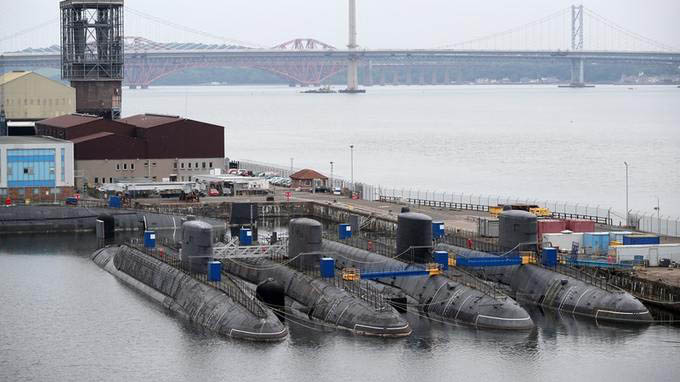
Nuclear Information Service expects no quick fix for removal of 15 decommissioned submarines laid up at Devonport
William Telford, Business Editor, 15 Feb 24 Plymouth Live
The dismantling of 15 decommissioned nuclear subs at Devonport Royal Dockyard is likely to hit delays, according to a new report. The briefing document published by the independent Nuclear Information Service says a history of infrastructure work at the Plymouth facility means “delays are more likely to materialise than not”.
The report said upgrades to 14 and 15 Docks and the Submarine Refit Complex at Devonport are overdue and progress on submarine dismantling is “on hold” while the Government focuses on its £298m “demonstrator” project to fully dismantle HMS Swiftsure at Rosyth, forecast to be complete at the end of 2026.
The Ministry of Defence told Plymouth Live it aims to dismantle the nuclear submarines at Devonport “as soon as practicably possible”. It said the Swiftsure project will “inform and refine” the dismantling process for subsequent submarines and provide more certainty on the dismantling schedule for future submarines and remains on schedule for completion by the original target date of 2026.
The Nuclear Information Service’s briefing report on Devonport Royal Dockyard gives an overview of the facility and its role in servicing the UK’s submarine fleet, including its nuclear-armed submarines. The report said: “The 15 out-of-service nuclear submarines stored at Devonport, and a further seven that are at Rosyth, together comprise every nuclear submarine the Navy has ever fielded.
“Aside from the long-overdue upgrades to 14 and 15 Docks, and the Submarine Refit Complex, progress on submarine dismantling is on hold while the Government focuses on its ‘demonstrator’ project to fully dismantle HMS Swiftsure. This work is being undertaken at Rosyth and is currently forecast to be complete at the end of 2026 at a cost of £298m.
“Three more submarines at Rosyth have had low-level waste removed from them, but it is not clear if work to defuel the nine submarines at Devonport that are still carrying nuclear fuel will begin before completion of the demonstrator project.
In 2016 the MoD estimated that fully dismantling 27 submarines would cost £2.4bn. Although the risk to in-service submarine availability from delays to submarine dismantling and defuelling is lower than from delays to the maintenance schedule, the history of problems with the project and with infrastructure work at Devonport suggests that delays are more likely to materialise than not.”…………………………..more https://www.plymouthherald.co.uk/news/plymouth-news/devonport-dockyard-nuclear-sub-dismantling-9098888—
AGAIN – THE POWER OF THE ZIONIST LOBBY
I was banned from Mastodon because I posted a link to an article supporting humanitarian aid to Gaza.Now I have been banned from one part of Reddit ( r/worldnews) for posting this link https://www.unz.com/…/over-a-million-palestinians-are…/
I can still post to other parts of Reddit.

Palestine and the Power of Language

TIME, BY ELENA DUDUM, FEBRUARY 16, 2024 Dudum is a Palestinian-Syrian-American writer currently working on a memoir about living in the diaspora as a Palestinian in America. She is a graduate of Columbia University
In today’s near-constant news cycle on Gaza, Palestinians seem to die at the hands of an invisible executioner. Palestinians are shot dead. Palestinians starve. Palestinian children are found dead. But where is there accountability? Palestinians die, they aren’t killed, as if their death is a fault of their own.
The obfuscation of responsibility is facilitated by a structure often overlooked since grade school: grammar. At this moment, grammar has the indelible power to become a tool of the oppressor, with the passive voice the most relied-upon weapon of all.
When I was young, teachers scolded me for using the passive voice—they wanted my writing to be precise and direct. Instead, my sentences always seemed to protect those who performed the actions. Back then, the fact that my sentence structure obscured accountability didn’t bother me. But I know better now. As a Palestinian American, with refugee grandparents who survived the Nakba, I’m confronting the occupation back home from the safety of my apartment in America. Over the years, I’ve combed through headlines searching for the active voice in a sea of passivity. I need those who commit actions, those who hold agency, to be named. I need Israel and its occupational forces to be named.
The passive voice often focused on the recipient of the event, not the doer. In the news today, I see only the passive voice: “A group of Palestinian men waving a white flag are shot at,” and I can’t help but hear the voices of my past English teachers ask, “But who ‘shot’ these men?” Accountability is not just vague; it’s altogether missing……………………………………………………………………………………………………………………………………….
“This is how Britain ruled the world,” Khalidi went on to explain. “It was an empire of violence. And that strategy of overwhelming violence, when challenged, has been Israel’s strategy ever since.” This history of violence can easily be traced back to the foundation of the Zionist movement. The first Israeli prime minister, David Ben-Gurion, wrote to his son in 1937: “The Arabs will have to go, but one needs an opportune moment for making it happen, such as a war.”
I saw intent in these words, but others in my class did not. So I kept searching, looking through the archive to help me piece together what parts of history I was missing. I found Joseph Weitz, director of the Jewish National Fund’s Lands Department, who wrote that there was no solution other than to transfer all Arabs from Palestine—who were the overwhelming majority in the region—into neighboring countries so that no Palestinian villages would remain. But when I shared these findings in class, they were brushed aside. “This isn’t intent,” a student said. “You can’t prove intent with a few peoples’ letters and actions.”………………………………………………………………………………………………………………
While writing tedious essays in high school, I didn’t care that I used the passive voice. I didn’t care because our writing assignments were often divorced from broader socio-political contexts. The violence of protecting those accountable versus those left bearing the burden of the violence didn’t yet touch me or my body. A privilege, I know. The calculated use of language against Palestinians didn’t yet anger me, either, even though blatant anti-Arab racism happened in front of me with growing frequency after 9/11. It felt as though this version of racism was acceptable, even expected……………………………………………………………………………………………..
The word “complicated” is often used to describe the occupation in Palestine, a word that insists that occupation is untouchable—Palestine’s history is too complex, there are too many moving parts, it’s a puzzle that can never be solved. But this word is condescending—a distraction. It wants us to feel small, worthless, and petty in our investigation. It demands power structures remain in place, allowing some to speak while requiring others to stay quiet. But what’s happening today in Palestine against the Palestinian people is not complicated. It’s a revolting violation of human rights. It is active and precise. Palestinians are killed or, if they’re lucky, violently evicted from their homes. The question—by whom?—is often never raised. Palestinian schools, hospitals, community centers, historic holy spaces, safe zones are bombed; their resources depleted; people are starving—as if all of this happened devoid of context or responsibility for those who hold power.
So let me amend the above statements, as my former English teachers would have requested, and put them into the active voice: Israel bombs Palestinian schools that house sacred archives. Israel bombs hospitals with necessary aid. Israel bombs community centers and historic holy spaces that have stood for centuries. Israel depletes Palestinian resources. Israel bombs Rafah, housing over 1 million displaced Palestinians, after claiming it a safe zone. Israel is starving Gaza. https://time.com/6695499/palestine-power-of-language-essay/—
What are Russia’s Top 5 Anti-Satellite Systems?
Sputnik, 15 Feb 24
Russia has effective means to thwart adversary satellites, including arms based on new physical principles. What are they?
Moscow trashed the groundless rumors of its alleged efforts to deploy a nuclear anti-satellite system in space on February 15.
A day earlier, mainstream US media claimed that Washington had informed Congress and its European allies about Russia’s work on a new, space-based nuclear weapon designed to undermine the US satellite network.
A new bugaboo about Russia’s supposed plans to destroy American satellites with nuclear arms is aimed at ramming a $60 billion funding package for Ukraine through US Congress, military analyst and editor-in-chief of the National Defense magazine Igor Korotchenko told Sputnik on Thursday. Even though the package in question was earlier passed in the US Senate as part of a $95 billion bill, the chances of the House approving the legislation is considered slim.
According to Korotchenko, Russia has cheaper and more effective means of anti-satellite warfare than those that Washington accuses it of developing.
This is a question of approaches. The fact is that the deployment of nuclear weapons in space is ineffective in terms of its use, especially given that Russia has much simpler and cheaper means to disable, in the event of hostilities, a significant part of the US satellite constellation,” the expert underscored.
Sputnik has taken a look at the systems that could do the job.
The Nudol System
On November 15, 2021, Moscow conducted a direct-ascent hit-to-kill anti-satellite (ASAT) test using the A-235 Nudol anti-satellite system. The test shot down an old Soviet reconnaissance satellite launched back in 1982.
The A-235 Nudol is an improved modification of the A-135 Amur strategic missile defense system. The missile can hit a target at a distance of up to 1,500 kilometers (versus 850 kilometers for the A-135), while its interception speed is increased to Mach 10 (versus Mach 3.5 for the A-135).
In contrast to its predecessor, the A-235 may use kinetic force, not nuclear or high-explosive fragmentation, to destroy the target.
The development of the A-235 Nudol started in 1985-1986 and was carried out in compliance with international ballistic missile agreements existing at the time. The weapon was designed to become the first Soviet mobile missile defense system capable of intercepting intercontinental-range missiles, spacecraft and satellites operating at high orbits.
Immediately after the Cold War, the development of the A-235 was suspended and restarted in 2011 by Almaz-Antey, nine years after the Bush administration unilaterally terminated the Antiballistic Missile Treaty (ABM) in 2002.
The system has been tested several times since 2014; however, in November 2021 the missile was fired at a specific moving space target and eventually destroyed it, causing a fuss in the Pentagon.
Nanosatellites: Nivelir, Burevestnik and Numismat
The development of Russia’s secretive project Nivelir (“Leveler”) has reportedly been carried out by the Central Scientific Research Institute of Chemistry and Mechanics Named after D.I. Mendeleyev since 2011.
The endeavor supposedly envisaged building small satellites designed to inspect other satellites in space. The first three satellite-inspectors were reportedly attached to three communications satellites launched between 2013 and 2015.
According to other sources, Russia has been experimenting with satellite inspectors since 2017. The satellites maneuvered in orbit, moving away from each other and then getting closer. In 2019, the Cosmos-2535 and Cosmos-2536 devices were launched. Their goal was to study the impact of “artificial and natural factors of outer space” on Russia’s space devices and to develop “technology for their protection.”…………………………………..
The Kontakt System
The USSR started to develop the 30P6 Kontakt (“Contact”) system in 1983. The 79М6 munition – a three-stage rocket – was supposed to be mounted on the MiG-31D fighter-interceptor.
Launched from an airplane at an altitude of 15 kilometers the munition was designed to fire a fragmentation warhead into space. It was assumed that the Kontakt system would be a stealth and inexpensive means of destroying enemy satellites……………………………………………………….
The Tirada Electronic Warfare System
According to the Russian Ministry of Defense, the Tirada-2S radio-electronic communication suppression system is capable of electronically jamming satellite communications with complete disabling. In this case, satellites can be deactivated directly from the Earth’s surface.
There is little information about the system’s specifications in the public domain. …………………………………………………………………………………..
The Peresvet Laser System
On March 1, 2018, Russian President Vladimir Putin first mentioned Russia’s laser weapon for air defense and anti-satellite warfare, the Peresvet, during his address to the Federal Assembly………………………………………….
The aforementioned systems are just a few of those potentially developed by the Russian military-industrial complex, indicating that Russia is capable of using its decades-long scientific and technological potential to ensure the nation’s security in the event of a large-scale conflict. https://sputnikglobe.com/20240215/what-are-russias-top-5-anti-satellite-systems-1116802215.html
SpaceX deorbiting 100 older Starlink satellites to ‘keep space safe and sustainable’

By Brett Tingley, Space,com , 14 Feb 24
There are still well over 5,000 operational Starlink satellites in low Earth orbit.
SpaceX will deorbit some of its older Starlink internet satellites in order to reduce the number of potentially dangerous spacecraft in low Earth orbit.
The company just announced that 100 Version 1 Starlink satellites will be deorbited over the next weeks and months in the name of space sustainability. SpaceX posted a statement to X (formerly Twitter) on Monday (Feb. 12) announcing the plan, noting that the move is “the right thing to do to keep space safe and sustainable.”
The statement, titled “Commitment to Space Sustainability,” points out that SpaceX‘s Starlink team found a “common issue in this small population of satellites that could increase the probability of failure in the future,” potentially rendering them unable to be maneuvered out of the way of other spacecraft. The deorbiting operation should take around six months…………………………………………………………..
All Starlink satellites are designed to fall into Earth’s atmosphere on their own in under five years from the time they are deployed due to the effects of atmospheric drag. They are also engineered to be “fully demisable by design,” SpaceX’s statement adds, meaning they burn up entirely as they deorbit, rendering the risk of debris falling to Earth to “effectively zero.”
While 100 satellites sounds like a significant amount, SpaceX currently has 5,438 Starlink craft in orbit, according to astrophysicist and satellite tracker Jonathan McDowell. The company already has regulatory approval to launch 12,000 Starlink satellites, and wants to eventually expand its fleet to 40,000 or so.
And more are going up every month; SpaceX plans to launch 144 missions this year, most of them likely devoted to placing Starlink satellites in orbit. (About 60% of the company’s launches in 2023 were dedicated Starlink missions.) The satellites offer high-speed broadband connectivity to users worldwide, including in war-torn or disaster-stricken areas. https://www.space.com/spacex-starlink-satellites-deorbit-space-sustainability
1 This Month

of the week – Shut Down Drone Warfare!


Tell the Ukrainian Government to Drop Prosecution of Peace Activist Yurii Sheliazhenko

Petition to revoke the licensing of the Near Surface Nuclear Disposal Facility (NSDF) at Chalk River. https://www.ourcommons.ca/petitions/en/Petition/Details?Petition=e-7247
To see nuclear-related stories in greater depth and intensity – go to https://nuclearinformation.wordpress.com
-
Archives
- April 2026 (114)
- March 2026 (251)
- February 2026 (268)
- January 2026 (308)
- December 2025 (358)
- November 2025 (359)
- October 2025 (376)
- September 2025 (257)
- August 2025 (319)
- July 2025 (230)
- June 2025 (348)
- May 2025 (261)
-
Categories
- 1
- 1 NUCLEAR ISSUES
- business and costs
- climate change
- culture and arts
- ENERGY
- environment
- health
- history
- indigenous issues
- Legal
- marketing of nuclear
- media
- opposition to nuclear
- PERSONAL STORIES
- politics
- politics international
- Religion and ethics
- safety
- secrets,lies and civil liberties
- spinbuster
- technology
- Uranium
- wastes
- weapons and war
- Women
- 2 WORLD
- ACTION
- AFRICA
- Atrocities
- AUSTRALIA
- Christina's notes
- Christina's themes
- culture and arts
- Events
- Fuk 2022
- Fuk 2023
- Fukushima 2017
- Fukushima 2018
- fukushima 2019
- Fukushima 2020
- Fukushima 2021
- general
- global warming
- Humour (God we need it)
- Nuclear
- RARE EARTHS
- Reference
- resources – print
- Resources -audiovicual
- Weekly Newsletter
- World
- World Nuclear
- YouTube
-
RSS
Entries RSS
Comments RSS
 nuclear-news