US Gives Israel the Green Light to Kill Civilians in Rafah
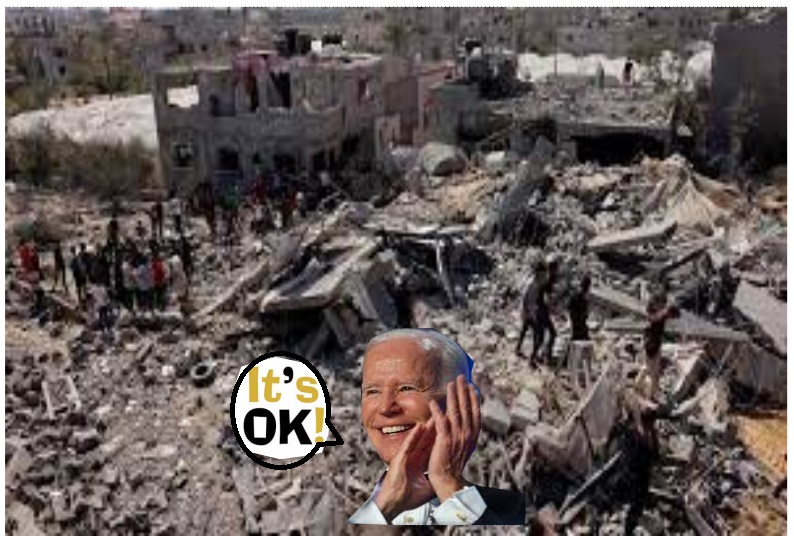
US officials told POLITICO that there would be no consequences for Israel if it invades Rafah, by Dave DeCamp February 13, 2024, https://news.antiwar.com/2024/02/13/us-gives-israel-the-green-light-to-kill-civilians-in-rafah/
The US has given Israel the green light to kill civilians in Rafah despite public comments from US officials calling for Israel to come up with a plan to protect civilians in the city, which is packed with an estimated 1.5 million Palestinians.
US officials told POLITICO that the Biden administration was not planning any consequences for Israel if it went ahead with a major assault on Rafah, which would inevitably kill a huge number of civilians. “No reprimand plans are in the works, meaning Israeli forces could enter the city and harm civilians without facing American consequences,” the report reads.
White House National Security Council spokesman John Kirby made clear at a press conference on Monday that the US wasn’t thinking about cutting off Israel from military aid if it went ahead with the assault. When asked if the US has threatened to withhold aid, Kirby said, “We’re going to continue to support Israel … And we’re going to continue to make sure they have the tools and the capabilities to do that.”
President Biden is also not reconsidering his full-throated support for the Israeli slaughter in Gaza despite reports of him disparaging Israeli Prime Minister Benjamin Netanyahu in private conversations.
Congress is also on board with continuing to support the mass killing of Palestinians as the Senate voted to pass a $95 billion foreign military aid bill that includes $14 billion for Israel. Only 20 Republicans voted for the bill, but the opposition is due to the lack of a border deal, as virtually all Republicans are in favor of unconditional support for Israel, even more so than Democrats in Congress.
Rafah’s pre-war population was 275,000, meaning Palestinians displaced from other areas of the Strip increased the population fivefold. The majority of the Palestinians in the city are sheltering in tents in the streets, leaving them especially vulnerable to an Israeli attack. Israeli airstrikes on Rafah on Sunday night into Monday morning killed 27 children and 22 women.
Breakthrough research unveils effects of ionizing radiation on cellular DNA

Feb 14 2024The Korea Advanced Institute of Science and Technology (KAIST)
Recent release of the waste water from Japan’s Fukushima nuclear disaster stirred apprehension regarding the health implications of radiation exposure. Classified as a Group 1 carcinogen, ionizing radiation has long been associated with various cancers and genetic disorders, as evidenced by survivors and descendants of atomic bombings and the Chernobyl disaster. Despite much smaller amount, we remain consistently exposed to low levels of radiation in everyday life and medical procedures.
Radiation, whether in the form of high-energy particles or electromagnetic waves, is conventionally known to break our cellular DNA, leading to cancer and genetic disorders. Yet, our understanding of the quantitative and qualitative mutational impacts of ionizing radiation has been incomplete.
On the 14th, Professor Young Seok Ju and his research team from KAIST, in collaboration with Dr. Tae Gen Son from the Dongnam Institute of Radiological and Medical Science, and Professors Kyung Su Kim and Ji Hyun Chang from Seoul National University, unveiled a breakthrough. Their study, led by joint first authors Drs. Jeonghwan Youk, Hyun Woo Kwon, Eunji Kim and Tae-Woo Kim, titled “Quantitative and qualitative mutational impact of ionizing radiation on normal cells,” was published in Cell Genomics.
Employing meticulous techniques, the research team comprehensively analyzed the whole-genome sequences of cells pre- and post-radiation exposure, pinpointing radiation-induced DNA mutations. Experiments involving cells from different organs of humans and mice exposed to varying radiation doses revealed mutation patterns correlating with exposure levels.
Notably, exposure to 1 Gray (Gy) of radiation resulted in on average 14 mutations in every post-exposure cell. Unlike other carcinogens, radiation-induced mutations primarily comprised short base deletions and a set of structural variations including inversions, translocations, and various complex genomic rearrangements. (Figure 3) Interestingly, experiments subjecting cells to low radiation dose rate over 100 days demonstrated that mutation quantities, under equivalent total radiation doses, mirrored those of high-dose exposure. ……………………………………….. more https://www.news-medical.net/news/20240214/Breakthrough-research-unveils-effects-of-ionizing-radiation-on-cellular-DNA.aspx
The Complexity of Nuclear Submarine Safeguards Impacts the Current Landscape

By Leonam dos Santos Guimarâes*
RIO DE JANEIRO | 14 February 2024 (IDN) — The topic of applying safeguards to nuclear submarine fuel, with a focus on ensuring security and proliferation resistance, involves a complex interplay of international regulations, agreements, and technical considerations.
A pivotal aspect of this discussion centers on the application of International Atomic Energy Agency (IAEA) safeguards, particularly in the context of military-to-military transfer of nuclear material for submarine programs. It has been argued that there should be no automatic exclusion from safeguards for nuclear material simply because it is used in military activities.
The emphasis is on ensuring that the non-application of safeguards is as limited as possible, encompassing all processes outside the actual use of relevant nuclear material in the submarine, such as enrichment, fuel fabrication, storage, transportation, reprocessing, and disposal.
AUKUS
The application of safeguards to the AUKUS (Australia, United Kingdom, and United States) Nuclear Submarine program is a complex and highly technical subject, requiring a nuanced understanding of international nuclear non-proliferation norms, the specific details of the AUKUS agreement, and the technical aspects of nuclear submarine technology. The AUKUS pact, a security agreement between Australia, the United Kingdom, and the United States, announced in September 2021, involves the provision of nuclear-powered submarines to Australia. This arrangement has significant implications for nuclear non-proliferation and safeguards. The following points are pertinent AUKUS agreement:
Nature of Nuclear Technology in Submarines: The nuclear reactors used in submarines are designed for propulsion and not for the production of nuclear weapons. However, they do use weapon degree HEU, which can be weaponized. This necessitates strict safeguards to ensure that the HEU is not diverted for non-peaceful purposes.
Australia’s Nuclear Non-Proliferation Commitments: Australia is a non-nuclear weapon state (NNWS) party to the Treaty on the Non-Proliferation of Nuclear Weapons (NPT). As such, Australia is obliged to maintain a civilian nuclear program exclusively for peaceful purposes and under international safeguards. The acquisition of nuclear-powered submarines places Australia in a unique position, as it will have to demonstrate that its new capabilities are not being used for prohibited military purposes, like nuclear weapons development.
International Safeguards and Oversight: The IAEA plays a crucial role in the implementation of safeguards. Australia, along with the UK and the US, must work closely with the IAEA to develop a framework that ensures the submarine program adheres to Australia’s non-proliferation commitments. This could involve regular inspections, monitoring, and verification mechanisms.
Regional and Global Implications: The deployment of nuclear-powered submarines by Australia could have significant implications for regional security dynamics, particularly in the Indo-Pacific region. There is a need for transparency and dialogue to address any concerns raised by neighboring countries and to prevent any escalation of regional arms races.
Technological and Operational Safeguards: Apart from international oversight, there are also technical and operational safeguards that are integral to the program. These include secure handling and accounting of nuclear materials, physical protection measures, and safety protocols to prevent accidents or unauthorized use.
Legal and Policy Frameworks: The AUKUS partners will need to develop robust legal and policy frameworks that align with international norms and bilateral agreements. This includes legislative and regulatory measures that govern the use, transfer, and disposal of nuclear materials and technology.
The application of safeguards
The application of safeguards to the AUKUS Nuclear Submarine program is a critical aspect of its implementation. It requires a balanced approach that addresses the non-proliferation concerns while allowing Australia to enhance its defense capabilities. Ensuring the program’s compliance with international nuclear non-proliferation norms and maintaining transparency will be essential in mitigating any regional tensions and in bolstering global nuclear security………………………………………………………………………………………………………….. more https://indepthnews.net/the-complexity-of-nuclear-submarine-safeguards-impacts-the-current-landscape/
“Threat to US national security” relates to Russia’s possible launch of nuclear weapons into space
EUROPEAN PRAVDA, UKRAINSKA PRAVDA — WEDNESDAY, 14 FEBRUARY 2024, https://www.pravda.com.ua/eng/news/2024/02/14/7441914/—
Two sources of the US television channel ABC News have claimed that a “serious national security threat to the US” which was discussed on 14 February relates to Russia’s alleged intention to launch nuclear weapons into space.
Source: European Pravda, ABC News
Details: The chairman of the US House Intelligence Committee, Mike Turner, had requested that intelligence be declassified that “has to do with Russia wanting to put a nuclear weapon into space”.
ABC News has clarified that this is not about Russia dropping nuclear weapons on Earth, but rather that these weapons could be used against satellites.
“It is very concerning and very sensitive,” one source told ABC News, calling it a “big deal”.
Details of the “serious national security threat to the US” were not disclosed, but many members of the US Congress, while describing the issue as serious, assured the public that it was no cause for alarm.
National Security Advisor Jake Sullivan said that he had personally contacted leading lawmakers from the national security committees before Turner publicly warned of the “serious threat to national security”.
Background: A survey conducted ahead of the Munich Security Conference revealed a lower perception of Russia’s war against Ukraine as a major threat to the world compared to the end of 2022.
EU nuclear weapons ‘unrealistic,’ says German defense committee chair
Some German politicians have suggested the EU needs its own nukes rather than relying on the U.S., France and the U.K.
Politico, FEBRUARY 14, 2024 , BY SEJLA AHMATOVIC
The EU should prioritize other areas over developing an independent nuclear deterrent, which is an unrealistic proposal, a top German defense policymaker said Wednesday.
A debate on the potential need for EU nuclear weapons has opened up in Germany following U.S. presidential candidate Donald Trump’s recent remarks on NATO members that don’t meet the target of spending 2 percent of their GDP on defense…………………………………………………….
The debate about nuclear weapons has triggered various responses. Former Foreign Minister Sigmar Gabriel, for instance, called for the expansion of nuclear deterrence on Wednesday.
All EU members are signatories to the Treaty on the Non-Proliferation of Nuclear Weapons (NPT), which is supposed to prevent the spread of nuclear weapons and facilitate cooperation between nuclear and non-nuclear countries.
Some 191 states have signed the agreement. India, Israel, Pakistan and South Sudan have never signed the treaty, while North Korea announced its retreat in 2003. According to its official website, the EU is “firmly committed to uphold and to strengthen the integrity” of the Treaty………………………………………………………..
While France is the only EU country with its own nuclear weapons, several host U.S. nuclear weapons, including Germany. https://www.politico.eu/article/germany-defense-committee-marie-agnes-strack-zimmermann-european-nuclear-weapons/
Safety panel urges Fukushima nuclear plant operator to better communicate with public
Feb. 14, 202, By MARI YAMAGUCHI, TOKYO, https://japantoday.com/category/national/safety-panel-urges-fukushima-nuclear-plant-operator-to-better-communicate-with-the-public-after-leak
A panel of safety experts has urged the operator of the tsunami-wrecked Fukushima Daiichi nuclear power plant in Japan to communicate more quickly with the public over incidents such as last week’s leak of contaminated water.
Thirteen years after the Fukushima disaster in which the plant suffered triple meltdowns following the 2011 earthquake, safety culture at the Tokyo Electric Power Company Holdings company has improved but there is still work to do, said Dale Klein, a former U.S. Nuclear Regulatory Commission chairperson who now serves as an advisor to TEPCO’s reform committee.
The panel’s news briefing Tuesday on its periodic assessment came a week after highly radioactive water leaked from a treatment machine during maintenance work at the Fukushima Daiichi plant. TEPCO said no one was injured, and radiation monitoring shows no leakage escaped the compound.
But the leak triggered criticism in and outside Japan. Any leak of radioactive water is a sensitive topic.
In another accidental leak in October, four workers were sprayed with radioactive liquid waste while cleaning a treatment facility. Two were briefly hospitalized for skin contamination, though none showed symptoms of poisoning.
Klein said both incidents could have been prevented, and TEPCO needs to quickly analyze what happened in such mishaps and “very quickly communicate to the public what happened and why.”
For risk control, many companies, including TEPCO, often try to know everything before they say anything publicly, Klein said. But in the age of social media, speculation spreads quickly, he said.
The filtering machine involved in last week’s incident is part of TEPCO’s controversial wastewater discharge project, which began in August.
The discharges, expected to continue for decades, have been strongly opposed by fishing groups and neighboring countries including China, which banned imports of all Japanese seafood. The Japanese government hopes the International Atomic Energy Agency’s assistance and reviews affirming the discharges have met international safety standards would further help address concerns in and outside the country.
The TEPCO safety experts acknowledged improved safety culture at TEPCO. It noted the Nuclear Regulation Authority’s lifting of a suspension on the utility to resume preparations to restart another nuclear power plant, Kashiwazaki-Kariwa, after addressing lax safeguarding measures.
The next big hurdle is consent from the local community.
“TEPCO must build trust every day, all the time,” Klein said. “(Trust) is hard to gain but easy to lose.”
PM Trudeau dismisses Algonquin concerns over Chalk River nuclear waste dump

COMMENT. This is a sad day when we witness so clearly who Trudeau sides with in regard to nuclear waste, as well as the betrayal to Indigenous peoples about authentic reconciliation as per the violations related to UNDRIP.
Thank heavens that various news media, including CBC, are beginning to pay increasing attention to the folly of nuclear waste disposal and how the CNSC absolutely fails to protect human health and the natural environment.
Attention also must be solicited among the news media about the proposed NWMO DGR, because if it is not stopped at this autumn’s site selection stage, I have no faith or trust in what would follow, namely, a federal environmental assessment (EA), because the EA would be controlled by the CNSC.
Trudeau touts nuclear safety commission’s expertise as Bloc leader allies with First Nations
Brett Forester · CBC News · Feb 14, 2024
Algonquin leaders are finding the Canadian government largely unmoved, but they continue to fight construction of a radioactive waste dump on unceded territory near Deep River, Ont., roughly one kilometre from the Ottawa River.
First Nations chiefs have allied with Bloc Québécois and federal Green Party leaders, joined forces with concerned civil society groups, and launched a legal fight against the project. On Wednesday they all rallied on Parliament Hill to voice their united opposition.
“The time to act is now, for the sake of our environment, our communities and the principles enshrined in the United Nations Declaration on the Rights of Indigenous Peoples,” said Lance Haymond, chief of Kebaowek First Nation, at a news conference outside the House of Commons.
While legally non-binding, the UN declaration, or UNDRIP, outlines minimum human rights standards, including against storing hazardous materials in Indigenous territories without their consent.
Last month, the Canadian Nuclear Safety Commission (CNSC) authorized construction of a “near surface disposal facility” at the government-owned, Second World War-era Chalk River nuclear laboratory, about 190 kilometres northwest of Ottawa.
Kebaowek applied for judicial review of that decision earlier this month, relying largely on UNDRIP. Three citizens’ groups applied for judicial review the same day.
Later on Wednesday in question period, Prime Minister Justin Trudeau dismissed the concerns, swatting away questions from Bloc leader Yves-François Blanchet, who picked up the cause.
“This is not a political decision. On this side of the House, we trust our experts,” said Trudeau in French.
Trudeau touted the commission as an independent, science-driven, quasi-judicial expert panel that consults with First Nations. But Haymond suggested Trudeau, always keen to recognize how Parliament Hill sits on unceded Algonquin land, is failing to live up to his promises.
“Actions speak louder than words. Reconciliation is a series of actions, and not words,” Haymond told reporters.
“So if this government is serious about reconciliation with the Anishinaabe people, we’ve given him and his government a golden opportunity.”
Run by private sector
Regulatory filings describe the disposal facility as similar to a municipal landfill, with added features for hazardous material, such as a base liner, cover, leak-detection system and wastewater treatment plant.
Canadian Nuclear Laboratories (CNL), a private-sector consortium contracted to manage federal nuclear sites, intends to bury a million cubic metres of low-level radioactive waste in the giant hillside mound.
The commission concluded the project is not likely to cause significant adverse effects on the environment or Indigenous peoples, provided CNL implements mitigation and monitoring measures.
Ten out of 11 federally recognized Algonquin First Nations oppose the project, while the Algonquins of Pikwàkanagàn, roughly 150 kilometres northwest of Ottawa, is the lone community to consent.
Before hosting a rally outside, Haymond and other Algonquin leaders joined Green Party leader Elizabeth May, Bloc MP Sébastien Lemire, and Ole Hendrickson, spokesperson for the citizens’ groups that launched a court challenge.
May accused the government of ignoring UNDRIP in the interests of industry. She singled out AtkinsRéalis, a member of the CNL consortium better known by its former name SNC Lavalin, the engineering giant that pleaded guilty to fraud in a 2019 corruption scandal.
“They are the powerful corporate lobbying interest behind ignoring UNDRIP, ” May told reporters………………………
Tritium in Perch Lake
Hendrickson warned the mound “would release pollutants into the Ottawa River during and after operation, according to the proponent’s own study. This makes it an issue for millions of people.”…………………………………https://www.cbc.ca/news/indigenous/prime-minister-chalk-river-nuclear-waste-1.7115467
First Nations urge Environment Minister not to green light Chalk River nuclear waste dump.
MARIE WOOLF, OTTAWA, Globe and Mail, 15 Feb 24
Environment Minister Steven Guilbeault was urged by First Nations chiefs Wednesday not to issue a permit to allow a nuclear waste dump on a forested site northwest of Ottawa where a variety of wildlife, including “at risk” wolves, live.
Ten chiefs and members of First Nations in Quebec and Ontario travelled to Parliament to urge the federal government to halt the Chalk River Near Surface Disposal Facility (NSDF), which the Canadian Nuclear Safety Commission approved for construction last month.
First Nations, supported by environmentalists and Bloc Québécois and Green MPs, said the site of the Canadian Nuclear Laboratories’ planned nuclear waste dump is too near the Ottawa River, which supplies drinking water to the country’s capital. They fear it could be polluted with a radioactive substance running off the site.
Kebaowek First Nation last week filed a Federal Court application for a judicial review of the Jan. 9 decision by the Canadian Nuclear Safety Commission, alleging the government breached its duty to consult Indigenous people.
At a press conference, preceding a rally with First Nations on Parliament Hill, Kebaowek Chief Lance Haymond urged the Prime Minister to intervene and halt the project saying First Nations had not been properly consulted.
Chief Dylan Whiteduck of Kitigan Zibi Anishinabeg First Nation told The Globe and Mail that an inadequate assessment of the impact on plants and mammals – including black bears hibernating in dens on the site – was conducted before approval was given.
First Nations spent several months surveying the site and found it rich with wildlife, but he said they were not given long enough, and a more extensive survey is needed.
Mr. Haymond said if Mr. Guilbeault were to issue a permit under the Species at Risk Act (SARA) it would pre-empt an assessment his department is carrying out on upgrading to a threatened species eastern wolves that roam on the site………………………………………………………………
In 2015, the Committee on the Status of Endangered Wildlife in Canada reassessed the status of the eastern wolf as threatened.
If the wolves are classed as threatened, their habitat would need to be protected, which could put on hold plans to build the waste dump on territory where they roam.
The eastern wolf, also known as the Algonquin wolf, numbers between an estimated 236 and 1,000 adults, and is confined to forests in Central Ontario and Southwestern Quebec. It is currently listed as a species of special concern.
The federal government published the proposed uplisting of the eastern wolf to a threatened species in November last year, carrying out a month-long consultation. It has until August to make a decision.
The proposed order amends Schedule 1 to the Species at Risk Act “to support the survival and recovery of the eastern wolf in Canada by uplisting it from a species of special concern to threatened.”……………………… https://www.theglobeandmail.com/politics/article-first-nations-urge-environment-minister-not-to-green-light-chalk-river/
Ukraine’s New Armed Forces Chief Warns Of ‘Extremely Difficult’ Situation On Front Line
Radio Free Europe 13 Feb 24
The new chief of Ukraine’s armed forces warned that the situation on the front line has become extremely difficult as Russia pours in additional troops and equipment after months trying to capture the eastern Ukrainian strongholds of Avdiyivka and Kupyansk.
Ukraine, which is heavily dependent on economic and military aid from its Western allies, has been facing a shortage of ammunition and military equipment on the battlefield and air-defense systems to protect its civilians and infrastructure pounded daily by Russian shelling and drone attacks.
As Russia’s unprovoked [?]invasion nears the two-year mark, depleted Ukrainian forces have been conserving dwindling ammunition as desperately needed U.S. military aid is being held back by Republican lawmakers in Washington.
“The operating environment is extremely complex and intense. Russian occupiers continue to step up their efforts and have a large advantage in personnel numbers,” Colonel General Oleksandr Syrskiy wrote on Facebook on February 14, a day after visiting the front line together with Defense Minister Rustem Umerov.
“On the Avdiyivka front, only during the last day, the units of the Defense Forces of Ukraine repelled 29 attacks by the Russian occupiers,” wrote Syrskiy, who was appointed to lead Ukraine’s military less than a week ago by President Volodymyr Zelenskiy.
After a largely failed counteroffensive last year, Ukrainian forces have been stretched on a front line of roughly 1,000 kilometers in the east.
Syrskiy said the Russians were employing aerial bombardment combined with mortar and heavy artillery fire to attack the positions of the Ukrainian military in addition to waves of infantry attacks that he called “flesh storms.”
Syrskiy’s assessment came as 31 NATO allies and 23 other allies of Ukraine met in Brussels on February 14 to discuss further military assistance for Kyiv.
U.S. Defense Secretary Lloyd Austin opened the meeting of the U.S.-led Ukraine Defense Contact Group (UDCG), also known as the Ramstein format, by saying the United States will “continue to dig deep” to provide military aid to Ukraine………………………………………. https://www.rferl.org/a/ukraine-syrskiy-front-line/32819423.html
1 This Month

of the week – Shut Down Drone Warfare!


Tell the Ukrainian Government to Drop Prosecution of Peace Activist Yurii Sheliazhenko

Petition to revoke the licensing of the Near Surface Nuclear Disposal Facility (NSDF) at Chalk River. https://www.ourcommons.ca/petitions/en/Petition/Details?Petition=e-7247
To see nuclear-related stories in greater depth and intensity – go to https://nuclearinformation.wordpress.com
-
Archives
- April 2026 (114)
- March 2026 (251)
- February 2026 (268)
- January 2026 (308)
- December 2025 (358)
- November 2025 (359)
- October 2025 (376)
- September 2025 (257)
- August 2025 (319)
- July 2025 (230)
- June 2025 (348)
- May 2025 (261)
-
Categories
- 1
- 1 NUCLEAR ISSUES
- business and costs
- climate change
- culture and arts
- ENERGY
- environment
- health
- history
- indigenous issues
- Legal
- marketing of nuclear
- media
- opposition to nuclear
- PERSONAL STORIES
- politics
- politics international
- Religion and ethics
- safety
- secrets,lies and civil liberties
- spinbuster
- technology
- Uranium
- wastes
- weapons and war
- Women
- 2 WORLD
- ACTION
- AFRICA
- Atrocities
- AUSTRALIA
- Christina's notes
- Christina's themes
- culture and arts
- Events
- Fuk 2022
- Fuk 2023
- Fukushima 2017
- Fukushima 2018
- fukushima 2019
- Fukushima 2020
- Fukushima 2021
- general
- global warming
- Humour (God we need it)
- Nuclear
- RARE EARTHS
- Reference
- resources – print
- Resources -audiovicual
- Weekly Newsletter
- World
- World Nuclear
- YouTube
-
RSS
Entries RSS
Comments RSS
 nuclear-news