‘Operation Al-Aqsa Flood’ Day 127: Growing international alarm over Israeli plans to invade Rafah

Israel has announced its intention to push ahead with its plans to invade Rafah in the southernmost Gaza Strip, where 1.3 million Palestinians are sheltering. Rafah’s mayor, Ahmed al-Sufi, warns any military action there would result in a “massacre”.
By Mondoweiss Palestine Bureau / Mondoweiss, 10 Feb 24 https://mondoweiss.net/2024/02/operation-al-aqsa-flood-day-127-growing-international-alarm-over-israeli-plans-to-invade-rafah/
Casualties:
- At least 28,064 people have been killed and 67,611 wounded in the Gaza Strip*
- More than 380 Palestinians have been killed in the occupied West Bank and East Jerusalem
- The death toll in Israel from the October 7th attacks stands at 1,139, according to Al Jazeera
- 564 Israeli soldiers killed since October 7, and at least 3,221 injured.**
*This figure was confirmed by Gaza’s Ministry of Health on its Telegram channel. Some rights groups put the death toll number at more than 35,000 when accounting for those presumed dead.
** This figure is released by the Israeli military, showing the soldiers whose names “were allowed to be published.”
Key Developments
- Israel has committed 16 massacres, killing 117 Palestinians and injuring 152 in Gaza over the past 24 hours, according to the Gaza Ministry of Health
- Despite U.S. criticisms, Netanyahu pushes ahead with planned invasion of Rafah to “take out four remaining [Hamas] battalions” in the southernmost Gaza Strip city, Haaretz reported.
- As Netanyahu allegedly makes plans for “civilian evacuation” in Rafah in preparation for Israeli ground invasion, Israeli army kills 28 Palestinians in Gaza in raid on residential homes in Rafah, including 10 children, the youngest of whom was a three-year-old child, Al Jazeera reported.
- The body has been found of missing 6-year-old Palestinian girl Hind Rajab, who made headlines after her desperate calls to be rescued after her family came under attack by an Israeli tank. The Palestinian medics who were dispatched to rescue her were also declared dead.
- UN relief chief expresses outcry over planned invasion of Rafah: “Many of the well over 1 million people who make up Rafah’s population today have endured unthinkable suffering. Where are they supposed to go? How are they supposed to stay safe?”
- Mayor of Rafah warns any invasion of the city “will lead to a massacre.”
- Biden to send CIA director to Egypt to continue negotiations on ceasefire deal and potential exchange of captives. This comes on the heels of Israel rejected a proposed ceasefire deal by Hamas, which Netanyahu called ‘crazy’ and Biden dubbed as ‘over the top’.
- Biden issues new directive requiring countries receiving U.S. military aid to prove that they are “in compliance with international humanitarian law and human rights law and other standards,” AP reported.
- Israeli forces and snipers are firing at civilians and medical personnel in and outside of the Nasser Medical Complex in Khan Younis, in southern Gaza. Doctors Without Borders says two people have been killed and five others have been injured over the past 48 hours.
- Claims surface of abducted Palestinian doctor and Director of Al-Shifa’ Hospital Muhammad Abu Salmiya is being tortured by Israeli forces and treated ‘like a dog’.
- Israeli forces kill a 17-year-old Palestinian boy in the northern occupied West Bank district of Nablus during a raid on the town of Beita.
- Israel conducts airstrikes and artillery shelling in southern Lebanon, no injuries were reported.
- Senior Biden administration aide reportedly apologizes for “missteps” in the administration’s handling of Israel’s war on Gaza in closed-door meeting with Arab-American political leaders in Michigan.
Growing chorus of international alarm over Israel’s plans to invade Rafah
Despite warnings and criticisms from the Biden administration, Israel is announcing its intention to push ahead with its plans to invade Rafah, the southernmost part of the Gaza Strip where an estimated 1 million Palestinians, half of Gaza’s population, are sheltering.
Israeli news daily Haaretz reported that Israeli Prime Minister Benjamin Netanyahu ordered the army and defense establishment on Friday to “present plans to defeat the Hamas battalions” that are allegedly operating in Rafah.
Quoting a statement from the Prime Minister, Haaretz reported Netanyahu as saying: “It is impossible to achieve the goal of the war of eliminating Hamas while leaving four Hamas battalions in Rafah.”
In an effort seemingly meant to appease vocal warnings from the Biden administration that the U.S. wouldn’t support an “unplanned” military operation in Rafah without considerations to “protect civilians,” Netanyahu also said that a military operation in Rafah would “require the evacuation of the civilian population from combat zones.”
It is not clear how Israel plans to evacuate the hundreds of thousands of Palestinians who have sought shelter in Rafah due to Israeli bombardment and Israeli orders to evacuate the north, central, and other areas of southern Gaza.
Inside Rafah’s city center, tens of thousands of displaced Palestinians shelter in buildings, schools, and hospitals. Meanwhile, on the outskirts of Rafah, near the Egyptian border, entire tent cities have been erected to house the growing population of displaced Palestinians.
According to Save the Children, an estimated 1.3 million Palestinians, including 610,000 children are currently displaced and sheltering in the Rafah area.
Given the current reality that Israel has destroyed its way through the rest of Gaza, obliterating more than half of Gaza’s infrastructure in the process, the question remains: where will the 1.3 million Palestinians in Rafah go if the army invades?
Since the start of the genocidal Israeli campaign on Gaza, Palestinians have been warning of Israeli desires to ethnically cleanse them, and push Palestinians from the small besieged enclave into Egypt. Those fears were intensified when, in late October, documents were leaked from the Israeli Ministry of Intelligence outlining plans to push the Palestinian civilian population in Gaza into the Egyptian Sinai Peninsula, which borders Gaza to the south.
Egypt’s borders, however, have remained firmly closed, save the entry and exit of minimal humanitarian aid. The Egyptian government and other Arab nations have also remained firmly opposed to Israeli ideations of mass expulsion of Palestinians from Gaza.
Despite the growing threat of an invasion in Rafah, many Palestinians sheltering there say they will not leave their shelters. “We have come to the border area with Egypt because we thought it would be the safest place, the last place where Israel would push the residents. Now it is not possible to push them any farther, it is not possible for us to move anywhere else. We will only move from here to the grave. This is our last resort,” a Palestinian woman in Rafah told Middle East Eye.
As Israel continues to promote its plans of an invasion into Rafah, a growing chorus of outcry is emerging both locally and on the international stage.
According to Al Jazeera, the mayor of Rafah, Ahmed al-Sufi, has warned that any military action in Rafah would result in a “massacre”.
Martin Griffiths, the UN Under-Secretary-General for Humanitarian Affairs and Emergency Relief Coordinator, posted on X warning that Palestinians in Rafah would have nowhere to go in the case of an Israeli invasion.
“Many of the well over 1 million people who make up Rafah’s population today have endured unthinkable suffering. Their homes have been destroyed, their streets mined, their neighborhoods shelled. They’ve been on the move for months, braving bombs, disease and hunger.
Where are they supposed to go? How are they supposed to stay safe? There’s nowhere left to go in Gaza. Civilians must be protected and their essential needs, including shelter, food and health must be met,” Griffiths wrote.
UN Secretary-General Antonio Guterres also posted on X, saying: “Half of Gaza’s population is now crammed into Rafah with nowhere to go. Reports that the Israeli military intends to focus next on Rafah are alarming.
Such an action would exponentially increase what is already a humanitarian nightmare with untold regional consequences.”
Amnesty International posted satellite images showing vast displacement camps in Rafah, saying” “Many have already faced successive waves of displacement. If these mass ‘evacuation orders’ are indeed issued they may amount to the crime of forcible transfer.”
UNICEF also warned against a ground invasion in Rafah, saying it would “mark another devastating turn. The agency’s director also called for an “immediate humanitarian ceasefire,” saying it would save lives.
Avril Benoit, the executive director of Doctors Without Borders (MSF)-USA also responded to Israel’s planned invasion of Rafah, saying it would be “catastrophic and must not proceed.”
“As aerial bombardment of the area continues, more than a million people—many living in tents and makeshift shelters—now face a dramatic escalation in this ongoing massacre.”
“Nowhere in Gaza is safe,” she continued, “and repeated forced displacements have pushed people to Rafah, where they are trapped in a tiny patch of land and have no options.”
Jordan’s Ministry of Foreign Affairs alo issued a statement, saying it “rejects the displacement of Palestinians inside or outside their territories and stresses the need to end the war on the Gaza Strip.”
As Israel mulls over plans to ‘protect civilians’, Israel kills more civilians in Gaza
Just hours after Prime Minister Benjamin Netanyahu announced his intentions to evacuate civilians in Rafah, Israeli forces killed 28 Palestinians in air attacks on residential homes in Rafah.
Continue readingReport: Egypt warns Israel Rafah offensive may lead to suspension of peace treaty

On Friday, Israel’s Channel 12 also reported that IDF Chief of Staff Herzi Halevi was opposed to Netanyahu’s plan for a swift Rafah campaign, saying that although the military is technically capable of such an operation, it would be unwise to undertake it without coordination with the Egyptians and plans for the city’s massive refugee population.
Saudis also raise alarm; ground op pledged by Netanyahu in refugee-packed border city draws rebukes even from allies
Times of Israel, By TOI STAFF 10 February 2024,
in Rafah, Wednesday, January 24, 2024. (AP Photo/Hatem Ali)
Egypt and Saudi Arabia have added their voices to a rising tide of criticism of a planned Israeli ground offensive in the Gaza Strip’s southern city of Rafah, after Prime Minister Benjamin Netanyahu indicated that such a campaign was forthcoming.
Netanyahu announced Friday that he had ordered the Israeli military to present the cabinet with a plan to both evacuate the city’s civilian population — augmented by over one million refugees from the strip’s north and center — and destroy Hamas’s remaining battalions in the area.
According to Netanyahu, an assault on Rafah is critical to completing Israel’s stated war aim of dismantling Hamas. Earlier in the week, the premier rejected Hamas’s “delusional” terms for a hostage deal, which included a full withdrawal of Israeli troops from the Strip and the release of hundreds of terrorists serving life sentences.
“There is limited space and great risk in putting Rafah under further military escalation due to the growing number of Palestinians there,” Egyptian Foreign Minister Sameh Shoukry said on Saturday during a press briefing, warning that an escalation would have “dire consequences.”
The Wall Street Journal reported Friday that Egyptian officials warned the decades-long peace treaty between Egypt and Israel could be suspended if Israel Defense Forces’ troops enter Rafah, or if any of Rafah’s refugees are forced southward into the Sinai Peninsula.
in Rafah, Wednesday, January 24, 2024. (AP Photo/Hatem Ali)
Egypt and Saudi Arabia have added their voices to a rising tide of criticism of a planned Israeli ground offensive in the Gaza Strip’s southern city of Rafah, after Prime Minister Benjamin Netanyahu indicated that such a campaign was forthcoming.
Netanyahu announced Friday that he had ordered the Israeli military to present the cabinet with a plan to both evacuate the city’s civilian population — augmented by over one million refugees from the strip’s north and center — and destroy Hamas’s remaining battalions in the area.
According to Netanyahu, an assault on Rafah is critical to completing Israel’s stated war aim of dismantling Hamas. Earlier in the week, the premier rejected Hamas’s “delusional” terms for a hostage deal, which included a full withdrawal of Israeli troops from the Strip and the release of hundreds of terrorists serving life sentences.Hostage RallyKeep Watching
“There is limited space and great risk in putting Rafah under further military escalation due to the growing number of Palestinians there,” Egyptian Foreign Minister Sameh Shoukry said on Saturday during a press briefing, warning that an escalation would have “dire consequences.”
The Wall Street Journal reported Friday that Egyptian officials warned the decades-long peace treaty between Egypt and Israel could be suspended if Israel Defense Forces’ troops enter Rafah, or if any of Rafah’s refugees are forced southward into the Sinai Peninsula.
Get The Times of Israel’s Daily Editionby email and never miss our top storiesNewsletter email addressGET IT
By signing up, you agree to the terms
In addition, Saudi Arabia — which has already conditioned normalization with Israel on an end to hostilities and steps toward the establishment of a Palestinian state — issued a statement Saturday warning of “the extremely dangerous repercussions of storming and targeting the city of Rafah in the Gaza Strip,” given the city being “the last refuge for hundreds of thousands of people.”
Reuters reported that in an effort to forestall a massive influx of refugees, Egypt has over the past two weeks stationed some 40 tanks near its border with Gaza, after having reinforced the border wall since the beginning of hostilities, both structurally and with surveillance equipment.
On Friday, Israel’s Channel 12 also reported that IDF Chief of Staff Herzi Halevi was opposed to Netanyahu’s plan for a swift Rafah campaign, saying that although the military is technically capable of such an operation, it would be unwise to undertake it without coordination with the Egyptians and plans for the city’s massive refugee population.
Netanyahu, according to the report, thinks the IDF would need to wrap up a Rafah campaign by the March 10 start of Ramadan, the Muslim holy month.
The two Arab countries’ admonitions follow similar warnings by the United States, where senior figures in the administration of President Joe Biden have publicly decried the prospect of a Rafah offensive as a “disaster.” Philippe Lazzarini, chief of the UN’s aid agency for Palestinian refugees UNRWA, was also quoted by Reuters saying “there is a sense of growing anxiety, growing panic in Rafah because basically people have no idea where to go.”
Hamas, meanwhile, issued a statement Saturday saying military action in Rafah would have catastrophic repercussions that “may lead to tens of thousands of martyrs and injured,” for which the terror group would hold “the American administration, international community and the Israeli occupation” responsible…………………………………… https://www.timesofisrael.com/report-egypt-warns-israel-rafah-offensive-may-lead-to-suspension-of-peace-treaty/
Atlantic Ocean circulation nearing ‘devastating’ tipping point, study finds

Collapse in system of currents that helps regulate global climate would be at such speed that adaptation would be impossible
Jonathan Watts, 12 Feb 24,
https://www.theguardian.com/environment/2024/feb/09/atlantic-ocean-circulation-nearing-devastating-tipping-point-study-finds
The circulation of the Atlantic Ocean is heading towards a tipping point that is “bad news for the climate system and humanity”, a study has found.
The scientists behind the research said they were shocked at the forecast speed of collapse once the point is reached, although they said it was not yet possible to predict how soon that would happen.
Using computer models and past data, the researchers developed an early warning indicator for the breakdown of the Atlantic meridional overturning circulation (Amoc), a vast system of ocean currents that is a key component in global climate regulation.
They found Amoc is already on track towards an abrupt shift, which has not happened for more than 10,000 years and would have dire implications for large parts of the world.
Amoc, which encompasses part of the Gulf Stream and other powerful currents, is a marine conveyer belt that carries heat, carbon and nutrients from the tropics towards the Arctic Circle, where it cools and sinks into the deep ocean. This churning helps to distribute energy around the Earth and modulates the impact of human-caused global heating.
But the system is being eroded by the faster-than-expected melt-off of Greenland’s glaciers and Arctic ice sheets, which pours freshwater into the sea and obstructs the sinking of saltier, warmer water from the south.
Amoc has declined 15% since 1950 and is in its weakest state in more than a millennium, according to previous research that prompted speculation about an approaching collapse.
Until now there has been no consensus about how severe this will be. One study last year, based on changes in sea surface temperatures, suggested the tipping point could happen between 2025 and 2095. However, the UK Met Office said large, rapid changes in Amoc were “very unlikely” in the 21st century.
The new paper, published in Science Advances, has broken new ground by looking for warning signs in the salinity levels at the southern extent of the Atlantic Ocean between Cape Town and Buenos Aires. Simulating changes over a period of 2,000 years on computer models of the global climate, it found a slow decline can lead to a sudden collapse over less than 100 years, with calamitous consequences.
The paper said the results provided a “clear answer” about whether such an abrupt shift was possible: “This is bad news for the climate system and humanity as up till now one could think that Amoc tipping was only a theoretical concept and tipping would disappear as soon as the full climate system, with all its additional feedbacks, was considered.”
It also mapped some of the consequences of Amoc collapse. Sea levels in the Atlantic would rise by a metre in some regions, inundating many coastal cities. The wet and dry seasons in the Amazon would flip, potentially pushing the already weakened rainforest past its own tipping point. Temperatures around the world would fluctuate far more erratically. The southern hemisphere would become warmer. Europe would cool dramatically and have less rainfall. While this might sound appealing compared with the current heating trend, the changes would hit 10 times faster than now, making adaptation almost impossible.
“What surprised us was the rate at which tipping occurs,” said the paper’s lead author, René van Westen, of Utrecht University. “It will be devastating.”
He said there was not yet enough data to say whether this would occur in the next year or in the coming century, but when it happens, the changes are irreversible on human timescales.
In the meantime, the direction of travel is undoubtedly in an alarming direction.
“We are moving towards it. That is kind of scary,” van Westen said. “We need to take climate change much more seriously.”
Worst places in Australia to be if World War Three hits

For Australia, the question isn’t where to hide in the event of a nuclear war. It’s where not to be — and this is the top of the list.
news.com.au Jamie Seidel Jamie Seidel is a freelance writer | @JamieSeidel 12 Feb 24
For Australia, the question isn’t where to hide in the event of a nuclear war. It’s where not to be. And how to cope afterwards.
………………………………………the bomb is back.
And international analysts fear there’s a growing will to use them…………………………………………………………………………….
The Bulletin of the Atomic Scientists chose to keep their “Doomsday Clock” at 90 seconds to midnight late last month – the closest it has ever been to an apocalypse.
They cited the danger of the Russia-Ukraine war, the slaughter in Gaza, and the worldwide diplomatic, economic and environmental toll associated with 2023 being the hottest year in recorded history.
All it takes is one “incident”. Then the domino effect of “Mutually Assured Destruction” kicks into play.
Those with the largest arsenals – China, Russia and the United States – are still likely to hit strategic targets. At least in the first wave of a nuclear exchange.
Australia in the firing line
……………………………………………………“Once we enter the slippery slope of even limited nuclear exchanges, the end result will be escalation to mutual annihilation — something about which both Vladimir Putin and Xi Jinping may need reminding,” says ANU emeritus strategic studies professor Paul Dibb.
PINE GAP has long been known to top the list. This highly secret US military installation exists to detect and track nuclear missiles. Removing it early in any war would degrade the ability of the US to defend its own soil.
“In the late 1970s, it was made quite clear to me during talks in Moscow that Pine Gap was a priority Soviet nuclear target,” Professor Dibb said in a recent ASPI critique.
“And in 2016, I was warned: ‘In the event of nuclear war between Russia and America, you Australians will find that nuclear missiles fly in every direction.
HAROLD E HOLT Naval Communications Station at Northwest Cape, near Exmouth, Western Australia, is in a similar category. This enormous communications facility has been built to communicate with submarines at depths of up to 30 metres. Eliminating it would sow confusion among US attack and ballistic missile submarine commanders.
From here, the list gets more controversial.
RAAF TINDAL near Katherine in the Northern Territory has recently been adapted to host nuclear-capable US B-52 bombers. Any nuclear-capable delivery system is a likely nuclear target…………………….
HMAS STIRLING, the naval base in Perth’s southern suburbs, is slated to become a regular pitstop call for US and UK nuclear-powered submarines. Eventually, it is hoped to also house Australia’s own. But such submarines are incredibly high-value targets because they combine immense firepower, globe-circling range and virtual invisibility.
OSBORNE NAVAL SHIPYARD in Port Adelaide could potentially join its US and UK cousins on a nuclear warhead list. The nuclear-powered submarines it is expected to begin assembling are among the most lethal ships in the sea. But also the hardest to build, maintain and repair.
“Armed with nuclear submarines, Australia itself will be a target for possible nuclear attacks in the future,” Communist Party mouthpiece Victor Gao threatened shortly after then Prime Minister Malcolm Turnbull dropped the AUKUS nuclear submarine pact bombshell in 2021.
“Do you really want to be a target in a possible nuclear war, or do you want to be free from nuclear menace,” he menaced. [ Ed note – “menaced” – I thought it was a fair question]
MARINE ROTATIONAL FORCE – DARWIN is a rotating force of 2500 US Marine troops, aircrew and sailors based in and around Darwin and at RAAF Base Darwin. While small, it does represent the core upon which a much larger force can be built. And it’s a high-profile US presence far from home shores.
RAAF BASE WILLIAMTOWN, 40km north of Newcastle, NSW, is home base to Australia’s small fleet of F-35 Lightning II stealth fighters. But the one thing these aircraft were explicitly designed to do – be invisible to radar – makes attacking their undefended airfields an obvious shortcut.
GARDEN ISLAND NAVAL BASE, Sydney, is already home to a disproportionately large number of Australia’s otherwise limited number of major surface (and subsurface) combat vessels. And while there are no plans for US or UK nuclear attack submarines to visit, Australia’s own will likely operate from this centralised hub. https://www.news.com.au/national/worst-places-in-australia-to-be-if-world-war-three-hits/news-story/1c0180b0a5f8652b024bfc1fe9444313
First Small Nuclear Reactor (SMR) domino falls, potentially to start cascade

February 8, 2024, https://beyondnuclear.org/first-smr-domino-falls-potentially-to-start-cascade/—
Same financial risks viewed as generic to entire reactor type
The nuclear industry is rattled by an Opinion piece appearing in the January 31, 2024 edition of the energy trade journal Utility Dive. The article, astutely entitled “The collapse of NuScale’s project should spell the end for small modular nuclear reactors,” is an extensively documented study of yet another nuclear folly.
Its author, M.V. Ramana, the Simons Chair in Disarmament, Global and Human Security and Professor at the School of Public Policy and Global Affairs, at the University of British Columbia in Vancouver, Canada, carefully focuses on the financial collapse of what was heralded to be the first units of a bow wave of mass produced small commercial power reactors to be constructed and operated in the United States.

NuScale Power Corp, the Portland, Oregon based company that started up in 2007, was supposed to be the US Department of Energy’s (DOE) poster child to mass produce the first US Small Modular Reactors (SMR) owned and controlled by US nuclear giant and thermonuclear weapons manufacturer Fluor Corporation. Instead, on November 9, 2023, NuScale was announced as just another financial causality in a growing tally of nuclear projects stymied by uncontrollable cost and a recurring pattern of delay after delay. In this case, however, NuScale fell victim even before its selected reactor design could be certified by the US Nuclear Regulatory Commission as a viable license for the groundbreaking ceremony.

The NuScale pilot project’s initial goal was to license, construct and operate twelve contiguous units, (50 to 60-megawatts electric (MWe) each for a total up to 720 MWe of generating capacity per site), housed in a single reactor building with one control room. On the promise that this would be safer, cheaper and quicker to build and operate, the NuScale SMR is really just a redesign of a decades-old technology for the impossibly expensive and larger (800 to 1150 MWe per unit) commercial pressurized water reactors operating on license extensions today.
Yet, even with this extensive experience going back to the 1960’s, the redesign has not yielded to be any more reliable for estimating cost-of-completion, time-to-completion or affordable operation. In fact, with the industry’s abandonment of the design and construction of new reactors on “economies of scale,” the prospect for generating affordable electricity from small “mirage” reactors has apparently only become more unattainable.
The NuScale pilot reactor construction site was awarded by the DOE on the federally owned Idaho National Laboratory (INL) near Idaho Falls. NuScale worked out a deal for its projected electricity customer base on a contract with the Utah Associated Municipal Power System (UAMPS), an electric cooperative of 50 cities in seven western states incentivized by a DOE federal government payout to would be customers of up to $1.4 billion over ten years.
But despite the federally promised awards to reduce nuclear power’s certain financial risks to customers, Ramana documents the NuScale and UAMPS struggle with first building its power purchase subscriptions from members who would shortly run for the designated “exit ramps” scheduled into the contract.
As these municipalities pulled out of the nuclear project because of financial concerns, UAMPS and NuScale renegotiated the project’s generating capacity down to six units each rated at 77 MWe for a total generating capacity of 462 MWe.
The reactor design’s safety, however, is still problematic and uncertified by the Nuclear Regulatory Commission and now demonstrated to be yet another expensive “house of cards.” Like the previous “nuclear renaissance” initiated by Congress and the nuclear industry in 2005, of the 34 “advanced” Generation III units put forward by industry, only one unit (Vogtle unit 3) is commercially operable today and another unit (Vogtle unit 4) still under construction. The initial $14 billion project in Georgia is now approaching as much as $40 billion to show for it.
In a follow-on article in the February 3, 2024 edition of DownToEarth, M.V. Ramana and Farrukh A. Chishtie are co-authors of “Tripling nuclear energy by 2050 will take a miracle, and miracles don’t happen” which identifies the same dangerous wild goose chase to expand nuclear power that is destined to fail climate change mitigation on the global scale.
Chishtie and Ramana expertly rebut the deluded notion as presented by the United States former Special Envoy on Climate Change John Kerry at the 28th Conference of Parties (COP28) in Dubai, UAE. They cite “the hard economic realities of nuclear power” historically to date as the principal reason nuclear power cannot be scaled up from what can only be termed a preposterous level by 2050. That will be far too late by most accounts to abate an accelerating climate crisis.
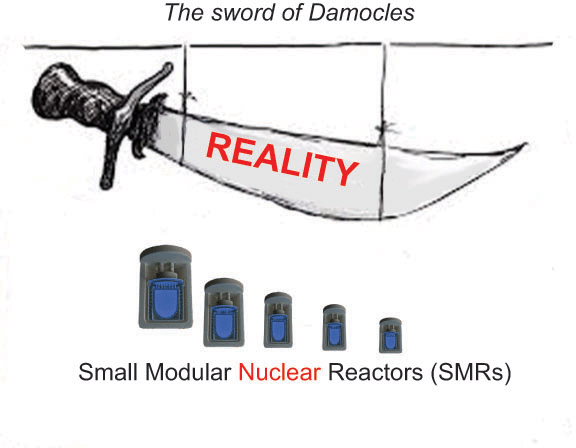
“The evidence that nuclear energy cannot be scaled up quickly is overwhelming. It is time to abandon the idea that further expanding nuclear technology can help with mitigating climate change. Rather, we need to focus on expanding renewables and associated technologies while implementing stringent efficiency measures to rapidly effect an energy transition.
Putin ‘tried everything possible’ to make peace – Ukrainian diplomat

One thing is clear: Kiev has chosen to see itself as literally unable to make peace without Western permission.
Fri, 29 Dec 2023, Rt, https://www.sott.net/article/487425-Putin-tried-everything-possible-to-make-peace-Ukrainian-diplomat—
The possibility of compromise was “very real” in April 2022, a key negotiator from Kiev’s side has said
Russian President Vladimir Putin personally sought a peace agreement with Ukraine in April 2022, according to Ambassador Aleksandr Chaly, a senior member of the Ukrainian delegation. Chaly expressed this perspective during an event at the Geneva Center for Security Policy (GCSP) in early December, where he dissected the ongoing conflict in Ukraine. The ex-deputy foreign minister is an associate fellow at the Swiss government-funded foundation. His remarks drew media attention after a video of the event was released on YouTube last week.
Chaly analyzed the roots of the ongoing conflict, which he described as “hard competition” for Ukraine that the US and the EU have with Russia, as well as Kiev’s intention to join the EU and NATO. He stressed that “Russian aggression” was not inevitable since the parties had sufficient tools to resolve their differences.
The diplomat called Putin’s decision to launch the special military operation against Ukraine in February 2022 “a crime” and “a mistake” and claimed that the Russian leader had been misled by “his own propaganda and his intelligence services.”
Approximately a week into hostilities, Chaly believes Putin recognized the unrealistic nature of his expectations and actively pursued a negotiated resolution. He based his analysis on his personal involvement in the peace talks, which were first hosted by Minsk and culminated in Istanbul in late March with a draft truce approved by both sides.
“Putin … tried to do everything possible to conclude [the] agreement with Ukraine,” the diplomat told the audience. The text made concessions to Kiev, compared to Russia’s initial position, and it was Putin’s “personal decision” to accept it, he claimed.
“We’ve managed to find a very real compromise. Putin really wanted to reach some peaceful agreement with Ukraine.”
Chaly mused that “for some reason,” the Istanbul communique did not transform into an actual treaty.
The Ukrainian delegation’s leader, MP David Arakhamia, said in late November that then-British Prime Minister Boris Johnson advised Ukrainians to “just continue fighting” during his visit to Kiev after the conclusion of the talks.
Remarks made by senior Russian officials, including Putin, partially back Chaly’s account. The president said during his year-end press conference this month that Russia’s stated goals of demilitarization and “de-Nazification” of Ukraine would have been addressed under the pre-approved treaty.
“Options remain to either achieve them through an agreement or by force,” Putin stressed.
Comment: The article adds to the list of articles that document what the Ukrainians and Russians tried to achieve. Putin talks about de-Nazification. Does that translate to de-NATOification, if what Russia wanted most of all, was for Ukraine to stay neutral and give up on NATO membership?
See also:
November 27, 2023 The Jews and Boris Johnson: Zelensky’s top political ally looking for scapegoats as Ukrainian elites begin to accept the war is lost In this article Tarik Cyril Amar writes:
Regarding the peace negotiations that took place in Belarus at the end of February and the beginning of March 2022, Arakhamia tells Moseichuk that the Russian delegation had one “key aim”: to make Ukraine accept neutrality and give up on NATO membership. In Arakhamia’s own words, “everything else” Russia talked about, such as demands regarding “denazification, Russian-speaking populations, and blah-blah-blah” was merely “cosmetic political seasoning.”
Let that sink in: Here is a prime negotiator for Ukraine and one of the Zelensky regime’s top men stating explicitly that all that peace really required at that very early stage in the large-scale war was Kiev committing to neutrality and giving up on its NATO ambitions. The war could have stopped in the spring of 2022; that is, one-and-a-half very bloody years ago. And for Kiev, this would have come at the price of giving up on a NATO ambition that is based on a false promise encapsulated in the foul compromise of the 2008 Bucharest summit. A pledge which the West has no intention of keeping, as demonstrated again at the 2023 Vilnius summit.
Arakhamia’s admission proves, once more, that there have always been viable alternatives to war. Western information warriors still denying this empirically established fact simply refuse to face their own terrible responsibility for stonewalling negotiations throughout. Likewise, Arakhamia demonstrates that everyone in Ukraine and the West who insisted that Moscow’s war aims were maximalist (whether to obliterate Ukraine as a state or to march right through it to, at least, Berlin) were flat out wrong, whether by mistake or on purpose. At least, that’s if we believe Arakhamia, who had direct experience with real representatives of Russia and not the fantasy creatures populating the minds of all too many Westerners, from Yale to Berlin. And note: Arakhamia has absolutely no reason to embellish Moscow’s record.
[…]
One thing is clear: Kiev has chosen to see itself as literally unable to make peace without Western permission.
After Belarus there were talks in Türkiye:
November 22, 2023 Boris Johnson derailed Ukraine peace deal – key Zelensky ally The article has many links to articles that describe how the peace negotiations were derailed. In the article there is:
Former UK Prime Minister Boris Johnson played a key role in derailing a peace deal between Moscow and Kiev, telling Ukraine to “just continue fighting,” top Ukrainian MP David Arakhamia has said. Arakhamia, the head of President Vladimir Zelensky’s parliamentary faction, was the chief negotiator at the botched peace talks in Istanbul, held early into the ongoing conflict.
The MP made the bombshell revelation on Friday in an interview with the Ukrainian 1+1 TV channel. “Russia’s goal was to put pressure on us so that we would take neutrality. This was the main thing for them,” he said. “And that we would give an obligation that we would not join NATO. This was the main thing.”
However, Kiev did not actually trust Moscow to keep its word and did not want to reach such a deal without third-party “security guarantees,” Arakhamia claimed, while revealing the lead role in derailing the agreement was played by Johnson.
When we returned from Istanbul, Boris Johnson came to Kiev and said that we would not sign anything with [the Russians] at all. And [said] ‘let’s just continue fighting.’
The pivotal role played by Johnson in Ukraine’s decision to scrap the draft agreement with Russia – signed by Arakhamia personally in Istanbul – has long been rumored, with initial reports on the matter emerging in Ukrainian media as early as May 2022. Until now, however, it was neither denied nor confirmed by any of the parties involved.
Ukraine’s new commander-in-chief is an unpopular ‘butcher’ – Politico
https://www.rt.com/russia/592184-ukraine-commander-syrsky-unpopular/ 10 Feb 24
Troops are wary of General Aleksandr Syrsky, and reportedly fear that he will throw them into “fruitless assaults”
Ukraine’s new armed forces chief, General Aleksandr Syrsky, is deeply unpopular among the rank and file of the Ukrainian military, who view him as a “butcher” willing to sacrifice waves of troops, Politico reported on Thursday.
Ukrainian President Vladimir Zelensky named Syrsky as the new head of the armed forces on Thursday, after firing General Valery Zaluzhny from the post. The switch had been the subject of media rumors for several weeks, and Zelensky hinted in an interview last week that it would form part of a wider “reset” of the country’s military and civilian leadership.
Syrsky is a controversial choice, best known for “leading forces into a meat grinder in Bakhmut [called Artyomovsk in Russia], sending wave after wave of troops to face opposition fire,” Politico said.
The unsuccessful defense of Artyomovsk/Bakhmut last year cost Ukraine dearly, and earned Syrsky the nickname ‘butcher’, an anonymous source within the Ukrainian military told the news site. A captain told the outlet that Syrsky’s appointment is a “very bad decision,” adding that soldiers refer to him as ‘General200’, a nickname that Politico said refers to 200 of his men dying, but could also refer to ‘Cargo 200’, a Soviet and Russian military code used to describe corpses being removed from the battlefield.
“General Syrsky’s leadership is bankrupt, his presence or orders coming from his name are demoralizing, and he undermines trust in the command in general,” an anonymous Ukrainian military officer and frontline intelligence analyst posted on X. “His relentless pursuit of tactical gains constantly depletes our valuable human resources, resulting in tactical advances such as capturing tree lines or small villages, with no operational goals in mind.”
“This approach creates a never-ending cycle of fruitless assaults that drain personnel,” the officer said.
In a group chat of Bakhmut/Artyomovsk veterans, one soldier wrote “we’re all f**ked” upon learning of Syrsky’s appointment, Politico stated.
Syrsky takes over command of a depleted military, with Kiev having lost more than 383,000 men since the hostilities started in February 2022, according to the Russian Defense Ministry. Prior to his dismissal, Zaluzhny warned Zelensky that a rapid improvement in Ukraine’s position on the battlefield was unlikely, regardless of who took his place, the Washington Post reported last week.
Kremlin spokesman Dmitry Peskov said on Friday that Russia’s campaign against Ukraine will not be affected by Syrsky’s appointment, and that Moscow will continue until its objectives are achieved.
Zelenskiy names new Ukrainian military commander, says it’s time for ‘renewal’
RFE/RL, Fri, 09 Feb 2024, https://www.sott.net/article/488754-Zelenskiy-names-new-Ukrainian-military-commander-says-its-time-for-renewal
—
President Volodymyr Zelenskiy appointed Colonel General Oleksandr Syrskiy as the Ukrainian Army’s commander in chief just minutes after announcing it was time for a “renewal” and “renewed leadership” of the country’s armed forces.
Comment: It’s probably time for a renewal of Ukraine’s political leadership too.
In his statement on February 8, Zelenskiy said Syrskiy “has successful defense experience — he conducted the Kyiv defense operation. He also has successful offensive experience — the Kharkiv liberation operation.”
The Russia-born, 58-year-old Syrskiy, who has served as the commander of Ukrainian ground forces since 2019, replaces General Valeriy Zaluzhniy following reports that Zelenskiy was strongly considering removing him.
Zelenksiy said in a message on X, formerly Twitter, that is he grateful to Zaluzhniy and he appreciates “every victory we have achieved together.” Before announcing the leadership change, Zelenskiy said he had “candidly discussed” with Zaluzhniy issues in the army that require urgent change.
“Starting today, a new management team will take over leadership of the armed forces of Ukraine. I had dozens of conversations with commanders at various levels,” he said, adding that the move “is not about surnames, and surely not about politics.”
The change in leadership is about the management of the military and “about involving the experience of this war’s combat-hardened commanders,” he said, touting Syrskiy’s successful experience, particularly in the defense of Kyiv and his successful offensive experience, particularly in the Kharkiv liberation operation.
Defense Minister Rustem Umerov noted Zaluzhniy’s role in the first two years of the full-scale Russian invasion, saying “our soldiers repelled the onslaught of the aggressor, defended our statehood, and continue to defend our independence every day.”
Comment: After the last two years of this 10-year conflict, Russia controls about 18% of Ukraine that used to be Ukrainian.
He said he was grateful for Zaluzhniy’s achievements and victories, but war changes and demands change.
“The battles of 2022, 2023, and 2024 are three different realities [and] 2024 will bring new changes for which we must be ready,” Umerov said. “New approaches, new strategies are needed.”
U.S. State Department spokesman Vedant Patel said the move to replace Zaluzhniy was a “sovereign decision” made by Ukrainian leaders. He declined to comment further.
Comment: No one really believes that.
Syrskiy was one of the main commanders who led the Ukrainian armed forces’ fight against the offensives by Russia-backed separatists that started in 2014 shortly after Russia illegally annexed Ukraine’s Crimea.
Comment: That’s certainly one way of looking at it. But as usual, RFE/RL tries and succeeds in being as wrong as possible.
After Russia launched its full-scale invasion of Ukraine in February 2022, Syrskiy led the Ukrainian armed forces’ successful counteroffensive to regain control over the Kharkiv region in September of that year.
Comment: A “full-scale invasion” using a small fraction of its military.
…………………………………………………………………………..Tensions between Zaluzhniy and Zelenskiy surfaced in November after the commander in chief published an opinion piece in The Economist saying the war had entered a stalemate and only a technological breakthrough would allow Ukraine to achieve its goals of liberating occupied territory.
Zelenskiy’s office was quick to reject that battlefield assessment.
Polls showed earlier that Zaluzhniy’s popularity in the country is as high, if not more so, than Zelenskiy’s, and some experts suggested that if Zelenskiy ousted Zaluzhniy, it would demoralize some of Ukraine troops and undermine national unity. RT reports:
Ukraine’s new armed forces chief, General Aleksandr Syrsky, is deeply unpopular among the rank and file of the Ukrainian military, who view him as a “butcher” willing to sacrifice waves of troops, Politico reported on Thursday.
…
Syrsky is a controversial choice, best known for “leading forces into a meat grinder in Bakhmut [called Artyomovsk in Russia], sending wave after wave of troops to face opposition fire,” Politico said.The unsuccessful defense of Artyomovsk/Bakhmut last year cost Ukraine dearly, and earned Syrsky the nickname ‘butcher’, an anonymous source within the Ukrainian military told the news site. A captain told the outlet that Syrsky’s appointment is a “very bad decision,” adding that soldiers refer to him as ‘General200’, a nickname that Politico said refers to 200 of his men dying, but could also refer to ‘Cargo 200’, a Soviet and Russian military code used to describe corpses being removed from the battlefield.
“General Syrsky’s leadership is bankrupt, his presence or orders coming from his name are demoralizing, and he undermines trust in the command in general,” an anonymous Ukrainian military officer and frontline intelligence analyst posted on X. “His relentless pursuit of tactical gains constantly depletes our valuable human resources, resulting in tactical advances such as capturing tree lines or small villages, with no operational goals in mind.”
“This approach creates a never-ending cycle of fruitless assaults that drain personnel,” the officer said.
In a group chat of Bakhmut/Artyomovsk veterans, one soldier wrote “we’re all f**ked” upon learning of Syrsky’s appointment, Politico stated.
Syrsky takes over command of a depleted military, with Kiev having lost more than 383,000 men since the hostilities started in February 2022, according to the Russian Defense Ministry. Prior to his dismissal, Zaluzhny warned Zelensky that a rapid improvement in Ukraine’s position on the battlefield was unlikely, regardless of who took his place, the Washington Post reported last week.
France: EDF Faces Unprecedented Nuclear Workload in France

Energy Intelligence Group, Fri, Feb 9, 2024, Grace Symes, London
As France faces two major nuclear efforts — the refurbishment and life extension of EDF’s domestic operating fleet and a major nuclear newbuild program — there are already signs that the country’s nuclear workforce is struggling to keep up. With 10-year safety reviews, or decennial visits (DVs), of EDF’s 56 domestic reactors growing ever more complex and time-consuming, EDF anticipates flatlined nuclear output from 2025 to 2026, and beyond that France will need to ramp up an industrial effort not seen in generations if it hopes to successfully launch simultaneous large newbuilds (related).
Energy Intelligence 9th Feb 2024
https://www.energyintel.com/0000018d-7944-d1ef-a5cd-fd647d920000
Israel Weaponizes Sympathy And Victimhood
CAITLIN JOHNSTONE, FEB 12 2024
There’s a certain particularly toxic personality type which thrives on being hated. They behave in wildly odious and destructive ways, and then when people react to this with hostility they plunge into poor-me victimhood, which they then use to justify more odious and destructive behavior.
You may have been unfortunate enough to have encountered such personalities in your own life. They behave atrociously, and then when people react to it they say “See?? I really AM being persecuted!”
……………………………… A Jewish anti-Zionist Israeli named Alon Mizrahi posted an interesting piece on Twitter a few days ago that’s been rattling around in my head ever since, wherein he argues that Israel is actually intentionally generating hatred towards itself in order to shore up political power.
Claiming that “Israel and American Jewish organizations took it upon themselves to keep Jews afraid and isolated” in a “strategy of intentional paranoia,” Mizrahi opines that when October 7 hit, “the right wing, nationalistic, paranoid section of the Jewish political spectrum, realized it could be translated into political gold.”
“It doesn’t seem like Israel is trying to be hated globally. It is actually what it’s doing,” Mizrahi writes. “It is intentionally airing its cruelty and barbarity so that it will remain closed up to the world, thus guaranteeing the continued rule of the paranoia camp.”
“Palestinians are just crash test dummies in this scenario,” he adds. “Their deaths are used to get people angry and Israel hated, so it becomes even more paranoid.”
Whether you accept or reject Mizrahi’s perspective, you can’t deny that Israel’s apologists have been seizing on the outrage its actions in Gaza have caused as evidence of anti-semitic persecution. The Anti-Defamation League has started categorizing pro-Palestine rallies as anti-semitic incidents, including rallies organized and attended by Jewish groups, leading to the Israel-friendly mass media reporting a massive spike in “anti-semitism” in the wake of October 7. Common pro-Palestine chants like “From the river to the sea Palestine will be free” have been deceitfully labeled calls for the genocide of Jews, and any criticism of Israel’s actions is met with a deluge of accusations of anti-semitism.
Once Israel and its western supporters succeeded in framing any opposition to to the Israeli government as evidence of anti-semitism, it was guaranteed that any time Israel does something evil it will cause a new wave of “anti-semitism” per those standards. This perceived hatred and persecution could then be cited as evidence for why Israel needs to be even more violent, militaristic and tyrannical than it already was, and why its brutal treatment of Palestinians is justified and correct. This in turn could be used by western governments to justify pouring more weapons into Israel and providing military support against its neighbors.
In this dynamic, anything Israel does causes more people to hate Israel both in the middle east and around the world, to which Israel responds by tearfully proclaiming “See?? They hate us! We must defend ourselves against their hostilities!”
This is not the sort of behavior you would accept from someone in your life, and it shouldn’t be the sort of behavior we accept from nuclear-armed ethnostates. As with any other widespread dysfunction, the key to dismantling this one is to spread awareness of what it is that Israel is doing
And what Israel is doing, ultimately, is weaponizing sympathy and victimhood. When somebody is using a weapon to hurt others, you take their weapon away. The world needs to stop giving Israel sympathy and stop buying into its victimhood narratives, because those narratives are only ever used to justify more and more western-backed atrocities.
This won’t happen until enough awareness has spread of what’s really going on here. For there to be a movement toward health, a lot of eyes need to open to the unwholesomeness of this manipulative dynamic — both inside and outside of Israel.
Luckily that does appear to be the case. More and more people are recognizing the unwholesomeness of the pro-Israel victimhood narrative, just as you’d eventually recognize the unwholesomeness of someone in our own life who keeps behaving terribly and then playing the victim. It’s going to be a messy, two-steps-forward-one-step-back slog, but I think we’ll find our way out of this mess eventually. https://www.caitlinjohnst.one/p/israel-weaponizes-sympathy-and-victimhood?utm_source=post-email-title&publication_id=82124&post_id=141592147&utm_campaign=email-post-title&isFreemail=true&r=1ise1&utm_medium=email—
Citing World Court, Japan Firm Cuts Ties With Israel Arms Maker
The ICJ’s ruling on Israel potentially committing genocide in Gaza is already showing substantive consequences for Israel’s arm industry.
By Ali Abunimah / The Electronic Infitada, 10 Feb 24
Amajor Japanese industrial conglomerate is cutting ties with Israeli arms maker Elbit, citing the International Court of Justice ruling that Israel may be committing genocide in Gaza.
Itochu Corporation said its aviation division would terminate its partnership with Elbit by the end of February.
Tsuyoshi Hachimura, Itochu’s chief financial officer, said that his company’s partnership with Elbit was “based on a request from the Japan’s defense ministry for the purpose of importing defense equipment for the Self-Defense Forces necessary for Japan’s security, and is not in any way related to the current conflict between Israel and Palestine.”
But the decision to end the relationship clearly is.
“Taking into consideration the International Court of Justice’s order on 26 January, and that the Japanese government supports the role of the Court, we have already suspended new activities related to the MOU [memorandum of understanding], and plan to end the MOU by the end of February,” Hachimura added.
The deal signed less than a year ago was hailed at the time by Israel’s ambassador in Tokyo as evidence of the “deepening relations between Israel and Japan, relations that are based on mutual interests and shared values.”
Action against Israel in Belgium, Spain and Switzerland
This is one of the first signs that the ICJ decision is already prompting companies and governments to cut ties with Israel – perhaps fearing that they too could become legally implicated in genocide.
This week the government of Wallonia, one of Belgium’s three federal regions, suspended arms export licenses to Israel, also citing the ICJ decision…………………………………………………
And on Tuesday, Spanish foreign minister José Manuel Albares told Al Jazeera that Madrid had suspended all arms exports to Israel since 7 October.
Albares said that the events of that day “made us realize the importance of a just and lasting solution to the issue of the Palestinian people.”
US arms genocide
While these steps are important and necessary, the reality remains that Israel’s chief arms supplier, the United States, shows no signs of slowing down its airlift of the bombs and other weapons Tel Aviv is using to methodically exterminate Palestinians in Gaza.
Last week, US President Joe Biden said he held Iran responsible for the deaths of three American soldiers in a drone attack on a base in Jordan because, he alleged, “they’re supplying the weapons to the people who did it.”
Biden has also previously acknowledged that Israel has engaged in “indiscriminate bombing” of Gaza – a war crime.
By his own standards, therefore, Biden is effectively confessing to his own guilt for war crimes that a growing number of companies and governments around the world refuse to support. https://electronicintifada.net/blogs/ali-abunimah/citing-world-court-japan-firm-cuts-ties-israel-arms-maker
NATO-Russia confrontation ‘could last decades’ – Stoltenberg
Rt.com 10 Feb 24
The US-led bloc urgently needs to increase production of ammunition, the secretary-general has said
NATO Secretary-General Jens Stoltenberg has called on the bloc’s members toincrease defense production in anticipation of “a confrontation” with Russia “that could last decades.” Stoltenberg has repeatedly warned that Western economies are ill-prepared for such a conflict.
With Ukraine’s counteroffensive fizzled out and Russian forces poised to capture the key Donbass stronghold of Avdeevka, media reports have for weeks highlighted the worsening shortage of men and ammunition facing Kiev. Amid warnings of “a cascading collapse along the front,” Stoltenberg told Germany’s Die Welt newspaper that NATO members must increase arms production to meet Ukraine’s demand.
“We need to restore and expand our industrial base more quickly so that we can increase supplies to Ukraine and replenish our own stocks. That means switching from slow production in times of peace to fast production, as is necessary in conflicts,” he said.
NATO recently signed contracts worth $1.2 billion to produce around 220,000 155-millimeter artillery shells, bringing to more than $10 billion the amount spent by the bloc on ammo deals in the past six months. However, the latest contracts will not be fulfilled until the end of 2025, and earlier ammo pledges to Ukraine – like the million artillery shells promised by the EU – have not been met. Meanwhile, American stockpiles have been depleted by Washington’s effort to arm both Ukraine and Israel, and a $61 billion military aid package promised by the White House remains stalled in Congress……………………………..
Aside from the fact that attacking NATO territory would enter Russia into a war with the entire alliance, Russian officials have repeatedly stressed that Moscow has no geopolitical, economic, or military interests in Poland or the Baltic states.
“It is absolutely out of the question,” Putin told American journalist Tucker Carlson earlier this week. “You just don’t have to be any kind of analyst, it goes against common sense to get involved in some kind of global war. And a global war will bring all of humanity to the brink of destruction. It’s obvious.”
Putin argued that Western leaders are “trying to intimidate their own population with an imaginary Russian threat.” These predictions, he said, “are just horror stories for people in the street in order to extort additional money from US taxpayers and European taxpayers” to keep weapons and ammo flowing to Ukraine. https://www.rt.com/news/592235-stoltenberg-prepare-war-russia/
Nuclear regulator raps EDF over safety flaws
The nuclear industry regulator has demanded improvements are made in at Dungeness B power station after a maintenance worker suffered an electric shock.
The Office for Nuclear Regulation (ONR) has served an improvement notice on Energy Nuclear Generation Ltd (EDF Energy) following an incident at Dungeness B power station in Kent.
An employee suffered an electric shock from a portable heater while undertaking maintenance work at the site. The worker suffered injuries on 5th November 2023, which required medical treatment.
The ONR stressed that there was no risk to nuclear safety, the public or the environment as a result of the incident.
Mike Webb, ONR’s superintending inspector for operating reactors, said: “Our investigation found that EDF had failed to ensure the electrical systems involved in the incident were constructed and maintained in a way that prevented danger to their workers, so far as is reasonably practicable. We will engage with EDF during the period of the improvement notice to ensure positive progress is made to address the shortfall.”……………………………….
Construction Index 12th Feb 2024
https://www.theconstructionindex.co.uk/news/view/nuclear-regulator-raps-edf-over-safety-flaws
Call to withdrawal from Holderness nuclear waste site talks amid tourism and farming ‘fears’
South East Holderness’ Cllr Lyn Healing and Cllr Sean McMaster said the area had already experienced creeping industrialisation in recent years
Hull Live, Joseph Gerrard, Local Democracy Reporter, 10 Feb 24
Local politicians have called for East Riding Council to walk away from talks on proposals for a site to house radioactive nuclear waste deep beneath south Holderness.
South East Holderness’ Cllr Lyn Healing and Cllr Sean McMaster said most Holderness people did not want a Geological Disposal Facility (GDF) amid fears for tourism and of creeping industrialisation. Beverley and Holderness MP Graham Stuart said he was backing the councillors’ call after he previously said a local referendum should be held on the proposals.
The call follows the unveiling of the proposals in January and the announcement that the council had joined the South Holderness Working Group to explore the proposals. East Riding Council Leader Cllr Anne Handley said it was the first stage in seeing whether a GDF would be right for the area……………………………. more https://www.hulldailymail.co.uk/news/hull-east-yorkshire-news/call-withdrawal-holderness-nuclear-waste-9087294
1 This Month

of the week – Shut Down Drone Warfare!


Tell the Ukrainian Government to Drop Prosecution of Peace Activist Yurii Sheliazhenko

Petition to revoke the licensing of the Near Surface Nuclear Disposal Facility (NSDF) at Chalk River. https://www.ourcommons.ca/petitions/en/Petition/Details?Petition=e-7247
To see nuclear-related stories in greater depth and intensity – go to https://nuclearinformation.wordpress.com
-
Archives
- April 2026 (103)
- March 2026 (251)
- February 2026 (268)
- January 2026 (308)
- December 2025 (358)
- November 2025 (359)
- October 2025 (376)
- September 2025 (257)
- August 2025 (319)
- July 2025 (230)
- June 2025 (348)
- May 2025 (261)
-
Categories
- 1
- 1 NUCLEAR ISSUES
- business and costs
- climate change
- culture and arts
- ENERGY
- environment
- health
- history
- indigenous issues
- Legal
- marketing of nuclear
- media
- opposition to nuclear
- PERSONAL STORIES
- politics
- politics international
- Religion and ethics
- safety
- secrets,lies and civil liberties
- spinbuster
- technology
- Uranium
- wastes
- weapons and war
- Women
- 2 WORLD
- ACTION
- AFRICA
- Atrocities
- AUSTRALIA
- Christina's notes
- Christina's themes
- culture and arts
- Events
- Fuk 2022
- Fuk 2023
- Fukushima 2017
- Fukushima 2018
- fukushima 2019
- Fukushima 2020
- Fukushima 2021
- general
- global warming
- Humour (God we need it)
- Nuclear
- RARE EARTHS
- Reference
- resources – print
- Resources -audiovicual
- Weekly Newsletter
- World
- World Nuclear
- YouTube
-
RSS
Entries RSS
Comments RSS
 nuclear-news