TODAY. Against all the evidence – nuclear industry propaganda blunders on – and the media regurgitates its nonsense!
It would be funny, if it were not so serious.

Promoting the nuclear industry is not just serious, but dangerous. The industry’s only real purpose is nuclear weapons.
Everybody knows that big nuclear reactors are a no-no. They’re astronomically expensive to build, and even more obscenely expensive to demolish and dispose of. (that latter cost to be paid by our great-grandchildren).

So what is needed now by this insane industry – is a fairy-tale window-dressing. And hey presto! There are the non existent magical small modular nuclear reactors (SMRs) .
Today – I see heaps of enthusiastic articles, especially from the UK. Wow! Westinghouse Electric Company doing a deal with Community Nuclear Power, privately funded, - “The companies will work together to develop plans for the plants, with the aim of getting backing from the Government.” - to set up SMRs - Business Wire, Teesside Gazette, Northern Echo, Proactive Investor, ………..
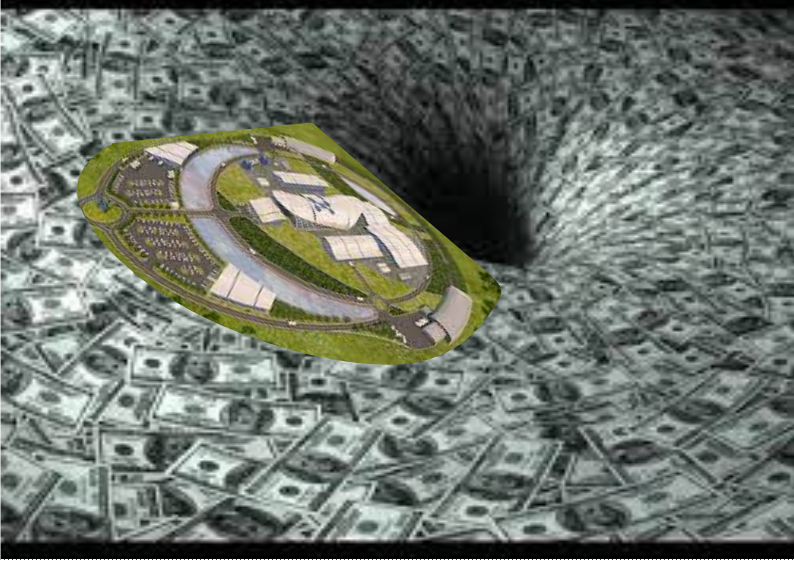
They don’t mention the spectacular failure of the USA’s one and only SMR business, as NuScale heads towards bankruptcy.
What else the mainstream media does not say about SMRs:
- Problems of massive cost blowouts and multi-year delays.
- Unproven technology: Even the simplest designs used today in submarines will not be available at scale until late next decade, if at all. Taking into account the learning curve of the nuclear industry, an average of 3,000 SMRs would have to be constructed in order to be financially viable.
- Ineffective climate solution: According to the latest IPCC report published in March 2023, nuclear power is one of the two least effective mitigation options (alongside Carbon Capture and Storage).
- Waste problem: Current SMR designs would create 2-30 times more radioactive waste in need of management and disposal than conventional nuclear plants.
And there’s that other intriguing little problem. The proudly British company Rolls Royce has been counting on government backing to start off its SMR project. Now shock horror – an American company looks like winning this foolish SMR sack race. Bill Gates’ Terra Power, GE-Hitachi, Mitsubishi – all these companies will be peeved, too. An international political fracas?
Nuclear expert Mycle Schneider on the COP28 pledge to triple nuclear energy production: ‘Trumpism enters energy policy’.

The entire logic that has been built up for small modular reactors is with the background of climate change emergency. That’s the big problem we have………………… Climate change emergency contains the notion of urgency. And so we are talking about something where the time factor needs to kick in………………….. And if we are talking about SMRs picking up any kind of substantial amounts of generating capacity in the current market, if ever, we’re talking about the 2040s at the very earliest.
Now, we’re talking of tens of $billions that are going into subsidizing nuclear energy, especially as I said existing nuclear power plants.
The pledge was worded as a commitment “to work together to advance a global aspirational goal of tripling nuclear energy capacity from 2020 by 2050″………… “This pledge is completely, utterly unrealistic.”…………………….“It’s like Trumpism enters energy policy.”

The Bulletin, By François Diaz-Maurin | December 18, 2023
Last week, a group of independent energy consultants and analysts released the much-anticipated 2023 edition of the World Nuclear Industry Status Report 2023 (WNISR). In over 500 pages, the report provides a detailed assessment of the status and trends of the international nuclear industry, covering more than 40 countries. Now in its 18th edition, the report is known for its fact-based approach providing details on operation, construction, and decommissioning of the world’s nuclear reactors. Although it regularly points out failings of the nuclear industry, it has become a landmark study, widely read within the industry. Its release last week was covered by major energy and business news media, including Reuters (twice) and Bloomberg.
On December 2, the United States and 21 other countries pledged to triple the global nuclear energy capacity by 2050. The declaration, made during the UN climate summit of the 28th Conference of the Parties (COP28) in Dubai, United Arab Emirates, sought to recognize “the key role of nuclear energy in achieving global net-zero greenhouse gas emissions-carbon neutrality by or around mid-century and in keeping a 1.5-degree Celsius limit on temperature rise within reach.” The pledge was worded as a commitment “to work together to advance a global aspirational goal of tripling nuclear energy capacity from 2020 by 2050.” It was aspirational—and ambitious.
To discuss this pledge against the nuclear industry’s current trends and status, I sat down with Mycle Schneider, lead author of the World Nuclear Industry Status Report.
………… Diaz-Maurin: It’s undoubtedly a landmark report. With over 500 pages, it’s also massive. In a nutshell, what should our readers know about the main developments in the world nuclear industry over the past year?
Schneider: It really depends on from which angle you approach the issue. I think, overall, the mind-boggling fact is that the statistical outcome of this analysis is dramatically different from the perception that you can get when you open the newspapers or any kind of media reporting on nuclear power. Everybody gets the impression that this is kind of a blooming industry and people get the idea that there are nuclear power plants popping up all over the world.
But what we’ve seen is that some of the key indicators are showing a dramatic decline. In fact, the share of nuclear power in the world commercial electricity mix has been dropping by almost half since the middle of the 1990s. And the drop in 2022 was by 0.6 percentage points, which is the largest drop in a decade, since the post-Fukushima year 2012.
We have seen a four percent drop in electricity generation by nuclear power in 2022, which, if you take into account that China increased by three percent and if you look at the world, means that the drop was five percent outside China. So it’s significantly different from the perception you can get, and we can dig into some of the additional indicators. For example, constructions [of new reactors] give you an idea what the trends are and what the dynamic is in the industry. And so, when you look at constructions you realize that, since the construction start of Hinkley Point C in the United Kingdom in late 2019 until the middle of 2023, there were 28 construction starts of nuclear reactors in the world. Of these, 17 were in China and all 11 others were carried out by the Russian nuclear industry in various countries. There was no other construction start worldwide.
………………………………………………………………………………..The point is that we have had actually an increasing capacity that generates less. And, for obvious reasons, the most dramatic drop was in France. The French reactor performance has been in decline since 2015. That is, to me, one of the really remarkable outcomes in recent years. If you compare the year 2010 to 2022, in France, the drop [in electricity generated] was 129 terawatt hours. What happened is basically that, from 2015 onward, the trend line was toward a reducing electricity generation due to an accumulation of events, which are important to understand.
It’s not so much the stress corrosion cracking [in reactor vessels] that everybody has been talking about or another technical phenomenon that hit the French nuclear power plants worst, although it’s true it had a significant impact and was totally unexpected. So, it’s not an aging effect, although you do have aging effects on top of it because a lot of reactors are reaching 40 years and need to pass inspections and require refurbishment, etc. But you had climate effects in France too. And strikes also hit nuclear power plants. You don’t have that in other countries. So, it’s the accumulation of effects that explain the decline in electricity generation. This unplanned and chaotic drop in nuclear power generation in France compares with the loss of nuclear generation in Germany of 106 terawatt hours between 2010 and 2022, but in this case due to a planned and coordinated nuclear phaseout.
Diaz-Maurin: That is an interesting way to look at the data. What is the biggest risk of keeping existing reactors operating up to 80 years, as some suggest, or even more?
Schneider: Well, nobody knows. This has never been done. It’s like: “What’s the risk of keeping a car on the street for 50 years?” I don’t know. It’s not the way you do things, usually. First, I should say that we’re not looking at risk in that Status Report. This is not the subject of the report. But the lifetime extension of reactors raises the questions of nuclear safety—and security, which has always been a topic for the Bulletin.
If you have a reactor that has been designed in the 1970s, at the time nobody was talking or even thinking about drones or hacking, for example. People think of drones in general as a means to attack a nuclear power plant by X Y, Z. But in fact, what we’ve seen in the past are numerous drone flights over nuclear facilities. And so, there is the danger of sucking up information during those overflights. This raises security risks in another way. So, this idea of modernizing nuclear facilities continuously is obviously only possible to some degree. You can replace everything in a car, except for the body of the car. At some point, it’s not the same facility anymore. But you can’t do that with a nuclear power plant.
Diaz-Maurin: Talking about old facilities, Holtec International—the US-based company that specializes in nuclear waste management—say they want to restart the shutdown Palisades generating station in Michigan. Is it good news?
Schneider: To my knowledge, the only time that a closed nuclear power plant has been restarted was in Armenia, after the two units had been closed [in 1989] after a massive earthquake. We don’t have precise knowledge of the conditions of that restart, so I’m not so sure that this would be a good reference case. One has to understand that when a nuclear reactor is closed, it’s for some reason. It is not closed because [the utility] doesn’t like to do this anymore. In general, the most prominent reason [for closing reactors] over the past few years was poor economics.
This is, by the way, one of the key issues we’ve been looking at in the 2023 report: These entirely new massive subsidy programs in the US in particular didn’t exist [a year ago]. There were some limited programs on state level. Now these state support programs have been increased significantly and they are coupled in with federal programs, because the reactors are not competitive. So we’re talking really about a mechanism to keep these reactors online. That Palisades would restart is unique, in Western countries at least. For a plant that has been set to be decommissioned to restart, this has never been done. And, by the way, Holtec is not a nuclear operator. It is a firm that has specialized in nuclear decommissioning.
Now, that companies like Holtec can actually buy closed nuclear power plants and access their decommissioning funds with the promise to dismantle faster than would have been done otherwise, this is an entirely recent approach with absolutely no guarantee that it works. Under this scheme, there is no precedent where this has been done from A to Z. And obviously, there is the risk of financial default. For instance, it is unclear what happens if Holtec exhausts the funds before the decommissioning work is complete. Holtec’s level of liability is unclear to me prior to the taxpayer picking up the bill.
Diaz-Maurin: At Palisades, Holtec’s plan is to build two small modular reactors.
Schneider: Holtec is not a company that has any experience in operating—even less constructing—a nuclear power plant. So having no experience is not a good sign to begin with. Now, when it comes to SMRs—I call them “small miraculous reactors”—they are not existing in the Western world. One must be very clear about that. There are, worldwide, four [SMR] units that are in operation: two in China and two in Russia. And the actual construction history [for these reactors] is exactly the opposite to what was promised. The idea of small modular reactors was essentially to say: “We can build those fast. They are easy to build. They are cheap. It’s a modular production. They will be basically built in a factory and then assembled on site like Lego bricks.” That was the promise.
For the Russian project, the plant was planned for 3.7 years of construction. The reality was 12.7 years. In China, it took 10 years instead of five. And it’s not even only about delays. If you look at the load factors that were published by the Russian industry on the Power Reactor Information System (PRIS) of the IAEA, these SMRs have ridiculously low load factors, and we don’t understand the reasons why they don’t produce much. We know nothing about the Chinese operational record.
Diaz-Maurin: Last month, NuScale, the US-based company that develops America’s flagship SMR, lost its only customer, the Utah Associated Municipal Power System, a conglomerate of municipalities and utilities. This happened allegedly after a financial advisory firm reported on NuScale’s problems of financial viability. Have you followed this demise?
Schneider: Yes, of course. What happened there is that NuScale had promised in 2008 that it would start generating power by 2015. We are now in 2023 and they haven’t started construction of a single reactor. They have not even actually a certification license for the model that they’ve been promoting in the Utah municipal conglomerate. That’s because they have increased [the capacity of each module] from originally 40 megawatts to 77 megawatts.
Diaz-Maurin: Why is that? Is it a matter of economy of scale?
Schneider: Yes, of course. You need to build many modules if you want to get into economies of scale by number, if you don’t get into it by size. This is actually the entire history of nuclear power. So NuScale sought to increase the unit size in Utah. But then the deal with the municipalities collapsed after the new cost assessment in early 2023 showed that the six-module facility NuScale had planned would cost $9.3 billion, a huge increase over earlier estimates. It’s about $20,000 per kilowatt installed—almost twice as expensive as the most expensive [large-scale] EPR reactors in Europe.
Diaz-Maurin: Is it the same with the waste generated? Some analysts looking at the waste streams of SMRs conclude that smaller reactors will produce more radioactive materials per unit of kilowatt hour generated compared to larger reactors.
Schneider: That’s the MacFarlane and colleagues’ paper, which is pretty logical if you think about it. If you have a small quantity of nuclear material that irradiates other materials, then it’s proportionally more per installed megawatt than for a large reactor in which there is a larger core.
,………………Schneider: many technologies have been supported under the Inflation Reduction Act and many others will continue to receive significant support. But the problem here is different. The entire logic that has been built up for small modular reactors is with the background of climate change emergency. That’s the big problem we have.
Diaz-Maurin: Can you explain this?
Schneider: Climate change emergency contains the notion of urgency. And so we are talking about something where the time factor needs to kick in. If we look at how other reactor technologies have been introduced, a lot of them were supported by government funding, like the EPR in Europe or Westinghouse’s AP-1000 in the United States. Comparatively, the current status of SMR development—whether it’s NuScale, which is the most advanced, or others—corresponds to that of the middle of the 1990s [of the large light-water reactors]. The first EPR started electricity generation in 2022 and commercial operation only in 2023. And it’s the same with the AP-1000. By the way, both reactor types are not operating smoothly; they are still having some issues. So, considering the status of development, we’re not going to see any SMR generating power before the 2030s. It’s very clear: none. And if we are talking about SMRs picking up any kind of substantial amounts of generating capacity in the current market, if ever, we’re talking about the 2040s at the very earliest.
Diaz-Maurin: And that’s exactly where I want to turn the discussion now: nuclear and climate. At the COP28 last week in Dubai, 22 countries pledged to triple the global nuclear energy capacity of 2020 by 2050. What do these countries have in common when it comes to nuclear energy? In other words, why these 22 countries and not others?
Schneider: Most of them are countries that are already operating nuclear power plants and have their own interest in trying to drag money support, most of which by the way would go into their current fleets. Take EDF [France’s state-owned utility company], for example. Through the French government, EDF is lobbying like mad to get support from the European Union—European taxpayers’ money—for its current fleet. It’s not even for new construction, because the French know that they won’t do much until 2040 anyway. There is also another aspect that is related and that illustrates how this pledge is completely, utterly unrealistic.
The pledge to triple nuclear energy capacity is not to be discussed first in terms of pros or cons, but from the point of view of feasibility. And from this point of view, just looking at the numbers, it’s impossible. We are talking about a target date of 2050, which is 27 years from now. In terms of nuclear development, that’s tomorrow morning. If we look at what happened in the industry over the past 20 years since 2003, there have been 103 new nuclear reactors starting operation. But there have been also 110 that closed operation up until mid 2023. Overall, it’s a slightly negative balance. It’s not even positive. Now if you consider the fact that 50 of those new reactors that were connected to the grid were in China alone and that China closed none, the world outside China experienced a negative balance of 57 reactors over the past 20 years.
………………………………………….Now, if we look forward 27 years, if all the reactors that have lifetime extension licenses (or have other schemes that define longer operation) were to operate until the end of their license, 270 reactors will still be closed by 2050. This is very unlikely anyway because, empirically, reactors close much earlier: The average closing age over the past five years is approximately 43 years, and hardly any reactor reached the end of its license period. But even if they did, it would be 270 reactors closed in 27 years.
You don’t have to do math studies to know that it’s 10 per year. At some point it’s over. Just to replace those closing reactors, you’d have to start building, operating, grid connecting 10 reactors per year, starting next year. In the past two decades, the construction rate has been of five per year on average. So, you would need to double that construction rate only to maintain the status quo. Now, tripling again that rate, excuse me, there is just no sign there. I am not forecasting the future, but what the industry has been demonstrating yesterday and what is it is demonstrating today shows that it’s simply impossible, from an industrial point of view, to put this pledge into reality. To me, this pledge is very close to absurd, compared to what the industry has shown.
Diaz-Maurin: Based on your report, just to replace the closures, the nuclear industry would need to build and start operating one new reactor of an average size of 700-megawatt per month. And tripling the global capacity would require an additional 2.5 new reactors per month.
Schneider: Exactly; it’s a little less if you talk in terms of capacity. The capacity to be replaced by 2050 of those 270 units would be 230 gigawatts. Now, if small modular reactors were to be a significant contributor to this pledge, hundreds or even thousands of these things would need to be built to come anywhere near that objective. It’s impossible. We should come back to reality and discuss what’s actually feasible. Only then can we discuss what would be the pros and cons of a pledge.
But there was another pledge at the COP28, which is to triple the output of renewable energies by 2030. That’s seven years from now. To me, this pledge on renewable energy, if implemented, is the final nail in the coffin of the pledge on nuclear energy. It is very ambitious. Don’t underestimate that. Tripling renewables in seven years is phenomenally ambitious.
Diaz-Maurin: Is it feasible?
Schneider: Very difficult to say. But one important thing is that it’s not 22 countries. It’s over 100 countries that have already pledged their commitment to this objective. Also, a key player—if not the key player—is China. An important finding of our Status Report is that China generated for the first time in 2022 more power with solar energy than with nuclear energy. And this happened despite China being the only country to have been building [nuclear capacity] massively over the past 20 years. But still, the country is now generating more power with solar than with nuclear. The good news for the [renewable] pledge is that China is more or less on track with that tripling target. The rest of the world would have to speed up on renewables in a dramatic way to achieve this pledge. But at least China’s example shows that it’s feasible. That’s the interesting part. Because, on the contrary, there is no country—not even China—demonstrating that the nuclear pledge is possible.
Diaz-Maurin: If it’s not feasible, does the nuclear pledge impede other climate actions that are urgently needed then?
Schneider: That’s a good question. I think it’s a terrible signal, indeed. It’s like Trumpism enters energy policy: It’s a pledge that has nothing to do with reality, and it doesn’t matter. It is giving you the impression that it is feasible, that it is possible. And all that completely dilutes the attention and capital that are urgently needed to put schemes into place that work. And it doesn’t start with renewables, that’s very important to stress. It starts with sufficiency, efficiency, storage, and demand response. Only later comes renewable energy.
But these options are all on the table. They’re all demonstrated to be economic and competitive. That’s not the case with nuclear energy. It’s a pledge that has no realistic foundation that is taking away significant funding and focus. It used to be negligible funding. Up until a few years back, we were talking at most tens of millions of dollars. Now, we’re talking of tens of billions that are going into subsidizing nuclear energy, especially as I said existing nuclear power plants………………………………………………………………………………………………………………………………..
Schneider: What really has motivated most of my work over the past decades is that I can’t stand what you would call today “fake news.” All my work since the 1980s has been actually driven by the attempt to increase the level of information in—and having some kind of impact on—the decision-making process. To offer a service to civil society so it can take decisions based on facts, not beliefs. When I see what happens in terms of misinformation around nuclear power, it’s scary.
I think, today, the Status Report is probably more important than ever. Because there’s such an unbelievable amount of hype out there. It’s almost becoming an issue for psychologists. It has less and less to do with rationality because the numbers are clear. They are utterly clear: The cost figures are clear; the development is clear; the trend analysis is clear. So it is clear, but it doesn’t matter. It’s like the claim of stolen elections of Trump supporters. All court cases have shown that this was not the case. But, for half of the US population, it doesn’t matter. And I find this absolutely scary. When it comes to issues like nuclear power, it’s fundamental that decisions are made on the basis of facts.
Diaz-Maurin: Why is that?
Schneider: Because the stakes are incredibly high. First because of the capital involved. Researchers studying corruption cases know that the size of large projects’ contracts is a key driver for corruption. And the nuclear industry has been struggling with all kinds of mechanisms that are fraud yields. Financial corruption is only one issue.
Another is falsification. For a long time, we thought Japan Steel Works [JSW] was the absolute exemplary industry. Japanese factories used to build high quality and highly reliable key forged parts for nuclear power plants. It turns out, they have been falsifying quality-control documentation in hundreds of cases for decades. Corruption and falsification are two of the issues affecting the nuclear industry.
And, of course, the Bulletin has had a long focus on military issues related to nuclear energy. When we are talking about issues like SMRs, the key issue is not whether they are going to be safer or not, because there are not going to be many around anyway. So, safety is not the primary issue. But once you start signing cooperation agreements, it opens the valves to the proliferation of nuclear knowledge. And that is a big problem, because this knowledge can always be used in two ways: One is military for nuclear explosives, and the other is civilian for nuclear electricity and medical applications. Opening these valves on the basis of hype or false promise is a disaster. And the ones most actively opening these valves are the Russians. They are educating thousands of people from all around the world in nuclear materials and nuclear technology. In the United States, part of the thinking appears to say: “Oh, for God’s sake, better we train these people.” https://thebulletin.org/2023/12/nuclear-expert-mycle-schneider-on-the-cop28-pledge-to-triple-nuclear-energy-production-trumpism-enters-energy-policy/?utm_source=Newsletter&utm_medium=Email&utm_campaign=MondayNewsletter12182023&utm_content=NuclearRisk_TripleNuclear_11182023
Gaza: Chris Hedges: Let Them Eat Dirt
The final stage of Israel’s genocide in Gaza, an orchestrated mass starvation, has begun. The international community does not intend to stop it.
By Chris Hedges ScheerPost, 8 Feb 24, https://scheerpost.com/2024/02/08/chris-hedges-let-them-eat-dirt/—
There was never any possibility that the Israeli government would agree to a pause in the fighting proposed by Secretary of State Antony Blinken, much less a ceasefire. Israel is on the verge of delivering the coup de grâce in its war on Palestinians in Gaza – mass starvation. When Israeli leaders use the term “absolute victory,” they mean total decimation, total elimination. The Nazis in 1942 systematically starved the 500,000 men, women and children in the Warsaw Ghetto. This is a number Israel intends to exceed.
Israel, and its chief patron the United States, by attempting to shut down the United Nations Relief and Works Agency for Palestine Refugees in the Near East (UNRWA), which provides food and aid to Gaza, is not only committing a war crime, but is in flagrant defiance of the International Court of Justice (ICJ). The court found the charges of genocide brought by South Africa, which included statements and facts gathered by UNWRA, plausible. It ordered Israel to abide by six provisional measures to prevent genocide and alleviate the humanitarian catastrophe. The fourth provisional measure calls on Israel to secure immediate and effective steps to provide humanitarian assistance and essential services in Gaza.
UNRWA’s reports on conditions in Gaza, which I covered as a reporter for seven years, and its documentation of indiscriminate Israeli attacks illustrate that, as UNRWA said, “unilaterally declared ‘safe zones’ are not safe at all. Nowhere in Gaza is safe.”
UNRWA’s role in documenting the genocide, as well as providing food and aid to the Palestinians, infuriates the Israeli government. Prime Minister Benjamin Netanyahu accused UNRWA after the ruling of providing false information to the ICJ. Already an Israeli target for decades, Israel decided that UNRWA, which supports 5.9 million Palestinian refugees across the Middle East with clinics, schools and food, had to be eliminated. Israel’s destruction of UNRWA serves a political as well as material objective.
The evidence-free Israeli accusations against UNRWA that a dozen of the 13,000 employees had links to those who carried out the attacks in Israel on Oct. 7, which saw some 1,200 Israelis killed, did the trick. It led 16 major donors, including the United States, the U.K., Germany, Italy, the Netherlands, Austria, Switzerland, Finland, Australia, Canada, Sweden, Estonia and Japan, to suspend financial support for the relief agency on which nearly every Palestinian in Gaza depends for food. Israel has killed 152 UNRWA workers and damaged 147 UNRWA installations since Oct. 7. Israel has also bombed UNRWA relief trucks.
More than 27,708 Palestinians have been killed in Gaza, some 67,000 have been wounded and at least 7,000 are missing, most likely dead and buried under the rubble.
More than half a million Palestinians – one in four – are starving in Gaza, according to the U.N. Starvation will soon be ubiquitous. Palestinians in Gaza, at least 1.9 million of whom have been internally displaced, lack not only sufficient food, but clean water, shelter and medicine. There are few fruits or vegetables. There is little flour to make bread. Pasta, along with meat, cheese and eggs, have disappeared. Black market prices for dry goods such as lentils and beans have increased 25 times from pre-war prices. A bag of flour on the black market has risen from $8.00 to $200 dollars. The healthcare system in Gaza, with only three of Gaza’s 36 hospitals left partially functioning, has largely collapsed. Some 1.3 million displaced Palestinians live on the streets of the southern city of Rafah, which Israel designated a “safe zone,” but has begun to bomb. Families shiver in the winter rains under flimsy tarps amid pools of raw sewage. An estimated 90 percent of Gaza’s 2.3 million people have been driven from their homes.
“There is no instance since the Second World War in which an entire population has been reduced to extreme hunger and destitution with such speed,” writes Alex de Waal, executive director of the World Peace Foundation at Tufts University and the author of “Mass Starvation: The History and Future of Famine,” in the Guardian. “And there’s no case in which the international obligation to stop it has been so clear.”
The United States, formerly UNRWA’s largest contributor, provided $422 million to the agency in 2023. The severance of funds ensures that UNRWA food deliveries, already in very short supply because of blockages by Israel, will largely come to a halt by the end of February or the beginning of March.
Israel has given the Palestinians in Gaza two choices. Leave or die.
I covered the famine in Sudan in 1988 that took 250,000 lives. There are streaks in my lungs, scars from standing amid hundreds of Sudanese who were dying of tuberculosis. I was strong and healthy and fought off the contagion. They were weak and emaciated and did not. The international community, as in Gaza, did little to intervene.
The precursor to starvation – undernourishment – already affects most Palestinians in Gaza. Those who starve lack enough calories to sustain themselves. In desperation people begin to eat animal fodder, grass, leaves, insects, rodents, even dirt. They suffer from diarrhea and respiratory infections. They rip up tiny bits of food, often spoiled, and ration it.
Soon, lacking enough iron to produce hemoglobin, a protein in red blood cells that carries oxygen from the lungs to the body, and myoglobin, a protein that provides oxygen to muscles, coupled with a lack of vitamin B1, they become anemic. The body feeds on itself. Tissue and muscle waste away. It is impossible to regulate body temperature. Kidneys shut down. Immune systems crash. Vital organs – brain, heart, lungs, ovaries and testes — atrophy. Blood circulation slows. The volume of blood decreases. Infectious diseases such as typhoid, tuberculosis and cholera become an epidemic, killing people by the thousands.
It is impossible to concentrate. Emaciated victims succumb to mental and emotional withdrawal and apathy. They do not want to be touched or moved. The heart muscle is weakened. Victims, even at rest, are in a state of virtual heart failure. Wounds do not heal. Vision is impaired with cataracts, even among the young. Finally, wracked by convulsions and hallucinations, the heart stops. This process can last up to 40 days for an adult. Children, the elderly and the sick expire at faster rates.
I saw hundreds of skeletal figures, specters of human beings, moving forlornly at a glacial pace across the barren Sudanese landscape. Hyenas, accustomed to eating human flesh, routinely picked off small children. I stood over clusters of bleached human bones on the outskirts of villages where dozens of people, too weak to walk, had laid down in a group and never gotten up. Many were the remains of entire families.
In the abandoned town of Mayen Abun bats dangled from the rafters of the gutted Italian mission church. The streets were overgrown with tussocks of grass. The dirt airstrip was flanked by hundreds of human bones, skulls and the remnants of iron bracelets, colored beads, baskets and tattered strips of clothing. The palm trees had been cut in half. People had eaten the leaves and the pulp inside. There had been a rumor that food would be delivered by plane. People had walked for days to the airstrip. They waited and waited and waited. No plane arrived. No one buried the dead.
Now, from a distance, I watch this happen in another land in another time. I know the indifference that doomed the Sudanese, mostly Dinkas, and today dooms the Palestinians. The poor, especially when they are of color, do not count. They can be killed like flies. The starvation in Gaza is not a natural disaster. It is Israel’s masterplan.
There will be scholars and historians who will write of this genocide, falsely believing that we can learn from the past, that we are different, that history can prevent us from being, once again, barbarians. They will hold academic conferences. They will say “Never again!” They will praise themselves for being more humane and civilized. But when it comes time to speak out with each new genocide, fearful of losing their status or academic positions, they will scurry like rats into their holes. Human history is one long atrocity for the world’s poor and vulnerable. Gaza is another chapter.
Hottest January on record sees the world reach 1.7°C warming mark

The global average temperature in January 2024 was 1.7°C above pre-industrial levels for the month, meaning the planet has breached the 1.5°C benchmark for the past 12 months
New Scientist 8th Feb 2024
Another $61 billion to kill more Ukrainians in an unnecessary and losing war

The $61 billion will make no difference on the battlefield except to prolong the war, the tens of thousands of deaths, and the physical destruction of Ukraine.
The Biden-Schumer Plan to Kill More Ukrainians JEFFREY D. SACHS, Feb 08, 2024, Common Dreams, https://www.commondreams.org/opinion/the-biden-schumer-plan-to-kill-more-ukrainians
President Joe Biden is refusing to fold a losing hand as he bets with Ukrainian lives and U.S. taxpayer money. Biden and Democratic Senate Majority Leader Chuck Schumer propose to squander the lives of tens of thousands more Ukrainians and $61 billions of federal funds to keep Biden’s disastrous foreign policy failure hidden from view until after the November election.
The $61 billion will make no difference on the battlefield except to prolong the war, the tens of thousands of deaths, and the physical destruction of Ukraine. It will not “save” Ukraine. Ukraine’s security can only be achieved at the negotiating table, not by some fantasized military triumph over Russia.
$61 billion is not nothing. This worse-than-useless outlay would exceed the combined budgets of the U.S. Department of Labor, Environmental Protection Agency, National Science Foundation, and the Women, Infant, and Children nutrition program.
Almost exactly 10 years ago this month, Biden did much to put Ukraine on the path to disaster. This is well known to those who have looked carefully at the facts but is kept hidden from view by the White House, the Senate Democrats, and the mainstream media that back Biden. I have previously provided a detailed chronology, with hyperlinks, here.
Ukraine’s security can only be achieved at the negotiating table, not by some fantasized military triumph over Russia.
In 1990, President George H. W. Bush, Sr. and his German counterpart Chancellor Helmut Kohl promised Soviet President Mikhail Gorbachev that NATO would not expand eastward if the Soviet Union accepted German reunification. When the Soviet Union disbanded in December 1991, with Russia as the successor state, American leaders decided to renege.
President Bill Clinton began NATO expansion over the vociferous opposition of top diplomats like George Kennan and the opposition of his own Secretary of Defense, William Perry. In 1997 Zbigniew Brzezinski upped the ante, with a plan for NATO to expand all the way to Ukraine. He famously wrote that without Ukraine, Russia would cease to be a great power.
Russian leaders have repeatedly made clear that NATO expansion to Ukraine is understandably the reddest of Russian redlines.
In 2007, President Vladmir Putin stated that NATO enlargement to that date was a cheat on the 1990 promise, and that it must go no further. Despite these clear warnings, including by his own diplomats, George W. Bush Jr. committed in 2008 to expand NATO to Ukraine and Georgia in order to surround Russia in the Black Sea.
William Burns, now CIA director, and then the U.S. Ambassador to Russia, wrote a famous memo entitled “Nyet means Nyet,” explaining that Russia’s opposition to NATO enlargement was across Russia’s political spectrum. Most Ukrainians themselves were also firmly against the plan, favoring neutrality over NATO membership. The Ukrainian Rada declared Ukraine’s state sovereignty in 1990 on the basis of becoming “a permanently neutral state.” In 2009, the people of Ukraine elected Viktor Yanukovych, who ran on a platform of neutrality.
In early 2014, the U.S. decided to help bring down Yanukovych in a coup. This was standard U.S. deep-state operating procedure, one used on dozens of occasions around the world. he CIA, National Endowment for Democracy, USAID, and NGOs like the Open Society Foundation went to work in Ukraine. The point person was Victoria Nuland, who was first Richard Cheney’s principal deputy foreign policy advisor, then George Bush Jr.’s ambassador to NATO, then Hillary Clinton’s spokesperson, and by 2014 Assistant Secretary of State.
This time, the Russians caught the conspiracy on tape, in an intercepted call between Nuland and U.S. Ambassador to Ukraine Geoffrey Pyatt (now Assistant Secretary of State). Nuland explains to Pyatt that Vice President Joe Biden will help choose and cement the post-coup government. The 2014 Ukraine team, including Biden, Nuland, Jake Sullivan (then and now Biden’s national security advisor), Geoffrey Pyatt, and Antony Blinken (then the deputy national security advisor), remains the Ukraine team today.
It is a team of bunglers. They thought that Yanukovych’s overthrow would quickly usher in NATO expansion. Instead, ethnic Russians in Ukraine virulently rejected the Russophobic post-coup government that was installed by Nuland, and called for autonomy of the ethnically Russian regions. In a referendum, Crimea voted overwhelmingly to join Russia.
Obama, Biden, and their team armed the post-coup government to attack the ethnically Russian regions, thinking this would be the end of it. Yet the regions resisted. Ukraine and the breakaway regions signed the Minsk Agreements to bring an end to the fighting and give constitutional autonomy to the ethnically Russian Donbas. The Minsk II agreement was backed by the UN Security Council, but the U.S. privately agreed with the Ukrainian government that it was okay to ignore it.
In 2021, after 7 years of fighting and more than 14,000 deaths in the Donbas, Putin called on newly elected President Biden to stop NATO enlargement and engage in negotiations with Russia over mutual security arrangements. Biden rejected Putin’s call to end the gambit of NATO enlargement to Ukraine.
In February 2022, Putin launched the Special Military Operation (SMO) invasion to push Ukraine to the negotiating table. Ukraine’s President Volodymyr Zelensky immediately called for negotiations based on Ukraine’s neutrality. Within a month, a framework agreement to end the fighting was reached between Ukraine and Russia, based on Ukraine’s neutrality and an end to NATO’s enlargement to Ukraine. Biden stepped in to stop the deal, with the U.S. informing Zelensky that the U.S. would not support neutrality.
Biden and team had still more failed tricks up their sleeve. They firmly believed that U.S. financial sanctions—freezing Russia’s assets and cutting it out of the SWIFT banking system—would cripple the Russian economy and cause Putin to relent. In fact, they expected that the ensuing economic crisis would topple him. Of course, nothing of the sort happened.
Then they expected that NATO weaponry would trounce Russia on the battlefield. That too did not happen. Then they expected that Ukraine’s “counter-offensive” in the summer of 2023, backed by Pentagon and CIA planners, would defeat Russia. Instead, Ukraine lost hundreds of thousands of soldiers dead and wounded—its military hardware destroyed.
The entire war, including the loss of Ukrainian territory, the hundreds of thousands of Ukrainian casualties, and the utter waste of more than $100 billion of U.S. taxpayer money to date, could easily have been avoided.
Now, Biden and Schumer want to throw more Ukrainian lives and more tens of billions of dollars at this glaring failure. They want to do this in a rushed vote, without any Congressional let alone public oversight, without hearings, and without any strategy. The fact is they want to save Biden from the embarrassment of a decade of puerile and failed plotting, at least until the November election.
There remains one answer for Ukraine’s security: diplomacy and neutrality. That solution doesn’t cost lives or money. It was Ukraine’s choice before the 2014 coup and again in 2022 until stopped by Biden. It is the path that Biden and the Senate Democrats still refuse to take.
Nuclearization is underway. Or not.

Everyone feels like this is a booming industry and people feel like there are nuclear power plants popping up all over the world. But what we have seen is that some of the key indicators are showing a dramatic decline. In fact, the share of nuclear power in the global commercial electricity mix has fallen by almost half since the mid-1990s. And the drop in 2022 was 0.6 percentage points, which is the largest drop significant in a decade, since the post-Fukushima year of 2012. We have seen a 4% drop in nuclear electricity production in 2022, which means, if we take into account that the China increased by 3%, while the decline was 5% outside of China. So it’s very different from the perception you may have.
None (small nuclear reactors) are close to any kind of production and serial release. Far from there……..No design has been certified in Europe and the United States, challengers left behind. Costs are exploding and there is no guarantee that the projects will be completed.
The new edition of the reference report on the state of civil nuclear power in the world has just been published. Exceptional independent work of public utility. Beyond the usual photographs, the opportunity will be given to extend the analysis: while some governments are frankly pushing for new construction of reactors, the relaunch of the nuclear program is questioned as to its reality; and the project to triple the production of electricity from nuclear origin is questioned about its feasibility.
Homo Nuclearus, 24 Jan 24 (not a very good translation from the French)
After the start of the literary season, it is the specialized edition of the year awaited by all individuals interested in nuclear power in the world: from governments to journalists, including operators and industrialists in the sector…
No exception to the rule, this volume of 549 pages remains produced by a group of independent consultants and analysts, not without surprise that such a priesthood is not supported financially and logistically by international institutions or agencies, in particular the IAEA as a major player and reference in the matter. So this detailed assessment of the situation and trends in the international nuclear industry would surprisingly not exist without Mycle Schneider and his team .
This eighteenth publication perseveres in its concern for a factual approach, nourished by details on the operation, construction and decommissioning of nuclear reactors throughout the world, i.e. more than 40 countries. Healthy reading of the past year 2022.
In any case, this is the media perception that emerges from the political will of a handful of countries
• According to the WNISR annual report, new construction remains driven by China but does not compensate for closures
• The share of nuclear power in the electricity generation mix is at its lowest level for a long time
• Construction costs are such that private investments are desired
• The objective of tripling nuclear capacities by 2050 cannot claim to be realistic
• The International Energy Agency seems to be behind the pragmatism of the success of solar and photovoltaic production.
The trend was not upward. But nuclear production represents 9.2% of electricity production, its lowest level since the 1980s.
The most salient facts remain quite identical to the previous edition in terms of closures, units in operation, constructions scheduled and awaiting finalization, etc. In a few paragraphs.
First, in France, the increase in shutdowns has increased by almost 50%: 8,515 days in 2022, or an average of 152 days of shutdown per reactor. Chooz 1 and 2, Civaux 1 and 2 and Penly 1 were shut down for 16 to 22 months between August 2021 and July 2023, 11 other reactors were shut down for more than 200 days, 20 simultaneously for the equivalent of 273 days. Stress corrosion did not help , requiring checks and repairs of cracks attributed to this impactful and systemic phenomenon . The nuclear recovery plan in France may give the impression of a significant exception: it is true that six next EPR2s, or even eight additional apparently demanded by the Macron government, must enter service between 2035 and 2042. But at the same time time, closures will be experienced on the fleet, maintenance will take place to extend aging reactors: between 2010 and 2022, France lost 129 TWh of nuclear electricity production. A longer-term trend which should not be denied. The CEO of EDF does not refute any of this and concedes that between ‘2005 and 2015, nine years out of ten, 400 TWh of nuclear electricity were produced but that since 2015, this was no longer possible’. EDF still sets the objective of reaching 400 TWh again in 2030, not without difficulties according to managers.
At the same time, as a host country for new nuclear units, India continues to rely on the sector to develop their electricity production capacity (six reactors are under construction).
On the British side, things are no more optimistic than in France in the context of the construction of the EPRs. The situation stagnates as projects are delayed. EDF has just announced that the Hinkley Point C site is expected to experience between two and four years of delay (the electro-mechanical assembly is more complex than anticipated) and an almost doubling of the initial bill (7 to 9 billion additional costs incurred ). by EDF since the departure of the Chinese CGN ). The commissioning of the first EPR would be postponed by at least two years, or even four: start-up is now planned at best in 2029, or even 2031.
Apart from these few active nations, the entire nuclear sector relies on two major players. Overall, Russia continues to use nuclear energy as a geopolitical lever , particularly on the African continent, in total competition with China. As already mentioned in previous reports, this requires substantial financial contributions and sales of electricity production at negotiated rates, in Africa but also in Bangladesh, Egypt, Turkey… Like the installation of EDF in the Kingdom -United. In addition, Russia proposes to manage spent high-activity nuclear fuel and take responsibility for its recycling. So it’s like a complete package offered to neo-nuclear countries, a turnkey service.
This type of export with financing included remains the only real source of creation of nuclear units. And before France announced its new program, the nuclear sector remained dominated by China’s new projects on its own soil. Since the year 2000, 52 of the 116 reactors commissioned around the world have been Chinese. Of the 58 reactors currently under construction, 24 are located in China. The control is now increasing with technological domination. The panel is expanding since China recently put the Shidao Bay SMR into commercial operation (two reactors were commissioned in June 2022, after a ten-year project instead of five planned).
The prospects for a new commercial market are supported by the very numerous SMR projects of numerous private companies . But none are close to any kind of production and serial release. Far from there. Even more of a commissioning: 72 projects have been identified and few are at an advanced stage of development. Russia remains China’s most serious competitor in this area: it also operates two SMRs on board a barge and connected to the network since December 2019 (nine years later than planned). No design has been certified in Europe and the United States, challengers left behind. Costs are exploding and there is no guarantee that the projects will be completed.
This significant upward trend in construction and maintenance costs is countered in the United States by massive subsidies granted to new nuclear programs. In this liberal country, in the midst of the fight against climate change, these state and federal interventions are necessary because nuclear reactors are simply not (anymore?) competitive.
……………………… The detailed assessment of the current nuclear landscape is therefore awaited by all readers and specialists. But it is also the opinion given on the trajectory of the international nuclear industry which is scrutinized with interest: in view of the attempts to build which seem to abound, it is appropriate to gauge their relevance and effectiveness. So what really is this construction policy, its viability and its feasibility?
Do these cumulative announcements of nuclear construction materialize? Not according to Mycle Schneider:
Everyone feels like this is a booming industry and people feel like there are nuclear power plants popping up all over the world. But what we have seen is that some of the key indicators are showing a dramatic decline. In fact, the share of nuclear power in the global commercial electricity mix has fallen by almost half since the mid-1990s. And the drop in 2022 was 0.6 percentage points, which is the largest drop significant in a decade, since the post-Fukushima year of 2012. We have seen a 4% drop in nuclear electricity production in 2022, which means, if we take into account that the China increased by 3%, while the decline was 5% outside of China. So it’s very different from the perception you may have.
The nuclear will is first and foremost that of a will displayed before being reified. On this initially political momentum, France was able to count on an event of choice: not sufficiently satisfied with having convinced a group of European countries to defend civil nuclear power , France was able to count on the United States so that commits to tripling global nuclear energy capacity by 2050 . A surprise statement made at the United Nations climate summit of the 28th Conference of the Parties (COP28) in Dubai, United Arab Emirates.
Official recognition of the ‘key role of nuclear energy in achieving carbon neutrality and net greenhouse gas emissions on a global scale’ which is good for France. But is this ambitious political objective tenable and realistic?
……………………………………………………………………………………… First, we must take into account that 270 reactors will close by 2050, that is to say as many reactors to replace. Where does this figure come from? From the International Atomic Energy Agency (IAEA) which plans to close 10 reactors (10 GW) per year from 2018 to 2050. For the sole purpose of replacing them, everyone will have to calculate: these are 10 reactors per year that ‘from 2024 it is necessary to build, operate, connect to the network… compared to a rate of five per year over the last two decades…
According to the WNISR report, to move beyond the status quo and triple global capacity, it would require an additional 2.5 new 700 MW reactors per month to reach more than 1,000 new reactors.
Nothing is less certain to achieve this objective displayed in the media. Nuclear power does not stand out to its advantage in this new report………………………………………………………………………………………………….

The thunderous announcement made by the twenty or so countries in favor of an increase in global nuclear capacities aims to convince international financial institutions to participate in the financing of nuclear programs, to favor the sector subscribed to heavy financial and economic constraints which are disadvantageous in the face of renewable energies. To cite only these last examples, remember that the American Westinghouse filed for bankruptcy in 2017, that EDF accumulates more than 65 billion euros in net debt (EPR of Flamanville, EPR of Great Britain, etc.), that the Korean national company KEPCO suffers a debt of 149 billion dollars…
A strategy for which France has the greatest hopes whatever happens: Macron has been leading intense nuclear diplomacy at the European level for two years. Question of survival of the nuclear sector. EDF’s debt and ultimately the State budget deficit being closely linked to the investment capacity to meet the large budgets of this program of 6 to 14 EPR2, we must know how to count on others.
In 2022, nearly 500 billion euros were invested in renewable energies worldwide, or around 14 times what was invested in nuclear power plants (investments in power plants are more the work of state or pseudo-structures). state than real private companies).
Dependent on public funding, due to its costs being much higher than wind and photovoltaic sectors, will nuclear energy be an energy of the future? According to the IEA, by 2026 , solar photovoltaics will exceed nuclear electricity production. Games are made ? https://homonuclearus.fr/nuclearisation-en-cours-ou-pas/?utm_source=Homo+nuclearus&utm_campaign=4b01f7a1f3-EMAIL_CAMPAIGN_2020_02_12_08_27_COPY_01&utm_medium=email&utm_term=0_338d2a581d-4b01f7a1f3-433658419
Chicago Tribune needs reality check on Russo Ukraine war.
Walt Zlotow, West Suburban Peace Coalition, Glen Ellyn IL 9 Feb 24
For the past 2 years now the Chicago Tribune has been misrepresenting both the nature and status of the Russo Ukraine war.
Its latest update in today’s editorial ‘Time for responsible GOP voices to step up and back Ukraine’ doubles down on both misrepresented aspects of the war.
Regarding its nature, the Trib continues spreading the false US narrative that Vladimir Putin’s reason for invading was to recreate the Soviet Union, starting with Ukraine. “Putin has made no secret of his ambitions to stitch something resembling the old USSR back together. Ukraine is by far the biggest prize in that quest. Stopping this ambition in its tracks is critical to future peace in the region.”
We know this is false. Putin spent 8 years prior to his invasion proclaiming and seeking US assurances NATO would not expand up to Russia’s border with Ukraine. While it may be easy to dismiss Putin’s words and actions prior to the invasion, it’s impossible to dismiss the words of NATO Secretary General Jens Stoltenberg and Ukraine President Volodymyr Zelensky himself.
Prior to the war Stoltenberg stated that “Russia’s NATO security demands were a precondition for not invading Ukraine.” He further stated after the invasion, “Putin went to war to prevent NATO from getting closer to Russia.”
On March 27, 2022, 5 weeks into the war, Ukraine President Zelensky admitted to an interviewer that Ukraine’s promise not to join NATO was “the first fundamental point for the Russian Federation not to invade.” He further stated “As far as I know, they started the war because of this.”
Prior to the war Stoltenberg stated that “Russia’s NATO security demands were a precondition for not invading Ukraine.” He further stated after the invasion, “Putin went to war to prevent NATO from getting closer to Russia.”
On March 27, 2022, 5 weeks into the war, Ukraine President Zelensky admitted to an interviewer that Ukraine’s promise not to join NATO was “the first fundamental point for the Russian Federation not to invade.” He further stated “As far as I know, they started the war because of this.”
Politics aside, the peace community supports any all efforts of many Republicans and a few courageous Democrats to derail squandering $61 billion more in weapons and other aid to maintain a war that will only end with a negotiated settlement.
So should the Chicago Tribune.
Canada citizens challenge environmental safety of Canadian Nuclear Safety Commission waste facility near Ottawa River

Pitasanna Shanmugathas | Vermont Law & Graduate School, US, FEBRUARY 9, 2024 https://www.jurist.org/news/2024/02/canada-citizens-challenge-environmental-safety-of-canadian-nuclear-safety-commission-waste-facility-near-ottawa-river/
A group of Canadian citizens launched a legal challenge against the Canadian Nuclear Safety Commission (CNSC) on Thursday over the commission’s recent approval of the construction of a Near Surface Disposal Facility (NSDF) near the Ottawa River. Led by the Concerned Citizens of Renfrew County and Area, Ralliement contre la pollution radioactive, and the Canadian Coalition for Nuclear Responsibility, the challenge encompasses a broad array of environmental and public health concerns surrounding the NSDF’s potential impacts.
At the core of this legal action is an application for judicial review pursuant to section 18 of the Federal Courts Act. The challenge targets the CNSC’s decision, dated January 8, approving Canadian Nuclear Laboratories’ (CNL) application to amend the Nuclear Research and Test Establishment Operating License for the Chalk River Laboratories sites. This amendment would authorize the construction of the NSDF, classified as a Class IB Nuclear Facility—a project not previously sanctioned under the existing license.
Represented by Nicholas Pope, the applicants seek an order to quash the decision to amend the license for NSDF construction.
The NSDF is envisaged as a nuclear waste disposal facility designed to contain up to one million cubic meters of radioactive waste. Its anticipated lifespan comprises several phrases, including a construction phase, operation phase, closure phase, institutional control period, and post-institutional control period. Of potential concern to the applicants is the potential for rainwater infiltration during the operation phase, which could lead to the leaching of radioactive materials into the environment. Moreover, plans to mitigate this risk by discharging treated wastewater into Perch Lake, a tributary of the Ottawa River, have raised further alarm.
To secure the license amendment, CNL underwent a rigorous approval process, which required an environmental assessment under the Canadian Environmental Assessment Act, compliance with the Nuclear Safety and Control Act (NSCA), and consultation with Indigenous communities. However, the applicants raised concerns about the CNL’s fulfillment of these requirements.
Of particular contention is the inclusion of an override section within the Waste Acceptance Criteria documented submitted by CNL. This provision, if implemented, would ostensibly permit the disposal of waste that does not meet the established acceptance criteria, thereby eroding any assurances of stringent waste management standards and rendering the safety case effectively null and void. Moreover, concerns persist regarding the efficacy of waste verification processes to ensure compliance with the acceptance criteria.
Assertions have been made that the CNL failed to adequately consider the environmental impacts of alternative wastewater discharge methods, including the proposed pipeline to Perch Lake.
In a comment to JURIST, Pope asserted:
According to Canadian Nuclear Laboratories, the proponents of the project, even if all goes according to plan and there are no disruptive events, the public will still be subjected to radiation doses that are one and a half times the regulated standard for radioactive material that have been released from regulatory controls. And, if a disruptive event does occur, the public could receive up to fourteen times the legal limit of a radiation dose. So this surface level facility has been designed to only last for 550 years before it erodes and only be under institutional control for 300 years yet the materials they are planning on placing in this mound have half-lives of thousands of years and will remain radioactive for thousands of years—well beyond when it is no longer under governmental control and when the cover has eroded away so the materials will be free to be released into the environment.
The applicants also raised concerns about CNL’s compliance with consultation requirements with Indigenous nations, particularly Kebaowek First Nation, whose traditional territory encompasses the proposed NSDF site.
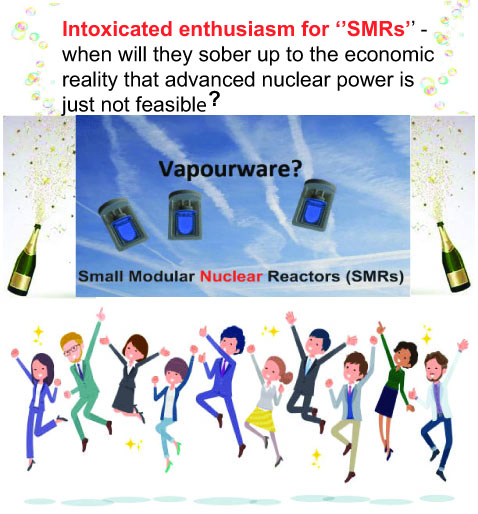
EU Policy. Commission invites industry to join support platform for mini nuclear
euronews, By Robert Hodgson, 09/02/2024
The European Commission has invited interested companies to help “to facilitate and speed up the development, demonstration, and deployment” of small modular nuclear reactors, a fledgling technology it hopes will help the EU achieve its goal of reaching net-zero greenhouse gas emissions by 2030.
……………………………………………………………………………………………………… The inclusion of nuclear power in Europe’s climate mitigation policy has been divisive, with France leading a group of EU members in favour promoting it as a low-carbon solution and Germany against …………………..
Internal market commissioner Thierry Breton said SMRs would play a “central role” in Europe’s climate action. “In a context of increasing business competition on SMRs at global level, Europe is promptly responding, capitalising on its strong nuclear competence, innovation, and manufacturing capability,” he said in a statement.
……………………………….. Environmental groups have criticised the Commission’s reliance on technologies, including SMRs and carbon capture and storage, that have yet to be proved at scale for meeting EU climate targets, rather than focusing resources on promoting existing solutions such as solar and wind power…………. https://www.euronews.com/green/2024/02/09/commission-invites-industry-to-join-support-platform-for-mini-nuclear
The pragmatist’s guide to nuclear disarmament
Feb. 9, 2024, Steve Olson, The Seattle Times, https://www.seattletimes.com/opinion/the-pragmatists-guide-to-nuclear-disarmament/
The United States has not seen a widespread nuclear disarmament movement since the early 1980s. A new one is desperately needed — but with a twist.
The 1980s movement was based on fear. In 1982, a million people, alarmed by President Ronald Reagan’s nuclear buildup, gathered in New York City’s Central Park to oppose the nuclear arms race — still the largest one-day protest in U.S. history. The next year, 100 million people — almost half the population of the United States — watched the television movie “The Day After,” which horrifically depicted the nuclear destruction of Kansas City.
Fear can generate a fight-or-flight reaction, but it’s ultimately counterproductive. People become so scared that they think nothing can be done and give up. Or they ignore the issue entirely, at least on a conscious level.
There are still plenty of things to fear. Nuclear treaties are lapsing. National leaders have threatened to use nuclear weapons against their enemies. New research, now being reviewed by the National Academies of Sciences, Engineering, and Medicine, has strengthened the case that even a limited nuclear war could shut down agriculture for years and doom billions to starvation. A large-scale nuclear war could smother agriculture for more than a decade and end civilization.
But fear isn’t necessary to spur action. There are two very practical reasons to abolish nuclear weapons.
The first is their outrageous cost. The U.S. government is on track to spend at least $1.5 trillion over the next 30 years modernizing its nuclear weapons. That’s as much as the federal government currently spends on the National Institutes of Health. Or, to put it another way, four years of that spending, evenly divided among the 50 states, would buy us an entirely new ferry fleet.
Key parts of the modernization effort, like the new Sentinel ballistic missile program, are already massively over budget. Taking apart nuclear weapons systems would cost a small fraction of the money now slated to build new ones.
The second reason for getting rid of nuclear weapons is that they are far more dangerous than they are useful. Nuclear bombs are too large and destructive to deploy effectively in warfare. They would kill soldiers and noncombatants on both sides of a conflict. Nuclear fallout would drift far from a battlefield. Weapons have been getting smaller and smarter, not bigger and dumber.
Nuclear weapons also don’t make sense politically. If a nuclear weapon were detonated in a war — assuming that a general nuclear war did not follow — the responsible nation would face devastating conventional attacks and be ostracized internationally. No country has been willing to face those consequences, at least not since the very different circumstances that prevailed at the end of World War II.
The existence of nuclear weapons supposedly deters their use. No one has been able to figure out what that nonsensical statement means. Making a threat implies being willing to carry it out. The idea that deterrence has worked ignores the history of crises, miscalculations, and accidents that almost triggered nuclear war. Deterrence works until it doesn’t.
Nuclear weapons are a federal responsibility. For us as Washingtonians, that means working through our 10 U.S. representatives and two U.S. senators to change nuclear policy. Except for U.S. Rep. Pramila Jayapal, the members of our congressional delegation have been, at best, guarded in their statements about nuclear weapons. Washington receives about $20 billion a year in defense spending. Reducing that flow of funds would seem to be a recipe for electoral disaster.
But couldn’t at least part of our defense funding be spent in more socially productive ways? After all, flying a nuclear bomb-carrying F-35A jet for two hours costs as much as a nurse makes in a year. Keeping more than 55,000 mostly young men and women here in Washington well-trained and outfitted for future conflicts may help us feel more secure. But it doesn’t build infrastructure, spark innovation, or improve the health and well-being of the population at large.
Here, the Washington Against Nuclear Weapons coalition, led by the Washington chapter of Physicians for Social Responsibility, has been exerting pressure on our representatives and senators to take a stand against nuclear weapons. The Ground Zero Center for Nonviolent Action — on a 4-acre plot adjacent to the Kitsap submarine base outside Bremerton — works for disarmament right next to the largest stockpile of deployed nuclear weapons anywhere in the world. At the national level, the Ploughshares Fund, the Federation of American Scientists, the Arms Control Association and many other organizations are working to reduce and then eliminate the existential threat these weapons pose.
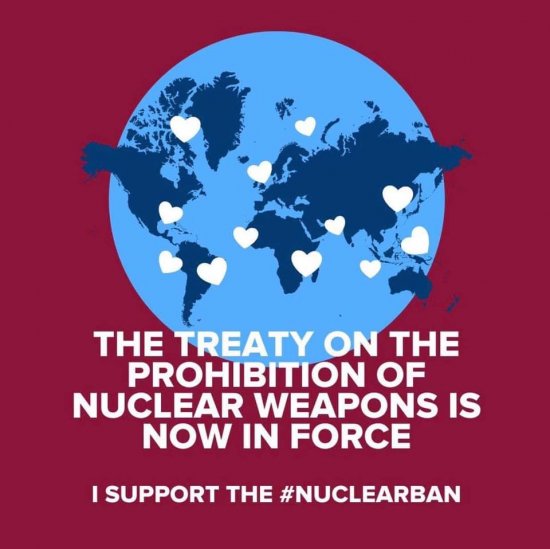
In 2021, the International Treaty on the Prohibition of Nuclear Weapons, which prohibits the development, production, use, and threat of use of nuclear weapons, entered into force after being ratified by 50 countries. The nine countries that have nuclear weapons have so far opposed the treaty, but they are nevertheless bound by the 1968 Treaty on the Non-Proliferation of Nuclear Weapons to negotiate an agreement “on general and complete disarmament under strict and effective international control.” That they have not yet done so is both a bitter disappointment and a betrayal of their stated intentions.
Nuclear disarmament will not be unilateral or immediate. Nations will need to negotiate stepped reductions and means of verifying progress. An especially urgent task is to eliminate the ground-based missiles now clustered in underground silos in Colorado, Montana, Nebraska, North Dakota and Wyoming, as well as in Russia and China. These weapons are inherently destabilizing and dangerous. They have to be launched within minutes if a president thinks a nuclear attack is underway. A mistake, miscalculation, or moment of madness could spell the end of the world.
Unlike efforts to slow climate change, which will require widespread changes in how we live, the threat of nuclear annihilation could be eliminated if nine men agreed to destroy about 12,500 pieces of elaborately machined metal. Reagan and then-president of the Soviet Union Mikhail Gorbachev almost agreed to junk their nuclear weapons in 1986. The only stumbling block was Reagan’s commitment to a nuclear weapons defense program that was canceled a few years later.
1 This Month

of the week – Shut Down Drone Warfare!


Tell the Ukrainian Government to Drop Prosecution of Peace Activist Yurii Sheliazhenko

Petition to revoke the licensing of the Near Surface Nuclear Disposal Facility (NSDF) at Chalk River. https://www.ourcommons.ca/petitions/en/Petition/Details?Petition=e-7247
To see nuclear-related stories in greater depth and intensity – go to https://nuclearinformation.wordpress.com
-
Archives
- April 2026 (34)
- March 2026 (251)
- February 2026 (268)
- January 2026 (308)
- December 2025 (358)
- November 2025 (359)
- October 2025 (376)
- September 2025 (257)
- August 2025 (319)
- July 2025 (230)
- June 2025 (348)
- May 2025 (261)
-
Categories
- 1
- 1 NUCLEAR ISSUES
- business and costs
- climate change
- culture and arts
- ENERGY
- environment
- health
- history
- indigenous issues
- Legal
- marketing of nuclear
- media
- opposition to nuclear
- PERSONAL STORIES
- politics
- politics international
- Religion and ethics
- safety
- secrets,lies and civil liberties
- spinbuster
- technology
- Uranium
- wastes
- weapons and war
- Women
- 2 WORLD
- ACTION
- AFRICA
- Atrocities
- AUSTRALIA
- Christina's notes
- Christina's themes
- culture and arts
- Events
- Fuk 2022
- Fuk 2023
- Fukushima 2017
- Fukushima 2018
- fukushima 2019
- Fukushima 2020
- Fukushima 2021
- general
- global warming
- Humour (God we need it)
- Nuclear
- RARE EARTHS
- Reference
- resources – print
- Resources -audiovicual
- Weekly Newsletter
- World
- World Nuclear
- YouTube
-
RSS
Entries RSS
Comments RSS
 nuclear-news