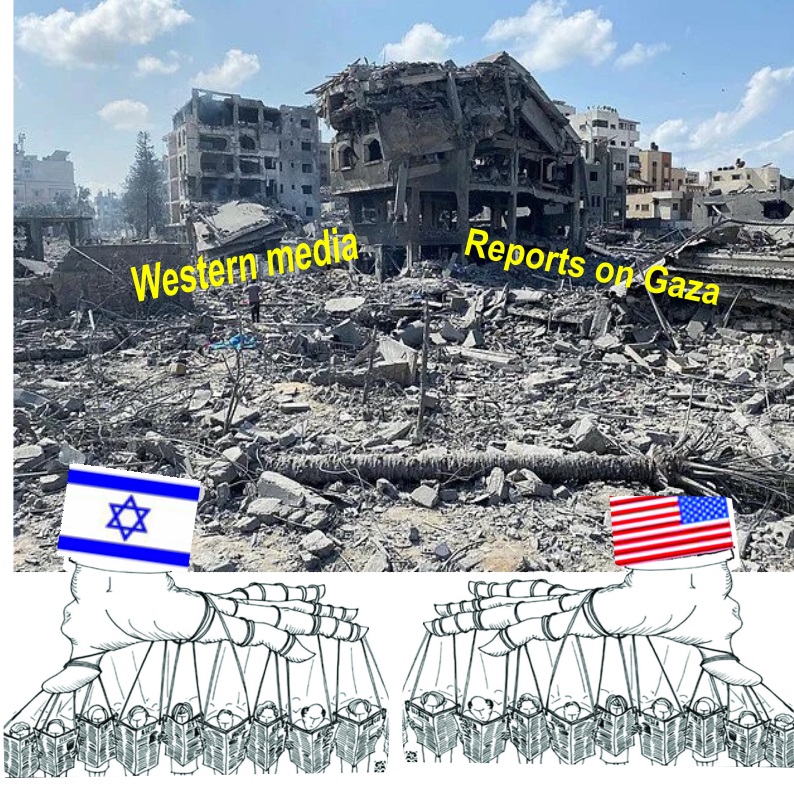
The push for more balanced coverage has been complicated by Israel’s block on foreign journalists entering Gaza except under IDF control and subject to censorship. That has helped keep the full impact of the war on Palestinians off of CNN and other channels while ensuring that there is a continued focus on the Israeli perspective.
Insiders say pressure from the top results in credulous reporting of Israeli claims and silencing of Palestinian perspectives
Insiders say pressure from thetop results in credulous reporting of Israeli claims and silencing of Palestinian perspectives
CNN is facing a backlash from its own staff over editorial policies they say have led to a regurgitation of Israeli propaganda and the censoring of Palestinian perspectives in the network’s coverage of the war in Gaza.
Journalists in CNN newsrooms in the US and overseas say broadcasts have been skewed by management edicts and a story-approval process that has resulted in highly partial coverage of the Hamas massacre on 7 October and Israel’s retaliatory attack on Gaza.
“The majority of news since the war began, regardless of how accurate the initial reporting, has been skewed by a systemic and institutional bias within the network toward Israel,” said one CNN staffer. “Ultimately, CNN’s coverage of the Israel-Gaza war amounts to journalistic malpractice.”
According to accounts from six CNN staffers in multiple newsrooms, and morethan a dozen internal memos and emails obtained by the Guardian, daily news decisions are shaped by a flow of directives from the CNN headquarters in Atlanta that have set strict guidelines on coverage.
They include tight restrictions on quoting Hamas and reporting other Palestinian perspectives while Israel government statements are taken at face value. In addition, every story on the conflict must be cleared by the Jerusalem bureau before broadcast or publication.
CNN journalists say the tone of coverage is set at the top by its new editor-in-chief and CEO, Mark Thompson, who took up his post two days after the 7 October Hamas attack. Some staff are concerned about Thompson’s willingness to withstand external attempts to influence coverage given that in a former role as the BBC’s director general he was accused of bowing to Israeli government pressure on a number of occasions, including a demand to remove one of the corporation’s most prominent correspondents from her post in Jerusalem in 2005.
CNN insiders say that has resulted, particularly in the early weeks of the war, in a greater focus on Israeli suffering and the Israeli narrative of the war as a hunt for Hamas and its tunnels, and an insufficient focus on the scale of Palestinian civilian deaths and destruction in Gaza.
One journalist described a “schism” within the network over coverage they said was at times reminiscent of the cheerleading that followed 9/11.
“There’s a lot of internal strife and dissent. Some people are looking to get out,” they said.
Another journalist in a different bureau said that they too saw pushback.
“Senior staffers who disagree with the status quo are butting heads with the executives giving orders, questioning how we can effectively tell the story with such restrictive directives in place,” they said.
“Many have been pushing for more content from Gaza to be alerted and aired. By the time these reports go through Jerusalem and make it to TV or the homepage, critical changes – from the introduction of imprecise language to an ignorance of crucial stories – ensure that nearly every report, no matter how damning, relieves Israel of wrongdoing.”
CNN staff say that some journalists with experience of reporting the conflict and region have avoided assignments in Israel because they do not believe they will be free to tell the whole story. Others speculate that they are being kept away by senior editors.
“It is clear that some who don’t belong are covering the war and some who do belong aren’t,” said one insider.
Edicts from on high
………………. In late October, as the Palestinian death toll rose sharply from Israeli bombing with more than 2,700 children killed according to the Gaza health ministry, and as Israel prepared for its ground invasion, a set of guidelines landed in CNN staff inboxes.
……………….CNN staff members said the memo solidified a framework for stories in which the Hamas massacre was used to implicitly justify Israeli actions, and that other context or history was often unwelcome or marginalised.
“How else are editors going to read that other than as an instruction that no matter what the Israelis do, Hamas is ultimately to blame? Every action by Israel – dropping massive bombs that wipe out entire streets, its obliteration of whole families – the coverage ends up massaged to create a ‘they had it coming’ narrative,” said one staffer.
The same memo said that any reference to casualty figures from the Gaza health ministry must say it is “Hamas-controlled”, implying that reports of the deaths of thousands of children were unreliable even though the World Health Organization and other international bodies have said they are largely accurate. CNN staff said that edict was laid down by Thompson at an earlier editorial meeting.
Broader oversight of coverage from the CNN headquarters in Atlanta is directed by “the Triad” of three CNN departments: news standards and practices, legal and fact-checking.
David Lindsay, the senior director of news standards and practices, issued a directive in early November effectively barring the reporting of mostHamas statements, characterising them as “inflammatory rhetoric and propaganda”.
………. one CNN staffer noted that the network repeatedly aired inflammatory rhetoric and propaganda from Israeli officials and American supporters, often without challenge in interviews.
They noted that other channels have carried interviews with Hamas leaders while CNN has not, including one in which the group’s spokesman, Ghazi Hamad, cut short questions from the BBC when he was challenged about the murder of Israeli civilians. One staffer said there is a view among correspondents that it is “agony to get a Hamas interview past the Triad
…………………………………………………….. In addition to the edicts from Atlanta, CNN has a longstanding policy that all copy on the Israel-Palestine situation must be approved for broadcast or publication by the Jerusalem bureau. In July, the network created a process it called “SecondEyes” to speed up those approvals.
…………… One result of SecondEyes is that Israeli official statements are often quickly cleared and make it on air on the principle that that they are to be trusted at face value, seemingly rubber-stamped for broadcast, while statements and claims from Palestinians, and not just Hamas, are delayed or never reported.
One CNN staffer said edits by SecondEyes often seemed aimed at avoiding criticism from pro-Israel groups……………………………..
Some CNN staff fear that the result is a network acting as a surrogate censor on behalf of the Israeli government.
“The system results in chosen individuals editing any and all reporting with an institutionalised pro-Israel bias, often using passive language to absolve the [Israel Defense Forces] of responsibility, and playing down Palestinian deaths and Israeli attacks,” said one of the network’s journalists.
……………………………………………………………. Another presenter, Sara Sidner, drew criticism for her excitable report on unverified Israeli claims that Hamas beheaded dozens of babies on 7 October.
“We have some really disturbing new information out of Israel,” she announced four days after the attack.
“The Israeli prime minister’s spokesman just confirmed, babies and toddlers were found with their heads decapitated in Kfar Aza in southern Israel after Hamas attacks in the kibbutz over the weekend. That has been confirmed by the prime minister’s office.”
………………… Gold, who was part of the SecondEyes team approving stories, again said the report had been confirmed by Netanyahu’s office and she drew parallels with the Holocaust. She responded to a Hamas denial that it had decapitated babies as unbelievable “when we literally have video of these guys, of these militants, of these terrorists doing exactly what they say they’re not doing to civilians and to children”.
Except, as a CNN journalist pointed out, the network did not have such video and, apparently, neither did anyone else………………………………….
By the time of Sidner’s broadcast there were already good reasons for CNN to treat the claims with caution.
Israeli journalists who toured Kfar Aza the day before said they had seen no evidence of such a crime and military officials there had made no mention of it. Instead, Tim Langmaid, the Atlanta-based CNN vice-president and senior editorial director, sent an instruction that President Biden’s claims to have seen pictures of the alleged atrocity “back up what the Israeli government said”.
…….. CNN insiders said senior editors should have treated the story with caution from the beginning because the Israeli military has a track record of false or exaggerated claims that subsequently fall apart.
Other networks, such as Sky News, were considerably more sceptical in their reporting and laid out the tenuous origins of the story, which began with a reporter for an Israeli news channel saying soldiers had told her that 40 children had been killed in the Hamas massacre and that one soldier had said he had seen “bodies of babies with their heads cut off”. The Israel Defense Forces (IDF) then used the claim to liken Hamas to the Islamic State.
Even after the White House admitted that neither the president nor his officials had themselves seen pictures of beheaded babies, and that they had been relying on Israeli claims, Langmaid told the newsroom it could still report the Israeli government assertions alongside a denial from Hamas.
CNN did report on the rolling back of the claims as Israeli officials backtracked, but one staffer said that by then the damage had been done, describing the coverage as a failure of journalism.
“The infamous ‘beheaded babies’ claim, attributed to the Israeli government, made it to air for roughly 18 hours – even after the White House walked back on Biden’s statement that he had seen the nonexistent photos. CNN had no access to photographic evidence, nor any ability to independently verify these claims,” they said.
……….. Some CNN staff raised similar issues with reporting on Hamas tunnels in Gaza and claims they led to a sprawling command centre under al-Shifa hospital.
The push for more balanced coverage has been complicated by Israel’s block on foreign journalists entering Gaza except under IDF control and subject to censorship. That has helped keep the full impact of the war on Palestinians off of CNN and other channels while ensuring that there is a continued focus on the Israeli perspective………………………………
The only foreign journalist to report from Gaza without an Israeli escort has been CNN’s Clarissa Ward, who entered for two hours with a humanitarian team from the United Arab Emirates.
……………. she was being prevented from conveying a fuller picture of the tragedy unfolding in Gaza because of the Israeli block on foreign journalists, putting the burden solely on a limited number of courageous Palestinian reporters who are being killed in disproportionate numbers.
“We must now be able to report on the horrific death and destruction being meted out in Gaza in the same way – on the ground, independently – amid one of the most intense bombardments in the history of modern warfare,” she wrote.
“The response to our report on Gaza in Israeli media suggests an unspoken reason for denying access. When asked on air about our piece, one reporter from the Israeli Channel 13 replied, ‘If indeed Western reporters begin to enter Gaza, this will for sure be a big headache for Israel and Israeli hasbara.’ Hasbara is a Hebrew word for pro-Israel advocacy.
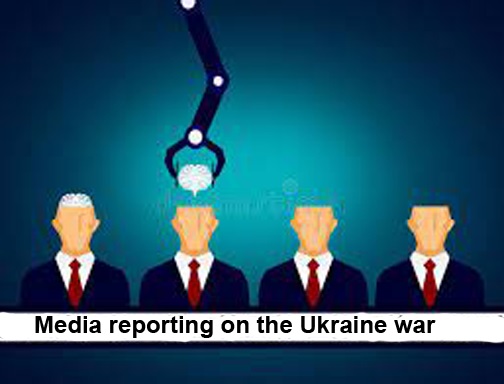
Some at CNN fear that its coverage of the latest Gaza war is damaging a reputation built up by its reporting of Russia’s invasion of Ukraine, which led to a surge in viewers. But others say that the Ukraine war may be part of the problem because editorial standards grew lax as the network and many of its journalists identified clearly with one side – Ukraine – particularly at the beginning of the conflict.
One CNN staffer said that Ukraine coverage set a dangerous precedent that has come back to haunt the network because the Israeli-Palestinian conflict is far more divisive and views are much more deeply entrenched.
“The complacency in our editorial standards and journalistic integrity while reporting on Ukraine has come back to haunt us. Only this time, the stakes are higher and the consequences much more severe. Journalistic complacency is an easier pill for the world to swallow when it’s Arab lives lost instead of European,” they said.
Another CNN employee said the double standards are glaring…………………………………………………
One of the noblest and most important things a western journalist can do these days is help expose the propagandistic manipulations of the mainstream western press institutions who have duped our civilization into consenting to a profoundly dysfunctional status quo which does not serve the interests of normal human beings. Unfortunately this rarely happens, because western journalists tend to view the mainstream press as allies and potential employers.
This happens to be one such rare occasion, and it happened in one of the lastplaces you’d probably have guessed if you follow mass media propaganda with a critical eye. The Guardian has a great new article out titled “CNN staff say network’s pro-Israel slant amounts to ‘journalistic malpractice’” by a guy named Chris McGreal which cites multiple CNN staff members and internal documents to reveal the immense top-down pressure in the network to tilt coverage heavily in favor of Israel.
McGreal writes the following:
“CNN is facing a backlash from its own staff over editorial policies they say have led to a regurgitation of Israeli propaganda and the censoring of Palestinian perspectives in the network’s coverage of the war in Gaza.
“Journalists in CNN newsrooms in the US and overseas say broadcasts have been skewed by management edicts and a story-approval process that has resulted in highly partial coverage of the Hamas massacre on 7 October and Israel’s retaliatory attack on Gaza.
“‘The majority of news since the war began, regardless of how accurate the initial reporting, has been skewed by a systemic and institutional bias within the network toward Israel,’ said one CNN staffer. ‘Ultimately, CNN’s coverage of the Israel-Gaza war amounts to journalistic malpractice.’”
McGreal’s sources say CNN’s wildly biased coverage of Israel’s assault on Gaza is the direct result of edicts from the network’s new CEO Mark Thompson, who assumed his role two days after the October 7 attack. From 2012 to 2020 Thompson was the president and CEO of The New York Times, which is currently experiencing its own internal strife due to the pro-Israel bias of that outlet.
Before his NYT executive gig Thompson was the director-general of the BBC, where he came under fire multiple times for the pro-Israel bias he imposed on the British state broadcaster. In 2005 he held meetings in Jerusalem with then-Israeli Prime Minister Ariel Sharon with the reported aim to “build bridges with the country’s political class,” immediately after which he removed BBC correspondent Orla Guerin from Jerusalem following accusations of “antisemitism” made against her by the Israeli government. In 2009 he was hotly criticized for choosing not to air the Disasters Emergency Committee appeal for Gaza, and in 2011 he presided over the decision to censor the lyrics “free Palestine” from a performance by rapper Mic Righteous on BBC Radio 1Xtra.
This is the sort of person who gets hired to multiple executive positions in multiple highly influential western media platforms. If you’ve ever wondered why it looks like the western press function in pretty much the same way as the state propaganda services in the autocracies the west proudly sets itself apart from, this is why. The corporate media are owned and controlled by plutocrats who have a vested interest in preserving the status quo power structure upon which their kingdoms are built, and state broadcasters like the BBC have the same interest for the same reason. They decide who the executives of those outlets will be, and those executives make policy and hiring decisions which cause the outlet to function in a way that is indistinguishable from state propaganda.
These are the people who’ve been pulling the wool over the eyes of the mainstream public and manipulating the masses into thinking, speaking, working, consuming, and voting in ways that serve the interests of the ruling power structure. In this way they are able to ensure that revolutionary opposition to that power structure remains a fringe minority position, even as that power structure wages wars, sponsors genocides, destroys the biosphere, and keeps everyone poor, sick, and stupid.
Our world will never see the revolutionary changes it desperately needs until the people begin using the power of their numbers to force those changes to happen, and the people will never start using the power of their numbers to force revolutionary change as long as they are being manipulated by propagandists into accepting the status quo. Our task therefore, as people who love truth and desire a healthy world, is to begin waking the public up to the reality that everything they’ve been told about their society, their government and their world is a lie, and pointing them toward true information about what’s really going on.
That’s how humanity will awaken from its propaganda-induced coma to create a healthy world: one pair of eyelids at a time. This might sound like a slow-going project, but for every newly opened pair of eyes there is one more voice who can help wake up the others, which means exponential growth is possible. This is how we move humanity into the light of truth and begin the shift toward a truth-based society.
And we’ve got an advantage: the empire needs to use human beings to generate its propaganda. That’s what we’re seeing in CNN staff turning against their boss and reporting his malfeasance to another news outlet. As long as the empire depends on ordinary human beings to turn its gears and facilitate its horrific atrocities, there’s always the possibility that the next pair of eyes to open will be someone on the inside.
Every now and then, some journalist steps out of the accepted line, and spills the beans on what is going on in critical news.
This week, the Guardian’s Guardian’s Chris McGreal did just that. He exposed the journalistic turmoil in CNN, over its very biased coverage of Israel’s war on Gaza
It’s got particularly important right now. Most of us are probably still believing in the Hamas massacre story of, “bodies of babies with their heads cut off” – despite not one shred of evidence of this. With the whole Middle East now a tinderbox, the media is still pushing the Israel storyline that goes like this:
The Israelis suffered the brutal massacre of 1200 citizens on October 7, 2023. That justifies the massacre of 27,365 Palestinians in Gaza. In the continuing massacre of Palestinians, the Israelis are the victims.To allow humanitarian aid to the desperate , hungry, Gazan survivors is to support terrorism.
Chris McGeal explains the long, complicated, and disgraceful background of media succumbing to pressure – “the CNN network repeatedly aired inflammatory rhetoric and propaganda from Israeli officials and American supporters, often without challenge in interviews.”
He also notes the restrictions on journalists, with the Israeli block on foreign journalists, and with all CNN’s copy on the Israel-Palestine situation having be first approved by the Jerusalem bureau.
And it’s not new – this subservience - it was the same thing with the coverage of the post 9/11 time, and the unbalanced and ultra-negative coverage of the Taliban-controlled Afghanistan, and the killing of Afghan civilians by US forces.
Caitlin Johnstone, the not-so-mainstream, and intrepid, excavator of the truth, has also dug up the troubling realities on the biased news that we are fed.
She aims her blowtorch on the careers of media executives moving through corporate media – New York Times – BBC – CNN – “ The corporate media are owned and controlled by plutocrats who have a vested interest in preserving the status quo power structure upon which their kingdoms are built, and state broadcasters like the BBC have the same interest for the same reason. They decide who the executives of those outlets will be, and those executives make policy and hiring decisions which cause the outlet to function in a way that is indistinguishable from state propaganda.”
UKRAINE
Caitlin Johnstone is also one of the few writers (apart from Russian journalists) who also shine a light on the media coverage of the Ukraine war. She has examined ”the brazen propaganda push to normalize war profiteering in Ukraine “, quoting CNN anchor Erin Burnett ………. pausing to explain to her audience that this funding is actually good for Americans, because it goes straight into the US arms industry.“
She points out not only the advantages to American weapons companies of continuing the Ukraine war indefinitely, but the way in which the media report this – with approval! “western officials are now going out of their way to communicate to the public that this war will stretch on for many more years to come.”
She quotes the Wall Street Journal, Reuters, and CNN - all positively gushing over how good this war is for America - jobs, share prices, company profits - all good!
When it comes to coverage of the actual war and its battles - well, we hear a lot about the dedicated President Zelensky. We hear about the Ukrainian counter-offensive (though it did not seem to work). We get genuinely sad stories about victims of Russian strikes, and rather more dubious stories about Russian atrocities. On the whole, we really don’t hear much about the actual progress of the war, and get a stunning silence about the Ukrainian troop casualties. And there’s little attempt to explain the background to this war. As with the Gaza story, it’s as though the hostilities were new and unprovoked, and the grievances are solely on the side that the USA supports
Mostly the Ukraine coverage is about how world democracy requires more weapons to be bought (by Western tax-payers) and given to Ukraine.
The media – journalists hanging on to their jobs, companies hanging on to their advertisers, and their profits – dance to the corporate line. Are we all dancing along with them, to World War 3 ?
Ever since South African Energy Minister Dr Kgosientsho Ramokgopa announced that Cabinet had approved the updated Integrated Resource Plan last December, local media has been awash with articles by nuclear supporters and sundry lobbyists exhorting politicians and government to ‘show true leadership’ and ‘do the right thing’ when it comes to nuclear power.
Invariably, doing so means showing unwavering support for the government’s plans to expand nuclear energy generation capacity by choosing the particular nuclear technology or reactor design favored by the author of the article being read or following the guidelines they helpfully drew up to assist policymakers by advising how they ought to proceed going about doing so, even if this means going against the recommendations of the presidentially-appointed panel of experts who sit on the Presidential Climate Commission or failing to address the numerous criticisms that have been leveled against government’s nuclear plans, prominent South African nuclear scientists among them. Presumably, depending on the responses these articles elicit, individual politicians would then be lauded for the leadership and courage they have shown or berated for their lack thereof.
It is curious, not to mention ironic, to hear such sentiments expressed by pro-nuclear supporters, especially those who have long attempted to portray the decision to ‘go nuclear’ as a self-evident outcome of a purely technical decision-making process that is obviously best left to ‘the experts’ i.e. appointed and unelected technocrats who are supposedly immune to political interference.
It is also somewhat misleading of them to characterize the decision to support the expansion of nuclear power capacity as one requiring ‘courage’ as such given the scant detail government has provided on its nuclear plans, the few general nuclear education and public awareness campaigns on nuclear power it has run within and outside of the communities in which it is proposed that reactors be located in future and the critical information related to its past nuclear dealings and the planned Koeberg life expansion project amongst others it has allegedly deliberately withheld from the public.
All of these combined result in persistent and extremely low public levels of knowledge of nuclear power and related issues, so much so that the general public appears ambivalent about the issue of nuclear power. This assessment seems to be supported by the persistently low turnout that is observed at the perfunctory public hearings which the government seemingly hosts to satisfy administrative requirements surrounding public participation in order to mitigate any potential for conflict to arise in the future rather than to genuinely engage the public’s views on nuclear power.
Subsequently, the organized anti-nuclear political movement nationally is under-resourced and the level of grassroots public support it enjoys is uncertain. Considering the limited organized opposition thereto and the general public’s nuclear indifference, none but the most biased observer would be reluctant to concede that the decision to champion nuclear power is unlikely to demand much by way of boldness or courage from the individual politician. More so since nuclear power, by its nature, accords so conveniently with the motivations of the average individual politician to amass more power and influence for themselves and members of their class and has the power to undermine the public oversight mechanisms and regulatory frameworks set up to monitor them. Yet perhaps the biggest reason why nuclear power is likely to appeal to representatives of SA’s major political parties especially is because it could enable their parties to navigate the political forces that assail them…………………………………………………………………………………………………………………………….
It is apparent from the scenarios described above that political imperatives dictate the adoption of a pro-nuclear position by politicians from all the major political parties in SA irrespective of the political ideologies they espouse or the content or merits of the specific nuclear plan under review. Under these circumstances, exhorting politicians to support nuclear power is akin to urging them to act to protect their party’s narrow political interests. One submits to the reader that this does not seem to be particularly brave or courageous.
In contrast, it would require a tremendous amount of courage for a politician to acknowledge and act on the insight that the distortions introduced by prevailing political considerations render it impossible for them to hold robust internal political debates on the issue of nuclear power, more so considering the increased frequency with which ostensible party comrades have resorted to using deadly methods to eliminate potential rivals. It is, therefore, naïve to rely on the party political system to formulate positions on nuclear power that are truly in the nation’s best interest.
……………………………………………… they could opt to support the right of every citizen to act with the courage and integrity nuclear supporters claim they want politicians to by calling upon the government to submit its nuclear plans to a popular referendum. In a country where citizens have become fed up by years of maladministration and corruption and large sections of the electorate are beginning to lose faith in the democratic system itself, this display of political courage would serve as definitive proof of the leadership credentials of the politician who wanted to ‘do the right thing’ by their compatriots.
Sunday, 02/04/2024, Umud Shokri, Iran International
Iran’s recently stated plan to build four more nuclear power reactors has raised questions about its feasibility as the country wrestles with economic crisis and isolation.
According to early estimates, work has started in the southern region with a five-thousand-megawatt total capacity in mind. With 4,000 employment prospects and an estimated $20 billion cost, the planned nine-year schedule raises questions under current economic circumstances.
The difficulties Iran has faced in building new power plants in the last ten years raise doubts about whether the 25,000 megawatts of new electricity that the previous national development plan sought to bring about can be achieved.
The Iranian government pledged to raise the percentage of renewable and clean energy power plants to a minimum of five percent in line with the sixth development plan (2017–2021). However, the share of nuclear power is currently one percent, which means that the program’s goals have been significantly missed………..
The only nuclear power plant in the country is a 1,000 megawatt facility that started up in 2011 with help from Russia. A 300 megawatt plant is reportedly under construction in Khuzestan.
Building times for nuclear power plants vary greatly due to factors like supply chain maturity, design revisions, and project management efficiency, but Iran faces a severe electricity shortage now. Consumption peaked at over 72,000 megawatts in 2023, surpassing the actual production capacity of power plants, capped at 60,000 megawatts during the warm season.
Iran is facing several obstacles in its efforts to build further nuclear power reactors, including financial and technological constraints, geopolitical and political instability, and international sanctions. The interplay of political and economic dynamics, together with worries about public opinion, safety, and international compliance, complicate Iran’s nuclear energy development scenario. Moreover, Mohammad Eslami, the head of Iran’s nuclear energy said last week that Tehran is planning to build the new reactors relying on domestic financing and knowhow……………………………………………………………….
Examining Iran’s foreign policy, one can see that the country is committed to scientific progress even in the face of external challenges, as seen by its tenacity in pursuing its nuclear program despite sanctions. Careful navigation is necessary to resolve the delicate dance between energy demands, geopolitical concerns, and the difficulties presented by international sanctions. Iran’s prospects for the energy sector both at home and abroad will depend on how well it can surmount these challenges https://www.iranintl.com/en/202402034292
t last year’s COP28 climate conference in Dubai, French President Emmanuel Macron triumphantly declared that “nuclear energy is back”. His celebratory remark was uttered after France led a group of 20 countries in signing a pledge to “triple nuclear energy capacity from 2020 by 2050”.
Since the summit, a range of announcements and promises have been made that appear to support France’s ‘nuclear renaissance’. In November, the European Parliament backed the development of small modular reactors (SMRs), a versatile technology that many consider to be the future of the industry. Two months later, Energy Transition Minister Agnes Pannier- Runacher said that France will need to build 14 new nuclear power plants rather than the six currently planned if the country is to meet its energy transition goals.
Is all this optimism warranted? France has long been a nuclear superpower but lost its position as the world’s second-largest producer of nuclear energy to China in 2022, with the US coming in first. It is worth considering whether Macron’s positivity is justified in the context of several issues that currently beset the country’s industry, including EDF’s unpredictable performance, lack of strong allies in the European Council, slow progress on SMR development and Russian interdependence.
EDF’s annus horribilis
Électricité de France (EDF) is the French multinational electric utility company that runs the country’s 56 reactors. Throughout 2022, many were forced offline for maintenance work, causing output to fall below 1990 levels, despite installed capacity being 5GW lower at this time.
Nuclear shutdowns are in themselves not a huge cause for concern. Older power plants need to be updated with the latest technologies and France was planning on widespread shutdowns for its ‘Grand Carénage’ refurbishment programme anyway. However, the nature of these specific stoppages was worrying.
In December 2021, the discovery of cracks in the emergency core cooling systems of four of the newest French reactors led to them being shut down. The four units, which each produce 1.5GW, did not generate a single kilowatt-hour throughout 2022. Other 1.3GW reactors also showed similar symptoms, and by mid-2022, 12 additional reactors were shut down due to the same problem. In its annual electricity review, Réseau de Transport d’Électricité highlighted the crux of the issue, stating, “these outages, or outage extensions to carry out maintenance, tests and repairs where needed, primarily involved the newest reactors in the fleet (N4 and P4 designs), i.e. reactors that were not targeted for investment in the Grand Carénage refit programme”.
Although EDF’s nuclear output was 14.8% higher in 2023 than 2022 as reactors came back online, Macron will have to square his desire for new reactors with the ongoing threat of unplanned shutdowns at existing newer plants. Mycle Schneider, nuclear analyst and author of the annual World Nuclear Status Reports, commented on the ongoing unpredictability of EDF’s output, stating: “We have repeatedly seen that EDF was off by several gigawatts of nuclear capacity availability in predictions for the following week. If you look at availability on a certain day, and then go back one week, nuclear availability is several gigawatts different to the projection made a week previously.”
Seeking international allies……………………………………………….
SMRs – a false dawn?
The creation of the EU SMR Industrial Alliance in November accentuates the blocs’ commitment to modular technology in its nuclear drive. Naturally, France led the group of 11 countries signing the alliance.
The International Atomic Energy Agency (IEAE) defines SMRs as advanced nuclear fission reactors that have a power generation capacity of up to 300MW per unit – around a third of the capacity of traditional reactors. The ‘small’ and ‘modular’ nature of their design means they can be sited at locations unsuited to larger nuclear power plants. Their diminutive size is also meant to save on construction time and cost.
Despite significant optimism around the technology, little progress has been made on the ground. The most advanced SMR project in the western world was forcibly abandoned in November 2023 due to excessive costs. US-based NuScale scrapped the development with a conglomerate of Utah municipalities after the cost estimate of the project increased to $9.3bn, bringing the cost per kilowatt to $20,000 for the plant, around twice the cost of the most expensive European pressurised water reactor.
Subsequently, there are no SMRs in commercial operation in the west. Placing the EU alliance in this context, Schneider said: “We are not talking commercial contracts. It is like this alliance [EU SMR Industrial Alliance], which is kind of nice. Everybody [the 11 signatories] puts a name under it, but it does not mean anything in industrial terms.”
Even in Russia, where SMR output has been achieved (although, not commercially), there have been construction issues. The reactor took more than 12.7 years to build, more than three-times the 3.7-year target. Schneider noted that this “was not really the demonstration of easy, quick feasibility” that SMRs are meant to be. China too has two operational SMRs, but no production or cost figures on the reactors are yet available.
Overcoming Russian interdependency
Russia is still the primary constructor and exporter of nuclear reactors, with the state company Rosatom, as of mid-2023, building 24 out of the 58 constructed around the world. While France has taken part in a host of EU sanctions placed on Russian energy exports designed to curb revenue for the Kremlin’s war on Ukraine, the measures have not included sanctions on the nuclear sector………………………………………………….
While France is looking to build an alliance with EU nations that still have strong links with the Russian nuclear sector, its own institutions are also interlinked. Framatome, an EDF subsidiary, originally planned to set up a joint venture with Rosatom subsidiary TVEL to manufacture VVER fuel elements in its Lingen plant in Germany. However, in spring 2023, it became clear that the German Government would likely oppose the deal, so the Franco-Russian company was set up in France, with TVEL owning 25% of it. Advanced Nuclear Fuels, a Framatome subsidiary that operates the Lingen plant, wants to extend the manufacturing plant with a dedicated VVER-fuel production line. The Lower Saxony Government is opposed to the project, but under the Atomic Law it does not have a veto right. This leaves the decision in the hands of the federal government, which as of January 2024, has not been taken. Schneider noted the irregularity of the Framatome-Rosatom partnership, considering Framatome could have worked with Westinghouse given the US company’s capability to manufacture VVER fuel. He added that although the reason for this decision is unclear and there is limited evidence to illustrate strong reasoning, “it is quite likely to do with technical difficulties” with the Westinghouse fuel.
As France looks to expand its nuclear industry, there will be challenges, both within its domestic industry and its international relations, that the country will have to address. France’s nuclear watchdog recently said there was “lack of rigour and performance” in EDFs supply chain monitoring and this will have to improve if output is to become stable. While Italy has signalled its desire to re-establish nuclear power, if plans remain unrealised, it is unlikely to be a reliable nuclear ally within the EU council – something which France desperately needs if it is to push through nuclear friendly legislation. SMRs could become a key source of nuclear energy if on-the-ground development begins in earnest, but so far progress has been limited to hopeful pledges. As long as it remains largely dependent on the tenuous, unpredictable Russian regime for its nuclear fuel generation, France’s nuclear plans will have an insecure foundation. If France is to materialise its abstract nuclear dreams into everyday energy production, it will need to address each of these issues pragmatically. https://www.power-technology.com/news/france-has-laid-out-ambitious-nuclear-plans-but-challenges-remain/?cf-view&cf-closed
[WBHG 24 News] – The latest reports from the International Atomic Energy Agency (IAEA), which has had a team of international inspectors at the Zaporizhzhia Nuclear Power Plant for 16 months, painted an alarming picture of leaking steam generation circuits and safety systems, inadequate staff, and no 2024 maintenance plan.
Europe’s largest nuclear power plant is located in occupied Enerhodar. Previously located on the banks of the Kakhovka Reservoir, the primary source of cooling water for ZNPP drained away in June 2023 after the Kakhovka Dam was destroyed. Russian forces captured the plant on March 3, 2022, during the opening days of the expanded war of aggression against Ukraine. Webcams showed Russian tanks firing on the power plant and shooting into administrative buildings during the brief siege.
After pictures, videos, and satellite images proved that Russian forces had militarized the plant in violation of international humanitarian law and the pillars of nuclear safety, the IAEA, backed by the United Nations, pressured Russia to establish an international group of permanent monitors. On September 1, IAEA Director General Rafael Grossi and a team of experts, accompanied by Russian state media, arrived at the plant. There have been 15 rotations of monitors since.
Three reactors have various leaks, and Russia doesn’t plan to fix them
Currently, five of the six reactors at ZNPP are in cold shutdown, with Reactor 4 in hot shutdown to provide steam for plant operations and heat for the nearby town of Enerhodar.
On November 17, IAEA inspectors were told by Russian occupiers that boron had been detected in the secondary cooling circuit of Reactor 4, which was in hot shutdown at the time. Boron is added to the primary cooling and steam circuits of modern nuclear reactors as an extra safety measure. Boron isn’t supposed to be the secondary cooling system, but trace amounts are acceptable.
Four days later, the reactor was shut down, with Russia declaring the boron leak was within acceptable levels and would not be repaired. This was the second unscheduled shutdown of 2023. On August 10, Reactor 4 had to be shut down after a water leak was discovered in one of its steam generators. Plant technicians also found that the heat exchangers needed to be cleaned and did regular maintenance on the reactor’s transformers and emergency diesel generators.
On December 22, inspectors found boric acid deposits on valves, a pump, and on the floors of several rooms in the containment building of Reactor 6. Russian occupation officials said the leak was coming from a cracked boric acid storage tank and it would not be repaired. After IAEA Director-General Rafael Grossi published the finding in a January 3 update, inspectors were barred from accessing parts of Reactor 6 for almost two weeks.
On February 1, the IAEA reported that boric acid leaks were also discovered in Reactor 1.
Unreliable external power connections
Although power plants generate electricity, power to run a power plant is provided by external sources. This provides a layer of safety by assuring that there is always electricity to support normal operations in the event of a facility shutdown. Although a nuclear reactor can be “shut down,” it still needs external power to continuously circulate cooling water in the reactors and on-site spent fuel storage. In the event of a total power failure, backup generators running on diesel fuel become the last line of defense. ZNPP has 20 generators and keeps enough diesel for a minimum of ten days of operation.
It’s estimated that if a ZNPP reactor is in cold shutdown, it can go more than three weeks without water circulation. But in hot shutdown, a meltdown can start 27 hours after the loss of all external power. In the worst-case scenario, the absolute last line of defense is when a nuclear plant operates in “island mode.” That’s when a reactor or reactors are used to generate onsite power to maintain plant operations. It’s inherently dangerous because it requires bringing a reactor online, leaving no margin for error if there are any additional failures. None of ZNPP’s reactors have produced electricity in the last 18 months…………………………………………………………………………………………………………… https://malcontentment.com/zaporizhzhia-nuclear-power-plant-is-falling-apart/
Thus, nothing prevents relaunching the nuclear reactor in Gentilly, according to the very words of a study commissioned by Hydro-Québec .
Nothing. Otherwise money. A lot of money.
Nothing. Otherwise common sense.
It would not be before 2035, we are told. Given the time it takes to get this type of operation underway, it’s tomorrow.
The study was carried out by AtkinsRéalis. A firm previously known as SNC-Lavalin. They are the prime contractors for Canada’s CANDU nuclear reactors. Basically, it’s a bit like asking the oil industry to comment on the appropriateness of oil wells.
When will the day come when foxes will be invited, for their part, to explain to us what we should think of henhouses?
In August 2023, the new management of Hydro-Québec affirmed, against all expectations, that it would be “irresponsible at this time” not to closely consider the relaunch of nuclear power on the banks of the St. Lawrence. Irresponsible?
Minister Fitzgibbon, the man who claims not to be buyable for only $100, immediately gave several signs of satisfaction, while formulating considerations favorable to nuclear power.
It is difficult to imagine that, in the name of reason, we are not totally mobilized against the absurdity of such nuclear energy production programs in Quebec. Are we to believe that the idea of progress, at least for some, does not necessarily lead to progress of the mind?
The reactors have improved, they say. However, accidents or incidents are always possible, as current events have continued to prove to us. Three Mile Island, Chernobyl and Fukushima are not nothing. In Japan, more than a million cubic meters of contaminated water have just been thrown into the ocean, due to a lack of space to store it ad vitam aeternam . What will be the consequences on marine life?
In May 1977, the Gentilly 1 reactor was shut down due to a breakdown. Ten tons of heavy water, loaded with 31,000 curies of tritium, escaped from the power plant into the St. Lawrence River. After only five years of activity, Gentilly 1 was finished. However, it was necessary to wait until 1984 to remove the fuel, without resolving the issue of radioactive waste. In all, Gentilly 1 only operated for the equivalent of 183 days. This plant cost $128 million to build, the equivalent of more than $900 million in 2024.
The new power plant, Gentilly 2, will replace it. Small iodine tablets are distributed to the surrounding population. Until 2012, citizens were instructed to swallow them, in the event of a problem, to try to save at least their thyroid gland… Too expensive, the site was finally closed in 2012. But it would be necessary to wait until 2060 for it to be completely secure. Here again, the question of radioactive waste proves to be an impossible puzzle.
In Ontario, in Chalk River, the green light has just been given, despite objections, to the construction of a facility to manage nuclear waste . There, two serious nuclear accidents occurred in 1952 and 1958. They required the intervention of the army. It was close for everything to slide towards the worst. Among the specialists rushed to the site was a future president of the United States: Jimmy Carter. More than half a century later, the soldiers who worked, like Carter, on the decontamination of Chalk River were offered by Ottawa — as long as they were still alive — a large check for… $24,000.
Justified in pirouettes in the name of the fight against climate change , the enthusiasm for nuclear energy is not about to diminish. Neither are its risks. At what price ? In the summer of 2023, the Canadian government indicated that it wanted to revise upwards the compensation regime adopted in 2016 in the event of a nuclear accident. Ottawa now committed to paying $1 billion as a compensation ceiling rather than the $75 million initially planned. An increase commensurate with awareness of the risks.
An irradiated body, shaken by nausea, doomed to wither from the conjunction of cancers, how is it truly “compensated”?
Nuclear power constitutes a danger and a burden on the future of humanity that Quebec can very well do without.
I hear from here saying this: “Oh! Mr. Nadeau… You are exaggerating so much! Civilian nuclear power plants, after all, are not to be confused with nuclear weapons. Let’s see, Mr. Nadeau! »
Radiations do not know whether they are military or civilian. They always put us within death’s reach, no matter in the name of which flag they are produced. Who will deny today that the nuclear technology transferred by Canada to India allowed this country to develop bombs? Has Canada therefore become friends with New Delhi?
The Zaporizhia nuclear power plant in Ukraine is not a military site. Despite disregard for life, she nevertheless serves as a target in the conflict with Russia.
Who will tomorrow be the new leaders capable of contemplating, like those of today, the destruction of humanity without flinching? Should we ignore the fact that Nero, Genghis Khan and Napoleon have constantly found themselves reincarnated until today?
Even complete strangers can have designs that are dangerous to say the least. In 1982, an Israeli-Swiss engineer, Chaïm Nissim, launched an attack on a nuclear site in France. He was armed with a rocket launcher. What could happen like this now, at a time when low-cost drones make it possible to discreetly carry fire and death everywhere from a clear blue sky?
Being responsible does not mean bowing down or being intimidated in favor of nuclear power in front of hired engineers or passing politicians.
Democrats were almost twice as likely as Republicans to find Israel’s bombardment of the Palestinian enclave excessive
Half of Americans think Israel’s military response to the October 7 Hamas raid has “gone too far,” according to an AP-NORC poll published on Friday. The figure represents a ten-point increase since the pollster asked the same question in November.
Less than a third (31%) of the 1,152 poll respondents said West Jerusalem’s military actions had “been about right,” while 15% said it had not gone far enough. Both figures represent a significant decrease from November, when 38% of those polled approved of the response, and 18% said it should go further.
Democrats were almost twice as likely as Republicans to say Israel had gone too far in its bombardment of Gaza – 62%, compared to 33%.
However, more Democrats also said the campaign had not gone far enough compared to November’s polling (9% vs 7%). Over a third (37%) of respondents said the US was too supportive of Israel. However, the majority (61%) of those who answered the survey said Hamas held “a lot” of responsibility for the war compared to just 35% who said the same about the Israeli government. A third also thought the Iranian government was significantly responsible, but just one in ten thought Washington had played a major role.
Two-thirds (67%) disapproved of President Joe Biden’s handling of the conflict, with a growing portion of Democrats speaking out against their leader (53% compared to just 39% in December).
Despite Washington’s unqualified support for Israel’s military actions in Gaza, only a little over a third (35%) of those surveyed described the nation as “an ally that shares US interests and values.” A plurality (44%) instead viewed it as “a partner that the US should cooperate with, but doesn’t share its interests and values,” while another 9% called it “a rival that the US should compete with, but that it’s not in conflict with.” Just 7% described Israel as an adversary.
Israel has killed over 27,000 Palestinians in Gaza since the war began nearly four months ago, according to the enclave’s Health Ministry, leading South Africa to accuse it of genocide in a case filed with the International Court of Justice in December. The court has since ordered West Jerusalem to prevent genocide in the territory and preserve evidence of any crimes classifiable as such.
Israel was also ordered to alleviate the humanitarian situation for Palestinians, most of whom are considered in danger of starvation or malnutrition. Over 85% of Gaza residents have been displaced by Israeli bombardment since October.
Instead of allowing more aid into the besieged territory, Israel accused the UN’s Palestinian refugee agency, UNRWA, of aiding and abetting Hamas. This led the US and over a dozen other countries to pull funding from the already-overstretched organization.








 nuclear-news