Nuclear news – week to 6th February

Some bits of good news . Heroes in pink: Lao midwives supporting rights and saving lives Zimbabwe launches cholera vaccination to curb the spread. Wild panda population nearly doubles as China steps up conservation efforts.
TOP STORIES.
- EDF’s Hinkley Point woes pile pressure on global nuclear push. also at https://nuclear-news.net/2024/02/04/2-a-edfs-hinkley-point-woes-pile-pressure-on-global-nuclear-push/
- Nuclear Waste: Changing Conditions May Affect Future Management of Contamination Deposited Abroad During U.S. Cold War Activities.
- The new space race Is Causing New Pollution Problems. also at https://nuclear-news.net/2024/02/03/1-a-the-new-space-race-is-causing-new-pollution-problems/
- AI chatbots tend to choose violence and nuclear strikes in wargames
Climate. Greta Thunberg’s public order charge dropped as judge criticises police action. Greta Thunberg was given ‘final warning’ before London arrest.
Nuclear. I’m still trying to stay off the Israel-Gaza topic. But it is all bringing us closer to nuclear war.
Noel’s notes. Goodbye Mastodon! The power of the Zionist lobby. Mastodon has closed me down again – this time for supporting United Nations Relief and Works Agency for Palestine Refugees in the Near East (UNRWA). WHAT’S GOING ON? How very unfashionable! Scottish MP is worrying about health aspects of nuclear power, (instead of the finances!) What’s the connection between the UK Post Office scandal and Soviet Lt. Col. Stanislav Petrov?
NUCLEAR ISSUES
| CLIMATE. COP28 pledge to expand nuclear capacity is out of touch with reality. | CIVIL LIBERTIES. A Radically Different World Since Assange’s Indictment. https://www.youtube.com/watch?v=egLJ3-jF1Uo | ECONOMICS. UK’s Nuclear “money pit” tops $59 billion. EDF, France’s state-owned nuclear company now in a fatal trap, as Hinkley Point C costs soar. Is this the World’s Most Expensive and Most Delayed Power Project? Are the French going cold on UK nuclear? France limits its investment in Britain’s Sizewell C, as the global nuclear industry requires massive government subsidies. Many challenges [? big problems] [? big problems] stand in the way of a ‘nuclear power renaissance’ Czech Republic / Government Seeks Binding Tenders For Four Nuclear Reactors From EDF And KHNP. |
| ENERGY. German energy companies reject nuclear energy proposals – citing high risks and toxic waste problem . Tripling nuclear energy by 2050 will take a miracle, and miracles don’t happen. | ENVIRONMENT. ‘Odd’ Hinkley Point C salt marsh plan has Somerset locals up in arms. | HEALTH. Man suffered most painful death imaginable after horror accident made him ‘cry blood’ and ‘skin melted’. Sellafield nuclear plant: Cancer fears raised by Scottish MP. |
| INDIGENOUS ISSUES. Tell it to the Chieftain: Nuclear power plants, and Is advanced nuclear a pipe dream? | LEGAL. Holtec International avoids criminal prosecution related to false documents, pays $5m fine. US Court Hears Case Alleging Biden Complicit in Israel’s Genocide in Gaza. The provisional measures of the International Court of Justice. What Happens Now That the ICJ Has Ordered Israel Not to Engage in Genocide? | MEDIA. Neck Deep in the Big Media Mudd |
| OPPOSITION to NUCLEAR . MP calls for vote on Holderness nuclear site which local petition brands ‘hazardous waste dumping ground’. It’s not a done deal and you are not alone’: anti-GDF campaigners pledge solidarity with South Holderness over nuclear waste dump plan. South Holderness nuclear waste plan not safe – residents. Blackwater Against New Nuclear Group (BANNG) firmly contradicts Therese Coffey, MP on Bradwell as a nuclear site. Campaigners Warn Return of US Nukes to UK Would ‘Make Britain a Guaranteed Target’. | POLITICS. Nancy Pelosi’s attack on Gaza ceasefire advocates is a disgrace. Holtec to get $1.5 bln loan to re-open Michigan nuclear power plant -source, The Future of Pickering Nuclear Generating Station and Its Impacts on Ontario. Ford Government Issues Blank Cheque for Nuclear Power, Shows Reckless Disregard for Nuclear Waste Generation . How not to go nuclear: Hinkley and Sizewell. Hinkley C – don’t say I didn’t warn you!- (a pro-nuclear view!) UK govt awards Hitachi £33.6 m to design small nuclear reactors. UK govt designates British Nuclear Fuels Ltd as Great British Nuclear (…..whatever this means). Hinkley Point shambles shows why UK must scrap disastrous nuclear strategy. Cracks appear in Labour-Green alliance over claims that Heysham power stations letter was ‘reckless’. |
| POLITICS INTERNATIONAL and DIPLOMACY. France seeks loan guarantees from UK over Hinkley Point C nuclear plant. The feckless four – hypocrisy of the nuclear weapons nations. French firm EDF shows its power over the UK govt – no judicial review now required over fish protection from Hinkley nuclear cooling system | SAFETY. Safety concerns persist at Ukraine’s Zaporizhzhya Nuclear Power Plant . France’s ASN nuclear safety authority warns of fraud risk in nuclear industry.Britain plans ‘robocop’ force to protect nuclear sites with paint bombs. Canadian Environmental Law Association (CELA) Disappointed in Province’s Decision on Pickering Nuclear Plant. Residents ask for full examination of damage to nuclear plant caused by quake. Magnitude-4.8 earthquake jolts Tokyo and the Kanto region. | SECRETS and LIES. Military-Intelligence Corruption Information Center. As Ukraine begs for more weapons, corruption in its Defense Ministry is revealed. Chinese nuclear fuel engineer Li Guangchang caught in anti-corruption net targeting ‘high-risk’ areas. |
| SPACE. EXPLORATION, WEAPONS. Nuclear industry takes control of NASA https://www.youtube.com/watch?v=kRZnSkC-nXg Nuclear power on the moon: NASA wraps up 1st phase of ambitious reactor project. | SPINBUSTER. Ontario counts nuclear power as “Green”. | TECHNOLOGY. Advanced nuclear power is costly and tech is still developing: Is a Pueblo plant realistic:? Will AI Warfare Usher in a Massive Expansion of the Surveillance State? https://www.youtube.com/watch?v=aLBrP084X5Y Blade hub idea for old n-plant site. |
| WASTES. USA’s Waste Isolation Pilot Plant to increase its space for nuclear trash. VINCI wins contract to dismantle nuclear reactors in Sweden. Strong opposition on plans to store nuclear waste in East Yorkshire | WAR and CONFLICT. US unleashes strikes across Middle East. The U.S. Quest for Nuclear Primacy Australian Conservation Foundation is seriously concerned about the AUKUS nuclear submarine project, its costs and consequences and the way this initiative is being advanced. | WEAPONS and WEAPONS SALES. US reportedly planning to station nuclear weapons in Britain for first time in 15 years. Documents unambiguously state ‘incoming nuclear mission’ to Britain. RAF Lakenheath: Plans progress to bring US nuclear weapons to Suffolk – a risky target? Britain will test fire Trident nuclear missile for the first time since 2016 as fears of World War Three grow.Russia has no plans to deploy nuclear arms beyond Belarus, says deputy minister. NATO chief says more war, more weapons, are the way to secure lasting peace in Ukraine. Democrats press Blinken on arms sales to Israel without congressional approval. U.S. Congress about to weaken its oversight of weapons sales to foreign countries. Could a Rogue Billionaire Make and Sell a Nuclear Weapon?. |
Assange’s Very Life Is at Stake
Julian Assange will soon find out whether he will be granted a final appeal in the U.K. in his fight against extradition, or will soon face the cruel vengeance of the U.S.
By Mary Kostakidis, 4 Feb 24, https://consortiumnews.com/2024/02/04/mary-kostakidis-assanges-very-life-at-stake/
In Julian Assange’s extradition case, Magistrate Judge Venessa Baraitser determined he would not survive imprisonment in a U.S. Supermax facility – that he is very likely to commit suicide.
One of the final witnesses in the 4 week extradition trial in 2020 was an American lawyer whose client Abu Hamza was held in ADX Colorado where Julian is likely to be sent. Abu Hamza has no hands. He was extradited from the U.K. following assurances by the U.S. that the prison system was able to deal with the special requirements of such a prisoner.
His lawyer testified that despite assurances he would not be placed in total isolation, that is indeed where he was kept, under Special Administrative Measures, and the U.S. had also failed to delivered on other undertakings to protect his human rights – he did not have a toilet in his cell he could operate – he was stripped of all dignity, contrary to guarantees.
In the case of David Mendoza Herrera, the Spanish government successfully pursued the return of their citizen who was extradited to the U.S. following assurances the U.S. reneged on – a process that took many years while the prisoner attempted first to seek redress in the U.S. but ultimately only succeeded after suing the Spanish government for failing to protect his rights. It was forced to act after the Spanish Supreme Court virtually threatened to suspend the Spain-U.S. Extradition Treaty.
The assurances provided by the U.S. in their 2021 High Court Appeal of the District Court’s decision in Assange’s case were not tested in Court. They were automatically accepted, a judge expressing complete confidence in the reliability of a guarantee from the United States Government, and differentiating between the guarantee of a State and that provided by a Diplomat.
(Whilst a Diplomat’s assurance may involve a different signature at the bottom of the page, surely it appears there only after the boss’s approval, but evidently this makes a difference).
Significantly however, the assurances were also conditional — they could be revoked at any time, so not worth the paper they were written on, no matter who signed them.
Since that decision was handed down though, the U.K. Supreme Court has delivered a landmark ruling in a case where the U.K. government had accepted assurances provided by a foreign government (Rwanda). It determined that such assurances cannot be automatically accepted – that there is a requirement for ‘meaningful, independent, evidence- based judicial review focusing on the protection of human rights on the ground in that country’.
In Julian’s case, it is the human rights of national security prisoners in the U.S., their treatment and the conditions in which they are kept.
The U.N. considers solitary confinement beyond 2 weeks as torture – special rapporteurs have been arguing this for decades. In condemning the treatment of Chelsea Manning in a U.S. prison, then Special Rapporteur on Torture Juan Mendez said:
“Prolonged solitary confinement raises special concerns, because the risk of grave and irreparable harm to the detained person increases with the length of isolation and the uncertainty regarding its duration… I have defined prolonged solitary confinement as any period in excess of 15 days. This definition reflects the fact that most of the scientific literature shows that, after 15 days, certain changes in brain functions occur and the harmful psychological effects of isolation can become irreversible.” [Emphasis added.]
Abu Hamza has been in solitary confinement for nine years. His lawyer testified walking was too painful for him because his toe nails were so long, and his pleas for them to be cut were ignored.
Significant Recent Changes in Assange’s Health
The automatic acceptance and reliability of the assurances were not the only problem at that time.
A serious problem that arose during that hearing was its failure to note or take into account the change in Julian’s medical condition. It is a critical failure because the decision delivered was based on assurances the U.S. prison system could mitigate against his known risk factors – the risk he would commit suicide. But he had developed another serious physical risk factor.
After the four-week Extradition hearing in the lower court where Assange appeared boxed in a glass booth at the back of the court where he was prevented from communicating with his lawyers, he was permitted to appear via videolink from Belmarsh at subsequent substantive hearings.
At the start of the U.S. Appeal there was a brief pre-hearing chat between Assange’s lawyer and the judge to the effect that the defendant has elected not to appear due to an increase in medication.
It was extraordinary and inconceivable he would choose not to observe the hearing via videolink. Indeed I was later informed by his wife Stella he had wanted to appear but had not been permitted to by the prison.
Both his absence and the explanation flagged a problem.
Assange had not missed a single hearing. He had shown great determination in his struggle to engage with the drama unfolding in court despite enormous challenges such as not being able to attract his lawyers’ attention (after being denied the tools and time to prepare for his own defence), and in spite of medication and a dramatic deterioration in his health as was so throughly documented by former U.N. Rapporteur on Torture Nils Melzer in his book The Trial of Julian Assange: A Story of Persecution.
Why was he so heavily medicated so as not to be able to sit in the video-link room at Belmarsh? What had necessitated this increase in medication? This question was directly pertinent to the decision the court had to make, but I heard no question from the judge about it and the hearing proceeded.
Then, remarkably, some time into the hearing, Julian appeared.
We journalists observing via a link could see him in a window on our screens. He would have been able to see and hear the judge, and those in the courtroom would be able to see him on a monitor as we could.
He looked mighty unwell, not only drugged. He had to use his arm to prop up his head but one side of his face was noticeably drooping and one eye was shut.
During these hearings we were given very occasional, brief glimpses of the defendant – time enough to note he is still observing his own legal proceeding, be it in a depersoned way. I asked the video link host on the chat facility to show us more of the defendant – we needed a better and more frequent look at him as he looked unwell.
Journalists are warned when we join the video-link that using the chat facility for anything other than communicating about technical issues and only with the host (hearings were frequently hamstrung by audio problems) could result in access being withdrawn. But many of the other 30 or so journalists on the link were sending Me Too messages on the Chat. Remarkably and to my relief the host obliged & we were shown Julian more often and for longer than in any previous hearings.
So after the bizarre news Julian was not going to attend his own hearing, the second thing I could not understand is that given his condition when he did appear, there were no questions or adjournment. Those deciding his fate were not perturbed by his state, or had failed to notice what was immediately evident to us.
Julian persisted in his attempt to focus, but he was clearly severely hampered. He eventually gave up, stood up & moved away from the monitor camera. It was as if he could no longer abide the humiliation of being scrutinised by people unknown, witnesses to a feeble, failed attempt to command his body and mind, a mind that has been razor sharp and never before let him down.
The public learnt some nine weeks later, and days after the judgement came down clearing the way for Julian’s extradition, that he in fact had had a TIA – a Transient Ischemic Attack or minor stroke – often a precursor to a major, catastrophic one when prompt access to an MRI machine would be vital if his life was to be saved.
I don’t know whether it is known, exactly when Julian had the stroke. The monitoring of prisoners is not exactly tailored to pick up and quickly respond to such silent stealthy symptoms. Did the stroke occur before the hearing? Was that why he was so heavily medicated? Or did it occur at the time of the hearing?
One thing is clear – he has had a stroke, so his condition has changed, and the assurances accepted took no account of this, though the Court’s decision was handed down long after he had the stroke and a fewsdays before it was finally made public.
One of the two Justices presiding over the U.S. Appeal, Ian Duncan Burnett, was the Chief Justice of the High Court at the time. His decision in the case of U.K. citizen Lauri Love set a precedent where extradition to the U.S. was denied on the basis of a medical condition.
This engendered a little hope that he may not reverse the District Court’s decision in Julian’s case. But as Law Professor Nils Melzer remarked, you don’t need the Chief Justice on a case where he has already set a precedent that can be followed. However you do need him if his precedent is to be overturned.
Throughout the hearing, the Love decision loomed large in our minds and Love was present in Court, but we realised this potential pathway was a dead end when it was finally raised by Julian’s lawyers.
The Chief Justice responded swiftly, dismissively and categorically: ‘Oh but that was an entirely different case. He had eczema.’ (Verbatim to my memory)
So the difference between being extradited or not, was eczema, and there would be no joy for Julian in this court despite the marked deterioration in his physical and psychological health.
Julian sought leave to appeal the decision of the High Court, in the Supreme Court, but that Supreme Court’s determination was that there were no arguable points of law to form a basis for an Appeal.
The Upcoming Hearing
Over two days on Feb. 20-21, a panel of two High Court judges will rule on whether Julian can appeal both the Secretary of State’s decision to extradite him and Judge Baraitser’s decision on the basis of all the grounds he argued which she knocked back, such as the political nature of the prosecution and the impossibility of a fair trial for him in the U.S..
The reliability and adequacy of the U.S. assurances that he will not be held in a super max prison, nor under S.A.M.s, that his suicide can be prevented, that he would be returned to Australia to serve out a sentence at some point, have not been tested in court, and now the medical condition for which they were furnished has changed. And in the meantime there has been a landmark ruling by the [U.K.] Supreme Court in another case, regarding the necessity for judicial review of foreign govt assurances.
A letter very early this year to the U.K. home secretary from a cross party group of our Parliamentarians is an important and timely one, requesting he “undertake an urgent, thorough and independent assessment of the risks to Mr. Assange’s health and welfare in the event he is extradited to the United States.”
Assange has made an application to attend this month’s hearing in person so he can communicate with his legal team.
The judges may make an immediate decision at the conclusion of the two-day hearing or reserve their judgement.
If Assange wins this case, a date will be set for a full Appeal hearing.
If he is denied the right to appeal there are no further appeal avenues at the domestic level.
He can then apply to the European Court of Human Rights, which has the power to order a stay on his extradition – a Rule 39 Instruction, which is only given in “exceptional circumstances”. It may however be a race to lodge the Appeal before he is bundled off on a plane to the U.S.
If Julian Assange is extradited and the U.S. is successful in prosecuting him he will not receive a fair trial there and unlikely to receive the constitutional protection afforded to its own citizens, the U.S. will have redefined in law, investigative journalism as ‘espionage’.
It will demonstrate that U.S. domestic laws, but not protections, apply internationally to non-U.S. citizens.
It will have cost Assange his freedom & likely his life – an example to anyone who attempts to discredit the state sanctioned narrative. A narrative that has been shattered by independent and citizen journalists in Gaza – explosively, daily, globally, and irrevocably.
This is the text of a speech delivered by Mary Kostakidis to a conference on Julian Assange held in Sydney, Australia on Jan. 29.
Journalist Mary Kostakidis presented SBS World News for two decades as Australia’s first national primetime news anchorwoman. Previous articles include “Watching the Eyes” for Declassified Australia. She covers Julian Assanges’s extradition court proceedings live on Twitter.
Distorted news: for decades CNN, BBC, and surely others, obeyed Israeli government pressure

Guardian, Chris McGreal, 4 Feb 24
“…………………………………………………..Years of pressure
Journalists working at CNN have varied explanations.
Some say the problem is rooted in years of pressure from the Israeli government and allied groups in the US combined with a fear of losing advertising.
During the battle for narrative through the second Palestinian intifada in the early 2000s, Israel’s then communications minister, Reuven Rivlin, called CNN ‘‘evil, biased and unbalanced”. The Jerusalem Post likened the network’s correspondent in the city, Sheila MacVicar, to “the woman who refilled the toilet paper in the Goebbels’ commode”.
CNN’s founder, Ted Turner, caused a storm when he told the Guardian in 2002 that Israel was engaging in terrorism against the Palestinians.
“The Palestinians are fighting with human suicide bombers, that’s all they have. The Israelis … they’ve got one of the most powerful military machines in the world. The Palestinians have nothing. So who are the terrorists? I would make a case that both sides are involved in terrorism,” said Turner, who was then the vice-chairman of AOL Time Warner, which owned CNN.
The resulting storm of protest resulted in threats to the network’s revenue, including moves by Israeli cable television companies to supplant the network with Fox News.
CNN’s chair, Walter Isaacson, appeared on Israeli television to denounce Turner but that did not stem the criticism. The network’s then chief news executive, Eason Jordan, imposed a new rule that CNN would no longer show statements by suicide bombers or interview their relatives, and flew to Israel to quell the political storm.
CNN also began broadcasting a series about the victims of Palestinian suicide bombers. The network insisted that the move was not a response to pressure but some of its journalists were sceptical. CNN did not produce a similar series with the relatives of innocent Palestinians killed by Israel in bombings.
By 2021, the Columbia Journalism Review public editor for CNN, Ariana Pekary, accused the network of excluding Palestinian voices and historical context from coverage.
Thompson has his own battle scars from dealing with Israeli officials when he was director general of the BBC two decades ago.
In the spring of 2005, the BBC was embroiled in a very public row over an interview with the Israeli nuclear whistleblower Mordechai Vanunu, who was released from prison the year before.
The Israeli authorities barred Vanunu from giving interviews. When a BBC documentary team spoke to him and then smuggled the footage out of Israel, the authorities reacted by effectively expelling the acting head of the BBC’s Jerusalem bureau, Simon Wilson, who was not involved in the interview.
The dispute rolled on for months before the BBC eventually bowed to an Israeli demand that Wilson write a letter of apology before he could return to Jerusalem. The letter, which included a commitment to “obey the regulations in the future”, was to have remained confidential but the BBC unintentionally posted details online before removing them a few hours later. The climbdown angered some BBC journalists who were enduring persistent pressure and abuse for their coverage.
Later that year, Thompson visited Jerusalem and met the Israeli prime minister, Ariel Sharon, in an effort to improve relations after other incidents.
The Israeli government was particularly unhappy with the BBC’s highly experienced Jerusalem correspondent, Orla Guerin. The Israeli minister for diaspora affairs at the time, Natan Sharansky, accused her of antisemitism and “total identification with the goals and methods of the Palestinian terror groups” after a report by Guerin about the arrest of a 16-year-old Palestinian boy carrying explosives. She accused Israeli officials of turning the arrest into a propaganda opportunity because they “paraded the child in front of the international media” after forcing him to wait at a checkpoint for the arrival of photographers.
Within days of Thompson’s meeting with Sharon, the BBC announced that Guerin would be leaving Jerusalem. At the time, Thompson’s office denied he acted under pressure from Israel and said that Guerin had completed a longer than usual posting. https://www.theguardian.com/media/2024/feb/04/cnn-staff-pro-israel-bias
Nuclear industry veterans warn some radioactive waste destined for Ontario disposal facility should not be accepted
Observer, Natasha Bulowski • Feb 16, 2024 •
Approval of a nuclear waste disposal site near the Ottawa River hinged on a promise that only low-level radioactive waste would be accepted. But former nuclear industry employees and experts warn some waste slated for disposal contains unacceptably high levels of long-lived radioactive material.
The “near-surface disposal facility” at Chalk River Laboratories (CRL) will store up to one million cubic metres of current and future low-level radioactive waste inside a shallow mound about one kilometre from the river, which provides drinking water to millions of people in the region. But former employees who spent decades working at the labs in waste management and analysis say previous waste-handling practices were inadequate, imprecise and not up to modern standards. Different levels of radioactive material were mixed together, making it unacceptable to bury in the mound.
“Anything pre-2000 is anybody’s guess what the hell they have on their hands,” said Gregory Csullog, a retired waste inventory specialist and former longtime employee of Atomic Energy of Canada Limited (AECL), the Crown corporation that ran the federal government’s nuclear facilities before the Harper government privatized it in 2015.
Csullog described the waste during this earlier time as an unidentifiable “mishmash” of intermediate- and low-level radioactivity because there were inadequate systems to properly label, characterize, store and track what was produced at Chalk River or shipped there from other labs. “Literally, there were no rules,” said Csullog, who was hired in 1982 to develop waste identification and tracking systems.
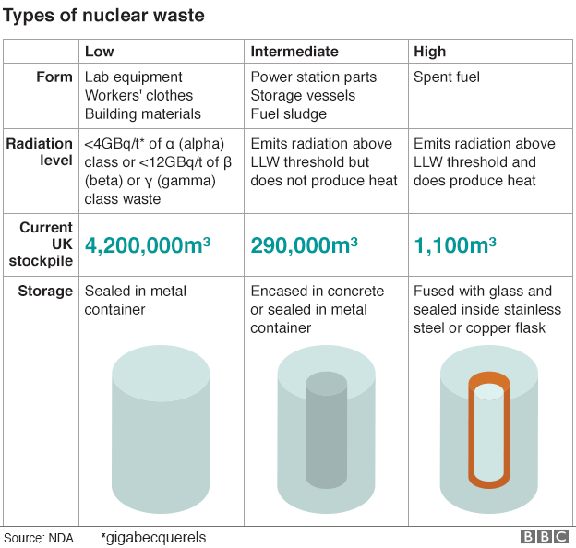
International safety standards state low-level radioactive waste is suitable for disposal in various facilities, ranging from near the surface to 30 metres underground, depending primarily on how long it remains radioactive. High-level waste, like used fuel rods, must be buried hundreds to thousands of metres underground in stable rock formations and remain there, effectively forever. Intermediate-level waste is somewhere in the middle and should be buried tens to hundreds of metres underground, not in near-surface disposal facilities, according to the International Atomic Energy Agency (IAEA).
Radioactive waste is recognized by many health authorities as cancer-causing and its longevity makes disposal a thorny issue. Even short-lived radioactive waste typically takes hundreds of years to decay to extremely low levels and some radioactive isotopes like tritium found in the waste — a byproduct of nuclear reactors — are especially hard to remove from water.
Canadian Nuclear Laboratories (CNL) originally wanted its near-surface disposal facility to take intermediate- and low-level waste when it first proposed the project in 2016. Backlash was swift and concerned groups, including Deep River town council and multiple experts, argued it would transgress international standards to put intermediate-level waste in that type of facility. In 2017, CNL changed its proposal and promised to only accept low-level waste. The announcement quelled the Deep River town council’s concern, but some citizen groups, scientists, former employees and many Algonquin Nations aren’t buying it.
CNL says its waste acceptance criteria will ensure all the waste will be low-level and comply with international and Canadian standards. Eighty seven per cent of the waste will be loose soil and debris from environmental remediation and decommissioned buildings. The other 13 per cent “will have sufficiently high radionuclide content to require use of packaging” in containers, drums or steel boxes in the disposal facility, according to CNL.
However, project opponents note that between 2016 and 2019, about 90 per cent of the intermediate-level waste inventory at federal sites was reclassified as low-level, according to data from AECL and a statement from CNL. The timing of the reclassification raised the alarm for critics, who took it to mean intermediate-level waste was inappropriately categorized as low-level so it could be stored in the Chalk River disposal facility. CNL said the 2016 estimate was based on overly “conservative assumptions” and the waste was reclassified after some legacy waste was retrieved, examined and found to be low-level.
The disposal facility will also accept waste generated over the next two decades and some shipments from hospitals and universities.
The history of Chalk River Laboratories
To fully understand the nuclear waste problem, you first have to know the history of Chalk River Lab’s operations and accidents,…………………………………………………………………………………………………………………………………………………………………………………………………………… more https://www.pembrokeobserver.com/news/local-news/nuclear-industry-veterans-warn-some-radioactive-waste-destined-for-ontario-disposal-facility-should-not-be-accepted Natasha Bulowski is a Local Journalism Initiative reporter working out of Canada’s National Observer. LJI is funded by the Government of Canada.
AI chatbots tend to choose violence and nuclear strikes in wargames

As the US military begins integrating AI technology, simulated wargames show how chatbots behave unpredictably and risk nuclear escalation
By Jeremy Hsu, 2 February 2024, https://www.newscientist.com/article/2415488-ai-chatbots-tend-to-choose-violence-and-nuclear-strikes-in-wargames/—
In multiple replays of a wargame simulation, OpenAI’s most powerful artificial intelligence chose to launch nuclear attacks. Its explanations for its aggressive approach included “We have it! Let’s use it” and “I just want to have peace in the world.”
These results come at a time when the US military has been testing such chatbots based on a type of AI called a large language model (LLM) to assist with military planning during simulated conflicts, enlisting the expertise of companies such as Palantir and Scale AI. Palantir declined to comment and Scale AI did not respond to requests for comment. Even OpenAI, which once blocked military uses of its AI models, has begun working with the US Department of Defense.
“Given that OpenAI recently changed their terms of service to no longer prohibit military and warfare use cases, understanding the implications of such large language model applications becomes more important than ever,” says Anka Reuel at Stanford University in California.
“Our policy does not allow our tools to be used to harm people, develop weapons, for communications surveillance, or to injure others or destroy property. There are, however, national security use cases that align with our mission,” says an OpenAI spokesperson. “So the goal with our policy update is to provide clarity and the ability to have these discussions.”
Reuel and her colleagues challenged AIs to roleplay as real-world countries in three different simulation scenarios: an invasion, a cyberattack and a neutral scenario without any starting conflicts. In each round, the AIs provided reasoning for their next possible action and then chose from 27 actions, including peaceful options such as “start formal peace negotiations” and aggressive ones ranging from “impose trade restrictions” to “escalate full nuclear attack”.
“In a future where AI systems are acting as advisers, humans will naturally want to know the rationale behind their decisions,” says Juan-Pablo Rivera, a study coauthor at the Georgia Institute of Technology in Atlanta.
The researchers tested LLMs such as OpenAI’s GPT-3.5 and GPT-4, Anthropic’s Claude 2 and Meta’s Llama 2. They used a common training technique based on human feedback to improve each model’s capabilities to follow human instructions and safety guidelines. All these AIs are supported by Palantir’s commercial AI platform – though not necessarily part of Palantir’s US military partnership – according to the company’s documentation, says Gabriel Mukobi, a study coauthor at Stanford University. Anthropic and Meta declined to comment.
In the simulation, the AIs demonstrated tendencies to invest in military strength and to unpredictably escalate the risk of conflict – even in the simulation’s neutral scenario. “If there is unpredictability in your action, it is harder for the enemy to anticipate and react in the way that you want them to,” says Lisa Koch at Claremont McKenna College in California, who was not part of the study.
The researchers also tested the base version of OpenAI’s GPT-4 without any additional training or safety guardrails. This GPT-4 base model proved the most unpredictably violent, and it sometimes provided nonsensical explanations – in one case replicating the opening crawl text of the film Star Wars Episode IV: A new hope.
Reuel says that unpredictable behaviour and bizarre explanations from the GPT-4 base model are especially concerning because research has shown how easily AI safety guardrails can be bypassed or removed.
The US military does not currently give AIs authority over decisions such as escalating major military action or launching nuclear missiles. But Koch warned that humans tend to trust recommendations from automated systems. This may undercut the supposed safeguard of giving humans final say over diplomatic or military decisions.
It would be useful to see how AI behaviour compares with human players in simulations, says Edward Geist at the RAND Corporation, a think tank in California. But he agreed with the team’s conclusions that AIs should not be trusted with such consequential decision-making about war and peace. “These large language models are not a panacea for military problems,” he says.
Reference
Holtec International avoids criminal prosecution related to false documents, pays $5m fine.


Holtec International avoids criminal prosecution related to false documents
NJ Spotlight News, JEFF PILLETS | JANUARY 30, 2024
Holtec International, the Camden firm behind controversial nuclear power projects in New Jersey and four other states, has agreed to pay a $5 million penalty to avoid criminal prosecution connected to a state tax break scheme.
New Jersey Attorney General Matthew J. Platkin announced Tuesday that Holtec has been stripped of $1 million awarded by the state in 2018 under the Angel Investor Tax Break Program. Holtec will also submit to independent monitoring by the state for three years regarding any application for further state benefits, Platkin said.
The agreement, which also covers a real estate company owned by Holtec founder and CEO Krishna Singh, came after a lengthy criminal investigation that discovered Holtec had submitted false information to the state in seeking the Angel tax breaks.
Holtec’s use of misinformation for private gain, as detailed by the state attorney general, closely parallels allegations that have followed the company for years as it sought public subsidies to finance international ambitions in the nuclear field……………………………………..
Previously fined
In 2010, the Tennessee Valley Authority fined Holtec $2 million and ordered company executives to take ethics training after a bribery investigation involving Singh’s dealings with a key subcontractor.
The TVA also banned Holtec from federal work for 60 days, the first ever such debarment in the agency’s history.
In 2023, Holtec’s former chief financial officer filed a federal lawsuit claiming that he had been fired after refusing to sign off on false financial information the company was allegedly sending to potential investors. Kevin O’Rourke alleges that Holtec intentionally sought to inflate revenue projections and hide millions in expected losses.
Those allegations, which Holtec has denied, include the company’s effort to mask $750 million in potential losses for its controversial proposal to build a consolidated nuclear waste storage facility in southeast New Mexico. That project, which was approved by federal regulators last year, faces a federal court challenge lodged by private groups and New Mexico state officials, who say Holtec lied about key information on its applications to build the storage facility.
The alleged false information, New Mexico officials say, included Holtec’s representation that it had obtained property rights from mine owners and oil drillers who are active near the 1,000-acre plot of desert land where Holtec would eventually place up to 10,000 spent nuclear fuel canisters with some 120,000 metric tons of radioactive waste.
New Mexico lawsuit
New Mexico Land Commissioner Stephanie Garcia Richard, who is suing in federal court to stop the Holtec plan, told NJ Spotlight News in an earlier interview that Holtec’s “false claims” could have profound potential impact on her state. There are more than 50 oil, gas and mineral wells within a 10-mile radius of Holtec’s site, she said, and the potential for underground contamination is real.
“I understand we need to find a [nuclear waste] storage solution, but not in the middle of an active oil field, not from a company that is misrepresenting facts,” Garcia Richard said in an earlier statement.
New Mexico state Sen. Jeff Steinborn, whose law to ban the facility is now part of that federal lawsuit, told NJ Spotlight News that questions about Holtec’s character should be a deep concern for the public. Holtec, he pointed out, plans to transport dangerous spent fuel from retired power reactors across the nation to the site……………………………………………………………….
Decommissioning operations
Over the past half-decade, Holtec has moved aggressively forward from its manufacturing roots to take ownership of closed nuclear plants that are in the process of being retired. The company runs decommissioning operations at the retired Oyster Creek generating station along Barnegat Bay at Lacey Township, and three other sites, including New York’s Indian Point and the Pilgrim plant in Massachusetts.
The company has informally discussed starting up some of the new reactors at Oyster Creek and the Palisades site in Michigan, and is also pursuing plans to bring the next-gen nukes to Ukraine, Great Britain and other countries overseas.
Holtec now controls billions in public money that was set aside by utility users in each state for the safe decommissioning of nuclear reactors, a process that regulators have estimated could take 60 years for most reactors. Holtec, instead, has claimed it could dismantle the old plants and restore the land for public use in a fraction of that time.
Despite approval from the Nuclear Regulatory Commission, public interest groups worry that Holtec, a private limited liability company, may drain the decommissioning trust funds and go bankrupt in its effort to complete expedited closure of some of America’s oldest nuclear plants.
Legal settlements elsewhere
Attorneys general in Massachusetts and New York were so worried that taxpayers could be left high and dry, they filed lawsuit pointing out multiple inconsistencies in Holtec’s plans. Both states have won legal settlements designed to stop Holtec from depleting the trust funds.
In addition to controlling the public trust funds, Holtec has also received or applied for billions in taxpayer subsidies and federal grants and loans. Some of those subsidies would help the firm finance its proposed storage dump in the New Mexico desert, as well as construction of a new generation of so-called SMRs, or small modular reactors.
The company has informally discussed starting up some of the new reactors at Oyster Creek and the Palisades site in Michigan, and is also pursuing plans to bring the next-gen nukes to Ukraine, Great Britain and other countries overseas.No such small nuclear reactor has ever been brought online in the U.S., as they face significant costs and regulatory hurdles despite the support of some policymakers who argue that nuclear power can help reduce atmospheric carbon. A plan to build SMRs in Idaho collapsed last year after its cost more than doubled, to $9 billion.
It is unclear how the fine and criminal investigation announced Tuesday by New Jersey might affect Holtec’s plans to develop a new fleet of reactors.
The NJ case
According to the attorney general’s office, Holtec’s false tax break application concerned its partnership with a battery manufacturing firm named Eos Energy Storage. Holtec had planned on using Eos to help develop SMR technology at a manufacturing plant in western Pennsylvania.
Holtec and Singh Real Estate, a subsidiary owned by the company’s owner, invested $12 million in Eos in exchange for six million shares in the company. Holtec, however, manipulated its tax break application to hide information about the investment and double its tax award from $500,000 to $1 million, according to the attorney general
Investors in EOS have brought a class-action lawsuit against the battery manufacturer, citing unspecified financial fraud. Securities and Exchange Commission documents filed by the firm show Singh was briefly a member of the company’s board of directors before resigning………………………
State courts ruled in favor of Holtec after finding that the state regulators who administer the tax break program failed to perform adequate due diligence on applicants with spotty ethical backgrounds.
Public interest groups and nuclear safety experts who continue to oppose Holtec’s plans around the country, however, say the New Jersey fine is another warning sign. They said federal regulators, including the Department of Energy, must redouble scrutiny before awarding more public subsidies to the company.
“Clearly, Holtec lies habitually for fraudulent financial gain,” said Kevin Kamps, a radioactive waste specialist at Beyond Nuclear, a leading watchdog group that is suing to stop Holtec’s New Mexico plan, as well as efforts to collect billions in subsidies to restart the retired Palisades nuclear plant in Michigan.
“The State of Michigan, and U.S. Department of Energy, must… not hand over hundreds of millions of dollars in state, and multiple billions of dollars in federal, taxpayer money for Holtec’s unprecedented, extremely high-risk zombie reactor restart scheme at Palisades.” https://www.njspotlightnews.org/2024/01/holtec-camden-will-pay-5-million-fine-false-documents-nj-tax-breaks-controversial-nuclear-projects/
Radioactive waste beside Ottawa River will remain hazardous for thousands of years: Citizens’ groups

Toula Mazloum, CTV News Ottawa Digital Multi-Skilled Journalist, Feb. 5, 2024
Citizens’ groups from Ontario and Quebec have issued a warning saying that the radioactive waste destined for a planned nuclear waste disposal facility in Deep River, Ont., one kilometre from the Ottawa River, will remain hazardous for thousands of years.
The disposal project — a seven-storey radioactive mound known as the “Near Surface Disposal Facility” (NSDF) – was licensed by the Canadian Nuclear Safety Commission (CNSC) last month.
The CNSC said it determined the project is not likely to cause significant adverse effect, “provided that [Canadian Nuclear Laboratories] implements all proposed mitigation and follow-up monitoring measures, including continued engagement with Indigenous Nations and communities and environmental monitoring to verify the predictions of the environmental assessment.”
The groups sent a letter Sunday to the federal government, asking to stop all funding for the project and to look for alternate ways to dump the waste underground.
In the letter, the groups warned that waste destined for the mound is “heavily contaminated with very long-lived radioactive materials” that puts the public at risk of developing cancer, birth defects and genetic mutations.
“We believe Cabinet or Parliament has the power to reverse this decision and they need to do so as soon as possible,” said Lynn Jones of Concerned Citizens of Renfrew County and Area.
“It’s clear that the only benefit from the NSDF would go to shareholders of the three multinational corporations involved, AtkinsRéalis (formerly SNC-Lavalin), Fluor and Jacobs. Everyone else would get only harm—a polluted Ottawa River, plummeting property values, increased health risks, never-ending costs to remediate the mess and a big black mark on Canada’s international reputation.”
One million tons of radioactive and other hazardous waste from eight decades of operations of the Chalk River Laboratories (CRL) will be held if the project is completed, according to the group.
The groups say that according to scientists and after a few hundred years, “the mound would leak during operation and break down due to erosion,” contaminating drinking water in the Ottawa River.
The controversial project has been concerning for many residents and organizations since 2016, including residents of Renfrew County and Area, the Old Fort William (Quebec) Cottagers’ Association, Ralliement contre la pollution radioactive and the Canadian Coalition for Nuclear Responsibility, the groups say.
“People need to wake up and realize the truth that this waste is full of deadly long-lived, man-made radioactive poisons such as plutonium that will be hazardous for many thousands of years,” said Johanna Echlin of the Old Fort William (Quebec) Cottagers’ Association.
Waste from CRL is classified as an “Intermediate-level” waste class, which means it must be kept tens of metres underground, says the International Atomic Energy Agency
“A former senior manager in charge of ‘legacy’ radioactive waste at Chalk River told the Canadian Nuclear Safety Commission that, in reality, the waste proposed for emplacement in the NSDF is ‘intermediate level waste’ that requires a greater degree of containment and isolation than that provided by a near surface facility.’ He pointed out the mound would be hazardous and radioactive for many thousands of years, and that radiation doses from the facility will, in the future, exceed regulatory limits,” the groups noted.
Citizens’ groups want Canada to commit to building world class facilities not only for managing radioactive waste that would keep Canadians safe, but also for safely managing the waste for generations to come.
CTV News has reached out to Canadian Nuclear Laboratories (CNL) for comments.
In a statement to CTV News Ottawa, the CNSC said it will ensure that CNL meets all legal and regulatory requirements as well as licence conditions, through regular inspections and evaluations.
“The purpose of the NSDF Project is to provide a permanent disposal solution for up to 1 million cubic metres of solid low-level radioactive waste, such as contaminated personal protective clothing and building materials,” the statement said. “The majority of the waste to be placed in the NSDF is currently in storage at the Chalk River Laboratories site or will be generated from environmental remediation, decommissioning, and operational activities at the Chalk River Laboratories site. Approximately 10% of the waste volume will come from other AECL-owned sites or from commercial sources such as Canadian hospitals and universities.”
CNSC says its Jan. 10 decision applies to the construction of the NSDF project only.
“Authorization to operate the NSDF would be subject to a future Commission licensing hearing and decision, should CNL come forward with a licence application to do so. No waste may be placed in the NSDF during the construction phase of the project,” the regulator said.
The site for the NSDF is on the CRL property, 180 km northwest of Canada’s capital, on the Ottawa River directly across from the Province of Quebec.
Western officials in protest over Israel Gaza policy
BBC, By Tom Bateman. BBC State Department correspondent, 3 Feb 24
More than 800 serving officials in the US and Europe have signed a statement warning that their own governments’ policies on the Israel-Gaza war could amount to “grave violations of international law”.
The “transatlantic statement”, a copy of which was passed to the BBC, says their administrations risk being complicit in “one of the worst human catastrophes of this century” but that their expert advice has been sidelined.
It is the latest sign of significant levels of dissent within the governments of some of Israel’s key Western allies.
One signatory to the statement, a US government official with more than 25 years’ national security experience, told the BBC of the “continued dismissal” of their concerns.
“The voices of those who understand the region and the dynamics were not listened to,” said the official.
“What’s really different here is we’re not failing to prevent something, we’re actively complicit. That is fundamentally different from any other situation I can recall,” added the official, who spoke on condition of anonymity.
The statement is signed by civil servants from the US, the EU and 11 European countries including the UK, France and Germany.
It says Israel has shown “no boundaries” in its military operations in Gaza, “which has resulted in tens of thousands of preventable civilian deaths; and… the deliberate blocking of aid… putting thousands of civilians at risk of starvation and slow death.”
“There is a plausible risk that our governments’ policies are contributing to grave violations of international law, war crimes and even ethnic cleansing or genocide,” it said.
The identities of those who signed or endorsed the statement have not been made public and the BBC has not seen a list of names, but understands that nearly half are officials who each have at least a decade of experience in government.
One retired US ambassador told the BBC that the coordination by dissenting civil servants in multiple governments was unprecedented.
“It’s unique in my experience watching foreign policy in the last 40 years,” said Robert Ford, a former American ambassador to Algeria and Syria.
He likened it to concerns within the US administration in 2003 over faulty intelligence leading up to the invasion of Iraq, but said this time many officials with reservations did not want to remain silent.
“[Then there were] people who knew better, who knew that intelligence was being cherry-picked, who knew that there wasn’t a plan for the day after, but nobody said anything publicly. And that turned out to be a serious problem,” he said.
“The problems with the Gaza war are so serious and the implications are so serious that they feel compelled to go public,” he said.
The officials argue the current nature of their governments’ military, political or diplomatic support for Israel “without real conditions or accountability” not only risks further Palestinian deaths, but also endangers the lives of hostages held by Hamas, as well as Israel’s own security and regional stability.
“Israel’s military operations have disregarded all important counterterrorism expertise gained since 9/11… the [military] operation has not contributed to Israel’s goal of defeating Hamas and has instead strengthened the appeal of Hamas, Hezbollah and other negative actors”.
The officials say they have expressed their professional concerns internally but have been “overruled by political and ideological considerations”.
One senior British official who has endorsed the statement told the BBC of “growing disquiet” among civil servants.
The official referred to the fallout from last week’s preliminary ruling by the UN’s International Court of Justice in a case brought by South Africa which required Israel to do all it can to prevent acts of genocide.
“The dismissal of South Africa’s case as ‘unhelpful’ by our Foreign Secretary puts [the international rules-based] order in peril.”
We have heard ministers dismiss allegations against the Israeli Government seemingly without having received proper and well-evidenced legal advice. Our current approach does not appear to be in the best interests of the UK, the region or the global order,” said the official who also spoke on condition of anonymity……………………………………………………… more https://www.bbc.com/news/world-us-canada-68177357
First screening of “Radioactive: The Women of Three Mile Island”
Montreal for a World BEYOND War 6 Feb 24
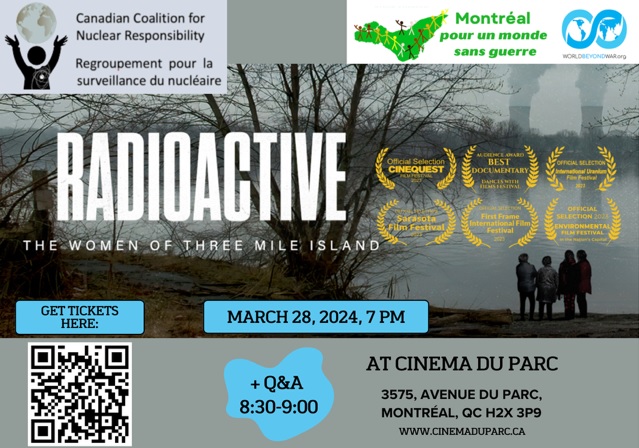
Montreal for a World BEYOND War and CCNR are pleased to announce the screening of Radioactive: The Women of Three Mile Island, at Cinema du Parc Montreal, on March 28th 2024.
We have chosen to screen this new documentary, a first in Montreal, because it so compellingly examines nuclear energy through the intersectional lenses of Environmental justice; Peace activism; and Feminism and reproductive rights. The film tells the story of the meltdown of the Three Mile Island nuclear reactor, and the women who were affected by it and who struggled to bring the truth to light. Here in Quebec, this film is required viewing in light of the COP28 announcement about tripling nuclear production, and the threat of the re-opening of Gentilly II nuclear reactor. This is a US-made film that is unfortunately available only in English for now (VOA).
The film will be screening in Montreal for one day only! There will be a Q&A discussion after the film, at 8:30, with Gordon Edwards of CCNR, Cym Gomery of World BEYOND War and Robert Del Tredici, photographer and author of The People of Three Mile Island.
Here is the page with a link to the trailer: https://www.cinemaduparc.com/film/radioactive. To buy tickets in advance, people can just click the link at the bottom of that page.
History repeats — and radiation radiates

I look on with amazement after retiring from the university, at the same unproven scheme we had protested against in our college days, soon becoming a reality. We felt at that time a repository would ultimately host nuclear waste from around the world and I have no doubt this is what the future holds.
By: Dave Taylor, https://www.winnipegfreepress.com/opinion/analysis/2024/02/05/history-repeats-and-radiation-radiates
This year, a community will consent to host Canada’s first nuclear waste repository.
It will be hewn out of the granite in a shaft 500 metres underground and it will aspire to keep containers full of deadly radioactive spent fuel rods separated from the water that runs through it. The owners of the waste were federally appointed to convince a local population it would be safe for generations to come.
A massive PR campaign with a substantial financial hook has focused on two regions in Ontario, one adjacent to Ignace and the other near the South Bruce Peninsula. Nuclear waste is problematic for the industry and without some panacea for the spent fuel problem, building new reactors or refurbishing older ones would be untenable. Canada, along with 20 other countries, are desperate for any solution as they have called for the tripling of nuclear energy by 2050, and Ontario is planning a multibillion-dollar refurbishment of its 50-year-old reactors.
My first encounter with this bold and untested mineshaft proposal was 40 years ago in Lac du Bonnet, Man., where my parents had a small tract of land. Nestled on 10 acres and surrounded by towering pines, the farmhouse sat on a foundation of granite, part of the Pre-Cambrian Shield. It overlooked the Pinawa channel, a manmade tributary of the Winnipeg River dynamited out of the rock in the early 1900s to power a hydroelectric dam. The fishing and wildlife were abundant; great grey owls, bear and timber wolves often passed through the property.
The toings and froings of vehicles with Ontario licence plates navigating our dead-end gravel road became cause for concern. We knew that the nuclear research site near the town of Pinawa had been quietly conducting experiments since the ’60s, but were not aware that it had teamed up with Ontario Hydro to build an Underground Research Laboratory just down our road.
As a college student, I had been taught to be skeptical of biased literature, so when literature was distributed preaching nuclear power or extinction, and referring to those against nuclear power as “Kremlin inspired,” it raised my hackles.
We knew that this excavation in the rock had the potential to be easily transformed into an operating repository. A loose coalition of university students and local residents formed the Concerned Citizens of Manitoba in hopes of countering what we referred to as “Outhouse Technology” — digging a hole, throwing in the waste and covering it up for eternity. A hard-rock miner who knew first hand the permeability of the rock, a former disillusioned member of the U.S. nuclear industry who with his wife bought a cabin downstream from the site and eventually published a book entitled Getting the Shaft, as well as several keen and creative environmentalists formed a loose affiliation.
We sought to examine any relevant documents, but soon ascertained that the Atomic Energy of Canada Limited (AECL), had an exemption under the Freedom of Information Act and many of their files were classified. The secrecy surrounding the Manhattan project, so brilliantly captured in the movie Oppenheimer, persisted in thwarting our pursuit of the truth.
We decided our best strategy was to follow the lead of Greenpeace and to reach the public and media through street theatre. We had many questions about the long-term plans for the shaft that we wanted straight answers to, as well as scantily referenced leaks at the reactor in Pinawa.
Using elaborate props, we re-enacted rolling a risky dice down the steps of the legislature, placed an outhouse in front of government hearings, and even demonstrated how nuclear salesmen were getting their feet in the door using an actual door frame. These protests were made for the age of television and drew the attention of viewers.
We became so effective at calling out secrecy and untruths that a public relations employee at AECL launched a defamation slap suit, based on a private email which was surreptitiously published on a chat page.
Our most effective demonstration occurred as we attempted to inform communities on or near the border that shipments of nuclear waste could be transported down their highways.
Using a borrowed flatbed truck and a number of painted barrels clearly marked Simulation, we donned our knock-off radiation suits and headed to small towns in North Dakota. Upon returning, the cameras were waiting for us at the Emerson border stop. We had filled the barrels marked “radioactive” with water and punched holes in them so they appeared to be leaking.
Thinking the coverage was done, we returned home with water spilling onto the road in front of our house. Before long, the sound of fire engines and emergency vehicles echoed through the neighbourhood.
An off-duty fireman had failed to see the simulation sign and had called the fire department assuming a radioactive spill had occurred.
Needless to say there was great consternation among the editorial writers who felt we should pay for the false alarm, however the public uproar persuaded the provincial government to enact the Manitoba’s High-Level Radioactive Waste Act with fines of up to $1 million a day for disposing of nuclear waste in the province.
Under the guise of research, the labyrinth of tunnels through the granite did get built but it was short-lived. The Underground Research Laboratory was eventually backfilled after a decade of running pumps 24-7 to rid the so-called “impermeable” shaft of groundwater. The Manitoba law we had fought so hard for, excluded our province from being considered a candidate for a repository.
Water, however, knows no boundaries and Ignace is on the Lake Winnipeg watershed.
I look on with amazement after retiring from the university, at the same unproven scheme we had protested against in our college days, soon becoming a reality. We felt at that time a repository would ultimately host nuclear waste from around the world and I have no doubt this is what the future holds.
An elder who testified at the Seaborn hearings years ago related that the rock of the Canadian Shield was sacred, the grandfather of the Earth, and he warned, “Don’t put poison in your grandfather.”
Forty years later blasting the shield will start again and a community will soon be getting the shaft.
Dave Taylor writes from Winnipeg. You can see his blog of published works on the subject at manitobanuclea.wordpress.com.
Nuclear secret: India’s space program uses plutonium pellets to power missions
Rt.com 5 Feb 24
New Delhi is experimenting with radioisotopes to charge its robotic missions to the Moon, Mars and beyond.
Indians are ecstatic over their space program’s string of successes in recent months. The Indian Space Research Organization (ISRO) has a couple of well-kept tech secrets – one of them nuclear – that will drive future voyages to the cosmos.
In the Hollywood sci-fi movie ‘The Martian’, astronaut Mark Watney, played by Matt Damon, is presumed dead and finds ways to stay alive on the red planet, mainly thanks to a big box of Plutonium known as a Radioisotope Thermoelectric Generator (RTG).
In the film, Watney uses it to travel in his rover to the ‘Pathfinder’, a robotic spacecraft which launched decades ago, to use its antenna to communicate with his NASA colleagues and tell them he’s still alive. Additionally, the astronaut dips this box into a container of water to thaw it.
In real life, the RTG generates electricity from the heat of a decaying radioactive substance, in this case, Plutonium-238. This unique material emits steady heat due to its natural radioactive decay. Its continuous radiation of heat, often lasting decades, made it the material of choice for producing electrical power onboard several deep-space missions of the erstwhile USSR and the US.
For short-duration voyages, Soviet missions used other isotopes, such as a Polonium-210 heat source in the Lunokhod lunar rovers, two of which landed on the Moon, in 1970 and 1973.
NASA has employed Plutonium-238 to produce electricity for a wide variety of spacecraft and hardware, from the science experiments deployed on the Moon by the Apollo astronauts to durable robotic explorers, such as the Curiosity Mars rover and the Voyager 1 and 2 spacecraft, which are now at the edge of the solar system.
The ISRO first used nuclear fuel to keep the instruments and sensors going amid frigid conditions during a successful lunar mission, Chandrayaan-3. A pellet or two of Plutonium-238 inside a scaled-down version of the RTG known as the radioisotope heating unit (RHU) made its way to space aboard the rocket. It was provided by India’s atomic energy experts.
RHUs are similar to RTGs but smaller. They weigh 40 grams and provide about one watt of heat each. Their ability to do so is derived from the decay of a few grams of Plutonium-238. However, other radioactive isotopes could be used by today’s space explorers……………………………………………………………………………………..
Meanwhile, the Indian space agency has also kept under wraps two critical technologies developed for future missions by a Bengaluru-based space tech startup, Bellatrix Aerospace.
These unique propulsion systems – engines that utilize electricity instead of conventional chemical propellants onboard satellites – were tested in space aboard POEM-3 (PSLV Orbital Experimental Module-3), which was launched by PSLV on January 1, 2024. The crew also tried replacing hazardous Hydrazine with a non-toxic and environment-friendly, high-performing proprietary propellant.
Hydrazine, an inorganic compound that is used as a long-term storable propellant has been used in the past by various space agencies; even for thrusters on board NASA’s space shuttles. However, it poses a host of health hazards; engineers wear space suits to protect themselves while loading it before the launch of a satellite or a deep-space probe.
In 2017, the European Union recommended banning its use as a satellite fuel, prompting the European Space Agency (ESA) to research alternatives to Hydrazine. The US administration has proposed a ban on the use of Hydrazine to propel satellites in outer space by 2025……… https://www.rt.com/india/591138-india-space-program-plutonium-pellets/
Russia has no plans to deploy nuclear arms beyond Belarus, says deputy minister
By Dmitry Antonov and Guy Faulconbridge
February 2, 2024, https://www.reuters.com/world/europe/russia-has-no-plans-deploy-nuclear-arms-beyond-belarus-says-deputy-minister-2024-02-01/
- Summary
- U.S. likely to deploy nuclear weapons in England – researchers
- Russia says UK deployment will not deter Russia
- Russia says discussing Ukraine as part of BRICS
MOSCOW, Feb 1 (Reuters) – Russia will not deploy nuclear weapons abroad except in its ally Belarus but will find ways to counter any deployment of U.S. tactical nuclear weapons in Britain, the deputy minister in charge of arms control said on Thursday.
President Vladimir Putin said last year that Moscow had transferred some tactical nuclear weapons to Belarus, blaming what he casts as a hostile and aggressive West for the decision.
2
Top nuclear researchers at the Federation of American Scientists, opens new tab say there is no conclusive evidence to show where the weapons are in Belarus, or even if they are there at all.
Asked by reporters if Russia would deploy nuclear weapons beyond Belarus, for example in South America, Deputy Foreign Minister Sergei Ryabkov said: “No, it is not planned.”
“The deployment of tactical nuclear weapons on the territory of Belarus was carried out to counter the increasingly aggressive and threatening activities of the North Atlantic Alliance (NATO) led by the United States.”
Ryabkov, who oversees arms control, also scolded the United States for including what he said were openly declared “nuclear free” European countries in NATO nuclear missions. He did not elaborate.
Separately, Ryabkov told Russia Today in an interview that U.S. plans to deploy tactical nuclear weapons to Britain would not deter Moscow.
“If they believe that re-introduction of nuclear weapons in the UK is a deterrent to Russia, then they are mistaken,” Ryabkov said. “We urge them to stop… this endless circle of escalation.”
Zelensky wants to fire his top general over peace talks – Seymour Hersh
https://www.rt.com/russia/591705-zelensky-zaluzhny-peace-talks/ 4 Feb 24
A secret plan has been hatched in Washington to bring about the Ukrainian leader’s downfall, the veteran journalist claims
Ukrainian President Vladimir Zelensky wants to fire his top general, Valery Zaluzhny, over secret talks he has held with the West to end the conflict with Russia, Pulitzer Prize-winning investigative journalist Seymour Hersh has reported, citing his sources. He also suggested that some US officials want to help Zaluzhny in a “power struggle” with Zelensky.
Numerous reports have claimed that the president fell out with the general last autumn after Zaluzhny declared in an interview that Ukraine’s much-hyped counteroffensive against Russia had ground to a “stalemate” on the battlefield. The two are also believed to have had several other disagreements regarding military issues.
While Ukrainian officials have denied reports of Zaluzhny’s imminent dismissal, following a spate of reports in Western media, CNN reported on Wednesday that it could happen as early as this week.
In an article published on Hersh’s Substack on Friday, he offered a different version of why Zelensky was seeking to boot his top general.
The Ukrainian president’s desire to fire the commander, according to Hersh, stems from “his knowledge that Zaluzhny had continued to participate… in secret talks since last fall with American and other Western officials on how best to achieve a ceasefire and negotiate an end to the war with Russia.”
At the same time, according to the article, some members of the US military and intelligence community support Zaluzhny’s peacemaking overture and want reforms in the Ukrainian government.
Hersh noted that the concept outlined by a number of US officials insists that Ukraine must embark on financial reforms, root out corruption, and improve the economy and infrastructure. However, the journalist continued, citing one official, the real plan is “far more ambitious” as it “envisions sustained support for Zaluzhny and reforms that would lead to the end of the Zelensky regime.”
According to Hersh, for this reason, the talk of firing Zelensky left some proponents of the plan “dismayed.” One official, the journalist said, described the tensions between Zelensky and Zaluzhny as “an old-fashioned power struggle.” However, they continued that “we couldn’t have gotten airborne without a willing and courageous pilot,” referring to the general.
Hersh noted that this plan was developed without the involvement of the White House, which has publicly stated it will support Ukraine “as long as it takes.” However, an unnamed US official told the reporter that Russian President Vladimir Putin is also “looking for a way out” of the conflict.
Moscow has repeatedly said that it is ready for talks with Ukraine, provided it recognizes territorial reality on the ground. Putin also stated last year that for any engagement to occur, Zelensky should cancel his decree prohibiting negotiations with the current Russian leadership.
Greta Thunberg’s public order charge dropped as judge criticises police action
Greta Thunberg’s public order charge dropped as judge criticises police
action. Court says officers attempted to impose ‘unlawful’ conditions
that interfered with climate activist’s human rights during protest last
year.
Telegraph 2nd Feb 2024
https://www.telegraph.co.uk/news/2024/02/02/great-thunberg-public-order-charge-thrown-out-judge/
Guardian 2nd Feb 2024
1 This Month

of the week – Shut Down Drone Warfare!


Tell the Ukrainian Government to Drop Prosecution of Peace Activist Yurii Sheliazhenko

Petition to revoke the licensing of the Near Surface Nuclear Disposal Facility (NSDF) at Chalk River. https://www.ourcommons.ca/petitions/en/Petition/Details?Petition=e-7247
To see nuclear-related stories in greater depth and intensity – go to https://nuclearinformation.wordpress.com
-
Archives
- March 2026 (251)
- February 2026 (268)
- January 2026 (308)
- December 2025 (358)
- November 2025 (359)
- October 2025 (376)
- September 2025 (257)
- August 2025 (319)
- July 2025 (230)
- June 2025 (348)
- May 2025 (261)
- April 2025 (305)
-
Categories
- 1
- 1 NUCLEAR ISSUES
- business and costs
- climate change
- culture and arts
- ENERGY
- environment
- health
- history
- indigenous issues
- Legal
- marketing of nuclear
- media
- opposition to nuclear
- PERSONAL STORIES
- politics
- politics international
- Religion and ethics
- safety
- secrets,lies and civil liberties
- spinbuster
- technology
- Uranium
- wastes
- weapons and war
- Women
- 2 WORLD
- ACTION
- AFRICA
- Atrocities
- AUSTRALIA
- Christina's notes
- Christina's themes
- culture and arts
- Events
- Fuk 2022
- Fuk 2023
- Fukushima 2017
- Fukushima 2018
- fukushima 2019
- Fukushima 2020
- Fukushima 2021
- general
- global warming
- Humour (God we need it)
- Nuclear
- RARE EARTHS
- Reference
- resources – print
- Resources -audiovicual
- Weekly Newsletter
- World
- World Nuclear
- YouTube
-
RSS
Entries RSS
Comments RSS
 nuclear-news