TODAY. How very unfashionable! Scottish MP is worrying about health aspects of nuclear power, (instead of the finances!).

Really and truly ! Doesn’t he understand what the zeitgeist Is? (OK – I’m not really sure what zeitgeist means, anyway).
But the thing is. If you want to talk seriously about the nuclear industry, then you must just focus on the costs and the (supposed) financial benefits.
Nobody’s that interested in public health these days. it’s all about the money. Perhaps we should be grateful for this global obsession about money and profits. It’s the one thing that might stop this toxic industry.

MP Allan Dorans of Scotland has had the temerity to suggest that disturbance of the seabed on the Cumbrian coast might cause radioactivity from nuclear wastes to be transmitted up the food chain - increasing cancer risks.
Last year, the British Medical Journal aired a similar warning, about the cancer risks from low level ionising radiation – Cancer mortality after low dose exposure to ionising radiation in workers in France, the United Kingdom, and the United States.
But that story didn’t really catch on. And after all, with the increasing numbers of cancer cases, we’re all gonna need increased nuclear electricity for the medical technology - and nuclear power is supposed to be cheaper, isn’t it?
The new space race Is Causing New Pollution Problems.

NY Times, Ed Friedman Tue, 30 Jan 2024
The high-altitude chase started over Cape Canaveral on Feb. 17, 2023, when a SpaceX Falcon 9 rocket launched. Thomas Parent, a NASA research pilot, was flying a WB-57 jet when the rocket ascended past the right wing — leaving him mesmerized before he hit the throttle to accelerate.
For roughly an hour, Mr. Parent dove in and out of the plume in the rocket’s wake while Tony Casey, the sensor equipment operator aboard the jet, monitored its 17 scientific instruments. Researchers hoped to use the data to prove they could catch a rocket’s plume and eventually characterize the environmental effects of a space launch.
In the past few years, the number of rocket launches has spiked as commercial companies — especially SpaceX, founded by Elon Musk — and government agencies have lofted thousands of satellites into low-Earth orbit. And it is only the beginning. Satellites could eventually total one million, requiring an even greater number of space launches that could yield escalating levels of emissions.
SpaceX declined to comment about pollution from rockets and satellites. Representatives for Amazon and Eutelsat OneWeb, two other companies working toward satellite mega-constellations, said they are committed to sustainable operations. But scientists worry that more launches will scatter more pollutants in pristine layers of Earth’s atmosphere. And regulators across the globe, who assess some risks of space launches, do not set rules related to pollution.
Image
The exhaust plume from a SpaceX Falcon 9 rocket taking off from Vandenberg Air Force Base in California in 2018,Credit…Matt Hartman/Associated Press
Experts say they do not want to limit the booming space economy. But they fear that the steady march of science will move slower than the new space race — meaning we may understand the consequences of pollution from rockets and spacecraft only when it is too late. Already, studies show that the higher reaches of the atmosphere are laced with metals from spacecraft that disintegrate as they fall back to Earth.
“We are changing the system faster than we can understand those changes,” said Aaron Boley, an astronomer at the University of British Columbia and co-director of the Outer Space Institute. “We never really appreciate our ability to affect the environment. And we do this time and time again.”
……………………………… By the time a rocket curves into orbit, it will have dumped in the middle and upper layers of the atmosphere as much as two-thirds of its exhaust, which scientists predict will rain down and collect in the lower layer of the middle atmosphere, the stratosphere.
The stratosphere is home to the ozone layer, which shields us from the sun’s harmful radiation. But it is extremely sensitive: Even the smallest of changes can have enormous effects on it — and the world below.
………………………….Just how rockets will affect that relatively clear top, the stratosphere, remains uncertain. But scientists are concerned that black carbon, or soot, that is released from current rockets will act like a continuous volcanic eruption, a change that could deplete the ozone layer and affect the Earth below.
……………………………………………… A Race Against the Space Race
As space companies set records for launches and satellites deployed, scientists are starting to quantify the potential effects.
In a paper published in 2022, soot from rockets was shown to be nearly 500 times as efficient at heating the atmosphere as soot released from sources like airplanes closer to the surface. It’s the muddy-barrel effect.
“That means that as we start to grow the space industry and launch more rockets, we’re going to start to see that effect magnify very quickly,” said Eloise Marais, an associate professor in physical geography at University College London and an author of the study.
That said, Dr. Maloney’s team did not quantify how much more radiation exposure could occur.
The exact amounts of soot emitted by different rocket engines used around the globe are also poorly understood. Most launched rockets currently use kerosene fuel, which some experts call “dirty” because it emits carbon dioxide, water vapor and soot directly into the atmosphere. But it might not be the predominant fuel of the future. SpaceX’s future rocket Starship, for example, uses a mix of liquid methane and liquid oxygen propellants.
Still, any hydrocarbon fuel produces some amount of soot. And even “green rockets,” propelled by liquid hydrogen, produce water vapor, which is a greenhouse gas at these dry high altitudes.
“You can’t take what’s green in the troposphere and necessarily think of it being green in the upper atmosphere,” Dr. Boley said. “There is no such thing as a totally neutral propellant. They all have different impacts.”
Smithereens of Satellites
What goes up must come down. Once satellites in low-Earth orbit reach the end of their operational lifetimes, they plunge through the atmosphere and disintegrate, leaving a stream of pollutants in their wake. Although scientists do not yet know how this will influence Earth’s environment, Dr. Ross thinks that it will be the most significant impact from spaceflight.
A study published in October found that the stratosphere is already littered with metals from re-entering spacecraft. It used the same NASA WB-57 jet that chased the SpaceX rocket plume last year, studying the stratosphere over Alaska and much of the continental U.S.
When the researchers began analyzing the data, they saw particles that didn’t belong. Niobium and hafnium, for example, do not occur naturally but are used in rocket boosters. Yet these metals, along with other distinct elements from spacecraft, were embedded within roughly 10 percent of the most common particles in the stratosphere.
The findings validate earlier theoretical work, and Dr. Boley, who was not involved in the study, argues that the percentage will only increase given that humanity is at the beginning of the new satellite race.
Of course, researchers cannot yet say how these metals will affect the stratosphere.
“That’s a big question that we have to answer moving forward, but we can’t presume that it won’t matter,” Dr. Boley said.
…………………………………..scientists argue, satellite operators and rocket companies need regulations. Few are currently in place.
“Space launch falls into a gray area,” said Gavin Schmidt, director of the NASA Goddard Institute for Space Studies, who has been involved in a working group on this research. “It falls between the cracks of all the regulatory authorities.”
The Montreal Protocol, for instance, is a treaty that successfully set limits on chemicals known to harm the ozone layer. But it does not address rocket emissions or satellites.
In the United States, the Environmental Protection Agency is not responsible for analyzing rocket launches. The Federal Communications Commission licenses large constellations of satellites but does not consider their potential harm to the environment. (The Government Accountability Office called for changes to that F.C.C. policy in 2022, but they have yet to occur.) And the Federal Aviation Administration assesses environmental impacts of rocket launches on the ground, but not in the atmosphere or space.
That could put the stratosphere’s future in the hands of Elon Musk, Jeff Bezos and other private space company executives — which is particularly worrying to Dr. Boley, who says the space industry does not want to slow down.
“Unless it immediately affects their bottom line, they’re simply not interested,” he said. “The environmental impact is an inconvenience.”……… https://www.nytimes.com/2024/01/09/science/astronomy-telescopes-satellites-spacex-starlink.html?action=click&module=RelatedLinks&pgtype=Article—
France limits its investment in Britain’s Sizewell C, as the global nuclear industry requires massive government subsidies

Why are nuclear power projects so challenging? Increasing nuclear energy
capacity is not easy. Projects across the globe have been fraught with
delays and budget overruns, with the Financial Times revealing last week
that France is pressing the UK to help fill budget shortfalls at the
Hinkley Point C project in England, being built by EDF.
The International Energy Agency (IEA) says nuclear projects starting between 2010 and 2020
are on average three years late, even as it forecasts nuclear power
generation will hit a record high next year and will need to more than
double by 2050. Technical issues, shortages of qualified staff,
supply-chain disruptions, strict regulation and voter pushback are the key
factors developers and governments are grappling with. In the US, Georgia
Power is scheduled to complete work within weeks on the second of two
gigantic new nuclear reactors that are at the vanguard of US plans to
rebuild its nuclear energy industry.
But the expansion of Plant Vogtle is
seven years late and has cost more than double the original price tag of
$14bn due to a series of construction problems, highlighting the complexity
of nuclear megaprojects. These complexities, high costs and long build
times — as well as strict regulation due to risks of nuclear accidents
— make nuclear power a daunting prospect for many investors.
As a result, the sector is heavily subsidised by governments. Many reactor suppliers for
large-scale projects are state-owned, working alongside the private sector
to build the full plant. But countries also have a limit on how much they
are willing to spend. EDF, now fully owned by the French state, will limit
its stake in its next planned UK plant, Sizewell C, to 20 per cent.
FT 1st Feb 2024
https://www-ft-com.ezproxy.depaul.edu/content/6d371375-b7be-4228-a3d5-2ad74f91454a
Britain will test fire Trident nuclear missile for the first time since 2016 as fears of World War Three grow
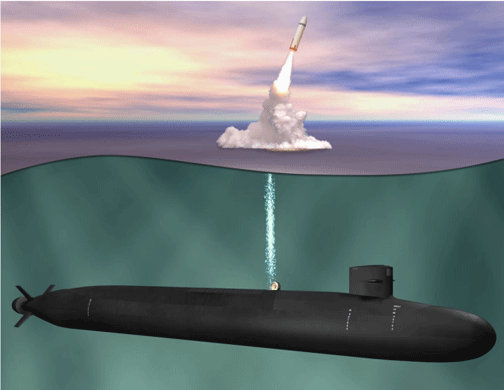
- HMS Vanguard is reported to have sailed into the Atlantic earlier this week
- It is expected to test-fire a Trident missile 3,500 miles from the US
Daily Mail, By CHRIS JEWERS, 2 February 2024
Britain is primed to test a Trident nuclear missile for the first time since 2016 amid growing fears of a global conflict, according to reports.
Officials are said to have issued a warning to shipping in the region of the test as nuclear submarine HMS Vanguard sailed into the Atlantic earlier this week.
The test will be the first time the UK has test fired a Trident missile since a botched launch in 2016 on sister sub HMS Vengeance which left the navy red-faced.
HMS Vanguard has undergone a seven-year refit in Plymouth since then, and is now set to fire an unnamed missile, The Sun reports.
The tests are understood to be the final hurdle the £4 billion submarine must clear in order to re-enter service as part of the UK’s nuclear deterrent force. ……..
HMS Vanguard has been hailed as a 491-foot ‘colossus’ that can patrol under the surface of the seas for months at a time.
On board, she can carry up to 16 Trident 2 D5 missiles, a submarine-launched ballistic missile (SLBM), built by American firm Lockheed Martin.
They also share the name with the UK’s nuclear programme (the Trident nuclear programme) the purpose of which is to ‘deter the most extreme threats to our national security and way of life, which cannot be done by other means,’ according to the mission statement by the Ministry of Defence.
Each missile is armed with British-made thermonuclear warheads that are 20 times more powerful than the Oppenheimer-developed weapons dropped during the Second World War on the Japanese cities of Hiroshima and Nagasaki.
The warheads are delivered by multiple independently targetable re-entry vehicles (MIRVs), or – in other words – exoatmospheric ballistic missiles.
Citing a Royal Navy source, The Sun said Britain’s nuclear submarines can carry more explosive power than was dropped in the entirety of the Second World War.
In the coming test, HMS Vanguard is expected to launch a single missile that will not be armed with nuclear warheads, about 55 miles off the US coast……………………
The missiles are designed to blast to the edge of space and track their position against the stars, before re-entering the atmosphere (hence exoatmospheric), plummeting to earth and raining warheads down on its target.
The maximum range of the missile is 12,000km (7,400 miles), which is roughly the distance from London to Indonesia one way, or Hawaii the other.
A warning was issued by the US National Geospatial Intelligence Agency to shipping that could cross the missile’s expected course, The Sun said.
The ‘hazardous operations’ warning also plots areas closer to the launch site where debris is expected to fall into the ocean…………………………….
Reports of the test come amid rising fears that Britain and her allies could be pulled into a conflict in the coming years.……………………………………………………………………
The test also comes after it was reported last year that a Royal Navy nuclear submarine and its crew were mere moments from being crushed after its depth gauge suddenly failed.
Reports said the Vanguard class sub, which had been carrying 140 crew and Trident 2 missiles, suffered the huge malfunction while on a mission in the Atlantic.
It caused a frantic scrabble with engineers managing to stop the submarine and its nuclear reactor from plunging further and being crushed by underwater pressure just minutes before disaster struck. …………………………………………………… more https://www.dailymail.co.uk/news/article-13034029/Britain-test-fire-Trident-missile.html
Campaigners Warn Return of US Nukes to UK Would ‘Make Britain a Guaranteed Target’

The U.S. is reportedly planning to deploy nukes “three times the strength of the Hiroshima bomb” to an air base in Suffolk.
JAKE JOHNSON, Feb 02, 2024, Common Dreams
Nuclear weapon abolitionists sounded alarm Friday in response to fresh evidence that the United States is planning to station nukes in the United Kingdom for the first time in more than 15 years, a move that opponents said would only heighten the risk of an atomic war.
The U.S. removed more than 100 nuclear bombs from Royal Air Force Lakenheath, a base in Suffolk, in 2008 following sustained protests from the U.K.-based Campaign for Nuclear Disarmament (CND) and other nonproliferation advocates.
CND warned in a statement Friday that the redeployment of nukes to Lakenheath would “make Britain a guaranteed target in the event of any war between NATO and Russia.”
Nuclear weapon abolitionists sounded alarm Friday in response to fresh evidence that the United States is planning to station nukes in the United Kingdom for the first time in more than 15 years, a move that opponents said would only heighten the risk of an atomic war.
The U.S. removed more than 100 nuclear bombs from Royal Air Force Lakenheath, a base in Suffolk, in 2008 following sustained protests from the U.K.-based Campaign for Nuclear Disarmament (CND) and other nonproliferation advocates.
CND warned in a statement Friday that the redeployment of nukes to Lakenheath would “make Britain a guaranteed target in the event of any war between NATO and Russia.”
“We encourage both the media and the public to increase pressure on the British government to be honest about this deployment,” said Kate Hudson, CND’s general secretary.
The Telegraphreported last week that “procurement contracts for a new facility at RAF Lakenheath in Suffolk confirm that the U.S. intends to place nuclear warheads three times the strength of the Hiroshima bomb at the air base.”………………………………………. more https://www.commondreams.org/news/us-nuclear-weapons-uk
In waging war on the UN refugee agency, the West is openly siding with Israeli genocide

Extraordinarily, the western media have done Israel’s PR work for it, happily focusing more attention on Israel’s claims about a handful of UNRWA staff than it has on the World Court’s decision to put Israel on trial for genocide.
By Jonathan Cook, Feb 1, 2024, – https://johnmenadue.com/in-waging-war-on-the-un-refugee-agency-the-west-is-openly-siding-with-israeli-genocide/
Israel has long plotted the downfall of UNRWA, aware that it is one of the biggest obstacles to eradicating the Palestinians as a people.
There is an important background to the decision by the United States and other leading western states, the UK among them, to freeze funding to the United Nations’ Relief and Works Agency (UNRWA), the main channel by which the UN disseminates food and welfare services to the most desperate and destitute Palestinians.
The funding cut – which has been also adopted by Germany, France, Japan, Switzerland, Canada, Netherlands, Italy, Australia and Finland – was imposed even though the International Court of Justice (ICJ) ruled on Friday that Israel may be committing genocide in Gaza. The World Court judges quoted at length UN officials who warned that Israel’s actions had left almost all of the enclave’s 2.3 million inhabitants on the brink of a humanitarian catastrophe, including famine.
The West’s flimsy pretext for what amounts to a war on UNRWA is that Israel claims 12 local UN staff – out of 13,000 – are implicated in Hamas’ break-out from the open-air prison of Gaza on October 7. The sole evidence appears to be coerced confessions, likely extracted through torture, from Palestinian fighters captured by Israel that day.
The UN immediately sacked all the accused staff, seemingly without due process. We can assume that was because the refugee agency was afraid its already threadbare lifeline to the people of Gaza, as well as millions of other Palestinian refugees across the region – in the West Bank, Lebanon, Jordan and Syria – would be further threatened. It need not have worried. Western donor states cut their funding anyway, plunging Gaza deeper into calamity.
They did so without regard to the fact their decision amounts to collective punishment: some 2.3 million Palestinians in Gaza face starvation and the spread of lethal disease, while another 4 million Palestinian refugees across the region are at imminent risk of losing food, health care and schooling.
According to law professor Francis Boyle, who filed a genocide case for Bosnia at the World Court some two decades ago, that shifts most of these western states from their existing complicity with Israel’s genocide (by selling arms and providing aid and diplomatic cover) into direct and active participation in the genocide, by violating the 1948 Genocide Convention’s prohibition on “deliberately inflicting on the group [in this case, Palestinians] conditions of life calculated to bring about its physical destruction in whole or in part.”
The World Court is investigating Israel for genocide. But it could easily widen its investigation to include western states. The threat to UNRWA needs to be seen in that light. Not only is Israel thumbing its nose at the World Court and international law, but states like the US and UK are doing so too, by cutting their funding to the refugee agency. They are slapping the court in the face, and indicating that they are four-square behind Israel’s crimes, even if they are shown to be genocidal in nature.
Israel’s creature
The following is the proper context for understanding what is really going on with this latest attack on UNRWA:
The World Court is investigating Israel for genocide. But it could easily widen its investigation to include western states. The threat to UNRWA needs to be seen in that light. Not only is Israel thumbing its nose at the World Court and international law, but states like the US and UK are doing so too, by cutting their funding to the refugee agency. They are slapping the court in the face, and indicating that they are four-square behind Israel’s crimes, even if they are shown to be genocidal in nature.
1 The agency was created in 1949 – decades before Israel’s current military slaughter in Gaza – to provide for the basic needs of Palestinian refugees, including essential food provision, health care and education. It has an outsize role in Gaza because most of the Palestinians living there lost, or are descended from families that lost, everything in 1948. That was when they were ethnically cleansed by the fledgling Israeli military from most of Palestine, in an event known to Palestinians as the Nakba, or Catastrophe. Their lands were turned into what Israel’s leaders described as an exclusively “Jewish state”. The Israeli army set about destroying the Palestinians’ towns and villages inside this new state so that they could never return.
2. UNRWA is separate from the UN’s main refugee agency, the UNHCR, and deals only with Palestinian refugees. Although Israel does not want you to know it, the reason for there being two UN refugee agencies is because Israel and its western backers insisted on the division back in 1948. Why? Because Israel was afraid of the Palestinians falling under the responsibility of the UNHCR’s forerunner, the International Refugee Organisation. The IRO was established in the immediate wake of the Second World War in large part to cope with the millions of European Jews fleeing Nazi atrocities.
Israel did not want the two cases treated as comparable, because it was pushing hard for Jewish refugees to be settled on lands from which it had just expelled Palestinians. Part of the IRO’s mission was to seek the repatriation of European Jews. Israel was worried that very principle might be used both to deny it the Jews it wanted to colonise Palestinian land and to force it to allow the Palestinian refugees to return to their former homes. So in a real sense, UNRWA is Israel’s creature: it was set up to keep the Palestinians a case apart, an anomaly.
Prison camp
3. Nonetheless, things did not go exactly to plan for Israel. Given its refusal to allow the refugees to return, and the reluctance of neighbouring Arab states to be complict in Israel’s original act of ethnic cleansing, the Palestinian population in UNRWA’s refugee camps ballooned. They became an especial problem in Gaza, where about two-thirds of the population are refugees or descended from refugees. The tiny coastal enclave did not have the land or resources to cope with the rapidly expanding numbers there. The fear in Israel was that, as the plight of the Palestinians of Gaza became more desperate, the international community would pressure Israel into a peace agreement, allowing for the refugees’ return to their former homes.
That had to be stopped at all costs. In the early 1990s, as the supposed Oslo “peace process” was being unveiled, Israel began penning the Palestinians of Gaza inside a steel cage, surrounded by gun towers. Some 17 years ago, Israel added a blockade that prevented the population’s movement in and out of Gaza, including via the strip’s coastal waters and its skies. The Palestinians became prisoners in a giant concentration camp, denied the most basic links to the outside world. Israel alone decided what was allowed in and out. An Israeli court later learnt that from 2008 onwards the Israeli military put Gaza on what amounted to a starvation diet by restricting food supplies.
There was a strategy here that involved making Gaza uninhabitable, something the UN started warning about in 2015. Israel’s game plan appears to have gone something like this:
By making Palestinians in Gaza ever more desperate, it was certain that militant groups like Hamas willing to fight to liberate the enclave would gain in popularity. In turn, that would provide Israel with the excuse both to further tighten restrictions on Gaza to deal with a “terrorism threat”, and to intermittently wreck Gaza in “retaliation” for those attacks – or what Israeli military commanders variously called “mowing the grass” and “returning Gaza to the Stone Age”. The assumption was that Gaza’s militant groups would exhaust their energies managing the constant “humanitarian crises” Israel had engineered.
At the same time, Israel could promote twin narratives. It could say publicly that it was impossible for it to take responsibility for the people of Gaza, given that they were so clearly invested both in Jew hatred and terrorism. Meanwhile, it would privately tell the international community that, given how uninhabitable Gaza was becoming, they urgently needed to find a solution that did not involve Israel. The hope was that Washington would be able to arm-twist or bribe neighbouring Egypt into taking most of Gaza’s destitute population.
Mask ripped off
4. On October 7, Hamas and other militant groups achieved what Israel had assumed was impossible. They broke out of their concentration camp. The Israeli leadership’s shock is not just over the bloody nature of the break-out. It is that on that day Hamas smashed Israel’s entire security concept – one designed to keep the Palestinians crushed, and Arab states and the region’s other resistance groups hopeless. Last week, in a knockout blow, the World Court agreed to put Israel on trial for genocide in Gaza, collapsing the moral case for an exclusive Jewish state built on the ruins of the Palestinians’ homeland.
The judges’ near-unanimous conclusion that South Africa has made a plausible case for Israel committing genocide should force a reassessment of everything that went before. Genocides don’t just emerge out of thin air. They happen after long periods in which the oppressor group dehumanises another group, incites against it and abuses it. The World Court has implicitly conceded that the Palestinians were right when they insisted that the Nakba – Israel’s mass dispossession and ethnic cleansing operation of 1948 – never ended. It just took on different forms. Israel became better at concealing those crimes, until the mask was ripped off after the October 7 break-out.
5. Israel’s efforts to get rid of UNRWA are not new. They date back many years. For a number of reasons, the UN refugee agency is a thorn in Israel’s side – and all the more so in Gaza. Not least, it has provided a lifeline to Palestinians there, keeping them fed and cared for, and providing jobs to many thousands of local people in a place where unemployment rates are among the highest in the world. It has invested in infrastructure like hospitals and schools that make life in Gaza more bearable, when Israel’s goal has long been to make the enclave uninhabitable. UNRWA’s well-run schools, staffed by local Palestinians, teach the children their own history, about where their grandparents once lived, and of Israel’s campaign of dispossession and ethnic cleansing against them. That runs directly counter to the infamous Zionist slogan about the Palestinians’ identity-less future: “The old will die and the young forget.”
Divide and rule
But UNRWA’s role is bigger than that. Uniquely, it is the sole agency unifying Palestinians wherever they live, even when they are separated by national borders and Israel’s fragmentation of the territory it controls. UNRWA brings Palestinians together even when their own political leaders have been manipulated into endless factionalism by Israel’s divide and rule policies: Hamas is nominally in charge in Gaza, while Mahmoud Abbas’ Fatah pretends to run the West Bank.
In addition, UNRWA keeps alive the moral case for a Palestinian right of return – a principle recognised in international law but long ago abandoned by western states.
Even before October 7, UNRWA had become an obstable that needed removing if Israel was ever to ethnically cleanse Gaza. That is why Israel has repeatedly lobbied to stop the biggest donors, especially the US, funding UNRWA. Back in 2018, for example, the refugee agency was plunged into an existential crisis when President Donald Trump acquiesced to Israeli pressure and cut all its funding. Even after the decision was reversed, the agency has been limping along financially.
6. Now Israel is in full attack mode against the World Court, and has even more to gain from destroying UNRWA than it did before. The freeze in funding, and the further weakening of the refugee agency, will undermine the support structures for Palestinians generally. But in Gaza’s case, the move will specifically accelerate famine and disease, making the enclave uninhabitable faster.
But it will do more. It will also serve as a stick with which to beat the World Court as Israel tries to fight off the genocide investigation. Israel’s barely veiled claim is that 15 of the International Court of Justice’s 17 judges fell for South Africa’s supposedly antisemitic argument that Israel is committing genocide. The court quoted extensively from UN officials, including the head of UNRWA, that Israel was actively engineering an unprecedented humanitarian crisis in Gaza. Now, as former UK ambassador Craig Murray notes, the coerced confessions against 12 UNRWA staff serve to “provide a propaganda counter-narrative to the ICJ judgment, and to reduce the credibility of UNRWA’s evidence before the court”.
Extraordinarily, the western media have done Israel’s PR work for it, happily focusing more attention on Israel’s claims about a handful of UNRWA staff than it has on the World Court’s decision to put Israel on trial for genocide.
Equally a boon to Israel is the fact that leading western states have so quickly pinned their colours to the mast. The funding freeze cements their fates to Israel’s. It sends a message that they will stand with Israel against the World Court, whatever it decides. Their war on UNRWA is intended as an act of collective intimidation directed towards the court. It is a sign that the West refuses to accept that international law applies to it, or its client state. It is a reminder that western states refuse any restraint on their freedom of action – and that it is Israel and its sponsors who are the true rogue states.
Could a Rogue Billionaire Make and Sell a Nuclear Weapon?

A decade ago, the Pentagon paid a team of experts to study the possibility of an entrepreneur or private company building and selling bombs. Their worrisome conclusions are even more relevant today.
By Sharon Weinberger, 2 Feb 24
I first learned of a secretive Pentagon-funded study about rogue nuclear entrepreneurs more than five years ago from Stephen Lukasik, a former head of the Defense Advanced Research Projects Agency.
We were talking about the Office of Net Assessment, the long-term analysis division of the Pentagon, famous in Washington policy circles for its predictions about the Soviet Union’s military capabilities and then later China’s rise. Lukasik mentioned that he had led several studies for the office, including one that looked at whether a private company or wealthy entrepreneur could produce nuclear weapons……………. (Subscribers only) more https://www.wsj.com/business/could-a-rogue-billionaire-make-a-nuclear-weapon-cd8bfde2
Vibrations in cooling system mean new Georgia’s Vogtle nuclear reactor will again be delayed, and costs blow out

Daily Mail, By ASSOCIATED PRESS, 2 Feb 24,
ATLANTA (AP) – Georgia Power Co. said Thursday that vibrations found in a cooling system of its second new nuclear reactor will delay when the unit begins generating power.
Plant Vogtle’s Unit 4 now will not start commercial operation until sometime in the second quarter of 2024, or between April 1 and June 30, the largest subsidiary of Atlanta-based Southern Co. announced.
The utility said in a filing to investors that the vibrations “were similar in nature” to those experienced during startup testing for Unit 3, which began commercial operations last summer, joining two older reactors that have stood on the site near Augusta for decades………
Georgia Power said it’s likely to lose $30 million in profit for each month beyond March that Unit 4 isn’t running because of an earlier order by state utility regulators. The five members of the Georgia Public Service Commission ordered that the company can’t earn an additional return on equity through a construction surcharge levied on Georgia Power’s 2.7 million customers after March 30.
The typical residential customer has paid about $1,000 in surcharges over time to pay for financing costs.
Georgia Power said it’s likely to lose $30 million in profit for each month beyond March that Unit 4 isn’t running because of an earlier order by state utility regulators. The five members of the Georgia Public Service Commission ordered that the company can’t earn an additional return on equity through a construction surcharge levied on Georgia Power’s 2.7 million customers after March 30.
The typical residential customer has paid about $1,000 in surcharges over time to pay for financing costs…………………………………..
The new Vogtle reactors are currently projected to cost Georgia Power and three other owners $31 billion, according to calulations by The Associated Press. Add in $3.7 billion that original contractor Westinghouse paid Vogtle owners to walk away from construction, and the total nears $35 billion.
The reactors were originally projected to cost $14 billion and be completed by 2017…………..
……even as government officials and some utilities are again looking to nuclear power to alleviate climate change, the cost of Vogtle could discourage utilities from pursuing nuclear power……….https://www.dailymail.co.uk/wires/ap/article-13036013/Vibrations-cooling-mean-new-Georgia-nuclear-reactor-delayed.html—
Nuclear power on the moon: NASA wraps up 1st phase of ambitious reactor project
By Andrew Jones. Space, 3 Feb 24
1The project aims to get a reactor up and running on the moon in the early 2030s. NASA is wrapping up the design phase of a project to develop concepts for a small, electricity-generating nuclear fission reactor for use on the moon…..
NASA and the U.S. Department of Energy announced contracts to three companies — Lockheed Martin, Westinghouse and IX (a joint venture of Intuitive Machines and X-Energy) — for the initial phase back in 2022. ……….. https://www.space.com/nasa-moon-nuclear-reactor-project-first-phase-complete
The reactor plan is one of a number of new nuclear plans for space, including launching a nuclear-powered spacecraft, named DRACO, by early 2026.
France seeks loan guarantees from UK over Hinkley Point C nuclear plant

French officials look for funding options for the EDF project as UK ministers insist they will not shoulder any costs.
Annabel Cossins-SmithFebruary 1, 2024 https://www.power-technology.com/news/france-loan-guarantees-from-uk-over-hinkley-point-c/?cf-view&cf-closed—
rance’s Government is putting pressure on UK ministers to provide loan guarantees for the drawn-out construction of its Hinkley Point C nuclear plant in an attempt to ease the financial burden on French state-owned utility EDF.
EDF, which also owns and operates the UK’s current active fleet of nuclear reactors, is paying for most of Hinkley Point C’s construction.
The company said last week that costs for the project are expected to rise again, the second announcement of a major cost increase in less than a year. The cost of completing Hinkley is now expected to be between £31bn (€36.29bn) and £34bn, although if completion is delayed to 2031, costs may rise to £35bn.
These figures from EDF are based on 2015 price values. In today’s terms, once inflation is taken into account, numbers become significantly higher. Less than a year ago, documents revealed that EDF executives were already expecting costs for the project to rise to up £33bn.
EDF also pushed back its completion date last week to 2029 at the earliest, or 2031 in an “unfavourable scenario”. This is more than a decade later than the original deadline of 2017 given in 2007. It is also four years later than the previous deadline of 2027 given in 2022.
Under a contract drawn up a decade ago, before costs had spiralled, the financial burden of any overruns in construction falls on EDF rather than the UK Government. However, French ministers are now demanding state guarantees from the UK, the Financial Times reports. Assurances would allow EDF to issue project-level debt and relieve pressure on the company’s finances, which took a major hit in 2022 after electrical output from the company’s ageing nuclear fleet in France nosedived.
China’s General Nuclear Power Group (CGN) holds a 33% stake in Hinkley Point C. Under the companies’ agreement, EDF can ask CGN to pump more capital into Hinkley if costs rise, but a spokesperson for EDF said last year: “The probability that CGN will not fund the project after it has reached its committed equity cap is high.” CGN has since stopped paying for overruns, so EDF is left shouldering all additional costs.
The UK Government insists it will not cover any costs. “Hinkley Point C is not a government project and so any additional costs or schedule overruns are the responsibility of EDF and its partners and in no way will fall on taxpayers,” a spokesperson said.
According to sources familiar with the matter, the proposal being pushed by French officials is similar to an initial offer from the UK Government when the Hinkley contracts were first negotiated in 2014, in which British ministers offered EDF a loan guarantee of £10bn for the project. However, this offer was withdrawn in 2016 when a final investment decision was taken because ministers already had concerns about soaring costs.
Another proposal from France involves changes in contract terms for the construction of the UK’s other flagship nuclear project, Sizewell C, also being built by EDF. Funding for Sizewell differs to Hinkley because it is being part-funded by the public purse, with the UK government also looking to raise £20bn in outside private investment.
Ford Government Issues Blank Cheque for Nuclear Power, Shows Reckless Disregard for Nuclear Waste Generation

North Bay – Today’s announcement to refurbish four reactors at the Pickering Nuclear Generating Station is being heralded as a colossal failure in governance by groups concerned about the large volume of highly radioactive wastes that will be generated.
Rebuilding the four aging reactors to allow an additional 30 years of operation will cost the province’s ratepayers many billion dollars – the Minister refused to estimate the total cost – and will add to the growing stockpile of highly radioactive nuclear fuel waste and refurbishment wastes.
The Nuclear Waste Management Organization (NWMO), a consortium of nuclear utilities led by Ontario Power Generation, has been working on a plan to construct a deep geological repository for Canada’s reactor fuel wastes for over twenty years, but is still at the “concept” stage and has yet to secure a site for the proposed used fuel processing facility and the underground complex of tunnels where the waste would be placed.
There was not a single word of acknowledgement that this refurbishment will generate large volumes of high-level radioactive waste which will require care and containment into the far, far future. The Mayor of Pickering professed that his municipality is a willing host for the refurbishment project, but there is no willing host for the wastes it will generate,” commented Brennain Lloyd, a spokesperson with the northern Ontario based environmental coalition Northwatch.
The NWMO is currently investigating two “candidate” sites for its proposed deep geological repository project, one in northwestern Ontario between Ignace and Dryden, and one in southwestern Ontario in the municipality of South Bruce.
The NWMO has not produced a detailed plan for its DGR and key parts of the project are still at the “concept” stage, but the NWMO’s plans to date have been premised on the current fleet of reactors without the refurbishment of the four reactors at Pickering.
“Refurbishing four reactors at Pickering has a large impact on the NWMO’s plan, and should send the NWMO back to square 1 in terms of informing the potential host regions about the NWMO project and its timeline and impacts. It significantly adds to the length of operations and the radiological burden that will be imposed upon those along the transportation route and in the area of the proposed facilities”, Lloyd added.
Over the 30-year operating period an additional half-million radioactive fuel bundles would be added to the inventory the NWMO has been estimating to be 5.5 million. That additional volume would mean an additional 2,265 truckloads of highly radioactive waste and add more than 900 days of operation to the used fuel packaging plant, which is expected to release radionuclides into the local environment.
Since 2021 the NWMO has been projecting that the last shipments of waste would leave Pickering in 2050, but the refurbishment would mean radioactive waste would still require interim on-site storage until at least 2105, pushing it past the 2088 date for final receipt of waste at the NWMO’s DGR site.
Residents along the transportation routes and in the vicinity of the two sites being investigated are concerned about the low levels of radiation that will emanate from each of the 2-3 truck shipments per day, the risk of transportation accidents, the radioactive releases from the processing facility and by ventilating air from the underground facility unfiltered to the surface, and releases from the underground repository to ground and surface water. The NWMO has acknowledged in its own reports that the used fuel containers will fail over time.
COP28 pledge to expand nuclear capacity is out of touch with reality.
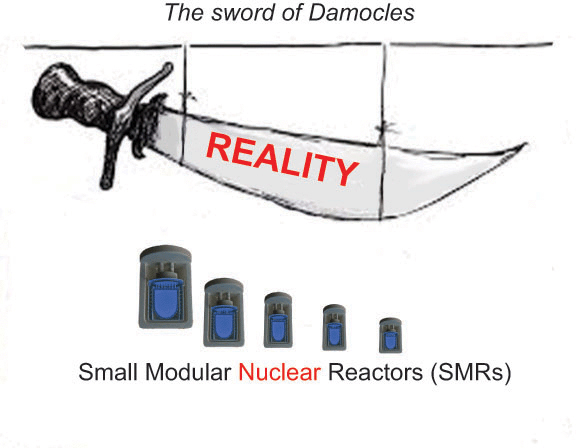
Tripling the scale of the world’s nuclear fleet by 2050 could cost upwards of $11 trillion.
PV Magazine 30th Jan 2024, M V Ramana,
The 2023 Conference of Parties (COP) climate change summit held in Dubai in December ended with a call to contribute to a transition “away from fossil fuels in energy systems.” The discussion at the COP about how to replace fossil fuels included two pledges. One was ambitious but within the realm of possibility. The other pledge was plain wishful thinking. The first, signed by 123 countries, was enshrined in the final COP28 document. The second was unofficial and attracted only 25 countries. One concerned renewable energy and energy efficiency, the other, nuclear energy. No prizes for guessing which pledge corresponded to which energy source.
Historical trends can help us understand why a goal of tripling nuclear energy generation capacity by 2050 is unattainable. According to the latest edition of the “World Nuclear Industry Status Report (WNISR2023),” the operating power generating capacity of all nuclear plants in the world is 365 GW, as of July 2023. Tripling this by mid century, 27 years from now, would mean close to 1.1 TW of nuclear capacity.
Twenty-seven years ago, in 1996, the world had 344 GW of nuclear generation capacity. Since then, when the capacity added by new nuclear reactors is tallied and that of old reactors that have been shut down is subtracted, the global nuclear fleet has grown an average of 800 MW per year. At that rate, nuclear capacity in 2050 would be a mere 386 GW, assuming that a large number of reactors would be built to replace the aging nuclear fleets of most countries. In other words, the likely nuclear capacity in 2050 would be a mere fraction of what is desired by the COP28 pledge.
Falling share
A second trend should also be acknowledged. Since 1996, the share of global electricity produced by nuclear reactors has declined from 17.5% to 9.2%, according to “WNISR2023.” That is in stark contrast to the corresponding trends for renewables, especially solar and wind energy. Between 1996 and 2023, the share of global electricity produced by modern renewable forms of energy has grown from 1.2% to 14.4%, according to the Energy Institute’s “2023 Statistical Review of World Energy.” The actual increase in the amount of energy produced by renewable sources is even more dramatic because the total energy flowing in the world’s electricity grids has more than doubled over that period.
The phenomenal growth of renewables is fueled by an even more astonishing decline in the cost of generating solar and wind power. Between 2009 and 2023, the levelized cost of generating electricity from utility scale photovoltaic farms and onshore wind farms in the United States has decreased by 83% and 63%, respectively, according to the “2023 Levelized Cost of Energy+” report published by Lazard. Nuclear electricity costs have escalated by 47% over the same period.
For recently constructed reactors, each gigawatt of generation capacity costs around $15 billion, meaning a bill of around $11 trillion to build the 730 GW needed to triple current capacity. The cost would be even more when taking into account the need to replace some of the old reactors shut down over the same period……………………………………………….
Some nuclear proponents argue that small modular reactors (SMRs) will change this picture. These will not benefit from economies of scale, however. A reactor that generates three times as much power as an SMR will not require three times as much concrete or three times as many workers. As a result, building and operating SMRs will cost more than large reactors for each megawatt of generation capacity. In turn, the electricity from small reactors will be more expensive than electricity from bigger sites, as was seen in the case of the many small reactors built in the United States before 1975. Those were financially uncompetitive and shut down early.
NuScale
The higher cost per unit of generating capacity was also seen in the case of the proposed NuScale reactor, which was planned for Utah, in the United States. The now abandoned project, which was to be developed by NuScale for electric utility Utah Associated Municipal Power Systems, would have involved six SMRs with a total generation capacity of 462 MW for an eye-popping $9.3 billion. At that rate, building a gigawatt of nuclear capacity would cost $20 billion, not $15 billion.
That cost would likely have been greater if the project had actually gone ahead and the reactor was built.
PV Magazine 30th Jan 2024 https://www.pv-magazine.com/2024/01/30/cop28-pledge-to-expand-nuclear-capacity-is-out-of-touch-with-reality/
Canadian Environmental Law Association (CELA) Disappointed in Province’s Decision on Pickering Nuclear Plant
Toronto (January 30, 2024) – https://cela.ca/media-release-cela-disappointed-in-provinces-decision-on-pickering-nuclear-plant/
Canadian Environmental Law Association (CELA) is disappointed in the decision released today by the Ontario Minister of Energy, directing Ontario Power Generation to proceed to seek a license to refurbish the Pickering Nuclear Generating Station.
CELA has participated for many years in licensing matters related to the Pickering site. In particular, CELA has undertaken in depth analysis of emergency planning readiness and has expressed very high concern for the protection of the surrounding communities in the event of a severe offsite nuclear accident.
“The population density around the Pickering plant is far too high for the continued operation of a nuclear power plant,” stated Theresa McClenaghan, Executive Director of CELA, “If such a proposal was brought forward today it would never pass the siting guidelines of the International Atomic Energy Agency that Canada says it follows. Putting a major commercial nuclear power plant in the midst of a high population area is unconscionable.”
For example, it is unrealistic to imagine that successful alerting and evacuation could move people out of harm’s way in time if something went seriously wrong. The length of time required for evacuating the various areas are highly impacted by traffic, weather, and other events that might be occurring simultaneously. The potential for getting potassium iodide distributed on time to all the children in the affected area would also be very questionable.
While it is hoped that a severe nuclear accident will never again happen in Ontario, the reality is that unexpected and extremely damaging severe accidents can occur. For that reason, high population areas and operating commercial nuclear plants are incompatible.
The 10-kilometer zone around Pickering extends well into the City of Toronto. Durham Region and the City of Toronto are both large, growing urban areas. “The 50 kilometer ‘ingestion zone’ covers much of the GTA,” said McClenaghan. “Based on public safety, CELA strenuously urges the province of Ontario to reconsider and reverse its decision to seek to refurbish Pickering, and instead proceed with the original plan for a safe and permanent shut down and decommissioning process.”
Leading Papers Skewed Gaza Debate Toward Israeli and Government Perspectives

FAIR, JULIE HOLLAR, FEBRUARY 1, 2024
At the New York Times and Washington Post, despite efforts to include Palestinian voices, opinion editors have skewed the Gaza debate toward an Israel-centered perspective, dominated by men and, among guest writers, government officials.
In the first two months of the current Gaza crisis, the Times featured the crisis on its op-ed pages almost twice as many times as the Post (122 to 63). But while both papers did include a few strong pro-Palestinian voices—and both seemed to make an effort to bring Palestinian voices close to parity with Israeli voices—their pages leaned heavily toward a conversation dominated by Israeli interests and concerns.
That was due in large part due to their stables of regular columnists, who tend to write from a perspective aligned with Israel, if not always in alignment with its right-wing government. As a result, the viewpoints readers were most likely to encounter on the opinion pages of the two papers were sympathetic to, but not necessarily uncritical of, Israel.
Many opinion pieces at the Times, for instance, mentioned the word “occupation,” offering some context for the current crisis. However, very few at either paper went so far as to use the word “apartheid”—a term used by prominent human rights groups to describe Israel’s treatment of Palestinians.
Clear calls for an unconditional ceasefire, while widespread in the real world, were vanishingly rare at the papers: two at the Times and at the Post only one, which itself was part of a collection of short responses to the question, “Should Israel agree to a ceasefire?,” which included strong opposition as well.
For guest perspectives, both papers turned most frequently to government officials, whether current or former, US or foreign. And the two papers continued the longstanding media bias toward male voices on issues of war and international affairs: the Times with roughly three male-penned opinions for every female-written one, and the Post at nearly 7-to-1.
For this study, FAIR identified and analyzed all opinion pieces published by the two papers from October 7 through December 6 that mentioned Israel or Gaza, using Nexis and ProQuest. Excluding editorials, web-only op-eds, letters to the editor and pieces with only passing mentions of Israel/Palestine, we tallied 122 pieces at the Times and 63 at the Post.
New York Times writers
During the first two months of the Gaza crisis, the New York Times published 48 related guest essays, along with 74 pieces by regular columnists, contributing writers (who write less frequently than columnists) and editorial board members (who occasionally publish bylined opinion pieces).
Of the 48 guest essays, the greatest concentration (16, or 33%) were written by Israelis or those with stated family or ancestral ties to Israel. Another 13 (27%) were written by Palestinians or people who declared ties to Palestine. Most of the rest (12, or 25%) were written by US writers with no identified family or ancestral ties to either Israel or Palestine.
The occupational category the Times turned to most frequently for guest opinions was government official, with current or former officials from the US or abroad accounting for 11 (23%) of the guest essays. (US officials outnumbered foreign officials, 6 to 5.) Journalists came in a close second, with nine (19%), followed by seven academics (15%). Six represented advocacy groups or activists (13%); four of these were Israeli and two Palestinian.
The paper also relied heavily on the opinions of men rather than women. Ninety-two of the Times opinion pieces were written by men (75%), while 30 were written by women (25%), an imbalance of more than 3-to-1.
Of the 17 pieces written by the Times‘ regular female columnists, eight came from Michelle Goldberg, and the preponderance were about domestic implications of the crisis. Examples of these include Goldberg’s “The Massacre in Israel and the Need for a Decent Left” (10/12/23) and Pamela Paul‘s “The War Comes to Stanford” (10/13/23), both of which decried the response to the Gaza crisis by the US pro-Palestinian left.
Washington Post writers
The Post published 46 pieces by regular columnists and only 17 by guest writers. Even given that the Post typically publishes fewer opinion pieces than the Times, that’s a strikingly small number of guest op-eds—roughly one every four days.
Unlike at the Times, the Post guest op-eds were dominated by US writers (7, or 41%), with only four by Israelis (24%) and three by Palestinians (18%). The Israeli-bylined op-eds expressed varied viewpoints, from hard-line support (“Every innocent Palestinian killed in this conflagration is the victim of Hamas”—10/10/23) to a call for “concrete steps to de-escalate the immediate conflict and to sow seeds for peace and reconciliation” (10/20/23). Two of the Palestinian-bylined pieces came from the same writer, journalist Daoud Kuttab (10/10/23, 11/28/23), who both times argued that Biden must recognize a Palestinian state as the only way forward.
It’s useful to compare the papers’ current representation of Palestinian voices to their historical record…………………………………..
New York Times columnists
Several New York Times columnists wrote repeatedly about the Gaza crisis……………………………………………………………………………………………….
Washington Post columnists………………………………………………………………………………………………………….
A majority of the US public has supported a ceasefire since the early days of the crisis, and one poll found support increasing over time. Yet in the country’s two most prominent papers, the ceasefire debate was either mostly ignored (at the Post) or presented in a way that came nowhere close to reflecting public opinion (at the Times)…………………………………………………………………………………………….
more https://fair.org/home/leading-papers-skewed-gaza-debate-toward-israeli-and-government-perspectives/—
VINCI wins contract to dismantle nuclear reactors in Sweden
A 6-year contract
• More than 30,000 tonnes of materials
Swedish energy company Vattenfall has awarded Nuvia, a subsidiary of VINCI Construction, a major contract on its programme to dismantle units 1 and 2 of the Ringhals nuclear power plant in Sweden.
Nuvia will remove, inspect and sort the radioactive and other materials currently inside the reactor buildings.
The works will be carried out from 2025 to 2031 and involve up to 400 people. ……….. more https://www.vinci.com/vinci.nsf/en/press-releases/pages/20240202-0830.htm
1 This Month

of the week – Shut Down Drone Warfare!


Tell the Ukrainian Government to Drop Prosecution of Peace Activist Yurii Sheliazhenko

Petition to revoke the licensing of the Near Surface Nuclear Disposal Facility (NSDF) at Chalk River. https://www.ourcommons.ca/petitions/en/Petition/Details?Petition=e-7247
To see nuclear-related stories in greater depth and intensity – go to https://nuclearinformation.wordpress.com
-
Archives
- March 2026 (244)
- February 2026 (268)
- January 2026 (308)
- December 2025 (358)
- November 2025 (359)
- October 2025 (376)
- September 2025 (257)
- August 2025 (319)
- July 2025 (230)
- June 2025 (348)
- May 2025 (261)
- April 2025 (305)
-
Categories
- 1
- 1 NUCLEAR ISSUES
- business and costs
- climate change
- culture and arts
- ENERGY
- environment
- health
- history
- indigenous issues
- Legal
- marketing of nuclear
- media
- opposition to nuclear
- PERSONAL STORIES
- politics
- politics international
- Religion and ethics
- safety
- secrets,lies and civil liberties
- spinbuster
- technology
- Uranium
- wastes
- weapons and war
- Women
- 2 WORLD
- ACTION
- AFRICA
- Atrocities
- AUSTRALIA
- Christina's notes
- Christina's themes
- culture and arts
- Events
- Fuk 2022
- Fuk 2023
- Fukushima 2017
- Fukushima 2018
- fukushima 2019
- Fukushima 2020
- Fukushima 2021
- general
- global warming
- Humour (God we need it)
- Nuclear
- RARE EARTHS
- Reference
- resources – print
- Resources -audiovicual
- Weekly Newsletter
- World
- World Nuclear
- YouTube
-
RSS
Entries RSS
Comments RSS
 nuclear-news