A new wave of climate denialism is on the rise

A new wave of denial about climate change is on the rise even as there is
greater acknowledgment of human-caused global warming, a study of more than
12,000 videos by a disinformation campaign group warns. The “new
denial” seeks to undermine confidence in green energy solutions, as well
as climate science and scientists, the research led by a group of academics
and the Center for Countering Digital Hate shows.
These forms of denial made up 70 per cent of falsehoods related to climate change in videos published on sites such as YouTube and X over a six-year period, said the
report, which was published on Tuesday. Videos that were identified as
containing climate denial claims received more than 325mn views in total,
based on research that used artificial intelligence tools to sort and
classify the assertions in content uploaded from 2018 to 2023.
The academics led by Travis Coan from the UK’s Exeter university found older
forms of denial about climate change had fallen to one-third of the
disinformation. Fewer instances highlighting cold weather or a coming ice
age were found, for example, as meteorological evidence of global warming
increased.
Instead, the majority of claims focused on three new main
categories: that the consequences of global warming were either harmless or
even beneficial; that climate science was unreliable; and that climate
solutions offered would not work — the most predominant theme. Examples
of this included that electric vehicles produce three times as much toxic
pollution as internal combustion engines when mining of the rare earth
materials involved in making the vehicle are taken into account. In fact,
the US Environmental Protection Authority and many scientists are clear
that over an EV’s lifetime the total greenhouse gas emissions are
typically lower even when accounting for manufacturing.
FT 16th Jan 2024
https://www.ft.com/content/aa369295-1805-414c-af99-3c7596df0847
Climate misinformation is mutating on YouTube – and the platform is
profiting. Researchers analysed thousands of hours of YouTube content from
the past six years and found that ‘old’ climate change denial is giving
way to a new type of misleading content intended to muddy the waters.
Independent 16th Jan 2024
Fukushima Nuclear Waste Water Disputes Continued: International Law in Japanese Court?
Written by Grace Nishikawa and Dr. Marlies Hesselman, https://www.ejiltalk.org/fukushima-nuclear-waste-water-disputes-continued-international-law-in-japanese-court/ 16 Feb 24
On 24th August 2023, Tokyo Electric Power Company (TEPCO) started releasing the ALPS-treated waste water from the Fukushima nuclear power plant into the Pacific Ocean over a period of 30 years. As discussed on this blog before, here and here, the decision led to strong international responses from neighbouring States, such as China and South Korea, as well as reactions by several UN human rights bodies. One legal question currently attracting attention in several fora, is whether Article 4 of the Protocol to the London Convention on the Prevention of Marine Pollution by Dumping of Wastes and Other Matters forbids the ‘dumping’ of the waste water into the sea, because it still contains radioactive matter, such as tritium.
This blog post draws attention to the interpretative controversy under the Londen Protocol by noting that the question is not only on the agenda of the Governing Bodies of the London Convention (LC) and its Protocol (LP), but also of the Fukushima District Court. In September, a group of Japanese citizens initiated a domestic lawsuit calling for an injunction to stop the release of the waste water. Their complaint is in large part based on personal rights under the constitution, but also invokes various international environmental law provisions, including Article 4 LC/LP. This post considers the interpretative controversy at hand, including whether the Japanese courts could play a role in addressing it.
Continue readingCONTINUATION. Incredible analysis of US warmongers plans for war with China ! Read this and weep!
(This is a continuation from https://nuclear-news.net/2024/01/18/incredible-analysis-of-us-warmongers-plans-for-war-with-china-read-this-and-weep-2/ -ran into technical difficulties.)
AirSea Battle, the expanded, more aggressive, multi-domain inheritor of Airland Battle, was revealed in dribs and drabs around 2011, just as the Obama administration declared the Pivot to Asia. Krepinevich was mentored and guided by Andrew Marshall (of the office of net assessment), who was pentagon’s secretive neocon war advisor to 12 presidents, who began planning for war with China in the 1990’s. Marshall also mentored Paul Wolfowitz, Dick Cheney, Donald Rumsfeld, Krepinevich. (I map this genealogy out in detail in the “Empire strikes back”‘ in this essay). Larry Wilkerson revealed recently that Cheney and Rumsfeld had been itching and preparing for war with China since 2002.
When ASB was revealed, Amital Etzioni asked in an otherwise muddled paper in 2013, the incisive question, “Who authorized preparations for war with China?”.
AirSea Battle calls for “interoperable air and naval forces that can execute networked, integrated attacks-in-depth to disrupt, destroy, and defeat enemy anti-access area denial capabilities…by launching a “blinding attack” against Chinese anti-access facilities, including land and sea-based missile launchers, surveillance and communica tion platforms, satellite and anti-satellite weapons, and command and control nodes. U.S. forces could then enter contested zones and conclude the conflict by bringing to bear the full force of their material military advantage. One defense think tank report, “AirSea Battle: A Point-of-Departure Operational Concept,” acknowledges that “[t]he scope and intensity of U.S. stand-off and penetrating strikes against targets in mainland China clearly has escalation implications,” because China is likely to respond to what is effectively a major direct attack on its mainland with all the military means at its disposal—including its stockpile of nuclear arms.[6] The authors make the critical assumption that mutual nuclear deterrence would hold in a war with China. However, after suggesting that the United States might benefit from an early attack on Chinese space systems, they concede in a footnote that “[a]ttacks on each side’s space early warning systems would have an immediate effect on strategic nuclear and escalation issues.”
Etzioni also pointed out correctly that ASB was not defensive, but provocative and escalatory:
…the Pentagon decided to embrace the ASB concept over alternative ways for sustaining U.S. military power in the region that are far less likely to lead to escalation. One such is the “war-at-sea” option, a strategy proposed by Jeffrey Kline and Wayne Hughes of the Naval Postgraduate School, which would deny China use of the sea within the first island chain (which stretches from Japan to Taiwan and through the Philippines) by means of a distant blockade, the use of submarine and flotilla attacks at sea, and the positioning of expeditionary forces to hold at-risk islands in the South China Sea. By foregoing a mainland attack, the authors argue that the war-at-sea strategy gives “opportunities for negotiation in which both sides can back away from escalation to a long-lasting, economically disastrous war involving full mobilization and commitment to some kind of decisive victory.”[22]…
Several defense analysts in the United States and abroad, not least in China, see ASB as being highly provocative. Former Vice Chairman of the Joint Chiefs of Staff General James Cartwright stated in 2012 that, “AirSea Battle is demonizing China. That’s not in anybody’s interest.”[24] An internal assessment of ASB by the Marine Corps commandant cautions that “an Air-Sea Battle-focused Navy and Air Force would be preposterously expensive to build in peace time” and if used in a war against China would cause “incalculable human and economic destruction.”[25]
Several critics point out that ASB is inherently escalatory and is likely to accelerate the arms race in the Asia-Pacific. China must be expected to respond to the implementation of ASB by accelerating its own military buildup. Chinese Colonel Gauyue Fan stated that, “If the U.S. military develops AirSea Battle to deal with the [People’s Liberation Army], the PLA will be forced to develop anti-AirSea Battle.”[26] Moreover, Raoul Heinrichs, from the Australian National University, points out that “by creating the need for a continued visible presence and more intrusive forms of surveillance in the Western Pacific, AirSea Battle will greatly increase the range of circumstances for maritime brinkmanship and dangerous naval incidents.”[27]
This military strategy, which involves threatening to defeat China as a military power, is a long cry from containment or any other strategies that were seriously considered in the context of confronting the USSR….ASB requires that the United States be able to take the war to the mainland with the goal of defeating China, which quite likely would require striking first. Such a strategy is nothing short of a hegemonic intervention.
Just recently, Krepinevich wrote a long article “The Big One” in Foreign Affairs warning the US ruling class to prepare themselves and the people for a long, painful, protracted war with China.
I invite you to read Krepinevich’s article to the ruling Elite in FA in its entirety.
https://archive.md/5ROsO
He argues:
- We can win this war, but we need to prepare now.
- It will be painful and long.
- It will not destroy the planet.
4. Here are the plans:
Note, he disingenuously argues the need for a plan for war with China–as if he has just discovered this need, rather than acknowledge he has been planning, preparing this war for 15 years now.
The Big One
Preparing for a Long War With China
By Andrew F. Krepinevich, Jr.
https://archive.md/5ROsO
https://www.foreignaffairs.com/china/united-states-big-one-krepinevich
Over the past decade, the prospect of Chinese military aggression in the Indo-Pacific has moved from the realm of the hypothetical to the war rooms of U.S. defense planners. Chinese leader Xi Jinping has significantly accelerated his country’s military buildup, now in its third decade. At the same time, China has become increasingly assertive across a wide swath of the Pacific, advancing its expansionist maritime claims and encroaching on the waters of key U.S. allies and important security partners, including Japan, the Philippines, and Taiwan.
COMMENT. Krepinevich (K) is confounding effect and cause. Krepinivich created ASB, the plan of war against China, 14 years ago, long expected to created an arms race. Krepinevich’s plan for war against China precedes Xi by at least 4 years, and as predicted Xi/China is responding to the US. ASB was a Self-fulfilling prophecy at best.
COMMENT. Notice the weasel words by K: “Assertive” (because they can’t say “aggressive” with a straight face–China is not aggressive).”Expansionist’–China is the least expansionist of any world power. It has the 2nd largest territory in the world with a tiny maritime claim relative to its size. The US goes on about China’s 9 dash line in the SCS, but no one mentions the 999 dash line over the entire pacific by the US–the US Claims the entire pacific as its lake.
Xi has asserted, with growing frequency, that Taiwan must be reunited with China, and he has refused to renounce the use of force to achieve that end.
COMMENT. Xi is repeating what every Chinese leader has said since Mao. “He has refused to renounce the use of force…” is an absurd statement for two reasons.
COMMENT. First, China has not threatened to unify TW by force, hence K’s absurd, tortured construction of denunciation: China is “guilty-by-failing-to-renounce”.
COMMENT.Second, one of the foundations of nationhood is the state’s monopoly on the use of force. The US seeking to restrict China’s use of force–in its own sovereign territory–for whatever reason–is like telling a driver to renounce the use of his horn on his own car. It’s part of your car, and it’s your discretion when to use it. You use it sparingly, but you use it if an when necessary. No one uses his horn because he wants to, but for a third party to mandate its non-use is absurd.
That would be like China telling the US to renounce the use of force within its borders.
Why does the US think it gets to demand what China should or shouldn’t do within its own territory?
COMMENT.. Or more importantly, why does the US get to mandate what TW does in the TERA? Neocons have repeated these mantras to themselves so often they don’t realize how absurd they sound.
With the United States distracted by major wars in Europe and the Middle East, some inWashington fear that Beijing may see an opportunity to realize some of these revisionist ambitions by launching a military operation before the West can react
COMMENT. This is a neocon fear. We are overstretched and therefore fearful of our own shadows. Whose fault is that?
With Taiwan as the assumed flash point, U.S. strategists have offered several theories about how such an attack might play out.
Comment: Why “assumed”? Because the US is trying hard to trigger one right there, with TERA and other provocations. “Strategy of Denial” has detailed this process of provocation.
First is a “fait accompli” conquest of Taiwan by China, in which the People’s Liberation Army employs missiles and airstrikes against Taiwanese and nearby U.S. forces while jamming signals and communications and using cyberattacks to fracture their ability to coordinate the island’s defenses. If successful, these and other supporting actions could enable Chinese forces to quickly seize control.
Nearby US forces”. Hmm, I wonder why they are there. Actually, what K is describing is exactly what he suggested for the US war against China in ASB.
COMMENT.“Nearby US forces”. Hmm, I wonder why they are there. Actually, what K is describing is exactly what he suggested for the US war against China in ASB.
A second path envisions a U.S.-led coalition beating back China’s initial assault on the island. This rosy scenario finds the coalition employing mines, antiship cruise missiles, submarines, and underwater drones to deny the PLA control of the surrounding waters, which China would need in order to mount a successful invasion.
COMMENT. Unlikely. Deny China control of its own littoral and territorial waters?
Meanwhile, coalition air and missile defense forces would prevent China from providing the air cover needed to support the PLA’s assault, and electronic warfare and cyber-forces would frustrate the PLA’s efforts to control communications in and around the battlefield. In a best-case outcome, these strong defenses would cause China to cease its attack and seek peace.
COMMENT.. No fly zone over China? Dominance in cyber warfare? Again, this is ASB. But note, it involves the “TW must fight” scenario of CSIS wargame where the Japanese cavalry will arrive.
Given that both China and the United States possess nuclear arsenals, however, many strategists are concerned about a third, more catastrophic outcome. They see a direct war between the two great powers leading to uncontrolled escalation. In this version of events, following an initial attack or outbreak of armed conflict, one or both belligerents would seek to gain a decisive advantage or prevent a severe setback by using major or overwhelming force. Even if this move were conventional, it could provoke the adversary to employ nuclear weapons, thereby triggering Armageddon. Each of these scenarios is plausible and should be taken seriously by U.S. policymakers.
COMMENT. The neocons have always factored nuclear war as one of their options. In fact, they (Andrew Marshall, who mentored Krepinevich) are drawn from nuclear scenario planners at RAND. But K wants to discuss nuclear escalation before dismissing it.
Yet there is also a very different possibility, one that is not merely plausible but perhaps likely: a protracted conventional war between China and a U.S.-led coalition. Although such a conflict would be less devastating than nuclear war, it could exact enormous costs on both sides.
COMMENT. This is CNAS’s Ukraine-Afghanistan option. “Protracted war” is now all the rage at CNAS (where K also roosts). Bleed China out. First this is wrong, because in any protracted war, China has the advantage. Not just because it wrote the book on PW, but because TW has no strategic depth. It has two weeks worth of fuel if China imposed a blockade. The tyranny of distance is also a factor: the US is 7000 miles away; China is 80.
It also could play out over a very wide geographic expanse and involve kinds of warfare with which the belligerents have little experience. For the United States and its democratic allies and partners, a long war with China would likely pose the decisive military test of our time.
COMMENT. This is the horizontal escalation–the third offset, which CNAS has been preparing for a decade. The plan to defeat China’s precision defensive capacity is to attack it from multiple theaters. Dispersed, diffused war defeats (offsets) both mass (nuclear or conventional strength) and precision (missiles).
BATTLES WITHOUT BOMBS
A military confrontation between China and the United States would be the first great-power war since World War II and the first ever between two great nuclear powers. Given the concentration of economic might and cutting-edge technological prowess in Japan, South Korea, and Taiwan—all three advanced democracies that are either close allies or partners of the United States—such a war would be fought for very high stakes. Once the fighting had started, it would likely be very difficult for either side to back down. Yet it is far from clear that the conflict would lead to nuclear escalation.
COMMENT. They hope–while creating conditions for exactly just that.
As was the case with the Soviet Union and the United States in the late twentieth century, both China and the United States possess the ability to destroy the other as a functioning society in a matter of hours. But they can do so only by running a high risk of incurring their own destruction by provoking a nuclear counterattack, or second strike. This condition is known as “mutually assured destruction,” or MAD. During the Cold War, the fear of setting off a general nuclear exchange provided Moscow and Washington with a strong incentive to avoid any direct military confrontation.
Of course, Beijing’s nuclear balance of power with Washington is significantly different from that of Moscow during the Cold War, when the United States and the Soviet Union achieved a rough parity in forces. China’s nuclear arsenal is a fraction of the size of the United States’, although Beijing is pursuing a dramatic expansion with the goal of matching the U.S. strategic arsenal within the next decade. Nevertheless, even now the Chinese arsenal is large enough that if China were attacked, it would have sufficient nuclear forces left to execute a retaliatory strike on the United States—thus bringing about MAD.
COMMENT. A U.S.-Chinese war would be the first between great nuclear powers.
Yet there is strong ground for thinking that a U.S.-Chinese war would not go nuclear
COMMENT. Every US wargame with China starts with this assumption–that China would not use nuclear weapons. China also does not have hair trigger Launch on warning, and it separates its bombs from its missiles.
However, what the US is thinking is much more suspect. US declaratory force posture permits US pre-emptive nuclear attacks and nuclear response to strategic losses (e.g. a sunken ACC). Tactical nuclear weapons are also a possibility and considered “below” the nuclear threshold.
In more than seven decades of conflicts since World War II, including many involving at least one nuclear power, nuclear weapons have been notable chiefly for their absence.
COMMENT. K confounds absence of use with absence of threat. The US has threatened its enemies many many times–Vietnam, Korea, etc.. It stationed nuclear weapons on Taiwan until the 1970’s and in Korea until 1992.
Even in wars in which only one side possessed nuclear weapons, that side refrained from exploiting its advantage. The United States fought bloody and protracted wars in Korea and Vietnam and yet abstained from playing its nuclear trump card.
COMMENT. Because the USSR, and later China had its own nuclear weapons by then.
Similarly, Israel refrained from employing nuclear weapons against Egypt or Syria, even in the darkest hours of the 1973 Yom Kippur War. The same has been true thus far of Russia in its war with Ukraine, even though that conflict is now approaching the end of a second year of fierce fighting and has already exacted from Russia an enormous price in blood and treasure.
COMMENT. Too early to tell. And wrong about Russia.
This nuclear restraint should not be surprising. During the Cold War, the possibility of a nonnuclear conflict played a significant part in strategic planning on both sides. Thus, U.S. and Soviet thinking addressed not only the threat of nuclear escalation but also the prospect of a prolonged conventional war. To prepare for that kind of war—and thus dissuade the other side from believing it could win such a conflict—each superpower stockpiled large quantities of surplus military equipment as well as key raw materials. The United States maintained an aircraft “boneyard” and maritime “mothball fleet”—large reserves of retired planes and ships that could be mobilized and brought into service as needed. For their part, the Soviets amassed enormous quantities of spare munitions, along with thousands of tanks, planes, air defense systems, and other weapons to support extended combat operations. A working assumption of these preparations on both sides was that a war could unfold over an extended period without necessarily triggering Armageddon.
COMMENT. 1st offset. Yom Kippur war–ALB–ASB. Deep strategic strikes, decapitation.
In the event of armed conflict between China and a U.S.-led coalition, a similar dynamic could play out again: both sides would have a strong interest in avoiding uncontrolled escalation and could seek ways to fight by other means. Simply put, the logic of mutually assured destruction would not end at the onset of hostilities but could deter the use of nuclear weapons during the war. Given this reality, it is crucial to understand what a twenty-first-century great-power conflict might look like and how it might evolve.
COMMENT. K argues (not convincingly) that since we won’t have nuclear war, let’s prepare for protracted conventional war. Notice how he snuck in the entire premise of war–that we are going to have war, It’s just a matter of how. Sneaky, Mr. K. And now he talks about how.
REASONS TO FIGHT
There are many ways that a war between China and the United States could start. Given China’s ambition to dominate the Indo-Pacific, such a war would very likely involve the so-called first island chain, the long arc of Pacific archipelagoes extending from the Kuril Islands north of Japan, down the Ryukyu Islands, through Taiwan, the Philippines, and parts of Indonesia.
COMMENT. Because the US is encircling China in the FIC
As many in Washington have argued, Taiwan is the most obvious target, given the island’s strategic location between Japan and the Philippines, its key role in the global economy, and its status as the principal object of Beijing’s expansionist aims.
COMMENT. This is Washington’s wish. It’s the main trigger. And as Bruce Lee said, “I fear not the person who has 10,000 techniques. I fear the person who has rehearsed one technique 10,000 times”, China is likely to win this won, as it is the only scenario of aggression it has planned.
China’s military has been increasingly active in the Taiwan Strait, and the PLA has massed its greatest concentration of forces across from the island. In the event of a Chinese attack on Taiwan, the United States would be compelled to defend the island or risk having key neutral countries and even allies drift toward an accommodation with Beijing.
In short, if war breaks out in any of these places, it could draw China and the United States into direct armed conflict. And if that happens, it would be unlikely to end quickly. Take the case of Taiwan. Although it is possible that China could either achieve a rapid conquest before the United States could respond or be stopped cold by a U.S.-led coalition, these outcomes are hardly assured. As Russia discovered in Ukraine in 2022, rapid subjugation, even of an ostensibly weaker power, can be harder than it looks.
But even if Washington and its partners are able to prevent the PLA from seizing Taiwan through a fait accompli, Beijing still might be unwilling to accept defeat. And like the United States, it would possess the means to continue fighting. Given the high stakes, neither side can be counted on to throw in the towel, even if it suffers severe initial reverses. And at that point, the course of events would be determined not only by the intentions of the two great powers themselves but also by the responses of other countries in the region.
In contrast to the Cold War, in which the two superpowers were each supported by rigid alliances—the U.S.-led NATO and the Soviet Union’s Warsaw Pact—the current situation in the Indo-Pacific is a geopolitical jumble. China has no formal alliances, although it enjoys close relationships with North Korea, Pakistan, and Russia. For its part, the United States has a set of bilateral alliances and partnerships in the region based on hub-and-spoke relationships, with Washington as the hub and Australia, Japan, the Philippines, South Korea, Taiwan, and Thailand forming the spokes. Yet unlike the members of NATO, which are obligated to view an attack on one as an attack on all, these Asian allies have no shared defense commitment.
Which is why the US built the AUKUS, QUAD, JAKUS over the past decade.
In the event of Chinese aggression in the Indo-Pacific, then, the responses of U.S. partners in the region are less than certain. It is reasonable to assume that Australia and Japan would join the United States in coming to the victim’s defense, given their close alliance with the United States, their ability to project significant military power abroad, and strong interest in preserving a free and open Indo-Pacific community of nations.
COMMENT. Yes, these are the reliable vassals, along with Korea. Notice he doesn’t bother to mention Korea, because it’s already part of the US military. It’s not even necessary to mention. Its cooperation is assumed.
But other powerful countries could influence the war’s character—arguably, the two most important being India (on the side of the United States) and Russia (on the side of China). Just as the local Asian and European wars in the late 1930s expanded to become a global war, so might a war with China overlap with the war in Ukraine or a conflict in South Asia or fighting in the Middle East
COMMENT. India is the unreliable QUAD partner. And yes, the US is planning world war.
What happens in the early stages of the war could also determine the constellation of powers on each side. The party that is judged to be the aggressor could alienate fence sitters that view the war from a moral perspective.
This, in a nutshell, is Elbridge Colby’s “Strategy of Denial” regarding using TW for war–provoke China into firing the first shot, and then bind allies (“binding strategy”) in a coalition to attack and sanction China.
What is so dangerous here, for the US, is that China is not responding. It’s like the martial artist that won’t fight. despite the street thug that is throwing jabs in its direction and harassing and bullying it.
States with more of a realpolitik view, on the other hand, might ally themselves with whichever side achieves early success (as Italy did in World War II), or they may decide against joining their natural partners should those partners suffer significant setbacks. Following Ukraine’s successful initial defense against Russia’s invasion in the spring of 2022, many countries in the West, including historically neutral countries such as Finland and Sweden, rallied to Kyiv’s support.
But the vast majority didn’t, including the Quad’s India. Mr K is worried about this. Ely Ratner is doing his best.
Similarly, if China were unable to quickly secure its objectives, traditionally neutral countries such as Indonesia, Singapore, and Vietnam might join efforts to resist Beijing’s aggression.
Vietnam not so much. Singapore is a US base-ally but it’s small. Its key asset is that it controls the Malacca straits
RESTRAINING ORDERS
Once a war has broken out, both China and the United States would have to confront the dangers posed by their nuclear arsenals. As in peacetime, the two sides would retain a strong interest in avoiding catastrophic escalation. Even so, in the heat of war, such a possibility cannot be eliminated. Both would confront the challenge of finding the sweet spot in which they could employ force to gain an advantage without causing total war. Consequently, leaders of both great powers would need to exercise a high degree of self-control.
“Sweet spot for world war”–that’s a first.
To keep the war limited, both Washington and Beijing would need to recognize each other’s redlines—specific actions viewed as escalatory and that could trigger counter-escalations.
COMMENT. We must fight China over Taiwan, or we lose the world, our hegemony of it.
Yet the Taiwan Strait is not the only place a war could begin. China has continued its incursions into Japan’s airspace and its provocative actions in the exclusive economic zones of the Philippines and Vietnam, raising the possibility of a war-provoking incident. Moreover, tensions between North Korea and South Korea remain high. If fighting broke out on the Korean Peninsula, the United States might dispatch reinforcements there, causing Beijing to see an opportunity to settle scores at other points along the first island chain.
Or a war with China could start in South Asia. Over the past decade, China has clashed with India along their shared border on several occasions. Despite lacking a formal alliance with the United States, India is a member of the Quad (Quadrilateral Security Dialogue), the security grouping that also includes Australia, Japan, and the United States and that has stepped up joint military cooperation over the past few years. If India were to become the victim of more significant Chinese aggression, Washington would have a strong interest in defending a major military power and partner that is also the world’s largest democracy.
COMMENT. Oh, no, the US is defending democracy again! More accurately, a fascist oligarchic-plutocratic neoliberal state
In short, if war breaks out in any of these places, it could draw China and the United States into direct armed conflict. And if that happens, it would be unlikely to end quickly. Take the case of Taiwan. Although it is possible that China could either achieve a rapid conquest before the United States could respond or be stopped cold by a U.S.-led coalition, these outcomes are hardly assured. As Russia discovered in Ukraine in 2022, rapid subjugation, even of an ostensibly weaker power, can be harder than it looks.
But even if Washington and its partners are able to prevent the PLA from seizing Taiwan through a fait accompli, Beijing still might be unwilling to accept defeat. And like the United States, it would possess the means to continue fighting. Given the high stakes, neither side can be counted on to throw in the towel, even if it suffers severe initial reverses. And at that point, the course of events would be determined not only by the intentions of the two great powers themselves but also by the responses of other countries in the region.
In contrast to the Cold War, in which the two superpowers were each supported by rigid alliances—the U.S.-led NATO and the Soviet Union’s Warsaw
In the event of Chinese aggression in the Indo-Pacific, then, the responses of U.S. partners in the region are less than certain. It is reasonable to assume that Australia and Japan would join the United States in coming to the victim’s defense, given their close alliance with the United States, their ability to project significant military power abroad, and strong interest in preserving a free and open Indo-Pacific community of nations.
COMMENT. Yes, these are the reliable vassals, along with Korea. Notice he doesn’t bother to mention Korea, because it’s already part of the US military. It’s not even necessary to mention. Its cooperation is assumed.
But other powerful countries could influence the war’s character—arguably, the two most important being India (on the side of the United States) and Russia (on the side of China). Just as the local Asian and European wars in the late 1930s expanded to become a global war, so might a war with China overlap with the war in Ukraine or a conflict in South Asia or fighting in the Middle East
COMMENT. India is the unreliable QUAD partner. And yes, the US is planning world war.
What happens in the early stages of the war could also determine the constellation of powers on each side. The party that is judged to be the aggressor could alienate fence sitters that view the war from a moral perspective.
COMMENT. This, in a nutshell, is Elbridge Colby’s “Strategy of Denial” regarding using TW for war–provoke China into firing the first shot, and then bind allies (“binding strategy”) in a coalition to attack and sanction China.
COMMENT. What is so dangerous here, for the US, is that China is not responding. It’s like the martial artist that won’t fight. despite the street thug that is throwing jabs in its direction and harassing and bullying it.
This is Washington’s wish. It’s the main trigger. And as Bruce Lee said, “I fear not the person who has 10,000 techniques. I fear the person who has rehearsed one technique 10,000 times”, China is likely to win this won, as it is the only scenario of aggression it has planned.
China’s military has been increasingly active in the Taiwan Strait, and the PLA has massed its greatest concentration of forces across from the island. In the event of a Chinese attack on Taiwan, the United States would be compelled to defend the island or risk having key neutral countries and even allies drift toward an accommodation with Beijing.
States with more of a realpolitik view, on the other hand, might ally themselves with whichever side achieves early success (as Italy did in World War II), or they may decide against joining their natural partners should those partners suffer significant setbacks. Following Ukraine’s successful initial defense against Russia’s invasion in the spring of 2022, many countries in the West, including historically neutral countries such as Finland and Sweden, rallied to Kyiv’s support.
COMMENT. But the vast majority didn’t, including the Quad’s India. Mr K is worried about this. Ely Ratner is doing his best.
Similarly, if China were unable to quickly secure its objectives, traditionally neutral countries such as Indonesia, Singapore, and Vietnam might join efforts to resist Beijing’s aggression.
COMMENT. Vietnam not so much. Singapore is a US base-ally but it’s small. Its key asset is that it controls the Malacca straits.
RESTRAINING ORDERS
Once a war has broken out, both China and the United States would have to confront the dangers posed by their nuclear arsenals. As in peacetime, the two sides would retain a strong interest in avoiding catastrophic escalation. Even so, in the heat of war, such a possibility cannot be eliminated. Both would confront the challenge of finding the sweet spot in which they could employ force to gain an advantage without causing total war. Consequently, leaders of both great powers would need to exercise a high degree of self-control.
COMMENT.“Sweet spot for world war”–that’s a first.
To keep the war limited, both Washington and Beijing would need to recognize each other’s redlines—specific actions viewed as escalatory and that could trigger counter-escalations.
COMMENT. China’s redline is Taiwan.
Efforts toward this end can be enhanced if both sides can clearly and credibly communicate what their redlines are and the consequences that would be incurred for crossing them.
COMMENT.I believe this is why the US is so adamant on military-military communications with China. Because it wants war, not because it wants to deter it
Even here, problems will arise, as the dynamics of war may alter these thresholds. For example, if the PLA proves effective at using conventionally armed ballistic missiles to attack U.S. air bases in the region, Washington could decide to strike Chinese missile sites, even at the risk of hitting nuclear-armed PLA missiles kept at the same location.
COMMENT. Notice how blithely he talks of this? This is because of what he has been planning for the past 14 years.
Moreover, individual coalition members will likely have their own, unique redlines. Consider a situation in which PLA air and sea attacks on major Japanese ports threaten to collapse Japan’s economy or cut off its food supplies. Under these circumstances, Tokyo may be far more willing to escalate the war than its coalition partners. If Japan has the means to escalate, it could do so unilaterally. If it lacks them and Washington refuses to escalate on its behalf, Tokyo might decide to seek a separate peace with Beijing.
COMMENT. The Neocons are not stupid. They know that Japan is an unreliable attack dog, because it has its own agenda regarding militarization. It’s like that warning, when a hunter brings a dog to kill a wolf, they need to remember that the dog has more in common with the wolf than the hunter.
To avoid this predicament, the coalition could pre-position air and missile defenses, as well as countermine forces, at Japanese ports, and Japan could stockpile crucial imported goods, such as food and fuel.
COMMENT. Yes, they are really preparing for war, if they are tallking logistics, food, fuel. Japan needs to stockpile Ramen and MSG.
Nevertheless, previous wars suggest that belligerents have often been able to limit their warfighting methods to prevent unnecessary escalation. Following China’s intervention in the Korean War, for example, U.S. forces had the capability to conduct airstrikes across the border in Manchuria, which served as a staging ground for Chinese forces threatening to overwhelm U.S. troops on the peninsula. But U.S. President Harry Truman turned down requests to attack these targets in order to avoid triggering a wider war with the Soviet Union. Similarly, in Vietnam, U.S. leaders declared North Vietnam’s main port of Haiphong off-limits to U.S. forces, despite its strategic importance.
COMMENT. Because they were afraid of Chinese troops. They were warned not to attack NV, otherwise VN would see a redux of the Korean war, with Chinese troops fighting the US directly on land.
As was the case with Korea, it was feared such attacks could spark a wider conflict with China or the Soviet Union. In both cases, this restraint was maintained even amid wars that cost tens of thousands of American lives.
COMMENT. Strange observation. The Korean war was actually between the US & China. Both troops fought each other.
Given the potential for uncontainable nuclear escalation, it is not unreasonable to assume that both China and the United States would err on the side of caution when considering how and where to intensify military operations. But the imperative on both sides to avoid nuclear escalation would not only create parameters for the objectives sought and the means employed to achieve them. It would also set the stage for a conflict that could likely be prolonged since both sides would have very significant resources to draw on to keep fighting. In this way, the war’s containment in one respect would also facilitate its broadening in others.
COMMENT. Horizontal escalation. But a big assumption, in particular on the part of China. The US already has no sense of caution. I think this is messaging to China. “We are going to have a world war with you, but trust us, we will fight you carefully. So don’t use nukes on us.”
A WAR OF WILLS
What strategy might a U.S.-led coalition pursue in a limited but extended war with China? Broadly speaking, there are three general strategies of war: annihilation, attrition, and exhaustion. They can be pursued individually or in combination. An annihilation strategy emphasizes using a single event or a rapid series of actions to collapse an enemy’s ability or will to fight, such as occurred with Germany’s six-week blitzkrieg campaign against France in 1940. By contrast, an attrition strategy seeks to reduce an enemy’s war-making potential by wearing down its military forces over an extended period to the point that they can no longer mount an effective resistance. This was the primary strategy the Allies employed against the Axis powers in World War II. An exhaustion strategy, finally, seeks to deplete the enemy’s forces indirectly, such as by denying it access to vital resources through blockades, degrading key transportation infrastructure, or destroying key industrial facilities. A classic example of this was the U.S. Civil War.
COMMENT. Protracted war is a matter of resolve, grit, will–and industrial capacity.
Early in that conflict, both the Union North and the Confederate South hoped that a strategy of annihilation would succeed, such as by winning a decisive battle or seizing the enemy’s capital. These hopes proved ill founded, and over time the Confederacy adopted an exhaustion strategy, hoping to extend the war to the point that its adversary’s will to persevere would run out, despite the Union’s far greater military power. In turn, relying on its advantages in manpower, industrial might, and military capabilities, the North combined an attrition strategy with an exhaustion one. It sought to reduce the Confederacy’s armies directly through attrition by persistent military battles and indirectly by blockading Confederate ports and destroying the South’s arsenals and transportation infrastructure. In this way, the Union deprived the Confederacy of the resources and recruits needed to offset its combat losses while convincing Southerners that they could not achieve their goal of secession.
COMMENT. Interesting that he mentions the civil war, because TW is a civil war for China. Wars of secession are incredibly bloody. The US is simply an interloper without staying power, if it thinks a protracted war is a solution or the formula. Based on the civil war analogy, the US would lose, because it has neither staying power, industry, and real skin in that game.
COMMENT. The only other approach, but which K. is surely thinking of, is to make China fight while the US “leads from behind”, letting all parties (and challengers) exhaust themselves (as in WWII). Then the US would be the winner again.
In a war between China and the United States, the strategy of annihilation carries unsustainable risks. Because both sides have nuclear weapons, an annihilation strategy based on an overwhelming military attack to destroy the enemy’s ability to resist could easily become a mutual suicide pact. That risk would also hobble efforts by either side to pursue an attrition strategy, which could similarly lead to nuclear escalation. Both belligerents would thus have an incentive to pursue strategies of exhaustion, supported when possible by attrition, to erode the enemy’s means and, perhaps more important, its will to continue fighting. Such an approach would seek to inflict maximum pressure and damage on the enemy without risking escalation to total war.
COMMENT. This is the heart of ASB and US war against China: choking off the strategic chokepoints. Interesting to frame that as a new revelation.
The United States must convince China that it can prevail in a long war.
In shaping these strategies, China and the United States would need to consider carefully where they choose to fight. For example, to avoid crossing redlines, the two sides might accord each other’s homelands (including their respective airspaces) limited sanctuary status.
COMMENT. You wish. The problem is, the US is fighting on China’s doorstep, practically on their “homeland”. And ASB requires deep strategic, decapitaton strikes. This is messaging to China. “We won’t attack you in land, please don’t attack Washington”. Noice the world “limited sanctuary”–akin to what the Israelis are doing in Palestine.
Instead, they might seek horizontal, or geographic, escalation. Thus, the conflict could spread to areas beyond the first island chain or South Asia to locations where both China and the United States could project military power, such as in the Horn of Africa and the South Pacific.
COMMENT. This is why they are talking about the 1st, 2nd, 3rd, and even 6th island chain.
The war would also likely migrate to those domains that are less likely to pose immediate escalation risks. Warfighting in domains associated with the global commons, for example, might be considered fair game by both sides. These could include maritime operations (including on the sea’s surface, under the sea, and on the seabed), as well as war in space and cyberspace
COMMENT. This is the essence of ASB, renamed, JAM-GC–“GC” referring to the “global commons”. GC is the SCS.
Both sides might also wage war more aggressively on and above the territories of minor powers allied with China or the United States, such as the Philippines and Taiwan.
COMMENT. Notice the assumption that the Philippines is in the US bag
In the war’s early phases, military targets might well have priority for both sides as the PLA attempts to win a quick victory while the U.S. coalition focuses on mounting a successful defense. If so, economic targets like commercial ports, cargo ships, and undersea oil and gas infrastructure would initially be accorded lower priority.
COMMENT. In other words, Nord stream again. And attacks on the BRI. This is total war–from the US. And Attacks on civilian infrastructure are war crimes. But Krepinevich sees the laws of war the way John Yoo sees injunctions against torture–as quaint.
As the war becomes protracted, however, each side would increasingly seek to exhaust the other’s war-making potential through economic and information warfare. Actions toward this end might involve blockades of enemy ports and commerce-raiding operations against an enemy’s cargo ships and undersea infrastructure. One side could impose information blockades on the other by cutting undersea data cables and interrupting satellite communications, or it could use cyberattacks to destroy or corrupt data central to the effective operation of the adversary’s critical infrastructure.
COMMENT. Full spectrum hybrid war. This is currently being prepared.
Another way the belligerents could keep the war limited would be to restrict the means of attack used. Attacks whose effects are relatively easy to reverse may be less escalatory than those that inflict permanent damage. For example, employing high-powered jammers that can block and unblock satellite signals as desired could be preferable to a missile strike that destroys a satellite ground control station located on the territory of a major belligerent power. By offering the prospect of a relatively rapid restoration of lost service, such attacks might prove effective at undermining the enemy’s will to continue the war. The same might be said of seabed operations that shut down offshore oil and gas pumping stations rather than physically destroying them or naval operations that seize and intern enemy cargo ships rather than sinking them. To the extent such actions are feasible, they can preserve key enemy assets as hostages that can be used as bargaining chips in negotiating a favorable end to the war.Hostage-taking of civilian infrastructure. Reversible warfare. Sanctions war/siege war.
TORTOISES, NOT HARES
To prevail in a war with China, then, the United States and its coalition partners will need to have a strategy not only for denying Beijing a quick victory but also for sustaining their own defenses in a long war. At present, the first goal remains a formidable task. The United States and its allies—let alone prospective partners such as India, Indonesia, Singapore, and Vietnam—appear to lack a coherent approach to deterring or defeating a Chinese attack. If China seizes key islands along the first island chain, it would be exceedingly difficult for the United States and its partners to retake them at anything approaching an acceptable cost. And if China is successful, it may propose an immediate cease-fire as a means of consolidating its gains. To some members of a U.S.-led coalition, such an offer might appear an attractive alternative to a costly fight that carries the risk of catastrophic escalation.
COMMENT. Mao said protracted war is war of peace against war. He said that the CPC/Socialism would win because it offers peace, as opposed to Capitalism, which only offers endless war. That, in essence, is what China is doing now–building, not bombing.
Still, Washington and its potential partners have the means and, at least for now, the time to improve their readiness. The United States should give priority to negotiating agreements to position more U.S. forces and war stocks along the first island chain, while allies and partners along the chain enhance their defenses. In the interim, U.S. capabilities that can be employed quickly, such as space-based systems, long-range bombers, and cyber weapons, can help fill the gap.
COMMENT. Prepositioning of stocks. This is already happening, not only with troops and weapons, but with basic logistics. Subic bay is now storing millions of gallons of fuel for war. What’s interesting is, in the past, they have framed these aggressive moves as “defensive”, “deterring” war. Now Krepinevish is arguing they are to prevent “war of annihilation or attrition”.
But U.S. strategists will also need to plan for what happens next, since preventing a Chinese fait accompli may serve only as the entry fee to a far more protracted great-power war. And unlike the initial aggression, that confrontation could broaden across a wide area and spill over into many other spheres, including the global economy, space, and cyberspace. Although there is no model for how such a war might play out, Cold War strategic thinking shows that it is possible to address the general question of a great-power conflict that extends horizontally and involves a variety of warfighting domains.
In the 1970s and early 1980s, the U.S. military developed an integrated set of operational concepts, or war plans, to respond to a conventional Soviet invasion of Western Europe. One, called AirLand Battle, envisioned the army and air force defeating successive “waves” of enemy forces advancing out of the Soviet Union through Eastern Europe. In this scenario, the U.S. Army would seek to block the Soviet frontline forces while a combination of U.S. air and ground-based forces—combat aircraft, missiles, and rocket artillery—would attack the second and third waves advancing toward NATO’s borders. Simultaneously, the U.S. Navy would employ attack submarines to advance beyond the Greenland–Iceland–United Kingdom maritime gaps to protect allied shipping moving across the Atlantic from Soviet submarines. And U.S. aircraft carriers would deploy to the North Atlantic with their combat air wings to defeat Soviet strike aircraft. To preclude the Soviets from using Norway as a forward staging ground, the U.S. Marine Corps also prepared to deploy quickly to that country and secure its airfields.
These concepts were based on a careful and systematic study of Soviet capabilities and strategy, including war plans, force dispositions, operational concepts, and expected rate of mobilization. Not only did these concepts guide U.S. and allied military thinking and planning; they also helped establish a clear defense program and budget priorities. The principal purpose of these efforts, however, was to convince Moscow that there was no attractive path it could pursue to wage a successful war of aggression against the Western democracies. Yet nothing like these plans exists today with respect to China.
COMMENT. ??? Dishonest! It’s called ASB, and its based on ALB, and he wrote it.
To develop a comparable set of war concepts for a great-power conflict with China, the United States should start by examining a range of plausible scenarios for Chinese aggression. These scenarios—which should include various flash points on the first island chain and beyond, not just those pertaining to Taiwan—could form the basis for evaluating and refining promising defense plans through war games, simulations, and field exercises
But U.S. strategists will also need to account for the enormous resources that will be needed to sustain the war if it extends over many months. As Russia’s war in Ukraine has revealed, the United States and its allies lack the capacity to surge the production of munitions. The same holds true regarding the production capacity for major military systems, such as tanks, planes, ships, and artillery. To address this critical vulnerability, Washington and its prospective coalition partners must revitalize their industrial bases to be able to provide the systems and munitions needed to sustain a war as long as necessary.
COMMENT. This is party subterfuge for the benefit of China–“we are only just thinking about this”. Krepinevich has been planning for this war, with precisely the above points, for a decade and a half.
COMMENT. But it’s also a message to the elites, we had this plan called ASB, and based on what we see in Ukraine, we underestimated its costs, We have to brace ourselves for more cost and more money and effort. We need to prepare for industrial war and hardship.
A protracted war would also likely incur high costs in global trade, transportation and energy infrastructure, and communications networks, and put extraordinary strain on human populations in many parts of the world. Even if the two sides avoided nuclear catastrophe, and even if the homelands of the United States and its major coalition partners were left partially untouched, the scale and scope of destruction would likely far exceed anything the American people and those of its allies have experienced. Moreover, the Chinese might hold significant advantages in this respect: with China’s very large population, authoritarian leadership, and historic tolerance for enduring hardship and suffering enormous casualties—the capacity to “eat bitterness,” as they call it—its population might be better equipped to persevere through a long war.
COMMENT. This is what they are afraid of–that Chinese resolve is stronger than the US’s. It’s also another version of General Westmoreland’s racist statement, “Life is cheap in Asia”.
Under these circumstances, the coalition’s ability to sustain popular support for the war effort, along with a willingness to sacrifice, would be crucial to its success. Leaders in Washington and allied capitals will need to convince their publics of the need to augment their defenses and to sustain them in peace and war until China abandons its hegemonic agenda.
COMMENT. In other words, manufacture consent for protracted war. “Until China abandons its hegemonic agenda” is projection. Should say, until the US gives up its agenda of unipolar global hegemony.
A DIFFERENT KIND OF DETERRENCE
To paraphrase German Field Marshal Helmuth von Moltke the Elder, wars can take one of three paths and usually elect to take the fourth. In the case of China, it is difficult to predict with any precision how, when, and where a war might begin or the path it will take once it does. Yet there are many reasons to think that such a conflict could remain limited and last much longer than has been generally assumed.
If that is the case, then the United States and its allies must begin to think through the implications of a great-power war that, while remaining below the threshold of nuclear escalation, could last for many months or years, incurring far-reaching costs on their economies, infrastructure, and citizens’ well-being. And they must convince Beijing that they have the resources and the staying power to prevail in this long war. If they do not, China may conclude that the opportunities afforded by using military force to pursue its interests in the Asia-Pacific outweigh the risks.
COMMENT. In others, prepare for global war. Prepare US populations for total war.
Incredible analysis of US warmongers plans for war with China ! Read this and weep!
Note, he (Andrew Krepinevich) disingenuously argues the need for a plan for war with China–as if he has just discovered this need, rather than acknowledge he has been planning, preparing this war for 15 years now
This, in a nutshell, is Elbridge Colby’s “Strategy of Denial” regarding using Taiwan for war–provoke China into firing the first shot, and then bind allies (“binding strategy”) in a coalition to attack and sanction China.
Subject: Foreign Affairs: Prepare for long, painful war with China
Alice Slater www.worldbeyondwar.org 16 Jan 24
If central casting ever needed a devil-as-lawyer-character, Andrew Krepinevich is that man. He looks like he stepped right out from a morality play (see, for example, his dialogue with John Pilger in “The coming war with China”).
Appropriately, Andrew Krepinevich is the architect of war with China. Around 2009, during the Obama administration, he started building out the explicit plans for war (euphemistically called “operational concepts”) called AirSea Battle at CSBA. This plan, which has already affected every branch and dimension of military operations, strategy, and procurement, was based on the US war doctrine against the USSR called AirLand Battle, itself derived from the Yom Kippur War . AirLand Battle doctrine was used in Kosovo, Iraq I & II, and every US war since its inception. It was described colloquially as “shock an
Why Joe Biden Is a Foreign Policy Failure

the Military Industrial Complex (MIC) has an iron grip on American foreign policy. As I’ve recently described, foreign policy has become an insider racket, with the MIC in control of the White House, Pentagon, State Department, the Armed Services Committees of the Congress, and of course the CIA, all in a tight embrace with the major arms contractors. Only an exceptional president could resist the endless war-profiteering of this mammoth war machine.
Biden’s 2024 military budget breaks all records, reaching at least $1.5 trillion in outlays for the Pentagon, CIA, homeland security, non-Pentagon nuclear arms programs, subsidized foreign weapons sales, other military-linked outlays, and interest payments on past war-related debts. On top of this mountain of military spending, Biden is seeking an additional $50 billion in “emergency supplemental funding” for America’s “defense industrial base” to keep shipping munitions to Ukraine and Israel.
America foreign policy is rudderless, with a president whose only foreign policy recipe is war.
Jan 15, 2024, https://www.commondreams.org/opinion/biden-foreign-policy-failure
Only an exceptional president could resist the endless war-profiteering of this mammoth war machine; alas, Biden doesn’t even try.
When it comes to foreign policy, the president of the United States has two essential roles. The first is to rein in the military-industrial complex, or MIC, which is always pushing for war. The second is to rein in U.S. allies that expect the U.S. to go to war on their behalf. A few savvy presidents succeed, but most fail. Joe Biden is certainly a failure.
One of the savviest presidents was Dwight Eisenhower. In late 1956, he confronted two simultaneous crises. The first was a disastrously misguided war launched by the United Kingdom, France, and Israel to overthrow the Egyptian government and retake control of the Suez Canal following its nationalization by Egypt. Eisenhower forced the allies to stop their brazen and illegal attack, including through a U.S.-sponsored United Nations General Assembly resolution. The second crisis was the Hungarian Uprising against Soviet domination of Hungary. While Eisenhower sympathized with the uprising, he wisely kept the U.S. out of Hungary and thereby avoided a dangerous military showdown with the Soviet Union.
Eisenhower’s historic farewell address to the American people in January 1961 alerted the public to the growing power of the MIC:
In the councils of government, we must guard against the acquisition of unwarranted influence, whether sought or unsought, by the military-industrial complex. The potential for the disastrous rise of misplaced power exists and will persist.
We must never let the weight of this combination endanger our liberties or democratic processes. We should take nothing for granted. Only an alert and knowledgeable citizenry can compel the proper meshing of the huge industrial and military machinery of defense with our peaceful methods and goals, so that security and liberty may prosper together.
Even Eisenhower did not fully rein in the military-industrial complex, especially the Central Intelligence Agency. No president has done so entirely. The CIA was created in 1947 with two distinct roles. The first and valid one was as an intelligence agency. The second and disastrous one was as a covert army for the president. In the latter capacity, the CIA has led one calamitous failure after another from Eisenhower’s time till now, including coups, assassinations, and stage-managed “color revolutions,” all of which have produced endless havoc and destruction.
Following Eisenhower, John F. Kennedy brilliantly resolved the 1962 Cuban Missile Crisis, narrowly avoiding nuclear Armageddon by facing down his own war-mongering advisers to reach a peaceful solution with the Soviet Union. The following year he successfully negotiated the Partial Nuclear Test Ban Treaty with the Soviet Union, over Pentagon objections, and then won Senate ratification, thereby pulling the U.S. and Soviet Union back from the brink of war. Many believe that Kennedy’s peace initiatives led to his assassination at the hands of rogue CIA officials. Biden has joined the long line of presidents that have kept classified or redacted thousands of documents that would shed more light on the assassination.
Sixty years onward, the MIC has an iron grip on American foreign policy. As I’ve recently described, foreign policy has become an insider racket, with the MIC in control of the White House, Pentagon, State Department, the Armed Services Committees of the Congress, and of course the CIA, all in a tight embrace with the major arms contractors. Only an exceptional president could resist the endless war-profiteering of this mammoth war machine.
Alas, Biden doesn’t even try. Throughout his long political career, Biden has been supported by the MIC and has in turn enthusiastically supported wars of choice, massive arms sales, CIA-backed coups, and NATO enlargement.
Biden’s 2024 military budget breaks all records, reaching at least $1.5 trillion in outlays for the Pentagon, CIA, homeland security, non-Pentagon nuclear arms programs, subsidized foreign weapons sales, other military-linked outlays, and interest payments on past war-related debts. On top of this mountain of military spending, Biden is seeking an additional $50 billion in “emergency supplemental funding” for America’s “defense industrial base” to keep shipping munitions to Ukraine and Israel.
Biden doesn’t have any realistic plans for Ukraine, and even rejected a peace agreement between Russia and Ukraine in March 2022 that would have ended the conflict based on Ukrainian neutrality by ending Ukraine’s futile bid to join NATO (futile because Russia will never accept it). Ukraine is big business for the MIC—tens and potentially hundreds of billions of dollars of arms contracts, manufacturing facilities across the U.S,, the opportunity to develop and test new weapons systems—so Biden keeps the war going despite the destruction of Ukraine on the battlefield, and the tragic and needless deaths of hundreds of thousands of Ukrainians. The MIC, and hence Biden, continue to shun negotiations, even though direct U.S.-Russia negotiations regarding NATO and other security issues (such as U.S. missile placements in Eastern Europe) could end the war.
In Israel, Biden’s failure is even more on display. Israel is led by an extremist government that reviles the two-state solution, according to which Israelis and Palestinians should live side by side in two sovereign peaceful and secure states, or indeed any solution that grants Palestinians their political rights. The two-state solution is deeply embedded in international law, including U.N. Security Council and General Assembly resolutions and supposedly in U.S. foreign policy. The Arab and Islamic leaders are committed to normalizing and securing safe relations with Israel in the context of the two-state solution.
Yet Israel is led by violent zealots who make the messianic claim that God has given Israel all the land of today’s Palestine, including the West Bank, Gaza, and East Jerusalem. These zealots therefore insist on political domination over the millions of Palestinians in their midst, or their annihilation or expulsion. Netanyahu and his colleagues don’t even hide their genocidal intentions, though most foreign observers don’t fully understand the biblical references that the Israeli leaders invoke to justify their ongoing mass slaughter of the Palestinian people.
Israel now faces highly credible charges of genocide in the International Court of Justice in a case brought by South Africa. The documentary record presented by South Africa and others is as clear as it is chilling. Israeli politics is not the politics of pragmatism and certainly not the politics of peace. It is the politics of biblical apocalypse.Biden nonetheless provides Israel with the munitions to carry out its massive war crimes. Instead of acting like Eisenhower and pressing Israel to end its slaughter in contravention of international law including the Genocide Convention, Biden continues to ship munitions, even bypassing congressional review to the maximum extent he can. The result is U.S. diplomatic isolation from the rest of the world, and the growing involvement of the U.S. military in a war that is rapidly and all-too-predictably expanding across Lebanon, Syria, Iraq, Iran, and Yemen. In the recent U.N. General Assembly vote backing political self-determination for the people of Palestine, the U.S. and Israel stood alone save two votes: Micronesia (bound by compact to vote with the U.S.) and Nauru (population 12,000).
America foreign policy is rudderless, with a president whose only foreign policy recipe is war. With the U.S. already up to its neck in the wars in Ukraine and the Middle East, Biden also intends to ship more arms to Taiwan despite China’s strident objections that the U.S. is thereby violating long-standing U.S. commitments to the One-China policy, including the commitment made 42 years ago in the U.S.-PRC Joint Communique that the U.S. government “does not seek to carry out a long-term policy of arms sales to Taiwan.” Eisenhower’s dire prophecy has been confirmed. The military-industrial complex threatens our liberty, our democracy, and our very survival.
South Africa has made its genocide case against Israel in court. Here’s what both sides said and what happens next

Paul Taucher, Lecturer in History, Murdoch University, Dean Aszkielowicz, Senior Lecturer in History and Politics, Murdoch University, January 16, 2024 https://theconversation.com/south-africa-has-made-its-genocide-case-against-israel-in-court-heres-what-both-sides-said-and-what-happens-next-221017
Following the October 7 attack by Hamas, Israeli forces have carried out sustained attacks on the Palestinian controlled territory, dividing the international community.
Last week, the South African government presented a case to the International Court of Justice. They argued the Israeli government’s attack on Gaza, and especially the actions of its forces within Gaza since early October, could amount to genocide.
Few cases that have gone before the court are as explosive and potentially significant as this one.
Here’s how the hearings unfolded and what happens now.
Defining genocide
The crime of genocide is covered in the 1948 United Nations Convention for the Prevention and Punishment of the Crime of Genocide.
It is defined as acts committed with intent to destroy, either in part or in whole, a national, ethnical, racial or religious group, including:
- killing members of the group
- causing serious bodily or mental harm to members of the group
- deliberately inflicting conditions of life calculated to bring about a groups physical destruction, in whole or in part
- imposing measures to prevent births
- forcibly transferring children.
The Genocide Convention is designed to not only prosecute individuals and governments who committed genocide, but to prevent it from occurring.
Therefore, the Convention states that while genocidal acts are punishable, so too are attempts and incitement to commit genocide, regardless of whether they are successful or not.
The South African case
The South African government argued that Israeli forces had killed 23,210 Palestinians. Approximately 70% were believed to be women and children.
Crucially for the court, South Africa argued Israeli forces were often aware that the bombings would cause significant civilian casualties. It said many of the Palestinians were killed in Israeli declared safe zones, mosques, hospitals, schools and refugee camps.
Beyond the death toll, South Africa argued that there were 60,000 wounded and maimed Palestinians. The separation of families through arrest and displacement has caused large scale and likely enduring harm to civilians. South Africa highlighted the displacement of 85% of Palestinians, particularly the October 13 evacuation order which displaced over one million people in 24 hours.
The South African government also alleged the Israeli attacks and the actions of its forces were preventing the humanitarian needs of the Palestinian people being met. It particularly emphasised the Israeli decision to cut off water supply to Gaza. The distribution of food, medicine and fuel were also hampered. Israeli attacks on hospitals were also highlighted.
South Africa alleged the denial of adequate humanitarian assistance, especially medical supplies and care, amounts to the imposing of measures to prevent births.
Finally, South Africa focused on speeches by Israeli political leaders and soldiers advocating for the erasure of Gaza. This included Prime Minister Benjamin Netanyahu’s reference to the biblical destruction of enemies of ancient Israel and military commanders’ reference to Palestinians as “human animals” that need to be eliminated. These were used as evidence of incitement to genocide.
If the International Court of Justice doesn’t find that Israel is committing genocidal acts, South Africa has argued the Israeli forces have demonstrated an intent to commit genocide, and that there should be an interim order made to stop it.
The Israeli response
The Israeli government rejects all of the allegations by South Africa. Israel presented its arguments on January 12.
Israel’s overall argument is that the attacks on Gaza have been directed at Hamas soldiers. It says the civilian casualties have been an unfortunate consequence of carrying out military operations in an urban environment. Accordingly, the deaths, injuries and damage are not genocidal in nature, but instead, are incidental to military action.
Israel has presented evidence that it is delivering food, water, medical supplies and fuel to Gaza, demonstrating the opposite of genocidal intent. The Israeli Defence Force also runs a Civilian Harm Mitigation Unit.
These actions, according to Israel, are “concrete measures aimed specifically at recognising the rights of the Palestinian civilians in Gaza to exist”.
Finally, Israel has argued that the quotes South Africa have argued display incitement to commit genocide have been taken out of context. According to Israel, the court has no grounds to find that there are acts of genocide taking place, or that there is genocidal intent.
At this point, the court will not decide whether Israel has committed genocide or not. Determining that will likely take several years. Instead, the court will decide whether the allegations are at the least plausible, and if so, likely order that Israel and Palestine reach an interim ceasefire, and for Israeli forces to take all necessary steps to prevent genocide.
How significant is it?
If the court rules in favour of South Africa, a major world power – supported by the US and much of the Western world – will have been found to have committed what has, historically, been the most notorious of crimes.
That said, the prospect of any ruling by the International Court of Justice having a meaningful impact on the conflict in Gaza is remote.
The UN and its legal institutions are powered solely by a belief the international community is respectful of international institutions and international law. The problem is when a powerful country does not believe a ruling by a United Nations body applies to them, little can be done to enforce it.
Biden, Israel’s accomplice in Gaza, pretends to be a bystander
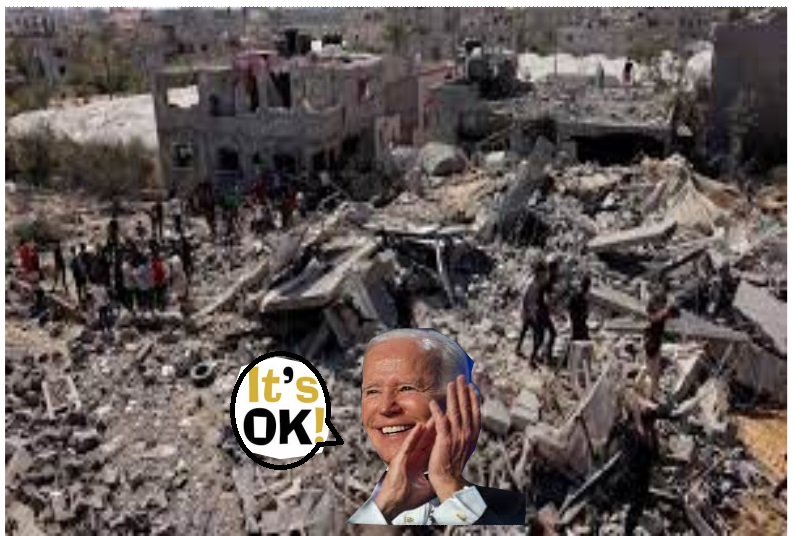
Biden is a willing scene partner in a barely disguised performance: pretending to be up in arms about Israel’s genocidal conduct while doing everything he can to support it.
While the White House claims to be “frustrated” with Israel’s conduct in Gaza, US support for the carnage continues.
AARON MATÉ, Substack, JAN 16, 2024
On October 15th, President Biden took umbrage at a suggestion that his administration could not back both the Ukraine proxy war and Israel’s assault on Gaza at the same time.
“We’re the United States of America for God’s sake, the most powerful nation… in the history of the world,” Biden told CBS News. “We can take care of both of these and still maintain our overall international defense.”
Three months and well over 20,000 defenseless Palestinians slain later, the self-declared leader of the most powerful nation in the history of world now claims to be a helpless bystander.
According to four US officials, Biden is “increasingly frustrated” and “losing his patience” with Israeli Prime Minister Benjamin Netanyahu, who has rejected “most of the administration’s recent requests related to the war in Gaza,” Axios reports. “The situation sucks and we are stuck,” one official complained. “The president’s patience is running out.” Another official fumes that “there is immense frustration” in the Oval Office. According to Democratic Senator Chris Van Hollen: “At every juncture, Netanyahu has given Biden the finger. They are pleading with the Netanyahu coalition, but getting slapped in the face over and over again.”
Van Hollen is correct that the administration is getting slapped in the face by Israel. But he omits that Biden is a willing scene partner in a barely disguised performance: pretending to be up in arms about Israel’s genocidal conduct while doing everything he can to support it.
As Likud parliamentarian Danny Danon explained last month, any US demand of Israel’s military is perfunctory. “They didn’t agree to a ground invasion — we invaded,” Danon said. “They didn’t agree to [attacking] Al-Shifa hospital — we ignored their request. They wanted a pause without hostages — we didn’t accept that. We have no American ultimatum. There is no deadline from the US.”
The US not only imposes no conditions on its support for Israel’s mass murder campaign in Gaza, but has twice bypassed Congress to expedite weapons for it. After all, this administration professes to have “no red lines” when it comes to Israeli aggression, and is fronted by a president who has declared that there is “no possibility” of a ceasefire.
While Biden and his aides now pretend to have their hands tied, their instrumental role is undeniable. “Biden is president of the United States, still the most powerful country in the world by almost every measure and a country without whose support Israel has no future,” former US diplomat Patrick Theros writes. “A firm public demand to cease and desist immediately would have enormous domestic political repercussions in Israel — far less in the United States. Biden would not have to publicly threaten to cut off weapons deliveries; a few words delivered in private to Netanyahu and a few members of his war cabinet would probably suffice.”
“If you want to use your leverage, use your leverage,” former Israeli negotiator Daniel Levy says of Biden’s stance. “You’ve chosen to give Israel a blank check.”

That choice continues. In meetings with Israeli officials on Nov. 30th, Secretary of State Antony Blinken informed his counterparts that they had “weeks, not months” to “wrap up combat operations at the current level of intensity,” US officials later told the New York Times. Upon a return visit to Israel this week, Blinken again touted his push for what he called “the phased transition of Israel’s military campaign in Gaza.” That “transition” to a “lower-intensity phase,” White House spokesperson John Kirby said on Sunday, “is coming here very, very soon.”
But away from the news cameras, the posture changes. A senior US official now explains to the Washington Post that it’s in fact “pointless to urge them [the Israelis] to change.” Accordingly, “Washington’s priority has now shifted to tolerating Israel’s high-intensity operation throughout January, while insisting instead that it downgrade the tempo in February.”
In other words, the US has decided to tolerate Israel’s genocidal tempo in Gaza as normal. From Washington’s point of view, saving thousands of Palestinian lives from murder at the hands of US-supplied weaponry would be pointless.
Biden is so committed to continuing the Gaza slaughter that he has even expanded the war zone to Yemen. ……………………………………………………………………………………………………………………………
“No one should have to endure even one day of what they have gone through, much less 100,” Biden said of the hostages. By refusing to acknowledge them, Biden is affirming via omission that he believes the exact opposite — and in fact infinitely worse — for Gaza’s two million Palestinian hostages. After 100 days of genocide, the people of Gaza are fated to endure continued atrocities as a direct result of US policy, no matter the Biden team’s ongoing effort to pretend otherwise.
https://www.aaronmate.net/p/biden-israels-accomplice-in-gaza?utm_source=post-email-title&publication_id=100118&post_id=140693425&utm_campaign=email-post-title&isFreemail=true&r=ln98x&utm_medium=email
US Offers Up To $500MM for Advanced Nuclear Fuel Production

by Jov Onsat, Rigzone Staff, Monday, January 15, 2024
The United States Department of Energy (DOE) is offering contracts worth up to $500 million in total for the production of a uranium fuel for smaller nuclear reactors, as it announced a breakthrough in an enrichment project
The request for proposals is for the enrichment of high-assay low-enriched uranium (HALEU). Currently this fuel is produced only in Russia and the US but only the former makes it at a commercial scale, according to the International Atomic Energy Agency (IAEA). The United Kingdom government earlier this month announced funding to enable domestic HALEU production.
“Currently, HALEU is not commercially available from U.S.-based suppliers, and boosting domestic supply could spur the development and deployment of advanced reactors in the United States”, the DOE noted in a press release announcing the funding offer……………………………………………………
Each contractor is assured of a minimum order value of $2 million. They must conduct enrichment and storage activities in the continental US and comply with the National Environmental Policy Act, the DOE said. Proposals are until March 8.
The $500 million offer includes a DOE request announced November for services to deconvert the uranium enriched through this funding into metal, oxide and other forms to be used as fuel for advanced reactor https://www.rigzone.com/news/us_offers_up_to_500mm_for_advanced_nuclear_fuel_production-15-jan-2024-175378-article/
Bypassing Parliament: Westminster, the Royal Prerogative and Bombing Yemen
Australian Independent Media, January 16, 2024, by: Dr Binoy Kampmark
There is something distinctly revolting and authoritarian about the royal prerogative. It reeks of clandestine assumption, unwarranted self-confidence and, most of all, a blithe indifference to accountability before elected representatives. That prerogative, in other words, is the last reminder of divine right, the fiction that a ruler can have powers vested by an unsubstantiated deity, the invisible God, and a punishing force beyond the reach of human control. It is anathema to democracy, a stain on republican models of government, a joke on any political system that has some claim on representing what might be called the broader citizenry.
On January 11, the UK government, in league with the United States with support from a number of other countries, attacked Houthi positions in Yemen. The decision had been made without recourse to Parliament and justified by Article 51 of the UN Charter as “limited, necessary and proportionate in self-defence.”
In his statement on the attacks, Prime Minister Rishi Sunak pointed to the Houthi’s role in staging “a series of dangerous and destabilising attacks against commercial shipping in the Red Sea, threatening UK and other international ships, causing major disruption to a vital trade route and driving up commodity prices.” He made no mention of the Houthis’ own justification for the attacks as necessary measures to disrupt Israeli shipping and interests in response to their systematic, bloodcurdling razing of Gaza.
Lip service has been paid by the executive within the Westminster system to Parliament’s importance in deciding whether the country commits to military action or not. The stark problem is that the action is always decided upon in advance, and no dissent among parliamentarians will necessarily sway the issue. Motions can be proposed and rejected but remain non-binding on the executive emboldened by the prerogative………………………………………………………………………………………………………..
The Yemen strikes eschew humanitarianism (the humanitarian justifications advanced by the Houthis in protecting Palestinian civilians has been rejected), but shipping interests. The Armed forces minister, James Heappey, was satisfied that an exception to the convention in consulting Parliament had presented itself. “The Prime Minister,” the minister parroted, “needs to make decisions such as these based on the military, strategic and operational requirements – that led to the timing.”
With the horse having bolted merrily out of the stable, Heappey remarked with all due condescension that Parliament would, in time, be able to respond to the decision to strike Yemen. An “opportunity” would be made available “when Parliament returns for these things to be fully discussed and debated.” The sheer redundancy of its role could thereby be affirmed.
Much agitated by this state of affairs, former shadow Chancellor John McDonnell opined that no military action should take place without Parliament’s approval. “If we have learnt anything in recent years it’s that military intervention in the Middle East always has dangerous & often unforeseen consequences. There is a risk of setting the region alight.”
Liberal Democrat Foreign Affairs spokesperson Layla Moran was of the view that Parliament should not be bypassed in matters of war, yet opting for the rather fatuous formula arising out of the 2011 convention. “Rushi Sunak must announce a retrospective vote in the House of Commons on these strikes, and recall Parliament this weekend.”
The use of the royal prerogative in using military force remains one of those British perversions that makes for good common room conversation but offends the sensibilities of the democratically minded elector. A far better practice would be to make the PM of the day accountable to that most essential body of all: Parliament. That same principle would be extended to other constitutional monarchies, which are similarly weighed down by the all too liberal use of the prerogative when shedding blood. If a country’s citizens are to go to war to kill and be killed, surely their elected representatives should have a say in that most vital of decisions? https://theaimn.com/bypassing-parliament-westminster-the-royal-prerogative-and-bombing-yemen/
 | |||
| |||
With friends like Netanyahu, President Biden needs a good war crimes defense lawyer

Walt Zlotow, West Suburban Peace Coalition, Glen Ellyn IL 15 Jan 24
Israeli Prime Minister Benjamin Netanyahu told the US Saturday that his 100 day war of genocidal ethnic cleansing of 2.3 million Palestinians in Gaza has got ‘MADE IN USA’ stamped all over it.
“This is not just our war – it is also your war. This is the war of the sons of light against the sons of darkness. This is a war against the axis of evil led by Iran and its three proxies: Hezbollah, Hamas, and the Houthis.”
Apparently, Netanyahu wants Joe to join him in the dock of potential genocidal ethnic cleansing charges currently being litigated at the International court of Justice.
“No one will stop us, not The Hague, not the axis of evil, and not anyone else,”Netanyahu boasted, knowing that the one man who can stop him, Joe Biden, is all in with billions in weapons to bomb virtually the entire Gaza population from their homes. In addition, Joe publicly supports the ongoing genocide, and gives Netanyahu veto proof protection in the UN Security Council.
After a 52 year political career supporting every senseless US war to the hilt, Biden is fading into oblivion a genocide denier, a genocide enabler. His overextended stay on the public stage is ending with the worst single criminal conduct toward humanity in US history. The best war crimes defense lawyers would be hard pressed to save him from conviction at The Hague should he end up there. But no one can save his soul from the harsh verdict of history.
São Tomé and Príncipe 70th State to ratify Treaty on the Prohibition of Nuclear Weapons

São Tomé and Príncipe has become the first new state party to the UN Treaty on the Prohibition of Nuclear Weapons (TPNW) in 2024. At UN Headquarters in New York on 15 January, the Minister of Justice of São Tomé and Príncipe, H.E. IIza Amado Vaz, deposited the instrument of ratification for this landmark treaty on behalf of the government, bringing the total number of states parties to 70.
The National Assembly of São Tomé and Príncipe unanimously approved ratification of the TPNW on 16 November 2023.
São Tomé and Príncipe’s ratification comes shortly after states parties to the TPNW renewed a “call for all States that have not yet done so to sign and ratify or accede to the Treaty without delay”, and reiterated their commitment to pursue universalisation of the Treaty as a priority, in a declaration issued at the second meeting of states parties of the treaty in New York in December 2023.
ICAN’s Executive Director, Melissa Parke, welcomed the move: “It’s great news that Sao Tome and Principe has ratified the Treaty which means it now has 70 states parties. As more and more countries join the TPNW they strengthen the new international norm it has created that makes nuclear weapons unacceptable. These are the responsible states in the international community, and we look forward to more ratifications and signatures in the year ahead.”
A total of 93 countries have signed the TPNW and 70 have ratified or acceded to it. In Africa, there are now 16 states parties and a further 17 signatories. The TPNW complements and reinforces the 1996 Treaty of Pelindaba, which established Africa as a nuclear-weapon-free zone. The states parties to the Treaty of Pelindaba have called upon all African Union member states “to speedily sign and ratify the [TPNW]”.
In January 2023, São Tomé and Príncipe was among the 37 African states that met in Pretoria, South Africa, for the African Regional Seminar on the Universalisation of the TPNW to promote adherence to the treaty by every African state as soon as possible.
Support for the TPNW
São Tomé and Príncipe was among the first countries to sign the TPNW at a high-level ceremony in New York when it opened for signature on 20 September 2017. Since then, it has promoted universal adherence to the TPNW, including by consistently voting in favour of an annual UN General Assembly resolution since 2018 that calls upon all states to sign and ratify the treaty “at the earliest possible date”.
São Tomé and Príncipe participated in the negotiation of the TPNW at the United Nations in New York in 2017 and was among 122 states that voted in favour of its adoption.
Former Polish PM admits Ukraine’s strategy failed
https://www.rt.com/russia/590598-poland-ukraine-fail/ 15 Jan 23
The conflict is “going in the wrong direction,” Mateusz Morawiecki told the UK’s Express newspaper
Ukraine’s 2023 counteroffensive was “not successful” and Russia has the upper hand strategically, former Polish prime minister Mateusz Morawiecki admitted, in an interview with Britain’s Express newspaper published on Friday.
The conflict in Ukraine is “not going in the right direction,” Morawiecki told the outlet, outlining his “huge concern” with a situation in which Moscow had apparently outflanked its opponents.
Russia has “huge resources,” he explained, noting the country’s military production capabilities significantly outweighed the EU’s own. “They have this strategic depth, and they have patience in international politics,” he added, also dismissing the country’s elections scheduled for March as mere “theater” unlikely to change the balance of power in Moscow.
Morawiecki also argued, however, that Ukraine’s failure had a silver lining for NATO in that it had brought Finland and Sweden into the alliance and was “awakening” countries like Denmark and Romania. The Scandinavian countries, he said, were among the most vocal in calling attention to the threat allegedly posed by Russia.
“Not only the security of the eastern flank of NATO, but also for the security of the United Kingdom, security of Germany, Denmark and the Scandinavians, they do understand it very, very well,” he said.
The former premier (2017-2023) was speaking to the British press for the first time since his successor, current PM Donald Tusk, had two lawmakers from Morawiecki’s Law and Justice Party (PiS) arrested earlier in the week. The ex-leader described the MPs as “political prisoners” and accused Tusk’s admittedly pro-EU government of “representing Brussels and Berlin, not Warsaw.”
While international attention has largely shifted away from the Ukraine conflict to Israel’s war with Gaza as the latter threatens to erupt into a broader conflict, UK Prime Minister Rishi Sunak traveled to Kiev on Friday to bestow his government’s largest gift yet on the government of Ukrainian President Vladimir Zelensky, announcing £2.5 billion ($3.2 billion) to be paid out over the coming financial year and starting in April, and a bilateral agreement that includes security guarantees for Ukraine “in the event that it is ever attacked by Russia again.”
Zelensky has been vocal about his concern over flagging international support for Kiev’s fight, after unprecedented amounts of foreign aid from the UK, US, and EU failed to appreciably move the needle against Russia. Legislative gridlock has stalled planned aid packages in the US even as the Biden administration insists on an urgency to it, with his political opposition countering that accountability for funds spent must be a requirement for any future aid.
Talks on Zelensky’s ‘peace formula’ are pointless – Kremlin

https://www.rt.com/russia/590675-zelensky-peace-formula-talks-useless/ 15 Jan 24
Russia’s absence means the negotiations in Davos could not have produced any concrete results, Dmitry Peskov has said
Top officials from dozens of countries who met in Switzerland to discuss Ukraine’s ‘peace formula’ were engaged in a completely useless endeavor without Russian participation, Kremlin spokesman Dmitry Peskov said on Monday.
On Sunday, national security advisers from 81 nations and international organizations gathered in Davos ahead of the World Economic Forum to talk about a 10-point initiative floated by Ukrainian President Vladimir Zelensky in October 2022 to end hostilities with Russia.
The plan calls for the withdrawal of Russian troops from the territory Kiev claims as its own and insists on the creation of a tribunal to prosecute Moscow for alleged war crimes. Russia has dismissed the proposal as divorced from reality.
Commenting on the Davos meeting, Peskov called it “talking for the sake of talking,” reiterating that the same applied to previous rounds of talks in such a format. “This process is not aimed and cannot be aimed at achieving a concrete result for an obvious and simple reason – we are not there.”
Russia was also absent from previous discussions last year in Denmark, Saudi Arabia, and Malta. At the same time, Moscow has never categorically refused peace talks with Kiev, despite Zelensky signing a decree banning all negotiations with the current Russian leadership after four regions overwhelmingly voted to join Russia in the autumn of 2022.
Meanwhile, Bloomberg reported on Sunday that the Davos talks had ended “with no clear path forward” despite Ukraine’s hopes that it would be able to secure backing for its plan from members of the Global South, many of whom have proclaimed neutrality in the conflict. That was denied by Ukrainian officials, however, who nevertheless acknowledged differences of opinion among the meeting’s participants.
On Sunday, Swiss Foreign Minister Ignazio Cassis echoed Peskov’s remarks, arguing that any Ukraine peace talks should involve Russia in one way or another.
Screams without proof: questions for NYT about shoddy ‘Hamas mass rape’ report
The public now knows that many Israeli noncombatants were killed by their country’s military on October 7. They know this largely thanks to the work of The Grayzone and other independent outlets. We were initially attacked for our work, but now Israeli media is demanding answers as well. Major legacy media organizations like yours continue to ignore serious political scandals like these while pursuing factually-challenged, shamefully unethical journalistic efforts aimed at legitimizing the Israeli government’s public relations objectives.
Haaretz reported on January 4, “The police are having difficulty locating victims of sexual assault from the Hamas attack, or people who witnessed such attacks, and decided to appeal to the public to encourage those who have information on the matter to come forward and give testimony. Even in the few cases in which the organization collected testimony about sexual offenses committed on October 7, it failed to connect the acts with the victims who were harmed by them.”
Were you aware, as The Grayzone documented, that Landau’s previous claims of having seen beheaded babies and a fetus cut from a dead woman’s womb on October 7 have been discredited not only by the Israeli newspaper by Haaretz, but by the Biden White House, which retracted the president’s claim that he had seen photographs of beheaded babies? In fact, only one baby is recorded among those killed on October 7, which means any claim to have seen multiple dead babies must be dismissed out of hand.
MAX BLUMENTHAL AND AARON MATÉ·JANUARY 10, 2024, https://thegrayzone.com/2024/01/10/questions-nyt-hamas-rape-report/—
After dismantling a New York Times front page feature alleging “a broader pattern of gender-based violence on Oct. 7” by Hamas, The Grayzone is demanding answers of the paper for its journalistic malpractice.
The following was submitted to New York Times editors and lead author, Jeffrey Gettleman.
The Grayzone has identified serious issues with the credibility of key sources quoted in the New York Times’ December 28 story, “Screams Without Words: How Hamas Weaponized Sexual Violence on October 7.” Authored by Jeffrey Gettleman, Anat Schwartz, and Adam Sella, the article purports to prove “a broader pattern of gender-based violence on Oct. 7” than even Israeli authorities have been willing to allege . However, the Times report is marred by sensationalism, wild leaps of logic, and an absence of concrete evidence to support its sweeping conclusion.
The Times has come under fire from family members of Gal Abdush, the so-called “girl in the black dress” who features as Exhibit A in Gettleman and company’s attempt to demonstrate a pattern of rape by Hamas on October 7. Not only have Abdush’s sister and brother-in-law each denied that she was raped, the former has accused the Times of manipulating her family into participating by misleading them about their editorial angle. Though the family’s comments have sparked a major uproar on social media, the Times has yet to address the serious breach of journalistic integrity that its staff is accused of committing.
The Israeli police have also issued a statement since the publication of the Times’ article asserting that they themselves are unable to locate eyewitnesses of rape on October 7, or to connect the testimonies published by outlets like the Times with anything remotely resembling evidence.
We call on the New York Times to publicly address the comments by the Abdush family accusing Times reporters of misleading them and lying about the circumstances of her death. The Times must also address the statement issued by Israel’s police subsequent to the article’s publication and explain why Gettleman and his co-authors apparently omitted it.
Further, we demand a response to our thoroughly sourced debunking of testimony by key witnesses quoted in the story, as well as the documented record of discredited claims and ethically dubious activity by those same witnesses.
We have provided several questions for your consideration. If you are unable to furnish responses which satisfactorily address the issues we have raised about the credibility of your article, we believe it must be retracted in full.
Family of “the girl in the black dress” accuses NYT of having “invented” rape claim
Continue reading‘Transported in Cages’ – Shocking Details of How Israel Treats Female Gaza Prisoners
January 5, 2024, By Fayha Shalash – Ramallah, https://www.palestinechronicle.com/transported-in-cages-shocking-details-of-how-israel-treats-female-gaza-prisoners/
This is a difficult, but critical read. The collective hardship experienced by Gaza’s female prisoners in Israel is unprecedented even within the tragic history of Israel’s treatment of Palestinian prisoners. The Palestine Chronicle reports ..
The names of 51 female prisoners, illegally detained by invading Israeli forces during their ground operation in Gaza, have been revealed.
This number was announced by the Palestinian Prisoners’ Affairs Authority in a statement, without confirming whether there are other female prisoners secretly detained in Israel.
Regardless of the exact number, however, the testimonies that were collected from released prisoners reveal shocking abuse, ill-treatment and torture.
The Palestine Chronicle spoke with Lama Khater, from Al-Khalil (Hebron), who was arrested on October 26 and released under the prisoner exchange deal between the Israeli government and the Palestinian Resistance on November 30.
Khater was detained along with ten female prisoners from Gaza and witnessed the abuse they were subjected to.
Arbitrary Arrest
Khater said the conditions of female prisoners from Gaza were particularly difficult, starting with their kidnapping during their displacement from the northern Gaza Strip.
“They were arrested randomly, mostly from the northern Gaza Strip. Israeli soldiers detained mothers, too, who have been forced to leave their children with passers-by,” she stressed.
Khater recounted that before arriving at Damon Prison, the female detainees were left without covers, subjected to humiliating strip searches and forced to sleep on the bare floor.
When they were brought into the prisons, they were blindfolded, handcuffed, and deprived of their hijab, said Khater.
They were reportedly placed in narrow cells in Damon Prison and not allowed to speak to the rest of the female prisoners from the occupied West Bank and Palestine 48.
“All female prisoners are subjected to great restrictions,” Khater said, “but the prisoners from Gaza were treated even worse.”
“For example, they are only allowed to shower in large groups of at least 50 women, and for not more than 15 minutes a day”.
Khater said that on December 10 and 11, five female prisoners from the Gaza Strip were taken out of Damon prison. Their current location is not yet known.
Among the female Gazan prisoners, some are in a particularly difficult state; an 80-year-old woman who suffers from Alzheimers and a pregnant woman. Both are subjected to medical negligence.
Held in Cages
The Palestine Chronicle also spoke with Palestinian lawyer Hassan al-Abadi, who collected the testimonies of several female prisoners in Damon.
Al-Abadi, who volunteered to visit the female prisoners, submitted his first request to the Israeli Prison Administration on November 30, but was told in response that there were no longer female prisoners in the detention facility.
A few days later, however, media reports revealed that dozens of female prisoners, from Gaza, Jerusalem and Palestine 48, were still held there.
Al-Abadi confirmed to The Palestine Chronicle that there are over 40 female prisoners from Gaza in the facility, but they are prohibited from seeing a lawyer.
“When I would visit any female prisoner from the West Bank or Jerusalem, she would tell me about the harsh conditions of detention of the prisoners from the Gaza Strip,” he said.
Al-Abadi said he was particularly disturbed by the way Israeli forces transported the female detainees from Gaza to the prisons.
According to the lawyer, they were placed in trucks carrying cages similar to those used for animal transport.
“This detail particularly hurt me: these women have been transported in animal trucks. They have been tied, blindfolded and stripped of their head covering, as a way to humiliate them,” al-Abadi said.
Stained with Blood
The lawyer also said that when the female detainees arrived at the prison, their clothes were stained with blood. Most of them were also bleeding from their hands, as the plastic chains had been tightly tied around their wrists for days.
Upon their arrival, they were distributed into three rooms, each containing six iron beds. Most of them were reportedly forced to sleep on the floor without pillows or mattresses.
“The prisoners told me that the food is also very bad and that the Israeli guards deliberately leave it on their cells’ doors for hours, until it turns cold. The water has a rusty taste as well,” al-Abadi said.
“The female detainees from Gaza are even forbidden from talking to the rest of the prisoners and they have to communicate in secret.”
Al-Abadi shared that one of the women had to leave her four children in Gaza. The eldest was only eight years old, the youngest an infant.
According to the testimony from other prisoners, the woman was walking on Salah Al-Din Street, fleeing from the north of the Gaza Strip, when the Israeli soldiers arrested her.
“When she learned that she would be under arrest, she immediately handed her children to a boy who was walking in the street and told him to take care of them,” al-Abadi said.
“I learned from the other prisoners that she asked about her children every day, crying inconsolably, but nobody was updating her on their fate.”
A few days ago, however, al-Abadi was able to deliver a verbal message to this woman, that her children had eventually reached their father. “This time, she cried out of joy,” he said.
Great Concern
According to al-Abadi, these women are not only suffering due to the extremely cruel conditions of their detention but because they are constantly concerned about their families.
They do not know the fate of their children as Israel continues to relentlessly bombard Gaza.
“They are not allowed to hear the news or follow what is happening in any way. They are isolated from the outside world and don’t know anything,” al-Abadi explained.
But there are other forms of violation carried out by Israeli authorities. Al-Abadi told us that the prison administration prevents these women from bringing along sanitary pads
Therefore, during their period, they are forced to wash their clothes daily and wear them when they are still wet, as the prison administration does not provide them with additional clothes. They only have what they were wearing at the time of arrest.
Israel considers men and women detained in the Gaza Strip to be prisoners of war under the so-called “unlawful combatants” law. Therefore, it prevents them from having contact with lawyers and human rights institutions.
(The Palestine Chronicle) – Fayha’ Shalash is a Ramallah-based Palestinian journalist. She graduated from Birzeit University in 2008 and she has been working as a reporter and broadcaster ever since. Her articles appeared in several online publications. She contributed this article to The Palestine Chronicle.
1 This Month
23 April – WEBINAR – Why new nuclear reactors are the wrong tools for decarbonization Thursday, April 23 • 1 AM – 2 AM AEST
World Nuclear Power. Reactors 1951-2026, 75 Years of Nuclear Power.
Interactive Map– https://dv.worldnuclearreport.org/
Chernobyl: The Lost Tapes – A good documentary on Chernobyl on SBS available On Demand for the next 3 weeks– https://www.sbs.com.au/ondemand/tv-program/chernobyl-the-lost-tapes/2352741955560

of the week–London Campaign for Nuclear Disarmament

Tell the Ukrainian Government to Drop Prosecution of Peace Activist Yurii Sheliazhenko
To see nuclear-related stories in greater depth and intensity – go to https://nuclearinformation.wordpress.com
-
Archives
- April 2026 (231)
- March 2026 (251)
- February 2026 (268)
- January 2026 (308)
- December 2025 (358)
- November 2025 (359)
- October 2025 (376)
- September 2025 (257)
- August 2025 (319)
- July 2025 (230)
- June 2025 (348)
- May 2025 (261)
-
Categories
- 1
- 1 NUCLEAR ISSUES
- business and costs
- climate change
- culture and arts
- ENERGY
- environment
- health
- history
- indigenous issues
- Legal
- marketing of nuclear
- media
- opposition to nuclear
- PERSONAL STORIES
- politics
- politics international
- Religion and ethics
- safety
- secrets,lies and civil liberties
- spinbuster
- technology
- Uranium
- wastes
- weapons and war
- Women
- 2 WORLD
- ACTION
- AFRICA
- Atrocities
- AUSTRALIA
- Christina's notes
- Christina's themes
- culture and arts
- Events
- Fuk 2022
- Fuk 2023
- Fukushima 2017
- Fukushima 2018
- fukushima 2019
- Fukushima 2020
- Fukushima 2021
- general
- global warming
- Humour (God we need it)
- Nuclear
- RARE EARTHS
- Reference
- resources – print
- Resources -audiovicual
- Weekly Newsletter
- World
- World Nuclear
- YouTube
-
RSS
Entries RSS
Comments RSS
 nuclear-news
