How France left the British taxpayer on the hook as Hinkley costs go nuclear
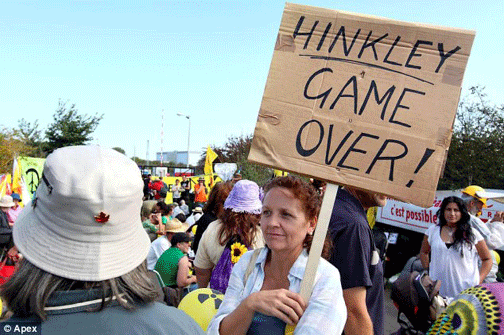
the Government will have to
put more taxpayer cash in and guarantee the debt.
Sizewell C was also likely to be put on ice unless British ministers came up with a big extra dollop of taxpayers’ money.
A series of cost overruns and delays are undermining the UK’s nuclear power revival
Jonathan Leake, 28 January 2024
For the future of Britain’s energy security it was a crucial decision,
and one that lay in the hands of France’s biggest power supplier.
However, not a single minister or civil servant was present when the
directors of EDF decided the fate of the UK’s two biggest nuclear
projects in their Paris boardroom on Tuesday. The finances of Hinkley Point
C and Sizewell C, the nuclear power stations which might one day supply
14pc of Britain’s electricity were top of the agenda. Shortly after the
meeting ended, Luc Remont, EDF’s managing director, and his colleagues
summoned their media managers to organise a briefing for analysts and
journalists.
Hinkley Point C, they were told, stood no chance of firing up
in 2027, as once promised. Its first reactor would come online around 2031
while the second has no date promised at all. Costs have surged again to
£46bn, a far cry from the £9bn EDF suggested when pushing the idea to
politicians around 2007 or the £24bn proposed when contracts were signed
in 2016.
Sizewell C was also likely to be put on ice unless British
ministers came up with a big extra dollop of taxpayers’ money.
Meanwhile, as EDF’s directors and French civil servants decided Britain’s nuclear
future in Paris, Andrew Bowie, the minister responsible for new nuclear
projects, was on his feet in parliament, talking up the UK’s prospects.
For Claire Coutinho, the Energy Secretary, the news was infuriating. Not
only had a decision vital to the UK been taken in Paris but it came just
days after she unveiled the Government’s long-awaited Nuclear Roadmap. A
statement rushed out that evening made clear that Coutinho blamed the
French for Hinkley’s extra costs and delays. “Hinkley Point C is not a
government project and so any additional costs or schedule overruns are the
responsibility of EDF and its partners and will in no way fall on
taxpayers,” a spokesman for her department said.
The comments irritated the French enough to hold a second round of media briefings, this time involving EDF’s owners, the French government. The UK, it was made clear,
would have to offer up billions of pounds more in taxpayers’ money if
Sizewell C was ever to be built. Coutinho subsequently pledged an extra
£1.8bn of taxpayers’ money for the project.
Meanwhile, EDF has refused
to up its stake from 20pc and Bowie has admitted he now needs to raise
£20bn of private finance, most likely meaning the Government will have to
put more taxpayer cash in and guarantee the debt.
Simon Taylor, professor of finance at Cambridge University, who specialises in the economics of nuclear energy, believes EDF’s reactor designs have some fundamental
flaws. “The EPR or European Pressurised Reactor were designed to be
incredibly safe, and to reassure people, after the Chernobyl disaster of
1986 but have turned out to be just much more difficult to build than
anyone had expected,” he says.
Amid a blame game between France and the
UK, the biggest loser remains the British taxpayer. They now face several
more years of reduced energy security and the prospect of power bills hikes
to raise the £20bn-plus bill for Sizewell C.
Telegraph 28th Jan 2024
https://www.telegraph.co.uk/business/2024/01/28/edf-hinkley-point-c-costs-go-nuclear-uk-taxpayer/
No comments yet.
1 This Month
Chernobyl: The Lost Tapes – A good documentary on Chernobyl on SBS available On Demand for the next 3 weeks– https://www.sbs.com.au/ondemand/tv-program/chernobyl-the-lost-tapes/2352741955560

of the week–London Campaign for Nuclear Disarmament

Tell the Ukrainian Government to Drop Prosecution of Peace Activist Yurii Sheliazhenko
To see nuclear-related stories in greater depth and intensity – go to https://nuclearinformation.wordpress.com
-
Archives
- April 2026 (126)
- March 2026 (251)
- February 2026 (268)
- January 2026 (308)
- December 2025 (358)
- November 2025 (359)
- October 2025 (376)
- September 2025 (257)
- August 2025 (319)
- July 2025 (230)
- June 2025 (348)
- May 2025 (261)
-
Categories
- 1
- 1 NUCLEAR ISSUES
- business and costs
- climate change
- culture and arts
- ENERGY
- environment
- health
- history
- indigenous issues
- Legal
- marketing of nuclear
- media
- opposition to nuclear
- PERSONAL STORIES
- politics
- politics international
- Religion and ethics
- safety
- secrets,lies and civil liberties
- spinbuster
- technology
- Uranium
- wastes
- weapons and war
- Women
- 2 WORLD
- ACTION
- AFRICA
- Atrocities
- AUSTRALIA
- Christina's notes
- Christina's themes
- culture and arts
- Events
- Fuk 2022
- Fuk 2023
- Fukushima 2017
- Fukushima 2018
- fukushima 2019
- Fukushima 2020
- Fukushima 2021
- general
- global warming
- Humour (God we need it)
- Nuclear
- RARE EARTHS
- Reference
- resources – print
- Resources -audiovicual
- Weekly Newsletter
- World
- World Nuclear
- YouTube
-
RSS
Entries RSS
Comments RSS
 nuclear-news
Leave a comment