Are the French going cold on UK nuclear?

‘It would be madness to give Sizewell C the final go-ahead while the questions of whether Hinkley C can be finished, and who pays, are not resolved. Sizewell C is bound to take longer and cost more, but this time it would be we consumers who would bear the risk and pay the price through the “nuclear tax” on our energy bills.’.
The French government, which was previously relaxed about EDF’s forays into UK nuclear, now wants its energy company to work on projects back home in France.
So far, Britain has put £2.5billion into the project in total and taxpayers are the biggest shareholders. Campaigners who vehemently oppose the project are alarmed by the recent comments from Paris, pointing out that if the French back off from Sizewell, taxpayers could be on the hook for huge extra amounts of cash via their bills.
By FRANCESCA WASHTELL , 28 January 2024, https://www.thisismoney.co.uk/money/markets/article-13015713/Are-French-going-cold-UK-nuclear.html
Our nuclear industry is reawakening,’ energy secretary Claire Coutinho
declared in a Government strategy document published earlier this month. In
between invoking Winston Churchill’s enthusiasm for nuclear power and its
ability to help the UK reach net zero, Coutinho added that setting up new
plants would ensure our energy security ‘so we’re never dependent on the
likes of [Vladimir] Putin again’. Fighting talk. But in the space of a
fortnight, Coutinho’s gung-ho attitude has already been dented as a
diplomatic row brews over who should pay for the controversial power
stations.
French state-owned energy company EDF last week lit the blue
touchpaper with the revelation the UK’s flagship Hinkley Point C nuclear
plant in Somerset would be delayed until 2029 at the earliest. The cost, it
added, could spiral to as much as £46billion, from initial estimates of
£18billion.
Few in the industry will have been surprised, particularly as EDF has experienced delays on similar projects in Finland and France. But what was a shock were some incendiary remarks from the French government.
The Elysee Palace began pressing the UK to help plug a funding gap at Hinkley and for good measure cast doubt over its commitment to Sizewell C, the next nuclear power station in the pipeline.
A French Treasury official suggested the Government was trying to leave EDF in the lurch on Hinkley.
The official added that it cannot, at the same time, abandon the French firm to ‘figure it out alone’ on Hinkley and also expect it to plough money into Sizewell. It is, the official said, ‘a Franco- British matter,’ and not one for the French to resolve single-handedly.
This is a bad moment for two critical new nuclear plants – and our broader energy security – to be dragged into a cross-Channel tussle.
The French government, which was previously relaxed about EDF’s forays into UK nuclear, now wants its energy company to work on projects back home in France.
Well-placed UK sources deny the French claims that EDF has been left to shoulder the financing burden alone at Hinkley, or that it has been jettisoned by the British state.
They point to the fact EDF has all along had contractual obligations to shoulder the costs at this stage of the project. The early stages of developing Hinkley were undertaken by EDF along with China General Nuclear.
The Chinese firm has fulfilled its part of the bargain, leaving the onus on the French. ‘It’s all down to the French state,’ a senior industry source told The Mail on Sunday. ‘It’s tough, but they’ve not managed it at all well.’
A Department for Energy Security and Net Zero spokesman said: ‘The Government plays no part in the financing or operation of Hinkley Point C. The financing of the project is a matter for EDF and its shareholders.’
As well as backing Hinkley, EDF several years ago began serious talks with the Government over Sizewell C in Suffolk. Each could power an estimated 6 million homes for 60 years, meaning the two projects are linchpins for meeting future energy demand.
The French group is due to take a 20 per cent stake in Sizewell. The Government has previously indicated it will take 20 per cent. It was hoped the rest would be funded through money from the private sector, such as pension funds and sovereign wealth funds.
So far, Britain has put £2.5billion into the project in total and taxpayers are the biggest shareholders. Campaigners who vehemently oppose the project are alarmed by the recent comments from Paris, pointing out that if the French back off from Sizewell, taxpayers could be on the hook for huge extra amounts of cash via their bills.
The new type of funding structure for Sizewell C means consumers will already face an added tax to help pay for the plant.
Alison Downes of the Stop Sizewell C campaign group said: ‘It would be madness to give Sizewell C the final go-ahead while the questions of whether Hinkley C can be finished, and who pays, are not resolved. Sizewell C is bound to take longer and cost more, but this time it would be we consumers who would bear the risk and pay the price through the “nuclear tax” on our energy bills.’
And another area of the industry is watching the fracas with mounting frustration.
Companies vying to build ‘mini’ stations known as small modular reactors (SMRs) hope this prompts the Government to commit instead to their projects, which are quicker to build and cheaper [?]
The firms include Rolls-Royce SMR, which has already received significant funding from the Government. New nuclear plants of whatever size will almost certainly be part of the UK’s energy mix in the years to come.
The sector had already been championed by Boris Johnson before soaring oil and gas prices in the wake of Russia’s invasion of Ukraine highlighted Britain’s dependence on overseas energy.
Any fisticuffs with France over Hinkley and Sizewell would strain the sector and could fatally damage the level of public. Industry figures are urging ministers to resist stumping up cash the French had agreed to pay.
One senior source said: ‘I hope the Government doesn’t lose its nerve, though there’s no sign of that at the moment. It would be a terrible precedent.’
.
Hinkley Point C woes threaten to break UK and France’s nuclear fusion

Two former EDF executives told the Guardian the odds were stacked against Hinkley from the start. “I would have bet at the time that we would see the costs we have today. And I think they’ll climb higher too,” said one.
Cross-Channel dream is turning sour as EDF’s costs mount and Britain faces a long wait for the power to come on
Jillian Ambrose, 27 Jan 24, https://www.theguardian.com/uk-news/2024/jan/27/hinkley-point-c-woes-threaten-break-uk-france-nuclear-fusion
rench trade unions wield significant political clout. But in the summer of 2016 there was little they could do to stop the French government from investing in what would soon become the most expensive power station in the world.
All six trade union representatives on the board of Électricité de France (EDF) voted against a deal to build a nuclear power station in the UK. It was just weeks after its finance chief, Thomas Piquemal, resigned from the company over fears that Hinkley Point C in Somerset was too great a risk. The project was approved by 10 in favour and seven against.
In the last seven years these fears have proved well founded. EDF revealed this week the latest delay to Hinkley, which may not now open until 2031, well beyond its original decade-long schedule. Its costs have climbed to £35bn in 2015 prices, almost double the original forecast of £18bn in 2016. In today’s money Britain’s first new nuclear plant in 30 years could cost £46bn. The spiralling costs were blamed on inflation, Covid and Brexit.
Hinkley was meant to represent a nuclear renaissance on both sides of the Channel, and further the nuclear ambitions of China. It was an opportunity for EDF, once the world’s leading nuclear developer, to secure a future for its reactor designs in a low-carbon world.
For the UK, the first new nuclear power plant in a generation marked the start of the government’s campaign to replace its ageing fleet of reactors. And China saw it as a way to showcase its nuclear expertise, furthering its ultimate aim of building its homegrown HPR1000 nuclear reactors at Bradwell in Essex.
The deal was struck in 2016 just weeks after the Brexit vote, making Hinkley an opportunity to forge fresh ties between old friends – and create opportunities for new economic alliances too. China General Nuclear Power Group (CGN), a state-run energy company, agreed to take on a third of the project as the first step in a plan to roll out a string of nuclear plants in the UK built with its own reactor design.
The chancellor at the time, George Osborne, argued that Britain should “run towards China” to help boost the UK economy. Within months of the Hinkley deal the French president, Emmanuel Macron, and his Chinese counterpart, Xi Jinping, began talks on strengthening ties between the two nations. These led to trade deals worth about $15bn (£11.8bn) and an order from Beijing for 300 aircraft from Airbus worth tens of billions of euros.
But the rationale for all three nations now looks precarious. Hinkley’s costs have climbed as diplomatic relations between China and the west have soured. By the time the former UK prime minister Boris Johnson vowed to purge China’s Huawei from the UK’s telecoms network over security fears, the notion of Chinese-built nuclear reactors powering British homes had become politically unthinkable. CGN has ruled out any further investment in Hinkley – leaving French taxpayers to pick up the tab.
Two former EDF executives told the Guardian the odds were stacked against Hinkley from the start. “I would have bet at the time that we would see the costs we have today. And I think they’ll climb higher too,” said one.
Philippe Huet, a former head of EDF’s internal auditing in Paris, said the deal was based on political strategy rather than a commercial rationale. The British government offered EDF a contract that would guarantee payment of £92.50 for every megawatt hour of electricity generated by the nuclear plant. It was criticised for being both eye-wateringly expensive for UK bill payers but not nearly enough to cover the risks of constructing the project.
“At the time that it was agreed it was already known that EDF’s estimates understated the cost and schedule of the project. Key decision-makers chose to ignore this because it was too important strategically. As they would say, if a project cannot be profitable it must at least be strategic,” Huet said.
Hinkley is one of many costs facing the French taxpayer after the government renationalised EDF last year. The company’s future investments – in maintaining its existing fleet of nuclear reactors, building new ones, and investing in renewable energy – could exceed €20bn (£17bn) a year, according to Agnès Pannier-Runacher, the country’s energy transition minister.
The French government is reportedly calling on the UK government to provide financial help for both Hinkley and the next planned plant, Sizewell in Suffolk, to keep the struggling nuclear revival afloat. The UK government has been quick to quash any suggestion that Hinkley’s financial fallout will be borne by UK taxpayers. A spokesperson said the government “plays no part in the financing or operation of Hinkley Point C”, which was a matter for EDF and its shareholders.
Huet has predicted that EDF may even try to renegotiate its contract with the government. He estimates it could seek to raise how much it charges per megawatt hour of electricity produced by about 15% to make Hinkley a worthwhile venture.
Cost of UK’s flagship nuclear project blows out to more than $A92 billion
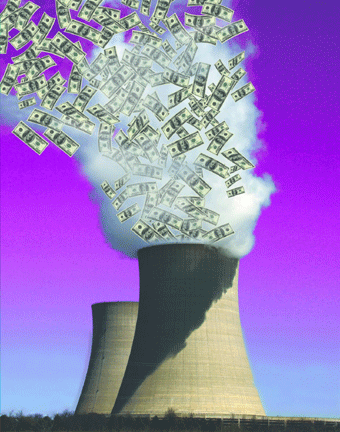
But it also has implications for Australia, because one its main political groupings, the right-wing Liberal and National Party coalition, has decided that Australia should abandon its current plan to dump coal for renewables and storage, and wait for nuclear instead.
Australia currently has a target of 82 per cent renewables by 2030, and AEMO’s latest Integrated System Plan suggests it could be close to 100 per cent renewables within half a decade after that.
Giles Parkinson, Jan 29, 2024, https://reneweconomy.com.au/cost-of-uks-flagship-nuclear-project-blows-out-to-more-than-a92-billion/
The cost of the flagship nuclear project in the United Kingdom has blown out again, this time to a potential $A92.6 billion as a result of yet more problems and delays at the Hinkley C project.
The latest cost blowout was revealed last week by the French-government owned EdF, whose former CEO had originally promised in 2007 that the Hinkley project would be “cooking Christmas turkeys” in England by 2017, at a cost of just £9 billion.
But like virtually every major nuclear project built in western economies, that ambitious deadline was never going to be met. The new start-up date is now for 2030, but more likely 2031 – and that is only for one of the two units.
The budget has leaped from the original promise of £9 billion, to £18 billion, and has since blown out multiple times to now reach £31 billion and £34 billion, and it could be more than £35 billion “in 2015 values,” according to EdF. This translates into current day prices, according to Michael Liebreich, the former head of Bloomberg New Energy Finance, of £48 billion, or $A92.6 billion.
“The cost of civil engineering and the longer duration of the electromechanical phase (and its impact on other work) are the two main reasons for this cost revision,” EdF said in its statement. It has also experienced massive cost over-runs and delays at other similar projects in Flammanville in Fance and Olkiluoto in Finland.
It is yet another crippling blow to the UK plans to make nuclear a centrepiece of its green energy transition. EdF has already had to be bailed out by its own government, and ultimately nationalised, because of the cost blowouts and the huge costs of buying replacement power when half its French nuclear fleet went offline in 2023.
China’s CGN had to be brought in to fund one third of the Hinckley project, but is refusing to contribute more funds because China has been frozen out of other UK projects.
Alison Downes of Stop Sizewell C, a campaign group opposed to the planned Suffolk nuclear plant, told the Financial Times that EDF and the Hinkley project was an “unmitigated disaster”.
She added the UK government should cancel Sizewell C, saying state funding for the project could be better spent on “renewables, energy efficiency or, in this election year, schools and hospitals”.
But it also has implications for Australia, because one its main political groupings, the right-wing Liberal and National Party coalition, has decided that Australia should abandon its current plan to dump coal for renewables and storage, and wait for nuclear instead.
The Coalition had been pushing so-called small modular reactors, but after the failure of the leading technology developer in the US last year, and confirmation by the CSIRO and the Australian Energy Market Operator that SMR costs would be three times more expensive than renewables, several key Coalition members pointed to large scale nuclear such as Hinckley.
Australia currently has a target of 82 per cent renewables by 2030, and AEMO’s latest Integrated System Plan suggests it could be close to 100 per cent renewables within half a decade after that.
This switch to low carbon electricity is critical for Australia’s emissions targets, and for emission cuts in other parts of the economy. Any delay in the roll-out of renewables, in the expectation that nuclear would fill its place, will push that timeline out by at least another decade, if not, and blow out the costs of the energy transition.
“It is not like cost over-runs in nuclear projects are a big secret,” Liebreich writes on his Sub-stack blog.
He cites the world’s leading academic expert on project management, Danish Professor Bent Flyvbjerg, author of How Big Things Get Done, who shows that nuclear plants are worse only than Olympic Games in terms of cost over-runs.
“On average they go 120% over the budget, with 58% of them going a whopping 204% over budget,” Liebreich writes.
The Coalition energy spokesman Ted O’Brien complained in December that the CSIRO/AEMO report focused only on the “investment” cost, and not the “consumer cost.”
It’s not clear what he means by that. But as Liebreich notes, while Hinkley’s construction costs are in the £42 to £48 billion range, its first 35 years of electricity at £87.50 or £92.50/MW in 2012 money, adjusted for inflation, will cost UK energy users a gargantuan £111 or £116 billion, or up to $A223 billion.
Hinkley Point C delay deals blow to UK energy strategy
“We have the expertise, the supply chains and the teams ready to build
Hinkley Point C safely, on time and on budget,” Vincent de Rivaz, then
chief executive of EDF, said in 2016 as the project to build the UK’s
first nuclear power station since the 1990s got under way.
That confidence has proven misplaced. Earlier this week, the French state-owned utility
announced the latest in a series of delays and cost overruns to the 3.2
gigawatt plant under construction in Somerset. The setback to a plant that
is meant to supply electricity to 6mn homes has raised fresh questions
about the UK’s energy strategy and its push to decarbonise the grid over
the next decade as part of its goal to reach net zero by 2050.
Analysts at LSEG estimated the latest delays to the plant would push wholesale power
prices up by as much as 6 per cent between 2029 and 2032, based on the
assumption that unit two would come online in 2033. EDF is looking at ways
to help mitigate the latest delay. Two weeks ago it said it was examining
plans to further extend the life of its four oldest plants, which use
advanced gas-cooled reactor technology and date back to the 1980s.
But
there is still some doubt about that plan. Jerry Haller, EDF’s former
decommissioning director, told a parliamentary committee inquiry in 2022
that nothing could be done to extend the life of the AGR fleet again. “No
further investment will take them further,” he said at the time. EDF said
since those comments further inspections of the reactor cores had “been
better than, or in line with, our expectations”. It had already decided
last year to keep two of the plants — Heysham 1 and Hartlepool — open
until at least 2026.
But even if more life can be eked out of existing
reactors, the problems besetting Hinkley Point C have raised wider
questions about how the UK will reach its 24GW nuclear build target by
2050.
FT 27th Jan 2024
https://www.ft.com/content/55ef86b4-f55c-47a9-8121-c6c8cf6b5b18
2
Still no end in sight for Fukushima nuke plant decommissioning work
January 27, 2024 (Mainichi Japan), https://mainichi.jp/english/articles/20240127/p2a/00m/0na/003000c
OKUMA, Fukushima — Nearly 13 years since the triple-meltdown following the March 2011 Great East Japan Earthquake and tsunami, it is still unclear when decommissioning of the Fukushima Daiichi Nuclear Power Station’s reactors will be completed.
Operator Tokyo Electric Power Company (TEPCO) Holdings Inc. showed the power plant to Mainichi Shimbun reporters on Jan. 26 ahead of the 13th anniversary of the nuclear accident. Radiation levels in many areas are almost normal, and people can move in ordinary work clothes. However, the most difficult part of the work, retrieving melted nuclear fuel, has been a challenge. The management of solid waste, which is increasing daily, also remains an issue. The decommissioning of the reactors, which is estimated to take up to 40 years, is still far from complete.
Meltdowns occurred in reactor Nos. 1, 2 and 3. The start of nuclear fuel debris removal at reactor No. 2, which had been scheduled to begin by the end of fiscal 2023, has just been postponed for the third time. Reactor buildings are still inaccessible due to high radiation, meaning the work has to be done remotely.
More than 1,000 tanks for storing treated wastewater are lined up next to reactor Nos. 1 through 4, and new facilities to stably store and process approximately 520,000 cubic meters of existing solid waste are being built by reactor Nos. 5 and 6.
Treated wastewater began being discharged into the ocean in 2023, and the tanks are gradually being removed, but there is no timetable for the disposal of the solid waste. A TEPCO representative said, “The final issue that remains is how to deal with the radioactive waste that continues to be produced even as the decommissioning of the plant progresses.”
Japanese original by Yui Takahashi, Lifestyle, Science & Environment News Department)
International Coalition to Stop Genocide in Palestine Welcomes World Court’s Order

By the International Coalition To Stop Genocide In Palestine, Popular Resistance., January 26, 2024 https://popularresistance.org/international-coalition-to-stop-genocide-in-palestine-welcomes-todays-icj-order/—
Demands Its Implementation.
The ICGSP encourages governments and global social movements to demand that provisional measures are enforced immediately.
In its provisional ruling issued today on the South African Genocide Convention case against Israel, the International Court of Justice (ICJ—also known as the World Court) demanded Israel stop killing civilians and destroying civilian infrastructure and medical facilities; prevent and punish incitement to genocide by its top officials; and permit the delivery of humanitarian aid to Gaza. The International Coalition to Stop Genocide in Palestine (ICSGP) applauds the Court’s Order as a crucial first step toward forcing Israel and its primary sponsor and strongest political ally—the United States—to end the months-long brutal assault on Gaza, and the decades-long denial to Palestinians of their rights to self-determination and return.
However, the ICSGP also recognizes that Israeli and U.S. government officials have made repeated official declarations in the past week making clear their plan to ignore the ICJ’s legally binding ruling and rejecting the Court’s process as illegitimate, and that the U.S. has been threatening world governments with sanctions and war—a promise it is making good on already by bombing Yemen—for opposing the ongoing genocide. The ICSGP also recognizes that numerous powerful state allies of the U.S. and Israel, including Germany and Canada, have already made clear their intent to back Israel against an ICJ finding of genocide. The dangerous rejection by the United States, Israel and their allies of this process—which was set up through the United Nations precisely to prevent genocide—undermines the legitimacy of that institution and in particular the U.N. Security Council, where the U.S. has long used its veto power as a tool to promote war and genocide. The ICSGP calls upon social movements to demand that world governments uphold international law and protect the integrity of the United Nations by ensuring that the ICJ’s provisional measures are immediately enforced, and to hold Israeli war criminals and their powerful U.S. accomplices accountable for genocide.
The ICSGP stands in full solidarity with its Palestinian coalition members, who have emphasized in their own statements today the need for governments and social movements around the world to double down in their efforts to bring the ongoing genocide in Gaza to an end. Dr. Luqa AbuFarah, North America Coordinator for the Palestinian Boycott, Divestment and Sanctions National Committee (BNC), an ICSGP member organization, states:
“It’s clear we have a moral obligation to take action and end our government’s complicity with Israel’s Gaza genocide. We must have the courage to speak out and take action to advance the struggle for justice. We must end US military funding to Israel which at $3.8 billion USD a year could instead provide more than 450,000 households with public housing for a year or pay for 41,490 elementary school teachers. I also hope that every person outraged with the blatant disregard for Palestinian life will join and escalate our BDS Campaigns and make sure companies know that complicity with Israeli apartheid and genocide is unacceptable. We must take action now more than ever!
ICSGP, together with numerous legal and human rights organizations including coalition members The PAL Commission on War Crimes and The Global Legal Alliance for Palestine, held press conferences in New York and Chicago following the Court’s Order on the request for the indication of provisional measures this morning, expressing gratitude to South Africa for its steadfast support, and calling on all organizations and countries to support South Africa’s legal actions against the Israeli military campaign.”
Lamis Deek, cofounder the PAL Commission on War Crimes and convener of the Global Legal Alliance for Palestine, states:
“This historic decision changes international and domestic approaches—military, legal, and political—to stopping the genocide in Palestine. This verdict profoundly reshapes the geopolitical and legal topography, regardless of whether Israel complies or not. Following the Court’s decision we must issue calls on state parties to the ICJ and the Genocide Convention as regards their compliance obligations, and address our legal colleagues and our communities regarding the next steps we think will be most critical on the heels of this decision.
The brutal Israeli genocide and torture in Gaza, alongside the targeted assassinations, destruction of civilian infrastructure including all of Gaza’s hospitals and universities, blocking of aid, and use of starvation and spread of disease as a war tactic, constitute a grotesque series of the highest war crimes. We commend the Court’s positive decision. The question now is how to deal with the anticipated US-Israeli obstruction of that decision.”
Biden cuts off life-saving aid to Palestinians based on Israeli allegations against UNRWA

The State Department has paused funding for UNRWA after the Israeli government accused 12 employees of being involved in the October 7 attack.
BY MICHAEL ARRIA , https://mondoweiss.net/2024/01/biden-cuts-off-life-saving-aid-to-palestinians-based-on-israeli-allegations-against-unrwa/
The State Department paused additional funding for the United Nations Relief and Works Agency for Palestine Refugees in the Near East (UNRWA) after the Israeli government accused 12 UNRWA workers of being involved in the October 7 Hamas attack.
A press statement from State Department spokesperson Matthew Miller said the Biden administration was “extremely troubled by the allegations.” Secretary of State Antony Blinken has spoken with United Nations Secretary-General Antonio Guterres “to emphasize the necessity of a thorough and swift investigation of this matter.”
UNRWA has already terminated the staffers and opened an investigation into the allegations. “The Israeli authorities have provided UNRWA with information about the alleged involvement of several UNRWA employees in the horrific attacks on Israel on October 7,” said UNRWA Commissioner General Philippe Lazzarini. “To protect the agency’s ability to deliver humanitarian assistance, I have taken the decision to immediately terminate the contracts of these staff members and launch an investigation in order to establish the truth without delay.”
Many have noted that UNRWA provides life-saving aid to more than 2 million Palestinians in Gaza.
“Based on unproven allegations alone, the U.S. has cut off funding to UNRWA, one of few groups which provides crucial on the ground aid to Palestinians,” said the antiwar group CODEPINK. “Yet, as Israel commits war crime after war crime, the U.S. continues sending weapons.”
“The US is collectively punishing Palestinians, who rely on UNRWA to survive, based on Israeli allegations against 0.0004% of UNRWA’s staff. Outrageous,” said the Institute for Middle East Understanding (IMEU).
The Biden administration’s announcement comes on the same day that the UN’s top court ordered Israel to prevent genocidal acts Gaza and a U.S. court began hearing a lawsuit accusing Israel of genocide.
Commentators questioned the State Department’s timing across social media.
“So, the US State Dept drops a rather significant statement on (unsubstantiated) allegations against UNRWA workers and pulling funding on the day of the ICJ ruling which finds sufficient evidence for plausible genocidal acts—- and decides there’s no need for a press briefing,” wrote AJ+’s Sana Saeed. “Honestly, this would be masterful manufacturing of the news if it wasn’t so transparent.”
“The US chose to stop funds to UNRWA only an hour after the ICJ decision,” tweeted USCPR Organizing & Advocacy Director Iman Abid. “Israel kills over 33,000 Palestinians and the US still continues to negotiate an increase in funding to Israel. I don’t know what more you need to know about this administration.”
Israeli Defense Minister Yoav Gallant praised the move on Twitter. “Major changes need to take place so that international efforts, funds and humanitarian initiatives don’t fuel Hamas terrorism and the murder of Israelis,” he wrote. “Terrorism under the guise of humanitarian work is a disgrace to the UN and the principles it claims to represent.”
In December, UNRWA announced that Israel’s onslaught against Gaza had killed 142 employees of the organization.

Britain, Italy and Finland ‘pause’ funding for UN refugee agency in Gaza, day after ICJ Gaza genocide ruling against Israel
Middle East Monitor, Sat, 27 Jan 2024, https://www.sott.net/article/488289-Britain-Italy-and-Finland-pause-funding-for-UN-refugee-agency-in-Gaza-day-after-ICJ-Gaza-genocide-ruling-against-Israel
Britain, Italy and Finland on Saturday became the latest countries to pause funding for the United Nations’ refugee agency for Palestinians (UNRWA), following allegations its staff were involved in the Oct. 7 Hamas attacks on Israel, Reuters reports.
Comment: It’s just a coincidence that it comes a day following the UN ICJ ruling on Israel’s genocide in Gaza?
Set up to help refugees of the 1948 war at Israel’s founding, UNRWA provides education, health and aid services to Palestinians in Gaza, the West Bank, Jordan, Syria, and Lebanon. It helps about two thirds of Gaza’s 2.3 million population and has played a pivotal aid role during the current war.
The United States, Australia and Canada had already paused funding to the aid agency after Israel said 12 UNRWA employees were involved in the cross-border attack. The agency has opened an investigation into several employees severed ties with them.
Comment: Israel’s own media have acknowledged that not only was the IDF given a stand down order, but that its own forces are responsible for the death of a significant number of those killed on Oct 7.
The Palestinian foreign ministry criticised what it described as an Israeli campaign against UNRWA, and the Hamas militant group condemned the termination of employee contracts “based on information derived from the Zionist enemy.”
The UK Foreign Office said it was temporarily pausing funding for UNRWA while the accusations were reviewed and noted London had condemned the Oct. 7 attacks as “heinous” terrorism.
“The Italian government has suspended financing of the UNRWA after the atrocious attack on Israel on October 7,” Foreign Minister Antonio Tajani said on social media platform X.
Finland also said it suspended funding.
Comment: Norway and Ireland have not, with Norway’s rep stating: “The situation in Gaza is catastrophic, and UNRWA is the most important humanitarian organization there…Norway continues our support for the Palestinian people through UNRWA.”
And, as some analysts state, the cessation of aid may in fact constitute a crime in itself:
Francis Boyle states that with States (including US and UK govs) cutting off funding to UNRWA, it is “no longer the case of these States aiding and abetting Israeli Genocide against the Palestinians in violation of Genocide Convention article 3 (e) criminalizing ‘complicity’ in genocide. These States are now also directly violating Genocide Convention article 2(c) by themselves: ‘Deliberately inflicting on the group conditions of life calculated to bring about its physical destruction in whole or in part…'”
Hussein al-Sheikh, head of the Palestinians’ umbrella political body the Palestine Liberation Organization (PLO), said cutting support brought major political and relief risks.
“We call on countries that announced the cessation of their support for UNRWA to immediately reverse their decision,” he said on X.
Comment: One can only hope that the virtuous nations in the multipolar world, like Russia and China, will take up the responsibility to help the Palestinians, exposing the sinister and petty Western establishment for what it is.
Note that Israel is blocking aid deliveries to Gaza, and because so little aid is getting through starvation and disease in Gaza are soaring: Israeli tanks open fire on hundreds of Gazans waiting for aid; Egypt’s President exposes IDF blocking critical deliveries
Sky News commentary on the aid ‘pause’:
Failure to deal with Trident concerns ‘puts Scots lives at risk’
FAILING to address acute concerns about the state of Trident nuclear
submarines is putting Scottish lives “at risk” and shows Westminster’s
“blatant disregard for Scotland”, an MP has said.
Martin Docherty-Hughes issued the warning ahead of a debate in Parliament today,
in which he will attempt to get answers from the UK Government over serious
concerns raised by a top insider about Britain’s nuclear weapons. The SNP
defence spokesperson will lead an adjournment debate on Wednesday evening
to highlight bombshell comments from former top government adviser Dominic
Cummings.
Cummings sparked concerns about Trident when he claimed to have
sought assurances from Prime Minister Rishi Sunak that he would deal with
the “scandal” of nuclear weapons infrastructure which he described as a
“dangerous disaster and a budget nightmare of hard-to-believe and highly
classified proportions”.
The National 24th Jan 2024
https://www.thenational.scot/news/24070255.failure-deal-trident-concerns-puts-scots-lives-risk/
Hinkley Point is glowing on my doorstep, but that won’t help us get a bus into town
In west Somerset broadband is patchy and childcare is scarce, but there’s always £10bn to spare for a badly run mega-project
In west Somerset broadband is patchy and childcare is scarce,
but there’s always £10bn to spare for a badly run mega-project.
Some 10,000 people work on site there (with another 12,000 associated jobs elsewhere).
Lifting the 245-tonne steel roof onto the first reactor, a few weeks ago,
utilised the world’s largest land-based crane. Hinkley Point C (next to the
original facilities A and B) will power some six million homes and what I
lie in bed at night wondering about is how the hell they feed the 10,000.
The Chinese state-owned CGN has a one-third stake in Hinkley and the French
state-controlled energy company EDF controls the rest.
It’s due to start generating power in 2030 and is the world’s most expensive power station.
Then this week EDF announced that, whoops, they need another £10 billion.
Prices have increased since 2015, design changes require more steel and
concrete and, I imagine, given the French contingent at the facility,
increases in the price of butter have skyrocketed the projected costs of
croissants. The final costs could be around £46 billion with the project
looking at a four-year delay.
All of which is great if you’ve got a job
there, be it in security, catering or nuclear fission, but otherwise this
futurist megalith rather clashes with the neighbouring muddy fields of
Exmoor. There are three key stumbling blocks here: childcare is scarce,
broadband is patchy and there are no buses. Which leaves people feeling
that these infrastructure projects – Hinkley Point, HS2 – are like the huge
sewage pipes that run through the slums of Mumbai. They carve up and
disrupt the landscape and lives of those who exist around it, but it’s only
the comfortable middle classes who benefit.
Telegraph 27th Jan 2024
https://www.telegraph.co.uk/columnists/2024/01/27/william-sitwell-hinkley-point/
Dutch gov’t asks its legal dept: “What can we say so that it appears as if Israel is not committing war crimes.”
Outgoing Prime Minister Mark Rutte denies that his Ministry interfered at the Ministry of Foreign Affairs to hide or change unwelcome information about Israel. “That simply did not happen,” the outgoing government leader said in a letter to parliament on Thursday. On Friday, the International Court of Justice in The Hague will make an interim ruling on the genocide case South Africa filed against Israel over its incessant bombings of the Gaza Strip in the war against Hamas.
Last week, NRC reported that Rutte’s Ministry of General Affairs asked the Legal Affairs Directorate at Foreign Affairs: “What can we say so that it appears as if Israel is not committing war crimes.” According to Rutte, there is a lot of discussion between Ministries about advice on how to weigh in. “That is normal.”
The Ministry of Foreign Affairs previously denied that General Affairs had tried to sweep matters under the rug. The criticism to that effect came from a letter written by about 20 anonymous civil servants. The piece was used in an appeal by three civil society organizations against the Dutch State to stop the delivery of F-35 parts to Israel.
The officials also said that Rutte had interfered at the last minute to prevent the Netherlands from voting in favor of a UN resolution in December that called for “creating the conditions for a long-term cessation of hostilities” in the Gaza Strip.
The Prime Minister did not say who ultimately decided on the vote. That would affect the unity of Cabinet policy, according to Rutte. According to the anonymous officials, Minister Hanke Bruins Slot (Foreign Affairs) actually wanted to support the resolution. “I don’t even have the position to overrule anyone,” Rutte said.
He added that the anonymous civil servants shouldn’t be judged too harshly. The Prime Minister thinks the practice is a shame, but “let’s be a little more relaxed about it.” According to him, there is “no problem” at Foreign Affairs with officials leaking information, and there is room in the department to have a different opinion.
Comment: If that was true, why did they feel compelled to leak the statement? Why was the government asking solely for reasons to support their argument, rather than for the legal view, or the range of views, present in that department?
The war in Gaza is causing a lot of discussion within, among others, the Ministry of Foreign Affairs. A few hundred civil servants also signed a letter last year stating that they believe the government is siding too much with Israelin the conflict. Officials at the Ministry of Foreign Affairs have already demonstrated six times against the Cabinet’s attitude.
Genocide ruling
The International Court of Justice in The Hague will rule on emergency measures against the war in Gaza on Friday in the genocide case South Africa filed against Israel. Whether the court considers Israel’s actions genocide will likely only become clear in years to come. But it could order a stop to the fighting on Friday.
At the end of last year, South Africa filed a case with the International Court of Justice for violations of the Genocide Convention. If the court finds Israel guilty of this, it would be a particularly severe conviction. That ruling won’t be made today. Such cases typically take years. Today’s ruling only concerns “provisional measures.”
The court could order Israel to stop the fighting. Such a ruling cannot be appealed against and is legally binding. But as the court cannot enforce the ruling, it would likely remain without consequences. Israel has already said that it intends to keep its war going.
Comment: Indeed, Israel has killed over 100 Gazans a day since the verdict.
Since October 7th, Israel has killed over 25,000 Palestinians in Gaza, including over 10,000 children. The Palestinian Ministry of Health announced that the death toll reached 25,105 on Sunday, Al Jazeera reported.
The International Court of Justice is the principal judicial organ of the United Nations. All 193 countries that are members of the UN can file a case there. In addition to the court’s 15 judges, two judges from the two countries involved will also join: Dikgang Moseneke from South Africa and Aharon Barak from Israel.
The court’s seat is in the Peace Palace in The Hague. Demonstrations are planned there on Friday, both by supporters and opponents of the Israeli war. There were also demonstrations and counter-demonstrations at the hearings two weeks ago.
1 This Month


Tell the Ukrainian Government to Drop Prosecution of Peace Activist Yurii Sheliazhenko

Petition to revoke the licensing of the Near Surface Nuclear Disposal Facility (NSDF) at Chalk River. https://www.ourcommons.ca/petitions/en/Petition/Details?Petition=e-7247


of the week – STOP SMALL MODULAR REACTORS IN CANADA
To see nuclear-related stories in greater depth and intensity – go to https://nuclearinformation.wordpress.com
-
Archives
- March 2026 (193)
- February 2026 (268)
- January 2026 (308)
- December 2025 (358)
- November 2025 (359)
- October 2025 (376)
- September 2025 (258)
- August 2025 (319)
- July 2025 (230)
- June 2025 (348)
- May 2025 (261)
- April 2025 (305)
-
Categories
- 1
- 1 NUCLEAR ISSUES
- business and costs
- climate change
- culture and arts
- ENERGY
- environment
- health
- history
- indigenous issues
- Legal
- marketing of nuclear
- media
- opposition to nuclear
- PERSONAL STORIES
- politics
- politics international
- Religion and ethics
- safety
- secrets,lies and civil liberties
- spinbuster
- technology
- Uranium
- wastes
- weapons and war
- Women
- 2 WORLD
- ACTION
- AFRICA
- Atrocities
- AUSTRALIA
- Christina's notes
- Christina's themes
- culture and arts
- Events
- Fuk 2022
- Fuk 2023
- Fukushima 2017
- Fukushima 2018
- fukushima 2019
- Fukushima 2020
- Fukushima 2021
- general
- global warming
- Humour (God we need it)
- Nuclear
- RARE EARTHS
- Reference
- resources – print
- Resources -audiovicual
- Weekly Newsletter
- World
- World Nuclear
- YouTube
-
RSS
Entries RSS
Comments RSS
 nuclear-news