Giving Mastodon another go. They approved my appeal
Now, to add to my confusion – Mastodon sent me a message “My appeal has been approved. My account is back again” . My appeal was just “I don’t understand why my account has been suspended. No reason was given” . So, now I am going to give Mastodon another go
Bitterly disappointed in Mastodon
Like many others, I left Twitter- X, because of Elon Musk and the whole weird setup developing there.
Today, on Mastodon, I find “Suspension of account from Jan 27, 2024”.
No warning, no notice, nothing.
My posts are almost always references to: my opposition to the nuclear industry, and to my condemnation of the genocide that Israel is perpetrating in Gaza.
Not personal attacks, not criminal accusations, not sexual content. No reason given for my suspension.
WHAT IS GOING ON WITH MASTODON?
I have done a little research, on Reddit. It turns out that many others have had the same experience. Apparently you can appeal, but your Mastodon account will be permanently deleted. Hard to know how to appeal, as you have no idea what prompted them to cut you off. It seems that all that is need is for one person to make an objection to you – and you’re out! But of course, not knowing what their objection was, it’s hard to answer it. My lame appeal was:
I don’t understand why my account is suspended. I think that I deserve an explanation.”
Where to, from here?
I have a Facebook account. It doesn’t get anything like the same volume of traffic that Mastodon does. With Facebook, I feel that we enthusiasts for a particular cause (a nuclear-free world) are just talking to each other.
And by the way, the nuclear industry has a huge presence on Mastodon.
Is there any open-source, non-profit, alternative to Twitter?
Can anyone help me?
International Court of Justice Rules That Israel Must Stop Killing Palestinians

By David Swanson, World BEYOND War, January 26, 2024
The International Court of Justice has ruled that Israel must cease its warmaking in Gaza — cease committing and inciting genocidal acts — and that the case charging Israel with genocide must proceed.
DETAILS OF THE RULING:
- By 15-2: Israel shall take all measures within its power to prevent all acts within the scope of Genocide Convention article 2
- 15-2: Israel must immediately ensure that its military does not commit acts within the scope of GC.2
- 16-1: Direct and punish all members of the public who engage in the incitement of genocide against Palestinians
- 16-1: Ensure provision of urgently needed basic services, humanitarian aid
- 15-2: Prevent the destruction of and ensure the preservation of evidence to allegation of acts of GC.2
- 15-2: Israel will submit report as to how they’re adhering to these orders to the ICJ within 1 month
This is Article 2 of the Genocide Convention:
In the present Convention, genocide means any of the following acts committed with intent to destroy, in whole or in part, a national, ethnical, racial or religious group, as such:
(a) Killing members of the group;
(b) Causing serious bodily or mental harm to members of the group;
(c) Deliberately inflicting on the group conditions of life calculated to bring about its physical destruction in whole or in part;
(d) Imposing measures intended to prevent births within the group;
(e) Forcibly transferring children of the group to another group.
Therefore, Israel must cease killing Palestinians.
This was a make or break moment for international law, or rather a break or make-a-first-step moment. There is hope for the idea and reality of international law, but this is only a beginning.
The president of the International Court of Justice, who read the ruling, is Judge Joan Donoghue, former top legal advisor under Hillary Clinton at the U.S. State Department during the Obama Administration. She previously was the lawyer for the United States in its unsuccessful defense before the ICJ against charges by Nicaragua of minining its harbor.
The court voted for portions of this decision by 15-2 and 16-1. The “No” votes came from Judge Julia Sebutinde of Uganda and Ad Hoc Judge Aharon Barak of Israel.
The case presented by South Africa was overwhelming (read it or watch a key part of it), and Israel’s defense paper-thin. And the case just grew more overwhelming during the bizarre delay (yes, courts are slow, but this genocide is swift).
People all over the world built the pressure to move South Africa to act and other nations to add their support. Over 1,500 organizations signed a statement. Individuals signed a petition by CODEPINK, and sent almost 500,000 emails to key governments’ United Nations consulates through World BEYOND War and RootsAction.org. Click those links because more emails are needed now. While several nations have made public statements in support of South Africa’s case, we need them to file papers officially with the International Court of Justice. To reach out to additional national governments, go here.
Governments that have made statement in support of the case against genocide include Malaysia, Turkey, Jordan, Bolivia, the 57 nations of the Organization of Islamic Countries, Nicaragua, Venezuela, Maldives, Namibia, and Pakistan, Colombia, Brazil, and Cuba.
Germany has backed Israel’s defense against the charge of genocide, which has been denounced by Namibia, victimn of a German genocide. Prominent Jews have denounced Germany’s shameful action.
Mass demonstrations in the streets of the world have continued in support of peace and justice, and to a far greater extent than major media outlets have reported.
Here’s a discussion of this campaign for justice with Sam Husseini on Talk World Radio.
Prior to today’s ruling from the International Court of Justice, the U.S. government pointedly refused to say whether it would comply with ruling, despite insisting that other nations comply with rulings by the ICJ.
Hamas said that it would cease fire if Israel does, and release all prisoners if Israel does
Germany, to its credit, reportedly said that it would comply……………………………………………………………………………………………………………………………….. https://worldbeyondwar.org/international-court-of-justice-rules-that-israel-must-cease-fire/
Sorry, France, you’re on the hook at Hinkley Point
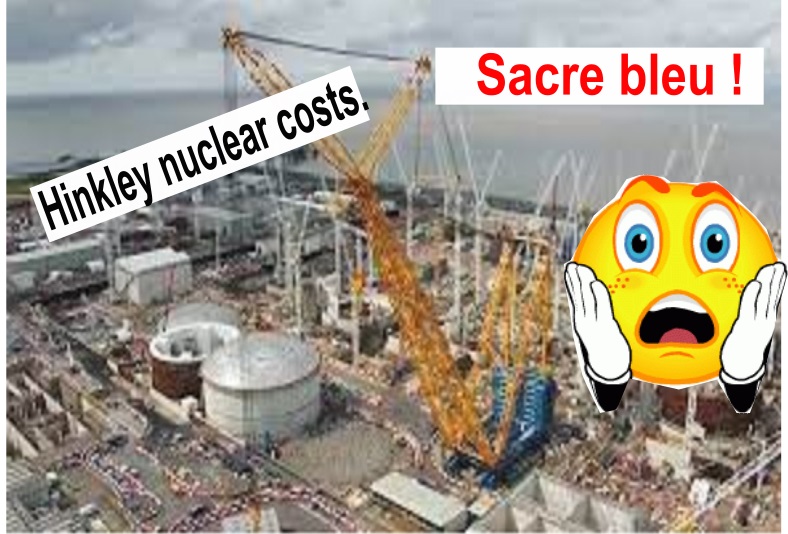
the French developers solely responsible for cost overruns during construction.
Nils Pratley, https://www.theguardian.com/uk-news/nils-pratley-on-finance/2024/jan/25/sorry-france-youre-on-the-hook-at-hinkley-point-edf
As its own finance director warned: EDF understood exactly what it was signing in 2016.
In the troubled history of Hinkley Point C, the resignation of Thomas Piquemal in 2016 ranks as a footnote, but he deserves a heroic mention in the week EDF, developer of the nuclear power station in Somerset, announced yet more cost overruns and delays.
Piquemal was the EDF finance director who took the dissenting view in the French boardroom that rushing to sign a contract with the UK government to build Hinkley would be a risk too far for his debt-laden employer. The energy company’s financial future could be put in jeopardy, he was reported to have said.
In truth, there were other reasons why EDF ended up being fully nationalised by the French state in 2022 – the cost of repairing domestic nuclear stations, and being forced to sell energy at a loss to subsidise French consumers’ bills – but Hinkley has been a financial albatross that has only become heavier. Back in 2016, the plant was meant to cost £18bn; the latest estimate is up to £35bn in equivalent terms and more like £46bn in today’s money. Vraiment, Piquemal was right.
Thus one cannot be surprised that an entertaining diplomatic row is brewing over Hinkley, with French officials telling the Financial Times that the UK might wish to contribute the odd billion to fill the budgeting hole. One argument says that, since EDF is also meant to be taking a stake of up to 20% in the replica Sizewell C plant in Suffolk, the two financing issues could be wrapped together.
Another says the UK worsened the financial pain in Somerset when it ditched the Chinese state firm CGN (one-third owner of Hinkley) as an investor in Sizewell. A disgruntled CGN, which owed its presence to the grotesque love-in with Beijing under David Cameron and George Osborne, is now refusing to invest more in Hinkley.
But, unusually, the UK’s hand looks excellent in this developing quarrel. As Piquemal’s warning demonstrated, EDF understood exactly what it was signing in 2016. The bargain was simple: the UK would buy Hinkley’s output for 35 years on inflation-linked terms that, at the time (but not now), were seen as wildly generous; in exchange, the developers were solely responsible for cost overruns during construction.
Nobody has ever doubted the watertight nature of the contract. EDF’s managing director at Hinkley made a video this week to explain the overruns and delays and said: “None of this affects British taxpayers or consumers.”
One could imagine a situation in which the UK agreed to lend a hand by buying an equity stake in Hinkley on commercial terms; even with higher costs, the projected internal rate of return over the long life of the plant is still 7%-ish. But there appears to be no obligation for the UK to negotiate.
Do Sizewell’s financing needs complicate the real-world politics? Possibly. The UK wants to attract outside capital to the Suffolk project and a proper cross-channel bust-up wouldn’t help the cause since EDF, aside from being a minority investor, will be a major supplier at Sizewell (but, not, as at Hinkley, the developer itself).
But, again, the UK has decent cards: the two projects have different funding models (UK billpayers are exposed to cost overruns at Sizewell) and the French nuclear industry presumably still wants the multibillion-pound orders for vital kit at Sizewell, including the reactors.
The deeper question over Sizewell is whether it is value for money if it, too, will end up costing £40bn-ish. Short answer: if the UK is committed to building 24 gigawatts of nuclear capacity by 2050, or enough to meet a quarter of national electricity demand, there isn’t a ready alternative today. But Hinkley’s budget woes should be kept separate. In Somerset, EDF is on the hook, just as it was warned.
Growing mountain of wasted money is a radioactive prospect
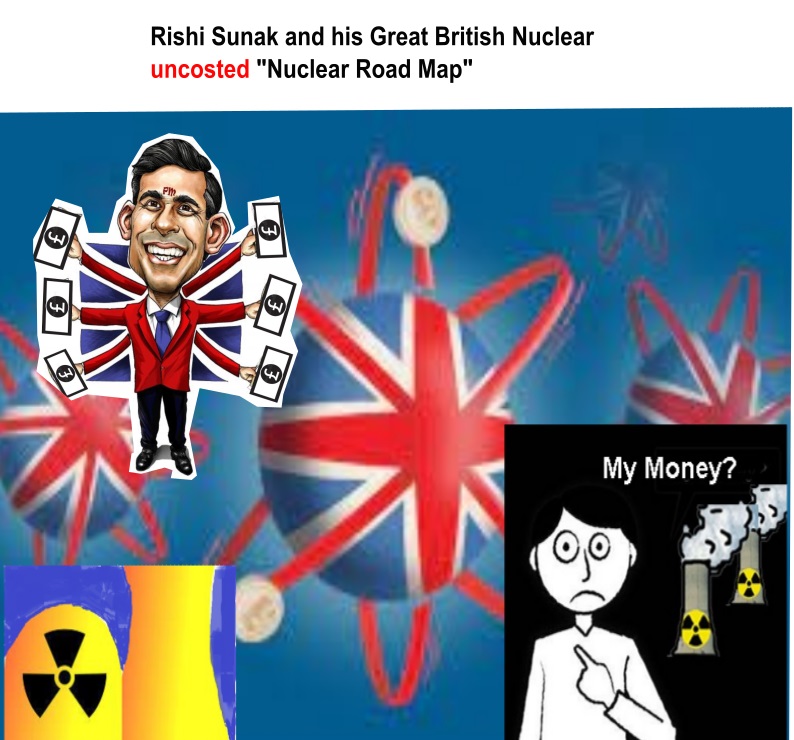
Alistair Osborne: Growing mountain of wasted money is a radioactive
prospect. Rishi Sunak’s apparent determination to press ahead with
mammoth investment in new nuclear reactors, whatever the cost, might not
prove to be the best solution.
It’s only a week since he set off — again — with his uncosted “nuclear road map”: a plan to have 24 gigawatts of new reactors by 2050, or seven more Hinkley Point Cs. On
Monday, the government sank another £1.3 billion into Sizewell C, so it
could “steam ahead” with that project, too, as Andrew Bowie, the
minister for nukes, put it.
Listen to him and investors are queueing up. So
what better news to encourage them than this jaw-dropper from EDF, the
state-backed French outfit behind both schemes? Hinkley Point’s costs
have shot up by as much as £10 billion to a top-end £35 billion, in 2015
prices.
And, instead of firing up in 2027, the first of the Somerset
nuke’s twin reactors could in an “unfavourable scenario” (the likely
outcome) be delayed until 2031. This is what comes with Hinkley’s
European pressurised reactor tech, as EDF has also proved at France’s
Flamanville, Finland’s Olkiluoto and China’s Taishan.
Indeed, two years after the Chinese nuke became operational, one unit had to be taken offline for a year’s repairs. So why is the government hellbent on a re-run with
Sizewell in Suffolk? Alison Downes from the Stop Sizewell C campaign is no
neutral voice. But she’s right to say the project “epitomises the
definition of insanity: doing the same thing over and over and expecting a
different result”. With Sizewell, though, things would be far pricier.
Under the contracts-for-difference regime, EDF is on the hook for
Hinkley’s costs. Repeat the trick at Sizewell and, under the new
regulated asset base model, consumers would find £10 billion added to
their bills — before the nuke’s even operational.
Times 25th Jan 2024
Don’t be surprised if the UK tax-payer, not France, ends up paying the astronomic costs of Hinkley C nuclear power station .
Should we be bothered that Hinkley C nuclear power station has run even further over
budget (the latest estimate is £35 billion, nearly twice that quoted when
the project was given the go-ahead in 2016) and that its completion date
has been put back yet further, to 2031?
After all, the whole point of offering French energy giant EDF a guaranteed ‘strike price’ at the then juicy rate of £92.50 per megawatt-hour (at 2013 prices, rising with
inflation) was supposed to be to transfer financial risk to EDF and its
financial backers. ‘It is important to say that British consumers won’t
pay a penny, with the increased costs met entirely by shareholders,’ EDF’s
managing director of the Hinkley project state this morning.
I wouldn’t be so confident. Yet more delays to Hinkley C punch a huge hole in the
government’s net zero plans, which include the full decarbonisation of the
national grid by 2035 (Labour says it will do it by 2030). By 2028, all but
one of the UK’s existing five nuclear power stations are due to close – and
the other one, Sizewell B, is due to be gone by 2035. From generating
nearly a third of the UK’s power at its peak in 1998 the nuclear industry
could be down to virtually nothing by the time Hinkley C eventually opens.
No-one should be surprised if, before we get to 2031, EDF goes cap in hand
to the government, and the government offers it some kind of deal which
transfers risk back onto the taxpayer.
Spectator 24th Jan 2024
https://www.spectator.co.uk/article/hinkley-c-and-the-rising-cost-of-net-zero/
The War On Journalism In Belmarsh, The War On Journalism In Gaza
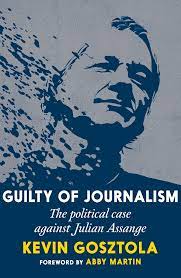
CAITLIN JOHNSTONE, JAN 26, 2024, https://www.caitlinjohnst.one/p/the-war-on-journalism-in-belmarsh?utm_source=post-email-title&publication_id=82124&post_id=141058691&utm_campaign=email-post-title&isFreemail=true&r=1ise1&utm_medium=email—
I haven’t written much about Julian Assange lately because I’ve been so fixated on what’s been happening in Gaza, but we should all be acutely aware that the 20th and 21st of February may be the WikiLeaks founder’s final chance to avoid extradition to the United States to face persecution for the crime of good journalism.
Assange and his legal team will face two High Court judges during the two-day hearing in London, who will then determine whether or not the UK will allow the Australian journalist to be dragged to the US in chains for a crooked show trial and cast into one of the world’s most draconian prison systems for exposing the war crimes of the world’s most powerful government.
Some US lawmakers are attempting to block the extradition from the other end with House Resolution 934, which asserts that “regular journalistic activities are protected under the First Amendment, and that the United States ought to drop all charges against and attempts to extradite Julian Assange.” If charges were dropped it would not only prevent the extradition but allow for Assange to be freed from the Belmarsh maximum security prison, where he has been jailed by the British government since 2019.
The fight to free Assange is a fight to protect press freedoms around the world, since the US is using the case in an attempt to set a legal precedent for extraditing and imprisoning any journalist or publisher anywhere in the world who shares information with the public that the US doesn’t want shared.
And it’s worth mentioning that this fight is not actually separate from the fight against Israel’s efforts to keep journalism out of Gaza by assassinating reporters and blocking the press from entering the enclave. It’s also not separate from humanity’s overall struggle to build a truth-based civilization, nor ultimately from our greater struggle to become a conscious species.
All throughout humanity there are pushes toward truth and seeing and pushes toward secrecy and darkness. In the press we see both: the authentic journalists like Assange who want all that is hidden to be made transparent, and the propagandists of the mainstream media who work to obfuscate and distort the truth. Those who seek the emergence of a harmonious and truth-based society want as much visibility into what’s really happening as possible, while tyrannical power structures like the US empire and Israel are constantly working to dim the lights.
Wherever you see domination and abuse, you see efforts to limit perception and keep human minds from seeing and understanding what’s going on. It’s true of empires, it’s true of governments, it’s true of cult leaders, it’s true of abusive spouses, and it’s true of the unpleasant dynamics within our own psyches that we would rather not look at. The less seeing there is, the more abusiveness is possible; the more seen things become, the closer we get to freedom.
I’m no prophet, but I strongly suspect that our future as a species will be determined by the outcome of this struggle. If the impulse toward truth and seeing wins out, we are probably headed toward a world of health and harmony. If the impulse to keep everything confused and hidden and unconscious wins, we are probably headed for dystopia and extinction.
In any case, all we can do is fight to make things more visible so that health and harmony become possible. Fight to make things conscious within ourselves. Fight to keep journalism legal in the shadow of the empire. Fight to spotlight Israel’s atrocities in Gaza. Fight to make the unseen seen. Fight to bring humanity into the light of consciousness.
Bitterly disappointed in Mastodon
Like many others, I left Twitter- X, because of Elon Musk and the whole weird setup developing there.
Today, on Mastodon, I find “Suspension of account from Jan 27, 2024”.
No warning, no notice, nothing.
My posts are almost always references to: my opposition to the nuclear industry, and to my condemnation of the genocide that Israel is perpetrating in Gaza.
Not personal attacks, not criminal accusations, not sexual content. No reason given for my suspension.
WHAT IS GOING ON WITH MASTODON?
I have done a little research, on Reddit. It turns out that many others have had the same experience. Apparently you can appeal, but your Mastodon account will be permanently deleted. Hard to know how to appeal, as you have no idea what prompted them to cut you off. It seems that all that is need is for one person to make an objection to you – and you’re out! But of course, not knowing what their objection was, it’s hard to answer it. My lame appeal was:
“I don’t understand why my account is suspended. I think that I deserve an explanation.”
Where to, from here?
I have a Facebook account. It doesn’t get anything like the same volume of traffic that Mastodon does. With Facebook, I feel that we enthusiasts for a particular cause (a nuclear-free world) are just talking to each other.
And by the way, the nuclear industry has a huge presence on Mastodon.
Is there any open-source, non-profit, alternative to Twitter?
Can anyone help me?,
More time needed for safety statement on Finland’s planned used fuel repository: no safety case has been made

COMMENT: The story below, from a pro-nuclear source, puts the best possible spin they can muster on the delays in the review of the Finnish nuclear waste burial proponent’s application for a deep geololgical repository for nuclear fuel waste. Here’s the straight story: the review period is being extended for another year (for now) because the regulator is waiting for missing information from the proponent, Posiva. No safety case has been made.
In comparison, the application by the Swedish proponent SKB was submitted in 2011, there have been repeated delays and extensions while the regulator waited for additional information, and while the Swedish government issued a political approval last year the Land and Environment Court has not issued the necessary approval.
23 January 2024, https://www.neimagazine.com/news/newsmore-time-needed-for-safety-statement-on-finlands-planned-used-fuel-repository-11456534
Finland’s Radiation & Nuclear Safety Authority (STUK – Säteilyturvakeskus) in its monitoring report from the last third of 2023 indicates that Posiva Oy, which is responsible for the final disposal of used nuclear fuel, is progressing without major problems, but at a slightly slower pace than was previously anticipated. Posiva is constructing the world’s first final used nuclear fuel disposal facility in Olkiluoto in Eurajoki. However, before it can start the operation of the facility it needs a permit from the Government. The permit decision requires a statement from STUK.
The Ministry of Labour & Business (TEM Työ- ja elinkeinoministeriö) had requested STUK’s opinion by the end of 2023 but, as the processing of the licence application data is still ongoing at STUK has requested additional time from TEM for issuing the statement until the end of 2024.
STUK says in its third-year report that the material to be inspected for the safety assessment for the operating licence is very large. Furthermore, STUK has not always been able to make its assessments based on the materials first submitted by Posiva and has required updates. Therefore, the processing of the material has taken longer than expected.
Posiva, owned by Teollisuuden Voima Oyj’s Olkiluoto NPP and Fortum Power & Heat Oy’s Loviisa NPP, applied for a construction licence application to TEM in December 2013. Posiva investigated the rock at Olkiluoto and based its licence application on results from the Onkalo underground laboratory, which will be expanded to form the basis of the repository. The government granted a construction licence in November 2015 and work began in December 2016. The site for the repository was selected in 2000 and parliament approved the decision-in-principle for the project in 2001.
Posiva has been preparing for the disposal of used nuclear fuel for more than 40 years. Its encapsulation plant is located above ground, and the fuel repository of the underground disposal facility is located in the bedrock at a depth of approximately 400-430 metres. Once it receives the operating licence, Posiva can start the final disposal of used fuel generated by the two NPPs, which were hoping to use the facility between 2024 and 2070. The facility will operate for about 100 years.
By the end of 2023, STUK had not only prepared a safety assessment, but also continued to supervise Posiva and its work. The matters to be monitored include the installation of equipment in the encapsulation plant, test runs and test run plans, as well as the ongoing rock construction work in the underground final disposal locations. It is also monitoring and inspecting the security arrangements of Posiva’s final disposal facility, the safety culture of the organisation and Posiva’s readiness to start final disposal operations.
As ‘Oppenheimer’ leads Oscar nominees, Sentor Hawley wants spotlight on nuclear testing victims
Rachel Looker, USA TODAY, 26 Jan 24, https://www.usatoday.com/story/news/politics/2024/01/26/josh-hawley-oscars-oppenheimer-nuclear-testing/72368363007/—
WASHINGTON − Sen. Josh Hawley, R-Mo., is pushing for the Oscars to acknowledge victims of nuclear testing after the Academy announced that “Oppenheimer” leads in nominations.
Hawley sent a letter Friday urging the Academy of Motion Picture Arts and Sciences to include programming that pays tribute to the victims of nuclear testing ahead of the 2024 Academy Awards.
“Oppenheimer,” directed by Christopher Nolan, chronicles the life of J. Robert Oppenheimer, the American physicist whose stewardship of the Manhattan Project led to the atomic bomb. The Manhattan Project‘s scientists built and deployed two bombs that were dropped on Japanese cities, leading to the country’s surrender in World War II.
“Oppenheimer” leads this year with 13 nominations.
“The ‘Oppenheimer’ film tells a compelling story of these test programs. But it does not tell the story of the Americans left behind—still reckoning with the health and financial consequences of America’s nuclear research, after all these years,” Hawley wrote in the letter.
The Missouri lawmaker pointed to Americans, like those in his home state, who suffer from cancer or other medical conditions because of radiation exposure from the radioactive waste that was not cleaned up as part of the Manhattan Project.
“Congress stands poised to allow what limited compensation the government has offered victims to expire. That cannot be allowed to happen,” he wrote. “These victims deserve justice through fair compensation from their government—and you can help by telling their stories.”
Hawley has long been an advocate for those impacted by government-caused nuclear contamination.
In December, Hawley called upon his colleagues in Congress to reauthorize the Radiation Exposure Compensation Act in the 2024 annual defense spending bill. The legislation compensates victims of government-caused radiation in the St. Louis region.
He created a procedural hurdle as the Senate worked to pass the defense bill and voted against the bill after the compensation program was not included in its final version
Brexit blamed for delays to nuclear power project

EDF’s former CEO had pledged christmas turkeys would be cooked by the plant by 20172
i By Ben Gartside, 24 Jan 24
The UK’s premier nuclear power project could be delayed by another four years as costs continue to balloon, with Brexit cited as a major factor………………According to EDF, the French firm in charge of developing the site, issues on the project had been caused by Brexit, the Pandemic and inflation…………………………………………………….
How has Brexit affected construction costs?
Developers have been hit hard by both the Covid pandemic and soaring energy prices. Tim Heatley, co-founder of Manchester-based Capital&Centricm, said Brexit had also been a “major factor”.
He previously told i: “On the surface there doesn’t seem as much jeopardy in construction as car manufacturing – you can’t outsource building new homes to Asia.
“But, I’d argue, we’re facing even bigger economic consequences if we don’t get things under control.”
“Both construction material and labour costs have rocketed here way more than EU countries, so Brexit must be a major factor.”
A report published in 2023 found that between 2015 and 2022 the cost of construction materials including cement, timber and steel increased by 60 per cent in the UK compared to 35 per cent in the EU…………………….. https://inews.co.uk/news/brexit-blamed-delays-nuclear-power-lower-energy-bills-2871548—
Microsoft Looks to Nuclear to Fuel AI Plans, (with help from nuclear front group Terra Praxis)

Microsoft goes nuclear to deal with energy influx due to the meteoritic rise of its AI platforms.
tech.co by Abby Ward, January 25, 2024,
Microsoft is looking to fuel its future AI plans with nuclear, according to a recent moves by the company.
AI notoriously requires huge amounts of energy on a daily basis, and with more and more of us using it, and companies investing heavily in the technology, the scramble for power is ramping up.
With Microsoft throwing its weight (and money) behind AI, including huge investments in OpenAI, it seems nuclear power could be the key to its success………………………………
Due to the explosive arrival of AI, consuming a whopping four times more power than cloud servers, Microsoft appears to be preparing for this increased demand to power their data centers as they continue to accelerate their growth plans in the AI arena.
Among other signs that Microsoft will be looking to nuclear power to plan for the shortfall in energy is the appointment of a Director of Nuclear Development Acceleration last week.
Data Center Energy Shortfall
Data centers, the things that physically store and share applications and data, require an enormous amount of energy to run……………………
To put the size of the problem into perspective, McKinsey wrote that a hyperscaler’s data center can use as much power as 80,000 households do.
In the same article, McKinsey forecasted that the power needed to facilitate US data centers are set to jump from 17 gigawatts (GW) in 2022 to 35 GW by 2030………………………………………
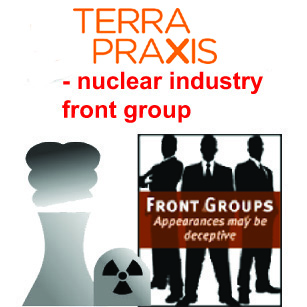
A recent collaboration between Microsoft and Terra Praxis, a non-profit advocating for repurposing old coal plants into SMR facilities, further underlines the company’s nuclear ambitions. According to reports from Data Center Dynamics, together, they developed a generative AI model to streamline the lengthy and costly nuclear regulatory process, showcasing Microsoft’s commitment to making nuclear power a viable option for its data centers…………………………………..
Microsoft’s foray into nuclear power is bound to raise eyebrows and concerns about safety and waste disposal will need to be addressed in due course………………………………
https://tech.co/news/microsoft-nuclear-fuel-a
“Doomsday Clock” Kept at 90 Seconds to Midnight for 2024
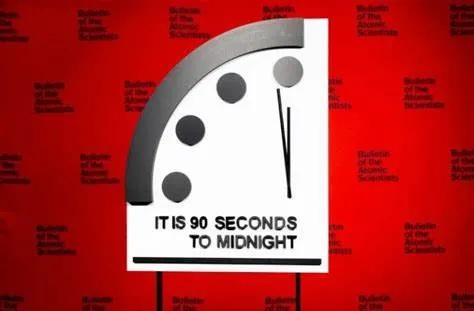
The Sentinel By Karl Grossman., Jan 25, 2024
The “Doomsday Clock” of The Bulletin of the Atomic Scientists was kept at 90 seconds to midnight this week—the closest to midnight that the clock has been set since it was created in 1947. Midnight is defined by The Bulletin as “nuclear annihilation.”
The hands of the clock were initially moved forward to 90 seconds to midnight last year. In moving the clock forward in 2023, The Bulletin, founded by Albert Einstein and scientists who helped develop the first atomic weapons in the Manhattan Project, issued a statement declaring it was: “A time of unprecedented danger.”
“Largely” but “not exclusively,” said The Bulletin in 2023, the clock was moved “to 90 seconds to midnight—the closest to global catastrophe it has ever been”—because of the war in Ukraine. It went on: “Russia’s thinly veiled threats to use nuclear weapons remind the world that escalation of the conflict—by accident, intention, or miscalculation—is a terrible risk,” said the statement. “The possibility that the conflict could spin out of anyone’s control remains high.”
On this Tuesday, January 23, The Bulletin, in keeping the clock at 90 seconds to midnight issued a statement that said: “Ominous trends continue to point the world toward global catastrophe.”
Said Dr. Rachel Bronson, president and CEO of The Bulletin, “Make no mistake: resetting the clock at 90 seconds to midnight is not an indication that the world is stable. Quite the opposite. It’s urgent for governments and communities around the world to act.”
The hands of the Doomsday Clock are set every year by The Bulletin’s Science and Security Board which includes 10 Nobel laureates.
Last year, The Bulletin’s statement quoted Antonio Guterres, secretary-general of the United Nations, as saying it had become “a time of nuclear danger not seen since the height of the Cold War.”
Since, there have been additions to that nuclear danger.
Take North Korea……………………………………………………………………………..
Consider Iran…………………………………………………………………….
Consider China and Taiwan. ………………………………………………….
As to Russia and Ukraine,……………………………………………..
Meanwhile, the organization Beyond Nuclear (I’m on its board) ran an article on its Beyond Nuclear International website this month headlined: “’Steadfast Noon’ spells doom.” Its subhead: “US prepared for nuclear war at foreign bases.” The article was written by John LaForge, co-director of the organization Nukewatch.
It told of how in October 2023, “the alliance” supporting Ukraine in its war with Russia “began its annual nuclear attack rehearsal dubbed ‘Steadfast Noon.’ This practice involves air forces from 13 countries, the ‘exercising’ of fighter jets and U.S. B-52s [which] roared over Italy, Croatia and the eastern Mediterranean.” It quoted NATO Secretary General Jens Stoltenberg saying: “Our exercise will help to ensure the credibility, effectiveness and security of our nuclear deterrent.”
Meanwhile, the U.S. is in the midst of a nuclear weapons “modernization” program. Notes the Center for Arms Control and Non-Proliferation: “The United States plans to spend up to $1.5 trillion over 30 years to its nuclear arsenal by rebuilding each leg of the nuclear triad and its accompanying infrastructure.
The good news: the Treaty on the Prohibition of Nuclear Weapons has been enacted, taken force and is moving forward. This month an additional two nations ratified it. The treaty, providing a legally binding agreement to prohibit nuclear weapons, leading to their total elimination, was adopted by the UN General Assembly—with 122 nations in favor—in 2017. The treaty bans the development, testing, production, stockpiling, stationing, transfer, use and threat of use of nuclear weapons.
“Let’s eliminate these weapons before they eliminate us,” Secretary-General Guterres has said of the treaty, an initiative “toward our shared goal of a world free of nuclear weapons.”
Leading in the drive for the treaty has been the International Campaign to Abolish Nuclear Weapons (ICAN). As it declares on its website: “Nuclear weapons are the most inhumane and indiscriminate weapons ever created. They violate international law, cause severe environmental damage, undermine national and global security, and divert vast public resources away from meeting human needs. They must be eliminated urgently.”
A big problem: the so-called “nuclear weapons states” including the U.S., Russia, China, France and Great Britain have not signed on to the treaty.
This is where pressure must be focused—through grassroots actions and through politics, and by media—directed at the “nuclear weapons states.”
People should join in with ICAN, become members. Its website is: https://www.icanw.org/………………… ” — https://www.thesentinel.com/communities/doomsday-clock-kept-at-90-seconds-to-midnight-for-2024/article_baacc924-bbef-11ee-a494-23c8a77b6613.html
Plan to store nuclear waste under Holderness for 175 years

Nuclear waste from across the UK could be stored below an area of East Yorkshire for up to 175 years.
Government agency Nuclear Waste Services (NWS) announced proposals today to build a storage facility beneath South Holderness.
A group has been set up to examine the proposals, but the agency’s chief executive Corhyn Parr said the scheme would only go ahead with residents’ approval.
She said: “This is a consent-based process, meaning if the community does not express support… it won’t be built there.”
Ms Parr added that the new geological disposal facility would bring benefits to the area, including thousands of jobs and transport improvements.
Two similar working groups are already established in Cumbria and at Theddlethorpe on the Lincolnshire coast.
Dr David Richards, independent chair of the South Holderness working group, said the aim was to work with local communities to discuss the potential of a series of vaults and tunnels being built deep underground, or under the sea, where the material would be buried.
He added: “My role as chair is to make sure local communities have access to information and to understand what people think.”…………………………
Graham Stuart, the MP for Beverley and Holderness, said that he will be meeting with Dr David Richards to discuss the plans.
He wrote on Facebook: “I’ll be asking for a copper bottomed guarantee that nothing would happen without public consent…………………………. https://www.itv.com/news/calendar/2024-01-25/plan-to-store-nuclear-waste-under-east-yorkshire-for-175-years
The Doomsday Clock is still at 90 seconds to midnight. But what does that mean?2 B1

THE CONVERSATION, Rumtin Sepasspour, January 25, 2024
Once every year, a select group of nuclear, climate and technology experts assemble to determine where to place the hands of the Doomsday Clock.
Presented by the Bulletin of the Atomic Scientists, the Doomsday Clock is a visual metaphor for humanity’s proximity to catastrophe. It measures our collective peril in minutes and seconds to midnight, and we don’t want to strike 12.
In 2023, the expert group brought the clock the closest it has ever been to midnight: 90 seconds. On January 23 2024, the Doomsday Clock was unveiled again, revealing that the hands remain in the same precarious position.
No change might bring a sigh of relief. But it also points to the continued risk of catastrophe. The question is, how close are we to catastrophe? And if so, why?
Destroyer of worlds
The invention of the atomic bomb in 1945 ushered in a new era: the first time humanity had the capability to kill itself.
Later that year, Albert Einstein, along with J. Robert Oppenheimer and other Manhattan Project scientists, established the Bulletin of the Atomic Scientists, in the hope of communicating to the public about the new nuclear age and the threat it posed.
Two years on, the Bulletin, as it came to be known, published its first magazine. And on the cover: a clock, with the minute hand suspended eerily only seven minutes from midnight.
The artist Martyl Langsdorf sought to communicate the sense of urgency she had felt from scientists who had worked on the bomb, including her physicist husband, Alexander. The placement was, to her, an aesthetic choice: “It seemed the right time on the page … it suited my eye.”
Thereafter, Bulletin editor Eugene Rabinowitch was the gears behind the clock’s hands until his passing in 1973, when the board of experts took over.
The clock ha
The clock has been moved 25 times since, particularly in response to the ebb and flow of military buildups, technological advancement and geopolitical dynamics during the Cold War.
Nuclear risk did not abate after the collapse of the Soviet Union, even as the total number of nuclear weapons shrank. And new threats have emerged that pose catastrophic risk to humanity. The latest setting of the clock attempts to gauge this level of risk.
A precarious world
In the words of Bulletin president and chief executive Rachel Bronson:
Make no mistake: resetting the Clock at 90 seconds to midnight is not an indication that the world is stable. Quite the opposite……………………………………………………………………………………………………………………………………… more https://theconversation.com/the-doomsday-clock-is-still-at-90-seconds-to-midnight-but-what-does-that-mean-221871?utm_medium=email&utm_campaign=The%20Weekend%20Conversation%20-%202858829013&utm_content=The%20Weekend%20Conversation%20-%202858829013+CID_8a44781376868ca758fe734ea2dc1adc&utm_source=campaign_monitor&utm_term=The%20Doomsday%20Clock%20is%20still%20at%2090%20seconds%20to%20midnight%20But%20what%20does%20that%20mean
1 This Month

of the week – Shut Down Drone Warfare!


Tell the Ukrainian Government to Drop Prosecution of Peace Activist Yurii Sheliazhenko

Petition to revoke the licensing of the Near Surface Nuclear Disposal Facility (NSDF) at Chalk River. https://www.ourcommons.ca/petitions/en/Petition/Details?Petition=e-7247
To see nuclear-related stories in greater depth and intensity – go to https://nuclearinformation.wordpress.com
-
Archives
- March 2026 (244)
- February 2026 (268)
- January 2026 (308)
- December 2025 (358)
- November 2025 (359)
- October 2025 (376)
- September 2025 (257)
- August 2025 (319)
- July 2025 (230)
- June 2025 (348)
- May 2025 (261)
- April 2025 (305)
-
Categories
- 1
- 1 NUCLEAR ISSUES
- business and costs
- climate change
- culture and arts
- ENERGY
- environment
- health
- history
- indigenous issues
- Legal
- marketing of nuclear
- media
- opposition to nuclear
- PERSONAL STORIES
- politics
- politics international
- Religion and ethics
- safety
- secrets,lies and civil liberties
- spinbuster
- technology
- Uranium
- wastes
- weapons and war
- Women
- 2 WORLD
- ACTION
- AFRICA
- Atrocities
- AUSTRALIA
- Christina's notes
- Christina's themes
- culture and arts
- Events
- Fuk 2022
- Fuk 2023
- Fukushima 2017
- Fukushima 2018
- fukushima 2019
- Fukushima 2020
- Fukushima 2021
- general
- global warming
- Humour (God we need it)
- Nuclear
- RARE EARTHS
- Reference
- resources – print
- Resources -audiovicual
- Weekly Newsletter
- World
- World Nuclear
- YouTube
-
RSS
Entries RSS
Comments RSS
 nuclear-news