The 2024 Doomsday Clock announcement
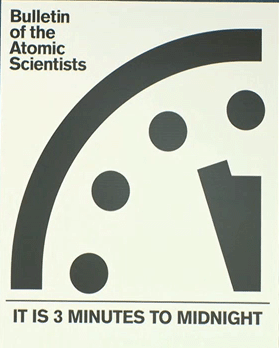
Watch the Clock unveiling live here on January 23 at 10 a.m. EST
Right now, the Clock is the closest it has ever been at 90 seconds to midnight. What time will it be this year? Join experts from our Science and Security Board along with science educator Bill Nye on January 23rd at 10 am EST to find out.
Another week in nuclear news

Some bits of good news. The Year in Cheer – 177 ways the world got better in 2023.
TOP STORIES. The Last Flurry: The US Congress and Australian Parliamentarians seek Assange’s Release.
UK’s nuclear obsessions kill off its net zero strategy . Military interests are pushing new nuclear power – and the UK government has finally admitted it.
LIES. United Against Nuclear Iran: The Shadowy, Intelligence-Linked Group Driving the US Towards War With Iran.
Nuclear goes backwards, again, as wind and solar enjoy another year of record growth.
********************************
Climate. State of the Climate: 2023 smashes records for surface temperature and ocean heat. A new wave of climate denialism is on the rise. The Greenland ice cap is losing an average of 30m tonnes of ice an hour due to the climate crisis. Shock Horror! – They’re letting some WOMEN into the Cop29 climate summit committee!
Nuclear. Pro nuclear propaganda seems to be doubling, as nuclear’s obscene costs become more apparent, as well as “clean nuclear’s absolute connection with weaponry!
Noel’s Notes. UK govt has come clean about it! Nuclear power- no use, really – just essential for the nuclear weapons industry. Biden in a bind – powerless to stop the genocide, but keen to fund it and promote it. The human cost when IT goes wrong. https://www.youtube.com/watch?v=LdQQib3rmkE
**********************************
ECONOMICS. The Times asks “Are big nuclear reactors really the right thing for the UK? Nuclear power may twice as expensive as the Swedish government thought? $25 billion for refurbishment of Darlingon and Bruce reactors. US Offers Up To $500MM for Advanced Nuclear Fuel Production for SMRs. Big costs sink flagship nuclear project
EMPLOYMENT. Federal Employees to Stage Walk Out Over Biden’s Support for Gaza Slaughter
ENERGY. An Unprecedented Momentum for Renewables. IEA: Global renewable capacity grows over 50% YoY in 2023. Analysis: World will add enough renewables in five years to power US and Canada. Fuel problems for nuclear power, as the industry continues to languish in the doldrums.
INDIGENOUS ISSUES. Kebaowek Nation calls for cancellation of nuclear waste disposal site at Chalk River. Documentary ‘Downwind’ shows deadly consequences of nuclear testing on tribal lands. https://www.youtube.com/watch?v=gkoVPZnLlUY&t=14s
LEGAL. South Africa has made its genocide case against Israel in court. Here’s what both sides said and what happens next. Fukushima Nuclear Waste Water Disputes Continued: International Law in Japanese Court?
MEDIA. How the Gaza War Can Be Big News and Invisible at the Same Time. Cancelling the Journalist: The Australian ABC’s Coverage of the Israel-Gaza War. The threat of catastrophe is assessed in Nuclear Armageddon: How Close Are We? — review https://www.youtube.com/watch?v=j43-i6E2UJU&t=128s. 1 B Scary simulator shows what could happen in the event of a nuclear disaster.
OPPOSITION to NUCLEAR . Blocking the Doors of the Treaty Blockers & the Nuclear Ban Treaty’s 3d Anniversary.
PERSONAL STORIES. ‘The fight isn’t over’: Idaho downwinders persist after Congress cuts compensation for them.
POLITICS.
- It’s All About Me: Netanyahu Rejects Palestinian Statehood.
- Even Britain’s ruling Tory party fear that their “Nuclear Roadmap” plan will end up on the scrap heap. Roadmap to warfare: new policy exposes links with UK military nuclear projects. Construction to start on Sizewell C nuclear power station amid opposition. Petition: 100 per cent renewables rather than Small Modular (nuclear) Reactors. Sizewell C opponents warn Suffolk nuclear plant ‘could be the new HS2‘.
- Biden administration finalizes a $1.1 billion aid package for California’s last nuclear power plant. Why Joe Biden Is a Foreign Policy Failure.
- Belarus says it is to change policy on nuclear weapons.
- For Estonia the risks of going nuclear are high, and the plant not strictly necessary.
- USA announces Australia’s participation in Yemen war, parliament in the dark.
POLITICS INTERNATIONAL and DIPLOMACY. São Tomé and Príncipe 70th State to ratify Treaty on the Prohibition of Nuclear Weapons. US urges discussions with China on practical nuclear risk reduction steps.
SAFETY. Limping along: EDF Energy looking to extend operational life of aging reactors AGAIN. Hinkley C site fire safety fears trigger enforcement notices.
SECRETS and LIES. Shining a light on the UK’s nuclear deterrent.
SPINBUSTER. Work officially ‘started’ at Sizewell C Nuclear on Monday – but it was really only political theatre. Why nuclear reactors are not the future of energy despite what UK Government would have you think.
TECHNOLOGY. Nuclear start-up Newcleo drops plans for British factory in favour of France. WASTES. Chalk River, or low-level nuclear governance. Finland’s Radiation and Nuclear Safety Authority (STUK) wants to delay completion of its review on waste dump.
WAR and CONFLICT. A response to Kallenborn: Why realism requires that nuclear weapons be abolished. Incredible analysis of US warmongers plans for war with China ! Read this and weep!
WASTES. Chalk River, or low-level nuclear governance. Finland’s Radiation and Nuclear Safety Authority (STUK) wants to delay completion of its review on waste dump.
WEAPONS and WEAPONS SALES.
- The Military-Industrial Complex Is the Winner (Not You). What sort of world do we want?: ICAN exec discusses ultimate goal of nuclear abolition. Nuclear Threats Are Looming, And Nobody Knows How Many Nukes Are Out There. Are Nuclear-Armed Nations Entering a New Arms Race in 2024? – Experts Weigh In.
- Germany plans to supply Israel with tanks shells as Gaza death toll nears 25,000.
- Zelensky Courts JPMorgan, Bank of America & Bridgewater CEOs At Davos, Urges More Money From West. German defense chief against going ‘all in’ on Ukraine.
- North Korea says it tested underwater nuclear attack drone in response to rivals’ naval drills. Nuclear tensions on the Korean Peninsula set to worsen in 2024. Are Nuclear-Armed Nations Entering a New Arms Race in 2024? – Experts Weigh In.
Nuclear start-up Newcleo drops plans for British factory in favour of France
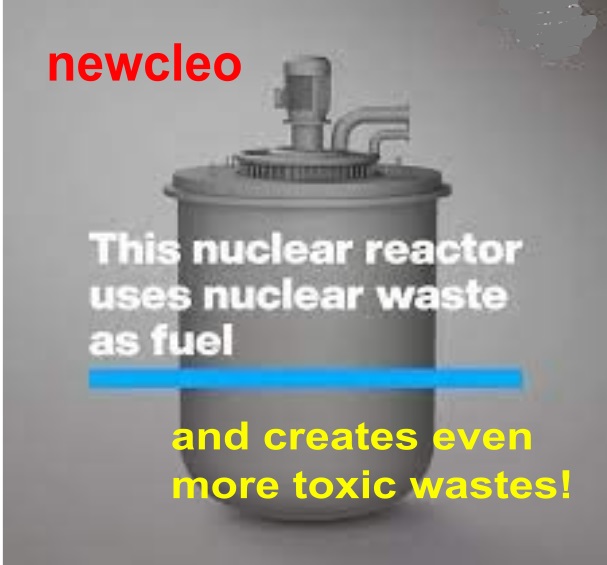
COMMENT. This is a very interesting article. For one thing, it shows that these “advanced” nuclear reactors require plutonium to get the fission process happening. It also claims that these advanced nuclear reactors can solve the problem of plutonium wastes. That is not true. The wastes resulting from this process are smaller in volume, but more highly toxic. That means that they require the same area/voume of space for disposal as the original plutonium. On another angle, it does indicate the confusion that the British government is in about the way ahead in their highly suspect “Civil Nuclear Roadmap”. And on another angle again, it shows how Macron’s France is putting all its eggs into the one nuclear basket. When we look at the extreme costs, and the extreme climate effects, Macron’s French nuclear obsession is likely to result in political suicide.
Matt Oliver, Sun, 21 January 2024, https://finance.yahoo.com/news/nuclear-start-drops-plans-british-131702123.html#:~:text=A%20British%20nuclear%20startup%20has,lobbied%20personally%20by%20Emmanuel%20Macron.
A British nuclear startup has dropped plans to build a pioneering power plant in Cumbria and will invest £4bn in France instead, after it was lobbied personally by Emmanuel Macron.
Newcleo, which is headquartered in London, is developing a type of mini nuclear power plant, known as an advanced modular reactor (AMR), that will use nuclear waste for fuel.
The company had hoped to tap into the UK’s vast stockpile of waste at Sellafield, where it wanted to invest £2bn in a waste reprocessing factory and AMR that would have created around 500 jobs.
It was also planning a similarly-sized facility in France.
But Stefano Buono, Newcleo’s chief executive and founder, said the company has now dropped the UK plans after the Government ruled out giving private companies access to the Sellafield stockpile in a nuclear industry “roadmap” published this month.
Instead, Newcleo is planning an enlarged development at an undisclosed location in the south of France, where it now plans to spend £4bn and create around 1,000 jobs, he said.
As part of that scheme, it will buy nuclear waste from French state energy giant EDF.
The company is also currently in the middle of a €1bn (£860m) fundraising.
The decision comes after the company was blocked from participating in the UK’s design competition for mini nuclear reactors.
By comparison, France has eagerly supported Newcleo and Mr Buono was lobbied repeatedly for investment by President Macron in face-to-face meetings.
Newcleo, which was also invited to last year’s “Choose France” business summit at the Palace of Versailles, has never been offered an in-person meeting with a British prime minister.
Mr Buono told The Telegraph: “Our plan initially was to use one factory in France and one in the UK.
“Now, we will double the capacity of France and we are not investing in the UK.”
He added that the company had hoped to pioneer its technology in Britain but added: “In two years, we were not able to even locate the site, so we have decided to accept the offer from France.
“We can proceed with our business model there.”
Newcleo’s decision to build its first plant abroad comes amid growing frustration within the British nuclear industry over the slow progress the Government has made towards identifying sites for new power plants.
The loss of significant investment to France will also be seen as the latest sign that Downing Street’s efforts to attract business investment are being outshone by President Macron, who has launched a charm offensive to lure companies across the Channel since Brexit.
He was the only G7 leader to attend the World Economic Forum in Davos, Switzerland, this week, while he has rolled out the red carpet for business leaders including Tesla boss Elon Musk and JP Morgan banker Jamie Dimon at his annual Choose France event.
Last year’s summit resulted in major deals, with Taiwanese car battery maker ProLogium unveiling plans for a €5.2bn plant at the port of Dunkirk and Verkor, a French company, pledging a €1.6bn battery factory there too.
In the UK, six SMR developers including Rolls-Royce have been shortlisted for support under a competition run by Great British Nuclear.
Newcleo was not considered because of the AMR’s lead cooling system and unusual fuel, Mr Buono has claimed.
The company’s novel design would run on processed plutonium, helping countries such as the UK dispose of the dangerous waste, which is expensive to manage. [Ed. This ignores the fact that this process results in a smaller volume of more highly toxic waste]
At Sellafield, the UK has amassed 140 tonnes of plutonium – the world’s biggest stockpile – as a result of historic nuclear weapons programmes and abandoned efforts to develop so-called fast breeding reactors that would have used it as fuel.
A massive effort is currently under way at the Cumbrian site to safely store the waste, but Mr Buono and his colleagues have argued it could be put to better use as reactor fuel.
The entrepreneur made his fortune selling cancer treatment developer AAA to Novartis for $3.9bn (£3.2bn) in 2017, reportedly earning him $420m.
His company has the backing of the Agnelli industrialist family, which made its money from Fiat and Ferrari.
The French government is expected to confirm a deal with Newcleo later this year.
The UK Government did not respond to requests for comment.
Nuclear power: molten salt reactors and sodium-cooled fast reactors make the radioactive waste problem WORSE

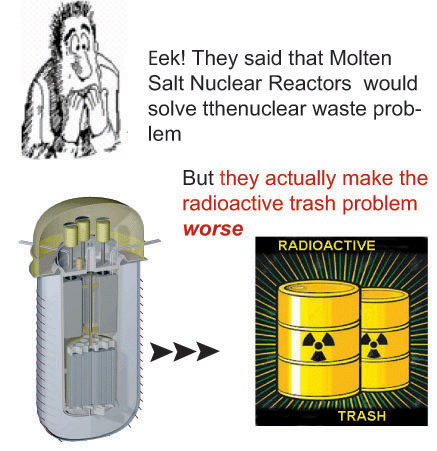
 reactors https://www.tandfonline.com/doi/full/10.1080/00963402.2018.1507791, Lindsay Krall &Allison Macfarlane, 31 Aug 18
ABSTRACT
Nuclear energy-producing nations are almost universally experiencing delays in the commissioning of the geologic repositories needed for the long-term isolation of spent fuel and other high-level wastes from the human environment. Despite these problems, expert panels have repeatedly determined that geologic disposal is necessary, regardless of whether advanced reactors to support a “closed” nuclear fuel cycle become available. Still, advanced reactor developers are receiving substantial funding on the pretense that extraordinary waste management benefits can be reaped through adoption of these technologies.
Here, the authors describe why molten salt reactors and sodium-cooled fast reactors – due to the unusual chemical compositions of their fuels – will actually exacerbate spent fuel storage and disposal issues. Before these reactors are licensed, policymakers must determine the implications of metal- and salt-based fuels vis a vis the Nuclear Waste Policy Act and the Continued Storage Rule.
Nuclear goes backwards, again, as wind and solar enjoy another year of record growth.

Jim Green 21 January 2024, https://reneweconomy.com.au/nuclear-goes-backwards-again-as-wind-and-solar-enjoy-another-year-of-record-growth/
The nuclear renaissance of the late-2000s was a bust due to the Fukushima disaster and catastrophic cost overruns with reactor projects. The latest renaissance is heading the same way, i.e. nowhere. Nuclear power went backwards last year.
There were five reactor start-ups and five permanent closures in 2023 with a net loss of 1.7 gigawatts (GW) of capacity. There were just six reactor construction starts in 2023, five of them in China.
Due to the ageing of the reactor fleet, the International Atomic Energy Agency (IAEA) anticipates the closure of 10 reactors (10 GW) per year from 2018 to 2050.
Thus the industry needs an annual average of 10 reactor construction starts, and 10 reactor startups (grid connections), just to maintain its current output. Over the past decade (2014-23), construction starts have averaged 6.1 and reactor startups have averaged 6.7.
The number of operable power reactors is 407 to 413 depending on the definition of operability, well down from the 2002 peak of 438.
Nuclear power’s share of global electricity generation has fallen to 9.2 percent, its lowest share in four decades and little more than half of its peak of 17.5 percent in 1996.
Over the two decades 2004-2023, there were 102 power reactor startups and 104 closures worldwide: 49 startups in China with no closures; and a net decline of 51 reactors in the rest of the world.
In China, there were five reactor construction starts in 2023 and just one reactor startup. Put another way, there was just one reactor construction start outside China in 2023. So much for the hype about a new nuclear renaissance.
Small modular reactors and ‘advanced’ nuclear power
Small modular reactors (SMRs) are the subject of endless hype but there were no SMR construction starts or startups last year. The biggest SMR news in 2023 was NuScale Power’s decision to abandon its flagship project in Idaho despite securing astronomical subsidies amounting to around US$4 billion (A$6.1 billion) from the US government.
The pro-nuclear Breakthrough Institute noted in a November 2023 article that efforts to commercialise a new generation of ‘advanced’ nuclear reactors “are simply not on track” and it warned nuclear advocates not to “whistle past this graveyard”:
It wrote:
“The NuScale announcement follows several other setbacks for advanced reactors. Last month, X-Energy, another promising SMR company, announced that it was canceling plans to go public. This week, it was forced to lay off about 100 staff.
“In early 2022, Oklo’s first license application was summarily rejected by the Nuclear Regulatory Commission before the agency had even commenced a technical review of Oklo’s Aurora reactor.
The nuclear renaissance of the late-2000s was a bust due to the Fukushima disaster and catastrophic cost overruns with reactor projects. The latest renaissance is heading the same way, i.e. nowhere. Nuclear power went backwards last year.
There were five reactor start-ups and five permanent closures in 2023 with a net loss of 1.7 gigawatts (GW) of capacity. There were just six reactor construction starts in 2023, five of them in China.
Due to the ageing of the reactor fleet, the International Atomic Energy Agency (IAEA) anticipates the closure of 10 reactors (10 GW) per year from 2018 to 2050.
Thus the industry needs an annual average of 10 reactor construction starts, and 10 reactor startups (grid connections), just to maintain its current output. Over the past decade (2014-23), construction starts have averaged 6.1 and reactor startups have averaged 6.7.
The number of operable power reactors is 407 to 413 depending on the definition of operability, well down from the 2002 peak of 438.
Nuclear power’s share of global electricity generation has fallen to 9.2 percent, its lowest share in four decades and little more than half of its peak of 17.5 percent in 1996.
Over the two decades 2004-2023, there were 102 power reactor startups and 104 closures worldwide: 49 startups in China with no closures; and a net decline of 51 reactors in the rest of the world.
In China, there were five reactor construction starts in 2023 and just one reactor startup. Put another way, there was just one reactor construction start outside China in 2023. So much for the hype about a new nuclear renaissance.
Nuclear decline vs. record renewables growth
The International Energy Agency (IEA) has just released its ‘Renewables 2023’ report and it makes for a striking contrast with the nuclear industry’s malaise.
Nuclear power suffered a net loss of 1.7 GW capacity in 2023, whereas renewable capacity additions amounted to a record 507 GW, almost 50 percent higher than 2022. This is the 22nd year in a row that renewable capacity additions set a new record, the IEA states. Solar PV alone accounted for three-quarters of renewable capacity additions worldwide in 2023.
Nuclear power accounts for a declining share of share of global electricity generation (currently 9.2 percent) whereas renewables have grown to 30.2 percent. The IEA expects renewables to reach 42 percent by 2028 thanks to a projected 3,700 GW of new capacity over the next five years in the IEA’s ‘main case’.
The IEA states that the world is on course to add more renewable capacity in the next five years than has been installed since the first commercial renewable energy power plant was built more than 100 years ago.
Solar and wind combined have already surpassed nuclear power generation and the IEA notes that over the next five years, several other milestones will likely be achieved:
— In 2025, renewables surpass coal-fired electricity generation to become the largest source of electricity generation
— In 2025, wind surpasses nuclear electricity generation
— In 2026, solar PV surpasses nuclear electricity generation
— In 2028, renewable energy sources account for over 42 percent of global electricity generation, with the share of wind and solar PV doubling to 25 percent
Tripling renewables
The IEA states in its ‘Renewables 2023’ report that:
“Prior to the COP28 climate change conference in Dubai, the International Energy Agency (IEA) urged governments to support five pillars for action by 2030, among them the goal of tripling global renewable power capacity. Several of the IEA priorities were reflected in the Global Stocktake text agreed by the 198 governments at COP28, including the goals of tripling renewables and doubling the annual rate of energy efficiency improvements every year to 2030. Tripling global renewable capacity in the power sector from 2022 levels by 2030 would take it above 11 000 GW, in line with IEA’s Net Zero Emissions by 2050 (NZE) Scenario.
“Under existing policies and market conditions, global renewable capacity is forecast to reach 7300 GW by 2028. This growth trajectory would see global capacity increase to 2.5 times its current level by 2030, falling short of the tripling goal.”
In the IEA’s ‘accelerated case’, 4,500 GW of new renewable capacity will be added over the next five years (compared to 3,700 GW in the ‘main case’), nearing the tripling goal.
Tripling nuclear?
The goal of tripling renewables by 2030 is a stretch but it is not impossible. Conversely, the ‘pledge’ signed by just 22 nations at COP28 to triple nuclear power by 2050 appears absurd.
The Labor federal government signed Australia up to the renewables pledge but not the nuclear pledge. The Coalition wants to do the opposite, and also opposes the Labor government’s target of 82 per cent renewable power supply by 2030.
One of the lies being peddled by the Coalition is that nuclear power capacity could increase by 80 percent over the next 30 years. That is based on a ‘high case’ scenario from the IAEA. However the IAEA’s ‘low case’ scenario — ignored by the Coalition — is for another 30 years of stagnation.
So should we go with the IAEA’s high or low scenarios, or split the difference perhaps?
According to a report by the IAEA itself, the Agency’s ‘high’ forecasts have consistently proven to be ridiculous and even its ‘low’ forecasts are too high — by 13 percent on average.
Nuclear power won’t increase by 80 percent by 2050 and it certainly won’t triple; indeed it will struggle to maintain current output given the ageing of the reactor fleet and recent experience with construction projects.
Comparing nuclear and renewables in China
China’s nuclear program added only 1.2 GW capacity in 2023 while wind and solar combined added 278 GW. Michael Barnard noted in CleanTechnica that allowing for capacity factors, the nuclear additions amount to about 7 terrawatt-hours (TWh) of new low carbon generation per year, while wind and solar between them will contribute about 427 TWh annually, over 60 times more than nuclear.
Barnard commented:
“One of the things that western nuclear proponents claim is that governments have over-regulated nuclear compared to wind and solar, and China’s regulatory regime for nuclear is clearly not the USA’s or the UK’s. They claim that fears of radiation have created massive and unfair headwinds, and China has a very different balancing act on public health and public health perceptions than the west. They claim that environmentalists have stopped nuclear development in the west, and while there are vastly more protests in China than most westerners realize, governmental strategic programs are much less susceptible to public hostility.
“And finally, western nuclear proponents complain that NIMBYs block nuclear expansion, and public sentiment and NIMBYism is much less powerful in China with its Confucian, much more top down governance system.
“China’s central government has a 30 year track record of building massive infrastructure programs, so it’s not like it is missing any skills there. China has a nuclear weapons program, so the alignment of commercial nuclear generation with military strategic aims is in hand too. China has a strong willingness to finance strategic infrastructure with long-running state debt, so there are no headwinds there either.
“Yet China can’t scale its nuclear program at all. It peaked in 2018 with 7 reactors with a capacity of 8.2 GW. For the five years since then then it’s been averaging 2.3 GW of new nuclear capacity, and last year only added 1.2 GW …”
Dr. Jim Green is the national nuclear campaigner with Friends of the Earth Australia and a member of the Nuclear Consulting Group.
The Politics of Nuclear Waste Disposal: Lessons from Australia
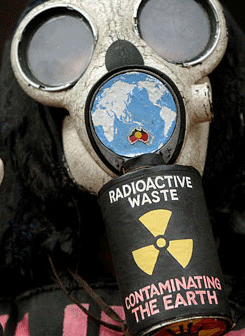
22 Jan 2024 | Jim Green and Dimity Hawkins, https://www.apln.network/projects/voices-from-pacific-island-countries/the-politics-of-nuclear-waste-disposal-lessons-from-australia
Click here to download the full report.
In this report, Jim Green and Dimity Hawkins explore Australia’s long and complex engagement with nuclear waste issues. With the failure to remediate atomic bomb test sites, and repeated failures to establish a national nuclear waste repository, the approaches of successive Australian governments to radioactive waste management deserve close scrutiny.
A recurring theme is the violation of the rights of Aboriginal First Nations Peoples and their successful efforts to resist the imposition of nuclear waste facilities on their traditional lands through effective community campaigning and legal challenges. Green and Hawkins argue for the incorporation of the UN Declaration on the Rights of Indigenous Peoples into Australian law, and amendments to the National Radioactive Waste Management Act to remove clauses which weaken or override Indigenous cultural heritage protections and land rights.
In addition, they highlight the need for studies, clean-up and monitoring of all British nuclear weapons test sites in Australia in line with the positive obligations in the Treaty on the Prohibition of Nuclear Weapons (TPNW). In light of the failure to manage existing radioactive waste management challenges, it must be questioned whether the Australian government can successfully manage the challenges of high-level nuclear waste management posed by the AUKUS defence pact and the plan to purchase and build nuclear-powered submarines.
This report was produced as part of a project on Nuclear Disarmament and the Anthropocene: Voices from Pacific Island Countries, sponsored by Ploughshares Fund.
Ontario is about to decide whether to overhaul Canada’s oldest nuclear power plant. Does it deserve a second life?
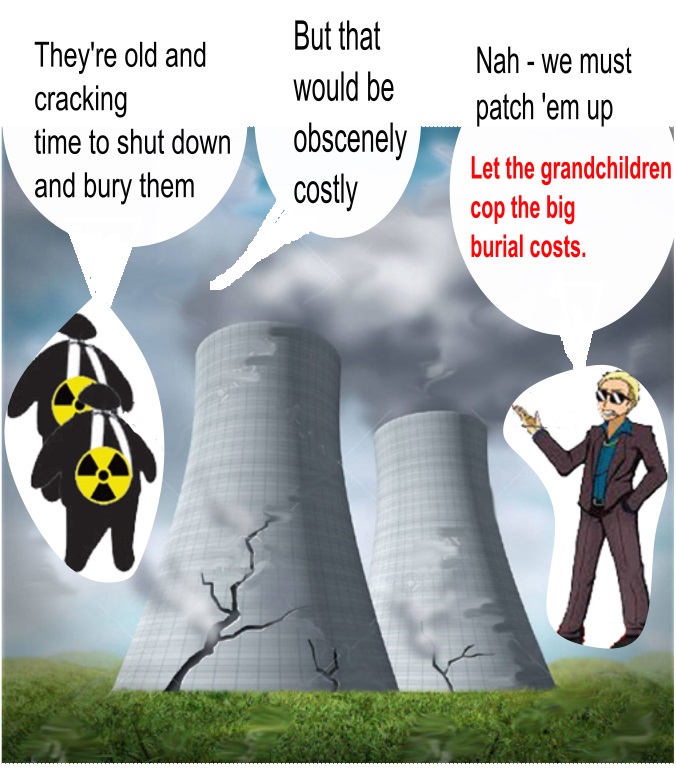
All of these are Candu reactors – Canada’s homegrown reactor design. They deteriorate with age. Inside their cores, pressure tubes (which contain the uranium fuel) grow longer, thinner and weaker. They begin to sag and corrode, increasing the risk of ruptures. Feeder pipes, which supply water to the pressure tubes, also corrode and thin.
Globe and Mail, MATTHEW MCCLEARN, 21 Jan 24
The Pickering Nuclear Generating Station’s dull, mottled-grey concrete domes testify to its more than half a century of faithful service. Lately, its six operating reactors have produced enough electricity to supply 1.5 million people, about one-tenth of Ontario’s total population.
In the coming weeks, Ontario Energy Minister Todd Smith is expected to reveal whether the province will extend the plant’s life. A study last summer from Ontario Power Generation, the station’s owner, examined the feasibility of refurbishing Pickering’s four “B” reactors, commissioned between 1983 and 1986. OPG has said there’s no technical reason the work can’t proceed. If approved, it would begin in 2028, with the aim of returning the reactors to service in the mid-2030s.
The real question is whether it’s worth it.
A firm cost estimate for extending the reactors’ lifespan has not been finalized. Refurbishments under way at OPG’s Darlington nuclear plant in Clarington and Bruce Power’s station in Tiverton have cost between $2-billion and more than $3-billion per reactor. The reactors at Pickering, Canada’s oldest nuclear plant, could cost even more, though their output is relatively small by modern standards.
Ontario’s government has said little about how it is weighing this decision, and it’s unclear what other options, if any, the province is considering. OPG has said its feasibility study would compare the refurbishment’s economic viability to “potential alternatives,” but the finished report has not been released publicly.
The Globe and Mail made a freedom of information request for a copy of the study. But Sean Keelor, chief administrative officer at Ontario’s Ministry of Energy, withheld the document in its entirety. He cited exemptions within the province’s Freedom of Information Act for “advice to government” and for information that could damage the “economic or other interests of Ontario.”
The Canadian Nuclear Safety Commission, which regulates the industry, allows utilitiesto perform upgrades thateffectively double reactors’ lives, as long as “all practicable safety improvements to bring the facility up to modern standards” have been identified. Upgrading Pickering would be no small undertaking.
“They are very old reactors, and the equipment is out of date,” said Ibrahim Attieh, a reactor physicist who worked on Candu designs. “It’s going to be a lot more costly to retrofit new equipment in.”
The Pickering station, situated on the shore of Lake Ontario about 30 kilometres east of downtown Toronto, also includes the four 1970s-era Pickering “A” reactors, which are not under consideration for refurbishment.
Two have been dormant for decades after an aborted refurbishment, and the remaining two are scheduled to shut down permanently this year.
All of these are Candu reactors – Canada’s homegrown reactor design. They deteriorate with age. Inside their cores, pressure tubes (which contain the uranium fuel) grow longer, thinner and weaker. They begin to sag and corrode, increasing the risk of ruptures. Feeder pipes, which supply water to the pressure tubes, also corrode and thin.
Candus were originally expected to operate for about 30 years. The industry has said decisions on whether to refurbish should be made after a quarter century – a milestone Pickering B has already passed.
All refurbishments involve sending workers into a reactor’s radioactive core, to replace major components such as pressure tubes and feeder pipes. But the scope of work varies considerably, depending on the age, design and condition of components, as well as other factors. A utility might also improve other infrastructure at a nuclear plant, such as turbines and control room equipment.
Subo Sinnathamby, OPG’s chief projects officer, said that among the components that would need to be replaced at Pickering B are the steam generators, which use heat produced inside the core to boil water, creating steam that drives turbine blades.
Ms. Sinnathamby said these components are too large to be removed through the reactor’s airlocks.
“We will have to cut a hole in the dome to remove it,” she said.
Pickering B’s control room is straight out of the Cold War and would also require modernization.
Continue readingBig costs sink flagship nuclear project and they’ll sink future small modular reactor projects too.

By Susan O’Donnell and M.V. Ramana, 024, https://beyondnuclearinternational.org/2024/01/21/big-costs-sink-flagship-nuclear-project/
The major news in the world of nuclear energy last November was the collapse of the Carbon Free Power Project in the United States. The project was to build six NuScale small modular nuclear reactors (SMRs). Given NuScale’s status as the flagship SMR design not just in the U.S. but even globally, the project’s cancellation should ring alarm bells in Canada. Yet SMRs are touted as a climate action strategy although it is becoming clearer by the day that they will delay a possible transition to net-zero energy and render it more expensive.
The NuScale project failed because there were not enough customers for its expensive electricity. Construction cost estimates for the project had been steadily rising—from USD 4.2 billion for 600 megawatts in 2018 to a staggering USD 9.3 billion (CAD 12.8 billion) for 462 megawatts. Using a combination of government subsidies, potentially up to USD 4.2 billion, and an opaque calculation method, NuScale claimed that it would produce electricity at USD 89 per megawatt-hour. When standard U.S. government subsidies are included, electricity from wind and solar energy projects, including battery storage, could be as cheap as USD 12 to USD 31 per megawatt-hour.
A precursor to the failed NuScale project was mPower, which also received massive funding from the U.S. Department of Energy. Described by The New York Times as the leader in the SMR race, mPower could not find investors or customers. By 2017, the project was essentially dead. Likewise, a small reactor in South Korea proved to be “not practical or economic”.
Ignoring this dire economic reality, provincial governments planning for SMRs – Ontario, New Brunswick, Saskatchewan and Alberta – published a “strategic plan” seemingly designed to convince the federal government to open its funding floodgates. Offering no evidence about the costs of these technologies, the report asserts: “The power companies assessed that SMRs have the potential to be an economically competitive source of energy.”
For its part, the federal government has coughed up grants totalling more than $175 million to five different SMR projects in Ontario, New Brunswick, and Saskatchewan. The Canada Infrastructure Bank loaned $970 million to Ontario Power Generation to develop its Darlington New Nuclear project. And the Canada Energy Regulator’s 2023 Canada’s Energy Future report envisioned a big expansion of nuclear energy based on wishful thinking and unrealistic assumptions about SMRs.
Canada’s support is puzzling when considering other official statements about nuclear energy. In 2021, Environment Minister Steven Guilbeault said that nuclear power must compete with renewable energy in the market. The previous year, then Environment Minister and current Energy and Natural Resources Minister Jonathan Wilkinson also emphasized competition with other sources of energy, concluding “the winner will be the one that can provide electrical energy at the lowest cost.” Given the evidence about high costs, nuclear power cannot compete with renewable energy, let alone provide electricity at the lowest cost.
Investing huge amounts of taxpayer money in technologies that are uncompetitive is bad enough, but an equally serious problem is wasting time. The primary justification for this government largesse is dealing with climate change. But the urgency of that crisis requires action now, not in two decades.
All the SMR designs planned in Canada’s provinces are still on the drawing board. The design furthest along in the regulatory process – the BWRX-300 slated for Ontario’s Darlington site – does not yet have a licence to begin construction. New Brunswick’s choices – a sodium cooled fast reactor and a molten salt reactor – are demonstrably problematic and will take longer to build.
Recently built nuclear plants have taken, on average, 9.8 years from start of construction to producing electricity. The requisite planning, regulatory evaluations of new designs, raising the necessary finances, and finding customers who want to pay higher electricity bills might add another decade.
SMR vendors have to raise not only the billions needed to build the reactor but also the funding to complete their designs. NuScale spent around USD 1.8 billion (CAD 2.5 billion), and the reactor was still left with many unresolved safety problems. ARC-100 and Moltex proponents in New Brunswick have each asked for at least $500 million to further develop their designs. Moltex has been unable to obtain the required funding to match the $50.5 million federal grant it received in 2021.
Adverse economics killed the flagship NuScale SMR project. There is no reason to believe the costs of SMR designs proposed in Canada will be any lower. Are government officials attentive enough to hear the clanging alarm bells?
Susan O’Donnell is adjunct research professor and primary investigator of the CEDAR project at St. Thomas University in Fredericton. M.V. Ramana is the Simons Chair in Disarmament, Global and Human Security and professor at the School of Public Policy and Global Affairs, University of British Columbia.
At least 25 killed in Russian-occupied Ukraine following missile strike, officials say
BY MIRANDA NAZZARO – 01/21/24, https://thehill.com/policy/international/4420260-at-least-25-killed-in-russian-occupied-ukraine-following-missile-strike-officials-say/
The shelling of a market in a part of Russian-occupied Ukraine killed at least 25 people on Sunday, The Associated Press reported.
Denis Pushilin, head of the Russian-installed authorities in the city of Donetsk, said another 20 people, including two children, were wounded in the strike on the outskirts of the city, the AP reported. He claimed shells were fired by the Ukrainian military.
Pushilin claimed the area was hit with a 155 mm caliber and 152 mm caliber artillery, with shells being fired from the direction of Ukrainian cities Kurakhove and Krasnohorivka, per the news wire.
Kyiv did not comment on the event and the claims could not be independently verified, the news wire noted.
The Russian Foreign Ministry, in a translated statement, called the incident a “barbaric terrorist act against the civilian population of Russia.”
“The terrorist attacks of the Kiev regime clearly indicate its lack of political will for peace and the settlement of the conflict by diplomatic means,” the statement said. “The need to achieve all the goals and objectives of a special military operation is obvious. Security threats and acts of terrorism should not come from the territory of Ukraine.”
A fire also broke out at a chemical transport terminal at Russia’s Ust-Luga port after two explosions, the AP said, citing local media reports. Local media reported the port was attacked by Ukrainian drones and a gas tank exploded.
Yuri Zapalatsky, who heads Russia’s Kingisepp district, where the port is based, reported no causalities and that the area was on high alert, the AP reported.
Russia’s Ministry of Defense also announced Sunday that Moscow’s forces took control of the village Krokhmalne in Ukraine’s Kharkiv region, the news wire added. Ukrainian forces confirmed the settlement was occupied, describing the incident as a “temporary phenomenon.”
The war between Ukraine and Russia is approaching its two-year mark next month, with thousands of troops killed on each side.
Western mercenaries used to fill Kiev’s expertise gaps, ex-CIA man tells RT
French fighters killed in Ukraine could have been clandestine weapons specialists, Larry Johnson has said…05
Ukraine is likely experiencing a shortage of soldiers capable of operating complex Western weapons systems, former CIA analyst Larry Johnson has told RT. A Russian report this week about a strike on “French mercenaries” in Kharkov may be a warning to would-be clandestine arms technicians that Paris plans to supply, he believes.
In response to the Russian Defense Ministry’s statement, France has denied having mercenaries in Ukraineor any other part of the world. Moscow claimed that approximately 60 foreign fighters, mostly French, were killed in the long-range attack. Meanwhile, President Emmanuel Macron has announced plans to supply additional air-launched SCALP cruise missiles to assist Kiev in its fight.
“I strongly suspect that many of those French ‘mercenaries’ – and I wouldn’t be surprised to see Brits and Americans scattered in there as well – are being brought in to help operate systems that they’ve been trained on previously in prior military careers.”
He named the US-made long-range Patriot anti-aircraft missile and the Storm Shadow, the British counterpart to SCALP, as examples of donated arms that may require competent foreign staff to deploy.
France is making itself a target by openly arming Kiev, Johnson told the broadcaster, contrasting current events with how the US acted in the past, when it sought to undermine the USSR:
“When the US ran covert operations through the CIA to fund the mujahideen in Afghanistan against the Soviets, it was done with some measure of secrecy and at least keeping up a pretense that we were not directly in conflict.
“I think Russia sent a very clear message in killing these mercenaries: If you are going to send them over here, if you are going to send that materiel, we’re gonna kill you.”
Johnson believes that Moscow could have acted in a far bolder manner in targeting Ukraine’s foreign donors, and that its reluctance to do so has been taken in the West as a sign of weakness.
“It’s not that, but the West has a track record of misinterpreting Russia on many points.”
Comment: Kiev is in critical manpower crisis as Zelensky pressures anyone semi-upright to take up arms and pretend they are soldiers…women, elderly, the infirm. French mercenaries? In a minute.
The following information is in regard to French PMCs (Private Military Company):
Site: Ministry of Foreign Affairs of the Russian Federation
With the ongoing developments in Ukraine, French PMCs offer their services to train Ukrainian forces in Eastern European countries. Since June 2022, they have been bringing onboard volunteers to participate in hostilities on Kiev’s side. Former members of the armed forces of EU countries and nationals of African countries are their first choice. French nationals taking part in the hostilities in Ukraine often get there via foreign PMCs or the Ukrainian International Legion.
Under French law, most of them do not fall under the Criminal Code article on mercenarism, because their remuneration for taking part in combat operations does not exceed the salary paid under a corresponding position in the French armed forces. Ukrainians that go to Ukraine from France in order to participate in the conflict, including the ones who are “on leave” from the French Foreign Legion are not qualified as mercenaries even if they hold French citizenship, since the people who are originally from a country participating in an armed conflict cannot be considered as such.
Military support functions are often delegated to “expendable” PMCs which recruit low-level personnel on the ground. A similar arrangement is used in Ukraine as well. Former French Foreign Legion members hailing from the countries in question often act as instructors. Ample supply of personnel from the ranks of former legionnaires makes it simple to create and use expendable PMCs for missions where use of force and/or participation in hostilities is likely.
About 100 French PMCs operate internationally. They are usually headed by former gendarmerie officers, and sometimes by retired security service officers. Mostly, these firms are mission-specific outfits and are put together for limited periods (for example, Lyon-based Byblos provided evacuation of French citizens from combat zones early on during the special military operation in Ukraine).
The most prominent French PMCs are as follows:
Aeneas Groupe, founded in 2004, provides consulting, security, and defence services, and trains personnel in France and abroad.
Anticip performs a variety of missions in war zones, such as crisis management, physical protection, armed escort, and site protection. It has worked in Iraq and Afghanistan and has subsidiaries in Nigeria and the UAE.
Chiron participates in the training of Ukrainian special forces. The instructors are former military members and French special service employees.
Défense Conseil International (DCI) is one of the leading companies of that kind and is unofficially used by the French Defence Ministry to perform a wide range of missions in the interests of friendly countries where, for some reasons, the use the French Armed Forces is impractical. It operates through 23 training centres in France and branches in 50 countries, such as Brunei, India, Kuwait, Malaysia, Saudi Arabia, Singapore, Qatar, and the UAE, to name a few. It provides combat training for ground, air and naval forces, special forces, advanced training in cybersecurity and radio electronic warfare, as well as interaction between different branches of the military. DCI operates through six subsidiary PMCs, the most famous of which – La Cofras – was hired by international organisations for demining in the Gulf area, Angola and Mozambique.
Gallice Défense is a group based in France, Europe and Africa that was founded in 2007. Its employees work under short-term contracts in the Sahel, LAC, Europe, Southeast Asia and the Middle East.
Geos was founded in 1998 by Stephane Gerardin, a former employee of the Main Directorate of Foreign Security (foreign intelligence), to address specific tasks abroad. It is staffed mostly by former employees of special services, the Defence Ministry and the Interior Ministry. It specialises in providing government customers with consulting services, economic intelligence, risk assessment-based analytical materials for major projects in various regions of the world, but also offers physical security and protection services. Operating in 80-plus countries, Geos has offices in Algeria, Argentina, Belgium, Brazil, Chile, China, Colombia, Germany, Libya, Mexico, Nigeria, Panama, Saudi Arabia, the UK, Ukraine and Venezuela,. The company is actively involved in training AFU personnel. Since June 2022, it has been recruiting volunteers to participate in combat operations on Kiev’s side. In total, at least 2,000 people have been recruited. The European Peace Foundation provides the funding. Candidates are trained in Eastern Europe.
Groupe Corpguard was founded in 2006. In 2016, it concluded a contract with the Government of Côte d’Ivoire as part of the operation to maintain peace and stability in the country.
Salamandre was founded in 1996. It brings together intelligence, counterintelligence and nuclear specialists. It has close ties with the French Directorate General for External Security and often acts on its behalf.
KBS Sécurité was founded in Lyon in 2007 as a company specialising in arms and military equipment sales. Currently, it offers security services and operates in Europe, the Middle East and North Africa.
Finland’s Radiation and Nuclear Safety Authority (STUK) wants to delay completion of its review on waste dump

Finland’s Radiation and Nuclear Safety Authority (STUK) has requested the
deadline for its opinion on Posiva Oy’s operating licence application for
the world’s first used fuel repository to be extended until the end of
2024. In September last year, it said it would not complete its review by
the end of 2023 as originally planned.
Radioactive waste management company
Posiva submitted its application, together with related information, to the
Ministry of Economic Affairs and Employment (TEM) on 30 December 2021 for
an operating licence for the used fuel encapsulation plant and final
disposal facility currently under construction at Olkiluoto.
The repository
is expected to begin operations in the mid-2020s. Posiva is applying for an
operating licence for a period from March 2024 to the end of 2070. The
government will make the final decision on Posiva’s application, but a
positive opinion by STUK is required beforehand. The regulator began its
review in May 2022 after concluding Posiva had provided sufficient
material. The ministry had requested STUK’s opinion on the application by
the end of 2023.
However, STUK announced in September that its safety
assessment and opinion on the application was taking longer than expected
and would not be completed by that deadline.
World Nuclear News 19th Jan 2024
https://www.world-nuclear-news.org/Articles/STUK-requests-extension-to-repository-review-deadl
A new ‘Cold War’ on a deadly hot planet?
China and the US must cut war-like posturing and face a world in desperate danger
By Tom Engelhardt, Tom Dispatch/Common Dreams
Tell me, what planet are we actually on? All these decades later, are we really involved in a “second” or “new” Cold War? It’s certainly true that, as late as the 1980s, the superpowers (or so they then liked to think of themselves), the United States and the Soviet Union, were still engaged in just such a Cold War, something that might have seemed almost positive at the time. After all, a “hot” one could have involved the use of the planet’s two great nuclear arsenals and the potential obliteration of just about everything.
But today? In case you haven’t noticed, the phrase “new Cold War” or “second Cold War” has indeed crept into our media vocabulary. (Check it out at Wikipedia.) Admittedly, unlike John F. Kennedy, Joe Biden has not actually spoken about bearing “the burden of a long, twilight struggle.” Still, the actions of his foreign policy crew — in spirit, like the president, distinctly old Cold Warriors — have helped make the very idea that we’re in a new version of just such a conflict part of everyday media chatter.
And yet, let’s stop and think about just what planet we’re actually on. In the wake of August 6 and August 9, 1945, when two atomic bombs destroyed the Japanese cities of Hiroshima and Nagasaki, there was little doubt about how “hot” a war between future nuclear-armed powers might get. And today, of course, we know that, if such a word can even be used in this context, a relatively modest nuclear conflict between, say, India and Pakistan might actually obliterate billions of us, in part by creating a — yes, brrr — “nuclear winter,” that would give the very phrase “cold” war a distinctly new meaning.
These days, despite an all too “hot” war in Ukraine in which the U.S. has, at least indirectly, faced off against the crew that replaced those Soviet cold warriors of yore, the new Cold War references are largely aimed at this country’s increasingly tense, ever more militarized relationship with China. Its focus is both the island of Taiwan and much of the rest of Asia. Worse yet, both countries seem driven to intensify that struggle.
In case you hadn’t noticed, Joe Biden made a symbolic and much-publicized stop in Vietnam (yes, Vietnam!) while returning from the September G20 summit meeting in India. There, he insisted that he didn’t “want to contain China” or halt its rise. He also demanded that it play by “the rules of the game” (and you know just whose rules and game that was). In the process, he functionally publicized his administration’s ongoing attempt to create an anti-China coalition extending from Japan and South Korea (only recently absorbed into a far deeper military relationship with this country), all the way to, yes, India itself.
And (yes, as well!) the Biden administration has upped military aid to Japan, Taiwan (including $85 million previously meant for Egypt), Australia (including a promise to supply it with its own nuclear attack submarines), and beyond. In the process, it’s also been reinforcing the American military position in the Pacific from Okinawa, Guam, and the Philippines to — yes again — Australia. Meanwhile, one four-star American general has even quite publicly predicted that a war between the U.S. and China is likely to break out by 2025, while urging his commanders to prepare for “the China fight”! Similarly, Director of National Intelligence Avril Haines has called China the “leading and most consequential threat to U.S. national security” and the Biden foreign policy team has been hard at work encircling — the Cold War phrase would have been “containing” — China, both diplomatically and militarily.
On the Chinese side, that country’s military has been similarly ramping up its air and naval activities around and ever closer to the island of Taiwan in an ominous fashion, even as it increases its military presence in places like the South China Sea (as has the U.S.). Oh, and just in case you hadn’t noticed, with a helping hand from Russia, Beijing is also putting more money and effort into expanding its already sizable nuclear arsenal.
Yes, this latest version of a Cold War is (to my mind at least) already a little too hot to handle. And yet, despite that reality, it couldn’t be more inappropriate to use the term “new Cold War” right now on a globe where a previously unimagined version of a hot war is staring us all, including most distinctly the United States and China, in the face.
As a start, keep in mind that the two great powers facing off so ominously against each other have long faced off no less ominously against the planet itself. After all, the United States remains the historically greatest greenhouse gas emitter of all time, while China is the greatest of the present moment (with the U.S. still in second place and Americans individually responsible for significantly more emissions than their Chinese counterparts). The results have been telling in both countries…………………………………………………………… more https://beyondnuclearinternational.org/2024/01/21/a-new-cold-war-on-a-deadly-hot-planet/
1 This Month

of the week – Shut Down Drone Warfare!


Tell the Ukrainian Government to Drop Prosecution of Peace Activist Yurii Sheliazhenko

Petition to revoke the licensing of the Near Surface Nuclear Disposal Facility (NSDF) at Chalk River. https://www.ourcommons.ca/petitions/en/Petition/Details?Petition=e-7247
To see nuclear-related stories in greater depth and intensity – go to https://nuclearinformation.wordpress.com
-
Archives
- March 2026 (244)
- February 2026 (268)
- January 2026 (308)
- December 2025 (358)
- November 2025 (359)
- October 2025 (376)
- September 2025 (257)
- August 2025 (319)
- July 2025 (230)
- June 2025 (348)
- May 2025 (261)
- April 2025 (305)
-
Categories
- 1
- 1 NUCLEAR ISSUES
- business and costs
- climate change
- culture and arts
- ENERGY
- environment
- health
- history
- indigenous issues
- Legal
- marketing of nuclear
- media
- opposition to nuclear
- PERSONAL STORIES
- politics
- politics international
- Religion and ethics
- safety
- secrets,lies and civil liberties
- spinbuster
- technology
- Uranium
- wastes
- weapons and war
- Women
- 2 WORLD
- ACTION
- AFRICA
- Atrocities
- AUSTRALIA
- Christina's notes
- Christina's themes
- culture and arts
- Events
- Fuk 2022
- Fuk 2023
- Fukushima 2017
- Fukushima 2018
- fukushima 2019
- Fukushima 2020
- Fukushima 2021
- general
- global warming
- Humour (God we need it)
- Nuclear
- RARE EARTHS
- Reference
- resources – print
- Resources -audiovicual
- Weekly Newsletter
- World
- World Nuclear
- YouTube
-
RSS
Entries RSS
Comments RSS
 nuclear-news