United Against Nuclear Iran: The Shadowy, Intelligence-Linked Group Driving the US Towards War With Iran
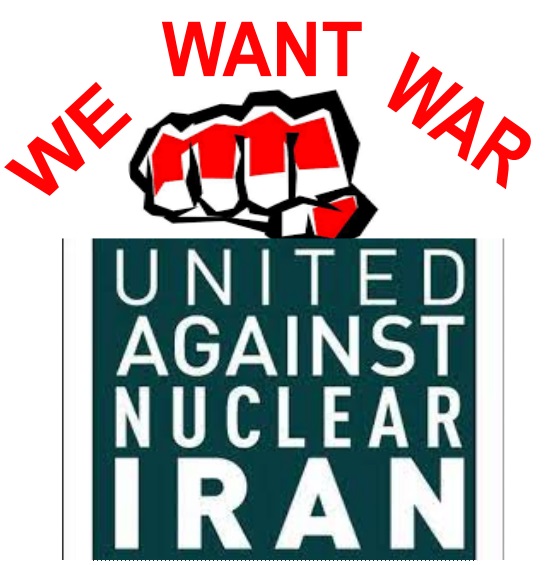
United Against Nuclear Iran, a secretive neoconservative organization with close links to the CIA and the Mossad, is trying to escalate the Israeli assault on Gaza into an Iraq-level U.S. Attack on Iran.
By Alan MacLeod / MintPress News
Most of the world has watched the Israeli assault on Gaza in horror. As tens of thousands have been killed and millions displaced, tens of millions of people around the world have poured onto the streets to demand an end to the violence. But a few select others have taken to the pages of our most influential media to demand an escalation of the violence and that the United States help Israel strike not just Palestine, Syria, and Lebanon but Iran as well.
“I might have once favored a cease-fire with Hamas, but not now,” wrote Bush-era diplomat Dennis Ross in The New York Times, explaining that “if Hamas is perceived as winning, it will validate the group’s ideology of rejection, give leverage and momentum to Iran and its collaborators and put [our] own governments on the defensive.”
In the wake of Hamas’ October 7 assault, arch-neoconservative official John Bolton was invited on CNN, where he claimed that what we witnessed was really an “Iranian attack on Israel using Hamas as a surrogate” and that the U.S. must immediately respond. When asked whether he had any evidence, given the implications of what he was saying, he shrugged and replied, “This is not a court of law.”
On December 28, Bolton doubled down on his hawkish stance, writing in the pages of Britain’s Daily Telegraph that “The West may now have no option but to attack Iran” – a position he has held for at least a decade.
Meanwhile, in an interview with Saudi state-funded broadcaster Iran International, senior Bush official Mark Wallace bellowed that, “This is Iran’s work. Iran will suffer at the hands of retribution and will suffer the consequences of supporting this terror group and its horrific attack on Israel.” Wallace continued:
No civilized country wants further conflict. But the Iranians are forcing the civilized world’s hand. And you will see a dramatic response soon as the United States, Israel, and our allies begin to position assets around the world in preparation.”
If there was any doubt as to what sort of “dramatic response” Wallace wanted to see, he added a message to Iran’s Islamic Revolutionary Guard Corps: “I look forward to seeing you hanged from the end of one of your own ropes.”
Iran was recently the victim of a deadly terrorist attack. As mourners commemorated the U.S. assassination of Qassem Soleimani, two bombs exploded, killing 91 and injuring hundreds more. In this context, it was understandable why Iranian officials pointed the finger at the U.S. and Israel.
WARMONGERS, INC
What these individuals all have in common is that they are board members of United Against Nuclear Iran (UANI), a shadowy but influential organization dedicated to pushing the West toward a military confrontation with the Islamic Republic.
Founded in 2008, the group is led by neoconservative hawks and has close ties to both U.S. and Israeli intelligence. It does not divulge where it receives its copious funding. However, it is known that right-wing Israeli-American billionaire Sheldon Adelson was a source. There is strong circumstantial evidence that Gulf dictatorships may also be bankrolling the group, although UANI has strongly denied this. In 2019, Iran designated UANI as a terrorist organization.
When asked by MintPress what he made of UANI’s recent statements, Eli Clifton, one of the few investigative journalists to have covered the group, said, “It’s very consistent with the positions and advocacy that the organization has taken since its inception.” Adding,
United Against Nuclear Iran does not miss an opportunity to try to bring the United States closer to a military conflict with Iran. And on the other side of the equation, they also have worked very hard to oppose efforts to de-escalate the U.S.-Iran relationship.”
UANI’s board is a who’s who of high state, military and intelligence officials from around the Western world. Among its more notable members include:………………………………………………………………………………………………………………………………….
In addition, notable former board members include ex-CIA Director R. James Woolsey; head of Mossad between 2002 and 2011, Meir Dagan; and one-time chief of British spy agency MI6, Sir Richard Dearlove.For 15 years, UANI has organized conferences, published reports, and lobbied politicians and governments, all with one goal: pushing a neoconservative line on Iran. “UANI are a force multiplier. They provide at least the veneer of an intellectual infrastructure for the Iran hawk movement. They did not invent being hawkish on Iran, but they sure made it a heck of a lot easier,” Ben Freeman, Director of the Democratizing Foreign Policy Program at the Quincy Institute, told MintPress.
CONFLICTS AND CONFLICTS OF INTEREST
For such a large, well-financed, and influential organization filled with senior officials, United Against Nuclear Iran keeps its funding sources very quiet. However, in 2015, Clifton was able to obtain a UANI donor list for the 2013 financial year. By far and away, the largest funders were billionaire New York-based investor Thomas Kaplan and multibillionaire Israeli-American casino mogul Sheldon Adelson……………………………………………………………………………………………………………..
PUTTING IRAN IN THE CROSSHAIRS
One of United Against Nuclear Iran’s primary activities, Iranian political commenter Ali Alizadeh told MintPress, is to create a worldwide “culture of fear and anxiety for investing in Iran.” The group attempts to persuade businesses to divest from the Islamic Republic and sign their certification pledge, which reads as follows:…………………………………………………………………………………………………………………………………………..
INTELLIGENCE CONNECTIONS
That UANI is headed by so many state, military and intelligence leaders begs the question: to what extent is this really a non-governmental organization? “That is one of the dirty secrets of think tanks: they are very often holding tanks for government officials,” Freeman said, adding:
The Trump folks all had to leave office when Biden won, so a lot of them ended up in think tanks for a while, four years, let’s say. And if Trump wins again, they will bounce back into government. And the same is true of Democratic administrations, too.”
he U.S. government also clearly has a longstanding policy of outsourcing much of its work to “private” groups in order to avoid further scrutiny. Many of the CIA’s most controversial activities, for example, have been farmed out to the National Endowment for Democracy (NED), a technically non-governmental organization funded entirely by Washington and staffed with ex-state officials. In recent years, the NED has funneled millions of dollars to protest leaders in Hong Kong, organized an attempted color revolution in Cuba, organized anti-government rock concerts in Venezuela, and propped up dozens of media organizations in Ukraine………………………………………………………………………………………….
UANI’s funders certainly also have extensive connections to Israel. Kaplan is the son-in-law of Israeli billionaire Leon Recanati and is said to be close with Prime Ministers Naftali Bennet and Yair Lapid. He has also employed a number of Israeli officials at his businesses. An example of this is Olivia Blechner, who, in 2007, left her role as the Director of Academic Affairs at the Israeli Consulate General in New York to become Executive Vice-President of Investor Relations and Research at Kaplan’s Electrum Group – a rather perplexing career move……………………………………………………………
A NETWORK OF REGIME CHANGE GROUPS
While United Against Nuclear Iran is already a notable enough organization, it is actually merely part of a large group of shadowy non-governmental groups working to cause unrest and, ultimately, regime change in Iran. These groups all share overlapping goals, funders and key individuals…………………………………………………………………………………………………………………………………………………
In short, then, there exists a network of American NGOs with the mission statements of helping Iran, opposing Iran, preserving Iran, and bombing Iran, all staffed by largely the same ex-U.S. government officials……………………………………………………………………………………………………..
A LESSON FROM HISTORY
The history of Iran has been intimately intertwined with the United States since at least 1953 when Washington orchestrated a successful coup against Prime Minister Mohammad Mosaddegh……………………………………………………………………………………………………………………………………….
The slaughter in Gaza has been horrifying enough. More than 22,000 people have been killed in the Israeli invasion, and a further 1.9 million displaced. Israel is also simultaneously bombing the West Bank, Syria and Lebanon. The U.S. is facilitating this, sending billions of dollars in weaponry, pledging iron-clad political support to Israel, silencing critics of its actions, and vetoing United Nations resolutions.
But United Against Nuclear Iran is eager to escalate the situation to a vastly greater level, urging Washington to attack a well-armed country of nearly 90 million people, erroneously claiming that Iran is behind every Hamas or Hezbollah action. ………………………………………………………………………
IF UANI gets its way, a conflict with Iran might spark a Third World War. And yet they are receiving virtually no pushback to their ultra-hawkish pronouncements, largely because they operate in the shadows and receive virtually no public scrutiny. It is, therefore, imperative for all those who value peace to quickly change that and expose the organization for what it is. https://scheerpost.com/2024/01/16/united-against-nuclear-iran-the-shadowy-intelligence-linked-group-driving-the-us-towards-war-with-iran/
The Times asks “Are big nuclear reactors really the right thing for the UK?

Nuclear minister Andrew Bowie had a case to hail it a “major
milestone”, with Julia Pyke, Sizewell’s joint managing director,
calling it a “significant moment” for the project and for UK “energy
security”.
Even so, there is still a long way to go. The project will
cost £30 billion-plus, with the PM yet to make a final investment
decision. Sizewell uses the same European pressurised reactor technology as
Hinkley: the Somerset nuke being built by France’s EDF and China’s CGN.
Who exactly will fund Sizewell? Alison Downes, of the Stop Sizewell C
campaign, is no neutral party. But she’s right to say the government is
“still months away” from securing finance, while keeping “secret”
the project’s “enormous cost”.
Bowie told the Financial Times he was
“very confident” of obtaining private finance, but the government is
now rowing back from the FT report that it’s “on track” to raise £20
billion. Even if it has changed the funding rubric to a “regulated asset
base” model that frontloads cost overruns on to consumer bills, investors
think that figure wildly optimistic. On a one third/two thirds split,
ministers need at least £10 billion of equity and £20 billion of debt.
But EDF wants no more than 19.9 per cent of Sizewell equity, while the UK
has booted off the Chinese. Ministers have reportedly lined up Abu Dhabi
funds for a chunk of the equity. But market talk is that the government is
still at least £5 billion short, while it also faces having to underwrite
all the debt — at least until it can syndicate some out once construction
hurdles are met.
Is this the best use of taxpayer’s money? And what’s
the risk private investors are given too generous terms? Yes, the wind
doesn’t blow or sun shine every day. So Britain will need baseload power
to offset intermittent renewables.
But, even if Sizewell C gets the
official go-ahead soon, it won’t be generating power until the late
2030s. A third station will be even further behind. Labour’s union
backers are typically pro-nuclear. But should Sir Keir Starmer come to
power, he must still tackle key questions. Are pricey mega nukes, largely
funded by the taxpayer and consumers, the right strategic bet for 2040? Or
do battery power, say, or modular nuclear reactors make more sense? The
government is yet to make a conclusive financial case for Sizewell C —
let alone any more.
Times 16th Jan 2024
https://www.thetimes.co.uk/article/sizing-up-sizewell-is-a-nuclear-option-fwpd2p53d
Biden administration finalizes a $1.1 billion aid package for California’s last nuclear power plant

LOS ANGELES (AP) — President Joe Biden’s administration on Wednesday finalized approval of $1.1 billion to help keep California’s last operating nuclear power plant running.
The funding is a financial pillar in the plan to keep the Diablo Canyon Power Plant producing electricity to at least 2030 — five years beyond its planned closing.
Terms of the aid package were not released by the Energy Department.
In 2016, plant operator Pacific Gas & Electric, environmental groups and plant worker unions reached an agreement to close the four-decade-old reactors by 2025. But the Legislature voided the deal in 2022 at the urging of Democratic Gov. Gavin Newsom, who said the power is needed to ward off blackouts as climate change stresses the energy system.
California is the birthplace of the modern environmental movement and for decades has had a fraught relationship with nuclear power. Environmentalists argued California has adequate power without the reactors and that their continued operation could hinder development of new sources of clean energy. They also warn that long-delayed testing on one of the reactors poses a safety risk that could result in an accident, a claim disputed by PG&E……………………… https://www.hindustantimes.com/world-news/biden-administration-finalizes-a-1-1-billion-aid-package-for-california-s-last-nuclear-power-plant-101705536723552.html
Petition: 100 per cent renewables rather than Small Modular (nuclear) Reactors
The UK/Ireland Nuclear Free Local Authorities are supporting a petition and
webinar hosted by 100 percent Renewables UK to condemn and counter the
one-sided pre-Christmas hearing convened by Parliament’s Environment Audit
Committee in support of the deployment of Small Modular Nuclear Reactors,
and to instead host an enquiry into the practicalities of a 100% renewable
future for the UK.
The initiative was launched by Dr David Toke, Director
of 100 percent Renewables UK and Reader in Energy Politics at the
University of Aberdeen. Dr Toke is now seeking signatures on the petition
which reads: We condemn the one-sided hearing on small modular rectors held
by the Environmental Audit Committee (EAC) and call upon the EAC to
organise an enquiry into the practicalities of a 100 percent or near 100
per cent UK renewable energy system. The petition can be found at
NFLA 16th Jan 2024
The Military-Industrial Complex Is the Winner (Not You)

The best route to preventing a future Chinese invasion of Taiwan would be to revive Washington’s “One China” policy that calls for China to commit itself to a peaceful resolution of Taiwan’s status and for the U.S. to forswear support for that island’s formal independence. In other words, diplomacy, rather than increasing the Pentagon budget to “win” such a war, would be the way to go.
SCHEERPOST, By William D. Hartung / TomDispatch, 17 Jan 24
2023 was a year marked by devastating conflicts from Russia’s ongoing invasion of Ukraine to Hamas’s horrific terror attacks on Israel, from that country’s indiscriminate mass slaughter in Gaza to a devastating civil war in Sudan. And there’s a distinct risk of even worse to come this year. Still, there was one clear winner in this avalanche of violence, suffering, and war: the U.S. military-industrial complex.
In December, President Biden signed a record authorization of $886 billion in “national defense” spending for 2024, including funds for the Pentagon proper and work on nuclear weapons at the Department of Energy. Add to that tens of billions of dollars more in likely emergency military aid for Ukraine and Israel, and such spending could well top $900 billion for the first time this year.
Meanwhile, the administration’s $100-billion-plus emergency military aid package that failed to pass Congress last month is likely to slip by in some form this year, while the House and Senate are almost guaranteed to add tens of billions more for “national defense” projects in specific states and districts, as happened in two of the last three years.
Of course, before the money actually starts flowing, Congress needs to pass an appropriations bill for Fiscal Year 2024, clearing the way for that money to be spent. As of this writing, the House and Senate had indeed agreed to a tentative deal to sign onto the $886 billion that was authorized in December. A trillion-dollar version of such funding could be just around the corner. (If past practice is any guide, more than half of that sum could go directly to corporations, large and small.)
A trillion dollars is a hard figure to process. In the 1960s, when the federal budget was a fraction of what it is now, Republican Senator Everett Dirksen allegedly said, “A billion here, a billion there, and pretty soon you’re talking real money.” Whether he did or not, that quote neatly captures how congressional attitudes toward federal spending have changed. After all, today, a billion dollars is less than a rounding error at the Pentagon. The department’s budget is now hundreds of billions of dollars more than at the height of the Vietnam War and over twice what it was when President Eisenhower warned of the “unwarranted influence” wielded by what he called “the military-industrial complex.”
To offer just a few comparisons: annual spending on the costly, dysfunctional F-35 combat aircraft alone is greater than the entire budget of the Centers for Disease Control and Prevention. In 2020, Lockheed Martin’s contracts with the Pentagon were worth more than the budgets of the State Department and the Agency for International Development combined, and its arms-related revenues continue to rival the government’s entire investment in diplomacy. One $13 billion aircraft carrier costs more than the annual budget of the Environmental Protection Agency. Overall, more than half of the discretionary budget Congress approves every year — basically everything the federal government spends other than on mandatory programs like Medicare and Social Security — goes to the Pentagon.
It would, I suppose, be one thing if such huge expenditures were truly needed to protect the country or make the world a safer place. However, they have more to do with pork-barrel politics and a misguided “cover the globe” military strategy than a careful consideration of what might be needed for actual “defense.”
Congressional Follies
The road to an $886-billion military budget authorization began early last year with a debt-ceiling deal negotiated by President Biden and then-House Speaker Kevin McCarthy. That rolled back domestic spending levels, while preserving the administration’s proposal for the Pentagon intact. McCarthy, since ousted as speaker, had been pressed by members of the right-wing “Freedom Caucus” and their fellow travelers for just such spending cuts. (He had little choice but to agree, since that group proved to be his margin of victory in a speaker’s race that ran to 15 ballots.)……………………………………………………………………………………
Threat Inflation and the “Arsenal of Democracy”
Perhaps you won’t be surprised to learn that the strategic rationales put forward for the flood of new Pentagon outlays don’t faintly hold up to scrutiny. First and foremost in the Pentagon’s argument for virtually unlimited access to the Treasury is the alleged military threat posed by China. But as Dan Grazier of the Project on Government Oversight has pointed out, that country’s military strategy is “inherently defensive”:
“[T]he investments being made [by China] are not suited for foreign adventurism but are instead designed to use relatively low-cost weapons to defend against massively expensive American weapons. The nation’s primary military strategy is to keep foreign powers, and especially the United States, as far away from its shores as possible in a policy the Chinese government calls ‘active defense.’”
The greatest point of potential conflict between the U.S. and China is, of course, Taiwan. But a war over that island would come at a staggering cost for all concerned and might even escalate into a nuclear confrontation. A series of war games conducted by the Center for Strategic and International Studies (CSIS) found that, while the United States could indeed “win” a war defending Taiwan from a Chinese amphibious assault, it would be a Pyrrhic victory. “The United States and its allies lost dozens of ships, hundreds of aircraft, and tens of thousands of servicemembers,” it reported. “Taiwan saw its economy devastated. Further, the high losses damaged the U.S. global position for many years.” And a nuclear confrontation between China and the United States, which CSIS didn’t include in its assessment, would be a first-class catastrophe of almost unimaginable proportions.
The best route to preventing a future Chinese invasion of Taiwan would be to revive Washington’s “One China” policy that calls for China to commit itself to a peaceful resolution of Taiwan’s status and for the U.S. to forswear support for that island’s formal independence. In other words, diplomacy, rather than increasing the Pentagon budget to “win” such a war, would be the way to go.
The second major driver of higher Pentagon budgets is allegedly the strain on this country’s arms manufacturing base caused by supplying tens of billions of dollars of weaponry to Ukraine, including artillery shells and missiles that are running short in American stockpiles. The answer, according to the Pentagon and the arms industry, is to further supersize this country’s already humongous military-industrial complex to produce enough weaponry to supply Ukraine (and now Israel, too), while acquiring sufficient weapons systems for a future war with China.
There are two problems with such arguments. First, supplying Ukraine doesn’t justify a permanent expansion of the U.S. arms industry. In fact, such aid to Kyiv needs to be accompanied by a now-missing diplomatic strategy designed to head off an even longer, ever more grinding war.
Second, the kinds of weapons needed for a war with China would, for the most part, be different from those relevant to a land war in Ukraine, so weaponry sent to Ukraine would have little relevance to readiness for a potential war with China (which Washington should, in any case, be working to prevent, not preparing for).
The Disastrous Costs of a Militarized Foreign Policy
Before investing ever more tax dollars in building an ever-expanding garrison state, the military strategy of the United States in the current global environment should be seriously debated. Just buying ever more bombs, missiles, drones, and next-generation artificial intelligence-driven weaponry is not, in fact, a strategy, though it is a boon to the military-industrial complex and an invitation to a destabilizing new arms race.
Unfortunately, neither Congress nor the Biden administration seems inclined to seriously consider an approach that would emphasize investing in diplomatic and economic tools over force or the threat of force. …………………………………………………………………………………………………………………
A serious national conversation is needed on what a genuine defense strategy would look like, rather than one based on fantasies of global military dominance. Otherwise, the overly militarized approach to foreign and economic policy that has become the essence of Washington budget-making could be extended endlessly and disastrously into the future, something this country literally can’t afford to let happen.
https://scheerpost.com/2024/01/17/the-military-industrial-complex-is-the-winner-not-you/
When Yemen Does It It’s Terrorism, When The US Does It It’s “The Rules-Based Order”
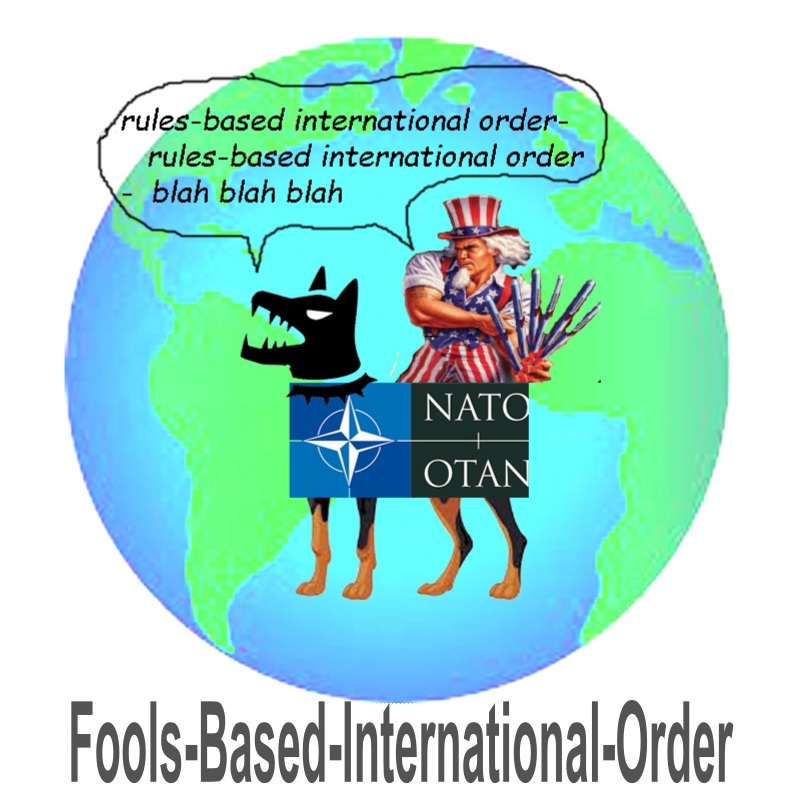
That’s right kids: when Yemen sets up a blockade to try and stop an active genocide, that’s terrorism, but when the US empire imposes a blockade to secure its geostrategic interests in the middle east, why that’s just the rules-based international order in action.
What this shows us is that the “rules-based international order” the US and its allies claim to uphold is not based on rules at all; it’s based on power, which is the ability to control and impose your will on other people. The “rules” apply only to the enemies of the empire because they are not rules at all: they are narratives used to justify efforts to bend the global population to its will.
CAITLIN JOHNSTONE, JAN 18, 2024
The Biden administration has officially re-designated Ansarallah — the dominant force in Yemen also known as the Houthis — as a Specially Designated Global Terrorist entity.
The White House claims the designation is an appropriate response to the group’s attacks on US military vessels and commercial ships in the Red Sea and the Gulf of Aden, saying those attacks “fit the textbook definition of terrorism.” Ansarallah claims its actions “adhere to the provisions of Article 1 of the Convention on the Prevention and Punishment of the Crime of Genocide,” since it is only enforcing a blockade geared toward ceasing the ongoing Israeli destruction of Gaza.
One of the most heinous acts committed by the Trump administration was its designation of Ansarallah as a Foreign Terrorist Organization (FTO) and as Specially Designated Global Terrorists (SDGT), both of which imposed sanctions that critics warned would plunge Yemen’s aid-dependent population into even greater levels of starvation than they were already experiencing by restricting the aid that would be allowed in. One of the Biden administration’s only decent foreign policy decisions has been the reversal of that sadistic move, and now that reversal is being partially rolled back, though thankfully only with the SDGT listing and not the more deadly and consequential FTO designation.
In a new article for Antiwar about this latest development, Dave Decamp explains that as much as the Biden White House goes to great lengths insisting that it’s going to issue exemptions to ensure that its sanctions don’t harm the already struggling Yemeni people, “history has shown that sanctions scare away international companies and banks from doing business with the targeted nations or entities and cause shortages of medicine, food, and other basic goods.” DeCamp also notes that US and British airstrikes on Yemen have already forced some aid groups to suspend services to the country.
So the US empire is going to be imposing sanctions on a nation that’s still trying to recover from the devastation caused by the US-backed Saudi blockade that contributed to hundreds of thousands of deaths between 2015 and 2022. All in response to the de facto government of that very same country imposing its own blockade with the goal of preventing a genocide.
That’s right kids: when Yemen sets up a blockade to try and stop an active genocide, that’s terrorism, but when the US empire imposes a blockade to secure its geostrategic interests in the middle east, why that’s just the rules-based international order in action…………………………………..
What this shows us is that the “rules-based international order” the US and its allies claim to uphold is not based on rules at all; it’s based on power, which is the ability to control and impose your will on other people. The “rules” apply only to the enemies of the empire because they are not rules at all: they are narratives used to justify efforts to bend the global population to its will……… https://www.caitlinjohnst.one/p/when-yemen-does-it-its-terrorism?utm_source=post-email-title&publication_id=82124&post_id=140790707&utm_campaign=email-post-title&isFreemail=true&r=1ise1&utm_medium=email
 | |||
| |||
Sizewell C opponents warn Suffolk nuclear plant ‘could be the new HS2’.
Sizewell C opponents warn Suffolk nuclear plant ‘could be the new HS2’.
Campaigners fighting a new nuclear power station on the Suffolk coast say
they fear a shortfall in finance for the project could mean it becomes
another HS2. Their comments came amid a landmark moment for the building of
Sizewell C as a Development Consent Order was triggered, meaning
construction can begin. Andrew Bowie, the minister for nuclear and
renewables, was at the construction site to herald what he claimed was a
significant point in the development. The new power plant, which could
create 10,000 jobs, was given the go-ahead in November – but campaigners
opposed to it say they will not give up.
ITV 15th Jan 2024
https://www.itv.com/news/anglia/2024-01-15/coastal-nuclear-plant-could-be-new-hs2-warn-campaigners
lear plant ‘could be the new HS2’.
What sort of world do we want?: ICAN exec discusses ultimate goal of nuclear abolition
January 18, 2024 (Mainichi Japan)
International Campaign to Abolish Nuclear Weapons (ICAN) Executive Director Melissa Parke is set to visit Hiroshima and Nagasaki from Jan. 19 to 21, ahead of the three-year anniversary since the Treaty on the Prohibition of Nuclear Weapons (TPNW) entered into force.
The risk of a nuclear conflict is at an all-time high since the end of the Cold War, and the TPNW has taken on an increasingly significant role to abolish all nuclear weapons to ensure safety for humanity, Parke said. The executive director sat down for an online interview with the Mainichi Shimbun prior to her first visit to the World War II atomic bombing sites, to share her views on the elimination of nuclear weapons……………………………………………………………………………………………………………………… https://mainichi.jp/english/articles/20240117/p2a/00m/0op/028000c
1 This Month

of the week – Shut Down Drone Warfare!


Tell the Ukrainian Government to Drop Prosecution of Peace Activist Yurii Sheliazhenko

Petition to revoke the licensing of the Near Surface Nuclear Disposal Facility (NSDF) at Chalk River. https://www.ourcommons.ca/petitions/en/Petition/Details?Petition=e-7247
To see nuclear-related stories in greater depth and intensity – go to https://nuclearinformation.wordpress.com
-
Archives
- March 2026 (237)
- February 2026 (268)
- January 2026 (308)
- December 2025 (358)
- November 2025 (359)
- October 2025 (376)
- September 2025 (257)
- August 2025 (319)
- July 2025 (230)
- June 2025 (348)
- May 2025 (261)
- April 2025 (305)
-
Categories
- 1
- 1 NUCLEAR ISSUES
- business and costs
- climate change
- culture and arts
- ENERGY
- environment
- health
- history
- indigenous issues
- Legal
- marketing of nuclear
- media
- opposition to nuclear
- PERSONAL STORIES
- politics
- politics international
- Religion and ethics
- safety
- secrets,lies and civil liberties
- spinbuster
- technology
- Uranium
- wastes
- weapons and war
- Women
- 2 WORLD
- ACTION
- AFRICA
- Atrocities
- AUSTRALIA
- Christina's notes
- Christina's themes
- culture and arts
- Events
- Fuk 2022
- Fuk 2023
- Fukushima 2017
- Fukushima 2018
- fukushima 2019
- Fukushima 2020
- Fukushima 2021
- general
- global warming
- Humour (God we need it)
- Nuclear
- RARE EARTHS
- Reference
- resources – print
- Resources -audiovicual
- Weekly Newsletter
- World
- World Nuclear
- YouTube
-
RSS
Entries RSS
Comments RSS
 nuclear-news