An international law expert explains why South Africa’s case at the ICJ is so important

A ruling by the International Court of Justice in favor of South Africa, which has accused Israel of genocide, could mean saving thousands of lives in Gaza. The alternative, however, could be devastating and further embolden Israeli violence.
BY YUMNA PATEL https://mondoweiss.net/2024/01/an-international-law-expert-explains-why-south-africas-case-at-the-icj-is-so-important/?fbclid=IwAR0_La2MT5GTGkKo2X56cAEa15B-SPBIOwKnMKznqzCczU0XVSIz_BlNrBE
South Africa and Israel will be appearing before the International Court of Justice, on Thursday, January 11, where the court will begin hearing arguments on whether Israel is committing the crime of Genocide.
The highly anticipated public hearings, which will last for two days, are based on an 84-page appeal submitted by South Africa in December to the ICJ, the top judicial body of the United Nations. In the appeal, South Africa argues that Israel’s military campaign in Gaza is “genocidal in character” and that through both action and intent to commit genocide, Israel has violated the 1948 Genocide Convention.
Both Israel and South Africa are parties to the convention, which came into being on the heels of World War II and the Holocaust. All signatories of the treaty are obligated not to commit genocide, to ensure that it is prevented, and to seek that the crime be prosecuted.
South Africa’s appeal to the ICJ, however, is not just about charging Israel with the crime of genocide – a lengthy process that could take the court months or years. It’s also seeking a more immediate solution by requesting the court institute provisional measures to immediately halt Israel’s military campaign in Gaza.
Essentially, South Africa wants two things: to stop the mass killing of Palestinians in Gaza now and for Israel to be charged with the crime of genocide in the long term. A condensed breakdown and explanation of the 84-page brief can be found here.
Expectedly, Israel has outright denied any accusations of genocide, lambasting the South African appeal as antisemtic “blood libel”. The U.S. has also rebuked South Africa’s appeal, called it “meritless” and “completely without any basis in fact.”
Nevertheless, Israel is pressing forward, sending a carefully crafted legal team to The Hague in the Netherlands to defend Israel’s position that it is not committing genocide in Gaza.
The much-talked about public proceedings, which will take place over the course of two days on Thursday and Friday, January 11th and 12th, are being welcomed by both Palestinians, as well as a number of countries around the world, who have thus far failed to bring about a ceasefire, primarily due to the U.S. veto of UN resolutions calling for a halt to the violence.
Despite the international buzz and anticipation, many in Palestine and around the world remain skeptical as to how much weight an ICJ ruling against Israel could hold due to a long history of Israeli impunity on the global stage and Israel’s well-documented disregard for international law and human rights norms.
Still, many Palestinian international law experts and human rights groups say the ICJ proceedings are significant and could hold serious consequences not only for Israel and Palestine but for the world.
Among them is Dr. Munir Nuseibah, a Palestinian professor of International law at Al-Quds University and the Director of the Al-Quds Human Rights Clinic. Mondoweiss spoke to Dr. Nuseibah about the significance of this case, why people should pay attention to it, and what implications it holds.
Why does this case matter?
The case filed by South Africa is important for a number of reasons. First, Dr. Nuseibah notes, the fact that it was filed at the ICJ in and of itself is significant, being that the court is the highest judicial body that settles disputes between states.
“This is quite significant because it’s… based on an agreement, or treaty that is binding to both South Africa and Israel,” he said, referring to the 1948 Genocide Convention.
“This is important in the history of the Palestinian cause, since we haven’t had an opportunity to get a binding international decision on any of the important questions that we have been dealing with, including for example, the issue of the Palestinian refugees, the [Israeli] occupation, etc,” Dr. Nuseibah continued.
The last time the ICJ made a decision in relation to Palestine was a 2004 advisory opinion that found Israel’s separation wall, which at that stage was still early on in its construction, violated international law and should be torn down.
However, because that decision was a non-binding advisory opinion, Israel was not obligated to stop construction or take down the wall. Instead, Israel continued constructing the wall, which today spans across hundreds of kilometers, cutting off Palestinians from their land and swallowing up swaths of Palestinian territory.
This case, Dr. Nuseibah says, would be different, as the resulting decision from this week’s proceedings would be binding, and if the court rules in favor of South Africa, it would mean that under international law, Israel would be obligated to end its military campaign in Gaza in the short term, and in the long term, potentially provide material reparations to the victims of its genocide.
The case is also significant as a symbolic measure as well. That, in the face of an ongoing genocide, which has been well documented by Palestinians and international human rights organizations alike, the world must intervene to stop it.
“If there is no serious intervention, and if the United Nations, the world, and what we call the international community is going to continue to be silenced and made inactive, and in a certain way deactivated and demobilized, this horror will continue,” Dr. Nusaibah said, not just in Palestine but around the world.
“To not only be accused of genocide, but to be charged by the court, and to be seen as a country guilty of genocide is very important,” he said. “In my opinion, everything that happens in the International Court of Justice now, is likely to influence thousands of lives in the future.
So whatever these judges will decide will actually be a question of life and death for many, many Palestinians.”
What will South Africa be arguing on Thursday?
The crux of South Africa’s argument is that Israel is committing genocide in Gaza and that it is violating its obligations under the 1948 Convention on the Prevention and Punishment of Genocide, which defines the crime as “acts intended to bring about the destruction of a substantial part of the Palestinian national, racial and ethnic group.”
South Africa’s argument hinges on proving that Israel is not only committing acts of genocide in Gaza but that there is a clear intent on Israel’s part to commit genocide – the latter being a significant focus of the 84-page brief, which listed off an array of quotes from Israeli politicians, officials, and public figures using genocidal language when speaking about Israel’s campaign in Gaza.
“[South Africa’s] first argument will involve the speeches and quotes basically from Israeli officials who have been using genocidal language from the very first day actually, from October 7th,” Dr. Nuseibah said.
“In criminal law it’s not enough to do something, but you have to intend to do something. And one of the signs of intent, are the things you say. So these quotes from Israeli officials will be used to show that Israel has been calling for genocide,” he continued.
And, of course, South Africa will be providing evidence of what it says are clear genocidal acts carried out by Israel in Gaza, such as “bombing civilians, heavily targeting homes, targeting hospitals, targeting cultural centers, targeting universities, schools, etc,” Dr. Nuseibah detailed.
“So all of these targets that the Israeli army has destroyed over the past months, and of course the civilian casualties, the human beings who have been murdered or injured or made disabled, [Israel] using hunger as a weapon, etc. – all of that will be a very important part of the facts South Africa will present,” he said, adding that the denial of fuel and electricity, the siege on 2 million civilians, and the forcible displacement of Palestinians in Gaza is also “an important element of genocide and especially in this case.”
What will Israel’s legal defense look like?
While there are 84 pages to give us an insight into South Africa’s case, it’s not as apparent what exactly Israel’s defense will consist of.
If the past few months have been any indication, however, during which Israel has denied any wrongdoing in Gaza, justified it as self-defense, and has actually accused Hamas of genocide for its October 7th attack – some assumptions can be made as to how Israel will approach it’s defense.
First, Israel’s primary strategy, Dr. Nuseibah says, will be to “deny, deny, deny.”
“Israel will deny everything that South Africa claims,” Dr. Nuseibah said. “It will deny that it has starved people, or that it is trying to starve people. It will deny that it is not allowing humanitarian aid into Gaza, by showing examples where it actually did allow some trucks to enter,” he continued, noting that what little humanitarian aid has been allowed into Gaza has been critically insufficient to address the needs of the more than 2 million people trapped in the strip.
“It [Israel] will talk about any attempts they made in any of their operations to ‘reduce civilian casualties’, whether by warning civilians in certain places,” Dr. Nuseibah said, referring to Israel’s practice of dropping leaflets to notify civilians that their area is going to be attacked, or by providing QR codes and maps of “safe zones” and “combat zones” in Gaza – all practices that have been widely criticized both as insufficient to save civilian lives, and as a PR move by Israel to save face in front of the international community.
At the time of publication, 96 days after Israel began its bombardment on Gaza, more than 23,000 Palestinians have been killed, the vast majority of them civilians.
“So, Israel’s strategy will be to deny everything, because there is nothing else they can do or say,” Dr. Nuseibah said. “It is a longtime strategy and practice of Israel that we are used to. Israel always denies its crimes. Even until today, Israel denies the Nakba, that is the official position of Israel, to deny it.”
While Israel has focused much of its propaganda campaign on accusing Hamas, and supporters of the Palestinian cause in general, of carrying out or advocating for the genocide of Israelis and Jewish people, Dr. Nuseibah said he doubts that will be a feature of Israel’s arguments at the ICJ.
“I doubt that they will do this or bring this up, because if they do, then they would have to present evidence. They would have to allow an open investigation into what happened on October 7th,” Dr. Nuseibah said, noting that Israel has historically prevented access to independent investigators seeking to probe potential crimes committed in the occupied Palestinian territory.
How will this impact Palestinian lives right now?
While the deliberations on whether Israel is guilty of genocide in Gaza or not could take years, South Africa’s case is expected to yield a much more immediate and time-sensitive result.
As part of its appeal to the court, South Africa is seeking an emergency interim decision by the court, or “provisional measures,” to order the Israeli military to cease its campaign in Gaza immediately, stop the displacement of Palestinians, and allow for the entry of adequate humanitarian aid into Gaza. The court could make that decision in as little as a few days or weeks.
These provisional measures, Dr. Nuseibah says, are some of the most critical elements to the case and have the biggest potential to change the course of the unfolding genocide in Gaza.
“This is very time sensitive. Every day that we lose, we are losing more lives. We are losing more casualties. There are more homes that are demolished. There are more days that children are not going to school,” he continued.”There is a lot of loss every single day of civilian life, and there is no human being in Gaza who is not heavily influenced by what is happening.”
“All of the provisional requests that South Africa has made are there to save lives immediately. And I do expect that the court will take these measures. History has shown that the ICJ has given these provisional measures in similar situations, even with less casualties and less risk,” Dr. Nuseibah said.
“So I do expect that the court will decide provisional measures, which would mean a ceasefire, which is the most important thing right now, as well as stopping the displacement, allowing for the entry of aid, and stopping the continuous demolition of Gaza.”
Israel has ignored international law before, what will be different this time?
Continue readingNuclear Continues To Lag Far Behind Renewables In China Deployments
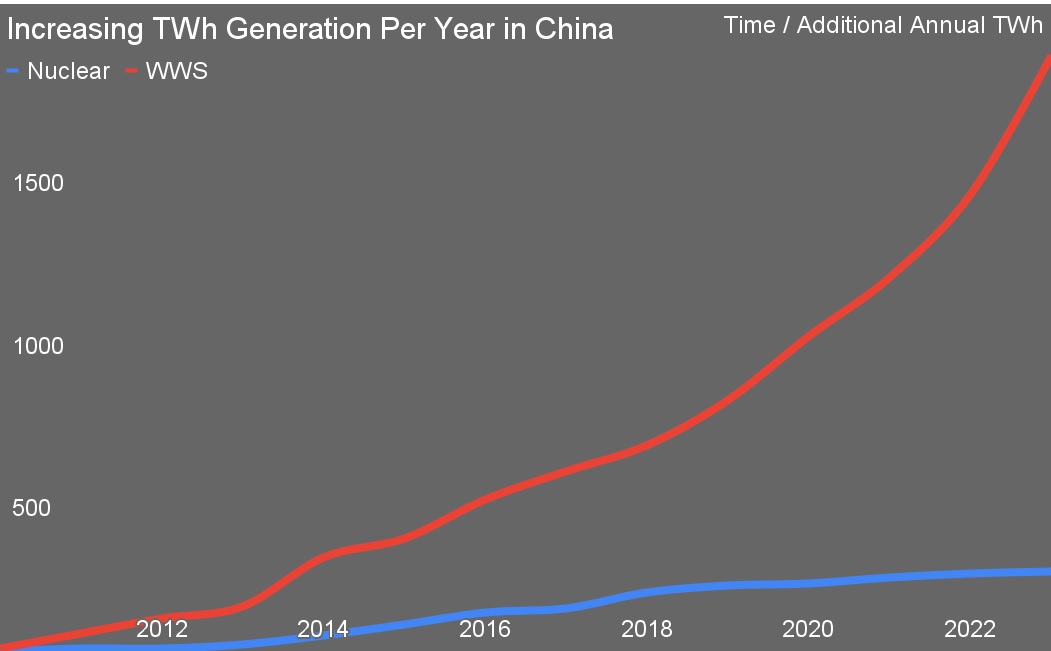
China can’t scale its nuclear program at all. It peaked in 2018 with 7 reactors with a capacity of 8.2 GW. For the five years since then then it’s been averaging 2.3 GW of new nuclear capacity, and last year only added 1.2 GW between a new GW scale reactor and a 200 MW small modular nuclear reactor.
Michael Barnard 13 Jan 24, https://cleantechnica.com/2024/01/12/nuclear-continues-to-lag-far-behind-renewables-in-china-deployments/
Since 2014 I’ve been tracking the natural experiment in China regarding the ability to scale nuclear generation vs renewables. My hypothesis was that the modularity and manufacturability of wind and solar especially meant that it would be much easier for them to scale up to massive sizes.
That hypothesis was strongly confirmed when I first published the results in 2019, and again in 2021 and 2022 when I updated them. In what is becoming a dog bites man annual article, here are the 2023 results. Once again, China’s nuclear program barely added any capacity, only 1.2 GW, while wind and solar between them added about 278 GW. Even with the capacity factor difference, the nuclear additions only mean about 7 TWh of new low carbon generation per year, while wind and solar between them will contributed about 427 TWh annually, over 60 times as much low carbon electricity.
As a note, there were no new hydroelectric dams commissioned in China, so that continued acceleration of deployment is solely due to wind and solar. That’s going to change when the absurdly massive Tibetan Yarlung Tsangpo river dam is commissioned, likely in the mid 2030s. That dam will generate three times the energy annually as the Three Gorges Dam, making it by far the biggest dam in the world by every measure.
A few points. First, what’s a natural experiment? It’s something which is occurring outside of a laboratory or research setting in the real world that coincidentally controls for a bunch of variables so that you can make a useful comparison. An often referenced example was of a specific region where half was without electricity for a few months. Researchers posited that the blackout region would have seen more pregnancies starting in that period, and sure enough, that’s what they found.
So why is China a natural experiment for scalability of wind and solar? Well, it controls for a bunch of variables. Both programs were national strategic energy programs run top down. I started the comparison in 2010 because the nuclear program had been running for about 15 years by then and the renewables program for five years, so both were mature enough to have worked out the growing pains.
One of the things that western nuclear proponents claim is that governments have over-regulated nuclear compared to wind and solar, and China’s regulatory regime for nuclear is clearly not the USA’s or the UK’s. They claim that fears of radiation have created massive and unfair headwinds, and China has a very different balancing act on public health and public health perceptions than the west. They claim that environmentalists have stopped nuclear development in the west, and while there are vastly more protests in China than most westerners realize, governmental strategic programs are much less susceptible to public hostility. And finally, western nuclear proponents complain that NIMBYs block nuclear expansion, and public sentiment and NIMBYism is much less powerful in China with its Confucian, much more top down governance system.
China’s central government has a 30 year track record of building massive infrastructure programs, so it’s not like it is missing any skills there. China has a nuclear weapons program, so the alignment of commercial nuclear generation with military strategic aims is in hand too. China has a strong willingness to finance strategic infrastructure with long-running state debt, so there are no headwinds there either.
Yet China can’t scale its nuclear program at all. It peaked in 2018 with 7 reactors with a capacity of 8.2 GW. For the five years since then then it’s been averaging 2.3 GW of new nuclear capacity, and last year only added 1.2 GW between a new GW scale reactor and a 200 MW small modular nuclear reactor.
So what’s going on? As I noted late in 2023, nuclear energy and free market capitalism aren’t compatible, but China isn’t capitalist, according to a lot of westerners. But it very definitely is a market and export capitalist economy, albeit with more state intervention and ownership, and the nuclear program is suffering as a result. That lone small modular reactor is a clear signal of that.
‘The Evidence of Genocide Is Not Only Chilling, It Is Also Overwhelming and Incontrovertible’. Quotes from International Court of Justice
by SCHEERPOST staff, https://scheerpost.com/2024/01/12/the-evidence-of-genocide-is-not-only-chilling-it-is-also-overwhelming-and-incontrovertible/
The World Court will hear the case on Jan. 11 and 12 at The Hague.
Notable quotes from Jan. 11 hearing
From South African attorney Tembeka Ngcukaitobi:
“There is an extraordinary feature in this case: that Israel’s political leaders, military commanders, and persons holding official positions have systematically and in explicit terms declared their genocidal intent… And these statements are then repeated by soldiers on the ground in Gaza as they engage in the destruction of Palestinians and the physical infrastructure of Gaza.”
“What state would admit to a genocidal intent? Yet the distinctive feature of this case has not been the silence as such but the reiteration and repetition of genocidal speech throughout every sphere of state in Israel.”
“We remind the court of the identity and authority of the genocidal inciters: the prime minister, the president the minister of defense, the minister of national security, the minister of energy and infrastructure, members of the Knesset, senior army officials, and foot soldiers… The evidence of genocidal intent is not only chilling, it is also overwhelming and incontrovertible.”
“Israel has subjected Gaza to what has been described as one of the heaviest conventional bombing campaigns in the history of modern warfare. Palestinians in Gaza are being killed by Israeli weaponry and bombs from air, land and sea. They are also at immediate risk of death by starvation, dehydration and disease as a result of the ongoing siege by Israel, the destruction of Palestinian towns, the insufficient aid being allowed through to the Palestinian population, and the impossibility of distributing this limited aid while bombs fall. This conduct renders essentials to life unobtainable.“
“…the level of Israel’s killing is so extensive that nowhere is safe in Gaza. … Palestinians in Gaza are subjected to relentless bombing wherever they go. They are killed in their homes, in places where they seek shelter, in hospitals, in schools, in mosques, in churches, and as they try to find food and water for their families. They have been killed if they failed to evacuate. In the places to which they have fled, and even while they attempted to flee along, Israeli declared safe routes.”
“Israel has killed an unparalleled and unprecedented number of civilians with the full knowledge of how many civilian lives each bomb will take.“
We Could Try Simply NOT Provoking A Wider War Via The Continued Destruction Of Gaza
CAITLIN JOHNSTONE, JAN 13, 2024, https://www.caitlinjohnst.one/p/we-could-try-simply-not-provoking?utm_source=post-email-title&publication_id=82124&post_id=140638200&utm_campaign=email-post-title&isFreemail=true&r=1ise1&utm_medium=email
The US has carried out another air raid on Yemen, with targets reportedly including the international airport in the capital city of Sanaa. This comes a day after US and UK airstrikes on Yemen in retaliation for Houthi attacks on Red Sea commercial vessels.
For weeks Yemen’s Houthi forces have been greatly inconveniencing commercial shipping with their blockade, with reports last month saying Israel’s Eilat Port has seen an 85 percent drop in activity since the attacks began. This entirely bloodless inconvenience was all it took for Washington to attack Yemen, the war-ravaged nation in which the US and its allies have spent recent years helping Saudi Arabia murder hundreds of thousands of people with its own maritime blockades.
Yemen has issued defiant statements in response to these attacks, saying they will not go “unanswered or unpunished”.
The Biden administration’s dramatic escalation toward yet another horrific war in the middle east has been hotly criticized by lawmakers on both sides of the aisle, who argue that the attacks were illicit because they took place without congressional approval. This impotent congressional whining will never go anywhere, since, as Glenn Greenwald has observed, the US congress never actually does anything to hold presidents to account for carrying out acts of war without their approval.
But there are some worthwhile ideas going around.
After the second round of strikes, a Democratic representative from Georgia named Hank Johnson tweeted the following:
“I have what some may consider a dumb idea, but here it is: stop the bombing of Gaza, then the attacks on commercial shipping will end. Why not try that approach?”
By golly, that’s just crazy enough to work. In fact, anti-interventionists have been screaming it at the top of their lungs since the standoff with Yemen began. All the way back in mid-October Responsible Statecraft’s Trita Parsi was already writing urgently about the need for a ceasefire in Gaza to prevent it from exploding into a wider war in the region, a position Parsi has continued pushing ever since.
As we discussed previously, Israel’s US-backed assault on Gaza is threatening to bleed over into conflicts with the Houthis in Yemen, with Hezbollah in Lebanon, with Iran-aligned militias in Iraq and Syria, and even potentially with Iran itself — any of which could easily see the US and its allies committing themselves to a full-scale war. Peace in Gaza takes these completely unnecessary gambles off the table.
And it is absolutely within Washington’s power to force a ceasefire in Gaza. Biden could end all this with one phone call, as US presidents have done in the past. As Parsi wrote for The Nation earlier this month:
“In 1982, President Ronald Reagan was ‘disgusted’ by Israeli bombardment of Lebanon. He stopped the transfer of cluster munitions to Israel and told Israeli Prime Minister Menachem Begin in a phone call that ‘this is a holocaust.’ Reagan demanded that Israel withdraw its troops from Lebanon. Begin caved. Twenty minutes after their phone call, Begin ordered a halt on attacks.
“Indeed, it is absurd to claim that Biden has no leverage, particularly given the massive amounts of arms he has shipped to Israel. In fact, Israeli officials openly admit it. ‘All of our missiles, the ammunition, the precision-guided bombs, all the airplanes and bombs, it’s all from the US,’ retired Israeli Maj. Gen. Yitzhak Brick conceded in November of last year. ‘The minute they turn off the tap, you can’t keep fighting. You have no capability.… Everyone understands that we can’t fight this war without the United States. Period.’ ”
In the end, you get peace by pursuing peace. That’s how it happens. You don’t get it by pursuing impossible imaginary ideals like the total elimination of Hamas while butchering tens of thousands of innocent Palestinians. You don’t get it by trying to bludgeon the middle east into passively accepting an active genocide. You get it by negotiation, de-escalation, diplomacy and detente.
The path to peace is right there. The door’s not locked. It’s not even closed. The fact that they don’t take it tells you what these imperialist bastards are really interested in.
Futile and Dangerous: Bombing Yemen in the Name of Shipping
Another feature of the strikes is the absence of a Security Council resolution from the United Nations, technically the sole body in the international system able to authorise the use of force under the UN Charter. A White House statement on January 11 attributes authority to the strikes much the same way the administration of George W. Bush did in justifying the warrantless, and illegal invasion of Iraq in March 2003. (Ditto those on his same, limited bandwidth, Tony Blair of the UK and John Howard of Australia.)
January 13, 2024, by: Dr Binoy Kampmark, https://theaimn.com/futile-and-dangerous-bombing-yemen-in-the-name-of-shipping/#
What a show. As US Secretary of State Antony Blinken was promoting a message of calm restraint and firm control in limiting the toxic fallout of Israel’s horrific campaign in Gaza, a decision was made by his government, the United Kingdom and a few other reticent collaborators to strike targets in Yemen, including the capital Sana’a. These were done, purportedly, as retribution for attacks on international commercial shipping in the Red Sea by the Iran-backed Houthi rebels.
The wording in a White House media release mentions the operation’s purpose and the relevant participants. “In response to continued illegal, dangerous, and destabilizing Houthi attacks against vessels, including commercial shipping, transiting the Red Sea, the armed forces of the United States and the United Kingdom, with support from the Netherlands, Canada, Bahrain, and Australia, conducted joint strikes in accordance with the inherent right of individual and collective self-defense.”
US Air Forces Central Command further revealed that the “multinational action targeted radar systems, defense systems, and storage and launch sites for one way attack unmanned aerial systems, cruise missiles, and ballistic missiles.”
The rationale by the Houthis is that they are targeting shipping with a direct or ancillary Israeli connection, hoping to niggle them over the barbarities taking place in Gaza. As the Israeli Defence Forces are getting away with, quite literally, bloody murder, the task has fallen to other forces to draw attention to that fact. Houthi spokesperson Mohammed Abdusalam’s post was adamant that “there was no threat to international navigation in the Red and Arabian Seas, and the targeting was and will continue to affect Israeli ships or those heading to the ports of occupied Palestine.”
But that narrative has been less attractive to the supposedly law-minded types in Washington and London, always mindful that commerce trumps all. Preference has been given to such shibboleths as freedom of navigation, the interests of international shipping, all code for the protection of large shipping interests. No mention is made of the justification advanced by the Houthi rebels and the Palestinian plight, a topic currently featuring before the International Court of Justice in the Hague.
Another feature of the strikes is the absence of a Security Council resolution from the United Nations, technically the sole body in the international system able to authorise the use of force under the UN Charter. A White House statement on January 11 attributes authority to the strikes much the same way the administration of George W. Bush did in justifying the warrantless, and illegal invasion of Iraq in March 2003. (Ditto those on his same, limited bandwidth, Tony Blair of the UK and John Howard of Australia.) On that occasion, the disappointment and frustrations of weapons inspectors and rebukes from the UN about the conduct of Saddam Hussein, became vulnerable to hideous manipulation by the warring parties.
On this occasion, a “broad consensus as expressed by 44 countries around the world on December 19, 2023” and “the statement by the UN Security Council on December 1, 2023, condemning Houthi attacks against merchant and commercial vessels transiting the Red Sea” is meant to add ballast. Lip service is paid to the self-defence provisions of the UN Charter.
In a separate statement, Biden justified the attack on Houthi positions as necessary punishment for “unprecedented Houthi attacks against international maritime vessels in the Red Sea – including the use of anti-ship ballistic missiles for the first time in history.” He also made much of the US-led Operation Prosperity Guardian, “a coalition of more than 20 nations committed to defending international shipping and deterring Houthi attacks in the Red Sea.” No mention of the Israeli dimension here, at all.
-ADVERTISEMENT-
In addition to the pregnant questions on the legality of such strikes in international law, the attacks, at least as far as US execution was concerned, was far from satisfactory to some members of Congress. Michigan Democratic Rep. Rashita Tlaib was irked that US lawmakers had not been consulted. “The American people are tired of endless war.” Californian Rep. Barbara Lee warned that, “Violence only begets more violence. We need a ceasefire now to prevent deadly, costly, catastrophic escalation of violence in the region.”
A number of Republicans also registered their approval of the stance taken by another Californian Democrat, Rep. Ro Khanna, who expressed with certitude the view that Biden had “to come to Congress before launching a strike against the Houthis in Yemen and involving us in another middle eastern conflict.” Republican Senator Mike Lee of Utah was in full agreement, as was West Virginia Republican Rep. Thomas Massie. “Only Congress has the power to declare war,” Massie affirmed.
Unfortunately for these devotees of Article I of the US Constitution, which vests Congress approval powers for making war, the War Powers Act, passed by Congress in November 1973, merely requires the president to inform Congress within 48 hours of military action, and the termination of such action within 60 days of commencement in the absence of a formal declaration of war by Congress or authorisation of military conflict. These days, clipping the wings of the executive when it comes to engaging in conflict is nigh impossible.
There was even less of a debate about the legality or wisdom of the Yemen strikes in Australia. Scandalously, and with a good deal of cowardice, the government preferred a deafening silence for hours in the aftermath of the operation. The only source confirming that personnel of the Australian Defence Forces were involved came from Biden, the commander-in-chief of another country. There had been no airing of the possibility of such involvement. Australian Prime Minister Anthony Albanese had, in not sending a warship from the Royal Australian Navy to join Operation Prosperity Guardian, previously insisted that diplomacy might be a better course of action. Evidently, that man is up for turning at a moment’s notice.
In a brief statement made at 4.38 pm on of January 12 (there was no press conference in sight, no opportunity to inquire), Albanese declared with poor conviction that, “Australia alongside other countries has supported the United States and the United Kingdom to conduct strikes to deal with this threat to global rules and commercial shipping.” He had waited for the best part of a day to confirm it to the citizenry of his country. He had done so without consulting Parliament.
Striking the Houthis would seem, on virtually all counts, to be a signal failure. Benjamin H. Friedman of Defense Priorities sees error piled upon error: “The strikes on the Houthis will not work. They are very unlikely to stop Houthi attacks on shipping. The strikes’ probable failure will invite escalation to more violent means that may also fail.” The result: policymakers will be left “looking feckless and thus tempted to up the ante to more pointless war to solve a problem better left to diplomatic means.” Best forget any assuring notions of taking the sting out of the expanding hostilities. All roads to a widening war continue to lead to Israel.
On the road to nowhere… UK Ministers launch nuclear ‘Roadmap’ in election year

11th January 2024, https://www.nuclearpolicy.info/news/on-the-road-to-nowhere-ministers-launch-nuclear-roadmap-in-election-year/
The UK/Ireland Nuclear Free Local Authorities are dismissive of the UK Government’s announcement today (11 Jan) of a ‘Roadmap’ supposedly outlining the route to undertake ‘the biggest expansion of nuclear power for 70 years’,[1] as another example of blinkered thinking by Ministers who are taking the wrong path to achieve energy security and net zero.
NFLA Chair Councillor Lawrence O’Neill said of the ‘Roadmap’: “Prime Minister Sunak and his ministers seem more like a group of clueless hikers too focused on the endless trail to their nuclear nirvana to see the turning immediately enroute which leads down the renewables path and the truly sustainable electricity future that Britain needs.
“Those with a cynical bent may be inclined to believe that its launch may not be coincidental in what is likely to be an election year as it represents a mantra of aspirations that will appeal to a certain voter base – two pointed references to Churchill are made by Energy Secretary Claire Coutinho in the preamble – but is nonetheless completely unaffordable. How can a vast programme of nuclear new build costing hundreds of billions of pounds be paid for, when the HS2 railway programme was curtailed on grounds of cost?
11th January 2024
On the road to nowhere… Ministers launch nuclear ‘Roadmap’ in election year
The UK/Ireland Nuclear Free Local Authorities are dismissive of the UK Government’s announcement today (11 Jan) of a ‘Roadmap’ supposedly outlining the route to undertake ‘the biggest expansion of nuclear power for 70 years’,[1] as another example of blinkered thinking by Ministers who are taking the wrong path to achieve energy security and net zero.
NFLA Chair Councillor Lawrence O’Neill said of the ‘Roadmap’: “Prime Minister Sunak and his ministers seem more like a group of clueless hikers too focused on the endless trail to their nuclear nirvana to see the turning immediately enroute which leads down the renewables path and the truly sustainable electricity future that Britain needs.
“Those with a cynical bent may be inclined to believe that its launch may not be coincidental in what is likely to be an election year as it represents a mantra of aspirations that will appeal to a certain voter base – two pointed references to Churchill are made by Energy Secretary Claire Coutinho in the preamble – but is nonetheless completely unaffordable. How can a vast programme of nuclear new build costing hundreds of billions of pounds be paid for, when the HS2 railway programme was curtailed on grounds of cost?
“Despite several academic reports having been published in recent months outlining how the UK can meet its electricity needs through renewables [2,3,4] this government appears intent to once more trod the route taken by many Ministers before them – the route of greatest resistance – to the nuclear never-never.
“A plan based upon generation by a range of green technologies, coupled with energy efficiency measures and storage solutions, would be far quicker, far cheaper, and create many jobs to achieve the government’s stated goals of achieving energy security and net zero for the nation.”
The ‘Civil Nuclear Roadmap’ recommits the government to building a fleet of nuclear reactors capable of producing 24GW by 2050, around a quarter of electricity demand. Approval will be given for one to two reactors every five years between 2030 and 2044, a rate far faster than historic trends. The plan is predicated upon building a third large-scale plant alongside Hinkley Point C and Sizewell C. This would most likely be located at Wylfa in North Wales, which was ‘talked up’ by Prime Minister Sunak in a recent interview with BBC Wales as ‘a fantastic site’.[5]
Government ministers are also wedded to investment in so-called Small Modular Reactors, which may be built at existing or former nuclear sites or co-located alongside large industrial consumers. A ‘competition’ is currently being held by a new company specifically created to take forward the government’s SMR ambitions. In the initial stage, Great British Nuclear has approved new SMR designs from six companies with a view to taking forward two as preferred competitors in the spring. The plan also provides for investment in a range of so-called Advanced Modular Reactors.
Alongside the ‘Roadmap’, the government has also launched two consultations. One is to establish a new policy on ‘siting’ nuclear plants on ‘a greater diversity of sites’ and with ‘a flexible approach to nuclear siting’. The second concerns Alternative Routes to Market for New Nuclear Projects exploring how to ease the way for new nuclear. To the NFLAs these both sound suspiciously like vehicles to favour developers by loosening the regulatory regime to enable SMRs and AMRs to make development and deployment possible on a wider range of sites, by adopting new procedures involving less planning, licensing, and consultation with elected members, community organisations and the public.
11th January 2024
On the road to nowhere… Ministers launch nuclear ‘Roadmap’ in election year
The UK/Ireland Nuclear Free Local Authorities are dismissive of the UK Government’s announcement today (11 Jan) of a ‘Roadmap’ supposedly outlining the route to undertake ‘the biggest expansion of nuclear power for 70 years’,[1] as another example of blinkered thinking by Ministers who are taking the wrong path to achieve energy security and net zero.
NFLA Chair Councillor Lawrence O’Neill said of the ‘Roadmap’: “Prime Minister Sunak and his ministers seem more like a group of clueless hikers too focused on the endless trail to their nuclear nirvana to see the turning immediately enroute which leads down the renewables path and the truly sustainable electricity future that Britain needs.
“Those with a cynical bent may be inclined to believe that its launch may not be coincidental in what is likely to be an election year as it represents a mantra of aspirations that will appeal to a certain voter base – two pointed references to Churchill are made by Energy Secretary Claire Coutinho in the preamble – but is nonetheless completely unaffordable. How can a vast programme of nuclear new build costing hundreds of billions of pounds be paid for, when the HS2 railway programme was curtailed on grounds of cost?
“Despite several academic reports having been published in recent months outlining how the UK can meet its electricity needs through renewables [2,3,4] this government appears intent to once more trod the route taken by many Ministers before them – the route of greatest resistance – to the nuclear never-never.
“A plan based upon generation by a range of green technologies, coupled with energy efficiency measures and storage solutions, would be far quicker, far cheaper, and create many jobs to achieve the government’s stated goals of achieving energy security and net zero for the nation.”
The ‘Civil Nuclear Roadmap’ recommits the government to building a fleet of nuclear reactors capable of producing 24GW by 2050, around a quarter of electricity demand. Approval will be given for one to two reactors every five years between 2030 and 2044, a rate far faster than historic trends. The plan is predicated upon building a third large-scale plant alongside Hinkley Point C and Sizewell C. This would most likely be located at Wylfa in North Wales, which was ‘talked up’ by Prime Minister Sunak in a recent interview with BBC Wales as ‘a fantastic site’.[5]
Government ministers are also wedded to investment in so-called Small Modular Reactors, which may be built at existing or former nuclear sites or co-located alongside large industrial consumers. A ‘competition’ is currently being held by a new company specifically created to take forward the government’s SMR ambitions. In the initial stage, Great British Nuclear has approved new SMR designs from six companies with a view to taking forward two as preferred competitors in the spring. The plan also provides for investment in a range of so-called Advanced Modular Reactors.
Alongside the ‘Roadmap’, the government has also launched two consultations. One is to establish a new policy on ‘siting’ nuclear plants on ‘a greater diversity of sites’ and with ‘a flexible approach to nuclear siting’. The second concerns Alternative Routes to Market for New Nuclear Projects exploring how to ease the way for new nuclear. To the NFLAs these both sound suspiciously like vehicles to favour developers by loosening the regulatory regime to enable SMRs and AMRs to make development and deployment possible on a wider range of sites, by adopting new procedures involving less planning, licensing, and consultation with elected members, community organisations and the public.
A third consultation on the taxonomy of nuclear projects, to declare nuclear a ‘green’ energy source to facilitate investment, and the publication of the government’s response to the consultation on managing radioactive waste are promised, but these have already been long-delayed.
But all is not ‘rosy’ in their nuclear garden.
Both the Hinkley Point C and Sizewell C plants will be built and operated by EDF, a French state- owned company which is in dire financial trouble and is faced with the diversion of needing to make further significant investment in existing and new nuclear plants at home. Hinkley Point C, which is currently under construction in Somerset, is behind schedule and massively over budget. In 2016, EDF estimated the cost of building the plant at £18 billion, this budget has now mushroomed to £33 billion at current prices. The enterprise was a partnership with CGN, a Chinese state-owned nuclear company, which agreed to take a 33.5 percent stake, but which last month declined to put any more money into the project after meeting its contracted share, putting more financial pressure on EDF.[6]
The date of first generation has also been constantly pushed back, with the latest official estimate that generation from reactor one will start in the summer of 2027 and from reactor two one year later. However, it is interesting to note that both The Daily Telegraph[7] and now The Guardian[8] have recently printed that generation will not actually begin until the 2030’s. Even the road map is non-specific pledging only to monitor developments so generation ‘can come online later this decade’.
At Sizewell C, EDF’s partners, CGN, were forced out on a tide of anti-Chinese sentiment and the French and British Governments instead agreed to take a fifty percent stake. £1.2 billion of UK taxpayers’ money has already been poured in, whilst Ministers seek private investment from the money markets to enable them to reduce the government’s stake. Eager to move things on, in the ‘Roadmap’ Ministers have pledged to arrive at a Financial Investment Decision ‘before the end of this Parliament’ and to hold a future consultation on taxonomy, but this will not make money materialise.
For whilst ministers and certain sections of the media talk of the budget as being as low as £20 billion, this seems fanciful given the additional engineering challenges attached to development at the Suffolk site and the established runaway cost of Sizewell’s older sister at Hinkley Point C, and respected academics, such as Professor Stephen Thomas at the University of Greenwich, have calculated that the eventual cost could be over twice that. Although there has rumours of interest in investment from Middle East sovereignty funds and Centrica, nothing of substance has so far materialised, and investors may baulk at the cost.
Hinkley Point C and Sizewell C would both be equipped with the EPR, the European Pressurised Reactor, a design with a chequered history. One EPR in China was offline for many months following an accident and others in Finland and France have, or are being, delivered very late, well over budget and with a series of ‘teething troubles’. Even EDF’s former Chief Executive Henri Proglio, in December 2022 told a hearing of the French National Assembly in exasperation that: “The EPR is too complicated, almost unbuildable. We see the result today.”[9]
Interest in Wylfa has been expressed by American nuclear engineering companies Westinghouse and Bechtel, whose performance has proven to be lamentable at the VC Summer and Vogtle 3 nuclear projects in the United States. In South Carolina, a new nuclear project ended in a fiasco, with a corporate bankruptcy, prosecutions for fraud, and an inoperable plant which amounted to a ‘hole in the ground which had to be filled in’ at an estimated cost of up to $9 billion to state taxpayers.[10] Whilst in Georgia, Vogtle 3 has just begun operations after a six-year delay and with a $30 billion price tag.[11] More likely to coalesce is an interest from KEPCO, the South Korean nuclear company, which signed a commercial partnership agreement alongside the recent state visit paid to the UK by the South Korean President.
On the SMR front, only two of the six potential designs have so far been entered into the Generic Design Assessment process managed by the Office of Nuclear Regulation. The government have pledged to speed this process up but may face pushback from the regulators. Although the ‘Roadmap’ specifies 2029 as the target date for investment decision making, we are still at an early stage with the six designs still technically unproven and, as shown by NuScale’s recent experience in Utah, financially uncertain. As to the supposedly Advanced Modular Reactor designs, these are mostly rehashed concepts first developed in the aftermath of the Second World War, tried previously, and found wanting.
In describing the ‘road’ that Ministers have ‘mapped’ out, NFLA Chair Cllr Lawrence O’Neill added:
“This is indeed a rocky road involving dependency on foreign investment, foreign technologies, and, yes until at least 2030, Russian uranium; failed or uncertain reactor designs; the uncertain risk of accidents; the most certain generation of radioactive waste; and the massive cost of managing both it and the decommissioning of old plants. And reliance on nuclear will mean creating an energy network of potential ‘dirty bombs’ that will be a prime target for terrorists and hostile state actors in time of war.
“Nonetheless these Whitehall hikers are heedless, for ultimately it will be electricity consumers and taxpayers who will pick up the tab for their folly with new plants funded through the imposition of a ‘nuclear tax’ on bills through the Regulated Asset Model; through paying higher metered prices for the electricity generated by nuclear plants; by paying for the cost of decommissioning the old nuclear plants; and by bankrolling the ongoing management of the resultant nuclear waste.
“These costs will be especially burdensome for low-income households already faced with huge energy bills and would be iniquitous to consumers in my own native Scotland which has so robustly rejected nuclear.”
Ends//… For further information please contact the NFLA Secretary, Richard Outram, by email at richard.outram@manchester.gov.uk
References: ……………………………………………………….
Commission decision a ‘gut-punch’, so years-long battle over radioactive waste mound will continue
“You cannot sit there and tell me that over the next 550 years nothing is going to leach out of this mound and get in and make its way into the surrounding environment and waterways.” —Kebaowek First Nation Councillor Justin Roy
By Shari Narine
Local Journalism Initiative Reporter
Windspeaker.com 12 Jan 24
Kebaowek First Nation is considering legal action now that the Canadian Nuclear Safety Commission has given the go ahead to Canadian Nuclear Laboratories (CNL) to construct a Near Surface Disposal Facility (NSDF) for solid low-level radioactive waste at its Chalk River Laboratories site on traditional unceded Algonquin territory.
“The big thing being discussed right now is pushing for a judicial review of the project. Just based on all of our environmental findings and the impacts that could be shown, we strongly believe we’d have a good case for this,” said Kebaowek First Nation Councillor Justin Roy.
Next steps will be decided once the legal team has fully reviewed the 169-page decision from the commission, which was released Jan. 9, he says.
The commission ruled it was confident that the NSDF project, an engineered containment mound for up to a million tonnes of radioactive and hazardous waste, was “not likely to cause significant adverse effects with respect to Aboriginal peoples.”
The containment mound is to be located 1.1 km from the Ottawa River on a bedrock ridge. The Kichi Sibi (Ottawa River) is sacred to the Algonquin people. The Chalk River site is also close to the sacred Algonquin sites of Oiseau Rock and Baptism Point.
The commission concluded “the design of the NSDF project is robust, supported by a strong safety case, able to meet its required design life, and sufficient to withstand severe weather events, seismic activity, and the effects of climate change.”
Roy calls the decision a “gut punch” but admits he is not surprised.
What does surprise him, however, is that the decision states that CNL adequately undertook a duty to consult with First Nations.
“I find that hard to believe when you have 10 of 11 Algonquin communities in direct opposition to the project. After everything that we’ve done over the last number of years and everything that we presented at last year’s hearing and then even in the hearing this last August, we’re just falling on deaf ears once again,” said Roy.
On June 9, the Algonquins of Pikwakanagan signed a long-term relationship agreement with CNL and Atomic Energy of Canada Limited, another nuclear organization. The agreement establishes a working group with representatives from all three parties.
The commission held that the disposal facility was also “not likely to cause significant adverse effects” when it came to fish and fish habitat, aquatic species at risk, migratory birds, or federal lands.
“We have inherent rights to our unceded Algonquin territory and that means we need to protect everything that encompasses that territory, from the environment, the trees, the land, the air, the water and all the living species that make up our Algonquin territory,” said Roy.
Algonquin people are on the ground, he said, hunting, fishing and picking berries and “were able to show that there are going to be plenty of environmental impacts and, especially, species at risk that are going to be affected by this.”……………………………………………………………… https://windspeaker.com/news/windspeaker-news/commission-decision-gut-punch-so-years-long-battle-over-radioactive-waste
IG report finds Pentagon failed to account for more than $1B in weapons sent to Ukraine
Pentagon finds nearly 40,000 weapons sent to Ukraine were not properly tracked
By Danielle Wallace , Liz Friden Fox News, 11 Jan 24
A new Department of Defense Inspector General report released Thursday finds more than $1 billion worth of weapons sent to Ukraine were not properly tracked by U.S. defense officials.
The DOD IG has personnel stationed in Ukraine and is investigating with its Defense Criminal Investigative Service allegations of diversion of weapons. For now, the IG says, “It was beyond the scope of our evaluation to determine whether there has been diversion of such assistance.”
The weapons in question are small and include shoulder-fired missiles, one-way attack drones and night-vision devices.
“From a monetary perspective, the delinquent serial numbers account for more than $1.005 billion of the total $1.699 billion (59 percent of the total value) of EEUM‑designated defense articles as of June 2, 2023,” the report says. “Until those challenges are resolved, the DoD will not be able to fully account for all of the more than $1.699 billion in EEUM‑designated defense articles provided to Ukraine.”
As Congress weighs sending more U.S. military assistance to Ukraine, a growing number of lawmakers are demanding greater oversight. ……………………………………………….. https://www.foxnews.com/politics/ig-report-finds-pentagon-failed-account-more-1b-weapons-sent-ukraine
Japanese nuclear plant admits 20,000 litres of oil leaked when it was hit by 10ft tsunami sparked by New Year’s Day earthquake – as officials call for drones to monitor radiation levels
- Hokuriku Electric Power reported second oil leak at Shika nuclear power station
Daily Mail, By JAMES CALLERY, 12 January 2024
A Japanese nuclear power station has admitted that 20,000 litres of oil leaked when 10ft tsunami waves slammed into the plant after the 7.6-magnitude New Year’s Day earthquake.
Shika nuclear power plant, which contains two reactors, was hit by the huge waves shortly after the powerful earthquake struck the central Ishikawa region on January 1.
Around 19,900 litres of insulating oil leaked after the transformers in the two nuclear reactors were damaged in the quake, Hokurika Electric Power, which runs the facility, said. A second oil leak was reported yesterday, raising yet more safety fears.
Water used to cool spent fuel rods was spilt and the plant’s electricity power was temporarily knocked out as a result of the 7.6-magnitude quake, which killed more than 200 people.
Though Hokuriku Electric claims that no that radiation leaked from the plant, a small number of nearby monitoring stations were taken offline by the earthquake, raising fears that there could in fact be more damage.
Nobuhiko Ban, a safety panel member at Japan’s nuclear watchdog NRA, said this is a ‘huge problem’ and proposed utilising drones and aircraft to measure radiation levels until the operator’s monitoring stations could be repaired………………………………………………………………………. https://www.dailymail.co.uk/news/article-12951991/Japanese-nuclear-power-station-admits-10ft-tsunami-waves-slammed-plant-7-6-magnitude-New-Years-Day-earthquake-facility-battles-contain-oil-leaks-amid-fears-safety.html
Ayrshire radiation highlighted as Labour’s nuclear support attacked
12th January
SCOTTISH Labour have been called out for their support of nuclear energy as
an MP warned of the risks of radioactivity in parts of the country. Allan
Dorans, the MP for Ayr said parts of his constituency were being
contaminated by radioactive waste from the Sellafield reprocessing plant in
Cumbria.
He highlighted research which found that shellfish caught off the
Ayrshire coast at Maidens, in the extreme west of his constituency,
contained radiation at a level which would mean it would be illegal for
sale in Japan.
It comes as the Government yesterday unveiled new plans for
what it called the “biggest nuclear expansion in 70 years”. Catches,
including the shells of mussels, cockles and winkles made off the Ayrshire
coast, which is downstream from Sellafield, were found to contain
“significant” levels of radiation in a 2015 study.
Labour are committed
to nuclear energy, with party leader Keir Starmer using a speech last
summer to slam the Government for stalling the UK’s progress on setting up
new atomic power plans and to pledge if in power he would invest in the
energy source. But concerns have been raised about its safety, with critics
pointing to the possibility of leaks or major breakdowns like Chernobyl or
Fukushima.
The National 12th Jan 2024
Allan Dorans: Scottish Labour’s support for nuclear fuel poses a risk
THE Labour candidate for the Central Ayrshire constituency at the next
General Election is supported by the GMB Scotland trade union. The GMB is a
champion of the nuclear fuels industry and of nuclear weapons.
The Labour candidate for my constituency of Ayr, Carrick and Cumnock will follow the
UK Labour Party line which supports Trident and is calling for new nuclear
power stations in Scotland.
My party, the SNP, is firmly opposed to both.
Just last month, The Guardian released a video explaining why the
Sellafield nuclear reprocessing plant in Cumbria, a short distance down the
coast from my constituency and upstream from it, is “Europe’s most
dangerous industrial site”, pointing out that Sellafield has failed to
contain numerous threats, including a cybersecurity breach by groups linked
to Russia and China and of growing physical cracks in its “most hazardous
facility”. In 2016, researchers at Glasgow University reported
“enhanced” radioactivity levels, in shellfish catches, at a number of
coastal locations in Cumbria, near the Sellafield plant, and on the west
coast of Scotland, including the village of Maidens, in my Ayrshire
constituency.
The National 12th Jan 2024
Government remains committed to Sizewell C timetable before a generalelection.
The Government remains committed to revealing a timetable for
investing in the new nuclear power station at Sizewell C before a general
election, a minister has said. Energy minister Andrew Bowie faced calls
from Labour to reveal the timetable for a final investment decision in the
Suffolk power station before the end of the Parliament.
Labour said the roadmap was “two years later” than promised and “still leaves a
number of unanswered questions about how the Government intends on turning
warm words into practical action”. Shadow business minister Sarah Jones
said: “It is all well and good talking about commitments to new stations
in the next Parliament but can he tell us the timetable for Sizewell C in
its final investment decision? “The Government promised to have a final
investment decision by the end of this Parliament so can he give a
categorical promise today that that will be done? Mr Bowie replied: “She
asks about the final investment decision on Sizewell C, we remain committed
to making that decision by the end of this Parliament, and in fact on
Hinkley Point C we are very proud of the progress that is being made.
Press & Journal 11th Jan 2024
1 This Month

of the week – Shut Down Drone Warfare!


Tell the Ukrainian Government to Drop Prosecution of Peace Activist Yurii Sheliazhenko

Petition to revoke the licensing of the Near Surface Nuclear Disposal Facility (NSDF) at Chalk River. https://www.ourcommons.ca/petitions/en/Petition/Details?Petition=e-7247
To see nuclear-related stories in greater depth and intensity – go to https://nuclearinformation.wordpress.com
-
Archives
- April 2026 (91)
- March 2026 (251)
- February 2026 (268)
- January 2026 (308)
- December 2025 (358)
- November 2025 (359)
- October 2025 (376)
- September 2025 (257)
- August 2025 (319)
- July 2025 (230)
- June 2025 (348)
- May 2025 (261)
-
Categories
- 1
- 1 NUCLEAR ISSUES
- business and costs
- climate change
- culture and arts
- ENERGY
- environment
- health
- history
- indigenous issues
- Legal
- marketing of nuclear
- media
- opposition to nuclear
- PERSONAL STORIES
- politics
- politics international
- Religion and ethics
- safety
- secrets,lies and civil liberties
- spinbuster
- technology
- Uranium
- wastes
- weapons and war
- Women
- 2 WORLD
- ACTION
- AFRICA
- Atrocities
- AUSTRALIA
- Christina's notes
- Christina's themes
- culture and arts
- Events
- Fuk 2022
- Fuk 2023
- Fukushima 2017
- Fukushima 2018
- fukushima 2019
- Fukushima 2020
- Fukushima 2021
- general
- global warming
- Humour (God we need it)
- Nuclear
- RARE EARTHS
- Reference
- resources – print
- Resources -audiovicual
- Weekly Newsletter
- World
- World Nuclear
- YouTube
-
RSS
Entries RSS
Comments RSS
 nuclear-news