TODAY. Who can be believed?

Government pressure, whether strong or subtle, makes the “mainstream” media toe the “correct ” line, especially when it comes to Israel, Ukraine, or the nuclear industry.
As for “social media” with its various founts of information - well – it is way open for lies, distortions, exaggerations. And it’s getting worse. Take Elon Musk’s “X”. Twitter used to monitor tweets for lies and hate speech. Musk has sacked 80 per cent of its trust and safety team.
There’s no proper fact-checking for social media, nor for the thousands of “alternative” media sites.
And every information site is subject to bias, whether that be by obviously biased information, or by simply omitting the facts that might give the other side of the story.
So – how to work this out?
Well, I don’t know, really. But I can try.
Here are some suggested steps:
1 Does it make sense to you? . A current example: when Israel says that not so many have died in Gaza, and that they are “avoiding civilian casualties” - you can ponder on the blanket bombing of cities, and on whether Israel’s statement is likely to be true.
2. Language. Is the language especially inflammatory ? The repetition of highly emotive words – e.g “atrocity” should cause you to wonder. Or is it bland, vague and not clear? – that’s an equal sign that it might not be trustworthy.
3. The source – the media outlet or journalist. For example -a Russian outlet – Rt.com or Sputnik. You can expect their information to be biased – pro Russian. The Chinese news - South China Morning Post – likewise – pro Chinese. But the tricky thing is - these outlets can still provide factual information. The thing is – to be aware of their bias.
I myself post items on nuclear-news.net. Nuclear-news.net is clearly biased in its opposition to the nuclear industry. At least you know what the bias is.
4. Be aware of corporate media. At least they do fact-checking, and that is a good thing. But it is becoming increasingly obvious that if a news medium wants to keep its access to government information, and its sponsors, it has to be mindful of government policy and mind its “p”s and “q”s.
5. Be aware of “think tanks” and other so-called “not-for profit” advisors, who tell you what is “safe” to read, and what isn’t.

A champion of these is NewsGuard, which purports to protect us from misinformation by rating websites on a scale of 0 to 100 on whether they provide “false or egregiously misleading content.”
It turns out that NewsGuard works closely with corporate advertisers and marketing data-brokers, “intelligence and national security officials,” “reputation management providers” and “government agencies.”
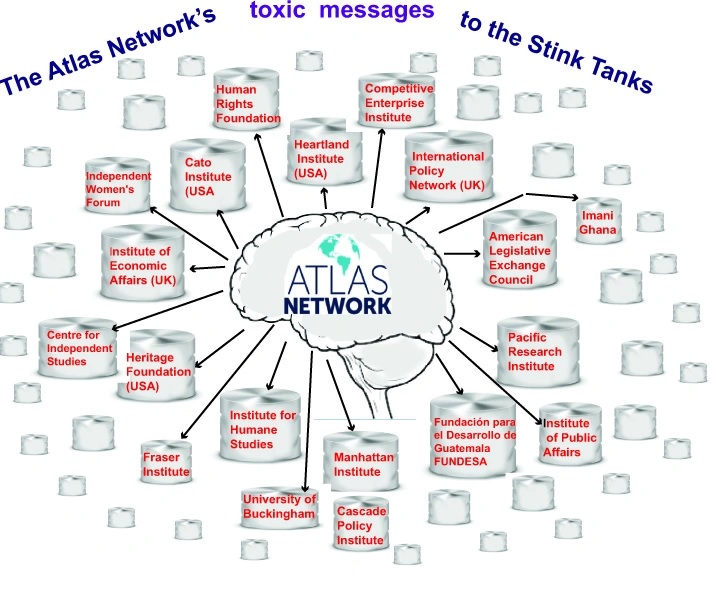
There is a growing trend for organisations to word their media message in consistent and repetitive phrases that back up the corporate and government agenda. I have previously written about the Atlas Network , which specialises in exactly this- its main function is to provide the “suitable” wording to the organisations.
6. Finally – make your choices, and be ready to change your mind. You can find outlets, and individual journalists who seem to make sense, and to take trouble to get accurate facts. Some are clearly biased, but admit this. Some are very persuasive, but you might find out later that they are dodgy in some way - e.g sensationalist, or paid to push a particular opinion.
I guess that approaching everything with a healthy scepticism is the way to go.
‘PR Fairy Dust’ Has Canada Tripling Nuclear Capacity by 2050.

So far, federal and provincial taxpayers have been footing the bill for Small Nuclear Reactor development in Canada, with little private sector investment—meaning the investor scrutiny and cost controls that torpedoed the NuScale project are muted at best.
Would Canadian taxpayers be OK with continuing to shell out up to a trillion dollars for a technology with no proven track record of producing reliable, affordable electricity?
So far, federal and provincial taxpayers have been footing the bill for SMR development in Canada, with little private sector investment—meaning the investor scrutiny and cost controls that torpedoed the NuScale project are muted at best. Would Canadian taxpayers be OK with continuing to shell out up to a trillion dollars for a technology with no proven track record of producing reliable, affordable electricity?
January 8, 2024, Susan O’Donnell and M.V. Ramana, https://www.theenergymix.com/odonnell-and-ramana-pr-fairy-dust-has-canada-tripling-nuclear-capacity-by-2050/
Near the end of 2023, the government published its second nuclear fantasy of the year. The December statement declares that Canada will work with other countries to “advance a global aspirational goal of tripling nuclear energy capacity from 2020 by 2050.”
In a sprinkling of public relations fairy dust, the declaration is labeled “COP28”, although written well before the two-week climate summit in Dubai. The nuclear declaration managed to attract only 25 endorsing countries, in contrast to the official COP28 pledge to triple renewable energy and energy efficiency by 2030, signed by 123 countries and eventually adopted by consensus in the final COP declaration.
The currently operating power generating capacity of all nuclear plants in the world is 365 gigawatts. Tripling that total by 2050, in the next 26 years, will mean reaching close to 1,100 gigawatts. Looking back 26 years, the power capacity of the global nuclear fleet has grown an average of 0.8 gigawatts each year. At that rate, nuclear capacity in 2050 will be a mere 386 gigawatts.
And tripling today’s nuclear capacity would require the industry to overcome the significant setbacks and delays in new reactor construction that have plagued it forever with no solution in sight, while building an additional large number of reactors to replace old ones shut down over the same period.
Earlier last year, the Canada Energy Regulator (CER) published the country’s previous nuclear fantasy document, with scenarios that also projected roughly a tripling of nuclear generation capacity by 2050. Canada’s six nuclear plants currently produce about 13 gigawatts of power; a tripling would bring that to 39 GW. The CER report envisions this new nuclear capacity coming from so-called small modular nuclear reactors (SMRs).
Only two public utilities in Canada are proposing to build SMRs: NB Power in New Brunswick, and Ontario Power Generation (OPG). The most authoritative report to date on SMRs, from the U.S. National Academies, found that the designs planned for New Brunswick—a molten salt reactor and a sodium-cooled reactor—are unlikely to reach commercial deployment by 2050.
OPG is promising that its SMR design, a 300-megawatt boiling water reactor, will be the first in the world to be deployed commercially starting in 2030, although the design has not yet been licenced to build in Canada or anywhere else. Assuming that this unit is chosen for widespread deployment in Canada, nearly 90 would need to be built and operating effectively on the grid between 2030 and 2050 to achieve the proposed tripling. Given the known construction time overruns for nuclear power plants, this also is impossible.
The news on the SMR front from around the world has been bleak—especially in the United States, which has been trying to commercialize SMR designs for more than a decade. The flagship SMR design in the U.S., the NuScale light-water reactor, was the first to receive design approval by the U.S. Nuclear Regulatory Commission. However plans to build an array of NuScale reactors were shelved in November when the estimated construction costs ballooned to US$9.3-billion (C$12.8-billion) for 462 megawatts and potential customers fled. Earlier this month, NuScale laid off nearly half of its work force.
Assuming the NuScale construction costs of $27.7 million per megawatt would be an acceptable price range to customers in Canada, that would give the OPG design, also a light-water reactor, a cost of $8.3 billion per unit. If 90 units were built as a way to triple nuclear energy capacity, the total price tag would be $747 billion. That assumes that costs won’t go up during construction, as has been the case with the majority of nuclear projects in Canada and around the world.
So far, federal and provincial taxpayers have been footing the bill for SMR development in Canada, with little private sector investment—meaning the investor scrutiny and cost controls that torpedoed the NuScale project are muted at best. Would Canadian taxpayers be OK with continuing to shell out up to a trillion dollars for a technology with no proven track record of producing reliable, affordable electricity? Particularly when the energy efficiency, solar, and wind technologies explicitly favoured by the Intergovernmental Panel on Climate Change as the quickest path to emission reductions are already proven, affordable, and ready for prime time?
Last month’s bogus “COP28” nuclear declaration is posted on the Natural Resources Canada website. Like its counterpart in the United States, the Department of Energy, NRCan is the department responsible for promoting the interests of the nuclear industry. In both the United States and Canada, that industry has been failing for decades, and one of its strategies for securing government support has been to appeal to geopolitical interests. In recent years, that appeal has usually involved pointing out how Western countries are falling behind Russia, the largest exporter of nuclear power plants, and China, which has built more nuclear plants than any other country over the past decade.
The U.S. government has responded by using its diplomatic clout to promote nuclear energy, especially small modular reactors. In Washington, Energy and Natural Resources Minister Jonathan Wilkinson delivered Canada’s statement on nuclear energy that linked Canadian exports of uranium and nuclear technology to energy security in response to Russia’s invasion of Ukraine. This geopolitical context explains why Russia and China were conspicuously missing from the list of signatories to the declaration to triple nuclear energy capacity by 2050.
The nuclear industry’s other argument to stay alive is the bogus claim that it can help solve climate change. But as veteran energy modeller and visionary Amory Lovins pointed out: “To protect the climate, we must abate the most carbon at the least cost—and in the least time—so we must pay attention to carbon, cost, and time, not to carbon alone.” The climate crisis is urgent. The world has neither the financial resources nor the luxury of time to expand nuclear power.
Meanwhile, the website of Environment and Climate Change Canada, the department truly responsible for the country’s international climate commitments, has a genuine COP28 statement that does not mention nuclear. Instead, it highlights “groundbreaking goals to triple renewable energy, double energy efficiency, and, for the first time ever… a historic consensus to move away from fossil fuels in energy systems.”
Tripling nuclear energy by 2050 is a nuclear industry fantasy and complete make-believe. Tripling renewable energy and doubling energy efficiency by 2030 is sensible and doable, as long as the requisite political will is present. It is past time to get real about the energy generation technologies we need to be supporting.
Susan O’Donnell is Adjunct Research Professor and leader of the CEDAR project at St. Thomas University in Fredericton, New Brunswick. M.V. Ramana is Professor and Professor and Simons Chair in Disarmament, Global and Human Security at the University of British Columbia.
In the name of ‘fake news,’ NewsGuard extorts sites to follow the government narrative
By Social Links for Lee Fang, Dec. 10, 2023, https://nypost.com/2023/12/10/opinion/newsguard-extorts-sites-to-follow-the-government-narrative/
Half a century ago, George Orwell, writing on literary censorship, wrote that “unpopular ideas can be silenced, and inconvenient facts kept dark, without the need for any official ban.”
That dynamic now broadly extends to an opaque network of government agencies and self-proclaimed anti-misinformation groups that have repressed online speech.
There’s no official ban on discussing the efficacy of COVID-19 vaccines or criticizing American involvement in the Ukraine-Russia war, but editors and journalists have realized that writing on such topics can come at a cost.
News publishers have been demonetized and shadow-banned for reporting dissenting views and the bureaucratic means for enforcing this form of control are under increasing scrutiny.
NewsGuard, a for-profit company that scores news websites on trust and works closely with government agencies and major corporate advertisers, exemplifies the problem.
The startup was founded in 2018 and quickly gained favor among establishment voices concerned with “fake news.”
NewsGuard’s core business is a misinformation meter, in which websites are rated on a scale of 0 to 100 on a variety of factors, including headline choice and whether a site publishes “false or egregiously misleading content.”
Such an endeavor might appear as an objective public service, but the devil is in the details.
Editors who have engaged with NewsGuard have found that the company has made bizarre demands that unfairly tarnish an entire site as untrustworthy for straying from the official narrative.
The Daily Sceptic, a libertarian-leaning British site, is one such example. In a series of emails over the last two years, editor Toby Young reached out to NewsGuard, hoping to improve the Daily Sceptic’s 74.5 rating.
NewsGuard took issue with the website’s criticism of lockdowns, calling them “unnecessary, ineffective and harmful,” and cited academic literature on the topic.
Young went so far as to add postscripts to his articles, relaying the issues raised by the fact-checkers and providing additional information.
For his good-faith interactions, Young was rewarded with a downgrade. NewsGuard updated his rating to 37.5 on its scale.
NewsGuard wanted nothing other than a retraction of the articles they objected to, despite the fact that further research has documented the harmful effects of lockdowns.
It was an experience that other publishers have echoed.
The ratings are not just a scarlet letter, but a cudgel to coerce conformity.
NewsGuard works closely with corporate advertisers and the data-brokers that serve as the backbone of the online ecosystem.
One of its largest investors is the Publicis Groupe, a French conglomerate that is the largest marketing agency in the world.
In an email to one of its government clients, NewsGuard touted that its ratings system of websites is used by advertisers, “which will cut off revenues to fake news sites.”
But perhaps the greatest danger is posed by NewsGuard’s extensive ties to the government. Internal documents I obtained through the “Twitter Files” show that the founders of NewsGuard privately pitched the firm to clients as a tool to engage in content moderation on an industrial scale, applying artificial intelligence to take down certain forms of speech.
The proposal noted that the service is already used by “intelligence and national security officials,” “reputation management providers” and “government agencies.”
There is little hope that the Biden administration, which has labeled online misinformation as a national security threat, will reverse course. Hope may be found in the courts.
Earlier this year, Consortium News, a left-leaning site, charged in a lawsuit that NewsGuard’s serves as a proxy for the military to engage in censorship.
The lawsuit brings attention to the Pentagon’s $749,387 contract with NewsGuard to identify “false narratives” regarding the war between Ukraine and Russia, among other forms of foreign influence.
Consortium News has published thousands of articles, but NewsGuard went after just a few columns about neo-Nazi elements in the Ukrainian military and U.S. influence over the Ukrainian government – issues raised by many credible news outlets – and demanded retractions.
And this week, conservative-leaning sites The Federalist and the Daily Wire, along with Texas Attorney General Ken Paxton, are bringing a far more sweeping suit against the government.
The lawsuit claims that the State Department’s Global Engagement Center financed firms such as NewsGuard in an attempt to create a “blacklist” of targeted sites that criticize government positions while steering readers to “news organizations that publish favored viewpoints.”
The attorneys for the case note that the agency is acting under explicit statutory authority to only counter foreign propaganda, and is forbade from turning inwards and “countering Americans’ speech.”
The issue may rest, ultimately, with a decision from the Supreme Court. Next year, the high court is scheduled to take up Missouri v. Biden, a sweeping case that will decide how and when the government can step in to shape content decisions on social media platforms.
The Louisiana judge who first ruled on the subject noted that the federal government appears to have “assumed a role similar to an Orwellian ‘Ministry of Truth,” a role that is plainly not in the constitution.
Investigative journalist Lee Fang writes at leefang.com
Israel is NOT promising to ‘scale back’ its war

Spencer Ackerman, The Nation, Mon, 08 Jan 2024, https://www.sott.net/article/487700-Israel-is-not-promising-to-scale-back-its-war
As the US secretary of state shuttles to stop the war from expanding, the Israeli defense minister vows “months” more war on Gaza and suggests taking the fight to Iran.
Readers of The New York Times were treated on Monday morning to a breaking-news alert heralding what seemed like a welcome development: “Israel says it has begun to scale back war.” That description, which led the Times website, is about as close to the opposite of the way Israel’s war is heading as could appear in the leading US newspaper.
The Israeli Defense Forces spokesman, Radm. Daniel Hagari, gave the Times the interview that it used for its headline. But Hagari’s quotes never actually promise the “less intense phase” in the Times paraphrase. Hagari instead describes the focus of the pitiless Israeli campaign shifting southward — while his superiors in the Israeli government indicate that it could expand regionally.
Northern Gaza, which has been the focus of intense Israeli ground operations, will apparently see more of what the Times calls “targeted raids” rather than attacks from larger-scale infantry, artillery, and airstrikes. Some Israeli brigades will redeploy out of Gaza, a development announced last week — but one intended to make the war more sustainable for “prolonged fighting,” as Hagari put it then. That fighting will refocus on the central and the southern regions of Gaza, where Israel had previously demanded that most of the population relocate. “It was far from clear that the new phase of Israel’s offensive would be less dangerous for Gazan civilians,” the Times‘ Patrick Kingsley observed. That was quite an understatement, considering the starvation and spread of infectious disease the war has inflicted upon those civilians, all as Israel has destroyed Gaza’s healthcare infrastructure.
The description of a “less intense” war was rendered all the more absurd by Israel’s lethal strike on a senior Hezbollah commander, Wissam al-Tawil, in southern Lebanon on Monday. (Haaretz, the liberal Israeli newspaper, attributed the strike to Israel.) Since the beginning of the Israeli reprisal on Gaza for Hamas’s October 7 massacre, Hezbollah has hit northern Israel with its missile arsenal to raise the costs of sacking Gaza, and the IDF has responded in kind. The persistent exchanges of fires have stayed just under the threshold of a declared second front. But that’s an arbitrary measure, not one that changes the reality faced by anyone who lives in northern Israel or southern Lebanon, tens of thousands of whom have fled.
The killing of al-Tawil follows two other high-profile IDF slayings over the last two weeks that look more like the future of the current conflict than its past. On Christmas, an Israeli strike in Damascus killed the Iranian Gen. Razi Mousavi of the Islamic Revolutionary Guard Corps. And on Wednesday, in the Dahiyeh suburb of Beirut, an Israeli drone killed Saleh al-Arouri, a senior political figure in Hamas.
While any Hamas leader must have considered his days numbered after October 7, Israel’s willingness to strike into the heart of Lebanon, which is reeling from a protracted economic crisis, has created deep fear that the so-called “Northern Front” will formally open.For the second time since October 7, Hassan Nasrallah of Hezbollah last week declined in a speech to declare war, but reiterated that there is only so much it will tolerate. The “Lebanese don’t want to be dragged, even Hezbollah does not want to be dragged into a regional war,” implored Abdallah Bou Habib, Lebanon’s foreign minister.
If there is a shift in Israel’s war, it’s less about a reduction in intensity in Gaza than it is a refocus against a more distant, formidable enemy. Israeli Defense Minister Yoav Gallant told The Wall Street Journal on Sunday night that Israel’s ultimate targets live far beyond Gaza. “My basic view: We are fighting an axis, not a single enemy,” Gallant told the paper. “Iran is building up military power around Israel in order to use it.” Like his colleagues in the Israeli government, Gallant signaled that Israel is running out of patience to negotiate calm on the Lebanese border — but did so by threatening Lebanese civilians, not Hezbollah: “They see what is happening in Gaza. They know we can copy-paste to Beirut.”
As for Gaza itself, Gallant portrayed the shift in military focus away from northern Gaza less as a decision to tamp down the war than a function of the IDF’s accomplishing most of what it can in the north. The coming phase, dependent more on “different types of special operations” — something no one should confuse with de-escalation — will “last for a longer time,” Gallant told the Journal.
This promise of a protracted war comes as the United Nations’ most senior humanitarian-aid official, Martin Griffiths, has already judged Gaza to be “uninhabitable” and South Africa brings a genocide case against Israel that will get underway on Thursday at the International Criminal Court.
The longer that Israel culls Gazans — something Israeli government officials have recently phrased as an “opportunity” to ethnically cleanse Gaza — the greater the pressures for the war to spiral outward. Tamping those pressures down is the express purpose of Secretary of State Antony Blinken, who has returned to the Middle East and is expected in Israel early this week. “This is a conflict that could easily metastasize, causing even more insecurity and even more suffering,” Blinken correctly observed in Qatar this weekend.

The response the Israelis provided Blinken, who has often looked hapless during his post-October 7 Mideast visits, was to kill al-Tawil in Lebanon while telling American news outlets it will kinda-sorta-but-not-really lower the scale of violence inflicted upon Gazans so President Biden can have some domestic and diplomatic breathing room.
Blinken is right that the war could escalate and grow more destructive. But the reality is that regionalization is already here. Much as Gallant looked beyond Hamas to the Iranian “Axis of Resistance” coalition that includes Hamas, Iranian strategy since October 7 has aimed beyond Israel and at its geopolitical patrons.
If Iranian strategy operates beneath the waterline of formally declared conflict, those waters are heavily mined and are already prompting counterproductive US actions. The Houthis in Yemen have jeopardized commercial shipping in the Red Sea, an economically crucial waterway for global trade, prompting the United States to assemble an international naval task force amid pressures to attack the Houthis on land. In Iraq and Syria, more than 120 rocket, missile, and drone strikes on US bases since October 7 have prompted US retaliatory strikes on Iran-backed militias. The most recent of them, Thursday’s US drone strike in Baghdad — the first there since 2020 — killed a senior figure in the quasi-official Popular Mobilization Forces and prompted Prime Minister Mohammed Shia al-Sudani, who is no Iranian catspaw, to demand that the US military finally leave Iraq.
Each provocation, whether from Israel, the United States, or the Iranian coalition, prompts a response that various partisans can individually justify on its own terms. But this is the logic that produces regional escalation. Nearly 100 days of it have yielded nothing but devastation for Palestinians, Lebanese, Iraqis, and indeed Israelis, with Yemenis potentially next.The way out is in the hands of the Biden administration, since only the US can impose a cease-fire on Israel, thereby removing the impetus for the Iranian-backed attacks and the US or Israeli reprisals. Yet Biden continues to show no inclination that he is willing to do what is necessary to forestall the regional conflagration he seeks to avoid.
And if American journalists can’t quite present that to their audiences, the Palestinian journalists who have heroically brought the reality of Gaza to the world can — or they could,before Israeli missiles and bullets killed them and their families, often to the silence of their American counterparts, who instead print dubious narratives about Israeli de-escalation.
About the Author:
Spencer Ackerman, a Pulitzer Prize and National Magazine Award-winning reporter, is the author of Reign of Terror: How The 9/11 Era Destabilized America and Produced Trump.
Kebaowek First Nation strongly opposes nuclear waste storage facility in Chalk River

Radioactive waste site in Chalk River a go
National Observer, By Natasha Bulowski / Local Journalism Initiative / Canada’s National Observer, 9 Jan 24
The Canadian Nuclear Safety Commission has greenlit a proposed nuclear waste storage facility in Chalk River, Ont., after a years-long battle waged by concerned citizens, environmentalists and First Nations.
On Jan. 9, the commission announced Canadian Nuclear Laboratories’ operating licence will be changed to allow construction of a “near-surface disposal facility” to hold up to a million tonnes of radioactive and hazardous waste. Stored in a large mound, the waste would sit about a kilometre from the Ottawa River, a culturally important river for Algonquins, and this proximity to drinking water for millions is one of many factors that raised alarm bells for opponents.
The proposed facility, referred to as the NSDF, “is not likely to cause significant adverse environmental effects” as long as Canadian Nuclear Laboratories sticks to its proposed mitigation and monitoring measures, the commission said in its decision.
Within hours of the announcement, Kebaowek First Nation put out a press release calling on the federal government to intervene and stop the project. Organizations representing 10 of the 11 Algonquin First Nations have opposed the project, alongside leaders and elders from those nations. Pikwakanagan First Nation, the only Ontario-based Algonquin Nation and closest to Chalk River, signed a long-term relationship agreement with Canadian Nuclear Laboratories on June 9, 2023………………………………………………
Kebaowek First Nation Chief Lance Haymond called the commission’s decision “unacceptable” because it goes against the rights of Indigenous Peoples and environmental protection in a press release issued a few hours after the decision.
“I want to be very clear: the Algonquin Peoples did not consent to the construction of this radioactive waste dump on our unceded territory,” Haymond said. “We believe the consultation was inadequate, to say the least, and that our Indigenous rights are threatened by this proposal.”
Algonquin leaders from Kebaowek and Kitigan Zibi Anishinabeg First Nations and Algonquins of Barriere Lake have long opposed the NSDF and have urged the commission to heed their concerns about environmental and human health. At the final licensing hearing in August, Kebaowek and Kitigan Zibi Anishinabeg argued the consultation was inadequate because it began far too late in the decision-making process and did not appear to take their concerns or traditional knowledge seriously………………………………………….
James Walker, a nuclear waste expert and former director of safety engineering and licensing at AECL, disputed the proclamation that all waste will be low-level in a submission to the commission. His calculations, based on the inventory of waste provided by Canadian Nuclear Laboratories, show that much of it is intermediate-level radioactive waste and should not be placed in a near-surface facility. There is also no inventory management system to properly verify the waste complies with the acceptance criteria, he wrote. Walker said the project is “non-compliant with International Safety Standards” for these reasons……………………..
Last month, concerned citizen Ole Hendrickson initiated a House of Commons petition (authorized by Pontiac, Que. MP Sophie Chatel) calling for an international review of three radioactive waste projects including the NSDF at Chalk River. At the time of writing, it has almost 2,950 signatures. Petitions require a minimum of 500 signatures to be presented in the House of Commons and receive an official response from the government. https://www.nationalobserver.com/2024/01/09/news/radioactive-waste-site-chalk-river-go#
France Moves Away from Renewable Targets in Favor of Nuclear Power

By ZeroHedge – Jan 09, 2024, https://oilprice.com/Alternative-Energy/Nuclear-Power/France-Moves-Away-from-Renewable-Targets-in-Favor-of-Nuclear-Power.html
- The bill proposes a change from reducing to just tending towards a reduction in greenhouse gas emissions.
- It includes the removal of various objectives related to renewable energy production and consumption.
- The bill strongly affirms the use of nuclear energy as a sustainable choice and includes it as a key objective in the multi-annual energy program.
Authored by Mike Shedlock via MishTalk.com,
Four Key Things
- The wording of this preliminary bill relating to energy sovereignty is of course not final. It can still evolve between now and its presentation to the Council of Ministers and, then, during its discussion in Parliament. However, it already demonstrates a significant change in the executive’s conception of national energy policy.
- This draft bill weakens France’s climate objectives, starting with the objective of reducing our greenhouse gas emissions. The objective would no longer be to “reduce” but to tend towards a reduction in “our greenhouse gas emissions.
- This preliminary draft proposes to translate into law the executive’s choice to maintain a preponderant share of nuclear energy in electricity production. A choice which breaks with that of reducing this share of nuclear power and which was included in law no. 2015-992 of August 17, 2015 relating to the energy transition for green growth.
- This preliminary bill also reflects concern, on the eve of the European elections in June 2024; to abandon the legal category of renewable energies” in favor of a new category, that of “carbon-free energies”.
Removals
- The removal of quantified objectives for production and consumption of renewable energies in mainland France.
- The removal of the objective of encouraging the production of hydraulic energy.
- The removal of the quantified objective for the development of offshore wind power.
- The removal of the objective of encouraging the production of agrivoltaic electricity.
- The removal of the contribution objective to achieving air pollution reduction objectives.
- The removal of the building’s energy performance objective.
- The removal of the multiplication objective ofthe quantity of renewable and recovery heat and cold.
- Removal of the condition for shutting down the operation of a nuclear reactor
New Objectives
- The affirmation of the “sustainable choice of using nuclear energy”
- The new objective of using nuclear energy in the multi-annual energy program
Wow!
How often does France lead the way in common sense?
This has not passed yet, but it represents a clear change in direction if any of it passes, and that seems highly likely.
I wonder if President Emmanuel Macron is starting to look at French polls. Then again, the next French presidential election is not until 2027.
In the US, Biden doubles down on the only tactic he knows, running on Bidenomics while claiming Trump will be a dictator if he wins.
Both are losing tactics.
Via Zerohedge.com
Nuclear power and net zero: Too little, too late, too expensive

Prof Steve Thomas, Greenwich University, assesses the considerable obstacles to the UK government’s target for new nuclear power.
Article from Responsible Science journal, no.6; advance online publication: 9 January 2024.
Introduction
In October 2023, the British government reaffirmed the 2022 Boris Johnson target of bringing online 24 gigawatts (GW) of nuclear capacity, eight stations the size of Hinkley Point C, by 2050. In its response to a parliamentary committee report on the nuclear programme, the government claims a “roadmap will set out these next steps [to achieve the 24GW target] and will be available later in 2023.”[1] By early January 2024, the roadmap had not been published. While there is talk about Small Modular Reactors making a significant contribution, as I argued in my article on these in Responsible Science, no.5,[2] their rationale is based on some highly suspect assumptions about cost-savings from reducing reactor size. At most a few demonstration SMRs might be built, demonstrating only that they are far from being competitive with other options for low-carbon generation.
So, if the 24 GW target is to be met, most of the capacity will have to be in large (1.2 GW-plus) reactors. The government seems determined to drive through the Sizewell C project whatever the cost. This would comprise two reactors of the EPR-1 design used at Hinkley Point C, but that would leave a further seven to build.
To achieve the 24 GW target, at least four conditions must be met:
The equivalent of eight new nuclear projects must be completed by 2050.Mature, commercial, large reactor technologies must be available.Seven sites beyond Sizewell, suitable for 3 GW stations, must be approved.Owners and financiers for eight stations, expected to cost about £250bn, must be found.
1. When could new capacity come online?
Ambitious nuclear programmes are always accompanied by the same tired rhetoric offered for more than 50 years – of cutting red tape, streamlining planning and regulatory processes, learning from past mistakes, and taking advantage of new technologies. This has never worked in the past, not because we were not trying hard enough, but because nuclear power stations intrinsically take a long time from start of planning to first power, and new technologies have proved expensive and bring their own problems. The government acknowledged this in its Impact Assessment for the Regulated Asset Base (RAB) legislation which stated that it typically took 13-17 years from a Final Investment Decision (FID) to first power.[3] It could have added that most announced projects do not make it as far as FID. The Impact Assessment also stated that nuclear projects typically cost 20-100% more than the estimate at FID. Adding in a few years to get from project inception to FID and it is clear the whole process is likely to take 15-20 years. The Flamanville (France) and the Olkiluoto (Finland) projects will take longer than 20 years and with at least four years of construction left at Hinkley Point C, that project will take nearly 20 years if there are no more delays. Flamanville[4] and Olkiluoto[5] are about 300% over budget. Planning for any capacity that will be online by 2050 must be started by 2030.
2. Which technologies?
The EPR-1 design supplied by the French nationalised utility, EDF, is not credible for further orders. A former CEO of EDF described EPR-1 as “too complicated, almost unbuildable”.[6] Design work has been in progress for more than a decade on its replacement, EPR-2, which is claimed to be cheaper and easier to build. EDF plans to build six EPR-2s in France, the first coming online in 2035-37. EDF has said it would not try to sell the design until an EPR-2 was operating in France. Whether the EPR-2 will live up to the claims made is irrelevant. If we must wait till the after 2035 for it to be available, EPR-2s cannot be online in the UK by 2050.
Assuming designs from Russia and China are not acceptable, that leaves us with the other two designs meant to make up the Blair programme of 16 GW by 2030, the Hitachi-GE ABWR and the Westinghouse AP1000. While these have been approved by the UK safety regulator, they are not attractive. The three reactors of the ABWR design operating in Japan use a 1986 version of it. No orders for the updated designs are in prospect and the vendor appears not to be offering it for sale.
The record of the AP1000 is almost as bad as that of the EPR with all eight orders going badly wrong. The history of the ‘AP’ designs illustrates the nuclear industry’s duplicity on reactor size. Initially it was the AP600 (about 700 MW), but this was found to be uneconomic. It was scaled up to the AP1000 (1170 MW) and this was built in China and in the USA, but to improve the poor economics, China has scaled it up to 1550 MW (CAP1400). In March 2023, Westinghouse announced its new design would be a scaled down AP1000, the 300 MW AP300.
The other candidate is the South Korean APR1400. Like the ABWR, this has been built but using a design that did not take account of the lessons from the Chernobyl disaster (a means of preventing a molten core getting into the environment) or from the 9/11 attack (a need to toughen the shell enough to absorb a hit by an aircraft). It seems unlikely that an updated design could complete the required safety review in time for an FID to be taken on a project using this technology until after 2030. The record of APR1400 projects is problematic with long delays due partly to falsification of quality control documentation in South Korea and quality issues in the UAE.
3. Where would they be built?
Eight sites were identified as suitable in the government’s siting decision of 2010.[7] With Hinkley and Sizewell already under some sort of development, this leaves Moorside, Wylfa, Oldbury, Bradwell, Heysham and Hartlepool. There are concerns about the impact of sea-level rises for all the sites.[8] A project for the Wylfa site underwent review by the Planning Inspectorate which recommended the project not be consented because of its environmental impact. Moorside, Oldbury and Bradwell have undergone some investigations for new nuclear capacity for projects now abandoned and this preparatory work could be utilised to speed things up.[9] Heysham and Hartlepool would need detailed assessment to determine their suitability before any project could be proposed, so they might not be available by 2030. If eight projects (including Sizewell C) need to be completed by 2050, then either the planning advice at Wylfa would need to be ignored or at least one new site would be needed – and this also assumes all planning issues at the other sites could be adequately dealt with by the end of this decade and none of these locations would be earmarked for SMRs.
4. How would they be financed and who would own them?
When electricity utilities could pass on whatever costs they incurred, they enthusiastically supported nuclear projects. Now, if nuclear projects go wrong, it will be their shareholders who bear some of the costs, so interest from utilities, particularly investor-owned ones, has evaporated. Direct government ownership is an option, although it would be an extraordinary decision to invest taxpayers’ money in nuclear projects on the basis that no other investors would be willing to take this risk. So, innovative methods of finance are required.
The finance model used for Hinkley Point C, the Contracts for Difference (CfD) model, was both a poor deal for consumers and the plant owner, EDF. The power purchase price was set in 2013, three years before the investment decision, at £92.5/MWh in 2012 money, indexed to inflation (about £124/MWh in 2023 money) with cost overruns falling on EDF. This price is more than double the price for new offshore wind.[10] In 2013, the expected construction cost was £16bn but the latest estimate is £26bn (both in 2016 money).[11] So EDF will have to absorb the cost overrun of at least 60% but with no increase in the price it will get for its output. This form of CfD is not an option any sane investor would back for nuclear even though, for offshore wind, it is producing impressive results and will continue to be used.
The UK government is now proposing the Regulated Asset Base (RAB) financial model. The main architecture of the scheme is known although crucial details have not been published. How far this lack of information is down to the government leaving these open for negotiation, to the government not having decided on them yet, or to the government not being willing to admit the details, is difficult to determine. There is brave talk of risk-sharing but the reality is that it will not be the government that sets the terms, it will be investors unless the government is prepared to walk away with no deal. But the government seems likely to agree to whatever it takes to lure investors in. Deepa Venkateswaran, an analyst at Bernstein, said would-be investors in Sizewell needed to be “assured a return” that was locked in at the point of investment rather than subject to change.[12]
Under RAB, it would be the investors’ income that would be fixed, not the price paid for power. The power price would be whatever it took to generate the guaranteed annual income to the owners. All electricity retailers and therefore all consumers would be required to buy their share of the output. With the Hinkley Point CfD, the owner took the risk; with Sizewell RAB, consumers take the risk.
The selling point for the RAB model has been the claim that it would reduce the cost of finance and therefore the cost of power. RAB reduces financing costs in two ways. First, because the risks will fall on consumers and taxpayers, the project would be seen by financiers as low risk to them and would attract a low interest rate. Second, the finance charges would effectively be paid by consumers as a surcharge on their bills payable from the date of FID to completion of the plant, expected to be about 15 years. Finance costs savings would be paid for by consumers as a surcharge on bills and by them, not the project owners, assuming the project risk.
Despite this, the government is struggling to find investors. It has said there are at least four companies that have pre-qualified as potential investors,[13] although pre-qualifying commits them to nothing. EDF has been forced to offer to take about 20% of the project ownership, while the government has said it would take an unspecified stake but it will be at least 20%, but probably more, enough to fill any funding gap.
The original target for RAB was UK institutional investors but given lack of interest from this source, government now seems to be relying on more controversial sources such as Middle East investment funds.[14] It will be difficult to explain to the public why, if the Bradwell project was politically unacceptable because of the presence of Chinese money, a RAB project with, say, Saudi money is acceptable.
The government may be able to offer enough sweeteners to allow the Sizewell C project to proceed but replicating it will be more difficult. For each project, a technology, a site, and investors will have to be found. Politically it will be difficult for the government to keep taking expensive stakes in nuclear projects just because nobody else will. The scale of investment is huge, and, for example, Sizewell C alone is expected to cost about 10 times the cost of the Thames Tideway ‘super-sewer’ water project, the first major project to use the RAB model.
Conclusions
The electricity sector ought to be one of the first sectors to be decarbonised because of the availability of a range of viable technologies available to replace fossil-fuel generation. Boris Johnson set a target of decarbonising electricity by 2035[15] while Keir Starmer has set a target of 2030.[16] Given that even Sizewell C is unlikely to be online by 2035, the nuclear programme is an irrelevance in achieving net-zero. The only justification is if nuclear was the cheapest way to meet electricity demand growth by the time the first capacity could come online and the current chasm in cost between nuclear and renewables or energy efficiency measures suggests this is implausible. Judged by the requirements of time, technology availability, sites and availability of finance, the programme will fail badly. In doing so, large amounts of government time and taxpayer money will, as with previous UK nuclear programmes, be diverted away from the options that have a much higher success probability, are more cost-effective and can be deployed much quicker.
Steve Thomas is Emeritus Professor of Energy Policy at Greenwich University, UK. He has researched and written on nuclear power policy issues for 40 years.
References………………………………………………………………………………………………………………….. re https://www.sgr.org.uk/resources/nuclear-power-and-net-zero-too-little-too-late-too-expensive
Bottled water discovered to contain thousands of invisible plastic pieces which can seep into your bloodstream
Most of these are nanoparticles which have the potential to penetrate human cells and gain entry into bloodstream and major organs
Climate Correspondent12
A new study found people are consuming a quarter million of tiny invisible pieces of plastic with every litre of bottled water – 10-100 times more than previously estimated.
One litre of water in a plastic bottle was found to contain an average of 240,000 particles, research published on Monday showed. Most of these are nanoparticles which have the potential to penetrate human cells and gain entry into the bloodstream and major organs.
The groundbreaking findings, published in the Proceedings of the National Academy of Sciences (PNAS) journal, show the extent of plastic in bottled water which was highly undervalued in previous studies.
While microplastics have been found everywhere from the deepest points in the ocean to inside our bodies from as early as birth, each bottle was earlier believed to contain only 325 pieces on an average.
But this new study by researchers from Columbia shows the presence of plastic particles is approximately a hundred times more than that, challenging the previously accepted norms surrounding bottled water safety.
Most of these particles were coming from the bottle itself, according to the authors. These are particles that are less than a micron in size.
Researchers used five samples from three brands of bottled water in the US and found that plastic particle levels ranged from 110,000 to 400,000 per litre, averaging at around 240,000 from seven types of plastics.
The authors declined to mention which brands were used as samples.
Approximately 90 per cent of these particles were identified as nanoplastics and the rest were microplastics. Nanoparticles are less than one-seventieth the width of a human hair, so tiny they cannot be seen under a microscope.
Researchers had to invent a technology to quantify these tiny particles to be able to count and analyze the chemical structure of nanoparticles in bottled water.
While scientists knew nanoplastics existed in bottled water, Naixin Qian, a PhD student in chemistry at Columbia and the first author of the new paper said “before our study, people didn’t have a precise number of how many”.
Previous studies showed nanoparticles of plastics can enter cells and tissues in major organs, move through the bloodstream and spread potentially harmful synthetic chemicals in the body, reaching the blood, liver, and brain.
While the potential impacts of these nanoparticles are known, researchers are not sure whether these findings make bottled water more dangerous. (Whaa -aat?)
“That’s currently under review. We don’t know if it’s dangerous or how dangerous,” said study co-author Phoebe Stapleton, a toxicologist at Rutgers.
“We do know that they are getting into the tissues (of mammals, including people) … and the current research is looking at what they’re doing in the cells,” study co-author Ms Stapleton said.
Japan quake stressed nuclear plant beyond design limit: panel

 KYODO NEWS, 11 Jan 24
Last week’s powerful earthquake in central Japan inflicted stress on parts of a local nuclear power plant that exceeded the limit anticipated in the facility’s design, according to a report shared in a safety panel meeting on Wednesday.
The report, discussed at a regular session of the Nuclear Regulation Authority, indicated the potentially alarming readings of ground acceleration did not appear to pose an immediate safety threat to the facility in Shika on the Noto Peninsula……………………………………………………………..
Shinsuke Yamanaka, chief of the authority, told reporters that such seismic research by experts may take years, and that the activity in undersea faults which triggered the latest quake “must be factored in as new knowledge” in updating safety standards.
Yamanaka, an expert on nuclear power engineering, also urged the operator to get to the bottom of a breakdown of electric transformers installed at its Nos. 1 and 2 reactors that has partially prevented the Shika plant from receiving power supplied from outside………………….
Nobuhiko Ban, another panel member and expert on protection from radiation exposure, called it “a huge problem” that real-time radiation levels have not been monitored at some locations near the Shika plant after the quake, and proposed using aircraft and drones for the purpose………… https://english.kyodonews.net/news/2024/01/79c47d437001-japan-quake-stressed-nuclear-plant-beyond-design-limit-panel.html
Nuclear Arms Buildup Isn’t Just about War. It Also Harms People and Communities.
Congress’ comprehensive nuclear review is 160 pages long. It doesn’t mention “waste” once.
INKSTICK, WORDS: LAURA CONSIDINE, PICTURES: BRIAN STANSBERRY, JANUARY 10, 2024
In October 2023, the Congressional Commission on the Strategic Posture of the United States released its final report on “America’s Strategic Posture.” This congressionally mandated review of US nuclear strategy, policy and posture concluded that “America’s defense strategy and strategic posture must change in order to properly defend its vital interests and improve strategic stability with China and Russia.”
The commission thus came to the conclusion that the US needed to go beyond its current modernization plan to develop a capability “to deter and defeat both” Russia and China “simultaneously.” This includes modifying the US strategic force posture to address larger numbers of targets and changing the posture on so-called “theater” nuclear weapons to allow for the US to engage in two simultaneous nuclear conflicts in Europe and Asia. While not every recent official report has advocated an arms buildup, the prevailing wisdom in policy and commentary circles is acceptance of a “coming arms race.”
The prevalence of this acceptance of arms racing and nuclear war fighting talk does not simply reflect the world we are in, it has political power to influence that world, to provoke action and reaction. This language has consequences. A new buildup of nuclear weapons and talk of nuclear war fighting is obviously dangerous because we know there is no winner of a nuclear war, never mind two. But even if those weapons are never used, they have impacts on the places and peoples in which they are produced.
Waste
I have recently spent a month conducting research in New Mexico, a state that has borne many of the consequences of the development of US nuclear weapons. In New Mexico, uranium miners and downwinders who lived near the very first nuclear test are not only dealing with generations of cancers caused by the nuclear weapons complex and the Trinity Test but have also had to fight for years to be included in government compensation schemes, a battle that is still ongoing.
Such harms are not mentioned in the recent Strategic Posture Commission Report. The report encourages an expansion of “the US nuclear weapons defense industrial base and the DOE/NNSA nuclear security enterprise, including weapons science, design, and production infrastructure” and “the full range of NNSA’s recapitalization efforts, such as pit production and all operations related to critical materials.” As such, it takes a “comprehensive” approach to what it deems necessary for its strategic recommendations including infrastructure, supply chain and labor issues. At no point in its 160 pages, however, does the report mention the word waste.
This is not the first comprehensive report on nuclear weapons that ignores the fact that weapons production has consequences beyond the strategic. Nuclear waste has long been an afterthought in weapons production, subservient to the demands of geopolitics. The Cold War nuclear arms race in the United States created “some of the world’s most dangerous radioactive sites with large amounts of radioactive wastes, spent nuclear fuel (SNF), excess plutonium and uranium, thousands of contaminated facilities, and contaminated soil and groundwater,” according to the Department of Energy’s (DOE) Office of Environmental Management.
A new weapons buildup means more nuclear waste when the US government has not adequately funded the vast clean-up from the last arms buildup, not just in New Mexico but all over the country and beyond. The Department of Energy is responsible for the ongoing cleanup of 16 US sites and the management of 102 other legacy sites. DOE spending on these sites has remained relatively flat and will continue so according to proposed five-year appropriations for defense environmental cleanup, going from $7.07 billion for 2024 to $7.62 billion in 2028. This is despite the fact that cleanup consistently costs more and takes longer than planned and costs continue to rise sharply. The amounts of money spent are already staggering but still pale in comparison to what is needed. The GAO estimates for the site in Hanford, Washington alone are estimated to be up to $640 billion. This shows that waste is not a postscript to weapons production but an immense and expensive primary outcome.
A new nuclear weapons buildup also has serious consequences across multiple socioeconomic issues. To give just one example, Los Alamos National Laboratory (LANL) is already hiring 2,500 new workers to respond to the current call to produce 30 new plutonium pits per year. These workers come into an area in New Mexico where housing is already scarce and expensive, and infrastructure cannot support commuters. This then has devastating knock-on effects for those who live in nearby areas and do not benefit from the higher-than-local average LANL technical salaries. LANL expansion heightens the already stark economic inequalities of New Mexico where the median household income in Los Alamos County (one of the richest in the US) is more than twice that of neighboring Rio Arriba and Taos counties. ……………………………………………………………………………………………………………………………
High-profile reports, such as “America’s Strategic Posture,” do not simply reflect the likelihood of an arms race — they contribute to it. As such, fatalism about nuclear buildup and potential nuclear war, as Brodie noted many years ago, neglects the fact that “great powers” do not simply react to the world as it is but make choices that shape it. New Mexicans have long had to live with the everyday consequences of such choices. https://inkstickmedia.com/nuclear-arms-buildup-isnt-just-about-war-it-also-harms-people-and-communities/
Sellafield nuclear safety and security director to leave.

Multiple safety and cybersecurity failings at nuclear waste site were revealed by Guardian last month
Guardian, Anna Isaac and Alex LawsonTue 9 Jan 2024
The top director responsible for safety and security at Sellafield is to leave the vast nuclear waste dump in north-west England, it has emerged.
Mark Neate, the Sellafield environment, safety and security director, is to leave the organisation later this year.
Neate reports directly to Euan Hutton, the interim chief executive of Sellafield, the nuclear waste and decommissioning site in Cumbria, which is also the world’s largest store of plutonium.
Multiple safety and cybersecurity failings, as well as claims of a “toxic” working culture, were revealed in Nuclear Leaks, a year-long Guardian investigation into Sellafield, last month.
The energy secretary, Claire Coutinho, said the reports were “deeply concerning” and wrote to the Nuclear Decommissioning Authority (NDA), the state-owned body which ultimately runs Sellafield, demanding a “full explanation”.
In his response last month, the NDA chief executive, David Peattie, said there had been “necessary changes to the leadership, governance, and risk management of cyber” and responsibility for its cyber function had been moved. A new head of cybersecurity was due to take up the role this month, which Peattie said would ensure “sustained focus and leadership on this matter”.
Sellafield said Neate had responsibility for cybersecurity operations until January 2023, when control was shifted to report to its chief information officer.
It declined to say whether Neate’s departure was related to cybersecurity and safety failings at the site and said that he made the decision to leave last autumn……………………………………………………………….
Sellafield has “more work to do” to reduce safety incidents, according to its annual accounts for the year to March 2023 which were published in late December. The accounts showed that annual operating costs at the taxpayer-funded site climbed by £170m to £2.5bn.
Last financial year the company pleaded guilty to a prosecution brought by the Office for Nuclear Regulation under health and safety regulations after an employee was injured falling from a scaffold ladder while carrying out repair work. The company was fined £400,000 and ordered to pay £29,210 in costs as well as a surcharge of £190. https://www.theguardian.com/business/2024/jan/08/sellafield-nuclear-safety-and-security-director-to-leave
Net-Zero and Nonproliferation: Assessing Nuclear Power and Its Alternatives

January 8, 2024 , https://npolicy.org/net-zero-and-nonproliferation-assessing-nuclear-power-and-its-alternatives/
Six years ago, NPEC ran a mock execution of a law Congress passed in 1978 but that the Executive refused to implement —Title V of the Nuclear Nonproliferation Act of 1978. Title V called on the State and Energy Departments to conduct country-specific analyses of how developing states might best meet their energy needs without nuclear power. It also called for the creation of an energy Peace Corps and an assessment of what our government was spending on energy development aid-related projects.
When NPEC started its efforts, the staff on the Senate Foreign Relations Committee asked to see what NPEC produced to use it to pressure the Executive finally to implement the law. NPEC commissioned a number of studies on how Iran, Saudi Arabia, China, and Taiwan might best meet their energy requirements without nuclear power. The center also contracted studies on the history and intent of Title V and on what government programs were already in play that aligned with Title V‘s stated objectives. As soon as NPEC’s project was completed, the Senate Foreign Relations Committee staff prepared a letter to Secretary of State Hillary Clinton asking the Secretary finally to implement Title V and file the reports required by law.
Then, something unexpected occurred. The committee’s legal counsel discovered that the Secretary was under no obligation to comply: Congress had eliminated Title V’s reporting requirements along with several hundred other Congressionally mandated reports back in 1995. Flummoxed, I quietly set the book manuscript aside.
Why, then, release it today? Because it is again timely. In October, the Biden Administration announced it is still considering extending civilian nuclear cooperation with Riyadh that would allow the Kingdom to enrich uranium — a process that can bring states within weeks of acquiring the bomb. Administration officials no longer question if Saudi Arabia really needs nuclear energy to meet its energy requirements. Shouldn’t they?
Meanwhile, Taiwan’s presidential election this coming Saturday will, among other things, decide if Taiwan will build more nuclear reactors or not. Again, is new nuclear Taiwan’s best energy bet? As for China, the Pentagon has become increasingly concerned that the two “peaceful” fast breeder reactors and plutonium reprocessing plants Beijing is building will be used to make hundreds of bombs worth of weapons plutonium. One of the two fast breeder reactors is already operating. The question these dangerous nuclear activities raise is just how necessary they are to meet China’s energy requirements.
Then, there’s Iran, which is intent on building reactors of Iranian design. It plans on expanding its nuclear power program from roughly one gigawatt electrical capacity to 11. Given Iran’s renewables potential and oil and gas reserves, how much sense does this make? Finally, in its efforts to achieve net zero, the Biden Administration has joined 20 other nations in pledging to triple global nuclear generation by 2050. Again, how practical is this?
This volume’s aim is to help provide answers. Of course, in light of how long our government has ignored Title V, demanding it be implemented now would be odd. Creating a clean energy Peace Corps, comparing the costs of different types of energy, and trying to determine what investments would reduce emissions quickest and cheapest, however, all should be discussed. It’s my hope that the release of Net-Zero and Nonproliferation: Assessing Nuclear Power and Its Alternatives today might prompt such discussion.
This Genocide Is Being Live-Streamed. We Can’t Say We Didn’t Know.

CAITLIN JOHNSTONE, JAN 10, 2024
How is anyone still talking about October 7? What Israel has done since October 7 is many times worse than what happened on that day by any conceivable metric; the only way to feel otherwise is to believe Israeli lives are worth many times more than Palestinian lives. How is Israeli suffering still being centered over vastly less significant acts of violence three months ago while exponentially worse violence and suffering is being inflicted by Israelis right this very moment?
If your nation is attacked, and you respond to that attack by immediately murdering thousands of children with incredible savagery, then you forfeit any right to expect anyone to give a shit that your nation was attacked.
Israel responded to the Hamas attack by doing something much, much worse than anything Hamas has ever done, and in so doing completely delegitimizing itself as a state and completely validating everything the Palestinian resistance has been saying about the state of Israel since day one.
This genocide is being live-streamed. We can’t say we didn’t know. For as long as we live we’ll never be able to say we didn’t know.
❖
Biden is everything people feared Trump would be. A genocidal monster facilitating racially motivated murder and ethnic cleansing while rapidly accelerating toward a nuclear-age world war. Nothing Trump did was as evil as what Biden has been doing. Biden is the real Trump.
Israel is in a nonstop state of conflict largely because it is such an artificial creation. Most states emerge in a more organic way out of the geographical, political and cultural circumstances of the land and the people in their unique slice of spacetime. Israel emerged because some people who didn’t live anywhere near the land of Palestine got some narratives in their heads involving an ancient religion and its adherents, and dropped a newly created country on top of a civilization that already existed there which had emerged organically out of the circumstances of the region……………………………………
Nothing about Israel’s US-backed assault on Gaza is comparable to the Allied offensive against Nazi Germany. They’re raining military explosives onto a trapped and besieged population in a giant concentration camp with the stated goal of eliminating a small militant group who poses exactly zero existential threat to the state of Israel, in response to an attack which was 100 percent provoked by the abuses of the apartheid Israeli regime.
……………………………………………………. , you need to understand that millions of people are on the exact same boat as you right now. Millions. The actions of the state of Israel over the last three months have caused huge numbers of people not previously aware of its depravity to open their eyes to what’s going on, do some research, and change their position……………………………………………… more https://www.caitlinjohnst.one/p/this-genocide-is-being-live-streamed?utm_source=post-email-title&publication_id=82124&post_id=140534382&utm_campaign=email-post-title&isFreemail=true&r=1ise1&utm_medium=email
Mr President, saying that nuclear power will save the climate is a lie.
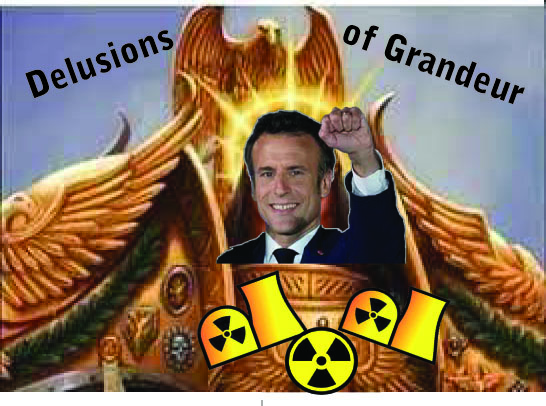
While Emmanuel Macron continues to affirm his attachment to the atom,
Yannick Jadot, Marine Tondelier, Eric Piolle and Sandra Regol are calling
on France not to get stuck again in costly and dangerous dependence on this
energy.
At the end of 2023, first in a forum, then in his wishes to the
French, President Macron reaffirmed his attachment to the relaunch of
nuclear power. He who questioned in 2017 the relevance of depending
three-quarters on a single source of electricity production has today
transformed into a nuclear industry salesman.
In Dubai, busy tripling
global production by 2050, he actively campaigned for the mention of
nuclear power in the final COP 28 agreement.
Liberation 9th Jan 2024
Behind the (somewhat dirty) scenes of nuclear waste processing

Behind the (somewhat dirty) scenes of nuclear waste processing. Nuclear
energy, even if many call it “clean”, produces a lot of waste (and costs
“crazy money”). A researcher was able to carry out a survey lasting
approximately one year on two French waste landfill sites. How are these
things managed? Exclusive interview. “There is no such thing as
decontamination. This is an abuse of language. You don’t kill the
radioactivity, you move it.”
Mediapart 9th Jan 2024
1 This Month


Petition to revoke the licensing of the Near Surface Nuclear Disposal Facility (NSDF) at Chalk River. https://www.ourcommons.ca/petitions/en/Petition/Details?Petition=e-7247


of the week – STOP SMALL MODULAR REACTORS IN CANADA
To see nuclear-related stories in greater depth and intensity – go to https://nuclearinformation.wordpress.com
-
Archives
- March 2026 (163)
- February 2026 (268)
- January 2026 (308)
- December 2025 (358)
- November 2025 (359)
- October 2025 (376)
- September 2025 (258)
- August 2025 (319)
- July 2025 (230)
- June 2025 (348)
- May 2025 (261)
- April 2025 (305)
-
Categories
- 1
- 1 NUCLEAR ISSUES
- business and costs
- climate change
- culture and arts
- ENERGY
- environment
- health
- history
- indigenous issues
- Legal
- marketing of nuclear
- media
- opposition to nuclear
- PERSONAL STORIES
- politics
- politics international
- Religion and ethics
- safety
- secrets,lies and civil liberties
- spinbuster
- technology
- Uranium
- wastes
- weapons and war
- Women
- 2 WORLD
- ACTION
- AFRICA
- Atrocities
- AUSTRALIA
- Christina's notes
- Christina's themes
- culture and arts
- Events
- Fuk 2022
- Fuk 2023
- Fukushima 2017
- Fukushima 2018
- fukushima 2019
- Fukushima 2020
- Fukushima 2021
- general
- global warming
- Humour (God we need it)
- Nuclear
- RARE EARTHS
- Reference
- resources – print
- Resources -audiovicual
- Weekly Newsletter
- World
- World Nuclear
- YouTube
-
RSS
Entries RSS
Comments RSS
 nuclear-news