Israel Is Terrified the World Court Will Decide It’s Committing Genocide

Public hearings on South Africa’s request for provisional measures will take place on January 11 and 12 at the ICJ which is located in the Peace Palace in The Hague, Netherlands. The hearings will be livestreamed from 4:00-6:00 a.m. Eastern/1:00-3:00 a.m. Pacific on the Court’s website and on UN Web TV. The court could order provisional measures within a week after the hearings.
Other States Parties to the Genocide Convention Can Join South Africa’s Case
South Africa, a party to the Genocide Convention, charged Israel with genocide in the International Court of Justice.
By Marjorie Cohn / Truthout, January 8, 2024, https://scheerpost.com/2024/01/08/israel-is-terrified-the-world-court-will-decide-its-committing-genocide/
For nearly three months, Israel has enjoyed virtual impunity for its atrocious crimes against the Palestinian people. That changed on December 29 when South Africa, a state party to the Genocide Convention, filed an 84-page application in the International Court of Justice (ICJ, or World Court) alleging that Israel is committing genocide in Gaza.
South Africa’s well-documented application alleges that “acts and omissions by Israel … are genocidal in character, as they are committed with the requisite specific intent … to destroy Palestinians in Gaza as a part of the broader Palestinian national, racial and ethnical group” and that “the conduct of Israel — through its State organs, State agents, and other persons and entities acting on its instructions or under its direction, control or influence — in relation to Palestinians in Gaza, is in violation of its obligations under the Genocide Convention.”
Israel is mounting a full-court press to prevent an ICJ finding that it’s committing genocide in Gaza. On January 4, the Israeli Foreign Ministry instructed its embassies to pressure politicians and diplomats in their host countries to make statements opposing South Africa’s case at the ICJ.
In its application, South Africa cited eight allegations to support its contention that Israel is perpetrating genocide in Gaza. They include:
(1) Killing Palestinians in Gaza, including a large proportion of women and children (approximately 70 percent) of the more than 21,110 fatalities and some appear to have been subjected to summary execution;
(2) Causing serious mental and bodily harm to Palestinians in Gaza, including maiming, psychological trauma, and inhuman and degrading treatment;
(3) Causing the forced evacuation and displacement of about 85 percent of Palestinians in Gaza — including children, the elderly and infirm, and the sick and wounded. Israel is also causing the massive destruction of Palestinian homes, villages, towns, refugee camps and entire areas, which precludes the return of a significant proportion of the Palestinian people to their homes;
(4) Causing widespread hunger, starvation and dehydration to the besieged Palestinians in Gaza by impeding sufficient humanitarian assistance, cutting off sufficient food, water, fuel and electricity, and destroying bakeries, mills, agricultural lands and other means of production and sustenance;
(5) Failing to provide and restricting the provision of adequate clothing, shelter, hygiene and sanitation to Palestinians in Gaza, including 1.9 million internally displaced persons. This has compelled them to live in dangerous situations of squalor, in conjunction with routine targeting and destruction of places of shelter and killing and wounding of persons who are sheltering, including women, children, the elderly and the disabled;
(6) Failing to provide for or ensure the provision of medical care to Palestinians in Gaza, including those medical needs created by other genocidal acts that are causing serious bodily harm. This is occurring by direct attacks on Palestinian hospitals, ambulances and other healthcare facilities, the killing of Palestinian doctors, medics and nurses (including the most qualified medics in Gaza) and the destruction and disabling of Gaza’s medical system;
(7) Destroying Palestinian life in Gaza, by destroying its infrastructure, schools, universities, courts, public buildings, public records, libraries, stores, churches, mosques, roads, utilities and other facilities necessary to sustain the lives of Palestinians as a group. Israel is killing whole families, erasing entire oral histories and killing prominent and distinguished members of society;
(8) Imposing measures intended to prevent Palestinian births in Gaza, including through reproductive violence inflicted on Palestinian women, newborns, infants and children.
South Africa cited myriad statements by Israeli officials that constitute direct evidence of an intent to commit genocide:
“Gaza won’t return to what it was before. We will eliminate everything,” Israel’s Defense Minister Yoav Gallant said. “If it doesn’t take one day, it will take a week. It will take weeks or even months, we will reach all places.”
Avi Dichter, Israel’s Minister of Agriculture, declared, “We are now actually rolling out the Gaza Nakba,” a reference to the 1948 ethnic cleansing of Palestinians to create the state of Israel.
“Now we all have one common goal — erasing the Gaza Strip from the face of the earth,” Nissim Vaturi, the Deputy Speaker of the Knesset and Member of the Foreign Affairs and Security Committee proclaimed.
Israel’s Strategy to Defeat South Africa’s Case at the ICJ
Continue readingWhere your $trillions go, to risk all life

Peace and Planet News, by Anthony Donovan | Winter 2023 Edition
We’ve seen an amazing level of bipartisan support!” For what initiative do we hear this rare statement echoed about Congress today?
The 15th Annual Nuclear Deterrence Summit, held once again at the Hyatt Regency in Arlington, Va., Feb. 13–15. For three days the rooms are filled with a multitude of companies and government agencies from around the country connected to the Department of Energy, Department of Defense, and National Nuclear Security Administration that make up our nuclear weapons industry, and its terribly secretive renewed Mutually Assured Destruction (MAD) race.
What is termed the “Enterprise” is in full-out sales and confidence-building mode. It is here the relationships for securing contracts through the next 5 to 35 years are solidified.
One aged reporter who once covered the industry in the 1980s confides his shock after a dizzying day of presentations: “How did you know these gatherings were going on? I just found out last week! Can’t believe this, I mean, this is a new unbridled arms race! These people in there are totally convinced this is the only way to go.” Looking at only two of us with our sign, he asks, “Why aren’t more people in the streets? Where is the movement pushing back?”………………………………………………………………….
Attendees were a bit puzzled that I wasn’t with a company connected to the summit, but I continued to share my purpose, seeing that we desperately need their dedication and skillset to begin turning toward the critical needs before us today: sustainability, good jobs supporting our environment, food, water, air, housing, healthcare, education, infrastructure … you know the issue. Some were relieved that I was all for science and space exploration, but first, for the precious earth!
…………………………………………………… Most exhibitors were too young to remember that the vast majority of citizens had voted with their feet to end this madness, and that there was no transparency or democratic process in the decision to use our treasure to fund it all.
Inevitably the confounding old Cold War rhetoric arose, painting China and Russia as vile enemies that we can not trust to honor any agreements. ……………………..
Naturally, I’d let them know we had a most worthy instrument, The Treaty on the Prohibition of Nuclear Weapons, now international law, to help guide this needed transformation, despite its being dismissed by our mainstream media. Only a few had heard of it, and of those, few knew particulars.
Laser beamed on their one aspect of the industry, several with competitors present vying for the same contract, many met in the dozens of closed-door side rooms for private company presentations/briefings. There were open “networking breakfasts” lunches and evening cocktail parties and several daily general gatherings in the large Hyatt Ballroom focused on the latest in pit production, delivery platforms, command-and-control infrastructure and communications, warhead modernization, STRATCOM reports, reports from the heads of all our labs, Los Alamos, Oak Ridge, Sandia, etc. Presentations on increasing efficiency in product and organization, best practices, and cited pathways to “success.” After all, we are leading and “winning.” Exactly what we think we are winning made no sense to anyone on the nuclear abolition team.
There were exhibitors displaying highly specialized metal nose cones and delivery vehicle parts. Designers of fabrics that claim to protect from radioactivity, cybersecurity “experts,” nuclear waste management specialists, triad infrastructure architects, specialists in improving uranium refining, nuclear physicists and engineers specializing in all materials and their “enhanced delivery” of precision warhead targeting and interception by “safety” umbrellas, inter-agency communication specialists, and those through it all maintaining secure communications. My presence seemed harmless enough to this security. I think of all our very brave colleagues who’ve risked life to enter the kill zones of these most highly sealed-off omnicidal compounds to render witness of the crime against humanity.
Amazon, a “Gold Sponsor” of the summit, had an exhibit: “We have established good relations with the CIA, but we need to get better integrated with the NNSA. This is new to us. That’s why we’re here.”
In this very clearly white male-oriented world, there was also a presentation on the essential hiring of more “diversity” for the future. One enticing statement read they “offer specialized worth to employees by valuing their entire career life cycle–creating stable careers…” Ah, such security………..
The revolving door is astoundingly evident here, and the boundaries of government, military, with private companies is quite indistinguishable. Those with Navy, Air Force, and other triad experience are now running these private companies or working as their specialized “experts in technical and professional innovation. support and security.” One “private” company proudly advertising that 70% of “our expertise” hold all the necessary security clearances within the government!
…………………………….. Former General Lloyd Austin, who retired to become Raytheon’s CEO, was easily confirmed by our Congress to become our current Secretary of Defense under President Biden. In his hearings, General/CEO Austin guaranteed to our representatives that the Triad would get his full support to obtain all that it needed. What seems illegal goes unchallenged.
Along with the DOE, National Security Administration, and Budget Office, the regular old nuclear weapon corps were very present: General Dynamics, Huntington Ingalls, Bechtel, Flour, Honeywell, Aerospace, SAIC, etc., and a number of universities……………………………………………………………………………………………………..
Within 25 minutes we were surrounded by hotel security and managers asking us to leave the premises immediately. They then claimed even the sidewalks outside the hotel were private and we could not remain there………………………………………………………..
Ask your representative to sign H. Res. 77, sponsored by Rep. James McGovern, supporting the goals of the Treaty on the Prohibition of Nuclear Weapons! Ask your senator to call for the same in the Senate. Thank all the nations ratifying the TPNW. Ask your representative to observe the Ban Treaty’s Meeting of States this November in New York City at the United Nations. They are welcome to learn, and think deeper.
Knowing the horror of war was pushing ahead and with it an increasing, completely unnecessary risk of nuclear annihilation, there was ever-present sense of unity with the citizens of the world who are pleading and advocating another way. There were many thumbs up and waves from passing vehicles. Thinking of those who have young children/grandchildren, including a good number I got to speak with on this Summit floor, we felt there was nowhere else to be on this day celebrating the love in our hearts and in our lives, round the world, Valentine’s Day. https://peaceandplanetnews.org/where-your-trillions-go/
Energy Transition Minister Agnes Pannier-Runacher enthuses over “the rebirth of France’s nuclear industry”

EDF will construct the new plants with tens of billions in public financing

“EDF will construct the new plants with tens of billions in public financing ” – what could possibly go wrong?
France sees potential for 14 new nuclear reactors. 8 Jan 24, https://www.power-technology.com/news/france-may-build-14-new-nuclear-reactors/
France may need to build more than 14 new nuclear power plants, more than the six currently planned, if the nation is to meet its energy transition goal of reducing fossil fuel dependence from 60% to 40% by 2035.
Energy Transition Minister Agnes Pannier-Runacher stressed that nuclear will play an increasingly vital role in France’s energy mix. Speaking to La Tribune Dimanche just a few weeks before parliament reveals a bill relating to energy sovereignty, Pannier-Runacher said: “We need nuclear power beyond the first six EPRs [European Pressurised Reactors] since the existing (nuclear) park will not be eternal.”
This new energy strategy will be debated in parliament from late January and must be codified into law.
In 2022, French nuclear power output fell to a 30-year low after operational issues forced many reactors offline. This placed additional upward pressure on European energy prices, which were already being driven up reduced gas flows from Russia. However, French President Emmanuel Macron emphasised the importance of nuclear, stating: “What our country needs, and the conditions are there, is the rebirth of France’s nuclear industry.”
Over the course of 2023, availability improved, falling in line with state-controlled energy provider EDF’s target of 300–330 terawatt-hours. EDF will construct the new plants with tens of billions in public financing and chief executive Luc Rémont said his company aims to build roughly one 1.6GW reactor a year.
President Macron also reinforced his country’s commitment to nuclear at the recent COP28 climate summit in Dubai, where he led a group of 20 world leaders signing a pledge to “triple nuclear energy capacity from 2020 by 2050”. Shortly after signing, Macron pronounced that “nuclear energy is back”.
France currently has 56 operable reactors that produce around 70% of the nation’s electricity. Comparatively, Germany, another European superpower, does not produce any of its electricity from nuclear power, while in the UK the figure is 15%.
Outrage as Government admits it kept medical results on nuke test veterans a ‘state secret’ in a move Tory grandee Sir John Hayes said ‘beggars belief’

Daily Mail, By EIRIAN JANE PROSSER , 8 January 2024 |
The Government has admitted it has kept medical results of military veterans who survived British nuclear tests a state secret, prompting a furious outrage.
Blood and urine samples from servicemen, civilians and indigenous people during the Cold War are among the thousands of personal records being held in a move that Tory grandee Sir John Hayes slammed as ‘beggars belief’.
The confidential documents could reveal whether those made to witness the atomic bomb tests had radiation enter their body, which could lead to a huge payout for veterans if they can prove the health consequences.
Prime Minister Rishi Sunak is now facing calls for the files to be made public. Previously the Ministry of Defence denied it held the records, until the Mirror revealed a cache of 150 documents discussing blood tests last year.
Reacting to the revelation MP Sir Hayes said: ‘It beggars belief that a diagnostic medical test confirming whether or not radiation entered a person’s body, with possible long-term health consequences, is in any way a state secret.
‘Veterans and survivors of this weapons testing have a legal and moral right to know what if anything happened to their bodies as a result, and I am sure they can be disclosed to individuals without any impact on national security.’
The Mirror reported that in 2018 the Ministry of Defence denied that the Atomic Weapons Establishment (AWE) holds any evidence that blood samples were taken at nuclear tests until it rowed back on the claim in 2023.
Freedom of Information requests by the paper revealed how both blood and urine samples were taken at test sites under a Lord Chancellor’s instruction, which is why the documents could be held from the National Achieves
Culture minister John Whittindale admitted to Parliament the withholding of such documents is down to various factors including national security, security against possible terrorist activity and international relations.
He also said ‘the risk of proliferation of nuclear weapons or to allow a more detailed review’ are also reasons to retain the files.
The files are said to relate to three nuclear tests in Australia that took place in 1957 dubbed Operation Antler.
One of the files, seen by the Mirror, is said to have been entitled ‘nuclear test veterans’ and were said to have first been hidden when Tony Blair came to power in 1997.
The AWE has been asked to confirm how many other records were also hidden in similar fashion, with Labour leader Keir Starmer pledging to give veterans and their families affected their records and compensation if they take office.
Those affected by the testing were previously asked to come forward by law firm McCue Jury & Partners, with managing partner Jason McCue stating that nuclear veterans had been ‘gaslighted by the British state’. ………………………………………………………………………………..
Nearly £21,000 has now been raised to help nuclear veterans sue the Government for ‘the toxic legacy of trauma and illness they have been left to endure’.
Servicemen were ordered to sail or crawl through the radioactive fallout to test the effects of radiation, as well as fly through mushroom clouds on sampling missions.
Many lived on testing sites for a year or more and when they returned began developing rare blood disorders and cancers, often proving fatal.
Their wives had three times the normal rate of miscarriages and their children suffered 10 times the normal rate of birth defects.
The British government carried out hundreds of explosions of atom bombs, fissile material, trigger devices and thermonuclear weapons in the US, Australia and South Pacific following the Second World War…………………….. more https://www.dailymail.co.uk/news/article-12936311/government-outrage-medical-results-nuke-text-secret.html?fbclid=IwAR284fF3V4h_LgFtbGW5W6CP_Ux9ZNHvgRtT87fif8uzKQgVrgjNIf2uIrw
Nuclear, CCS & LNG Are Distractions As Shipping Goes Low Carbon

Forbes, Michael Barnard, 8 Jan 24
“……………………………………………… About a year ago I created a series of sexy vs meh quadrants charts for different aspects of decarbonization, covering ground transportation, aviation & aerospace, electricity & grid storage, carbon drawdown, heat and most pertinently, the maritime industry.
When I first created the visual, it didn’t occur to me to add nuclear-powered ships to it. Having gone deep and wide on nuclear generation’s past and present, I knew that nuclear-powered ships were fit for purpose for a handful of affluent countries with big militaries, a subset of the ones with nuclear weapons.
There are still many nuclear-powered submarines and aircraft carriers on and under the seas. Unsurprisingly, the USA has eleven of the twelve aircraft carriers, with France’s Charles de Gaulle being the sole non-American example of the class. There are over a hundred nuclear-powered submarines, with the USA again having the most, but China, France, Russia and the United Kingdom all having vessels, although some are awaiting decommissioning at significant expense. Further, there are a handful of nuclear ice breakers operating in Arctic waters, all Russian.
I knew that the first commercial nuclear reactors were repurposed military vessel reactors and that they had proven deeply uneconomic, requiring scaling the small reactors up to gigawatt sizes to achieve thermal efficiencies for cheaper electricity. That’s part of the problem with the current hype around small modular nuclear reactors, that they forego that scaling for efficiency and hence are proving uneconomic, mostly recently with the cancellation of the NuScale deployment in Utah.
I knew that nuclear cargo ships had been tried 70 years ago, and failed miserably. Most ports wouldn’t accept them and New Zealand passed a law banning them that’s still on their books. And I knew that nuclear decommissioning was very expensive, for example with the UK nuclear submarine effort costing almost US$100 million per vessel.
So I was surprised when I was invited by Elisabet Liljeblad, Head of Climate & Energy Transition with Stena Teknik, to debate maritime decarbonization at a Stena technical leaders offsite to find that there was a proponent of nuclear-powered shipping participating, along with a methanol-industry representative and a battery electrification firm’s sales director.
Is it technically feasible to build a nuclear-powered container or bulk ship? Of course. But there are major headwinds facing it. The first is that the current interest is aligned with small modular nuclear reactors being commercialized and being able to be repurposed at relatively low cost for ships. As those reactors are almost entirely on the drawing board, with exactly one 200 MW version in commercial operation in China as of late 2023 and design progressing for a deployment in Ontario, it’s going to be a long wait with little likelihood of success.
One of the major problems that small modular reactors face is that they virtually all depend on high assay low enrichment uranium or HALEU. Over the past decades, the supply chain has devolved to the point where only Russia is a supplier of the material, with obvious concerns. At present the USA is attempting to develop a coalition of nations to create a new supply chain, but it’s fraught.
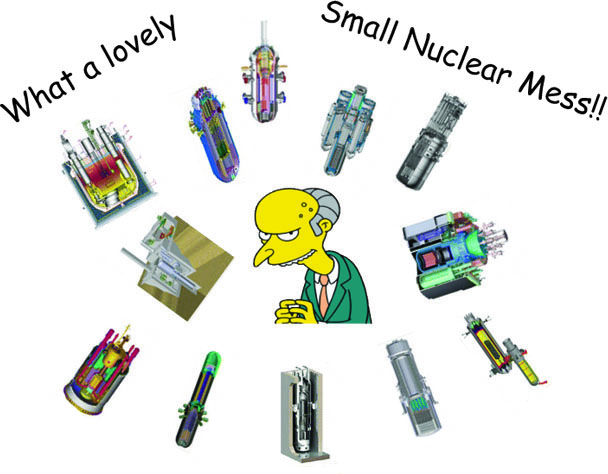
The likelihood of small reactors being commercially viable for electricity is already low due to the thermal efficiency challenge, and there are far too many designs and technologies under development to make it possible for a single design to be built enough times to lower costs.
Every commercial nuclear reactor has seven circles of overlapping security around it, and with the exception of the Russian Arctic icebreaker fleet, where remoteness and harsh conditions provide security, those circles would have to be recreated for commercial vessels. Submarines depend on stealth, but air craft carriers travel in a fleet of escort vessels.
The cost of the reactor for a large commercial vessel is likely to be as high or higher than the rest of the ship, making current multi-million dual-fuel engine capital expenditures look like pocket change. And the owner vs operator conflict which makes any excess capital expenditures problematic would apply as well, with the operator accruing the benefits but the owner paying. That high decommissioning cost will also be prohibitive.
There is only one commercial nuclear cargo ship in operation at present, the Soviet-built Sevmorput. For context for the cost, the small 1,328 container capacity ship cost roughly US$265 million. By contrast, Maersk’s dual-fuel, 9,000 container capacity ships cost US$115 million each. The Sevmorput’s history is a cautionary tale as well. Multiple Soviet port cities refused to let it enter their ports over safety concerns. The Port of Vancouver refused entry as well as the port’s safety and emergency plans didn’t include nuclear accident preparedness. It also has a history of maintenance issues. The combination has led to it being inactive more than active since built, and mostly it has been used to transport Russian military materiel to Arctic region bases.
This isn’t stopping various organizations from undertaking designs, but the likelihood of seeing nuclear-powered commercial ships on our oceans is low. Every port they entered would have to have security, operational and emergency procedures upgrades, and so most will simply refuse entry.
Nuclear energy is a distraction, and it gets so little hype compared to foils, green hydrogen and green synthetic fuels that I’ve put it in the foolish and meh quadrant……………………………………………………………………………………………………………………………………………………………….
And so, the end of the also rans in my projection of maritime repowering. Batteries will be dominating inland and near shore shipping. Some oceanic shipping will be boosted a bit by wind power, mostly parafoils in my opinion. Ammonia need not apply, with the minor exception of actual ammonia tankers, which won’t be growing in numbers. Nuclear and LNG power are distractions. Up next, the real decarbonization fuel of the future. https://www.forbes.com/sites/michaelbarnard/2024/01/08/nuclear–lng-are-distractions-as-shipping-goes-low-carbon/?sh=22f290124da7
Reducing energy demand- technologies are available, scalable and affordable today

Economic growth relies in part on affordable and reliable energy. Demand
for energy is set to rise by up to a third between now and 2050 to support
a global economy that will be twice as large and a population of 2bn more
people. This surge in population and productivity will be most concentrated
in emerging markets, which makes the energy transition even more
challenging.
We have to change the very nature of our energy system, from a
predominantly fossil fuel-based economy to one based on low-carbon energy
sources. Crucially, we must do so while ensuring energy remains affordable
and secure for all.
The conversation has concentrated on the supply-side.
Governments and energy companies are rightly focusing on how to increase
the supply of low-carbon energy sources and boost transmission
infrastructure. Despite this, we are nowhere near reaching our climate
goals. And there is another side of this debate that has received far less
attention.
Energy supply is critical, but what about energy demand? Demand
is something everybody — individuals, businesses and governments alike
— can take action on. By reducing the intensity of our energy demand (by
one definition, the energy used per unit of gross domestic product
generated) we can do more with less.
But we are not doing nearly enough on
this front. The International Energy Agency estimates that the world needs
to improve energy intensity by more than 4 per cent a year between 2020 and
2030, and almost 3 per cent annually thereafter, to reach net zero by 2050.
Last year, we only managed 1.3 per cent.
First, we need to find ways to save energy.
For instance, artificial intelligence innovations in heating,
ventilation and air conditioning of offices could achieve a 25 per cent
drop in consumption. Second, we need to focus on energy efficiency: using
less energy to perform the same task or produce the same product. For
instance, retrofitting buildings can reduce energy consumption by 45 per
cent. Finally, we have to find value chain collaborations. That means
different businesses along the value chain working together to drive change
in the wider energy system. Recovering heat from industrial plants, for
example, could reduce energy consumption by around 25 per cent, as seen in
the use of waste heat from sulphuric acid production in Sweden. These
technologies are available, scalable and affordable today.
FT 7th Jan 2024
https://www.ft.com/content/bc2ba5ae-ac4c-4ea8-b7b2-160c5b8aaaa1
The mystery of a Truchas woman who died with extraordinary amounts of plutonium in her body
KUNM | By Alice Fordham, https://www.kunm.org/local-news/2024-01-08/the-mystery-of-a-truchas-woman-who-died-with-extraordinary-amounts-of-plutonium-in-her-body
With the release of the movie Oppenheimer last year, there has been a resurgence of interest in the history of the Los Alamos National Laboratory. But for writer Alicia Inez Guzmán at the investigative nonprofit Searchlight New Mexico, that interest has been there for years as she has covered the past and present of the lab and its impact on the people of northern New Mexico. Her reporting includes the town of Truchas, where she grew up. In her latest report, Guzmán looks at the story of one woman who lived in Truchas, and died in 1972, inexplicably with extraordinarily high levels of plutonium in her body. Guzmán spoke with KUNM about her reporting.
ALICIA INEZ GUZMAN: When I first heard about this mystery woman, it was on an airplane coming back to Santa Fe. And I was sitting next to Jay Coghlan, who’s the executive director of Nuclear Watch New Mexico. And he said something to the effect of, the woman with the most plutonium in her body after the Trinity Site detonation, was from Truchas. And I just thought it was so fascinating and cryptic that I actually got the source of the information, which is the LAHDRA report or the Los Alamos Historical Document and Retrieval Assessment. And that’s where I was able to read for myself that there was a woman from Truchas, who had 60 times the amount of plutonium than the average New Mexico resident, and it was attributed to the Trinity Site, which led me on a wild goose chase basically
KUNM: Why was this so intriguing to you?
GUZMAN: Sure, so Truchas is 225 miles away from the Trinity Site. It’s in northern New Mexico in the Sangre de Cristo Mountains. And we know of course, the fallout did reach places like Truchas and far beyond, but in order for somebody to have plutonium in their body, they have to ingest it or inhale it. And so that was part of the question that I had was: well, she’s 225 miles away, could she have ingested or inhaled plutonium at that distance?
KUNM: So you had these questions, how did you go about finding out more about this person?
GUZMAN: When she was listed in the larger report, simply she was from Truchas, alive when Trinity detonated. So I had two pieces of information to go on. But what I realized was that the reason why they had that information about her at all was because the lab had conducted a series of autopsies on not only workers from Los Alamos National Laboratory, but the surrounding community. And once I found that information out, I was able to determine that there had actually been a class action lawsuit made on behalf of families of people who had been autopsied, because their families had never given informed consent. So I had to go to the courthouse here in Santa Fe, and from there, I found an issue of Health Physics magazine from 1979. And her name was not given, but it gave her age, at death, where she was from, what she did — a housewife — and the year that she died. And so, when I did a search in obituaries for that set of criteria, only one woman came up. And it turns out, as I suspected, that I knew the family.
KUNM: And what did they learn from you, and what did you learn from them?
GUZMAN: I should start out with what they learned, because I had to basically call them and reveal that possibly their grandmother had been involved in this clandestine study. And that if it was her, she had by far the most amount of plutonium in her body than anybody else who had been autopsied as a resident in that study. So, I think it was a huge shock to them.
Of course, what I learned from them was that this woman, whose name is Epifania Trujillo, she ended up moving in with her daughter and son in law, and her son in law, as it happened, worked at the laboratory as a janitor in a hot site, a hot site being somewhere where there was radiation, and that all of his children, he had seven children, all of his children except for one ended up getting cancer, and his wife. And so, I started talking to epidemiologists and toxicologists and physicists to really think through: is it possible that instead of having been exposed or contaminated from the Trinity Site, could it be Epifania and her family had been exposed and contaminated by what I later came to know or find out was take-home toxins? And largely what I hypothesize in the story was it is far more likely that her exposure came from Los Alamos National Laboratory, then it would be from Trinity Site.
Coldwater Creek to finally have warning signs after decades of nuclear contamination
Nuclear waste stored outside St. Louis was found to pose a risk to nearby Coldwater Creek as early as 1949. The contaminated creek will finally have warning signs almost 75 years later.
Missouri Independent, BY: ALLISON KITE – JANUARY 8, 2024
More than 70 years after workers first realized barrels of radioactive waste risked contaminating Coldwater Creek, the federal government has started work to put up signs warning residents.
The U.S. Army Corps of Engineers said in a statement Monday that it was working with the Environmental Protection Agency to add signs along the creek to help it monitor areas “that may pose a risk if disturbed.”
Coldwater Creek has been contaminated for decades with radioactive waste left over from the World War II-era effort to build an atomic bomb. But though the creek winds through some of St. Louis’ busiest suburbs and past public parks and schools, the federal government had resisted calls to post signs warning visitors of the contamination.
“This is decades of potential exposure that could have been prevented that they drug their feet on,” said Dawn Chapman, co-founder of Just Moms STL, an organization formed to advocate for communities affected by St. Louis-area radioactive waste.
Despite the delays, Chapman said she’s thankful that the signs are finally going to be installed.
The St. Louis area has long struggled with a radioactive waste problem. Uranium for the Manhattan Project, the name given to the effort to develop the first atomic bomb, was refined in downtown St. Louis.
After World War II, radioactive waste left over from those efforts was trucked to the St. Louis airport and dumped — some on the open ground and some in barrels — next to Coldwater Creek. As early as 1949, Mallinckrodt Chemical Works, the company that refined uranium for the federal government, was aware the waste could escape deteriorating barrels and enter the creek…………………………………………………………………………………………………………………………..
While the Army Corps, which has overseen the sites since the late 1990s, said the remaining contaminated sites surrounding Coldwater Creek only pose a risk if they’re disturbed, in previous decades exposure to the creek’s waters may have raised the risk of cancer for St. Louis residents.
The Agency for Toxic Substances and Disease Registry concluded in 2019 that children and adults who played in or near Coldwater Creek or lived in its floodplain between the 1960s and 1990s may have been exposed to radioactive materials that raise the risk of certain cancers. The agency — part of the Centers for Disease Control and Prevention — recommended signs be placed along the creek to warn residents of the potential exposure risk.
According to the St. Louis Post-Dispatch, the Army Corps said at the time doing so wasn’t its role………………………………………………………………………………………………………………………….
The announcement comes at a time of renewed focus on St. Louis’ radioactive waste problem. Bush and U.S. Sen. Josh Hawley have sought compensation for residents sickened because of exposure to radioactive waste, and an investigation by The Missouri Independent, MuckRock and The Associated Press found that private companies and government agencies downplayed the risks associated with the contamination for decades .
Andy Quinones, senior communications manager for the city of Florissant, said the Army Corps had requested to put signs in several of the city’s parks that sit along the creek.
“I’m glad,” Quinones said, “that they are taking the initiative to start doing a better job of informing the public.” https://missouriindependent.com/2024/01/08/coldwater-creek-to-finally-have-warning-signs-after-decades-of-nuclear-contamination/
‘The potential is extraordinary’: Business action on energy efficiency could save $2tr a year, new research claims

Business Green Michael Holder, 08 January 2024
World Economic Forum and PwC report sets out host of energy efficiency actions it claims are ‘doable today, at attractive returns with no need for new technology’
A suite of “doable today” business actions that would slash demand for energy could unlock annual savings of at least $2tr a year across the global economy, while helping to boost growth, save companies cash, unlock competitive advantages, and reduce greenhouse gas emissions.
That is the conclusion of major new research published today and backed by over 120 CEOs of global corporates, which sets out a host of near-term actions businesses can take to reduce energy demand across their buildings, infrastructure, and transport use.
Drawn up by consulting giant PwC in collaboration with the World Economic Forum (WEF), the research contends that if cost effective energy efficiency measures were taken by companies by the end of the current decade, and better supported by effective policy frameworks, it could unlock a major acceleration in the net zero transition.
The research, which comes ahead of next week’s annual global WEF meeting in Davos, Switzerland, argues “the potential of demand-side action is extraordinary”, and details a host of measures it claims are “doable today, at attractive returns with no need for new technology”.
Recommended measures include retrofitting buildings with insulation and other efficiency and green energy measures, electrifying transport systems, and harnessing artificial intelligence to optimise factory-line design to unlock efficiencies. The report also recommends deeper collaboration between businesses across value chains in order to unlock further efficiencies, as well as “industrial clustering” to share clean energy sources and maximise the benefits of efficiency initiatives.
The research argues energy efficiency measures remain an “under-addressed” component of the net zero transition, which can deliver substantial energy and emissions savings.
It claims proven measures could deliver a short-term, cost-efficient reduction in energy demand of almost a third – 31 per cent – shared across the buildings, industry, and transport sectors, and avoid the need to construct almost 3,000 extra power stations.
Moreover, these efforts would support the UAE Consensus agreed at COP28 in Dubai last month, which saw hundreds of nations commit to tripling renewable energy capacity and doubling the rate of energy efficiency improvements worldwide by 2030…………………………………………………………………………………..
today’s report warns that awareness among companies of the potential for energy efficiency to benefit their business, achieve cost savings, and support emissions reduction efforts remains low, as it called for more supportive government policy to help drive progress.
As many as 47 per cent of CEOs on the WEF’s International Business Council surveyed for the report cited a lack of supportive regulation as a barrier to effort to reduce energy demand.
Chair of the Council Ana Botín, who is group executive chair at Spanish banking giant Santander, said businesses had a “vital role to play” in slashing energy demand worldwide, and stressed that firms could do so without decreasing economic output.
“Reducing the amount of energy needed to manufacture products and deliver services is something we can act on now,” she said. “Although progress is being made, there is a lot more to be done, and the fact is that our energy demand continues to rise at unsustainable rates.
“It is crucial, therefore that we work together with governments and regulators across both developed and developing markets to help accelerate progress on this issue.” https://www.businessgreen.com/news/4161032/potential-extraordinary-business-action-energy-efficiency-save-usd2tr-research-claims
Touting a ‘new age of nuclear fusion’

West Burton, a sprawling site that is also home to a gas-fired station,
has been chosen as the location for a nuclear fusion plant that the
government aims to have in operation by 2040.
It is an ambitious plan.
Fusion has been the next big thing in energy since the 1950s, but it still
faces big technical obstacles to becoming a reality. It also will be a race
against a big field of international rivals.
The largest developed
economies, in particular the United States and Japan, are pouring billions
into fusion research, as are a gaggle of deep-pocketed technology
billionaires.
Before Brexit, Britain was a leading member of a
multinational effort spearheaded by the European Union. The West Burton
plan represents it striking out on its own.
It will not be a small
undertaking. Paul Methven, the executive in charge of the project, says it
is too early to estimate the likely cost, but suggests that the plant and
its associated infrastructure will be of a similar size to Hinkley Point C,
the nuclear power station being built in Somerset by EDF. That scheme’s
latest budget estimate is £33 billion.
Times 7th Jan 2024
Dutch engineer spread Stuxnet in Iran nuclear plant in 2008: report

IT Wire, By Sam Varghese, 9 Jan 24
A Dutchman was responsible for infecting equipment at Iran’s Natanz nuclear plant in 2008 with the Stuxnet virus, leading to years of delay in the country’s nuclear program, a Dutch publication, Volkskrant, claims.
Erik van Sabben, who was 36 at the time, is claimed to have carried out the task after having been recruited in 2005 by the AIVD, a Dutch intelligence outfit.
A few years ago, Volksrant claimed Van Sabben had been recruited by AIVD and also another Dutch intelligence outfit, MIVD.
Stuxnet was discovered by researcher Sergey Ulasen in 2010; he joined Russian security firm Kaspersky a year later. At that time, the virus was believed to have been infiltrated into the Natanz plant through an USB drive as the lab was not connected to any external network………………………………..
Another new claim by Volksrant was that Stuxnet, which is believed to have been developed jointly by the NSA and Israel’s Unit 8200, cost more than US$1 billion to create.
Reacting to the story, Costin Raiu, long-time head of Kaspersky’s Global Research & Analysis Team who left the company last year, said: “Some interesting points from the article: Stuxnet cost more than US$1 billion to build (!).
“If true, it was brought into Natanz in a ‘water pump’, that later spread it to the network.
“The guy who did this died in 2009, so very important detail, the Stuxnet variant he brought in 2007 would be a really early one, like Stuxnet 0.5.
“IMHO, the really impactful variants were the later ones, that were seeded through five different organisations in Iran, in 2009 and 2010.”
Mikko Hypponen, chief research officer at security firm WithSecure, said he did not buy the claim of the US$1 billion price tag. “Millions, certainly, dozens of millions, sure. A billion? I don’t think so,” he said. https://itwire.com/business-it-news/security/dutch-engineer-spread-stuxnet-in-iran-nuclear-plant-report.html
1 This Month

of the week – Shut Down Drone Warfare!


Tell the Ukrainian Government to Drop Prosecution of Peace Activist Yurii Sheliazhenko

Petition to revoke the licensing of the Near Surface Nuclear Disposal Facility (NSDF) at Chalk River. https://www.ourcommons.ca/petitions/en/Petition/Details?Petition=e-7247
To see nuclear-related stories in greater depth and intensity – go to https://nuclearinformation.wordpress.com
-
Archives
- April 2026 (114)
- March 2026 (251)
- February 2026 (268)
- January 2026 (308)
- December 2025 (358)
- November 2025 (359)
- October 2025 (376)
- September 2025 (257)
- August 2025 (319)
- July 2025 (230)
- June 2025 (348)
- May 2025 (261)
-
Categories
- 1
- 1 NUCLEAR ISSUES
- business and costs
- climate change
- culture and arts
- ENERGY
- environment
- health
- history
- indigenous issues
- Legal
- marketing of nuclear
- media
- opposition to nuclear
- PERSONAL STORIES
- politics
- politics international
- Religion and ethics
- safety
- secrets,lies and civil liberties
- spinbuster
- technology
- Uranium
- wastes
- weapons and war
- Women
- 2 WORLD
- ACTION
- AFRICA
- Atrocities
- AUSTRALIA
- Christina's notes
- Christina's themes
- culture and arts
- Events
- Fuk 2022
- Fuk 2023
- Fukushima 2017
- Fukushima 2018
- fukushima 2019
- Fukushima 2020
- Fukushima 2021
- general
- global warming
- Humour (God we need it)
- Nuclear
- RARE EARTHS
- Reference
- resources – print
- Resources -audiovicual
- Weekly Newsletter
- World
- World Nuclear
- YouTube
-
RSS
Entries RSS
Comments RSS
 nuclear-news