The ‘Ghost Budget’: How America Pays for Endless War
The post-9/11 war funding pattern was completely different. For the first time since the American Revolutionary War, war costs were covered almost entirely by debt. There were no wartime tax increases or cuts in spending. Quite the reverse
a “culture of endless money” inside the Pentagon.
the ability to keep borrowing and spending with minimal oversight allowed the United States to keep fighting indefinitely.
Prior to 2001, U.S. wars were financed through a mixture of higher taxes and budget cuts, and funded mostly through the regular defense budget. The post-9/11 war funding pattern was completely different.
By Linda Bilmes / Just Security https://scheerpost.com/2024/01/08/the-ghost-budget-how-america-pays-for-endless-war/
The post-9/11 wars in Iraq and Afghanistan were enabled by a historically unprecedented combination of budgetary procedures and financing methods. Unlike all previous U.S. wars, the post-9/11 wars were funded without higher taxes or non-war budget cuts, and through a separate budget. This set of circumstances – one that I have termed the “Ghost Budget” – enabled successive administrations to prosecute the wars with limited congressional oversight and minimal transparency and public debate. I adopted the name “Ghost Budget” because the term “ghost” appeared frequently in post-9/11 government reports in reference to funds allocated to people, places, or projects that turned out to be phantoms.
The Ghost Budget was the result of an interplay between changes in the U.S. budgetary process, a more assertive military establishment, and the conditions in global capital markets. It has had far-reaching implications for the conduct and course of the post-9/11 wars and for defense policy today.
Funding the Post-9/11 Wars
The “Ghost Budget” was the biggest budgetary anomaly in U.S. history. Prior to 9/11, U.S. wars were financed through a mixture of higher taxes and budget cuts, and funded mostly through the regular defense budget. One third of the costs of World War I and half the costs of World War II were met through higher taxes. During World War II, President Franklin D. Roosevelt described paying taxes as a “patriotic duty” as he raised taxes on business, imposed a “wealth tax,” raised inheritance taxes, and expanded the number of income taxpayers to roughly 80 percent of the workforce by 1945. Wars in Korea and Vietnam largely followed a similar pattern, with President Harry Truman pledging to make the country “pay as you go” for the Korean War. War funding was also a central issue in the Vietnam War, which ended when Congress refused to appropriate money for the South Vietnamese military.
The post-9/11 war funding pattern was completely different. For the first time since the American Revolutionary War, war costs were covered almost entirely by debt. There were no wartime tax increases or cuts in spending. Quite the reverse: far from demanding sacrifices, President George W. Bush slashed federal taxes in 2001 and again in 2003, just as the United States invaded Iraq. President Donald Trump reduced taxes further in 2017. Overall, federal taxes declined from 18.8 percent of GDP in 2001 to 16.2 percent by the start of 2020. In the same period, outstanding federal debt held by the public rose from $3.5 trillion to $20 trillion. War spending contributed at least $2.2 trillion to this increase.
Not only was the financing strategy unprecedented, but the budgetary mechanism used to approve the vast post-9/11 wartime spending also diverged radically from the past. In all previous conflicts, the United States paid for wars as part of its regular defense appropriations (the defense “base budget”), after the initial period (1-2 years) of supplemental “emergency” funding bills. By contrast, for the entire decade from FY 2001 to FY 2011, Congress paid for the conflicts in Iraq and Afghanistan as “emergencies,” devoid of serious legislative or executive oversight.
By statute, emergency spending is defined as “unanticipated…sudden…urgent…unforeseen…and temporary” and is typically reserved for one-off crises such as floods and hurricanes. Such emergency spending measures are exempt from regular procedural rules in Congress because the intent is to disburse money quickly in situations where delay would be harmful.
Congress continued to enact “emergency supplemental” funding even as the war effort expanded. The United States sent 130,000 military personnel into Iraq in 2003 (alongside troops from more than 30 countries). By 2009, there were 187,200 U.S. “boots on the ground” in Iraq and Afghanistan, supported by a similar number of military contractors, with nearly 500 U.S. military bases set up across Iraq, but the conflict was still being paid for as an “emergency.” In FY 2012, President Obama renamed the “Global War on Terror” as “Overseas Contingency Operations” (OCO) but the war continued to be funded using money that – although not designated as “emergency” – was explicitly exempted from regular spending limits on other government spending programs.
How We Got Here
There were three primary drivers of the Ghost Budget: unusual economic conditions, congressional budget dysfunction, and military assertiveness.
Economic Conditions: Unlike earlier wars, the post 9/11 conflicts took place in an era of free-flowing international capital markets. That provided the U.S. Treasury with access to a deep and global pool of capital, making it easy to borrow large amounts without negatively affecting the cost. It was also a period of historically low interest rates. Real interest rates (nominal rate minus inflation) on 10-year Treasury bonds fell from 3.4% at the start of 2001 to negative (-0.4%) by early 2021 — a 40-year low. Consequently, the Treasury was able to borrow trillions of dollars to pay for the wars, and simultaneously finance the tax cuts of 2001 and 2003 without having any material effect on the amount of debt service being repaid through the annual budget. By FY 2017, total public debt had more than tripled, but debt service payments as a percentage of annual budget outlays had decreased to 6.6 percent, compared to 8.5 percent of federal budget outlays in FY 2002. In terms of cash outlays, this meant that the United States paid only slightly more in interest payments in FY 2017 than it had in FY 2002 ($268 billion versus $232 billion in 2018 dollars). Borrowing seemed virtually painless.
Budget Dysfunction: For several decades, the federal budget process has become increasingly dysfunctional. This breakdown may be traced to the post-Watergate budget reforms enacted in 1974, which shifted power away from the President and to the Congress. Most budget experts from both parties agree that the reforms made the budget process weaker, less predictable, less capable of reconciling competing demands, and more prone to fiscal crises. Prior to 1974, the federal government had never ceased operations for lack of funding. Since then, it has “shut down” 22 times, completely or partially. There have been only four years in which Congress passed its annual appropriations bills on time, and a series of near-defaults and other fiscal crises. In the absence of reliable budgets, Congress has enacted hundreds of short-term stopgap “continuing resolutions” to pay the bills. In this context, it was convenient for all the stakeholders to fund the wars as an “emergency” outside the regular process. The President was able to exclude war funding from his annual defense budget request to Congress, thus presenting an artificially low number for the federal budget deficit. This helped the Bush administration sustain the pretense that the wars would be short, while pursuing its political agenda of cutting taxes. Meanwhile, Congress was freed from the need to find politically painful spending cuts elsewhere to pay for the war, and the Pentagon was able to prosecute the wars without worrying about whether Congress would pass the defense appropriations bills on time.
Military Assertiveness: In 2001, the Pentagon was actively seeking to increase its budget after a decade of post-cold war budget cuts. The Afghanistan and Iraq conflict not only reversed the downward trend in military spending, but opened the floodgates to a spending bonanza due to the nature of emergency and OCO appropriations. Unlike the regular defense base budget, the wartime supplemental money was easier to secure, had few restrictions on how it could be spent, and avoided the lengthy internal Planning, Programming, Budgeting & Execution Process (PPBE) budget justification process. Consequently, the Defense Department was able to shift war funding into other categories to obtain items on its long-time “wish list” that were only tangentially (or not at all) related to the wars in Iraq or Afghanistan. Former Defense Secretary Robert Gates termed this a “culture of endless money” inside the Pentagon.
By 2009, war spending accounted for almost one quarter of the total military budget; the Pentagon budget had grown to its highest level since the Second World War, and military spending had rebounded from 2.9% of GDP in FY 2001 to above 4% of GDP, where it remained through FY 2019. The OCO budget had evolved into a second defense budget that was largely untethered from the wars, and protected the military from congressional budget volatility.
Implications for Perpetual War
The Ghost Budget provided the ability to keep borrowing and spending in an almost unconstrained manner for more than two decades. The absence of new taxes insulated the public from the mounting cost of the wars and broke the expectation that wars would inevitably involve higher taxes. The OCO budget extended far beyond the immediate operational needs of the wars in Afghanistan and Iraq, perpetuating military actions throughout the region. As Immanuel Kant predicted in Perpetual Peace (1795), the ability to keep borrowing and spending with minimal oversight allowed the United States to keep fighting indefinitely.
Implications for Perpetual War
The Ghost Budget provided the ability to keep borrowing and spending in an almost unconstrained manner for more than two decades. The absence of new taxes insulated the public from the mounting cost of the wars and broke the expectation that wars would inevitably involve higher taxes. The OCO budget extended far beyond the immediate operational needs of the wars in Afghanistan and Iraq, perpetuating military actions throughout the region. As Immanuel Kant predicted in Perpetual Peace (1795), the ability to keep borrowing and spending with minimal oversight allowed the United States to keep fighting indefinitely.
The legacy of the Ghost Budget is that money is no longer a serious deterrent to war. To date, 99% of US assistance to Ukraine has been funded by supplemental emergency funds – which means that this spending is in addition to the $840 billion regular defense budget. The Biden administration has asked Congress to approve another $106 billion in emergency funding for the Middle East, Ukraine, and other regions. Regardless of the merits of any particular endeavor, the use of Ghost Budgets makes it far easier to prolong the fighting at any cost.
France has more grandiose plans for building nuclear reactors, but has no renewable energy targets.
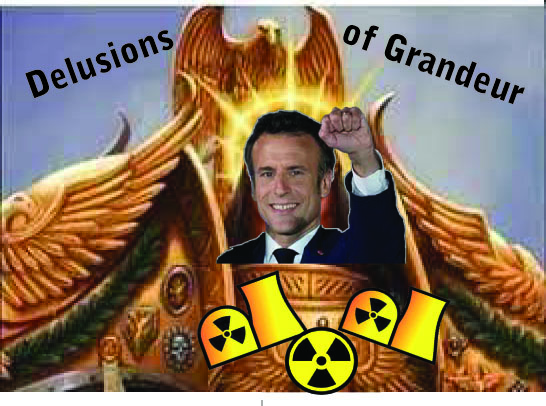
France outstrips plans, to build additional nuclear plants beyond six
DAILY SABAH, BY AGENCE FRANCE-PRESSE – PARIS JAN 07, 2024
France is set to build eight new nuclear plants on top of six already announced, the energy minister has said, arguing more reactors are needed to hit carbon reduction targets.
A draft law set to be presented soon recognizes that “we will need nuclear power beyond the six first European Pressurized Reactors” (EPRs) announced by President Emmanuel Macron in early 2022, Agnes Pannier-Runacher told Sunday’s edition of the weekly newspaper Tribune Dimanche.
The bill will include a further eight plants that had until now been discussed as an “option” by the government, Pannier-Runacher said.
By contrast, the text would not include any targets for renewable energy generation by 2030, remaining “technologically neutral,” she added………………………………………………..
Pannier-Runacher suggested that the construction of even more than 14 nuclear reactors could be raised in talks with lawmakers once the energy bill reaches Parliament.
State energy firm EDF’s next-generation EPR has had a rocky start.
Three are online, one in Finland and two in China, after suffering massive construction delays and cost overruns that have also beset projects in Britain and France.
The first EPR in France, at Flamanville in Normandy, is set to come online for testing in mid-2024, EDF said last month – 17 years after construction started and at a cost of 12.7 billion euros ($13.9 billion), around four times the initial budget of 3.3 billion. more https://www.dailysabah.com/business/energy/france-outstrips-plans-to-build-additional-nuclear-plants-beyond-six
Another Voice: Nuclear (yet again)

By CRISPIN B. HOLLINSHEAD, January 7, 2024, https://www.ukiahdailyjournal.com/2024/01/07/another-voice-nuclear-yet-again/
At COP28, the latest United Nations Climate gathering, nuclear power received more attention. Saudi Arabia committed to developing nuclear electrical generation. China is constructing 21 large nuclear reactors. Some people believe a massive nuclear build out will avert the climate crisis. The 436 reactors now operating produce about 10 percent of the global electricity. It would take 10,000 additional reactors to completely decarbonize the global economy.
It is true that an operating reactor produces no greenhouse gases (GHG), but when the whole life cycle of a reactor is analyzed, including construction and fuel enrichment, a standard 1,000MW reactor releases GHG comparable to a natural gas power plant. Even that evaluation is incomplete, as it excludes complete decommissioning of a large nuclear plant (never been done), and long-term storage of high level nuclear waste (not yet done even after 70 years).
Nuclear corporations were blackmailed into business. After the atomic destruction in Japan, the US government wanted a happy face for the atom, so Atoms For Peace promoted “power too cheap to meter.” The electrical industry was told to develop nuclear power, or the government would do it, putting them out of business. This was a bluff, but nobody knew it then.
Economically, nuclear power is a bust. Reactors are large, expensive, and centralized, making construction more an art than manufacturing. Costs consistently comes in over budget and behind schedule, making nuclear power more expensive than solar or wind, even including storage. Even operating an existing nuclear reactor is more costly than building renewable projects. While solar, wind, and battery costs are dropping every year, nuclear costs keep increasing. Small modular reactors (SMR), heralded as the salvation of the nuclear industry, suffer the same cost problems, plus a lack of customers. The only SMR project in the US was just canceled due to cost overruns.
Uranium is a finite commodity, and used inefficiently. A reactor core contains tons of highly processed enriched uranium. After a few years, when only 5 percent of the uranium has been consumed, the core must be replaced. When fission byproducts build up, performance degrades to the point of economic inefficacy. Millions of tons of highly radioactive “spent” fuel are stored at reactor sites. The best uranium deposits have already been developed, leaving only poorer quality ore. Most low level enriched uranium comes from Russia.
But the real economic costs come when a reactor breaks. Designed to last for 40 years, decisions were made in the beginning with incomplete information, with multiple units built on those designs in order to make nuclear construction seem profitable. So far, the worst US designed reactor failures were the 40 year old units at Fukushima, in 2011. Complete cleanup cost estimates are over $1T. Actual repairs have yet to begin, because radioactivity is too high for even robots to function for very long, let alone humans.
The only reactors still operating in California are the 40 year old pair at Diablo Canyon, near San Luis Obispo. Heavy radioactivity embrittles metal, making it more prone to shock failure. Several earthquake faults have been identified near the site, including one right through the plant. PG&E has done embrittlement tests, but refuses to release the results to the public, claiming “proprietary rights”. The Diablo Canyon reactors were recently granted a 5-year extension, with no changes required to the existing, aging equipment.
A reactor failure due to a seismic event could affect a large area of central California, from LA to San Francisco and inland to Nevada, depending on which way the wind blows. But PG&E would not be liable for any damages beyond $13B, due to the Price Anderson Act, a sweet heart deal the US made when the nuclear industry began. Every liability insurance policy written has an exclusion for nuclear damages. This all helps the nuclear industry seem profitable.
Nuclear power highlights a fundamental capitalist problem: the conflict between safety and profits. Each reactor is so powerful, that any accident can become catastrophic faster than humans can react. It is so expensive, that the incentive is enormous to cut costs to be more profitable. Add in limited corporate financial liability, and you get a recipe for disaster.
Fukushima shows the “small probability, high impact” nature of a failed nuclear reactor. The economics of even a properly operating reactor fail basic capitalist reasoning. To leave a habitable planet for our descendants, we have to do better.
Crispin B. Hollinshead lives in Ukiah. This and previous articles can be found at cbhollinshead.blogspot.com.
Carlsbad depositary- 79% of waste came from nuclear wastes from Idaho National Laboratory
Hundreds of shipments of nuclear waste were buried at a facility near
Carlsbad in 2024, and the federal government was poised to send even more
waste to the site in 2024. For that work, the Department of Energy’s
contractor Salado Isolation Mining Contractors (SIMCO) earned about $11.5
million or about 89% of its available $13 million fee between Feb. 4, 2023
when SIMCO took over the contract and the end of the last federal fiscal
year on Sept. 30, 2023.
DOE records show 479 shipments of transuranic (TRU)
nuclear waste were received at the Waste Isolation Pilot Plant between Jan.
1 and Dec. 31, 2023, from federal labs and other nuclear facilities around
the U.S. TRU waste is made of clothing materials, equipment and other
debris irradiated during nuclear activities, and it is buried in a salt
deposit at WIPP about 2,000 feet underground. The DOE said in 2023 it
worked to increase shipments to 17 per week, and hold that level in the
coming years. Most of the waste, about 79%, came from Idaho National
Laboratory in the form of 377 waste shipments.
Carlsbad Current-Argus 7th Jan 2024
It’s time to invoke the Geneva Convention

World Beyond War, 8 January 24
Urge Governments to Invoke the Genocide Convention to Stop the War on Gaza
South Africa has heeded this call. Let’s ask other countries to join!
Several countries’ governments have accused the Israeli government of genocide and asked the International Criminal Court to prosecute Israeli officials, but that court effectively answers to the U.S. government and has refused for years to prosecute crimes by Israel or anyone else outside of Africa.
But the International Court of Justice has ruled against Israel in the past, and if any party to the Genocide Convention invokes it, the court will be obliged to rule on the matter.
If the ICJ determines that genocide is happening, then the ICC will not need to make that determination but only consider who is responsible.
This has been done before. Bosnia and Herzegovina invoked the Genocide Convention against Serbia, and the ICJ ruled against Serbia.
The crime of genocide is happening. The intentional destruction of a people, in whole or in part, is genocide. The law is meant to be used to prevent it, not just review it after the fact.
more https://worldbeyondwar.org/gaza-genocide/
 |
Amid Fears of Wider War, US Reportedly Drafting Plans to Bomb Yemen
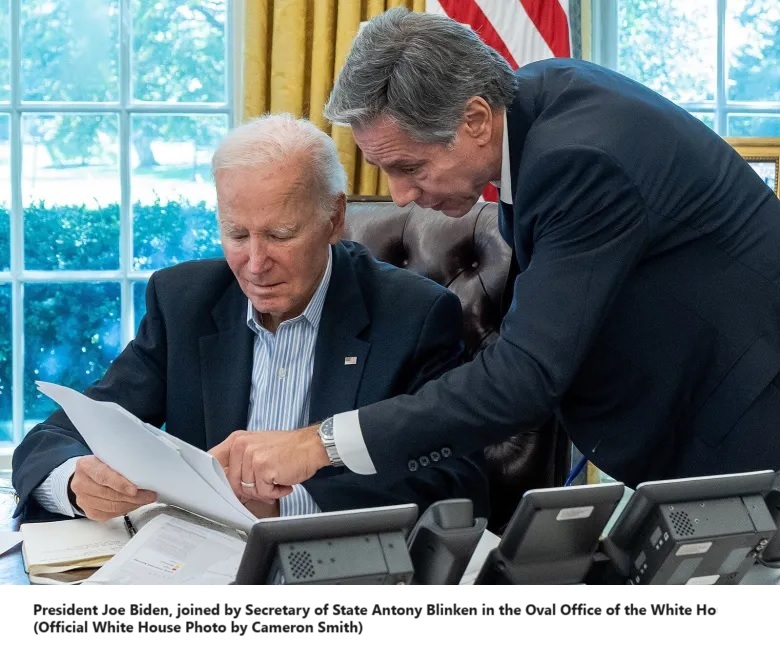
“Biden’s support for Israel’s Gaza war ties the U.S. to Israel’s escalatory cycle that may result in American soldiers dying in yet another Middle East war,” warned one analyst.
By Jake Johnson / Common Dreams, https://scheerpost.com/2024/01/05/amid-fears-of-wider-war-us-reportedly-drafting-plans-to-bomb-yemen/
The Biden administration is reportedly drafting plans to bomb Houthi targets in Yemen amid escalating fears of a wider war in the Middle East, where the U.S. is inflaming regional tensions by heavily arming Israel’s assault on the Gaza Strip.
Politicoreported Thursday that U.S. officials are “increasingly concerned” that Israel’s devastating war on Gaza “could expand… to a wider, protracted regional conflict.” Citing unnamed U.S. officials, the outlet noted that the U.S. military is drawing up plans to “hit back at Iran-backed Houthi militants who have been attacking commercial shipping in the Red Sea.”
Usamah Andrabi, communications director for Justice Democrats, wrotein response to the new reporting that U.S. President Joe Biden is “pushing the United States to the brink of a new endless war in the Middle East, all because he doesn’t want to stop funding Benjamin Netanyahu’s attempted eradication of the Palestinian people and Palestine itself.”
Eli Clifton, a senior adviser to the Quincy Institute for Responsible Statecraft, similarly argued that “Biden’s support for Israel’s Gaza war ties the U.S. to Israel’s escalatory cycle that may result in American soldiers dying in yet another Middle East war.”
“Biden has leverage to call for a cease-fire in Gaza,” Clifton added. “He isn’t using it.”
“The most effective way of avoiding this escalation is not to bomb the Houthis but to secure a cease-fire in Gaza.”
News of the administration’s private planning comes after dozens of advocacy organizations implored Biden not to consider any military assault on Yemen, which has been ravaged by years of Saudi-led, U.S.-backed bombing.
It also comes after several recent U.S. and Israeli attacks in the Middle East intensified concerns that the region is perilously close to all-out war.
On Tuesday, an Israeli drone strike in the Lebanese capital of Beirut killed a senior Hamas official, prompting Hezbollah’s leader to vow a “response and punishment.” Days earlier, an Israeli airstrike in Syria killed a senior adviser in Iran’s Islamic Revolutionary Guard Corps.
The U.S., for its part, has bombed Syria and Iraq multiple times over the past several months in response to drone and missile attacks on American forces stationed in the region. A U.S. airstrike in central Baghdad on Thursday killed Mushtaq Jawad Kazim al-Jawari, the leader of an Iran-aligned militia group operating in Iraq and Syria.
Biden administration officials have said publicly that they don’t want the Gaza war to expand, but their continued military support for Israel’s mass atrocities in Gaza and opposition to diplomatic efforts to stop the bloodshed in the Palestinian enclave has cast serious doubt on their commitment to preventing a full-blown conflict.
“The most effective way of avoiding this escalation is not to bomb the Houthis but to secure a cease-fire in Gaza,” Trita Parsi, executive vice president of the Quincy Institute for Responsible Statecraft, wrote in response to Politico‘s reporting.
“But Biden won’t even consider that—instead, he is ‘getting ready’ for a regional war,” Parsi added. “This is a dereliction of his duty to keep Americans safe.”
Antony Blinken Is A Cold-Blooded Sociopath

CAITLIN JOHNSTONE, JAN 8, 2024
US Secretary of State Antony Blinken just referred to the US-sponsored assassination of yet another journalist in Gaza as a “terrible tragedy”…………………………………………………..
Blinken went on to acknowledge the scores of journalists who have been killed in Gaza, saying that this shows the need to get humanitarian aid into the enclave and achieve a lasting peace. What Blinken did not do is issue anything resembling a condemnation of Israel and the clear and demonstrable fact that it has been highly focused on the task of murdering journalists in Gaza. He just offered his deepest condolences for Dahdouh’s death, framed it as a passive “tragedy” instead of an active assassination using highly sophisticated military technology under the sponsorship and support of the United States, and moved on.
It’s hard to say who’s worse, the far-right Israelis who openly revel in the butchery they are inflicting in Gaza, or the liberal Americans who directly sponsor that butchery and then look you dead in the eye and tell you how deeply, sincerely sorry they are to hear that another person in Gaza has died in a tragic accident.
Blinken is always doing sociopathic stuff like this. Late last month he tweeted, “This has been an extraordinarily dangerous year for press around the world. Many killed, many more wounded, hundreds detained, attacked, threatened, injured — simply for doing their jobs. I am profoundly grateful to the press for getting accurate, timely information to people.”
I mean, can you believe the gall of this freak? As though his own administration wasn’t responsible for most of those killings. As though Israel has not spent the last three months directing wildly disproportionate firepower at the places it knows journalists are hiding.
He’s standing there on top of a pile of corpses while mournfully shaking his head about their tragic unfortunate deaths.
There’s something about the job of US secretary of state that appears to require a significant level of sociopathy. From war criminal Henry Kissinger to Madeleine “We think the price was worth it” Albright to Mike “We lied, we cheated, we stole” Pompeo, the absolute worst person in any given presidential administration is very often the head of the State Department. A severe personality disorder is practically in the job description.
This is because while the secretary of state is officially the head of US diplomacy, “diplomacy” for the US empire looks a whole lot different from what it looks like for normal countries. US “diplomacy”, in practice, typically looks like going from country to country negotiating for international alignment behind wars, starvation sanctions, proxy conflicts and western-backed uprisings. In theory the State Department should be the department of peace, but in practice it’s just a subtler, sneakier military department.
Nothing epitomizes the depraved manipulations of the US empire better than Antony Blinken. There is no better representation of that empire than Tony standing there on his mountain of corpses, covered in blood, telling you how sorry he is to learn of the unfortunate accidental deaths of the people he just murdered, staring at you with his cold dead eyes, playing remarkably soulless blues guitar under the light of a bright red moon. https://www.caitlinjohnst.one/p/tony-blinken-is-a-cold-blooded-sociopath?utm_source=post-email-title&publication_id=82124&post_id=140464817&utm_campaign=email-post-title&isFreemail=true&r=1ise1&utm_medium=email
| |||
| |||
Challenging questions concerning UK’s Geological Disposal Facility (GDF)Test of Public Support.

Nuclear Waste Services (NWS), the division of the taxpayer-funded Nuclear
Decommissioning Authority, charged with identifying a location for a
Geological Disposal Facility (GDF) into which Britain’s legacy and future
high-level radioactive waste will be deposited, has stated that the two
criteria that will determine the location are – the availability of
sufficient ‘suitable’ geology and the consent of a ‘willing
community’.
Three ‘Search Areas’ are known to be under consideration
for the GDF – Theddlethorpe on the East Lincolnshire coast and Mid and
South Copeland on the West coast of Cumbria.
According to the government
and industry guidance that governs the conduct of this investigation,
whether such consent exists will ultimately be determined by a Test of
Public Support amongst the members of the Potential Host Community (PHC).
The timing of the test is down to the Relevant Principal Local Authorities
(RPLAs) – Cumberland Council in Cumbria and Lincolnshire County Council
and East Lindsey District Council in Lincolnshire, but its nature and the
participants in it are determined by the Community Partnerships that have
been established supposedly to provide stakeholder oversight to the
process.
Whether the test is then carried out by the RPLAs, NWS staff or
both is not specified, but if the result is negative, NWS are required to
withdraw the area from further consideration.
NFLA 2nd Jan 2024
UK’s Nuclear Waste Service (NWS) to grant £millions to the 3 Community Partnerships, to seek a site for nuclear waste dump.

In Phase 1, Community Investment Funding of up to £1 million per annum is
made available by Nuclear Waste Services (NWS) to each of the three
Community Partnerships currently engaged in the siting process for a
Geological Disposal Facility (GDF).
Where a Community Partnership / Search
Area is taken forward into Phase 2, involving the commencement of borehole
investigations, this sum will increase to £2.5 million per annum.
A decision on which two Search Areas will be taken forward is anticipated in
2026. The grants can be used to fund projects, schemes or initiatives
benefiting the community of each Search Area that: provide economic
opportunities, enhance the natural and built environment, or improve
community wellbeing. Each Community Partnership can also agree its own
criteria for awards based on local circumstances.
A Freedom of Information
request was submitted to NWS with a short question set which was identical
for each of the Community Partnerships. The responses received from NWS
follow.
NFLA 5th Jan 2024
BBC Panorama to feature RAF Lakenheath nuclear weapons saga- BBC Two on Thursday, January 18
A new BBC Panorama documentary is set to look into the ongoing saga around
nuclear weapons potentially being stored at RAF Lakenheath. Fears have been
mounting that the north Suffolk airbase is set to host nuclear weapons for
the first time in 16 years. The first US nuclear bombs arrived on British
soil in September 1954, and several sources confirmed the withdrawal of the
weapons from Lakenheath in 2008. Panorama’s senior foreign affairs
correspondent Jane Corbin will speak to campaigners in Suffolk in the
documentary that is set to air on BBC Two on Thursday, January 18.
East Anglian Daily Times 6th Jan 2024
https://www.eadt.co.uk/news/24031890.bbc-panorama-feature-raf-lakenheath-nuclear-weapons-saga/
Hinkley Point C proposes new wetland reserve to protect fish from cooling system

Pippa Neill, https://www.endsreport.com/article/1856616/hinkley-point-c-proposes-new-wetland-reserve-protect-fish-cooling-system. 05 Jan 2024
The developers of the Hinkley Point C nuclear power station are asking the public for views on plans to create more than 320 hectares of saltmarsh habitat on the river Parrett in Somerset, which it says will act as a natural alternative to installing an acoustic fish deterrent.
Under a previous proposal, French energy firm EDF Energy was planning to install an acoustic fish deterrent (AFD) system to keep some fish species away from the power station’s cooling water system.
This system would have used 280 speakers to make noise louder than a jumbo jet, 24 hours a day for 60 years. However EDF said there were “significant issues” associated with the installation, namely that installing and maintaining the sound projectors underwater would present risks to divers and offshore works.
In August last year, the Environment Agency approved an amendment to the permit allowing the firm to remove this AFD system from the plans.
Campaigners have warned that the removal of the AFD could “decimate” fish stocks. A report published in 2021 by the Hinkley Point C stakeholder reference group, an expert panel which advises the Welsh government on the development of the new power station, estimated that without AFDs, 182 million fish would be caught by the system annually, “and it is likely that many of these will not survive”.
The firm has said that the proposed saltmarsh will help wildlife and the environment around the Severn estuary by providing breeding grounds for fish and providing food and shelter for birds and animals. The plans are being developed with Natural England, Natural Resources Wales and the Environment Agency.
It also said that Hinkley Point C is “still the first power station in the area to have any fish protection measures in place – including a fish recovery and return system and low velocity water intakes. Power stations have been taking cooling water from the Bristol Channel for decades with no significant impact on fish populations”.
In March, the Environment Agency issued three new permits linked to the Sizewell C nuclear plant in Suffolk, despite concerns that the approved cooling system and lack of fish deterrent device could result in “thousands of fish dying every day”.
Chris Fayers, head of environment at Hinkley Point C, said: “The new wetland would be a fantastic place for wildlife and a beautiful place to visit. Using natural and proven ways to improve the environment is better than creating 60 years of noise pollution with a system that is untested far offshore in the fast-flowing waters of the Severn.
“Hinkley Point C is one of Britain’s biggest acts in the fight against climate change and its operation will provide significant benefits for the environment”.
The proposals for habitat creation and other changes to Hinkley Point C’s design, such as alterations to the way the power station will store spent fuel, will be included in a public consultation launching on 9 January.
All CNN Gaza Coverage Seen by Bureau Monitored by Israeli Defense Force Before Publication
The word “genocide” is “taboo” in the outlet’s newsroom, one staffer said.
SCHEERPOST, By Sharon Zhang / Truthout, 6 Jan 24
CNN has for years maintained a policy of running all of its coverage on Israel and Palestine, including its recent Gaza coverage, past its bureau in Jerusalem, where it is subject to the censorship policies set by Israel’s military, damning new reporting by The Intercept has revealed.
The Jerusalem CNN staff who review the reporting do so under the watchful eye of the Israel Defense Forces (IDF), which, as The Intercept has previously reported, is maintaining strict media bans around the genocide in Gaza, including censorship of topics and stories that may be embarrassing to the IDF. All reporters in Israel must sign an agreement to abide by such rules set by the IDF, and Israel has reportedly censored thousands of news stories since the beginning of the current massacre in Gaza.
In practice, this means that coverage of Israel and Palestine have a strong pro-Israel bias, as one anonymous staff member explained to The Intercept………………………………………..
Further, the investigation found that CNN leaders have explicitly prescribed policies that favor Israel.
In an email sent October 26, CNN’s News Standards and Practices sent staff an email directing them to refer to the ministry of health in Gaza as “Hamas-controlled” every time they reference the Palestinian death count — a widespread practice among major outlets, despite numerous human rights groups and war experts maintaining that the Gaza health ministry’s death tolls have historically been accurate and that public health experts have independently found no evidence that the ministry has inflated death counts.
“If the underlying statistics have been derived from the ministry of Health in Gaza, we should note that fact and that this part of the Ministry is ‘Hamas-controlled’ even if the statistics are released by the West Bank part of the ministry or elsewhere,” the memo said.
Then, on November 2, CNN’s Senior Director of News Standards and Practices, David Lindsey, sent another note to staff explicitly saying that statements from Hamas leaders should not be given a platform unless highly contextualized, and that as a rule, Hamas “representatives are engaging in inflammatory rhetoric and propaganda.”…………………………………………………..
The report lends evidence to what advocates for Palestinian rights have long maintained: that major U.S. and many other western outlets have a strong anti-Palestinian bias. This has become especially potent amid the current genocide, as CNN and other major outlets have come under scrutiny for embedding themselveswith the IDF to report on Gaza, meaning that they are escorted and observed by Israeli military forces and must submit coverage to the IDF before publication, all while supposedly reporting with an “objective” lens. https://scheerpost.com/2024/01/06/all-cnn-gaza-coverage-seen-by-bureau-monitored-by-idf-before-publication/
1 This Month


Tell the Ukrainian Government to Drop Prosecution of Peace Activist Yurii Sheliazhenko

Petition to revoke the licensing of the Near Surface Nuclear Disposal Facility (NSDF) at Chalk River. https://www.ourcommons.ca/petitions/en/Petition/Details?Petition=e-7247


of the week – STOP SMALL MODULAR REACTORS IN CANADA
To see nuclear-related stories in greater depth and intensity – go to https://nuclearinformation.wordpress.com
-
Archives
- March 2026 (193)
- February 2026 (268)
- January 2026 (308)
- December 2025 (358)
- November 2025 (359)
- October 2025 (376)
- September 2025 (258)
- August 2025 (319)
- July 2025 (230)
- June 2025 (348)
- May 2025 (261)
- April 2025 (305)
-
Categories
- 1
- 1 NUCLEAR ISSUES
- business and costs
- climate change
- culture and arts
- ENERGY
- environment
- health
- history
- indigenous issues
- Legal
- marketing of nuclear
- media
- opposition to nuclear
- PERSONAL STORIES
- politics
- politics international
- Religion and ethics
- safety
- secrets,lies and civil liberties
- spinbuster
- technology
- Uranium
- wastes
- weapons and war
- Women
- 2 WORLD
- ACTION
- AFRICA
- Atrocities
- AUSTRALIA
- Christina's notes
- Christina's themes
- culture and arts
- Events
- Fuk 2022
- Fuk 2023
- Fukushima 2017
- Fukushima 2018
- fukushima 2019
- Fukushima 2020
- Fukushima 2021
- general
- global warming
- Humour (God we need it)
- Nuclear
- RARE EARTHS
- Reference
- resources – print
- Resources -audiovicual
- Weekly Newsletter
- World
- World Nuclear
- YouTube
-
RSS
Entries RSS
Comments RSS
 nuclear-news