How France left the British taxpayer on the hook as Hinkley costs go nuclear
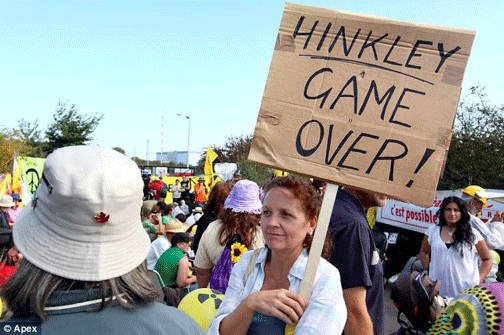
the Government will have to
put more taxpayer cash in and guarantee the debt.
Sizewell C was also likely to be put on ice unless British ministers came up with a big extra dollop of taxpayers’ money.
A series of cost overruns and delays are undermining the UK’s nuclear power revival
Jonathan Leake, 28 January 2024
For the future of Britain’s energy security it was a crucial decision,
and one that lay in the hands of France’s biggest power supplier.
However, not a single minister or civil servant was present when the
directors of EDF decided the fate of the UK’s two biggest nuclear
projects in their Paris boardroom on Tuesday. The finances of Hinkley Point
C and Sizewell C, the nuclear power stations which might one day supply
14pc of Britain’s electricity were top of the agenda. Shortly after the
meeting ended, Luc Remont, EDF’s managing director, and his colleagues
summoned their media managers to organise a briefing for analysts and
journalists.
Hinkley Point C, they were told, stood no chance of firing up
in 2027, as once promised. Its first reactor would come online around 2031
while the second has no date promised at all. Costs have surged again to
£46bn, a far cry from the £9bn EDF suggested when pushing the idea to
politicians around 2007 or the £24bn proposed when contracts were signed
in 2016.
Sizewell C was also likely to be put on ice unless British
ministers came up with a big extra dollop of taxpayers’ money.
Meanwhile, as EDF’s directors and French civil servants decided Britain’s nuclear
future in Paris, Andrew Bowie, the minister responsible for new nuclear
projects, was on his feet in parliament, talking up the UK’s prospects.
For Claire Coutinho, the Energy Secretary, the news was infuriating. Not
only had a decision vital to the UK been taken in Paris but it came just
days after she unveiled the Government’s long-awaited Nuclear Roadmap. A
statement rushed out that evening made clear that Coutinho blamed the
French for Hinkley’s extra costs and delays. “Hinkley Point C is not a
government project and so any additional costs or schedule overruns are the
responsibility of EDF and its partners and will in no way fall on
taxpayers,” a spokesman for her department said.
The comments irritated the French enough to hold a second round of media briefings, this time involving EDF’s owners, the French government. The UK, it was made clear,
would have to offer up billions of pounds more in taxpayers’ money if
Sizewell C was ever to be built. Coutinho subsequently pledged an extra
£1.8bn of taxpayers’ money for the project.
Meanwhile, EDF has refused
to up its stake from 20pc and Bowie has admitted he now needs to raise
£20bn of private finance, most likely meaning the Government will have to
put more taxpayer cash in and guarantee the debt.
Simon Taylor, professor of finance at Cambridge University, who specialises in the economics of nuclear energy, believes EDF’s reactor designs have some fundamental
flaws. “The EPR or European Pressurised Reactor were designed to be
incredibly safe, and to reassure people, after the Chernobyl disaster of
1986 but have turned out to be just much more difficult to build than
anyone had expected,” he says.
Amid a blame game between France and the
UK, the biggest loser remains the British taxpayer. They now face several
more years of reduced energy security and the prospect of power bills hikes
to raise the £20bn-plus bill for Sizewell C.
Telegraph 28th Jan 2024
https://www.telegraph.co.uk/business/2024/01/28/edf-hinkley-point-c-costs-go-nuclear-uk-taxpayer/
Ontario to announce refurbishment of four reactors at Pickering Plant
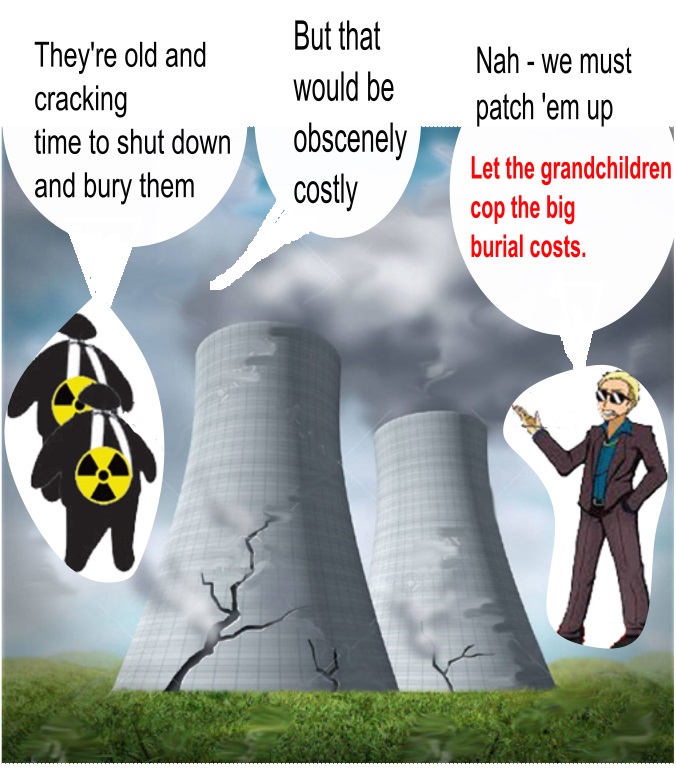
MATTHEW MCCLEARN, JEFF GRAY, QUEEN’S PARK REPORTER, TORONTO, 30 Jan 24, https://www-theglobeandmail-com.cdn.ampproject.org/c/s/www.theglobeandmail.com/amp/canada/article-ontario-pickering-nuclear-reactor/
Ontario is proceeding with a massive, multibillion-dollar refurbishment of four aging nuclear reactors at its Pickering power plant east of Toronto, according to two provincial government sources.
The decision will be formally unveiled by Ontario Energy Minister Todd Smith at the facility in Pickering on Tuesday, a senior government source said. This would mark the government’s latest major move to preserve and expand the province’s reactor fleet.
Another government official said the province has approved a $2-billion budget for Ontario Power Generation, the plant’s owner, to complete the necessary engineering and design work and order crucial components, which can require years to manufacture. The Globe and Mail is not naming the sources, because they were not authorized to speak publicly about the decision.
No full cost estimate for the project has been revealed. Refurbishments under way at OPG’s Darlington nuclear plant in Clarington, and at Bruce Power’s station in Tiverton, have cost between $2-billion and more than $3-billion a reactor.
Mr. Smith’s announcement had been expected. In 2022, the province asked OPG to study the feasibility of refurbishing the four Pickering “B” units, which entered service in the mid-1980s and had previously been passed over for refurbishment 15 years ago. Mr. Smith received OPG’s report last summer, but his ministry rebuffed a request from this newspaper to release it underthe province’s freedom of information legislation.
The Pickering station, situated on the shore of Lake Ontario about 30 kilometres from downtown Toronto, generates about 15 per cent of Ontario’s power. It also includes the four 1970s-era Pickering “A” reactors, which are not currently being considered for refurbishment. Two have been dormant for decades after an aborted refurbishment, and the remaining two are scheduled to shut down permanently this year.
OPG’s current licence for Pickering B allows its reactors to operate only to the end of this year. OPG has applied to the Canadian Nuclear Safety Commission, which regulates the industry, for permission to operate them until late 2026. CNSC approval would also be required for a refurbishment.
Refurbishment involves replacing major components to extend reactors’ operating lives by 30 years, although the list of required upgrades varies from station to station. Subo Sinnathamby, OPG’s chief projects officer, told The Globe earlier this month that, if the project were approved, OPG would begin Pickering’s refurbishment in 2028, with the goal of returning its reactors to service by the mid-2030s. Previous refurbishments have unfolded over longer periods.
“It is a compressed timeline,” she acknowledged. But she added that this time OPG will benefit from the experience it and its contractors and suppliers gained during previous refurbishments.
RAF Lakenheath: Plans progress to bring US nuclear weapons to Suffolk – a risky target?

Matt Precey – BBC News, Suffolk, Tue, 30 January 2024
Matt Precey – BBC News, Suffolk
Tue, 30 January 2024 at 1:33 am AEDT·3-min read

Plans to deploy American nuclear weapons to an airbase in Suffolk have progressed, according to a US Department of Defence (DoD) notice.
A contract to build shelters to protect troops that would defend storage facilities at RAF Lakenheath has been awarded.
The document states the work was in preparation for the base’s “upcoming nuclear mission”.
The US Air Force (USAF) has yet to respond to a request for comment.
Matt Precey – BBC News, Suffolk
Tue, 30 January 2024 at 1:33 am AEDT·3-min read
Plans to deploy American nuclear weapons to an airbase in Suffolk have progressed, according to a US Department of Defence (DoD) notice.
A contract to build shelters to protect troops that would defend storage facilities at RAF Lakenheath has been awarded.
The document states the work was in preparation for the base’s “upcoming nuclear mission”.
The US Air Force (USAF) has yet to respond to a request for comment.
The Ministry of Defence said there was a longstanding agreement among NATO partners not to comment on the location of nuclear weapons.
In March 2023, a document from the US Office of the Under Secretary of Defense disclosed how $50m (£39m) had been earmarked to build a facility known as a “Surety Dormitory” at RAF Lakenheath.
This phrase is understood to refer to nuclear weapons storage……………………………………………………….
Thermonuclear bomb
This would be the first time in more than 15 years nuclear weapons have been deployed on British soil.
In 2008, the BBC reported the bombs had been removed from RAF Lakenheath, which houses 4,000 service personnel and more than 1,500 British and US civilians.
The base is currently home to the USAF’s 48th Fighter Wing, the only unit in Europe which operates both the F-15E Eagle and the F-35A Lighting II fighter aircraft.
Reports from the US indicate the newer F-35A had been flight tested to use the latest variant of the B61-12 thermonuclear bomb, which paved the way for the aircraft to begin carrying such weapons.
According to the defence publication Janes, B61-12 was capable of an explosive power (known as a yield) of up to 340 kilotons, or more than twenty times the power of the Hiroshima bomb.
The Campaign for Nuclear Disarmament’s general secretary, Kate Hudson, said: “These documents highlight plainly that an ‘upcoming nuclear mission’ will be stationed at RAF Lakenheath – confirming what we have strongly suspected since November 2022 – that US nuclear weapons are returning to Britain.”
“It’s shameful that both the US and UK governments continue to take the public for fools on this serious matter – refusing to give us crucial information about our security,” she added.
Ms Hudson claimed it escalated the dangers and had “made us a nuclear target.”
Documents unambiguously state ‘incoming nuclear mission’ to Britain
30 Jan 24 https://cnduk.org/documents-unambiguously-state-incoming-nuclear-mission-to-britain/
Recently reported documents add further evidence that the US is planning to deploy nuclear weapons to Britain, with CND forwarding its concerns to Suffolk Council.
The files describes “Stationary and Mobile Guard Shacks” which will be constructed at RAF Lakenheath for ballistic protection for the 48th Security Forces Squadron – who are attached to the 48th Fighter Wing based at Lakenheath. It notes that the shacks are needed for the “upcoming nuclear mission” of the 48th SFS.
The document dates from 29 September 2023, a month after it was reported that the US Air Force plans to build a 144-bed “surety dormitory” at Lakenheath. “Surety” is the term used by the US government and military to refer to the handling of nuclear weapons.
In November 2023, CND’s lawyers wrote to West Suffolk Council insisting that the planning rights used to build the dormitory are incorrect and that it needs to be subject to an environmental impact assessment. In light of the recent files we have again written to the Council, to draw attention to the fact that it “suggests unambiguously that nuclear weapons will be stationed at RAF Lakenheath.”
CND General Secretary Kate Hudson said:
“These documents highlight plainly that an ‘upcoming nuclear mission’ will be stationed at RAF Lakenheath – confirming what we have strongly suspected since April 2022 – that US nuclear weapons are returning to Britain. It’s shameful that both the US and UK governments continue to take the public for fools on this serious matter – refusing to give us crucial information about our security. This deployment has been in the works for some time, prior to Russia’s deployment of its own nuclear weapons to Belarus. So far from making us safer, this deployment has escalated the dangers, brought Russian nukes to Europe, and made us a nuclear target.”
Advanced nuclear power is costly and tech is still developing. Is a Pueblo plant realistic?
James Bartolo, Pueblo Chieftain, 29 Jan 24
While a committee of 11 local leaders championed advanced nuclear as the best replacement for the Comanche 3 coal plant earlier this month, others question the feasibility of nuclear in Pueblo…………….
Is advanced nuclear too expensive? Can it be built on time?
Xcel Energy is the primary owner of Comanche 3 through its subsidiary, Public Service Company of Colorado. On July 20, 2023, Xcel Energy leadership team members presented a hypothetical timeline to PIESAC for replacement of Comanche 3 with advanced nuclear.
Regulatory processes, licensing processes, construction and development of small modular nuclear reactor technology could push the start date of an advanced nuclear plant to 2037 or later, according to the timeline.
“Right now what is known of the solutions that we have, if you stack it up, we are much closer to 2040 before a solution like this would be serving our customers,” said Kathryn Valdez, carbon-free technology policy director at Xcel Energy, on July 20.
Matthew Gerhart, senior attorney of the Sierra Club Environmental Law Program, told the Chieftain that the lengthy timeline associated with advanced nuclear should rule it out as a potential replacement for Comanche 3.
Gerhart said advanced nuclear is ultimately a “distraction” from considering more feasible and cost-effective energy replacements.
“Not only have a handful of people settled on option, which is not even feasible to be built by 2031, but they’ve settled on the most expensive option by far.”
A draft study by the Colorado Energy Office models scenarios for reaching zero greenhouse gas emissions in the state’s electric power sector before 2040. A “cost-optimized” scenario for reaching zero emissions in the study did not select nuclear “due to high costs,” according to the study.
The scenario in the Colorado Energy Office’s draft study did, however, select several other fuel sources including batteries, biomass, clean hydrogen, demand response, geothermal, solar and wind.
“What they found was that you could reduce emissions and get really close to zero emissions in the utility sector without nuclear,” Gerhart said………………………………………………………………………………. https://www.chieftain.com/story/news/2024/01/29/is-advanced-nuclear-a-realistic-replacement-for-comanche-3-in-pueblo/72339785007/
USA’s Waste Isolation Pilot Plant to increase its space for nuclear trash
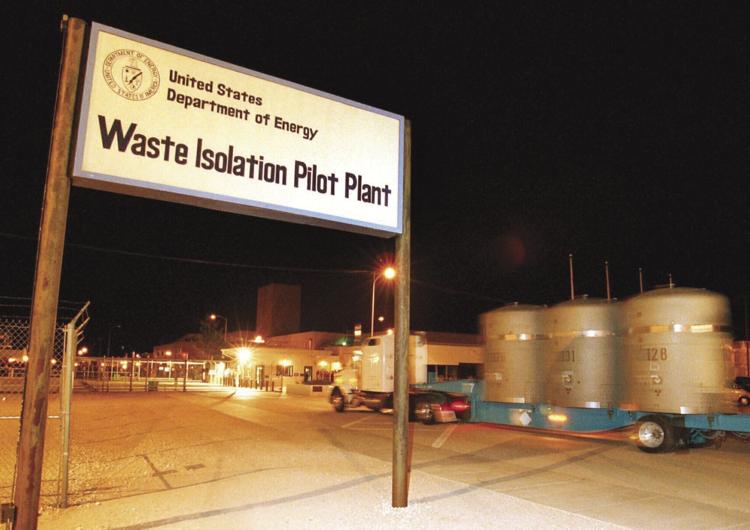
More space is coming to dispose of nuclear waste at a Carlsbad-area
facility where the materials from around the country are buried thousands
of feet underground. The Waste Isolation Pilot Plant was initially
permitted for eight disposal panels, where drums of transuranic (TRU)
nuclear waste is disposed of via burial in an underground salt deposit
about 2,000 feet beneath the surface.
But in 2014, a drum of waste ruptured
and left portions of WIPP’s underground contaminated and unusable for
further waste disposal. That’s why the U.S. Department of Energy sought
to mine two additional panels as it works toward WIPP’s volume of
capacity of 6.2 million cubic feet of waste.
Carlsbad Current Argus 28th Jan 2024
German energy companies reject nuclear energy proposals – citing high risks and toxic waste problem
Will nuclear energy make a comeback in Germany? Germany phased out nuclear
energy nearly a year ago. But even with the multi-billion euro problem of
how to store radioactive waste, some policians are calling for new nuclear
plants to be built.
The CDU and CSU have changed their position on nuclear
power again. Now many in the party are calling for new reactors to be
built. CDU leader Friedrich Merz has said that shutting down the last
reactors was a “black day for Germany.” The parties also say that old
reactors should be reconnected to the grid. Merz says that the country
should restart the last three power plants that were shut down — citing
climate protection, as well as rising oil and gas prices.
Those proposals have not found much enthusiasm among German energy companies. EnvironmentMinister Steffi Lemke is not surprised. “The energy companies made
adjustments a long time ago, and they still reject nuclear power in Germany
today. Nuclear power is a high-risk technology whose radioactive waste will
continue to be toxic for thousands of years, and will be an issue for many
generations.”
Deutsche Welle 28th Jan 2024
https://www.dw.com/en/will-nuclear-energy-make-a-comeback-in-germany/a-68098059
US reportedly planning to station nuclear weapons in Britain for first time in 15 years
THE UNITED STATES is reportedly planning to station nuclear warheads in Britain that are three times as powerful as 1945’s Hiroshima bomb.
Pentagon documents seen by the Telegraph indicate that the weapons could be stationed at RAF Lakenheath in Suffolk, where the US previously stored nuclear missiles until 2008.
The papers show procurement contracts for a new facility at the air base.
A Ministry of Defence spokesperson said: “It remains a longstanding UK and Nato policy to neither confirm nor deny the presence of nuclear weapons at a given location.”
The documents have surfaced amid concerns of an escalation between Nato countries and Russia as Vladimir Putin continues his war on Ukraine.
Last week, Nato announced its biggest drills since the cold war, involving deployment of 90,000 military personnel to central and eastern Europe.
EDF, France’s state-owned nuclear company now in a fatal trap, as Hinkley Point C costs soar
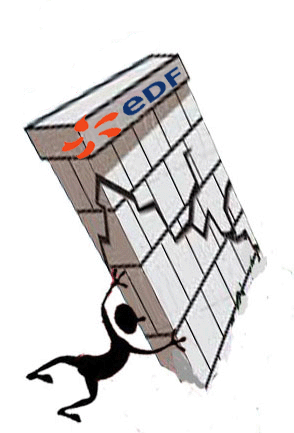
Hinkley Point: endless setbacks at nuclear plant highlight political choice to destroy EDF
On January 22nd, state-owned French utilities group
EDF announced new delays in the construction of two EPR nuclear reactors at
the British plant of Hinkley Point. Originally planned to enter service in
2024, the first of the two reactors is now expected to be, at best,
operational in 2029, or possibly “2030 or 2031”.
Seven years after the project was launched, all the warnings against EDF’s involvement in it
made by the group’s staff have proved be right, writes Mediapart
economics correspondent Martine Orange in this op-ed article.
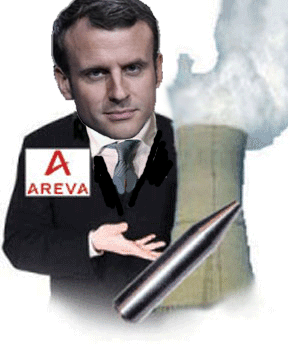
The state-owned group now finds itself in a fatal trap created by Emmanuel
Macron. Following the epic delays with the Olkiluoto nuclear power plant in
Finland, those of Flamanville in France, and those of Taishan in China, the
under-construction plant of Hinkley Point C in south-west England has now
joined the long story of an industrial catastrophe which is the third
generation EPR (pressurised water reactor) first designed by Areva, once
France’s nuclear energy giant.
Mediapart 28th Jan 2024
US Court Hears Case Alleging Biden Complicit in Israel’s Genocide in Gaza
“We are watching a genocide unfold in Gaza in real time and, despite the government’s view that a U.S. court can do nothing about it, CCR and our clients argue that it certainly can and it absolutely must!” said one advocate.
JULIA CONLEY. Jan 26, 2024, https://www.commondreams.org/news/us-complicity-genocide
Calling for an emergency injunction to stop the Biden administration from aiding Israel in its bombardment of Gaza, which has so far killed more than 26,000 people and pushed roughly 2 million more to the point of starvation, human rights organizations and Palestinians in the U.S. on Friday took federal leaders to court to stop U.S. “complicity in the Israeli government’s unfolding genocide.”
The U.S. District Court for the Northern District of California in Oakland held a hearing on the case, in which the Center for Constitutional Rights (CCR) is representing groups including Defense for Children International – Palestine (DCIP) and Al-Haq in suing President Joe Biden, Secretary of State Antony Blinken, and Secretary of Defense Lloyd Austin.
The groups, joined by individual plaintiffs whose families in Gaza have been subjected to Israel’s assault and decades of occupation, argue that the U.S. is violating domestic and international law and breaching the Genocide Convention, of which it is a a signatory.
The hearing was held hours after the International Court of Justice (ICJ) released its initial ruling in South Africa’s case accusing Israel of genocide in Gaza. The ICJ found that Israel must “take all measures within its power” to prevent genocide.
Laila El-Haddad, one of the plaintiffs in the U.S. case, said the group entered the courtroom “proud and hopeful” on the heels of the ICJ ruling.
The CCR reported that the court’s livestream was at capacity during the hearing, while outside the courtroom, supporters painted, “Biden complicit in genocide,” and, “No bombs to Israel” on the street.
“A recording of the hearing will be made available by the court in due course,” said CCR.
Dena Takruri of AJ+reported that in the “unprecedented” hearing, a doctor testifying remotely from Rafah, Gaza told the court that “cases of childbirth in the streets are widespread at this time.”
Along with relentless air and ground attacks by Israeli forces, Gazans have for nearly four months faced a near-total blockade on Gaza, with aid deliveries severely curtailed by Israel. Roughly 90% of Gaza residents are now frequently going without any meals for at least a full day.
South Africa’s case at the ICJ outlined numerous statements of genocidal intent by top Israeli officials.
Despite the mounting evidence of ethnic cleansing, the Biden administration has called South Africa’s accusations “meritless” and has continued to arm Israel without congressional approval.
“Our community mobilized to put Biden in power after [former President Donald Trump,” Basim Elkarra, executive director of the Council on American-Islamic Relations (CAIR) in the Sacramento Valley and another Palestinian American plaintiff, testified at the hearing. “It hurts. It hurts deeply.”
The plaintiffs planned to hold a post-hearing press conference.
“The takeaway from today’s court hearing,” said CCR executive director Vince Warren, “is that we are watching a genocide unfold in Gaza in real time and, despite the government’s view that a U.S. court can do nothing about it, CCR and our clients argue that it certainly can and it absolutely must!”
Nancy Pelosi’s attack on Gaza ceasefire advocates is a disgrace
Walt Zlotow, West Suburban Peace Coalition, Glen Ellyn IL 29 Jan 24
Every day of America’s descent into moral depravity supporting, enabling Israel’s genocide in Gaza brings new madness.
Yesterday, former House Speaker went on CNN to compare the tens of millions of us Americans demanding ceasefire in Gaza to apologists spreading “Putin’s message. Make no mistake, this is directly connected to what he would like to see.”
So far Pelosi was correct but not for the venal reason she intended. Putin would like to see ceasefire in Gaza for the same reason the entire world, save for Israeli and US leaders, including Biden and Pelosi do…end the ongoing genocide. Biden and Pelosi viciously oppose ceasefire to continue their lockstep support of the Israeli leadership determined to make Gaza uninhabitable for its 2,300,000 Palestinians.
Being a good soldier in Biden’s crazed foreign policy, which is also destroying Ukraine, Pelosi then pivoted to charge, “Same thing with Ukraine. It’s about Putin’s message” That’s what known in propaganda circles as a ‘twofer.’ Peace advocates seek to undermine benevolent US policy toward both Ukraine and Gaza, regardless those policies are destroying both.
Worst of all, Pelosi didn’t just stop at demonizing ceasefire advocates. She wants the FBI to investigate us. “Some of these protesters are sincere, but some, I think, are connected to Russia. I think some financing should be investigated. And I want to ask the FBI to investigate that.”
Good grief. As a spokesman in the peace community for ceasefire and end to US supported genocide, Pelosi’s got me pondering the next knock at my door. If it’s my local FBI dude, I’ll answer by asking…”Did Nancy send you?”
Are the French going cold on UK nuclear?

‘It would be madness to give Sizewell C the final go-ahead while the questions of whether Hinkley C can be finished, and who pays, are not resolved. Sizewell C is bound to take longer and cost more, but this time it would be we consumers who would bear the risk and pay the price through the “nuclear tax” on our energy bills.’.
The French government, which was previously relaxed about EDF’s forays into UK nuclear, now wants its energy company to work on projects back home in France.
So far, Britain has put £2.5billion into the project in total and taxpayers are the biggest shareholders. Campaigners who vehemently oppose the project are alarmed by the recent comments from Paris, pointing out that if the French back off from Sizewell, taxpayers could be on the hook for huge extra amounts of cash via their bills.
By FRANCESCA WASHTELL , 28 January 2024, https://www.thisismoney.co.uk/money/markets/article-13015713/Are-French-going-cold-UK-nuclear.html
Our nuclear industry is reawakening,’ energy secretary Claire Coutinho
declared in a Government strategy document published earlier this month. In
between invoking Winston Churchill’s enthusiasm for nuclear power and its
ability to help the UK reach net zero, Coutinho added that setting up new
plants would ensure our energy security ‘so we’re never dependent on the
likes of [Vladimir] Putin again’. Fighting talk. But in the space of a
fortnight, Coutinho’s gung-ho attitude has already been dented as a
diplomatic row brews over who should pay for the controversial power
stations.
French state-owned energy company EDF last week lit the blue
touchpaper with the revelation the UK’s flagship Hinkley Point C nuclear
plant in Somerset would be delayed until 2029 at the earliest. The cost, it
added, could spiral to as much as £46billion, from initial estimates of
£18billion.
Few in the industry will have been surprised, particularly as EDF has experienced delays on similar projects in Finland and France. But what was a shock were some incendiary remarks from the French government.
The Elysee Palace began pressing the UK to help plug a funding gap at Hinkley and for good measure cast doubt over its commitment to Sizewell C, the next nuclear power station in the pipeline.
A French Treasury official suggested the Government was trying to leave EDF in the lurch on Hinkley.
The official added that it cannot, at the same time, abandon the French firm to ‘figure it out alone’ on Hinkley and also expect it to plough money into Sizewell. It is, the official said, ‘a Franco- British matter,’ and not one for the French to resolve single-handedly.
This is a bad moment for two critical new nuclear plants – and our broader energy security – to be dragged into a cross-Channel tussle.
The French government, which was previously relaxed about EDF’s forays into UK nuclear, now wants its energy company to work on projects back home in France.
Well-placed UK sources deny the French claims that EDF has been left to shoulder the financing burden alone at Hinkley, or that it has been jettisoned by the British state.
They point to the fact EDF has all along had contractual obligations to shoulder the costs at this stage of the project. The early stages of developing Hinkley were undertaken by EDF along with China General Nuclear.
The Chinese firm has fulfilled its part of the bargain, leaving the onus on the French. ‘It’s all down to the French state,’ a senior industry source told The Mail on Sunday. ‘It’s tough, but they’ve not managed it at all well.’
A Department for Energy Security and Net Zero spokesman said: ‘The Government plays no part in the financing or operation of Hinkley Point C. The financing of the project is a matter for EDF and its shareholders.’
As well as backing Hinkley, EDF several years ago began serious talks with the Government over Sizewell C in Suffolk. Each could power an estimated 6 million homes for 60 years, meaning the two projects are linchpins for meeting future energy demand.
The French group is due to take a 20 per cent stake in Sizewell. The Government has previously indicated it will take 20 per cent. It was hoped the rest would be funded through money from the private sector, such as pension funds and sovereign wealth funds.
So far, Britain has put £2.5billion into the project in total and taxpayers are the biggest shareholders. Campaigners who vehemently oppose the project are alarmed by the recent comments from Paris, pointing out that if the French back off from Sizewell, taxpayers could be on the hook for huge extra amounts of cash via their bills.
The new type of funding structure for Sizewell C means consumers will already face an added tax to help pay for the plant.
Alison Downes of the Stop Sizewell C campaign group said: ‘It would be madness to give Sizewell C the final go-ahead while the questions of whether Hinkley C can be finished, and who pays, are not resolved. Sizewell C is bound to take longer and cost more, but this time it would be we consumers who would bear the risk and pay the price through the “nuclear tax” on our energy bills.’
And another area of the industry is watching the fracas with mounting frustration.
Companies vying to build ‘mini’ stations known as small modular reactors (SMRs) hope this prompts the Government to commit instead to their projects, which are quicker to build and cheaper [?]
The firms include Rolls-Royce SMR, which has already received significant funding from the Government. New nuclear plants of whatever size will almost certainly be part of the UK’s energy mix in the years to come.
The sector had already been championed by Boris Johnson before soaring oil and gas prices in the wake of Russia’s invasion of Ukraine highlighted Britain’s dependence on overseas energy.
Any fisticuffs with France over Hinkley and Sizewell would strain the sector and could fatally damage the level of public. Industry figures are urging ministers to resist stumping up cash the French had agreed to pay.
One senior source said: ‘I hope the Government doesn’t lose its nerve, though there’s no sign of that at the moment. It would be a terrible precedent.’
.
Hinkley Point C woes threaten to break UK and France’s nuclear fusion

Two former EDF executives told the Guardian the odds were stacked against Hinkley from the start. “I would have bet at the time that we would see the costs we have today. And I think they’ll climb higher too,” said one.
Cross-Channel dream is turning sour as EDF’s costs mount and Britain faces a long wait for the power to come on
Jillian Ambrose, 27 Jan 24, https://www.theguardian.com/uk-news/2024/jan/27/hinkley-point-c-woes-threaten-break-uk-france-nuclear-fusion
rench trade unions wield significant political clout. But in the summer of 2016 there was little they could do to stop the French government from investing in what would soon become the most expensive power station in the world.
All six trade union representatives on the board of Électricité de France (EDF) voted against a deal to build a nuclear power station in the UK. It was just weeks after its finance chief, Thomas Piquemal, resigned from the company over fears that Hinkley Point C in Somerset was too great a risk. The project was approved by 10 in favour and seven against.
In the last seven years these fears have proved well founded. EDF revealed this week the latest delay to Hinkley, which may not now open until 2031, well beyond its original decade-long schedule. Its costs have climbed to £35bn in 2015 prices, almost double the original forecast of £18bn in 2016. In today’s money Britain’s first new nuclear plant in 30 years could cost £46bn. The spiralling costs were blamed on inflation, Covid and Brexit.
Hinkley was meant to represent a nuclear renaissance on both sides of the Channel, and further the nuclear ambitions of China. It was an opportunity for EDF, once the world’s leading nuclear developer, to secure a future for its reactor designs in a low-carbon world.
For the UK, the first new nuclear power plant in a generation marked the start of the government’s campaign to replace its ageing fleet of reactors. And China saw it as a way to showcase its nuclear expertise, furthering its ultimate aim of building its homegrown HPR1000 nuclear reactors at Bradwell in Essex.
The deal was struck in 2016 just weeks after the Brexit vote, making Hinkley an opportunity to forge fresh ties between old friends – and create opportunities for new economic alliances too. China General Nuclear Power Group (CGN), a state-run energy company, agreed to take on a third of the project as the first step in a plan to roll out a string of nuclear plants in the UK built with its own reactor design.
The chancellor at the time, George Osborne, argued that Britain should “run towards China” to help boost the UK economy. Within months of the Hinkley deal the French president, Emmanuel Macron, and his Chinese counterpart, Xi Jinping, began talks on strengthening ties between the two nations. These led to trade deals worth about $15bn (£11.8bn) and an order from Beijing for 300 aircraft from Airbus worth tens of billions of euros.
But the rationale for all three nations now looks precarious. Hinkley’s costs have climbed as diplomatic relations between China and the west have soured. By the time the former UK prime minister Boris Johnson vowed to purge China’s Huawei from the UK’s telecoms network over security fears, the notion of Chinese-built nuclear reactors powering British homes had become politically unthinkable. CGN has ruled out any further investment in Hinkley – leaving French taxpayers to pick up the tab.
Two former EDF executives told the Guardian the odds were stacked against Hinkley from the start. “I would have bet at the time that we would see the costs we have today. And I think they’ll climb higher too,” said one.
Philippe Huet, a former head of EDF’s internal auditing in Paris, said the deal was based on political strategy rather than a commercial rationale. The British government offered EDF a contract that would guarantee payment of £92.50 for every megawatt hour of electricity generated by the nuclear plant. It was criticised for being both eye-wateringly expensive for UK bill payers but not nearly enough to cover the risks of constructing the project.
“At the time that it was agreed it was already known that EDF’s estimates understated the cost and schedule of the project. Key decision-makers chose to ignore this because it was too important strategically. As they would say, if a project cannot be profitable it must at least be strategic,” Huet said.
Hinkley is one of many costs facing the French taxpayer after the government renationalised EDF last year. The company’s future investments – in maintaining its existing fleet of nuclear reactors, building new ones, and investing in renewable energy – could exceed €20bn (£17bn) a year, according to Agnès Pannier-Runacher, the country’s energy transition minister.
The French government is reportedly calling on the UK government to provide financial help for both Hinkley and the next planned plant, Sizewell in Suffolk, to keep the struggling nuclear revival afloat. The UK government has been quick to quash any suggestion that Hinkley’s financial fallout will be borne by UK taxpayers. A spokesperson said the government “plays no part in the financing or operation of Hinkley Point C”, which was a matter for EDF and its shareholders.
Huet has predicted that EDF may even try to renegotiate its contract with the government. He estimates it could seek to raise how much it charges per megawatt hour of electricity produced by about 15% to make Hinkley a worthwhile venture.
Cost of UK’s flagship nuclear project blows out to more than $A92 billion
But it also has implications for Australia, because one its main political groupings, the right-wing Liberal and National Party coalition, has decided that Australia should abandon its current plan to dump coal for renewables and storage, and wait for nuclear instead.
Australia currently has a target of 82 per cent renewables by 2030, and AEMO’s latest Integrated System Plan suggests it could be close to 100 per cent renewables within half a decade after that.
Giles Parkinson, Jan 29, 2024, https://reneweconomy.com.au/cost-of-uks-flagship-nuclear-project-blows-out-to-more-than-a92-billion/
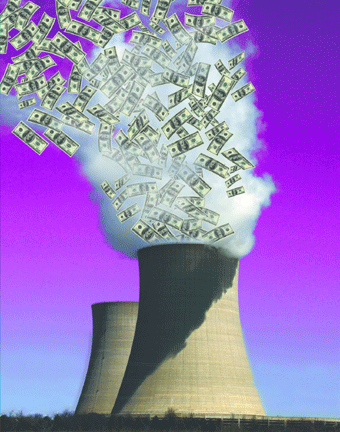
The cost of the flagship nuclear project in the United Kingdom has blown out again, this time to a potential $A92.6 billion as a result of yet more problems and delays at the Hinkley C project.
The latest cost blowout was revealed last week by the French-government owned EdF, whose former CEO had originally promised in 2007 that the Hinkley project would be “cooking Christmas turkeys” in England by 2017, at a cost of just £9 billion.
But like virtually every major nuclear project built in western economies, that ambitious deadline was never going to be met. The new start-up date is now for 2030, but more likely 2031 – and that is only for one of the two units.
The budget has leaped from the original promise of £9 billion, to £18 billion, and has since blown out multiple times to now reach £31 billion and £34 billion, and it could be more than £35 billion “in 2015 values,” according to EdF. This translates into current day prices, according to Michael Liebreich, the former head of Bloomberg New Energy Finance, of £48 billion, or $A92.6 billion.
“The cost of civil engineering and the longer duration of the electromechanical phase (and its impact on other work) are the two main reasons for this cost revision,” EdF said in its statement. It has also experienced massive cost over-runs and delays at other similar projects in Flammanville in Fance and Olkiluoto in Finland.
It is yet another crippling blow to the UK plans to make nuclear a centrepiece of its green energy transition. EdF has already had to be bailed out by its own government, and ultimately nationalised, because of the cost blowouts and the huge costs of buying replacement power when half its French nuclear fleet went offline in 2023.
China’s CGN had to be brought in to fund one third of the Hinckley project, but is refusing to contribute more funds because China has been frozen out of other UK projects.
Alison Downes of Stop Sizewell C, a campaign group opposed to the planned Suffolk nuclear plant, told the Financial Times that EDF and the Hinkley project was an “unmitigated disaster”.
She added the UK government should cancel Sizewell C, saying state funding for the project could be better spent on “renewables, energy efficiency or, in this election year, schools and hospitals”.
But it also has implications for Australia, because one its main political groupings, the right-wing Liberal and National Party coalition, has decided that Australia should abandon its current plan to dump coal for renewables and storage, and wait for nuclear instead.
The Coalition had been pushing so-called small modular reactors, but after the failure of the leading technology developer in the US last year, and confirmation by the CSIRO and the Australian Energy Market Operator that SMR costs would be three times more expensive than renewables, several key Coalition members pointed to large scale nuclear such as Hinckley.
Australia currently has a target of 82 per cent renewables by 2030, and AEMO’s latest Integrated System Plan suggests it could be close to 100 per cent renewables within half a decade after that.
This switch to low carbon electricity is critical for Australia’s emissions targets, and for emission cuts in other parts of the economy. Any delay in the roll-out of renewables, in the expectation that nuclear would fill its place, will push that timeline out by at least another decade, if not, and blow out the costs of the energy transition.
“It is not like cost over-runs in nuclear projects are a big secret,” Liebreich writes on his Sub-stack blog.
He cites the world’s leading academic expert on project management, Danish Professor Bent Flyvbjerg, author of How Big Things Get Done, who shows that nuclear plants are worse only than Olympic Games in terms of cost over-runs.
“On average they go 120% over the budget, with 58% of them going a whopping 204% over budget,” Liebreich writes.
The Coalition energy spokesman Ted O’Brien complained in December that the CSIRO/AEMO report focused only on the “investment” cost, and not the “consumer cost.”
It’s not clear what he means by that. But as Liebreich notes, while Hinkley’s construction costs are in the £42 to £48 billion range, its first 35 years of electricity at £87.50 or £92.50/MW in 2012 money, adjusted for inflation, will cost UK energy users a gargantuan £111 or £116 billion, or up to $A223 billion.
Hinkley Point C delay deals blow to UK energy strategy
“We have the expertise, the supply chains and the teams ready to build
Hinkley Point C safely, on time and on budget,” Vincent de Rivaz, then
chief executive of EDF, said in 2016 as the project to build the UK’s
first nuclear power station since the 1990s got under way.
That confidence has proven misplaced. Earlier this week, the French state-owned utility
announced the latest in a series of delays and cost overruns to the 3.2
gigawatt plant under construction in Somerset. The setback to a plant that
is meant to supply electricity to 6mn homes has raised fresh questions
about the UK’s energy strategy and its push to decarbonise the grid over
the next decade as part of its goal to reach net zero by 2050.
Analysts at LSEG estimated the latest delays to the plant would push wholesale power
prices up by as much as 6 per cent between 2029 and 2032, based on the
assumption that unit two would come online in 2033. EDF is looking at ways
to help mitigate the latest delay. Two weeks ago it said it was examining
plans to further extend the life of its four oldest plants, which use
advanced gas-cooled reactor technology and date back to the 1980s.
But
there is still some doubt about that plan. Jerry Haller, EDF’s former
decommissioning director, told a parliamentary committee inquiry in 2022
that nothing could be done to extend the life of the AGR fleet again. “No
further investment will take them further,” he said at the time. EDF said
since those comments further inspections of the reactor cores had “been
better than, or in line with, our expectations”. It had already decided
last year to keep two of the plants — Heysham 1 and Hartlepool — open
until at least 2026.
But even if more life can be eked out of existing
reactors, the problems besetting Hinkley Point C have raised wider
questions about how the UK will reach its 24GW nuclear build target by
2050.
FT 27th Jan 2024
https://www.ft.com/content/55ef86b4-f55c-47a9-8121-c6c8cf6b5b18
2
-
Archives
- February 2026 (211)
- January 2026 (308)
- December 2025 (358)
- November 2025 (359)
- October 2025 (376)
- September 2025 (258)
- August 2025 (319)
- July 2025 (230)
- June 2025 (348)
- May 2025 (261)
- April 2025 (305)
- March 2025 (319)
-
Categories
- 1
- 1 NUCLEAR ISSUES
- business and costs
- climate change
- culture and arts
- ENERGY
- environment
- health
- history
- indigenous issues
- Legal
- marketing of nuclear
- media
- opposition to nuclear
- PERSONAL STORIES
- politics
- politics international
- Religion and ethics
- safety
- secrets,lies and civil liberties
- spinbuster
- technology
- Uranium
- wastes
- weapons and war
- Women
- 2 WORLD
- ACTION
- AFRICA
- Atrocities
- AUSTRALIA
- Christina's notes
- Christina's themes
- culture and arts
- Events
- Fuk 2022
- Fuk 2023
- Fukushima 2017
- Fukushima 2018
- fukushima 2019
- Fukushima 2020
- Fukushima 2021
- general
- global warming
- Humour (God we need it)
- Nuclear
- RARE EARTHS
- Reference
- resources – print
- Resources -audiovicual
- Weekly Newsletter
- World
- World Nuclear
- YouTube
-
RSS
Entries RSS
Comments RSS
 nuclear-news