Christmas Eve Massacre in Gaza Refugee Camp
The Grayzone goes to the scene of one of the most heinous crimes Israel committed in the besieged Gaza Strip: the Christmas Eve massacre in Maghazi Refugee Camp, which left over 70 dead in a single airstrike. We speak to survivors of the attack and expose the scale of damage with exclusive drone footage.
The Long History Of Zionist Proposals To Ethnically Cleanse The Gaza Strip
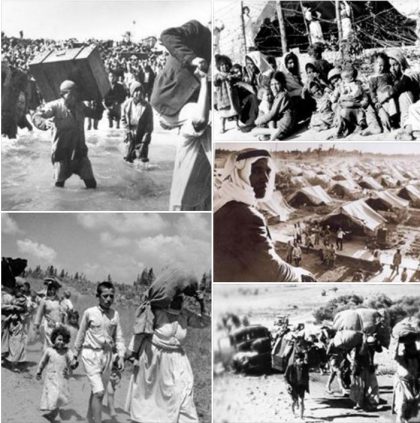
Ethnic cleansing or “transfer” is an intrinsic part of Zionism’s early history, and has remained an essential feature of Israeli political life. More recently, “transfer” has been mainstreamed by billing it as encouraging “voluntary emigration.”
SCHEERPOST, By Mouin Rabbani / Mondoweiss, December 29, 2023
Senior Israeli leaders, including Prime Minister Binyamin Netanyahu, are again publicly advocating the ethnic cleansing of the Gaza Strip. Their proposals are being presented as voluntary emigration schemes, in which Israel is merely playing the role of Good Samaritan, selflessly mediating with foreign governments to find new homes for destitute and desperate Palestinians. But it is ethnic cleansing all the same.

Alarm bells should have started ringing in early November when U.S. Secretary of State Antony Blinken and other Western politicians began insisting there could be “no forcible displacement of Palestinians from Gaza.” Rather than rejecting any mass removal of Palestinians, Blinken and colleagues objected only to optically challenging expulsions at gunpoint. The option of “voluntary” displacement by leaving residents of the Gaza Strip with no choice but departure was pointedly left open.

Ethnic cleansing, or “transfer” as it is known in Israeli parlance, has a long pedigree that goes back to the late-nineteenth-century beginnings of the Zionist movement. While the early Zionists adopted the slogan, “A Land Without a People for a People Without a Land,” the evidence demonstrates that, from the very outset, their leaders knew better. More to the point, they clearly understood that the Palestinians formed the main obstacle to the establishment of a Jewish state in Palestine. This is for the simple reason that, to them, a “Jewish state” denotes one in which its Jewish population acquires and maintains unchallenged demographic, territorial, and political supremacy.
Enter “transfer.” As early as 1895, Theodor Herzl, the founder of the contemporary Zionist movement, identified the necessity of removing the inhabitants of Palestine in the following terms: “We shall try to spirit the penniless population across the border by procuring employment for it in the transit countries, while denying it any employment in our own country … expropriation and the removal of the poor must be carried out discreetly and circumspectly.” David Ben-Gurion (née Grün), Chairman of the Executive Committee of the Jewish Agency for Palestine, and later Israel’s first prime minister, was more blunt. In a 1937 letter to his son, he wrote: “We must expel the Arabs and take their place.”
Writing in his diary in 1940, Yosef Weitz, a senior Jewish National Fund official who chaired the influential Transfer Committee before and during the Nakba (“Catastrophe”), and became known as the Architect of Transfer, put it thus: “The only solution is a Land of Israel devoid of Arabs. There is no room here for compromise. They must all be moved. Not one village, not one tribe, can remain. Only through this transfer of the Arabs living in the Land of Israel will redemption come.” His diaries are littered with similar sentiments.
The point of the above is not to demonstrate that individual Zionist leaders held such views, but that the senior leadership of the Zionist movement consistently considered the ethnic cleansing of Palestine an objective and priority. Initiatives such as the Transfer Committee, and Plan Dalet, initially formulated in 1944 and described by the pre-eminent Palestinian historian Walid Khalidi as the “Master Plan for the Conquest of Palestine,” additionally demonstrate that the Zionist movement actively planned for it.
The 1948 Nakba, during which more than four-fifths of Palestinians residing in territory that came under Israeli rule were ethnically cleansed, should, therefore, be seen as the fulfillment of a longstanding ambition and implementation of a key policy. A product of design, not of war (historical Christmas footnote: the Palestinian town of Nazareth was spared a similar fate only because the commander of Israeli forces that seized the city, a Canadian Jew named Ben Dunkelman, disobeyed orders to expel the population, and was relieved of his command the following day).
That the Nakba was a product of design is further substantiated by the Transfer Committee’s terms of reference. These comprised not only proposals for the expulsion of the Palestinians but, just as importantly, active measures to prevent their return, destroy their homes and villages, expropriate their property, and resettle those territories with Jewish immigrants. Weitz, together with fellow Committee members Eliahu Sassoon and Ezra Danin, on June 5, 1948, presented a three-page blueprint, entitled “Scheme for the Solution of the Arab Problem in the State of Israel,” to Prime Minister Ben-Gurion to achieve these goals. According to leading Israeli historian Benny Morris, “there is no doubt Ben-Gurion agreed to Weitz’s scheme,” which included “what amounted to an enormous project of destruction” that saw more than 450 Palestinian villages razed to the ground.
The understandable focus on the expulsions of 1948 often overlooks the fact that ethnic cleansing remains incomplete unless its victims are barred from returning to their homes by a combination of armed force and legislation, and thereafter replaced by others. It is Israel’s determination to make Palestinian dispossession permanent that distinguishes Palestinian refugees from many other war refugees.
After 1948, Israel put out a whole series of fabrications to shift responsibility for the transformation of the Palestinians into dispossessed and stateless refugees onto the Arab states and the refugees themselves. These included claims that the refugees voluntarily left (they were either expelled or fled in justified terror); that Arab radio broadcasts ordered the Palestinians to flee (in fact, they were encouraged to stay put); that Israel conducted a population exchange with Arab states (there was nothing of the sort); and the bizarre argument that because they’re Arabs, Palestinians had numerous other states while Jews have only Israel (by the same logic, Sikhs would be entitled to seize British Columbia and deport its population to either the rest of Canada or the United States). More importantly, even if uniformly substantiated, none of these pretexts entitles Israel to prohibit the right of Palestinian refugees to return to their homes at the conclusion of hostilities. It is, furthermore, a right that was consecrated in United Nations General Assembly resolution 194 of December 11, 1948, which has been reaffirmed repeatedly since.
Ethnic cleansing after 1967
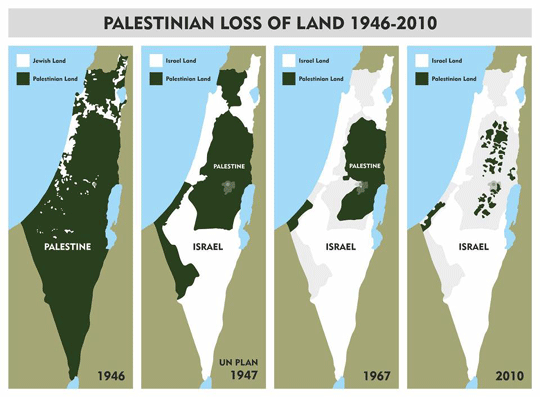
In 1967, Israel seized the remaining 22 percent of Mandatory Palestine — the West Bank (including East Jerusalem) and the Gaza Strip. Depopulation in these territories operated differently than in 1948. Most importantly, Israel, in addition to prohibiting the return of Palestinians who fled hostilities during the 1967 June War, and encouraging others to leave (by, for example, providing a daily bus service from Gaza City to the Allenby Bridge connecting the West Bank to Jordan), conducted a census during the summer of 1967 . Any resident who was not present during the census was ineligible for an Israeli identity document and automatically lost their right of residency.
As a result, the population of these territories declined by more than twenty percent overnight. Many of those thus displaced were already refugees from 1948. Aqbat Jabr Refugee Camp near Jericho, for example — until 1967, the West Bank’s largest — became a virtual ghost town after almost all its inhabitants became refugees once again in Jordan. So many Palestinians from the Gaza Strip ended up in Jordan that a new refugee camp, Gaza Camp, was established on the outskirts of Jerash. The occupied Palestinian territories would not recover their 1967 population levels until the early 1980s.
Within the West Bank, there were also cases of mass expulsion………………………………………………….
Depopulation through administrative rule
In subsequent years, Israel employed all kinds of administrative shenanigans to further reduce the Palestinian population of the West Bank and Gaza Strip. Until the 1993 Oslo Accords, for example, an exit permit from Israel’s military government was required to leave the occupied territory. It was valid for only three years and thereafter renewable annually for a maximum of three additional years (for a fee) at an Israeli consulate. If a Palestinian lost an exit permit or failed to renew an exit permit prior to its expiration for any reason (including bureaucratic foot-dragging), or couldn’t pay the renewal fee, or failed to return to Palestine prior to its expiration, that Palestinian automatically lost residency rights………………………………………………..
………………………………………. the mass expulsion was, as always in such matters, approved by Israel’s High Court of Justice after minor modifications. It ruled, among other things, that this was not a collective deportation but rather a collection of individual deportations……………………………………………….
Israel’s strategies to ‘thin’ Gaza’s population
With the focus in recent years on the intensified campaigns of ethnic cleansing in the West Bank, it is often forgotten that, for decades, the primary target for depopulation was the Gaza Strip, particularly its refugee population, which accounts for approximately three-quarters of the territory’s residents. Even before it occupied Gaza in 1967, Israel regularly promoted initiatives to achieve the “thinning” of its refugee population, with destinations as far afield as Libya and Iraq………………………………………………………………………………….
‘Transfer’ and Gaza today
In the decades since, “transfer,” often presented as the encouragement of voluntary emigration either by providing material incentives or making the conditions of life impossible, has become increasingly mainstreamed in Israeli political life. In 2019, for example, a “senior government official,” quoted in the Israeli newspaper Ha’aretz, expressed a willingness to help Palestinians emigrate from the Gaza Strip.
Mass expulsion has been gaining its share of adherents as well, and it is a position that is today represented within Israel’s coalition government. As has the idea that “transfer” should include Palestinian citizens of Israel — Avigdor Lieberman, for example, who was Israel’s Minister of Defense several years ago, is an advocate of not only emptying the West Bank and Gaza Strip of Palestinians but of getting rid of Palestinian citizens of Israel as well. As one might expect from a minister who was in charge of the Israeli military, he is also an advocate of “beheading” disloyal Palestinian citizens of Israel with “an axe.”
Against this background, Israel saw the attacks of October 7 as not only a threat but also as an opportunity. Fortified with unconditional U.S. and European support, Israeli political and military leaders immediately began promoting the transfer of Gaza’s Palestinian population to the Sinai desert.
The proposal was enthusiastically embraced by the United States and by Secretary of State Antony Blinken in particular. As ever hopelessly out of his depth when it comes to the Middle East, he appears to have genuinely believed he could recruit or pressure Washington’s Arab client regimes to make Israel’s wish a reality. Given Egyptian strongman Abdel-Fatah al-Sisi’s economic troubles, the fallout of the Menendez scandal, and the looming Egyptian presidential elections, it was suggested to him by the Washington echo chamber that it would take only an IMF loan, debt relief, and a promise to file away Menendez to bring Cairo on board. As so often when it comes to the Middle East, Blinken, armed only with Israel’s latest wish list, didn’t have a clue his indecent proposal would be categorically rejected, first and foremost by Egypt.
‘Transfer’ as ‘voluntary immigration’
The fallback position is opposition to “forcible displacement” at the point of a gun, while anything else is fair game. This includes reducing the Gaza Strip to rubble in what may well be the most intensive bombing campaign in history; a genocidal assault on an entire society that has killed civilians at an unprecedentedly rapid pace; the deliberate destruction of an entire civilian infrastructure, including the targeted obliteration of its health and education sectors; the highest proportion of households in hunger crisis ever recorded globally and the real prospect of pre-meditated famine; severance of the water and electricity supply leading to acute thirst, widespread consumption of non-potable water, and termination of sewage treatment; and promotion of a sharp rise in infectious disease. …………………………………………………..
In other words, if desperate Palestinians seek to flee this seventh circle of hell to save their skins, that’s considered voluntary emigration — their choice……………………………………………………………….
As an editorial in the Israeli newspaper Ha’aretz put it on December 27: “Israeli lawmakers keep pushing for transfer under the guise of humanitarian aid.”………………………………………………
Not individual Gazans, but “the people of Gaza.” Notably, such proposals consistently take it as a given that those departing will never return. ………………………………………….
While ethnic cleansing has been intrinsic to Zionist/Israeli ideology and practice from the very outset, it also has a flip side: the 1948 expulsion of the Palestinians expanded what had been a conflict between the Zionist movement and the Palestinians into a regional, Arab-Israeli one. The second Nakba Israel is currently inflicting on the Gaza Strip similarly appears well on its way to instigating the renewal of hostilities across the Middle East.
As importantly, the 1948 Nakba did not defeat the Palestinians, who initiated their struggle from the camps of exile, those in the Gaza Strip most prominently among them. It would take a Blinken level of foolishness to assume the expulsion of Palestinians from the Gaza Strip would produce a different outcome. https://scheerpost.com/2023/12/29/the-long-history-of-zionist-proposals-to-ethnically-cleanse-the-gaza-strip/
Tokyo High Court holds Japan government not liable for Fukushima nuclear disaster
Sean Nolan | Southwestern Law School, US, DECEMBER 28, 2023
Tokyo’s High Court found the government of Japan not liable Tuesday for damages related to the 2011 Fukushima nuclear disaster and associated mass evacuations, leaving responsibility solely with plant operator the Tokyo Electric Power Co. (TEPCO).
The ruling also reduced the damages amounts of a previous court order from $414,400 to $165,000 for 44 of 47 petitioners. The decision mirrors a previous ruling in 2022 which found that the government “was highly unlikely to been able to prevent the flooding” that damaged the plant. Ultimately, the court held that more stringent regulatory actions would have been insufficient to prevent the disaster since the size, direction and scale of the tsunami exceeded estimations for such an event. This is the latest in a series of decisions with different outcomes over the last several years including court cases in 2020 and 2017 which litigated the government’s role in failing to prevent the disaster. There is also a 2022 court case that found TEPCO executives personally liable.
Motomitsu Nakagawa, a lawyer, representing the evacuees expressed dismay with the decision and raised the possibility of another appeal calling the decision a “copy and paste” of the previous Supreme Court ruling. The nuclear disaster has already caused $82 billion in damages to victims, decommissioning work and storage for contaminated materials. While TEPCO has been responsible for all the decommissioning, including contaminant storage, it’s financial position has deteriorated over the last few years amid the massive costs associated with the work and multiple postponements due to technological challenges.
Legal fallout has also extended to the cleanup itself with court cases from South Korea fisheries and Japanese fisherman over the release of radioactive wastewater into the Pacific Ocean. The discharge also sparked international concern from neighboring countries and protests from activists who fear pollution and widespread destruction of wildlife and marine ecosystems.
 | |||
| |||
The Biden Administration Is Quietly Shifting Its Strategy in Ukraine
For two years, Biden and Zelenskyy have been focused on driving Russia from Ukraine. Now Washington is discussing a move to a more defensive posture.
Politico, By MICHAEL HIRSH, 12/27/2023
With U.S. and European aid to Ukraine now in serious jeopardy, the Biden administration and European officials are quietly shifting their focus from supporting Ukraine’s goal of total victory over Russia to improving its position in an eventual negotiation to end the war, according to a Biden administration official and a European diplomat based in Washington. Such a negotiation would likely mean giving up parts of Ukraine to Russia.
The White House and Pentagon publicly insist there is no official change in administration policy — that they still support Ukraine’s aim of forcing Russia’s military completely out of the country. But along with the Ukrainians themselves, U.S. and European officials are now discussing the redeployment of Kyiv’s forces away from Ukrainian President Volodymyr Zelenskyy’s mostly failed counteroffensive into a stronger defensive position against Russian forces in the east, according to the administration official and the European diplomat, and confirmed by a senior administration official. This effort has also involved bolstering air defense systems and building fortifications, razor wire obstructions and anti-tank obstacles and ditches along Ukraine’s northern border with Belarus, these officials say. In addition, the Biden administration is focused on rapidly resurrecting Ukraine’s own defense industry to supply the desperately needed weaponry the U.S. Congress is balking at replacing.
The administration official told POLITICO Magazine this week that much of this strategic shift to defense is aimed at shoring up Ukraine’s position in any future negotiation. “That’s been our theory of the case throughout — the only way this war ends ultimately is through negotiation,” said the official, a White House spokesperson who was given anonymity because they are not authorized to speak on the record. …………………………………………………………….
“Those discussions [about peace talks] are starting, but [the administration] can’t back down publicly because of the political risk” to Biden, said a congressional official who is familiar with the administration’s thinking and who was granted anonymity to speak freely……………………………………….
Over the past year — with U.S. military support flagging fast on Capitol Hill and Zelenskyy’s once-vaunted counteroffensive failing since it was launched in June — Biden has shifted from promising the U.S. would back Ukraine for “as long as it takes,” to saying the U.S. will provide support “as long as we can” and contending that Ukraine has won “an enormous victory already. Putin has failed.”
Some analysts believe that is code for: Get ready to declare a partial victory and find a way to at least a truce or ceasefire with Moscow, one that would leave Ukraine partially divided…………………………………………………………………. more https://www.politico.com/news/magazine/2023/12/27/biden-endgame-ukraine-00133211
Cold War nuclear waste is prioritized at Carlsbad-area repository. How much is there?
Ed comment. This article is yet another example of what a mess the nuclear industry really is!.

Whatever label they give it, nuclear waste is just long-lasting toxic radioactive trash, with no real solution in sight.
Yet our revered leaders still think it’s OK to just keep on making this trash!!
Adrian Hedden, Carlsbad Current-Argus
Concerns were raised by government watchdog groups for a plan to dispose of Cold War nuclear waste at the Waste Isolation Pilot Plant repository in southeast New Mexico, as the federal government could soon generate more new waste through weapons development that would also need disposal.
In a recent 10-year renewal of the Department of Energy’s permit with the New Mexico Environment Department for WIPP’s operations, the NMED added a mandate to prioritize “legacy waste” held for decades at DOE sites and ensure there was adequate space in the underground for its disposal.
At a Dec. 13 public meeting held in Carlsbad and virtually, required by the new permit enacted Nov. 3, DOE and WIPP officials sought input on officially defining legacy waste and how it would be disposed of at WIPP.
:More than 400 shipments of nuclear waste came to Carlsbad-area repository in 2023
Joni Arends with New Mexico-based Concerned Citizens for Nuclear Safety argued the DOE had held inadequate public meetings with the generator sites, and needed to work quicker to determine how much legacy waste was needing disposal around the U.S.
“You’ve got to do more to get people involved in this very important issue so that we have a complete inventory by the due date in November 2024,” she said.
The permit specified that a legacy waste disposal plan must be developed and submitted to NMED a year after the permit takes effect, and reserved Panel 12 for the disposal of this waste.
That panel was one of two new panels approved for mining in the permit, intended to replace space lost to contamination in a 2014 incident……………………………………………………………………
Edward Holbrook, with the Department of Ecology’s nuclear waste program at Washington State University said legacy waste is not officially defined at the DOE’s Hanford Site in Washington.
He proposed meetings at the local level as the project moves forward to better determine what the term meant to specific sites, and how much of the waste was present.
“I don’t have those answers right now,” Holbrook said.
Former-NMED scientist Steve Zappe said during the meeting the legacy waste requirement was added to the permit amid concerns that newer streams of waste, such as from increased plutonium pit production at Los Alamos and other facilities, could take up space originally intended for older waste.
“Newly-generated waste which might be easier to dispose of could displace legacy waste which is maybe difficult to characterize or retrieve,” he said.
Tom Clements, executive director at Savannah River Site Watch, a government watchdog group focused on the DOE facility in South Carolina, worried an ongoing project to “down-blend” or dilute surplus weapons-grade plutonium at the facility could result in excess waste needing disposal.
This new stream would likely not be considered legacy waste, and Clements argued the DOE would need to find a process to balance such emerging needs, including planned pit production at Savannah River.
“This is not legacy material,” Clements said. “The pit-TRU is not included. I wonder how the plutonium down-blended material is going to be categorized. To me it is not legacy waste.”
Chavez agreed that the wastes Clements mentioned were not legacy waste.
That could be a problem, said Don Hancock with the Southwest Research and Information Center in Albuquerque.
Hancock pointed to a 2020 study from the National Academies of Science finding there may not be enough space at WIPP for the waste the DOE plans to produce in the coming years. https://www.currentargus.com/story/news/2023/12/28/cold-war-nuclear-waste-disposed-of-new-mexico-amid-space-concerns/72014679007/
South Carolina nuclear plant’s cracked pipes get downgraded warning from officials
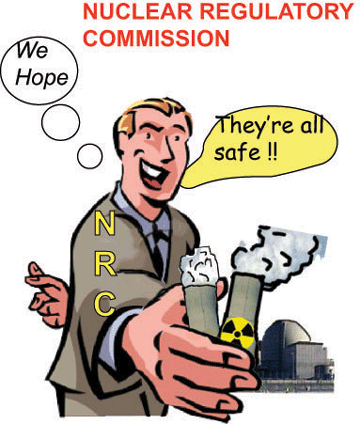
Federal regulators have lessened the severity of their warning about cracks discovered in a backup emergency fuel line at a South Carolina nuclear plant northwest of the state capital
VOA News, By The Associated Press, December 30, 2023
JENKINSVILLE, S.C. — Federal regulators have lessened the severity of their warning about cracks discovered in a backup emergency fuel line at a South Carolina nuclear plant northwest of the state capital.
The U.S. Nuclear Regulatory Commission downgraded its preliminary “yellow” warning for V.C. Summer Nuclear Station issued this October to a final “white” one after owner and operator Dominion Energy showed its generator could still run for six hours in an emergency, the agency announced Thursday.
That demonstration calmed officials’ concerns that Dominion Energy’s failure to maintain cracks and leaks — discovered at least five times over the past two decades — had neutralized the plant’s ability to cool down its reactors if electricity failed.
The new rating means that the generator is underperforming but still meeting its key targets.
“While not indicative of immediate risk, this finding underscores the need for continuous vigilance and improvement in the plant’s corrective action process,” NRC Region II Administrator Laura Dudes said in a statement………………………………..
Officials plan to complete another inspection to see if Dominion Energy fixes the ongoing issues. In a statement to The Associated Press on Friday, the company said it immediately replaced the piping and will install “more resilient piping” early next year………………………………………
The State Newspaper reported that a leader at a watchdog group said the length of the problem warranted the more serious finding. The risk is that fires could break out, according to Edwin Lyman, the director of nuclear power safety at the Union of Concerned Scientists. The changes from Dominion Energy seem to be “pencil-sharpening exercises that make a bad situation look better on paper,” Lyman told The State. https://abcnews.go.com/US/wireStory/south-carolina-nuclear-plants-cracked-pipes-downgraded-warning-105988939#:~:text=The%20U.S.%20Nuclear%20Regulatory%20Commission,emergency%2C%20the%20agency%20announced%20Thursday.
Japan Lifts Operational Ban on Fukushima Nuclear Plant Owners
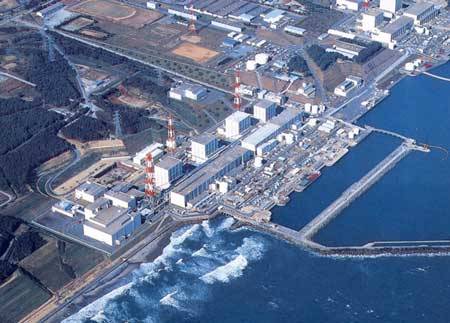
Japanese nuclear safety regulators lifted an operational ban Wednesday imposed on a nuclear plant owned by Tokyo Electric Power Company Holdings, the operator behind the Fukushima plant that ended in disaster, allowing the company to resume preparations for restarting the Kashiwazaki-Kariwa plant after more than 10 years.
At its weekly meeting, the Nuclear Regulation Authority formally lifted the more than two-year ban imposed on the TEPCO’s Kashiwazaki-Kariwa plant over its lax safety measures at the site, saying a series of inspections and meetings with company officials has shown sufficient improvement. The decision removes an order that prohibited TEPCO from transporting new fuel into the plant or placing it into reactors, a necessary step for restarting Kashiwazaki-Kariwa’s reactors.
The plant on Japan’s northern coast of Niigata is TEPCO’s only workable nuclear power plant since the March 2011 earthquake and tsunami destroyed its Fukushima Daiichi plant and caused Fukushima Daini plant to cease operations. For the company now burdened with the growing cost of decommissioning the Fukushima Daiichi plant and compensating disaster-hit residents, restarting the Kashiwazaki-Kariwa reactors soon is key to stabilizing its business.
TEPCO President Tomoaki Kobayakawa told reporters Wednesday that it was too early to comment on the prospect for the restart. He said the company will provide its safety and security measures to gain understanding from the local residents, who must approve a restart…………………………………………………………..
The case raised questions about whether TEPCO learned any lessons from the 2011 Fukushima crisis, which was largely attributed to the utility’s lack of concern about safety.
NRA Chair Shinsuke Yamanaka told Wednesday’s meeting that the lifting of the restrictions is just the beginning, and TEPCO is still required to keep improving its safety precautions………………………………………………………. https://www.voanews.com/a/japan-lifts-operational-ban-on-fukushima-nuclear-plant-owners/7414251.html
A nuclear-powered ship in Murmansk started to burn. Only few locals got to know about the serious incident
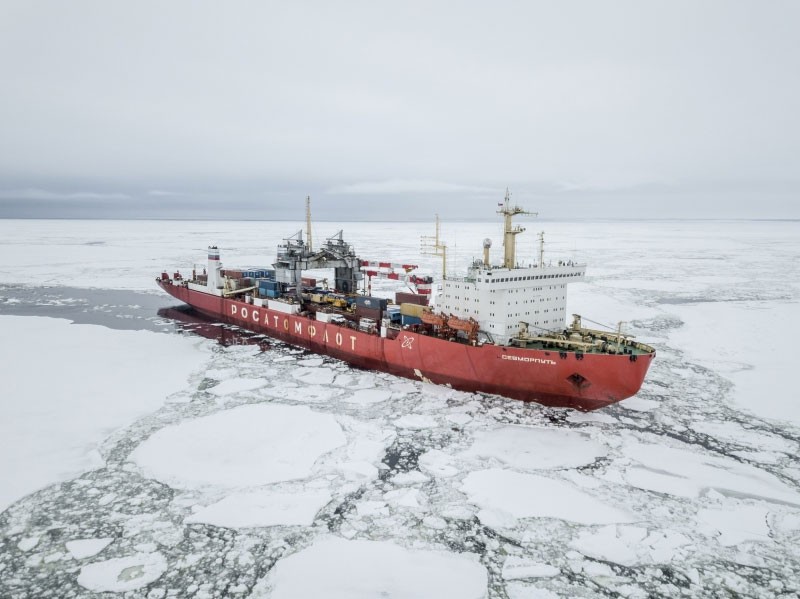
The fire brigade in Murmansk quickly extinguished the blaze that broke out on the 24th of December in a cabin onboard nuclear-powered container ship Sevmorput. State shipowner Rosatom never issued any information about the dramatic situation.
By Atle Staalesen, 28 Dec 23
Little information is available about the fire that broke out in Atomflot, the base for nuclear-powered vessels in Murmansk.
Only two short announcements were in the evening of the 24th of December posted on messenger service Telegram by the local Ministry of Emergency Situations (Emercom).
The first message posted at 21.17 pm informed about a fire on the territory of Atomflot and about the fire brigades that were on the way.
About 1,5 hour later, Emercom informed about its successful fire fighting……………
According to the emergency service, the fire covered an area of about 30 square meters in a cabin onboard the Sevmorput.
The Telegram messages were read by about ten thousand people. A few of them commented on the posts.
Where should we flee?” one of the readers asked.
Rosatom, the state nuclear power company that operates the Sevmorput, has apparently not issued any information about the fire. Neither has any of the company’s subsidiaries, such as the Atomflot or the Rosatomflot.
There is no information about the incident on the companies’ websites or their social media.
The fire could potentially have created a dramatic situation in the big Russian Arctic city. The Atomflot base is located only few kilometres from downtown Murmansk and a major fire on the nuclear-powered ship would have posed a serious threat to the about 270,000 population.
The Sevmorput is the world’s only nuclear-powered merchant container ship.
It is 260 meter long and was built in 1988. For many years, the ship lay idle in Murmansk and Russian authorities ultimately decided to scrap it. However, in 2013 it was instead decided to undertake a major renovation, and in autumn 2015, the ship was again test-sailing the Barents Sea. The following year, Sevmorput was back in regular service and has in the lastest years delivered cargo to military installations in the Russian Arctic, as well as to the petroleum development along the Siberian coast. The ship can carry 74 lighters or 1324 containers.
After the 2015 upgrade and safety evaluation, the reactor’s service life was prolonged with 150,000 hours aimed at keeping the vessel in operation until 2024.
It now looks increasingly likely that the ship will exit service and ultimately be scrapped. In a recent conference on the Arctic, Head of Atomflot Leonid Irlitsa said that his company plans to replace the ship with alternative non-nuclear vessels in 2024…………. https://thebarentsobserver.com/en/nuclear-safety/2023/12/nuclear-powered-ship-murmansk-started-burn-only-few-locals-got-know-about
How green is the UK Government’s nuclear energy strategy?
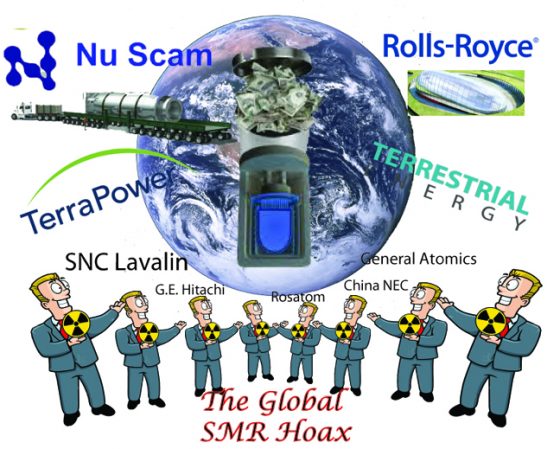
Small modular reactors have been touted as a solution to reaching net-zero – but how safe are they and will they do the job?
By Lucie Heath, Environment Correspondent, 28 Dec 23, https://inews.co.uk/news/how-green-is-the-governments-nuclear-energy-strategy-2824596
The Government has pledged to boost the country’s nuclear energy capacity, setting itself a target to power a quarter of the national grid with nuclear energy by 2050.
But i has revealed that the transition to nuclear energy has been beset by delays, prompting former prime pinister Boris Johnson to urge Rishi Sunak to “get on with it”.
Mr Johnson has been a vocal supporter of nuclear energy and has championed the development of new small modular nuclear reactors (SMRs).
SMRs have been touted as a key solution as the world transitions towards a net-zero future, but some have raised questions regarding the green credentials and viability of the technology.
Here i fact-checks the key claims with regards to SMRs.
Nuclear is low carbon
True or False: True

Ed. comment. That’s as long as you don’t count the CO2 emissions from the full nuclear fuel cycle, and the waste disposal methods.
Nuclear power is considered to be a low carbon source of energy. It has a minimal carbon footprint of around 15–50 grams of CO2 per kilowatt hour (gCO2/KWh), compared to an average footprint of around 450 gCO2/KWh for a gas powered generator and 1,050 gCO2/KWh for coal.
According to the International Energy Association (IEA), over the past 50 years the use of nuclear power has reduced CO2 emissions by over 60 gigatonnes – nearly two years’ worth of global energy-related emissions.
While nuclear produces far less CO2 than fossil fuels, environmentalists dispute its green credentials, not least due to the high volume of radioactive waste created as part of the fuel cycle.
SMRs will play a key role in the energy transition
True or False: Jury’s out
Small modular reactors have many potential benefits that overcome some of the hurdles of traditional nuclear reactor sites.
Their smaller size means that can be placed in locations not suited to large power plants and the modular nature of their design means they should be cheaper and quicker to build.
But as of 2023, only Russia and China have successfully built operational SMRs, and neither are in commercial use.
Mr Johnson’s plan to have the UK’s first SMRs contributing to the grid by 2030 looks increasingly unlikely. Rolls-Royce, which was one of the winners of a Government competition to develop them in the UK, recently told MPs its project could be contributing to the grid by 2031-32 at the very earliest.
MPs sitting on the Science, Innovation and Technology Committee recently published a report that described the Government’s nuclear strategy as more of a “wish list” and said ministers need to make it clearer what role SMRs will play in the energy transition.
SMRs are cheaper to build
True or False: Unclear
This section fails to mention the one and only commercial application of small nuclear reactors - the NuScale attempt in the USA, which was a financial fiasco, and had to be cancelled.
One of the largest hurdles to the deployment of nuclear energy are the huge costs of developing new plants. In theory, SMRs should be cheaper to build due to their size and modular nature, allowing for prefabrication.
However, it is not known exactly what the cost will be to the public purse of developing new SMRs in the UK.
The Environmental Audit Committee recently launched an inquiry into the topic, saying it was “currently unclear what financing models will be used to fund SMRs”.
Critics of nuclear argue it would be wiser to spend money on the deployment of renewable energy, which is cheaper to build.
SMRs are safer
True or false: True in theory
Safety has proved to be a massive issue preventing wider uptake of nuclear energy in the past. Incidents such as the 2011 Fukushima nuclear accident have sparked greater fears regarding the vulnerability of plants during a natural disaster, while nuclear stations can also be a risk during times of conflict, such as in Ukraine.
Proponents of SMRs say they are safer than traditional reactors, partly because their smaller core produces less heat, reducing the likelihood of overheating. A number of other innovations exist in their design which in theory should reduce the risk of failure.
While seen as being safer than large plants, SMRs are still associated with many of the same risks as traditional nuclear.
Feds back away from harsh rating of SC nuclear plant, but will keep an eye on it BY SAMMY FRETWELL UPDATED DECEMBER 28, 2023
27 Dec 23 https://www.thestate.com/news/local/environment/article283528323.html
The U.S. Nuclear Regulatory Commission has toned down concerns it had raised about a safety system at the V.C. Summer power plant northwest of Columbia — but the agency says it will keep an eye on the facility. After hearing from Dominion Energy, the federal oversight agency recently reduced a “yellow’’ safety finding to a “white’’ finding. Both ratings flag concerns about the quality of operations at nuclear plants, but yellow findings are more serious. The NRC has had its eye on the Summer plant because the power company failed for two decades to stop cracks and leaks in its backup diesel generator system. The system is designed to provide electricity to parts of the nuclear plant in the event of a power outage.
Proper maintenance and operation of the backup diesel generators ensures that water will continue to circulate through the atomic reactor during an emergency. Without cooling water, reactor cores can overheat and release radiation. In an email to The State this week, the NRC said it downgraded the yellow finding to white after Dominion presented more evidence that the emergency diesel generator system’s shortcomings were not as serious as originally thought. The power company, which owns the nuclear plant, showed that the diesel generator system, even with the problems that had been outlined, could operate for six hours during an emergency. That would give plant workers time to take additional measures to avoid a problem, according to the nuclear agency.
“The insight into the generator’s capacity led the NRC to reassess the issue’s safety significance, ultimately concluding that it posed a lower risk than initially assessed,’’ the email from NRC spokesman Dave Gasperson said. The NRC’s scale of severity for nuclear plant problems runs from green, which is of least concern, to red, which is of most concern. A yellow finding is the second most serious. White findings are less serious than yellow, but greater than green. Cracks and leaks involving the diesel generator system occurred on at least five occasions from 2003 to 2022, according to the NRC.
Each time, Dominion — or its predecessor, SCE&G — fixed the problems. But the utilities never resolved to the NRC’s satisfaction why the cracks and leaks continued to occur. The full reason for the problems remains unclear, but previous NRC reports suggested that vibrations and maintenance of the pipes that later cracked may have contributed. The problems were found during testing at the plant, so they did not occur during an actual emergency. Despite lowering the safety rating from yellow to white, the NRC will conduct an additional inspection at the V.C. Summer plant, according to a Dec. 21 letter from the agency’s regional administrator, Laura Dudes, to Dominion nuclear chief Eric Carr.
The agency will make sure the cause of the problems are fully understood and that changes made by Dominion are sufficient to ensure problems at the plant don’t happen again, the letter said. “This inspection aims to ensure Dominion Energy has thoroughly analyzed the root cause and implemented effective measures to prevent recurrence,’’ according to the NRC’s email. Dominion, in a statement this week, said it is replacing piping in the diesel generator system and has improved the design of the fuel delivery system. “More resilient piping’’ will be installed in the first quarter of 2024, the company said.
“Dominion Energy’s commitment to safety, along with the NRC’s process for regulating nuclear power stations, ensure we continue to operate to the highest safety standards,’’ the company’s statement said. The company also noticed that one of the problems, found in November 2022, marked the first time in 40 years that a fuel oil leak had made an emergency diesel generator inoperable. Problems with cracks in the diesel generator system were uncovered at about the same time electrical problems with the system were noted last year.
In that case, an electrical problem was found in the plant’s “B” diesel generator system. That made the system inoperable for several weeks in 2022. In that case, the NRC also said the company failed to correct the problem and issued a white finding against Dominion. The history of problems with the generator system prompted one nuclear power watchdog to express reservations about the NRC’s recent decision to drop the safety designation from yellow to white. Edwin Lyman, director of nuclear power safety at the Union of Concerned Scientists, said Dominion’s assurances appear to be “pencil-sharpening exercises that make a bad situation look better on paper.’’ Most of the risk from the cracks and leaks comes from the possibility of fires that could break out, he said.
“I think that given the length of time that this problem was ignored, since at least 2003, despite warning signs, … the more serious finding was warranted,’’ Lyman said in an email. Dominion Energy’s V.C. Summer plant is located about 25 miles northwest of Columbia in Fairfield County. Its former owner, SCE&G, attempted to build two additional reactors, but the project was beset by cost overruns and delays and was ultimately abandoned in 2017.
Inside the Pentagon’s Painfully Slow Effort to Clean Up Decades of PFAS Contamination
By Hannah Norman and Patricia Kime / Kaiser Health News, December 28, 2023
Oscoda, Michigan, has the distinction as the first community where “forever chemicals” were found seeping from a military installation into the surrounding community. Beginning in 2010, state officials and later residents who lived near the former Wurtsmith Air Force Base were horrified to learn that the chemicals, collectively called PFAS, had leached into their rivers, lakes, and drinking water…………………………………….
PFAS chemicals have been linked to increased cholesterol levels, preeclampsia in pregnant women, decreased birth weights, and decreased immune response to vaccines, as well as certain types of cancer. A federal study of U.S. military personnel published in July was the first to show a direct connection between PFAS and testicular cancer, and the chemicals have been linked to increased risk of kidney cancer…………………………………………………………………………………………………………………………………. more https://scheerpost.com/2023/12/28/inside-the-pentagons-painfully-slow-effort-to-clean-up-decades-of-pfas-contamination/
France’s Council of State opinion on a Bill relating to governance of nuclear safety in relaunching the nuclear sector
Only France could produce such a load of linguistical gymastics as this lengthy gobbledygook.
I’ve read the whole of the original, and still don’t understand it. I think it means that the Council of State thinks that what the government plans – is OK
It could mean a bit of privatising of some nuclear bits is OK. And the military connection is OK?
“the Council of State considers it unnecessary to provide, as the bill does, that the powers of the future authority do not extend to nuclear installations and activities of interest to defense”,”
“the bill modifies the rules currently applicable to ASN staff, in particular so that the ASNR can employ employees under private law,……… including 140 who will be automatically made available. of the Ministry of Defense for missions concerning it”
The Government has decided to make public
the opinion of the Council of State relating to the organization of the
governance of nuclear safety and radiation protection to meet the challenge
of relaunching the nuclear sector.
This bill, which includes twenty-two
articles, is organized into two titles respectively entitled “Nuclear
Safety and Radiation Protection Authority” and “Adaptation of the rules
of public procurement to nuclear projects” corresponding to its two
objects, which are distinct.
Title I includes provisions relating to the
missions and operation of the new independent administrative authority
(AAI) created by the bill, called the Nuclear Safety and Radiation
Protection Authority (ASNR) and resulting from the merger of the current
Nuclear Safety Authority. Nuclear Safety (ASN), which is an AAI, and the
Institute for Radiation Protection and Nuclear Safety (IRSN), which is a
public industrial and commercial establishment of the State (EPIC). This
title also includes provisions relating to the statutes and representation
of staff of the new authority and transitional provisions, particularly
concerning employees currently employed by the IRSN.
Council of State 22nd Dec 2023
Why Artificial Intelligence is a disaster for the climate.

What this excellent article does not go on to explain is that the “tech gods” (that’s Musk, Gates, Bezos etc) are happy to have nuclear power expand – to fill the endless hunger for electricity of artificial intelligence and the rest of the digital marvels to come.

AI requires staggering amounts of computing power. And since computers require electricity, and the necessary GPUs (graphics processing units) run very hot (and therefore need cooling), the technology consumes electricity at a colossal rate. Which, in turn, means CO2 emissions on a large scale – about which the industry is extraordinarily coy, while simultaneously boasting about using offsets and other wheezes to mime carbon neutrality.
Guardian, John Naughton, 24 December 23
Amid all the hysteria about ChatGPT and co, one thing is being missed: how energy-intensive the technology is.
What to do when surrounded by people who are losing their minds about the Newest New Thing? Answer: reach for the Gartner Hype Cycle, an ingenious diagram that maps the progress of an emerging technology through five phases: the “technology trigger”, which is followed by a rapid rise to the “peak of inflated expectations”; this is succeeded by a rapid decline into the “trough of disillusionment”, after which begins a gentle climb up the “slope of enlightenment” – before eventually (often years or decades later) reaching the “plateau of productivity”.
Given the current hysteria about AI, I thought I’d check to see where it is on the chart. It shows that generative AI (the polite term for ChatGPT and co) has just reached the peak of inflated expectations. That squares with the fevered predictions of the tech industry (not to mention governments) that AI will be transformative and will soon be ubiquitous. This hype has given rise to much anguished fretting about its impact on employment, misinformation, politics etc, and also to a deal of anxious extrapolations about an existential risk to humanity.
All of this serves the useful function – for the tech industry, at least – of diverting attention from the downsides of the technology that we are already experiencing: bias, inscrutability, unaccountability and its tendency to “hallucinate”, to name just four. And, in particular, the current moral panic also means that a really important question is missing from public discourse: what would a world suffused with this technology do to the planet? Which is worrying because its environmental impact will, at best, be significant and, at worst, could be really problematic.
How come? Basically, because AI requires staggering amounts of computing power. And since computers require electricity, and the necessary GPUs (graphics processing units) run very hot (and therefore need cooling), the technology consumes electricity at a colossal rate. Which, in turn, means CO2 emissions on a large scale – about which the industry is extraordinarily coy, while simultaneously boasting about using offsets and other wheezes to mime carbon neutrality.
The implication is stark: the realisation of the industry’s dream of “AI everywhere” (as Google’s boss once put it) would bring about a world dependent on a technology that is not only flaky but also has a formidable – and growing – environmental footprint. Shouldn’t we be paying more attention to this?
Fortunately, some people are, and have been for a while. A study in 2019, for example, estimated the carbon footprint of training a single early large language model (LLM) such as GPT-2 at about 300,000kg of CO2 emissions – the equivalent of 125 round-trip flights between New York and Beijing. Since then, models have become exponentially bigger and their training footprints will therefore be proportionately larger.
But training is only one phase in the life cycle of generative AI. In a sense, you could regard those emissions as a one-time environmental cost. What happens, though, when the AI goes into service, enabling millions or perhaps billions of users to interact with it? In industry parlance, this is the “inference” phase – the moment when you ask Stable Diffusion to “create an image of Rishi Sunak fawning on Elon Musk while Musk is tweeting poop emojis on his phone”. That request immediately triggers a burst of computing in some distant server farm. What’s the carbon footprint of that? And of millions of such interactions every minute – which is what a world of ubiquitous AI will generate?……………………………………………………more https://www.theguardian.com/commentisfree/2023/dec/23/ai-chat-gpt-environmental-impact-energy-carbon-intensive-technology
Japan allows world’s biggest nuclear plant to restart
DW, 27 Dec 23
The safety ban on TEPCO’s Kashiwazaki-Kariwa plant has been lifted, allowing it to become operational once again. However, the facility still needs permission from local government bodies
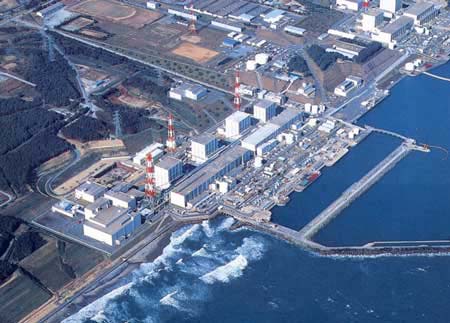
Japan’s nuclear regulator announced Wednesday that it has lifted its safety ban on Tokyo Electric Power’s (TEPCO) Kashiwazaki-Kariwa plant, the largest in the world in terms of capacity.
TEPCO has been looking to restart the plant due to high operating costs. It must now seek permission from local bodies in the Niigata prefecture, Kashiwazaki city, and Kariwa village.
Why was the ban imposed?
The Kashiwazaki-Kariwa plant has a capacity of 8,212 megawatts (MW) and was TEPCO’s only operable atomic power station. It has been offline since 2012, after the Fukushima disaster in March 2011 led to the shutdown of all nuclear power plants in Japan……………………
Previously in 2021, the NRA had barred the plant from operating due to safety breaches and insufficient antiterrorism measures. This included a failure to protect nuclear materials and an incident that involved an unauthorized staff member accessing sensitive areas of the plant.
It had then issued an order that prevented TEPCO from transporting new uranium fuel to the plant or loading fuel rods into its reactors……………………….
After the decision, TEPCO said it would continue to work towards gaining the trust of the local community and society at large. On Tuesday, a Tokyo court ruled that TEPCO, the only operator of the tsunami-wrecked Fukushima nuclear power plant, had to pay damages to dozens of evacuees.
Japan has been trying to reactivate all domestic nuclear power plants that comply with the safety network, to reduce its reliance on fossil fuels which need to be imported. But in some cases, there is opposition from locals or other regulatory bodies. https://www.dw.com/en/japan-allows-worlds-biggest-nuclear-plant-to-restart/a-67829687
Low-Flying Helicopters Will Monitor Any Nuclear Threat In Las Vegas This Weekend
Matt Novak, Senior Contributor Forbes 27 Dec 23
If you see low-flying helicopters over the Las Vegas strip during the next few days, don’t be alarmed. The U.S. Department of Energy is conducting surveillance flights to make sure any potential terrorists aren’t able to sneak a dirty bomb into the tourist destination. And, believe it or not, it’s the kind of surveillance that’s been happening since the 1970s, even if it doesn’t always get a public announcement.
The low-flying aircraft are operated by the National Nuclear Security Administration under a special group called the Nuclear Emergency Support Team, which was established almost 50 years ago to protect the U.S. from nuclear threats.
The flights are scheduled for Friday, Dec. 29 and Sunday, Dec. 31 to prepare for the big New Year’s Eve celebrations in Las Vegas.
“The public may see NNSA’s twin-engine Bell 412 helicopter, which is equipped with radiation-sensing technology,” the Department of Energy said in a press release on Wednesday………………..
The helicopter flights first measure the amount of background radiation that’s naturally occurring in a major city and allow investigators to look out for any abnormal radiation, which would be present if terrorists ever constructed what’s called a “dirty bomb” from nuclear material.
The NEST task force was first set up in 1975 after a number of nuclear threats against major American cities, many of which didn’t make the evening news and were only revealed decades later in the book Defusing Armageddon by Jeffrey T. Richelson. Some of the threats turned out to be just kids, like the 14-year-old who threatened to blow up Orlando in 1970 if he didn’t get $1 million. But other threats stemmed from instances where actual nuclear material was stolen from U.S. labs.
And that’s why NEST has been in action ever since, largely working behind the scenes, as many Americans have no idea that the Department of Energy is even monitoring for such things. But they’re constantly monitoring for nuclear threats, especially during large events like the Super Bowl or New Year’s Eve celebrations in a city like Las Vegas………………………………….. more https://www.forbes.com/sites/mattnovak/2023/12/27/low-flying-helicopters-will-monitor-any-nuclear-threat-in-las-vegas-this-weekend/?sh=13cd7d4784b9
1 This Month

petition to oppose the rapid increase of space-military industry threatening Jeju Island and the region.
[Petition by April 19th (KST)] Stop the joint military-Hanwha Systems-Jeju Provincial Government Sea Launch!
World Nuclear Power. Reactors 1951-2026, 75 Years of Nuclear Power.
Interactive Map– https://dv.worldnuclearreport.org/
Chernobyl: The Lost Tapes – A good documentary on Chernobyl on SBS available On Demand for the next 3 weeks– https://www.sbs.com.au/ondemand/tv-program/chernobyl-the-lost-tapes/2352741955560

of the week–London Campaign for Nuclear Disarmament


Tell the Ukrainian Government to Drop Prosecution of Peace Activist Yurii Sheliazhenko
To see nuclear-related stories in greater depth and intensity – go to https://nuclearinformation.wordpress.com
-
Archives
- April 2026 (211)
- March 2026 (251)
- February 2026 (268)
- January 2026 (308)
- December 2025 (358)
- November 2025 (359)
- October 2025 (376)
- September 2025 (257)
- August 2025 (319)
- July 2025 (230)
- June 2025 (348)
- May 2025 (261)
-
Categories
- 1
- 1 NUCLEAR ISSUES
- business and costs
- climate change
- culture and arts
- ENERGY
- environment
- health
- history
- indigenous issues
- Legal
- marketing of nuclear
- media
- opposition to nuclear
- PERSONAL STORIES
- politics
- politics international
- Religion and ethics
- safety
- secrets,lies and civil liberties
- spinbuster
- technology
- Uranium
- wastes
- weapons and war
- Women
- 2 WORLD
- ACTION
- AFRICA
- Atrocities
- AUSTRALIA
- Christina's notes
- Christina's themes
- culture and arts
- Events
- Fuk 2022
- Fuk 2023
- Fukushima 2017
- Fukushima 2018
- fukushima 2019
- Fukushima 2020
- Fukushima 2021
- general
- global warming
- Humour (God we need it)
- Nuclear
- RARE EARTHS
- Reference
- resources – print
- Resources -audiovicual
- Weekly Newsletter
- World
- World Nuclear
- YouTube
-
RSS
Entries RSS
Comments RSS
 nuclear-news