As the world starts to panic over climate change, nuclear evangelists offer spurious solutions


I too wish that the things that the nuclear industry says about itself were true—I wish it was green and renewable. I wish that there weren’t multiple uranium mining sites around the world with thousands of tons of uranium tailings abandoned and open to the elements, continuing to harm the health of generations born long after mining ceased.
I wish that it didn’t take immense, carbon-intensive mining projects to extract uranium from the Earth, and then again to “deposit” the spent nuclear fuel from reactors back half a kilometer underground.
Nuclear Stockholm Syndrome, https://www.counterpunch.org/2021/07/09/nuclear-stockholm-syndrome/
BY ROBERT JACOBS 9 July 21, Bhaskar Sunkara’s recent opinion piece extoling the virtues of nuclear power and castigating its opponents as paranoid and ill-informed, is clearly motivated by his deep concerns over the dire impacts of global warming, which loom closer by the hour. Unfortunately, his arguments amount to little more than regurgitated industry talking points, in their traditional form of a Jeremiad.
First, Sunkara poses the decline of the nuclear industry in the West as an achievement of progressive political movements. Specifically, he cites the decline of nuclear power in Germany as attributable to a “Green party-spearheaded campaign.” This decline has been more reasonably ascribed to both market conditions and missteps by nuclear industry giants such as Westinghouse and AREVA. From its inception, nuclear power has been heavily dependent on government subsidies to appear economically viable (subsidies such as insurance and the disposal of waste largely configured as taxpayer burdens).
Rather than succumbing to its political opponents on the left, the industry has been sunk by its structural economic dysfunctions. In the US, this has sparked schemes to secure additional taxpayer subsidies in legislative fixes such as guaranteed returns for nuclear utilities, and outright bribery of legislators for taxpayer bailouts of failing companies.
The most simplistic recitation of nuclear industry talking points is when Sunkara dismisses concerns about nuclear waste, and extolls the mythic separation between “civilian” and “military” nuclear technologies. He asserts that most nuclear waste “can be recycled to generate more electricity,” an assertion that goes back more than half a century and has been ritualistically recited by an army of nuclear industry PR professionals before him…yet here we are 50 years later and very little spent nuclear fuel has actually been recycled. The most successful nuclear recycling nation is France which, nevertheless, is experiencing a “nuclear exit” and is unlikely to ever use this recycled fuel. AREVA, the French nuclear giant, has gone bankrupt. Reprocessing facilities like the Rokkasho plant here in Japan have never functioned properly, unless you consider their role enabling the stockpiling of plutonium by Japan to hedge against future weapon needs to be an elemental goal.
There is a difference between what can be done, and what actually happens. Rather than being recycled, hundreds of thousands of metric tons of spent nuclear fuel await “final disposal” in deep geological repositories. Some have been waiting for over 70 years. Just last week, a panel advising the EU on categorizing nuclear plant as “green” energy, and thus eligible to receive EU funding as a “sustainable investment,” concluded that the problems of nuclear waste preclude that designation.
I would point out that even though plastics manufacturers assure us that most plastic can be recycled, we still seem to be living a world with ever increasing amounts of plastic waste. Their greenwashing has not eventuated in a world full of plastics made from recycled materials. The market reality is that it is cheaper to manufacture new plastic than it is to manufacture plastic from recycled materials. Similarly, it is cheaper to discard spent nuclear fuel than it is to reprocess it.
Sunkara dismisses the irrevocable link between military and civilian nuclear technologies as imaginary. First, let’s consider the present imbrication. A 2019 Atlantic Council study places the value of the US civilian nuclear complex to the US national security apparatus at $26 billion annually simply in terms of the human capital assets: “In terms of nuclear technology innovation, export capacity, and geopolitics, a vibrant civilian nuclear energy sector is a critically important national security asset.”
However, the civilian operation of nuclear power plants also places future generations at military risk. I have written that, historically, nuclear reactors were “born violent.” That is to say, they were invented by the Manhattan Project in the early 1940s to manufacture plutonium for use in nuclear weapons, and were instrumental in killing almost 100,000 people in 1945. The “first” American commercial atomic plant in Shippingport, PA that went critical in 1958, was actually the 14th industrial nuclear reactor built in the United States, the other 13 only manufactured plutonium, which by then formed the fissile cores of thousands of nuclear weapons.
In nuclear reactors used to make electricity, this plutonium is not separated out for use in weapons. However, all nuclear power plants remain plutonium production factories. The fact that most of those tons of plutonium remain in the spent fuel rods does not mean they will stay there forever. Thousands of years from now, some government or military may dig up the spent fuel in our deep geological repositories and separate that plutonium out to build nuclear weaponry. All it would take is the technology (technology we currently possess) and the will. We continue to manufacture that plutonium—perhaps for them to weaponize. Every nuclear power plant that operates adds to that inventory; more than 99% of existing plutonium was manufactured in nuclear reactors. In 1962, the US successfully detonated a nuclear weapon assembled with just such “reactor-grade” plutonium. Our generation’s use of nuclear power silently stockpiles fissile material that will remain militarily viable for millennia.
I too wish that the things that the nuclear industry says about itself were true—I wish it was green and renewable. I wish that there weren’t multiple uranium mining sites around the world with thousands of tons of uranium tailings abandoned and open to the elements, continuing to harm the health of generations born long after mining ceased. I wish that it didn’t take immense, carbon-intensive mining projects to extract uranium from the Earth, and then again to “deposit” the spent nuclear fuel from reactors back half a kilometer underground. Estimates before construction began at Onkalo spent fuel repository in Finland were that the site would entail a “half-billion-euro construction project will generate some 2,500 person years of employment,” and would take 100 years to complete. That is just to contain the spent fuel from five nuclear power plants. The United States, by contrast, has 94 commercial nuclear power plants. There is still no actual plan for the astonishingly large and carbon-intensive site it will take to bury the more than 140,000 metric tons of spent nuclear fuel, with some hope of containing it for thousands of generations of future human beings. This doesn’t include the thousands of tons of spent nuclear fuel from the nuclear reactors operated by the US military to provide the fissile cores of more than 70,000 nuclear weapons during the Cold War.
The panic-inducing impacts of anthropic climate change spark a desperate need for immediate reassurance and calming: we want to fix it now. We long to turn some corner that will change the situation. It is unlikely that the same short-sighted military-industrial technophilia that brought us to this climate crisis will flip over and provide us the urgent path to its resolution. Technological evangelists have been auditioning for the part of Climate Change Savior to anyone who will listen. Some proffer a Reagan-era Star Wars pitch: they will fill the skies with material to block the enemy (in this case sunlight rather than Soviet ICBMs). These geoengineering quick-fix schemes are more likely to cause unplanned outcomes than to achieve their missions.
At one time nuclear weapon producers imagined they too could geoengineer the planet to shape it to human desires. They tested the use of nuclear weapons to sculpt harbors into coastlines, and to release natural gas trapped in rock formations. These experiments led to some of the most significant radiological distributions and contaminated sites in the wide panoply of nuclear testing. Still, hyper-capitalist techno utopians like Elon Musk envision the key to human habitation on Mars is the detonation of a massive arsenals of thermonuclear weapons to shape it to our needs.
The nuclear industry will ignore its market dilemmas as long as taxpayers continue to backstop its investors. However, to believe that this massive, for-profit, military-based industry has concern for the welfare of the Earth and its inhabitants is akin to believing the plastic industry is actually beavering away to make the plastic waste disappear. Repackaging their talking points out of a genuine concern for living creatures is a resource they will continue to tap so long as it flows freely. Sunkara would do better to advocate for the mass social movements that have shifted giant industries towards social welfare in the past rather than preaching that the industries themselves are saviors. Time is obviously short, wrong turns are catastrophic.
Robert (Bo) Jacobs is a historian at the Hiroshima Peace Institute and Graduate School of Peace Studies at Hiroshima City University. He has written and edited multiple books and articles on nuclear history and culture including, The Dragon’s Tail: Americans Face the Atomic Age, and Filling the Hole in the Nuclear Future: Art and Popular Culture Respond to the Bomb. He is a founder and a principal researcher of the Global Hibakusha Project, studying radiation exposed communities around the world. His book, Nuclear Bodies: The Global Hibakusha, will be published by Yale University Press in 2022. His Global Hibakusha blog can be found here.
UN Members Support Gaza Cease-Fire in Overwhelming 153-10 Vote
“Humanity has prevailed,” said Egyptian Ambassador Osama Abdel Khalek. “The Israeli aggression on Gaza must end. This bloodshed must stop.”
SCHEERPOST, By Jessica Corbett / Common Dreams, December 13, 2023
The United Nations General Assembly on Tuesday passed a resolution demanding “an immediate humanitarian cease-fire” in Israel’s two-month war on Gaza after the U.S. last week used its permanent member status to veto a similar Security Council measure.
The resolution also demands “that all parties comply with their obligations under international law, including international humanitarian law, notably with regard to the protection of civilians,” as well as “the immediate and unconditional release of all hostages, as well as ensuring humanitarian access.”
The final vote during the General Assembly’s emergency special session in New York was 153-10 with 23 abstentions.
Humanity has prevailed,” declared Egyptian Ambassador to the U.N. Osama Abdel Khalek after the vote. “This resolution must be implemented immediately. The Israeli aggression on Gaza must end. This bloodshed must stop.”
Tuesday’s meeting came after Egypt and Mauritania invoked Resolution 377A (V), which states that “if the Security Council, because of lack of unanimity of the permanent members, fails to exercise its primary responsibility for the maintenance of international peace and security in any case where there appears to be a threat to the peace, breach of the peace, or act of aggression, the General Assembly shall consider the matter immediately.”
Last week’s U.S. veto came after United Nations Secretary-General António Guterres invoked Article 99, a rarely used section of the U.N. Charter empowering him to bring to the attention of the Security Council “any matter which in his opinion may threaten the maintenance of international peace and security,” for the first time in his tenure.
Noting Guterres’ message to the council as well as a recent letter from the commissioner-general of the United Nations Relief and Works Agency for Palestine Refugees in the Near East, the General Assembly resolution expresses “grave concern over the catastrophic humanitarian situation in the Gaza Strip and the suffering of the Palestinian civilian population,” and emphasizes that “the Palestinian and Israeli civilian populations must be protected in accordance with international humanitarian law.”
Israeli Ambassador Gilad Erdan on Tuesday had urged member states to oppose the resolution, arguing that it would amount to “voting in favor of a genocidal jihadist organization” and hamper Israel’s ongoing operation to destroy Hamas.
“A cease-fire is a death sentence,” claimed Erdan, who said the effort to pass the resolution made the United Nations “a moral stain on humanity.”
Israel’s assault on Gaza has killed at least 18,412 Palestinians and injured over 50,100 more, according to local health officials. The war has also devastated civilian infrastructure and displaced 85% of the besieged enclave’s 2.3 million residents.
Urging the assembly to support the resolution, Francesca Albanese, the United Nations special rapporteur for the occupied Palestinian territories, said Tuesday that “the Israeli army is fighting everyone and everything in Gaza—including the U.N.”……………………………………
The United States—which voted against the resolution on Tuesday— gives Israel $3.8 billion in annual military aid and Congress is now considering a new $14.3 billion package……………………………… more https://scheerpost.com/2023/12/13/un-members-support-gaza-cease-fire-in-overwhelming-153-10-vote/
UN General Assembly votes to demand immediate ceasefire in Gaza
By Caitlin Hu, CNN, https://edition.cnn.com/2023/12/12/middleeast/ceasefire-vote-gaza-israel-un-intl
The United Nations General Assembly has voted to demand an immediate humanitarian ceasefire in war-torn Gaza, in a rebuke to the United States which has repeatedly blocked ceasefire calls in the UN’s Security Council.
A majority of 153 nations voted for the ceasefire resolution in the General Assembly’s emergency special session Tuesday, while 10 voted against and 23 abstained.
While a General Assembly vote is politically significant and seen as wielding moral weight, it is nonbinding, unlike a Security Council resolution. The US last week vetoed a ceasefire resolution in the smaller Security Council, which had been approved by a majority of the powerful 15-member body.
Tuesday’s brief resolution calls for a ceasefire, for all parties to comply with international law, and for humanitarian access to hostages as well as their “immediate and unconditional” release. It notably contains stronger language than an October vote in the assembly that had called for a “sustained humanitarian truce.”
The vote, hailed as “historic” by Palestinian Ambassador to the UN Riyad Mansour, comes as the war between Israel and Hamas enters its third month, and as medics and aid groups sound alarm bells on the humanitarian situation in besieged Gaza. More than 18,000 people have been killed in Gaza since fighting broke out, the Hamas-controlled health ministry in the enclave said Monday.
The resolution “does not ‘call for’ or ‘urges’ – it demands, and we will not rest until we see compliance of Israel with this demand,” Mansour said. A ceasefire is necessary to move the “massive” amounts of humanitarian assistance needed by Gaza’s besieged civilian population, he added.
Ahead of Tuesday’s vote, Israel’s UN Ambassador Gilad Erdan described the resolution as a “disgraceful” attempt to bind Israel’s hands, warning that “continuing Israel’s operation in Gaza is the only way any hostages will be released.”
Israel has rejected previous calls for a ceasefire, though it agreed to a seven-day truce for the release of Israeli hostages held in Gaza.
Israel voted against Tuesday’s resolution along with the US, Papua New Guinea, Paraguay, Austria, the Czech Republic, Guatemala, Liberia, Micronesia and Nauru.
‘One singular priority’
“We have one singular priority – only one – to save lives,” said General Assembly President Dennis Francis, opening the emergency session on Tuesday afternoon, warning that civilians in Gaza have nowhere safe to shelter from the fighting and aerial bombardment.
“Even war has rules, and it is imperative that we prevent any deviation from these principles and values – the validity of which resides in their universal application,” he said.
With vital infrastructure blasted to rubble and limited access to water, medicine and food, more Gaza civilians may end up dying of diseases than from bombs and missiles, UN officials have warned. Hunger is a growing issue in the enclave.
Addressing the assembly, US Ambassador to the UN Linda Thomas-Greenfield said that Washington does “agree that the humanitarian situation in Gaza is dire…and that civilians must be protected with international humanitarian law,” but urged nations to support an amendment to the resolution condemning Hamas, which did not pass.
”A ceasefire right now would be temporary at best, and dangerous at worst,” she said. “Dangerous to Israelis, who would be subject to relentless attacks, and also dangerous to Palestinians who deserve the chance to build a better future for themselves free from a group that hides behind innocent civilians.”
In a break with its southern neighbor, Canada cast its vote in support of the resolution, with Prime Minister Justin Trudeau issuing a joint statement with the leaders of Australia and New Zealand in support of “urgent international efforts towards a sustainable ceasefire.”
Australian Foreign Minister Penny Wong said Australian officials had been engaging with Canadian officials for some time on the issue, and more recently with New Zealand’s new government.
“We think that it’s important that very close allies and likeminded countries speak together in support of the position that we’ve articulated,” Wong told reporters Wednesday.
“We are democracies, and we expect of ourselves a high standard, and we expect that we will all work to comply with international humanitarian law, including the protection of civilian life,” she said.
Canadian ambassador to the UN Bob Rae called on Hamas to lay down its weapons and stop using civilians as “human shields.”
He added: “The price of defeating Hamas cannot be the continuous suffering of Palestinian civilians.”
South Africa’s representative Mathu Joyini meanwhile invoked her country’s “own painful past experience of a system of apartheid” to impress on fellow states the need to “take action in accordance with international law.”
Tuesday’s vote, she said, “presents an opportunity for us to illustrate that the organization that was created to give hope for peace is not tone-deaf to the suffering of the most vulnerable.”
In a short statement, Izzat Al-Rishq, a member of the Hamas Political Bureau, welcomed the resolution and condemned what he termed as a “war of genocide and ethnic cleansing” against the Palestinian people.
Does nuclear power generate GHG CO2 emissions?
Yes. More than what people expect. [Ref. 2 – Year 2021]
Quote:
“How climate-friendly is nuclear compared to other energies?
If the entire life cycle of a nuclear plant is included in the calculation, nuclear energy certainly comes out ahead of fossil fuels like coal or natural gas. But the picture is drastically different when compared with renewable energy.”
“According to new but still unpublished data from the state-run German Environment Agency (UBA) as well as the WISE figures, nuclear power releases 3.5 times more CO2 per kilowatt-hour than photovoltaic solar panel systems. Compared with onshore wind power, that figure jumps to 13 times more CO2. When up against electricity from hydropower installations, nuclear generates 29 times more carbon.”
Why does the IAEA state otherwise? It’s convenient, as simple as that.
IAEA statement at COP28: on Dec. 1st, 2023 [Ref. 1]
Fact check: Is nuclear energy good for the climate? NATURE AND ENVIRONMENTGLOBAL ISSUES. Joscha Weber. November 29, 2021. Supporters of nuclear energy say it can help us wean our economies off polluting fossil fuels. No surprise, it’s a heated issue. But what about the facts? Can nuclear power really help save the climate?
Link: https://www.dw.com/en/fact-check-is-nuclear-energy-good-for-the-climate/a-59853315
“Is nuclear power a zero-emissions energy source?
No. Nuclear energy is also responsible for greenhouse gas emissions. In fact, no energy source is completely free of emissions, but more on that later.
“When it comes to nuclear, uranium extraction, transport and processing produces emissions. The long and complex construction process of nuclear power plants also releases CO2, as does the demolition of decommissioned sites. And, last but not least, nuclear waste also has to be transported and stored under strict conditions — here, too, emissions must be taken into account.”
“How much CO2 does nuclear power produce?
Results vary significantly, depending on whether we only consider the process of electricity generation, or take into account the entire life cycle of a nuclear power plant. A report released in 2014 by the UN’s Intergovernmental Panel on Climate Change (IPCC), for example, estimated a range of 3.7 to 110 grams of CO2 equivalent per kilowatt-hour (kWh).
“It’s long been assumed that nuclear plants generate an average of 66 grams of CO2/kWh — though Wealer believes the actual figure is much higher. New power plants, for example, generate more CO2 during construction than those built in previous decades, due to stricter safety regulations.”
Studies that include the entire life cycle of nuclear power plants, from uranium extraction to nuclear waste storage, are rare, with some researchers pointing out that data is still lacking. In one life cycle study, the Netherlands-based World Information Service on Energy (WISE) calculated that nuclear plants produce 117 grams of CO2 emissions per kilowatt-hour
“Could we rely on nuclear energy to help stop global warming?
Around the world, nuclear energy representatives, as well as some politicians, have called for the expansion of atomic power. In Germany, for example, the right-wing populist AfD party has backed nuclear power plants, calling them “modern and clean.” The AfD has called for a return to the energy source, which Germany has pledged to phase out completely by the end of 2022.
Other countries have also supported plans to build new nuclear plants, arguing that the energy sector will be even more damaging for the climate without it. But Wealer from Berlin’s Technical University, along with numerous other energy experts, sees takes a different view.
“The contribution of nuclear energy is viewed too optimistically,” he said. “In reality, [power plant] construction times are too long and the costs too high to have a noticeable effect on climate change. It takes too long for nuclear energy to become available.”
Mycle Schneider, author of the World Nuclear Industry Status Report, agrees.
“Nuclear power plants are about four times as expensive as wind or solar, and take five times as long to build,” he said. “When you factor it all in, you’re looking at 15-to-20 years of lead time for a new nuclear plant.””
“He pointed out that the world needed to get greenhouse gases under control within a decade. “And in the next 10 years, nuclear power won’t be able to make a significant contribution,” added Schneider.
“Nuclear power is not being considered at the current time as one of the key global solutions to climate change,” said Antony Froggatt, deputy director of the environment and society program at the international affairs think tank Chatham House in London.
He said a combination of excessive costs, environmental consequences and lack of public support were all arguments against nuclear power.”
Ukraine was never going to win – US senator
Tommy Tuberville has also dismissed the notion that Russia could invade EU states as just a “selling point”
https://www.rt.com/news/588986-ukraine-never-win-senator/ 13 Dec 23
Ukraine always faced the prospect of losing the conflict with Russia in the event that Washington cut off its aid, US Republican Senator Tommy Tuberville has said.
His comments came after the US Senate last week blocked a bill by President Joe Biden that was intended to allocate a further $60 billion in funding to Kiev, on top of the $110 billion already spent. Republicans opposed to the package have demanded tougher immigration control on the US-Mexico border in exchange for approving the bill, rejected by the White House.
Speaking to CNN on Tuesday, Tuberville was asked whether cutting off funding to Kiev could result in Ukraine being defeated. The senator replied that he personally “never thought they can win to begin with,” especially with the way the US “eased into” the conflict.
Tuberville also dismissed claims by Kiev’s backers that Russia will advance elsewhere into western Europe once it defeats Ukraine’s forces. The Republican argued that Moscow “can’t beat Ukraine on the eastern side,” and questioned how it was expected to push further across Europe.
“I’ve never believed that scenario. I think it’s a good selling point to send more money,” Tuberville suggested.
The US has so far provided Ukraine with an estimated $111 billion in military and economic assistance since the outbreak of its conflict with Russia in February 2022. While Washington has increasingly warned that funds are beginning to run out, Ukrainian President Vladimir Zelensky has nevertheless continued to insist on receiving more money.
The Ukrainian leader traveled to Washington on Tuesday to hold a series of meetings with top US officials, in an attempt to save Biden’s $60 billion aid package. However, Zelensky appears to have failed to convince key Republicans to change their mind about opposing the bill. Instead, some senators left the meeting while describing it as “the same old stuff” and “very scripted.”
Biden has continued to urge Congress to approve the funding package and has also pledged an additional $200 million in emergency military aid for Kiev through the Presidential Drawdown Authority, which allows him to send weapons from US stocks without congressional approval.
Meanwhile, Moscow has brushed off Zelensky’s latest visit to Washington as inconsequential for the outcome of the conflict. Russia’s ambassador to the US, Anatoly Antonov, claimed that “everyone is tired of the Kievan beggarman.” Kremlin spokesperson Dmitry Peskov has also stressed that no amount of money would change the situation on the front lines.
China drops out of British nuclear power program.
China was providing 1/3 of the capital for the Hinkley Point 2xEPR reactor project in the UK, with the aim of smoothing the waters for China to build its own reactors in the UK (Bradwell). But the British govt effectively cancelled China’s plans to build reactors in the UK, for various reasons including cybersecurity.
Now, China, has pulled funding for Hinkley Point! France’s EDF, which is already carrying over A$100 billion in debt and was fully nationalised this year, may have to pick up the slack to keep Hinkley going. Or maybe the British govt increases its subsidies for Hinkley Point. Already, the UK National Audit Office estimates that British taxpayer subsidies for Hinkley Point could amount to £30 billion (A$56.4 billion).
Amazing.
‘China’s CGN Halts Funding for UK’s Hinkley Point Nuclear Plant’
‘Withdrawal comes after UK took over CGN stake in other project’
‘EDF may have to fund multibillion completion of plant alone’
Zelensky gives US TV viewers fake frontline facts
https://www.rt.com/russia/588976-zelensky-no-village-lost/—13 Dec 23
The Ukrainian president touted his country’s supposed military success on Fox News
Ukrainian President Vladimir Zelensky has contradicted frontline developments by claiming that Russian troops have failed to capture a single village from Kiev’s forces this year. The Ukrainian leader talked up his country’s supposed military achievements in an interview with Fox News anchor Bret Baier on Tuesday.
Zelensky is visiting Washington this week to urge continued military assistance for Kiev in 2024. Political clashes on Capitol Hill have caused a White House request for more than $110 billion in foreign security spending, including over $60 billion for Ukraine, to be blocked.
Speaking in English, Zelensky claimed that Ukrainian forces had “destroyed mostly [the] Russian fleet that was situated in our waters and near… occupied Crimea.” Kiev has launched several successful attacks on Russia’s Black Sea Fleet using Western-provided cruise missiles, although Moscow’s forces have repelled numerous other assaults.
Zelensky further claimed that Ukraine had killed 20,000 members of the now-disbanded Wagner private military company, and that “Russia did not occupied [sic] any Ukrainian village during this year.
The Ukrainian leader made the assertions despite evidence to the contrary on the battlefield, with Wagner fighters playing an important role in the fighting for the Donbass city of Artyomovsk (known as Bakhmut in Ukraine). The Zelensky government had declared the city an invincible “fortress” and reportedly ignored repeated US calls to pull troops out. After losing control of the city in May, Zelensky downplayed the significance of the settlement, declaring that it no longer existed and remained “only in our hearts.”
In early 2023, Kiev also lost control of Soledar in Donbass. Fox News host Baier did not dispute Zelensky’s claims that Russia had enjoyed no success in the conflict.
According to Western media, Kiev’s bid to retain Artyomovsk significantly impacted its summer counteroffensive, having needlessly drained Ukrainian manpower and resources. The push to break through Russian defensive lines, which started in June and according to Russia estimates cost Ukraine over 125,000 casualties, failed to yield significant territorial gains for Kiev.
Zelensky and his aides publicly clashed with Ukraine’s top general, Valery Zaluzhny, after he described the frontline situation as a “stalemate” in early November. The president’s office finally acknowledged that no progress was being made by the end of the month.
A profile of Zelensky published by Time magazine in late October said his close associates believe him to be delusional. His belief in a Ukrainian victory over Russia is “immovable, verging on the messianic,” according to the outlet.
Why can’t the US ever say no to Israel?
The American UN veto on a Gaza ceasefire is a low point of wag-the-dog international politics
Rt.com, Tarik Cyril Amar, 13 Dec 23
December 8, 2023, is a day that will live in infamy. The United States made history of the worst kind by using its permanent seat on the UN Security Council to veto a resolution calling for an immediate ceasefire in Gaza. The resolution was advanced by the United Arab Emirates (a US partner) and supported by more than 90 member states. It also had preponderant backing in the global organization’s privileged “upper chamber,” the Security Council, where 13 of its 15 members were in favor (while the UK abstained, abdicating its sovereignty to the US, again).
The American veto directly defied UN Secretary-General Antonio Guterres. Not a natural-born rebel, the UN chief had deployed a rarely used procedure to promote the ceasefire, putting his authority on the line. Referring to Article 99 of Chapter 15 of the UN Charter, he already implied that “international peace and security” were in danger. His spokesperson was explicit that Guterres was making a “dramatic constitutional move.” While maintaining diplomatic balance by also highlighting the Hamas attack on Israel, Guterres’ letter to the Security Council depicted the catastrophic suffering of the Palestinians under the ongoing Israeli attack and concluded that “nowhere” was safe in Gaza.
All to no avail. The US could not be swayed and maintained its de facto unconditional support for Israel, even while the latter is conducting an intensifying genocidal assault on Gaza and its civilian population. This is no longer up for debate, and is no secret either; Israeli leaders have repeatedly made statements that signal the kind of intent that is a crucial element in the crime of genocide, while their actions and those of their forces on the ground speak even louder than their words.
The world has taken note. It took no special bias for the Palestinian leadership – the one derived from the PLO, as well as Hamas – to identify the veto as “disastrous” and “a disgrace and another blank cheque given to the occupying state to massacre, destroy and displace.” China and Russia have denounced American double standards and the “death sentence” Washington has handed down on future Palestinian victims of the Israeli assault.
Amnesty International says Washington has “brazenly wielded and weaponized its veto to strongarm the UN Security Council… undermining its credibility” and displaying a “callous disregard for civilian suffering in the face of a staggering death toll.” Doctors without Borders did not mince its words either, accusing the US of standing “alone in casting its vote against humanity,” with America “complicit in the carnage in Gaza” and undermining not only its own credibility but also that of international humanitarian law.
Craig Mokhiber – an authority on international law and former head of the UN High Commissioner for Human Rights office in New York – tweeted that “on the eve of the 75th Anniversary of the Genocide Convention, the US has again vetoed a ceasefire in the UN Security Council… demonstrating its further complicity in the #genocide in #Palestine.”
This list of censure and condemnation could be prolonged almost ad infinitum, especially if we add voices from the Global South. The key point, however, should be clear already: The US stands isolated and disgraced by its very own, easily avoidable – or so it would seem – decision. This was, after all, not a vote asking for justice and restitution for the victims, or – perish that radical thought! – for prosecution of the perpetrators. All this was about was the barest of bare minimums, just a ceasefire, not even a peace deal. Still, that was too much to ask of the US……………………………..
Future historians will ask how this happened. How could the single most powerful nation in the world, which claims to lead not only by force but by “values,” side with the Israeli perpetrators of such an outrageous and open crime, while openly contravening much of the international community? Some will even ask the more cynical question how America, even if its elites are entirely bereft of ethics, could do so much harm to itself.
The simplest, almost technical answer to that question has to do with a historical irony. America owes its veto power – as one of the five permanent members of the Security Council – to what happened in World War II. And while World War II and the German Holocaust against the Jews of (mostly) Europe are not the same, they are part of the same history. Much US pride has been invested in being among the powers that brought down the Holocaust perpetrator state Germany. And yet, here we are: The same US is now using that very veto not only to shield another genocidal state but to help it continue its crime.
There are, of course, broader reasons for this great American failure. Many have been discussed before. Israel serves the function of an enforcer and imperial outpost in the Middle East and sometimes beyond. As current US President Joe Biden – by now often trending on X as #GenocideJoe – stated in 1986, when still an ambitious and pandering senator, if there were no Israel, America would have to invent one. Let’s set aside that even the callous realpolitik behind such thinking is flawed: If it ever was an asset, Israel is turning into a liability. Let’s just note that the American elite claims to believe that Israel is so useful that the commitment to it must be, in Vice President Kamala Harris’ words, “ironclad.”
But so it was for Ukraine only, as it were, yesterday. And yet Kiev is about to be dropped, as so many US clients before. What makes Israel different? Clearly, it is the long-standing top recipient of US financial and military support. Is it sunk cost fallacy then? Is America so over-committed to Israel that it simply won’t walk away?
Yet that hypothesis does not explain the striking one-sidedness of the US-Israel relationship. If there has ever been a case of wag-the-dog, this is it: One thing that the American veto on the Gaza ceasefire resolution shows is that it is Israel that is dominating US foreign policy, not the other way around. Otherwise, Washington would have sought to find a compromise between preserving its own credibility and interests by allowing at least this very modest resolution to pass, while still supporting Israel in multiple other ways.
Clearly, one thing that is determining this American dependence on another, much smaller country is the massive success of lobbying and foreign influence operations on behalf of Israel. Indeed, it is Israel that has run the most invasive and effective such attack on US politics in history. And for the avoidance of any misunderstandings: Noting this obvious fact has nothing to do with “anti-Semitism.” Indeed, trying to smear those who dare bring it up with that accusation is part of how that influence operation works. It’s time to entirely disregard such cheap tricks.
………………………………………………………………. If only we could return, at least, to a world where Americans could forget a little about their Russia obsession when thinking about foreign influence on their country and focus that concern where it matters, namely on Israel. If in addition they could think a little more about Russia as a viable partner – at least occasionally – in helping resolve severe international crises, we would all be much better off. We might even be able to stop a genocide here or there. https://www.rt.com/news/588952-us-israel-un-veto/
Bernie Sanders Votes No on Giving Israel Aid to Continue ‘Inhumane War’ on Gaza
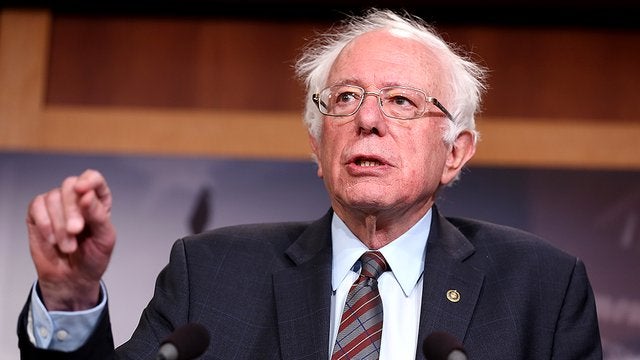
“I do not believe that we should give the right-wing extremist Netanyahu government an additional $10.1 billion with no strings attached.”
By Jake Johnson / Common Dreams, more https://scheerpost.com/2023/12/13/bernie-sanders-votes-no-on-giving-israel-aid-to-continue-inhumane-war-on-gaza/
Sen. Bernie Sanders was the lone member of the Senate Democratic caucus to oppose advancing a $110.5 billion supplemental foreign aid measure on Wednesday, expressing opposition to the bill’s unconditional military assistance for the Israeli government.
“I voted NO on the foreign aid supplemental bill today for one reason,” Sanders (I-Vt.) said in a statement. “I do not believe that we should give the right-wing extremist Netanyahu government an additional $10.1 billion with no strings attached to continue their inhumane war against the Palestinian people.”
“Israel has the absolute right to defend itself against the Hamas terrorists who attacked them on October 7,” Sanders added. “They do not have the legal or moral right to kill thousands of innocent Palestinian men, women, and children.”
The aid package, which also includes billions in military assistance for Ukraine, failed to clear a procedural hurdle Wednesday, with every Republican voting no over the absence of immigration policy changes that progressives have condemned as draconian. Senate Majority Leader Chuck Schumer (D-N.Y.) flipped his initial yes vote to no in a maneuver that will allow him to bring the bill forward again at a later date.
According to a summary released by the Senate Appropriations Committee, the supplemental package contains over $10 billion in military aid for Israel, which already receives roughly $4 billion in assistance from the U.S. per year and has gotten tens of thousands of bombs, artillery shells, and other weaponry since the Hamas-led October 7 attack.
The measure is largely in line with a request issued in October by the Biden White House, which has sought to expedite U.S. arms shipments to Israel even as the nation’s military is using American-made weaponry to commit heinous war crimes in the Gaza Strip.
One human rights monitor estimated earlier this week that at least 90% of the people killed by Israeli forces in Gaza since October 7 have been civilians.
Sanders, who has faced progressive criticism and outrage for rejecting calls for a permanent cease-fire in Gaza, said in a Senate floor speech on Monday that Israel “must dramatically change its approach to minimize civilian harm and lay out a wider political process that can secure lasting peace.”
The senator conceded during his remarks that there is no evidence Israel has altered its approach in response to light pressure from top U.S. officials, pointing to recent bombings of United Nations schools and other civilian infrastructure.
“Israel’s indiscriminate approach is, in my view, offensive to most Americans, it is in violation of U.S. and international law, and it undermines the prospects for lasting peace and security,” said Sanders.
TODAY. The demise of Vladimir Zelensky – when will the USA throw him under a bus?
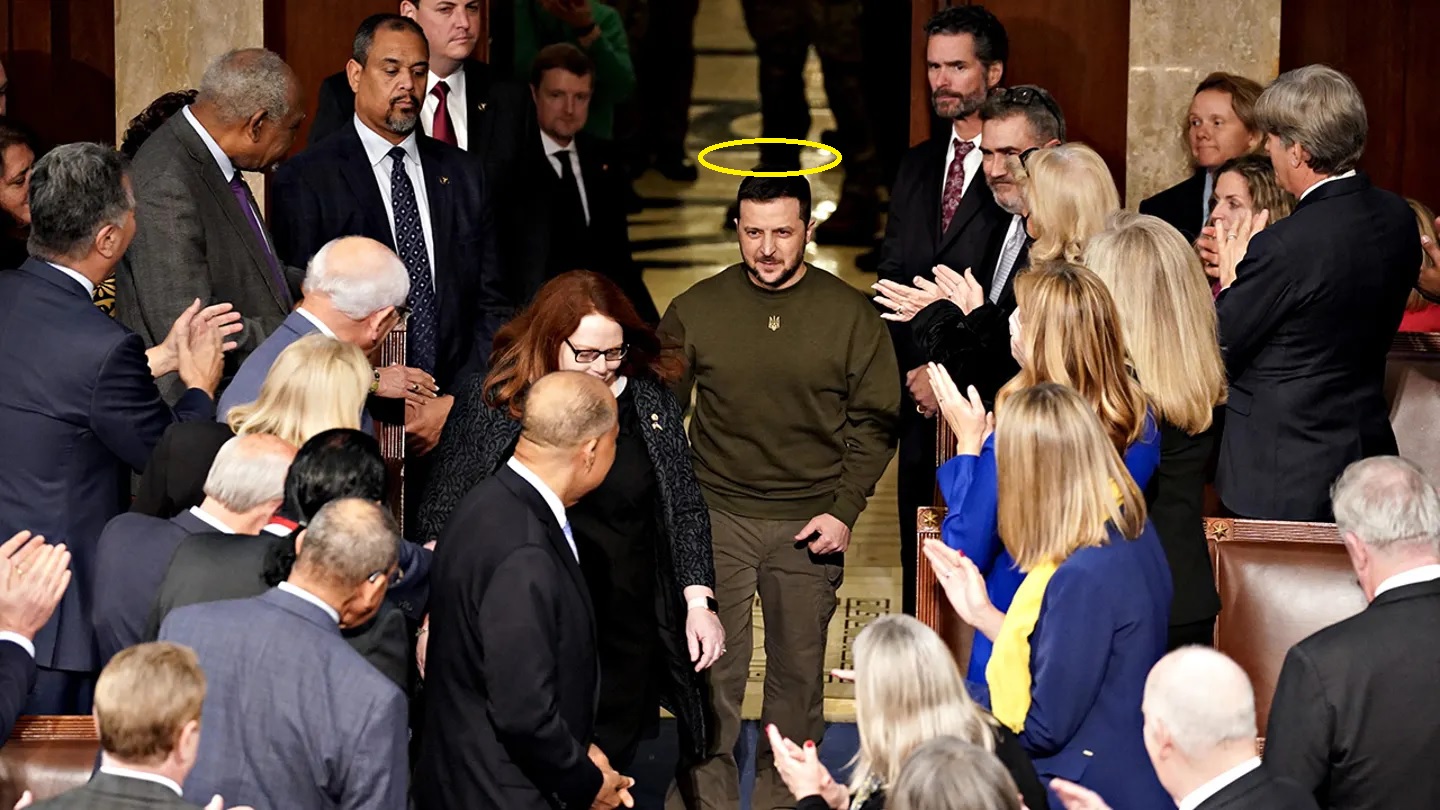
The augurs are not good for Ukraine’s President Zelensky .
Menacing clouds gather: Zelensky in his latest trip to Washington failed to get more $billions from USA – the Ukraine counter-offensive against Russia has failed – European support for Ukraine is faltering- huge losses of soldiers and civilians – continuing corruption in Ukraine – shutting down of Orthodox churches in closed trials, alienation of all except fascist and nazi -connected political parties – unhappiness of oppressed Russian-speaking citizens.
With complete disregard for Ukraine’s history, – its experiences during World War 2, the Minsk agreement, the 8 years of war against the Donbass region, and then disregard of Zelensky’s promises pre-election, – USA and the West swallowed the whole magical myth of Zelensky as messiah for Ukraine, saving the world from the satanic Putin.
It might have been wise to consider just who is this person they are choosing to lead Ukraine, USA, NATO into this super-expensive murderous mess. The comedic background sounds like fun - the clown who once pretended to play the piano with his penis. But not only did Zelensky lack a background in politics: he was really out of his depth in the complicated and corrupt world of Ukraine’s business and political system
What Zelensky did have was an inflated ego, a narcissistic personality, and a superb ability to charm, con and persuade people. So he’s brave, energetic, etc. But it has been a disastrous two-way street - Zelensky conning the West and the West conning Zelensky. into Ukraine’s suicidal aim to humiliate Russia, re-acquire Crimea and the Donbass, and become a NATO bastion.
In the meantime, the Ukrainian death toll mounts, and the USA weapons manufacturers profits mount.
But hey! – now we’ve got the Israel-Gaza crisis. That all needs USA weapons, too, to keep that massacre going. The spotlight is off Ukraine.
There must be many who resent Zelensky – to put it mildly. Perhaps there will be a negotiated way out of the Ukraine mess, and Zelensky might safely slide off to quiet retirement overseas.
Vladimir Zelensky has been very useful to the USA. But it’s time to discard him.
1 This Month


Tell the Ukrainian Government to Drop Prosecution of Peace Activist Yurii Sheliazhenko

Petition to revoke the licensing of the Near Surface Nuclear Disposal Facility (NSDF) at Chalk River. https://www.ourcommons.ca/petitions/en/Petition/Details?Petition=e-7247


of the week – STOP SMALL MODULAR REACTORS IN CANADA
To see nuclear-related stories in greater depth and intensity – go to https://nuclearinformation.wordpress.com
-
Archives
- March 2026 (204)
- February 2026 (268)
- January 2026 (308)
- December 2025 (358)
- November 2025 (359)
- October 2025 (376)
- September 2025 (258)
- August 2025 (319)
- July 2025 (230)
- June 2025 (348)
- May 2025 (261)
- April 2025 (305)
-
Categories
- 1
- 1 NUCLEAR ISSUES
- business and costs
- climate change
- culture and arts
- ENERGY
- environment
- health
- history
- indigenous issues
- Legal
- marketing of nuclear
- media
- opposition to nuclear
- PERSONAL STORIES
- politics
- politics international
- Religion and ethics
- safety
- secrets,lies and civil liberties
- spinbuster
- technology
- Uranium
- wastes
- weapons and war
- Women
- 2 WORLD
- ACTION
- AFRICA
- Atrocities
- AUSTRALIA
- Christina's notes
- Christina's themes
- culture and arts
- Events
- Fuk 2022
- Fuk 2023
- Fukushima 2017
- Fukushima 2018
- fukushima 2019
- Fukushima 2020
- Fukushima 2021
- general
- global warming
- Humour (God we need it)
- Nuclear
- RARE EARTHS
- Reference
- resources – print
- Resources -audiovicual
- Weekly Newsletter
- World
- World Nuclear
- YouTube
-
RSS
Entries RSS
Comments RSS
 nuclear-news