4 east African countries are going for nuclear power – why this is a bad idea
The Conversation, Hartmut Winkler, Professor of Physics, University of Johannesburg, 8 Dec 23
The east Africa region has the fastest growing population in Africa. Between 2013 and 2017, its growth rate was twice the African average. The region is also experiencing strong economic growth. It’s sub-Saharan share of GDP has risen from 14% in 2000 to 21% in 2022.
Such growth translates to higher electricity demand. Among a variety of new energy proposals is building nuclear power plants. Earlier this year, Uganda announced plans to construct a 2,000MW nuclear plant 150km north of Kampala, with the first 1,000MW operational by 2031. Rwanda also recently signed up to a deal to build a nuclear reactor, while Kenya and Tanzania have made more or less similar announcements.
It is in many ways tempting for these countries to pursue a nuclear power plant build. Even a single large-scale nuclear reactor would typically double national electricity generation capacity. In addition, it is technology that is – in theory at least – able to provide a constant electricity output independent of weather, season or time of day.
Another factor that motivates many potential entrants to nuclear power is that it has historically been perceived in many quarters as confirmation of high technological status and proof of national respectability. This is despite many of the world’s technologically and economically strongest nations now having shut down their nuclear plants. Germany and Italy are examples.
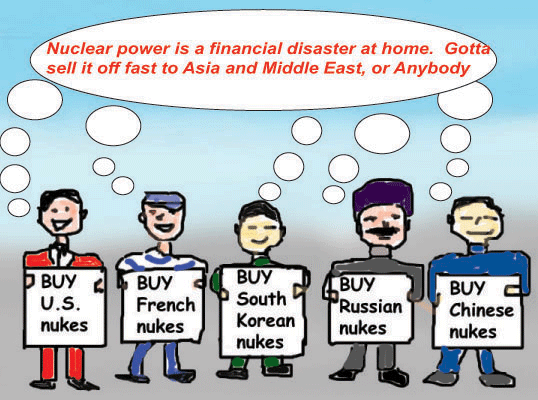
But there are several risks of choosing the nuclear path. The biggest in my view is financial. The costs of constructing, maintaining and later decommissioning a nuclear plant make this one of the most expensive forms of electricity generation. The actual cost is invariably a lot higher than originally announced.
Along with that, the construction period is usually many years longer than declared at the start.
In addition, safety issues can never be discounted when dealing with nuclear energy, as the 2011 Fukushima disaster in Japan amply illustrated………………………………………………………………………………..
East Africa’s likely future energy mix
In view of the financial risk and high cost, and as global experience has shown that it typically requires ten or more years to set up a new nuclear plant from project approval to electricity production, east African countries should pursue alternatives for electricity production.
New medium-scale solar, wind and geothermal power-generating facilities would likely dominate the expansion of east African electricity generation capacity in the coming decade as they are cheap in comparison. Typical construction timescales are also much lower than nuclear or hydro megaprojects.
………………………………………………………………… Given all these factors, investing in a large and expensive nuclear build with uncertain completion timeframes that may end up being way more expensive than projected is ultimately simply not worth it.
https://theconversation.com/4-east-african-countries-are-going-for-nuclear-power-why-this-is-a-bad-idea-218046
No comments yet.
1 This Month


Tell the Ukrainian Government to Drop Prosecution of Peace Activist Yurii Sheliazhenko

Petition to revoke the licensing of the Near Surface Nuclear Disposal Facility (NSDF) at Chalk River. https://www.ourcommons.ca/petitions/en/Petition/Details?Petition=e-7247


of the week – STOP SMALL MODULAR REACTORS IN CANADA
To see nuclear-related stories in greater depth and intensity – go to https://nuclearinformation.wordpress.com
-
Archives
- March 2026 (183)
- February 2026 (268)
- January 2026 (308)
- December 2025 (358)
- November 2025 (359)
- October 2025 (376)
- September 2025 (258)
- August 2025 (319)
- July 2025 (230)
- June 2025 (348)
- May 2025 (261)
- April 2025 (305)
-
Categories
- 1
- 1 NUCLEAR ISSUES
- business and costs
- climate change
- culture and arts
- ENERGY
- environment
- health
- history
- indigenous issues
- Legal
- marketing of nuclear
- media
- opposition to nuclear
- PERSONAL STORIES
- politics
- politics international
- Religion and ethics
- safety
- secrets,lies and civil liberties
- spinbuster
- technology
- Uranium
- wastes
- weapons and war
- Women
- 2 WORLD
- ACTION
- AFRICA
- Atrocities
- AUSTRALIA
- Christina's notes
- Christina's themes
- culture and arts
- Events
- Fuk 2022
- Fuk 2023
- Fukushima 2017
- Fukushima 2018
- fukushima 2019
- Fukushima 2020
- Fukushima 2021
- general
- global warming
- Humour (God we need it)
- Nuclear
- RARE EARTHS
- Reference
- resources – print
- Resources -audiovicual
- Weekly Newsletter
- World
- World Nuclear
- YouTube
-
RSS
Entries RSS
Comments RSS
 nuclear-news
Leave a comment