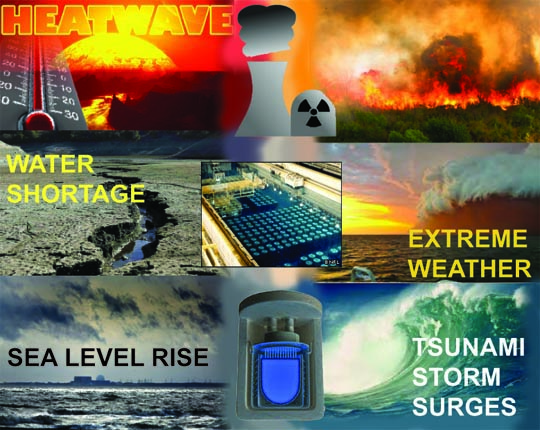
Changing ambient temperatures are already posing serious risks to nuclear plants across the world. Nuclear regulators cannot wait until sea-level rise coupled with storm surges begin impacting operational safety of their plants—they must act now.
Note: This is part two of a two-part blog series on the impacts of climate change on nuclear power plants. Check out our first blog post on the impact of increasing ambient temperatures.
Climate action isn’t simply about reducing emissions—it’s also about addressing local environmental concerns and minimizing risks to human health and safety. With that in mind, if nuclear power is going to have a role in addressing climate change, stronger safety and environmental regulations will be needed.
Unfortunately, this approach is missing from the U.S. Nuclear Regulatory Commission (NRC), which in January voted in a 3-to-2 decision to water down recommendations from its own staff to reevaluate seismic and flooding hazards at nuclear sites. “This decision is nonsensical,” Commissioner Jeff Baran wrote in his dissent, “Instead of requiring nuclear power plants to be prepared for the actual flooding and earthquake hazards that could occur at their sites, NRC will allow them to be prepared only for the old, outdated hazards typically calculated decades ago when the science of seismology and hydrology was far less advanced than it is today.”
The January ruling came almost eight years after staff scientists released a list of recommendations in direct response to the 2011 Fukushima nuclear meltdown. With the approval (and pending approvals) this year to rollback multiple safety regulations , the U.S. nuclear fleet, the oldest in the world, cannot afford to wait another decade to strengthen safety and environmental regulations in preparation of climate change–in this case, rising sea levels.
What are the Risks?
Nuclear power plants require huge amounts of water to prevent fission products in the core and spent nuclear fuel from overheating (incidentally making nuclear the most water intensive energy source in terms of consumption and withdrawal per unit of energy delivered). That’s why over 40 percent of the world’s nuclear plants are built along the coasts, with that number rising to 66 percent for just plants under construction. Unable to run on the electricity it generates itself to power the pumps that provide cooling water to the core and to the spent nuclear fuel stored onsite, a nuclear plant must rely on the grid or backup generators to ensure cooling water circulation. Any hazard that cuts off access to those sources of power restricts access to cooling water, ultimately risking a nuclear meltdown and off-site release of radiation, as happened during the flooding of Fukushima.
Flooding evaluations conducted by the NRC concluded that 55 of the 61 evaluated U.S. nuclear sites experienced flooding hazards beyond what they were designed to handle. Even more alarming, in 2014, the flood barriers at Florida Power & Light’s St. Lucie Nuclear Plant–one of the few plants reported to be prepared for disaster but which had been missing proper seals for decades–gave way to 50,000 gallons of water after heavy rainfall.
Storm surges like the one at St. Lucie Nuclear plant and extreme weather events, as witnessed in Fukushima, pose very real risks to both operational and decommissioned plants, almost all of which (in the US) will continue to store nuclear waste onsite for decades until a permanent storage solution is found. Coupled with increasingly rising sea-levels, these risks will continue to grow. Even under a very low scenario of 1°C warming by midcentury, the 2018 U.S. National Climate Assessment reports that the “frequency, depth, and extent of both high tide and more severe, damaging coastal flooding will increase rapidly in the coming decades.” And the Intergovernmental Panel on Climate Change concluded that 1.5°C of warming could be reached in as little as 11 years.
While all energy technologies will be impacted in some way by the increasing severity of natural disasters and sea level rise, the failure of nuclear power plants can result in irreversible health and environmental consequences on top of social and economic damages, including worst of all the release of radiation that can remain lethal for thousands of years. Under government estimates, the Fukushima meltdown resulted in the displacement of 165,000 people, cleanup and compensation costs of up to $200 billion, and a timeline of 30 to 40 years. Experts say, however, that true costs could reach $500 billion and decontamination timelines could be underestimated by decades.
Nuclear in East Asia
Despite initial vocal opposition from the public in many East Asian countries that have slowed down nuclear buildout after Fukushima, the direction of government policies for nuclear development in East Asia remain mostly unchanged, and have simply resulted in rather a more conservative, moderate pace. In fact, this pace has sustained much of nuclear development in East Asia, home to many countries that have found nuclear power as an attractive solution to addressing the dilemma between achieving energy security for an increasing population and decarbonizing to mitigate global climate change.
Of the 56 nuclear power plants currently in construction around the world, 33 of them are in Asia; 16 in China alone. As observed in the graph below, [on original] if all nuclear units that are currently under construction reach completion, East Asia is slated to become the region with the largest number of operating nuclear power plants, 93 percent of which will reside along the coast.
What is alarming is that East Asia and the Pacific region is uniquely vulnerable to sea-level rise. A 2015 report by Climate Central found that of the top 10 countries most likely to be affected sea level rise for 4°C warming, seven are in Asia. Similarly, in a study by the World Bank, China and Indonesia will be the most vulnerable to permanent inundation. Given the heightened flooding risks in Asia, strengthening the authority of regulatory structures that oversee the safety of nuclear build out will be increasingly important.
What’s the Plan?
Fukushima was a lesson to the global community that even one of the world’s most technologically advanced and experienced countries can fail to prevent a nuclear meltdown. To prepare for the realities of rising sea levels that pose unique risks to different nuclear plants, regulators must require climate adaptation plans and heightened safety oversight. Nonetheless, at the international scale, not much work is being done to address these sea-level rise concerns.
The Nuclear Energy Agency (NEA), in recognizing that the “world is ill-prepared for the risks from a changing climate,” conducted a study on the vulnerability of nuclear power plants to climate change, which is not yet available to the public. Since 2014, the International Atomic Energy Agency (IAEA) has begun to include a section about the impacts of climate change on nuclear energy in its annual Climate and Nuclear Power Report. Yet even as these international organizations detail the many hazards changing climate poses to nuclear reactors, preventative and/or adaptation measures do not seem to be prioritized or encouraged, especially for existing nuclear plants.
“Outside of their Scope” at Home
Similar attitudes are held here in the U.S. Perched at the southern tip of Florida, the Turkey Point Nuclear Generating Station is seeking to be the first U.S. nuclear plant permitted to run for 80 years. Initially refusing to consider sea-level rise in the environmental review of the license extension, the Nuclear Regulatory Commission (NRC) released a revised draft this year, only to come to the following conclusion: It’s outside of the scope of the agency.
If new information about changing environmental conditions (such as rising sea levels that threaten safe operating conditions or challenge compliance with the plant’s technical specifications) becomes available, the NRC will evaluate the new information to determine if any safety-related changes are needed at licensed nuclear power plants,” the NRC report said.
The report arrives at this conclusion by utilizing lower-bound sea level rise estimates from the 2018 U.S. Climate Change assessment, rationalizing that the report “assigns very high confidence to the lower bounds of these projections and medium confidence to the upper bounds.” As highlighted by this Bloomberg analysis released this year, nuclear plant operators are not only allowed to perform their own flood risk estimates but are also able to decide what assumptions are made, with review from the NRC.
The uncertainty that comes with sea-level rise projections obviously exists. In securing the safety of such critical infrastructure, however, using the highest sea-level rise estimates is the only way to ensure that all actions that can be taken against a potential threat are taken. On the other hand, relying on the lowest storm surge estimates is akin to receiving a warning about a potential threat, and taking the bare minimum actions to prepare for it.
Changing ambient temperatures are already posing serious risks to nuclear plants across the world. Nuclear regulators cannot wait until sea-level rise coupled with storm surges begin impacting operational safety of their plants—they must act now. With the world’s scientists calling attention to the climate crisis ahead of us, action must be taken to ensure nuclear plants are part of the solution, not the problem.
Nuclear energy generated 2,546 terawatt-hours (TWh) of electricity worldwide last year, accounting for 9.2% of total gross electricity generation, the annual World Nuclear Industry Status Report (WNISR) showed.
Proponents of nuclear say as a low-carbon power source it could be vital in helping countries meet climate targets, but several plants around the world are coming to the end of their life expectancies and many new ones have faced delays.
The most nuclear power in the world is generated in the United States, followed by China.
Nuclear energy has regained some popularity recently as countries search for low-carbon power sources, but long lead times, high costs and climate impacts put the prospect of nuclear as a solution at “virtually zero”, the WNISR said.
As of mid-2023, a total of 407 reactors were operating in 32 countries, four less than a year earlier and 31 below a 2002 peak of 438, the report said.
The slow progress of construction has lifted the average age of a reactor to 31.4 years by the end of 2022, up from 31 years in mid-2022, the report said.
Some 58 reactors representing 58.6 gigawatts (GW) of additional capacity were under construction by mid-2023, five more than in 2022, with four in five reactors being built in Asia or Eastern Europe and over half facing years-long delays, the report said.
Nuclear is also continuing to fall behind renewables in terms of cost, as reactors are seen as more expensive and taking longer to build.
The adjusted cost of nuclear energy – which compares the total lifetime cost of building and running a plant to lifetime output – is nearly four times that of onshore wind, the report said.
Reporting by Forrest Crellin Editing by Mark Potter
New Mexico’s congressional delegation has expressed outrage with the U.S. House leadership’s move to block compensation for people sickened by exposure to radiation during nuclear weapons testing and the mining of uranium during the Cold War
SANTA FE, N.M. — All members of New Mexico’s congressional delegation expressed outrage with the U.S. House leadership’s move to block compensation for people sickened by exposure to radiation during nuclear weapons testing and the mining of uranium during the Cold War.
Originally, the bill expanded eligibility for compensation under the Radiation Exposure Compensation Act, offering up tens of thousands of dollars in compensation to residents of New Mexico, Colorado, Montana, Guam and Missouri — as well as those in some parts of Arizona, Nevada and Utah — who suffered the effects of nuclear testing or uranium mines and who are not covered under the current program.
The Santa Fe New Mexican reported that the compensation was included in a massive defense spending bill that won Senate approval in July. But the GOP-controlled House removed those provisions from the act Wednesday, rendering New Mexicans — including those stricken with ailments from the radioactive fallout of the first atomic bomb — still ineligible for federal help unless it is reattached to the final bill.
“Generations of New Mexicans and their families have gotten sick and died from the radiation exposure and the lasting impacts of the Trinity Test,” said Sen. Ben Ray Luján, referring to the first-ever atomic bomb test in the New Mexico desert in 1945. “For New Mexico to have been ground zero for the first nuclear weapon — and left out of the original RECA program — is an injustice.”
Luján, a Democrat, has introduced radiation exposure compensation bills in every Congress since he was first elected to the U.S. House in 2008.
The hit summer film “Oppenheimer” about the top-secret Manhattan Project and the dawn of the nuclear age during World War II has brought new attention to decades-long efforts to extend compensation for families who were exposed to fallout and still grapple with related illness.
Advocates also have been trying for years to bring awareness to the lingering effects of radiation exposure on the Navajo Nation, where millions of tons of uranium ore were extracted over decades to support U.S. nuclear activities.
A first-of-its-kind nuclear energy summit will be held next year, it was announced at COP28 today. Leaders from around the world will gather in Brussels in March 2024 to highlight the role of nuclear energy in addressing the global challenges to reduce the use of fossil fuels, enhance energy security and boost economic development.
This factsheet analyzes the role of nuclear energy in global climate scenarios. It shows that a global tripling of nuclear capacity until 2050 is neither realistic nor is it needed to achieve climate targets according to the Paris agreement.
The factsheet presents an analysis of nine global climate scenarios that achieve climate targets according to the Paris agreement as well as two non-target scenarios with an emphasis on the role of nuclear energy.
In order to assess how realistic these top-down scenarios are, it compares these figures with the plans and programs of governments for the expansion (or phase out) of nuclear power.
A tripling of today’s nuclear capacity of 370 GW would require 1.110 GW net electrical capacity to be operational in 2050. If we assume a very high sixty year lifetime for all nuclear reactors in operation and under construction today, roughly 210 GW of the current nuclear fleet would still be online in 2050.
Thus, a total of nearly 900 GW would have to be constructed additionally between 2024 and 2050. Assuming a linear increase in the rate of new construction up to 2050, starting with the amount of new nuclear connected to the grid in 2023, in 2050 more than 60 GW would need to be connected to the grid to meet the tripling nuclear target, compare Figure 10.
This would be approximately twice the maximum historic capacity connected to the grid in a single year. On average, more new capacity would have to be added every year over 25 years as was the case at the historical maximum in 1985. From these numbers, it is evident, that a tripling of nuclear capacity until 2050 is neither realistic nor is it needed to achieve climate targets according to the Paris agreement.
The Conversation, Hartmut Winkler, Professor of Physics, University of Johannesburg, 8 Dec 23
The east Africa region has the fastest growing population in Africa. Between 2013 and 2017, its growth rate was twice the African average. The region is also experiencing strong economic growth. It’s sub-Saharan share of GDP has risen from 14% in 2000 to 21% in 2022.
Such growth translates to higher electricity demand. Among a variety of new energy proposals is building nuclear power plants. Earlier this year, Uganda announced plans to construct a 2,000MW nuclear plant 150km north of Kampala, with the first 1,000MW operational by 2031. Rwanda also recently signed up to a deal to build a nuclear reactor, while Kenya and Tanzania have made more or less similar announcements.
It is in many ways tempting for these countries to pursue a nuclear power plant build. Even a single large-scale nuclear reactor would typically double national electricity generation capacity. In addition, it is technology that is – in theory at least – able to provide a constant electricity output independent of weather, season or time of day.
Another factor that motivates many potential entrants to nuclear power is that it has historically been perceived in many quarters as confirmation of high technological status and proof of national respectability. This is despite many of the world’s technologically and economically strongest nations now having shut down their nuclear plants. Germany and Italy are examples.
But there are several risks of choosing the nuclear path. The biggest in my view is financial. The costs of constructing, maintaining and later decommissioning a nuclear plant make this one of the most expensive forms of electricity generation. The actual cost is invariably a lot higher than originally announced.
Along with that, the construction period is usually many years longer than declared at the start.
In addition, safety issues can never be discounted when dealing with nuclear energy, as the 2011 Fukushima disaster in Japan amply illustrated………………………………………………………………………………..
East Africa’s likely future energy mix
In view of the financial risk and high cost, and as global experience has shown that it typically requires ten or more years to set up a new nuclear plant from project approval to electricity production, east African countries should pursue alternatives for electricity production.
New medium-scale solar, wind and geothermal power-generating facilities would likely dominate the expansion of east African electricity generation capacity in the coming decade as they are cheap in comparison. Typical construction timescales are also much lower than nuclear or hydro megaprojects.
The global nuclear industry got a morale boost at the COP28 climate summit in Dubai after more than 20 nations vowed to triple capacity by 2050. But reaching that goal will require the industry to overcome regulatory hurdles, financing obstacles, fuel bottlenecks, and public safety concerns that have contributed to a long history of project delays and decades of stagnation.
It took 70 years to bring global nuclear capacity to the current level of 370 gigawatts (GW), and the industry must now select technologies, raise finance and develop the rules to build another 740 GW in half that time.
“Judging by the international nuclear industry’s performance over the past two decades, it is impossible,” said Mycle Schneider, lead author of the World Nuclear Industry Status Report.
The declaration, signed by the U.S., France, Britain, South Korea, and others commits countries to mobilise investment and encourage financial institutions like the World Bank to back nuclear power. It also promises efforts to extend the life of existing plants – with about 200 of 420 reactors around the world scheduled to be decommissioned before 2050 – and support for new technologies like small modular reactors (SMRs).
Yesterday, 22 countries including the United States, the United Kingdom, South Korea, Canada, Hungary, and the Netherlands signed a pledge to triple nuclear deployment by 2050.
TerraPower and the UK have stalled on discussions around UK projects, but nuclear on the whole is another energy front on which the UK is currently losing ground.
The target of 24 GW by 2050 was first conceived in the Energy Security Strategy of 2021 but precious little progress has been made since.
Even with the reactor plans it has been able to conceive, the sector remains repeatedly hamstrung by bureaucratic process and the absence of a long-awaited nuclear road map that is likely delayed once more to 2024.
A significant factor halting development is that nuclear investment is still not labelled green, despite being promised by the Chancellor back in March.
Examining the UK’s current stock showcases the problem even further. British nuclear capacity stands at 5.9 GW, 4.7 GW of which retires in less than five years.
Through completing Hinkley Point C, Sizewell C and securing a life extension to Sizewell B, the UK could reach 7.7 GW; less than one third of the 24 GW target.
In the 12 years since the UK restarted nuclear development, only one project has proceeded to a Final Investment Decision (HPC in 2016).
To get to 24 GW of capacity by 2050, the UK nuclear needs to build and start operations on another six Hinkley Point C-size projects and move the stymied Sizewell C project into production.
………………………………….those within the sector believe the government is still avoiding making short-term capital investments to shore up the long-term energy security set out in 2021.
One official involved in the UK nuclear industry told City A.M: “They’re slow and hesitant, we know what happens when you have government money tied up in multi-billion pound projects and a sniff of a cost increase comes along, they opt to slow down and rethink”.
Others believe that despite union backing for large job creators like Hinkley Point, a Labour government isn’t in a position to speed up the nuclear timeline.
Negotiations on how the world can slash greenhouse gas emissions and stave off the worst impacts of the climate crisis will reach a fresh intensity over the next few days, with nations wrangling over whether to phase out or phase down fossil fuels.
For the remaining five negotiating days of the Cop28 UN climate summit in Dubai ministers will hold a series of meetings to try to break the impasse and present a text that sets out a roadmap for staying within a rise of 1.5C of global heating above preindustrial levels.
Simon Stiell, the UN climate chief, told countries: “Now all governments must give their negotiators clear marching orders – we need highest ambition, not point-scoring or lowest common denominator politics. Good intentions won’t halve emissions this decade or save lives right now.”
With its supply of Western weapons dwindling and little sign of change from the NATO powers, Ukraine will be incapable of launching another counteroffensive like last summer, an analyst told Sputnik. However, barring a mutiny or political crisis, a collapse of the Ukrainian war effort isn’t necessarily imminent.
White House Office of Management and Budget Director Shalanda Young told federal lawmakers on Monday that the US was “out of money to support Ukraine in this fight.”
According to Pentagon statistics, the US has sent Ukraine some $44 billion in military aid since February 2022, as well as $76 billion in other types of support, including budget financing and humanitarian aid. US President Joe Biden has asked for billions more to be approved, but the Republican majority in the House, now led by Ukraine skeptic House Speaker Mike Johnson (R-LA), has remained cool to the idea without improvements in oversight.
Moscow-based international relations security analyst Mark Sleboda told Radio Sputnik’s The Final Countdown on Monday that Ukrainian President Volodymyr Zelensky was correct in a way: Ukraine is indeed entering a new phase of the conflict – a defensive phase, as it waits and hopes that time will bring favorable changes to the situation.
“But it is definitely having an effect on the battlefield in Ukraine. There was already a trend because of the US and collectively NATO’s inability to ramp up their own industrial production to provide their Kiev Regime proxy with enough of the war basics like artillery shells, air defense missiles, and many other things that it needed. And now, that is coupled with the fact that Kiev is competing with Israel for many of the same things, which have been on the demand list … for Israel for what it needs for its conflict. And Zelensky is finding himself second-fiddle, vying not only for attention and supplies and funding” from the US and European Union, which he said had hit a “speed bump” in attempting to support both Kiev and Jerusalem at once…………………..
Over the weekend, NATO Secretary-General Jens Stoltenberg said the alliance “should also be prepared for bad news” from Ukraine, noting that wars “develop in phases” and that the West should continue to support Kiev “in both good and bad times.”
“For Zelensky, this is really a case of ‘the emperor has no clothes,’” Sleboda said, noting that other figures had turned against him, too, including anti-Russian journalist Simon Shuster, who quoted Ukrainian officials calling Zelensky “delusional” and claiming he won’t hear talk of Ukraine losing the conflict, and Kiev Major Vitaly Klitschko had called Zelensky “authoritarian.”
“I guess the Western propaganda is failing, and when the mainstream media is already out in front of him, even Jens Stoltenberg has to turn it around and admit certain things, although it must be said that these admissions are not coming in front of the media, they’re coming behind it, he simply no longer has any propaganda spin for maneuver.”
Sleboda said he agreed with Zelensky that Ukraine had entered a new phase of the conflict.
“Their offensive days are over, there is no large new offensive package from the West anywhere within sight, there’s not even enough maintenance aid to continue basic supplies of anything at this point. So the next year is solidly about desperate defense, building defensive lines, and a much-talked-about new total mobilization, meaning mass, forced conscription, that could possibly include 17- to 70-year-olds now and possibly women being conscripted for combat roles. And, evidently, it is going to be privatized, the last months of conscription having failed miserably, they are now evidently going to turn to private companies, which literally means Westerners coming in and help press-gang Ukrainians off the streets and putting them in the trenches.”
Andrey Yermak has called for more funds for Kiev as Congress remains at loggerheads
President Vladimir Zelensky’s chief of staff has admitted that there is a “big risk” that Ukraine will lose its conflict with Russia unless the US Congress approves more funding to support Kiev. Andrey Yermak was among a number of Ukrainian officials who “swarmed Washington” ahead of a Senate vote on a White House request for over $100 billion in aid for Kiev, Israel and Taiwan, according to the New York Times.
Republican lawmakers are adamant that they will not approve the spending, unless the Democrats compromise on the issue of southern border security. President Joe Biden called their resistance “crazy” and “totally wrong.”
Yermak made the case for more funding during an appearance at the US Institute of Peace, a Washington-based government-funded think tank. He claimed that his country had inflicted casualties on Russian forces at a ratio of 1:10, and was capable of defeating it on the battlefield in the long run. However, he admitted that even a delay in the provision of American aid could pose a challenge for Kiev. Such an outcome would “give the big risk that we can be in [the] same position [where] we are located now,” he said, speaking in English, presumably meaning a lack of progress in retaking land from Russia. “Of course, it make with very high possibility impossible to continue liberate and give the big risk to lose this war,” Yermak added.
Zelensky’s chief-of-staff was ostensibly promoting the so-called “peace formula” that was first floated by the Ukrainian president last year. It would involve full control over pre-2014 territories for Kiev, while Russia would pay war reparations and face a tribunal. Moscow has dismissed these demands as detached from reality.
Yermak claimed that helping Ukraine to beat Russia was of strategic importance to the US and its allies. Zelensky himself was scheduled to make a virtual appearance at a closed Senate hearing, during which senior White House officials gave lawmakers a briefing on the importance of appropriations. He canceled at the last moment.
The Republican-controlled House has previously declined to include Ukraine aid in stopgap spending bills on two previous occasions, which kept the US government from shutting down this year.
Speaker Mike Johnson has demanded a “full accounting of how prior US military and humanitarian aid” to Ukraine was spent and a plan for “an accelerated path to victory” from the White House. Lawmakers opposed to bankrolling Ukraine have cited concerns over corruption in Kiev and the cost to American taxpayers as key objections.
The US Department of State and US Export-Import Bank (EXIM) have announced a suite of financial tools to support the deployment of advanced nuclear energy systems to help reach net-zero goals. They also announced plans to mobilise more than USD4.2 billion of investment in enrichment and conversion capacity through the five-nation Sapporo 5 collaboration.










 nuclear-news