As the global corporate media fawns over the nuclear industry, The Guardian has the guts to do some REAL INVESTIGATIVE JOURNALISM .

If you type in “Google News” , and then “Nuclear” you will get an endless list of pro nuclear headlines: Nuclear power is the only solution – EU says nuclear is clean after all – Nuclear power finally has its moment at UN climate summit – Nuclear power deserves a place in the clean energy mix ……….Nuclear power takes center stage at COP 28 – Triple nuclear power by 2050 to address climate change. Climate is the focus this week, though usually it is praise for Small Nuclear Reactors (SMRs).
It’s understandable. Journalists want to keep their jobs. News Media want to stay “respectable” with powerful businesses and governments. So – they toe the line, dutifully regurgitating the pro nuclear handouts given to them by powerful businesses and governments.
But hey! What happened? This week the Guardian went way off script! Their naughty journalists – Anna Isaac and Alex Lawson have gone and done a whole heap of burrowing, excavating, doggedly pursuing – the facts about Sellafield. They’ve found safety concerns, risks to other countries, endless costs of endless toxic wastes, hacking, radioactive leaks and toxic workplace culture.
What could Isaac and Lawson be thinking of? And What bad taste! Just as The IAEA and global nuclear lobby are pitching themselves as our saviour at the climate summit.
And – have they committed professional suicide? Will The Guardian now be damned as a “suspicious website”?
The other possibility is – that other journalists and media might now show a bit of backbone, and start taking an interest in telling us the truth about the nuclear industry.
Nuclear Power Pushing at the UN’s COP28 Climate Change Conference
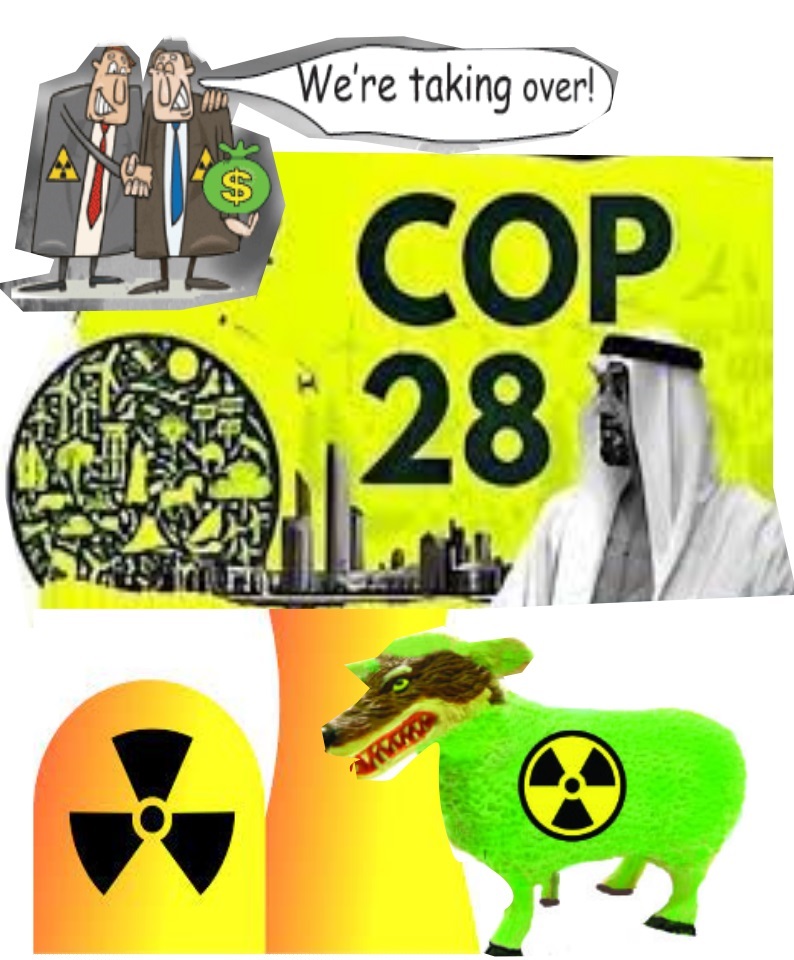
in the way of a vested interest, nuclear interests, corporate and governmental, moved in on COP28.

Beyond its danger and multi-billion dollar cost, nuclear power is not an antidote for climate change—it’s not “carbon emissions-free”
the nuclear fuel cycle—including uranium mining, enrichment and fabrication of nuclear fuel—is “carbon intensive.”
by Karl Grossman., Dec 6, 2023, https://www.thesentinel.com/communities/nuclear-power-pushing-at-the-un-s-cop28-climate-change-conference/article_16811ba6-9472-11ee-8a41-77222a8ab869.html
“U.S. leads coalition to triple nuclear power by 2050 in effort to address climate change,” was the headline of a December 4th CNBC article on activity at the UN conference called COP28 being held in Dubai, United Arab Emirates on the climate crisis.
COP stands for Conference of the Parties, annual gatherings under the United Nations Framework Convention on Climate Change. The 28 is for this being the 28th session. It began on November 30th and is to end on December 12.
When it started, there was a stir over the conference president being Sultan Al Jaber who just happens to head the UAE’s state-owned oil company, Abu Dhabi National Oil Company, (ADNOC). Time magazine splashed a photo of Al Jaber on its cover with the caption: “Oil executive Sultan Al Jaber is at the center of a global climate fight. MAN IN THE MIDDLE.”
The UAE “has the world’s largest oil reserves and has historically worked to protest its fossil-fuel economy in climate negotiations,” noted Time.
And it soon became clear that the sultan was not just in “the middle” as reports emerged in media about how in an online event in November “he cast doubt on whether eliminating fossil fuels would help limit global warning,” as Rolling Stone reported.
Here was documentation of a chief executive of an oil company who was leading the climate change conference minimizing the role of fossil fuels in climate change when the burning of fossil fuels has long been determined by scientists to be its leading cause. “There is no science out there, or no scenario out there, that says that the phase-out of fossil fuel is what’s going to achieve 1.5C,” he was quoted as saying. He added that phasing out fossil fuels would “take the world back into caves.”
Al Jaber’s vested interest was focused upon.
But then, in the way of a vested interest, nuclear interests, corporate and governmental, moved in on COP28.
As the CNBC piece related, at COP28 “the “U.S. and more than 20 other countries pledged to triple nuclear power to achieve net-zero carbon emissions and limit climate change. The declaration is the most concrete step taken yet by major nations to place nuclear power at the center of the push to transition to clean energy. Interest in nuclear is booming worldwide amid growing recognition that a dependable source of clean electricity will be needed to support the rapidly growing role of wind and solar in power grids.”
Nations signing on to what was titled a “Declaration to Triple Nuclear Energy” which was presented at COP28 on December 2 included, beyond the U.S., the United Kingdom, Canada, France, Japan, Hungary, Sweden, Netherlands, Ukraine, Czech Republic, Finland, Ghana, Hungary, Bulgaria, Moldova, Mongolia, Morocco, Netherlands, Poland, Romania, Slovakia, Slovenia and, yes, United Arab Emirates.
It begins: “Recognizing the key role of nuclear energy in achieving global net-zero greenhouse gas emissions/carbon neutrality by or around and mid-century and in keeping a 1.5C limit on temperature rise within reaching and achieving Sustainable Development Goal”—and then begins a series of paragraphs starting with “Recognizing.”
This includes: “Recognizing that nuclear energy is already the second-largest source of clean dispatchable baseload power” and “Recognizing the IAEA’s activities in supporting its members states”—referring to the International Atomic Energy Agency set up by the UN with a mission to promote nuclear power—and “Recognizing the importance of financing for the additional nuclear power capacity needed to keep a 1.5C limit on temperature rise within reach” and “Recognizing the need for high-level political engagement to spur further action on nuclear power,” the “Participants in this pledge” agree to a series of commitments.
These include committing to “invite shareholders of the World Bank, international financial institutions, and regional development banks to encourage the inclusion of nuclear energy in their organizations’ energy lending policies” and to “recognize the importance, where technically feasible and economically efficient, of extending the lifetimes of nuclear power plants” and committing “to support responsible nations looking to explore new civil nuclear deployment” and to “welcome and encourage complementary commitments from the private sector, non-governmental organizations, development banks, and financial institutions” and “to review progress toward these commitments on an annual basis on the margin of the COP.”
Further, it calls “on other countries to join this declaration.”
Commenting on the declaration, Harvey Wasserman, author of the books Killing Our Own: The Disaster of America’s Experience with Atomic Radiation and Solartopia, called it “beyond insane.” Promoters of nuclear power are making, he told me, a “full court press” to push it, trying to use climate change as a new reason while attempting “to kill” renewable energy technologies led by solar and wind, skyrocketing in adoption and efficiency and plummeting in cost.
Dr. Mark Z. Jacobson, director of the Atmosphere/Energy Program and professor of civil and environmental engineering at Stanford University, called the declaration the “stupidest policy proposal I’ve ever seen.” Jacobson’s most recent books are No Miracles Needed: How Today’s Technology Can Save Our Climate and Clean Our Air and before that 100% Clean, Renewable Energy and Storage for Everything. He says: “The world needs to switch away from using fossil fuels to using clean, renewable sources of energy as soon as possible.” In his books he details the use of existing technologies to produce, store and transmit energy from wind, water and solar sources. As to nuclear power, it is “not needed” to deal with climate change.
Beyond its danger and multi-billion dollar cost, nuclear power is not an antidote for climate change—it’s not “carbon emissions-free,” its opponents say. Michel Lee, chair of the Council on Intelligent Energy & Conservation Policy, stresses how the nuclear fuel cycle—including uranium mining, enrichment and fabrication of nuclear fuel—is “carbon intensive.”
And, nuclear power plants themselves emit carbon-14, a radioactive form of carbon.
Moreover, spending money on new nuclear power diverts funding to provide for implementation of truly carbon emissions-free energy technologies, they say.
Last year, the former heads of nuclear regulation in the U.S., Germany and France, along with the former secretary of the U.K.’s radiation protection committee, issued a joint statement that said: “Nuclear is just not part of any feasible strategy that could counter climate change.”
The former leaders were Dr. Greg Jaczko, who had been chairman of the U.S. Nuclear Regulatory Commission; Wolfgang Renneberg, ex-head of Reactor Safety, Radiation Project and Nuclear Waste for the German government; Dr. Bernard Laponche who had been director general of the French Agency for Energy Management; and Dr. Paul Dorfman, who had been secretary of the U.K.’s Government’s Committee Examining Radiation Risk from Internal Emitters.
They wrote: “The central message, repeated again and again, that a new generation of nuclear will be clean, safe, smart and cheap, is fiction. The reality is nuclear is neither clean, safe or smart but a very complex technology with the potential to cause significant harm.”
Their statement continued that “nuclear as strategy against climate change is: Too costly in absolute terms to make a relevant contribution to global power production; More expensive than renewable energy in terms of energy production…; Too costly and risky for financial market investment and therefore dependent on very large public subsidies and local guarantees; Unsustainable due to the unresolved problem of very long-lived radioactive waste; Financially unsustainable as no economic institution is prepared to insure against the full potential cost, environmental and human impacts of accidental radiation release—with a majority of those very significant costs borne by the public; Militarily hazardous since newly promoted reactor designs increase the risk of nuclear weapons proliferation;
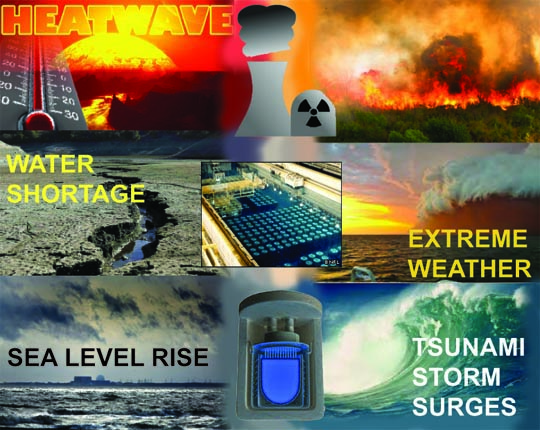
Further, their statement said nuclear power is not suitable to counter climate change because it is: “Inherently risky due to unavoidable cascading accidents from human error, internal faults and external impacts, vulnerability to climate-driven sea-level rise, storm, storm surge, inundation and flooding hazard…; Subject to many unresolved technical and safety problems associated with newer unproven concepts including ‘Advanced’ and Small Modular Reactors; Too unwieldly and complex to create an efficient industrial regime for reactor construction and operation processes within the intended build-time and scope needed for climate change mitigation; Unlikely to make a relevant contribution to necessary climate change mitigation needed by the 2030s due to nuclear’s impracticably lengthy development and construction time-lines and the overwhelming construction costs of the very great volume of reactors that would be needed to make a difference.”
A presentation by Pope Francis was read at COP28. “Are we working for a culture of life or a culture of death?” asked the pope. “Let us choose life! Let us choose the future! May we be attentive to the cry of the earth….Climate change signals the need for political change. Let us emerge from the narrowness of self-interest….Now there is a need to set out anew. May this COP prove to be a turning point demonstrating a clear and tangible political will that can lead to a decisive acceleration of ecological transition…achieved in four sectors: energy efficiency; renewable sources; the elimination of fossil fuels; and education in lifestyles that are less dependent on the latter.”
With the vested interest and self-interest shown so far at it, COP28 has far to go.
‘Dirty 30’ and its toxic siblings: the most dangerous parts of the Sellafield nuclear site
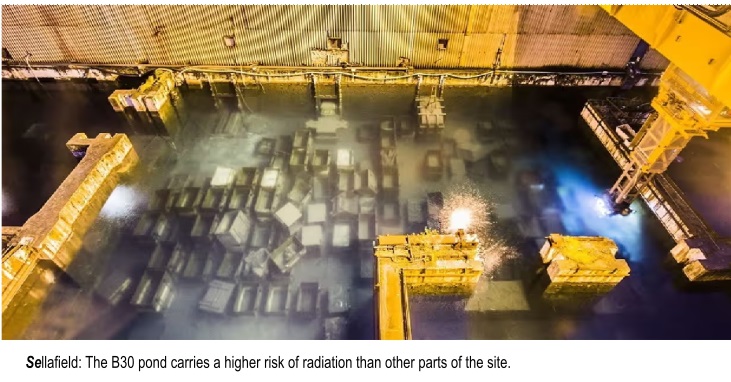
Cracks in ponds holding highly radioactive fuel rods lead to safety fears
https://www.theguardian.com/business/2023/dec/05/dirty-30-dangerous-sellafield-nuclear-site-ponds-safety-fears . by Alex Lawson and Anna Isaac
Radioactive sludge
In the early 1950s, a huge hole was dug into the Cumbrian coast and lined with concrete. Roughly the length of three Olympic swimming pools and known as B30, it was built to hold skip loads of spent nuclear fuel.
Those highly radioactive rods came from the 26 Magnox nuclear reactors that helped keep Britain’s lights on between 1956 and 2015. When B30 was first put to work, it was designed to keep the fuel rods submerged for only three months before reprocessing work was carried out.
But when 1970s miners’ strikes shut down coal power stations and forced greater reliance on nuclear plants, more spent fuel than could be quickly reprocessed was generated. The silos and ponds, built to prevent airborne contamination if the fuel or radioactive sludge dried out, rapidly filled up. Meanwhile, the fuel corroded in the water, breaking down into radioactive sludge.
Debris from elsewhere within Sellafield was later added and the pond was abandoned when new facilities were built in 1986, clouding over and leaving workers on site with little idea what lay beneath its murky waters.
‘A nightmare job with no blueprint’
In 2014, photos of B30 and nearby B29 leaked via an anonymous source to the Ecologist led to concerns over the radioactive risk associated with the poor repair of the ponds.
The two facilities were used until the mid-1970s for short-term storage of spent fuel until it could be reprocessed and used for producing plutonium for the military.
The Ecologist pictures showed hundreds of highly radioactive fuel rods in ponds housed within cracked concrete overgrown with weeds, with seagulls bathing in the water. The images, taken over a period of seven years, led the nuclear safety expert John Large to warn that any breach of the wall would “give rise to a very big radioactive release”.
At the time, the Office for Nuclear Regulation (ONR), the nuclear safety regulator, said that while the old ponds bring “significant challenges”, their appearance “does not mean that operations and activities on those facilities are unsafe”.
It took 15 years and £1.5bn to bring B30 to a point where decommissioning could begin several years ago, with builders limited to working only half an hour a day close to the pool to prevent them from exceeding radiation exposure limits. Remotely operated vehicles, normally used to help with submarine rescues, were originally deployed but quickly failed, often within hours, because of the overpowering radiation. Newer models have since been used to vacuum up nuclear sludge, which is then moved to alternative long-term storage.
Sellafield hopes to have drained the pond by the early 2030s, and demolished it by the 2050s.
A new facility, the sludge packaging plant, has been built to receive radioactive sludge from B30. The nuclear watchdog said there have been some “regulatory challenges along the way … including noncompliance with fire regulations”.
Although the reservoir is still nicknamed “Dirty 30”, it was officially rebranded in 2018 as the First Generation Magnox storage pond.
But one former longstanding employee says that, despite the cracks, the contents of the ponds are gradually improving: “I have seen it at its worst. The water quality was horrendous; you could stand on the roof and look down and not see a single thing in there.
“In the control room, there are a group of lads using PlayStation-like controls for robots to pick up bits the size of a 50p piece and hoover up the sludge. It’s cutting edge.”
He adds: “[Decommissioning Sellafield] is the biggest job in nuclear and there is no blueprint. It’s a dream and a nightmare job. There has been real progress – every skip that comes out makes it safer and reduces the hazard risk.”
Toxic neighbours
B30 sits in a “separation zone” that requires greater security checks, and carries a higher risk of radiation, than the rest of the town-sized site. Although B30 is the most notorious crumbling building on Sellafield’s sprawling estate, it is far from the only problem child.
Nearby is B38, used to store highly radioactive cladding from reactor fuel rods. It was also used heavily during the miners’ strike of 1972, when nuclear plants were relied on to produce extra power, and it proved impossible to process all the waste that was being generated. Two years later, the public’s view of the nuclear industry was sharpened by the launch of the Protect and Survive advice on surviving a nuclear attack.
In B29 lie the toxic remains of Britain’s attempt to become an atomic superpower during the cold war.
Windscale, a former munitions factory, was selected to host the first atomic reactors, known as Pile 1 and Pile 2, after the second world war. They produced plutonium for nuclear weapons, and efforts were rushed through to allow Britain to explode its own atomic bombs by 1952.
The toxic waste from this programme was stored in B29 – which stretched between Piles 1 and 2 – and a massive silo, B41. There have been efforts to secure and remove the waste in B41 in recent years.
There are also grave concerns over leaks from the Magnox swarf storage silo (MSSS), described as “one of the highest-hazard nuclear facilities in the UK”. It was constructed as a radioactive waste store in four stages between 1964 and 1983 and has not been in active use since the 1990s. The waste is stored under water to prevent ignition and to maintain constant temperatures.
The silo was first found to be leaking radioactive water into the ground in the 1970s and there are concerns that work to retrieve the waste, planned over the next three decades, has the “potential to reopen historic leak paths” and introduce new ones, according to the ONR.
Earlier this year, the ONR warned that a leak from the MSSS was likely to continue to 2050, with “potentially significant consequences” if it gathered pace.
The government’s long-term plan is to bury Britain’s nuclear waste deep underground in a geological disposal facility. The project, estimated to cost between £20bn and £53bn, would receive intermediate-level waste from nuclear facilities by 2050 and high-level waste and spent fuel from 2075.
It will echo similar projects in Sweden, France and Finland, which is nearing completion of its storage cave. A government body, Nuclear Waste Services, which is running the project, is in the process of engaging with different communities – two near Sellafield, and another near Mablethorpe on the east coast – in an attempt to win local approval for the plans.
COP28: Where Fossil Fuel Industries Go to Gloat

December 6, 2023, by: Dr Binoy Kampmark, https://theaimn.com/cop28-where-fossil-fuel-industries-go-to-gloat/
The sequence of COP meetings, ostensibly a United Nations forum to discuss dramatic climate change measures in the face of galloping emissions, has now been shown for what it is: a luxurious, pampered bazaar for the very industries that fear a dip in their profits and ultimate obsolescence. Call it a drugs summit for narcotics distributors promoting clean-living; a convention for casino moguls promising to aid problem gamblers. The list of wicked analogies is endless.
Reading the material from the gathering that is known in its longer form as the United Nations Climate Change Conference, one could be forgiven for falling for the sweetened agitprop. We find, on the UN website explaining the role of COP28, that the forum is “where the world comes together to agree on ways to address the climate crisis, such as limiting global temperature rise to 1.5 degrees Celsius, helping vulnerable communities adapt to the effects of climate change, and achieving net-zero emissions by 2050.”
Then comes the boggling figure: 70,000 delegates will be mingling and haggling, including the parties of the UN Framework Convention on Climate Change (UNFCCC). “Business leaders, young people, climate scientists, Indigenous Peoples, journalists, and various other experts and stakeholders are also among the participants.”
The view from outside the conference is a matter of night and day. Fernando Racimo, evolutionary biologist and member of the activist group Scientist Rebellion, sums up the progress of ever bloating summitry in this field since 1995: “Almost 30 years of promises, of pledges,” he told Nature, “and yet carbon emissions continue to go up to even higher levels. As scientists, we’re recognizing this failure.”
In Dubai, where COP28 is being held, representatives from the coal, oil and gas industries have come out in numbers to talk about climate change. They, it would seem, are the business leaders and stakeholders who matter. And such representatives have every reason to be encouraged by the rich mockery of it all: the United Arab Emirates is a top league oil producer and member of the Organisation of Petroleum Exporting Countries.
According to an analysis from the environmental Kick Big Polluters Out (KBPO) coalition, 2,456 fossil fuel lobbyists were granted access to the summit. “In a year when global temperatures and greenhouse gas emissions shattered records, there has been an explosion of fossil fuel lobbyists heading to UN talks, with nearly four times more than were granted last year.”
The breakdown of the attendee figures makes for grim reading. In the first place, fossil fuel lobbyists have outdone the number delegates from climate vulnerable nations: the number there comes to a mere 1,509. In terms of country delegations, the fossil fuel group of participants is only outdone by Brazil, with 3,081 people.
In contrast, the numbers of scientist presents are minimal to the point of being invisible. Climate change activists, the young, and journalists serve in decorative and performative roles, the moralising priests who give the last rites before the execution.
-ADVERTISEMENT-
The theme of the conference had already been set by COP president Sultan al-Jaber, who felt, in his vast wisdom, that he could simultaneously host the conference with high principle and still conduct his duties as CEO of the Abu Dhabi National Oil Company (Adnoc).
This, after all, presented a wonderful chance to gossip about climate goals in hazy terms while striking genuine fossil fuel deals with participating countries. This much was shown by leaked briefing documents to the BBC and the Centre for Climate Reporting (CCR).
The documents in question involve over 150 pages of briefings prepared by the COP28 team for meetings with Jaber and various interested parties held between July and October this year. They point to plans to raise matters of commercial interest with as many as 30 countries. The CCR confirms “that on at least one occasion a nation followed up on commercial discussions brought up in a meeting with Al Jaber; a source with knowledge of discussions also told CCR that Adnoc’s business interests were allegedly raised during a meeting with another country.”
The COP28 team did not deny using bilateral meetings related to the summit to discuss business matters. A spokesperson for the team was mightily indifferent in remarking that Jaber “holds a number of positions alongside his role as COP28 President-Designate. That is public knowledge. Private meetings are private, and we do not comment on them.”
The Sultan proved to be more direct, telling a news conference that such “allegations are false, not true, incorrect, are not accurate. And it’s an attempt to undermine the work of the COP28 presidency.” Jaber went on to promise that he had never seen “these talking points that they refer to or that I ever even used such talking points in my discussions.” No need for notes, then, when advancing the fossil fuel interests of country and industry.
Concerned parties are attempting to find various ways of protesting against a summit that has all the hallmarks of gross failure. Scientists and environmentalists are choosing to voice their disagreement in their respective countries, thereby avoiding any addition to the increasingly vast carbon footprint being left by COP28. As well they should: Dubai is, essentially, hosting an event that could be best described as a museum piece of human failings.
Currently, delegates are poring over a draft of the final agreement that proposes “an orderly and just phase-out of fossil fuels.” What is just here is a fascinating question, given the lobbying by the fossil fuel advocates who have a rather eccentric notion of fairness. As Jean Paul Prates, CEO of Brazil’s state-run oil company Petrobras declared, “The energy transition will only be valid if it’s a fair transition.” The prospects for an even more grandiose, stage-managed failure, helped along by oil and gas, is in the offing.
With the figures of science essentially excluded from these hot air gatherings in favour of industries that see them as troubling nuisances best ignored, the prospect for local and domestic reform through informed activism becomes the only sensible approach. There are even heartening studies suggesting that climate protest can warm frigid public opinion, the only measure that really interests the vote getting politician. Unfortunate that this seems a last throw for much of humanity and the earth’s ecosystem.
Abject failure to forge ceasefire means international community complicit in unfolding catastrophe in Gaza
December 7, 2023, by: The AIM Network, https://theaimn.com/abject-failure-to-forge-ceasefire-means-international-community-complicit-in-unfolding-catastrophe-in-gaza/
Oxfam says that many within the international community – particularly Israel’s state supporters – are complicit in the mass death, forcible displacement, starvation and deprivation being inflicted upon more than 2 million people being penned and moved around Israeli designated target zones in Gaza, both in the besieged north and now throughout the entrapped south.
Oxfam staff in Gaza speak of young children asking their parents to pack their clothes into separate bags for their next displacement under fire, in case their parents are killed. People are now fighting over basic necessities like food, water and fuel. An Oxfam partner told us today:
“This is one of the most difficult days and wars that we have experienced. If you look anywhere around, you will find displaced people, injured people, people sleeping in the streets, and even we face many difficulties in distributing aid because there is no safe place in Gaza. Every area can be dangerous, each and every place can be bombed at any moment.”
Virtually no aid is now going into Gaza. Whatever Israel might allow to trickle in is insufficient and cannot be safely distributed to civilians being forced to run for their lives. “This kind of systemic, militarised chaos has overwhelmed the international humanitarian system. Our governments don’t even have the smokescreen of humanitarianism to hide behind now as Israel carries out its campaign of collective punishment,” said Garcia.
“Israel’s so called safe zones within Gaza are a mirage: unprotected, not agreed or trusted, not provisioned, and not accessible. We hold genuine fears that masses of terrified people will be forced beyond Gaza itself under the guise of ‘safety’,” she said. “This would force the humanitarian system into an impossible choice between helping civilians and being complicit in their forced deportation.”
“The terrible irony is that this militarised destruction of Gaza is literally blowing away any chance of real security for both Palestinians and Israelis alike. Gaza needs a ceasefire now and humanitarian agencies need the guarantee of safe access in order to help its people and save lives.”
Sellafield nuclear site workers claim ‘toxic culture’ of bullying, sexual harassment and drugs could put safety at risk

Multiple sources warn poor working culture heightens risk of accidents, suicide and sabotage
Guardian, Alex Lawson and Anna Isaac 7 Dec 23
A “toxic culture” of bullying, sexual harassment and drug-taking risks compromising the safety of Europe’s most hazardous nuclear site, multiple employees at Sellafield have claimed.
More than a dozen current and former employees have alleged to the Guardian that the Cumbrian site, a vast dump for nuclear waste, has a longstanding unhealthy working culture, where staff have been bullied, harassed and belittled, with some apparently pushed to suicide.
The site’s human resources department has been accused of taking a “bully, break, bribe” approach to dealing with employees who raise concerns over their colleagues and site safety.
Whistleblowers warn that the toxic culture could have dangerous consequences for safety and security at Europe’s biggest nuclear waste dump, which hosts decades of radioactive material. The revelations have emerged as part of Nuclear Leaks, a year-long Guardian investigation into cyber hacking, radioactive contamination and toxic workplace culture at the 6 sq km (2 sq mile) site.
A whistleblower, Alison McDermott, a consultant who said she was sacked in 2018 after raising concerns over Sellafield’s culture and sexual harassment, warned that this climate heightens the risk of not just accidents and mistakes, but also terrorism and sabotage.
“Those risks are far more likely to materialise if you’re working in a highly toxic and dysfunctional culture,” she claimed.
The vast taxpayer-funded site employs 11,000 staff, who are tasked with making safe crumbling buildings containing nuclear waste. It is one of the biggest employers in the north-west, with generations of the same families working there.
The investigation into Sellafield has found:
Several suicides apparently linked to the pressures of working at the site.
A former young worker who claimed he was bullied to the point where he “just wanted to die” after he was repeatedly mocked over his sexual experience.
Workers who alleged they have either experienced or witnessed incidents of sexual assault.
Staff who allegedly regularly bring cocaine on to the site and keep samples of untainted urine in case of random drugs tests.
It is understood that several suicides have been linked to the pressures of working at the site in recent years.
Sources with knowledge of medical services at the site claimed that there have been a disproportionately high number of severe mental ill-health episodes, suicides and suicide attempts among the workforce…………………………………………
Last year, it emerged that seven workers tested positive for drugs after 741 workers were randomly tested between November 2021 and November 2022.
There are also concerns about allegations of racist, misogynistic and other troubling behaviour at Sellafield. In late 2020, a network of ethnic minority employees wrote to the company’s board, listing 27 alleged racist incidents……………………………………………………………
McDermott, an experienced HR consultant who has consulted for a range of blue-chip organisations, was brought in to identify issues with Sellafield’s culture and make recommendations. However, she alleges she was fired after telling managers that an investigation should be carried out into claims of sexual harassment and a subsequent cover-up. She is awaiting a decision on her case from the court of appeal after a lengthy legal battle with Sellafield.
McDermott said: “The gravity of the bullying and harassment and the abuse employees were being subjected to was just really shocking and off the scale and there clearly was an endemic problem with bullying and harassment at Sellafield.”
McDermott, an equality consultant, has spoken to scores of current and former employees before and after she was let go in 2018. She raised concerns over claims of sexual harassment by an employee and allegations of a subsequent cover-up at Sellafield………………………………………………………………………………………………………………………….more https://www.theguardian.com/business/2023/dec/06/sellafield-toxic-culture-bullying-harassment-safety
In the UK and Ireland, Samaritans can be contacted on freephone 116 123, or email jo@samaritans.org or jo@samaritans.ie. Youth suicide charity Papyrus can be contacted on 0800 068 4141 or email pat@papyrus-uk.org. In the US, you can call or text the National Suicide Prevention Lifeline on 988, chat on 988lifeline.org, or text HOME to 741741 to connect with a crisis counsellor. In Australia, the crisis support service Lifeline is 13 11 14. Other international helplines can be found at befrienders.org
Suffering and killing in Gaza must stop now

December 6, 2023, The AIM Network, https://theaimn.com/suffering-and-killing-in-gaza-must-stop-now/
Plan International Australia Media Release
STATEMENT: The horror and trauma children are facing in Gaza right now is indescribable and unconscionable – suffering and killing must stop now.
After a pause in fighting for just one week, Plan International is devastated by the resumption of violence in Gaza over the weekend and the shocking number of civilians and children being killed in a matter of days.
Following the week-long pause and the release of 110 hostages from Gaza and 240 Palestinian prisoners, hopes held out by humanitarian agencies of a permanent and lasting ceasefire were crushed when Israel’s bombardments across the Gaza Strip resumed on Friday 1 December.
More than 500 civilians – including children – have been killed since bombing resumed, according to the Palestinian health ministry, as of Monday 4 December. Of those killed, 70% been women and children. The UN says more than 1.9 million people in Gaza are now displaced from their homes.
This sudden escalation of violence reverses the limited gains made in terms of humanitarian assistance during the pause. The devastating number of deaths, total destruction of health facilities and lack of basic sanitation and clean water, and other lifesaving and life-sustaining infrastructure and materials bring a grave risk of more children dying of disease and starvation. Sustained bombing is causing emotional distress and trauma amongst children that no words can truly explain.
With Israel expanding its ground military operations in the south of the Gaza Strip on Sunday, millions of people who had previously fled from the north have been left with nowhere to go. The health system in Gaza has now collapsed and UNICEF staff have described the few hospitals that remain in operation as “warzones”.
There is never any justification for the killing or maiming of children. In war and conflict, children are always innocent and must not be targeted. The horror and trauma children are facing in Gaza right now is indescribable and unconscionable.
While limited humanitarian assistance is being provided, the intensifying violence makes the situation in Gaza immensely dangerous for humanitarians and civilians alike.
Plan International is closely monitoring the situation in Gaza and is preparing to scale up operations through our offices in Egypt, Jordan and Lebanon and through local partners. Plan International Egypt are supporting the Egyptian Red Crescent to deliver supplies including food and first aid kits via the Rafah crossing, while Plan International Jordan have signed an MoU with Terre Des Hommes to support their work in Gaza. In the south of Lebanon, where cross-border tensions have led to widespread internal displacement, Plan International Lebanon are providing a range of support to displaced children and their families including non-food items, food, and household hygiene kits.
With the two-month mark of this terrible escalation of violence approaching, Plan International continues to call on all parties involved for an unconditional, immediate, sustained and complete ceasefire and improved humanitarian access. We also call for the release of all civilian hostages and Palestinian children held as prisoners.
About Plan International
About Plan International
Plan International is the charity for girls’ equality. Working across 83 countries, we tackle the root causes of poverty, support communities through crises, campaign for gender equality, and help governments do what’s right for children and particularly for girls. We believe a better world is possible. An equal world; a world where all children can live happy and healthy lives, and where girls can take their rightful place as equals. www.plan.org.au
US aid to Ukraine laundered back to military-industrial complex – congressman
https://www.rt.com/news/588617-us-ukraine-aid-congress/ 6 Dec 23
Republican representative Thomas Massie claims that the money being sent to Kiev ultimately ends up in the pockets of stockholders
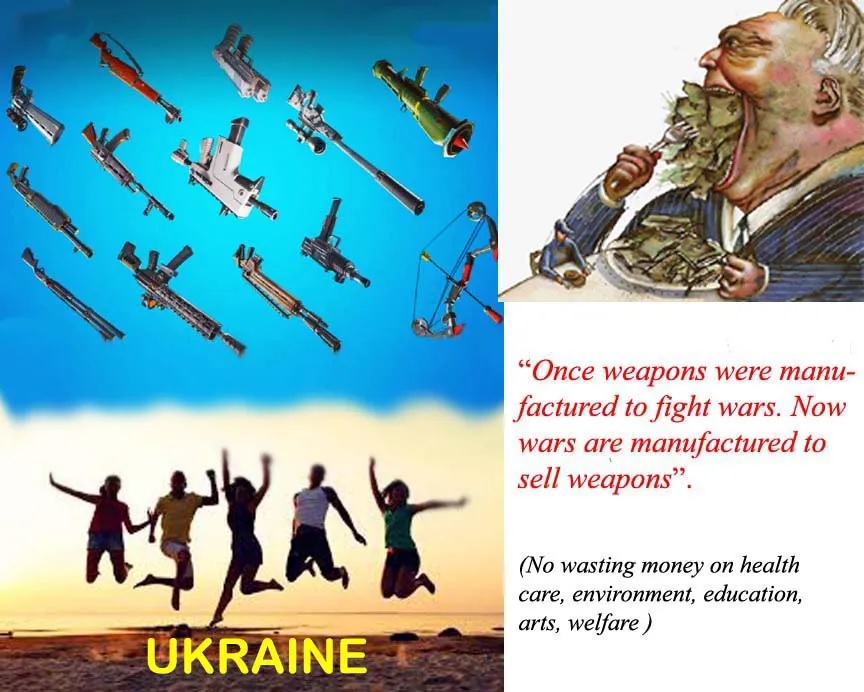
The US Congress is continuing to vote in favor of sending billions of dollars to Ukraine because a lot of that money ends up being laundered back into the US military-industrial complex, Kentucky Representative Thomas Massie has said.
In an interview with Tucker Carlson on X (formerly Twitter) published on Wednesday, the politician was asked to explain why Washington continued to push for more funding for Ukraine despite it becoming obvious that Kiev’s forces “cannot win.”
Massie, who has repeatedly voted against funding Kiev’s military operations, alleged that a lot of the funds that are sent to Ukraine ultimately end up “enriching” people within specific US districts and “stockholders, some of whom are congressmen.”
“You know, people are getting rich, so let’s do it. It’s an immoral argument, but it is one. But that’s not the argument they’re making in public,” he said, noting that those supporting the funding of Ukraine with US tax dollars are instead arguing that it is a “moral obligation” to do so.
“You’re a bad person if you’re against this,” he complained, referring to a statement recently made by US National Security Advisor Jake Sullivan, who suggested that failing to support “the fight for freedom in Ukraine” meant letting Russian President Vladimir Putin “prevail.”
“But no one mentions that we have abetted the killing of an entire generation of Ukrainian men that will not be replaced. To fight a war that they cannot win,” Massie noted.
In order to support the US government’s proposals on Ukraine aid, the congressman claimed, a person has to be “economically illiterate and morally deficient.”
Meanwhile, US President Joe Biden has hit out against Republicans like Massie, who have opposed aid packages for Ukraine, calling the failure to support Kiev “absolutely crazy” and “against US interests.” The US leader has repeatedly pledged that Washington would support Kiev for “as long as it takes” in its conflict with Russia.
Congress is currently in the midst of a debate around accepting a $111 billion ‘national security supplemental request,’ which includes funding for Ukraine, as well as Israel. Republicans have said they would not let the bill pass unless Washington first boosts spending on the US-Mexico border, tightens immigration controls, revises asylum and parole laws in immigration proceedings.
Last week, former Russian President Dmitry Medvedev also stated that Washington’s continued support for Ukraine had nothing to do with defending “democracy” or battling Russia, but instead boiled down to making a profit and modernizing the US military-industrial complex.
UK nuclear police and workers share WhatsApp jokes about paedophilia, racism and homophobia
Work-linked WhatsApp groups include abusive comments about political figures and television personalities
Sellafield workers claim ‘toxic culture’ could put safety at risk
Guardian, Anna Isaac and Alex Lawson, 7 Dec 23
Specialist police officers and workers at some of the UK’s most secure nuclear sites have been sharing jokes about paedophilia, racism and homophobia in work-linked WhatsApp groups, the Guardian can reveal.
Images and messages reviewed by this newspaper show racist comments about public figures and politicians including a black Labour politician as well as homophobic images and conversations about the paedophiles Jimmy Savile and Rolf Harris.
Two groups’ activities have been examined by the Guardian, including one of which has members of the Civil Nuclear constabulary (CNC) at Sellafield in Cumbria and workers there. The other group largely comprises staff in sensitive areas of two other nuclear sites and CNC officers.
Among the messages are racist comments about a black Labour MP, who has been a frequent target of racist abuse online. The conversations also include homophobic memes about a prominent TV presenter. The Guardian has chosen not to name them but offered specific details about the content of the messages and the groups’ geographic locations to the CNC.
The messages also show explicit images of nudity, as well as racist imagery and descriptions of graphic paedophilic acts. They also show men ridiculing female colleagues at the sites for their appearance and sexual attractiveness.
Among the members of the groups, who have taken part in the conversations, are employees of the CNC, tasked with protecting some of the UK’s most sensitive and toxic sites.
The messages have come to light amid broader revelations in Nuclear Leaks, an investigation into cultural challenges, security and safety concerns at Sellafield and other nuclear sites throughout the country.
The groups also suggest that cultural concerns at Sellafield may extend to a range of other sensitive sites, raising questions about conduct within the nuclear sector as a whole.
Sources told the Guardian that they fear a failure to address a negative working culture and concerns ranging from bullying to a lack of trust in management could ultimately undermine the safety of some of the most hazardous sites in Europe.
Studies examining safety in the nuclear industry have found that working culture can feed into how sites are run. A 2020 report from the Office for Nuclear Regulation argued that poor culture fed into events which led to nuclear disasters, including Chornobyl in 1986 and Fukushima in 2011.
Last year, the Independent Office for Police Conduct (IOPC) began a criminal investigation into messages shared by nuclear police in a WhatsApp group separate to the ones reviewed by the Guardian. The investigation involves “grossly offensive messages” sent by current and former CNC officers. The IOPC said when the investigation was launched that the allegations were “extremely serious and concerning”.
Last year, two Metropolitan police officers were sentenced to three months in prison after being found guilty of sharing racist, homophobic, misogynistic and ableist messages in a WhatsApp group. Another messaging group has been used as an example of a “toxic, abhorrent culture” within the Met……………………………………………………………………………….. more https://www.theguardian.com/business/2023/dec/06/uk-nuclear-police-workers-whatsapp-jok
—
John Kerry furthering his career as nuclear lobbyist, at COP 28.
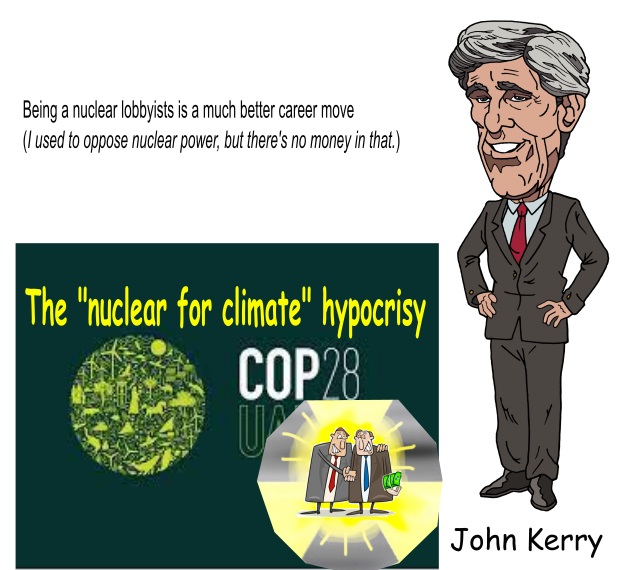
U.S. special climate envoy John Kerry on Tuesday launched an international
engagement plan to boost nuclear fusion, saying the emissions-free
technology could become a vital tool in the fight against climate change.
Kerry said the plan involved 35 nations and would focus on research and
development, supply chain issues, and regulation, and safety. “There is
potential in fusion to revolutionize our world,” Kerry told the COP28
climate summit in Dubai.

Reuters 6th Dec 2023
A Scotland without nuclear power would be safer for people and planet.

https://greens.scot/news/a-nuclear-power-free-scotland-would-be-safer-for-people-and-planet 6 Dec 23
Nuclear power is costly, dangerous and leaves a toxic legacy.
A Scotland without nuclear power would be safer for people and planet, says the Scottish Greens climate spokesperson, Mark Ruskell MSP.
Mr Ruskell’s warnings come as the UK government has committed to trebling nuclear capacity by 2050 as part of a COP declaration, and with reports that the Sellafield nuclear site has been targeted by groups linked to China and Russia.
Mr Ruskell said: “The allegations of hacking at Sellafield should alarm all of us. Nuclear energy is costly, dangerous and unsafe for people and planet. It will leave a legacy of toxic waste and higher bills for generations to come. It has no place in Scotland.
“The Tory’s epic failure to deliver Hinkley Point to time and budget shows just how unreliable and costly new nuclear is. That time and money could have been far better spent on expanding our homegrown renewable energy, which is the real solution to ending our reliance on climate-wrecking fossil fuels.
“With Scottish Greens in government here in Scotland are getting on with the job, and building our new wind and solar capabilities at pace. That is how we will ensure a safer and greener future.”
Scotland’s Energy Secretary Neil Gray points to safety risks as he rejects nuclear power attempts
Herald Scotland, 6th December, By David Bol, @mrdavidbol, Political Correspondent
The SNP’s Energy Secretary has turned down the latest plea for nuclear power stations to be constructed north of the Border – insisting the technology “is not safe, it is expensive and it is not wanted”.
The Scottish Government has a long-held opposition to nuclear power and is not part of its plans for the nation to meet net zero.
Instead, the Scottish Government believes it can meet energy demands by drastically ramping up the capacity for offshore wind and other renewables………………
Power and energy is largely reserved to the UK Government, but Scottish ministers can effectively veto proposals for Scotland through devolved planning regulations.
Torness power station in East Lothian is the only remaining operational nuclear power station in Scotland.
SNP Energy Secretary Neil Gray was asked by Conservative MSP Edward Mountain if the Scottish Government will change its mind and embrace nuclear power.
Speaking in Holyrood, Mr Gray said: “We are doing that because it is not safe, it is expensive and it is not wanted in Scotland. In addition, it is not needed in Scotland.
“We have abundant natural energy resources and capital that can contribute and are contributing to our energy mix.”
He added: “As we are all seeing from experiences elsewhere in the United Kingdom, new nuclear power takes years—if not decades—to become operational, and it will push up household and business energy bills even more.
“Under the contract awarded by the UK Government to Hinkley Point C, the electricity that will be generated will be priced at £92.50 per megawatt hour.
“We know that the Tories care little these days about achieving a pathway to net zero, but the Scottish National Party Government still does. We believe that significant growth in renewables, storage, hydrogen and carbon capture provides the best pathway to net zero for Scotland.”
………………………Mr Gray pointed to “evidence of the alleged hacking of Sellafield this week and what we have seen from Russia’s invasion of Ukraine” as “worries around safety”.
He added: “We in Scotland are not the only ones who have such concerns: many colleagues in the European Union are either moving away from or continue to oppose new nuclear power.”https://www.heraldscotland.com/news/23970270.neil-gray-points-safety-risks-rejects-nuclear-power-attempts/
US officials think Gaza ground operation could end by January as Biden admin privately warns Israel about its tactics, (but USA still sending weapons)

By Natasha Bertrand, MJ Lee, Alex Marquardt and Oren Liebermann, CNN 6 Dec 23
US officials expect the current phase of Israel’s ground invasion of Gaza targeting the southern end of the strip to last several weeks before Israel transitions, possibly by January, to a lower-intensity, hyper-localized strategy that narrowly targets specific Hamas militants and leaders, multiple senior administration officials tell CNN.
But as the war enters this new ground phase in the south, the White House is deeply concerned about how Israel’s operations will unfold over the next several weeks, a senior US administration official said. The US has warned Israel firmly in “hard” and “direct” conversations, they said, that the Israeli Defense Forces cannot replicate the kind of devastating tactics it used in the north and must do more to limit civilian casualties.
The US has conveyed to Israel that as global opinion has increasingly turned against its ground campaign, which has killed thousands of civilians, the amount of time Israel has to continue the operation in its current form and still maintain meaningful international support is quickly waning………………………………………………………………………………………. more https://edition.cnn.com/2023/12/05/politics/israel-ground-operation-us-warnings/index.html
1 This Month
Chernobyl: The Lost Tapes – A good documentary on Chernobyl on SBS available On Demand for the next 3 weeks– https://www.sbs.com.au/ondemand/tv-program/chernobyl-the-lost-tapes/2352741955560

of the week–London Campaign for Nuclear Disarmament

Tell the Ukrainian Government to Drop Prosecution of Peace Activist Yurii Sheliazhenko
To see nuclear-related stories in greater depth and intensity – go to https://nuclearinformation.wordpress.com
-
Archives
- April 2026 (126)
- March 2026 (251)
- February 2026 (268)
- January 2026 (308)
- December 2025 (358)
- November 2025 (359)
- October 2025 (376)
- September 2025 (257)
- August 2025 (319)
- July 2025 (230)
- June 2025 (348)
- May 2025 (261)
-
Categories
- 1
- 1 NUCLEAR ISSUES
- business and costs
- climate change
- culture and arts
- ENERGY
- environment
- health
- history
- indigenous issues
- Legal
- marketing of nuclear
- media
- opposition to nuclear
- PERSONAL STORIES
- politics
- politics international
- Religion and ethics
- safety
- secrets,lies and civil liberties
- spinbuster
- technology
- Uranium
- wastes
- weapons and war
- Women
- 2 WORLD
- ACTION
- AFRICA
- Atrocities
- AUSTRALIA
- Christina's notes
- Christina's themes
- culture and arts
- Events
- Fuk 2022
- Fuk 2023
- Fukushima 2017
- Fukushima 2018
- fukushima 2019
- Fukushima 2020
- Fukushima 2021
- general
- global warming
- Humour (God we need it)
- Nuclear
- RARE EARTHS
- Reference
- resources – print
- Resources -audiovicual
- Weekly Newsletter
- World
- World Nuclear
- YouTube
-
RSS
Entries RSS
Comments RSS
 nuclear-news