URANIUM WARHEAD POISONING IS THE SPECIALTY OF US AGAINST RUSSIANS, ISRAEL AGAINST PALESTINIANS

by John Helmer, Moscow , December 2023
@bears_with
Long before the British intelligence agency MI6 invented the story that Russian military agents had carried the nerve agent weapon Novichok into England, fired it at two Russians, and left it in a dustbin for a local scavenger to find, take home and kill his girlfriend, there was depleted uranium poisoning.
This is a weapon of mass destruction (WMD).
In the past thirty years it has been used by the US, British, and Israeli armies in their wars against Iraq, Lebanon, and Palestine (Gaza), Serbia, and recently against the Russians on the Ukrainian battlefield. As a US invention, however, depleted uranium dispersal as a gas to contaminate terrain for enemy soldiers has been acknowledged in secret since 1943.
In the official military manuals, depleted uranium rounds are used because their metal concentration and intense heat burn their way through armour plate. In practice, they vaporise high concentrations of radioactive particles to cover large swathes of territory, civilian and military.
The US Department of Homeland Security defines a weapon of mass destruction (WMD) as “a nuclear, radiological, chemical, biological, or other device that is intended to harm a large number of people.” DU harms a relatively small number of soldiers on a battlefield operating in tanks, other armoured vehicles, self-propelled artillery and reinforced bunkers. DU strikes a much larger number of people through the release of radiation downwind of the battlefield by penetrating their bodies, attacking their genetic codes, and triggering cancers, birth defects, miscarriages of the unborn, and premature death of adults.
According to Homeland Security, it “works every day to prevent terrorists and other threat actors from using these weapons to harm Americans.” But when the US supplies its DU weapons to the Israeli and Ukrainian armies, it intends to cause this mass destruction by not caring for the harm they do — in fact concealing this harm, and publicly pretending DU ordnance is not what it is.
DU is a WMD by stealth. The US knows this because US and British soldiers who participated in the first battlefield use of DU shells and bombs, the war against Iraq in 1991, have been the long-term victims of their own weapons.
When the Israel Defence Forces (IDF) fire their DU shells and bombs into the buildings of Gaza, they are not aiming at Hamas tanks, armoured personnel carriers, or howitzer units – the Palestinian forces have none of those. Instead, the Israelis are aiming at the mass destruction of the Palestinian people, including those still unborn. The supply chain for this WMD includes the Cypriot, Greek, German and British governments.
In Gaza, and in the Ukraine, they are all witting participants in targeting a race of people for extermination, now and for the future.
According to US Government publications, the use of depleted uranium (DU) as a super-burning, heavy-metal weapon began in the US in the 1970s.
“Naturally occurring uranium ore is abundant in nature and contains several forms of uranium called isotopes. All uranium isotopes are radioactive; however, only one of these isotopes, Uranium-235 (U-235), provides the fuel used to produce both nuclear power and the powerful explosions used in nuclear weapons… In nature, U-235 only makes up a very small part of the uranium ore. Given its importance for nuclear power and nuclear weapons technology, U-235 is often removed from the natural uranium ore and concentrated through a process called uranium enrichment. Depleted uranium hexafluoride, also known as DU, is the material left behind after enrichment. Like the natural uranium ore, DU is radioactive. DU mainly emits alpha particle radiation.” …………………………………………………………………………….
US nuclear bomb designers describe the DU artillery shell or bomb as a “dirty radiation weapon” because of its uncontrollable dispersal on wind, rain, and through the soil targeting civilian populations far from the battlefield targets; indeed, the very civilian populations supporting and paying for the use of DU munitions against their purported enemies. “Some of the uranium used with DU weapons vaporises into extremely small particles, which are dispersed into the atmosphere where they remain until they fall to the ground with the rain. As a gas, the chemically toxic and radioactive uranium can easily enter the body through the skin or the lungs and be carried around the world until it falls to earth with the rain. AFP asked Marion Falk, a retired chemical physicist who built nuclear bombs for more than 20 years at Lawrence Livermore lab, if he thought that DU weapons operate in a similar manner as a dirty bomb. ‘That’s exactly what they are,’ Falk said. ‘They fit the description of a dirty bomb in every way.’”
According to Falk, more than 30 percent of the DU fired from the cannons of U.S. tanks is reduced to particles one-tenth of a micron (one millionth of a meter) in size or smaller on impact. ‘The larger the bang the greater the amount of DU that is dispersed into the atmosphere,’ Falk said. With the larger missiles and bombs, nearly 100 percent of the DU is reduced to radioactive dust particles of the micron size or smaller, he said.”
One of the leading nuclear physicists in Europe to have researched the long-range dispersal of DU biochemical damage is Christopher Busby. Here is his report, published in 2011, of the long-term poisoning of Iraqi civilians following the US and British use of DU ammunition during the fighting at Fallujah in 2004. The data on which Busby and his colleagues based their findings came from soil and water sampling, as well as from spectrometric analysis of the hair of civilian children, fathers and mothers in Iraq. The abnormally high concentrations of uranium were traced to the use by US and UK forces of artillery shells, ground-fired missiles, and air-fired rockets, missiles and bombs. According to Busby, “US forces also used Fallujah to combat-test prototypes of at least two new types of thermobaric weapons – Thermobaric Hellfire missiles – AGM-114N [54]- and a new thermobaric RPG called SMAW-NE (Shoulder-fired, Multi-purpose Assault Weapon – Novel Explosive).”
Testing new radiation weapons in civilian areas of Iraq, Lebanon, and Afghanistan has been standard practice for the US, the British, and the Israelis over more than thirty years.
The conclusion of Busby’s Fallujah study of September 2011 was that “we found significant levels of Uranium, a material which has been associated with weapons employed in Iraq and in the Balkans since 1991 and also with genotoxicity. These levels were significantly higher than those expected on the basis of published control group data from various studies and particularly from Southern Israel. Further, the pattern of contamination with regard to hair length indicated a major contamination event in the past. The levels of Uranium could not be explained by any local Uranium deposits in the soil since measurements made of soil Uranium showed only modest concentrations though the Uranium was slightly enriched…Since none of the other elements found in excess in the parents were genotoxic except Uranium we conclude that these results support the belief that the effects in Fallujah follow the deployment of a Uranium-based weapon or weapons of some unknown type.”
Other research studies by Busby and others have produced the evidence of Israeli use of DU air-dropped bombs and artillery fired shells against Arab targets in Gaza and Lebanon since 2006. Independent research has been undertaken by Arab experts of late miscarriages, stillbirths, and birth defects for pregnant Palestinian women at the Al-Shifa Hospital in Gaza City. “These data suggests a causative/favouring role of acute exposure of parents to the weapons-associated contaminants, and/or of their chronic exposure from their persistence in the environment on the embryonic development of their children.”
In a research paper published in December 2021, Arab scientists from Egypt and Gaza, with a Japanese colleague, and collaboration from a German institute in Munich, reported that uranium weapon contamination was found in sand, stone, concrete, demolition and other building materials in Gaza as well as in Egyptian Sinai. “The past and ongoing siege of the Gaza Strip has led to a severe shortage of building materials since 2007. Many houses, buildings and infrastructure were destroyed and produced huge amounts of demolition debris after the war in the Gaza Strip in 2008. As a result, re-use of the degraded building materials has been required in the past and present. According to the United Nations Development Program (UNDP), the amount of demolition debris in the Gaza Strip, produced from 2008 through 2009, was estimated to be 600,000 tonnes. The demolition debris was crushed, sieved and re-used as recycled building materials.”
In other words, the Israeli-American DU attacks on Gaza make the recycling of the current destruction hazardous for rebuilding. The findings indicate that long before the present war began last month, it has been Israeli state policy, backed and supplied by the US, to make Gaza uninhabitable for the future. This is genocide, using genotoxic weapons. For the first attempt at documenting the wind dispersal of DU radioactive particles fired by the IDF since October 7 to Egypt, Jordan, Saudi Arabia, and Israel itself, click on this.
In time Busby and Arab scientists will report the evidence of DU health damage among the Gazans who survive direct destruction by Israeli attack.
On November 25, Busby has reported new research documenting the bioch
Busby has now updated the earlier findings in a research paper issued on November 25. Because the standard European and US academic publishers are so far refusing to report the evidence, Busby’s report is published here in full.
The Khmelnitsky Ukraine Uranium explosion revisited.
The calculated source term is approximately 50 tons.
Public health implications for Poland and Western Ukraine.
By Christopher Busby, PhD………………………………………………………………………………more https://johnhelmer.net/biochemical-weapon-for-race-war-uranium-warhead-poisoning-is-the-specialty-of-us-against-russians-israel-against-palestinians/?fbclid=IwAR2H2vUD6Fw26z_-MTk2qEOyRLXTmRK4vUCjw8Bs8N_QIYxMgg3OcAgCDnY
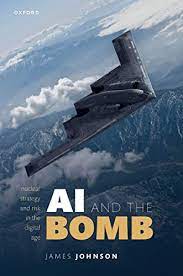
AI and the Bomb: Nuclear Strategy and Risk in the Digital Age
Nuclear Deterrence: Unsafe at Machine Speed
AI and the Bomb: Nuclear Strategy and Risk in the Digital Age, By James Johnson,
Reviewed by Douglas B. Shaw, 3 Dec 23, Arms Control Association,
James Johnson’s book is the most important book about preventing nuclear war that has been published in recent years. The author confronts head-on the complexity of the dangers that artificial intelligence (AI) and other emerging technologies pose for nuclear deterrence. He combines a commanding view of deterrence theory with the imagination to point toward where technology is already obscuring deterrence practice and concludes darkly that, “[i]n the context of AI and autonomy, particularly information complexity, misinformation, and manipulation, rationality-based deterrence logic appears an increasingly untenable proposition.”
AI and the Bomb opens with a gripping account of a “flash war” between China and the United States, taking place over less than two hours in June 2025, in which nuclear weapons are used, millions of people die, and afterward, no one on either side can explain exactly what happened. This story underscores the fact that even if not given control of nuclear weapons, AI and emerging technologies connected to adjacent or seemingly unrelated systems may combine in unforeseen ways to render nuclear escalation incomprehensible to the humans in (or on) the loop.
Johnson’s book is the first comprehensive effort to understand the implications of the AI revolution for the Cold War notion of “strategic stability” at the core of nuclear deterrence. He finds new challenges for deterrence theory and practice in emerging technologies, centering inadvertent escalation as a “new model for nuclear risk.” He formulates a novel “AI-security dilemma” more volatile and unpredictable than the past. He also adds a new dimension of “catalytic nuclear war” by which states without nuclear weapons or nonstate actors might use AI to cause nuclear war among nuclear-armed states.
Artificial Intelligence, Emerging Technology, and Deterrence Theory
The author embraces and extends the emerging conventional wisdom that AI should not be plugged into nuclear command-and-control systems, observing that “the delegation of the decision-making process (to inform and make decisions) to machines is not a binary choice but rather a continuum between the two extremes—human decision-making and judgment and machine autonomy at each stage of the kill chain.” Beyond using AI to facilitate nuclear launch decisions, Johnson shows how AI could affect the nuclear balance by changing nuclear weapons system accuracy, resilience and survivability, and intelligence, surveillance, and reconnaissance for targeting. AI capabilities also may give conventional weapons systems dramatic new capabilities to attack nuclear weapons systems, through increased ability to penetrate air defenses; increased ability to “detect, track, target, and intercept” nuclear missiles; and advanced cybercapabilities, potentially including manipulation of “the information ecosystem in which strategic decisions involving nuclear weapons take place.”
Importantly, Johnson uses AI as a shorthand for referring to AI and a suite of other emerging technologies that enable AI, including “cyberspace, space technology, nuclear technologies, GPS technology, and 3D printing.” This choice mirrors the practice of other thought leaders, including Henry Kissinger, Eric Schmidt, and Daniel Huttenlocher in The Age of AI and Mustafa Suleyman in The Coming Wave.
The book is a grim journey for scholars of nuclear deterrence theory, forcing them to confront concepts such as “machine-speed AI warfare,” “non-human agents,” nuclear arsenals with a “larger attack surface” in a world in which ubiquitous sensors feed data oceans, and “disinformation cascades” that could lead to an “unravelling of deterrence in practice.” These ominous signs begin to flesh out the broad concerns about nuclear strategy that Kissinger, Schmidt, and Huttenlocher raise, including that “[t]he management of nuclear weapons, the endeavor of half a century, remains incomplete and fragmentary” and that the “unsolved riddles of nuclear strategy must be given new attention.”………………………………………………………
First, the AI security dilemma features the possibility of extraordinarily fast technological breakthroughs, incentivizing states in competition with peers in AI technology to move first rather than risk being second. For example, the U.S. National Security Commission on AI found that “defending against AI-capable adversaries [notably China] operating at machine speeds without employing AI is an invitation to disaster.”
Second, the AI security dilemma risks placing latent offensive capabilities in civilian hands, such as the massive data facilitated by communication and navigation satellites. Whereas the traditional security dilemma is driven primarily by the misinterpretation of defensive military capabilities, the AI security dilemma also can be driven by the misinterpretation of ostensibly peaceful commercial capabilities.
Third, the AI security dilemma is driven by commercial and market forces not under the positive control of states. Whereas the traditional security dilemma causes states to fear each other’s actions, the AI security dilemma drives states increasingly to fear the actions of private firms. Taken together, these three novel characteristics of potentially explosive technological breakthroughs, ambiguous commercial capabilities, and the absence of positive control over commercial capabilities led Johnson to conclude that AI is “a dilemma aggravator primus inter pares.”……………………………..
Beyond Rational Nuclear Deterrence?
The book demonstrates repeatedly how revolutionary change in the technological terrain in which nuclear deterrence takes place demands urgent theoretical and practical adaptation. Old assumptions and human rationality may decrease sharply in effectiveness as tools for preventing nuclear war.
Johnson offers some initial ideas of how to manage the stark challenges that AI poses for nuclear deterrence. Arms control will remain important, if challenging, in new ways; he suggests that banning AI enhancements to nuclear deterrence capabilities might be an important first step……………………………………………………..
Ultimately, Johnson expects that “AI technology in the nuclear domain will likely be a double-edged sword: strengthening the [nuclear command-and-control] systems while expanding the pathways and tools available to adversaries to conduct cyberattacks and electronic warfare operations against these systems.” He encourages policymakers to act “before the pace of technological change outpaces (or surpasses) strategic affairs.”
Johnson concludes his book with a quote from machine learning pioneer Alan Turing: “We can only see a short distance ahead, but we can see plenty there that needs to be done.” AI and the Bomb is a must read for those seeking to understand the first signals of revolutionary change that AI is bringing to the challenge of preventing nuclear war. It sends a clear warning that the world does not yet know how to manage the effects of AI on nuclear deterrence and, without significant urgent effort, it is likely to fall short.
https://www.armscontrol.org/act/2023-12/book-reviews/ai-bomb-nuclear-strategy-risk-digital-age
U.S. to Develop Unanticipated New Nuclear Bomb
December 2023, By Shannon Bugos
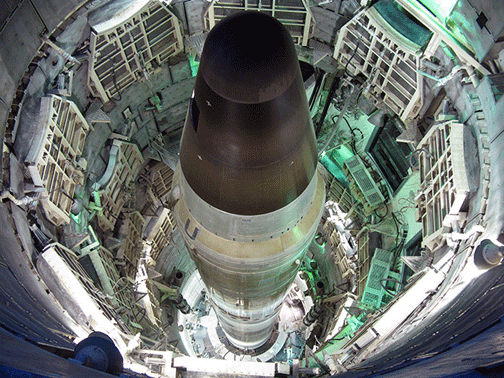
The U.S. Defense Department unexpectedly announced its intention to develop an additional variant of the B61 nuclear gravity bomb, to be known as the B61-13.
………………………………….. The Pentagon acknowledged its hope that the B61-13 variant would help catalyze the stagnant retirement process of the B83 megaton gravity bomb.
“The B61-13 will provide the President with additional options against certain harder and large-area military targets, even while the department works to retire legacy systems such as the B83-1,” according to a Pentagon fact sheet……………………………..
“The case for the B61-13 is strange,” assessed the Federation of American Scientists in an Oct. 27 blog post. “For the past 13 years, the sales pitch for the expensive B61-12 has been that it would replace all other nuclear gravity bombs,” as well as “cover all gravity missions with less collateral damage than large-yield bombs.”
The B61-13 would be deliverable by modern aircraft and have a maximum yield similar to the 360-kiloton B61-7 variant, a massive increase when compared to the most recent 50-kiloton B61-12. The B61-12 is scheduled for initial deployment this year, replacing the 100 B61-3/4 bombs believed to be stationed across Belgium, Germany, Italy, the Netherlands, and Turkey under the NATO nuclear sharing mission………………………..
In an Oct. 24 letter to Congress, the Energy Department officially requested to amend its fiscal year 2024 budget request to cover development engineering activities for the B61-13.
Whether the request will be granted remains to be seen because Congress has yet to pass the necessary legislation to fund any department for all of fiscal year 2024. https://www.armscontrol.org/act/2023-12/news/us-develop-unanticipated-new-nuclear-bomb
Zaporizhzhia nuclear plant suffered power outage, energy ministry says

Reuters, December 2, 2023
KYIV, Dec 2 (Reuters) – Ukraine’s Russian-occupied Zaporizhzhia nuclear power plant lost its power supply after the last remaining line to it from Ukrainian-controlled territory was disrupted, but it has since been repaired, the energy ministry said on Saturday.
The plant was occupied by Russia in March 2022 and is no longer generating power, but needs a supply of electricity to cool one of its four reactors which is in a state of ‘hot conservation’ – meaning it has not fully been shut down.
According to a statement published by Ukraine’s energy ministry on Telegram, one power line to the plant was disrupted late on Friday, while the last, 750 kW, line was broken at 2:31 a.m. (0031 GMT) on Saturday.
“This is the eighth blackout which occurred at the (Zaporizhzhia plant) and could have led to nuclear catastrophe,” the statement said.
The ministry said that after losing grid connection the plant turned on 20 backup generators to supply its own electricity needs.
Swiss nuclear power plants are running out of staff
After warning Switzerland over two years ago, the International Atomic Energy Agency (IAEA) recommends the authorities develop a roadmap to deal with the impending problem of labour shortage in Swiss nuclear power plants.
This content was published on December 3, 2023 – 14:17December 3, 2023
Switzerland’s existing nuclear power plants are on the verge of having their lifetimes extended from 50 to 80 years. But now a problem is threatening to thwart these plans.
The search for skilled labour is becoming increasingly challenging, as reported by the NZZ am Sonntag newspaper on Sunday. There are currently over 40 vacancies at the Beznau, Gösgen and Leibstadt nuclear power plants.
A team of experts from the IAEA warned Switzerland back in October 2021. In a report, the agency concluded that the search for personnel was one of the biggest challenges for Swiss nuclear plants and for the supervisory authority itself…………………https://www.swissinfo.ch/eng/business/swiss-nuclear-power-plants-are-running-out-of-staff/49027136
1 This Month


Tell the Ukrainian Government to Drop Prosecution of Peace Activist Yurii Sheliazhenko

Petition to revoke the licensing of the Near Surface Nuclear Disposal Facility (NSDF) at Chalk River. https://www.ourcommons.ca/petitions/en/Petition/Details?Petition=e-7247


of the week – STOP SMALL MODULAR REACTORS IN CANADA
To see nuclear-related stories in greater depth and intensity – go to https://nuclearinformation.wordpress.com
-
Archives
- March 2026 (176)
- February 2026 (268)
- January 2026 (308)
- December 2025 (358)
- November 2025 (359)
- October 2025 (376)
- September 2025 (258)
- August 2025 (319)
- July 2025 (230)
- June 2025 (348)
- May 2025 (261)
- April 2025 (305)
-
Categories
- 1
- 1 NUCLEAR ISSUES
- business and costs
- climate change
- culture and arts
- ENERGY
- environment
- health
- history
- indigenous issues
- Legal
- marketing of nuclear
- media
- opposition to nuclear
- PERSONAL STORIES
- politics
- politics international
- Religion and ethics
- safety
- secrets,lies and civil liberties
- spinbuster
- technology
- Uranium
- wastes
- weapons and war
- Women
- 2 WORLD
- ACTION
- AFRICA
- Atrocities
- AUSTRALIA
- Christina's notes
- Christina's themes
- culture and arts
- Events
- Fuk 2022
- Fuk 2023
- Fukushima 2017
- Fukushima 2018
- fukushima 2019
- Fukushima 2020
- Fukushima 2021
- general
- global warming
- Humour (God we need it)
- Nuclear
- RARE EARTHS
- Reference
- resources – print
- Resources -audiovicual
- Weekly Newsletter
- World
- World Nuclear
- YouTube
-
RSS
Entries RSS
Comments RSS
 nuclear-news