DOUBLING DOWN ON NUCLEAR POWER IS NO SOLUTION TO CLIMATE CRISIS

https://greens.scot/news/doubling-down-on-nuclear-power-is-no-solution-to-climate-crisis 3 Dec 23
Nuclear power is costly, inefficient and leaves a long and toxic legacy.
Doubling down on nuclear power will not solve the climate crisis, says the Scottish Greens climate spokesperson Mark Ruskell.
Mr Ruskell was responding to the announcement from the COP climate summit that 22 countries, including the US, France and the UK, have signed a declaration to triple nuclear capacity by 2050.
Mr Ruskell said: “Nuclear energy is costly, dangerous and out of date. It’s no kind of solution, and will leave a long and toxic legacy for generations to come. The UK experience of Hinkley Point underlines all of these problems, with delay after delay and ever-ballooning costs.
“The climate emergency is happening all around us. We simply don’t have time to waste on overpriced and dirty solutions like nuclear energy.”
Mr Ruskell welcomed the announcement that 118 countries have pledged to triple renewable energy, saying: “This is a significant step in the right direction and could be key to our shift away from climate-wrecking fossil fuels.
“Locally sourced renewable energy is the cheapest and greenest energy available. We have more and better technology available to us than ever before, all that is missing is the political will.
“I hope that this summit can be when leaders finally turn a corner and start to give renewables the investment and support that they deserve.”
Chris Hedges: Israel Reopens the Gaza Slaughterhouse
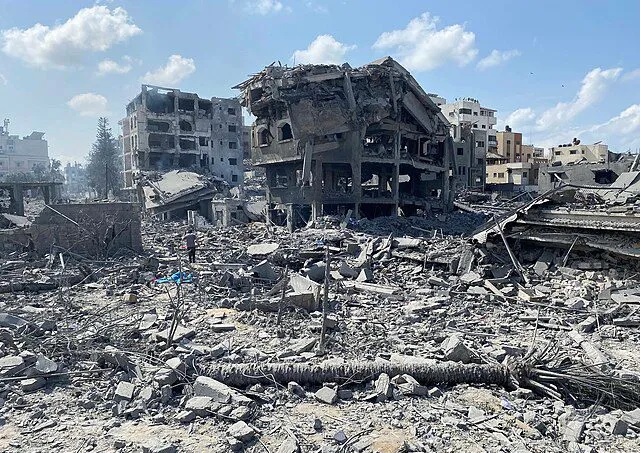
Nothing is off limits. Hospitals. Mosques. Churches. Homes. Apartment blocks. Refugee camps. Schools. Universities. Media offices. Banks. Sewer systems. Telecommunications infrastructure. Water treatment plants. Libraries. Wheat mills. Bakeries. Markets. Entire neighborhoods. Israel’s intent is to destroy Gaza’s infrastructure and daily kill or wound hundreds of Palestinians. Gaza is to become a wasteland, a dead zone that will be incapable of sustaining life.

Secretary of State Antony Blinken visited Israel this week, and while calling for Israel to protect civilians, refused to set conditions that would disrupt the $3.8 billion Israel receives in annual military assistance or the $14.3 billion supplemental aid package.
https://scheerpost.com/2023/12/01/chris-hedges-israel-reopens-the-gaza-slaughterhouse/
Phase One of Israel’s genocidal campaign on Gaza has ended. Phase Two has begun. It will result in even higher levels of death and destruction.
By Chris Hedges / Original to ScheerPost
The skies over Gaza are filled — after a seven-day truce — with projectiles of death. Warplanes. Attack helicopters. Drones. Artillery shells. Tank shells. Mortars. Bombs. Missiles. Gaza is a cacophony of explosions and forlorn screams and cries for help beneath collapsed buildings. Fear, once again, is coiling itself around every heart in the Gazan concentration camp.
By Friday evening, 184 Palestinians — including three journalists and two doctors — had been killed by Israeli air strikes in the north, south and central Gaza, and at least 589 injured, according to the Ministry of Health in Gaza. Most of them are women and children. Israel will not be deterred. It plans to finish the job, to obliterate what is left in the north of Gaza and decimate what remains in the south, to render Gaza uninhabitable, to see its 2.3 million people driven out in a massive campaign of ethnic cleansing via starvation, terror, slaughter and infectious diseases.
The aid convoys, which brought in token amounts of food and medicine — the first batch was shrouds and coronavirus tests according to the director of al-Najjar hospital — have been halted. No one, least of all President Joe Biden, plans to intervene to stop the genocide. Secretary of State Antony Blinken visited Israel this week, and while calling for Israel to protect civilians, refused to set conditions that would disrupt the $3.8 billion Israel receives in annual military assistance or the $14.3 billion supplemental aid package. The world will watch passively, muttering useless bromides about more surgical strikes, while Israel spins its roulette wheel of death. By the time Israel is done, the 1948 Nakba, where Palestinians were massacred in dozens of villages and 750,000 were ethnically cleansed by Zionist militias, will look like a quaint relic of a more civilized era.
Nothing is off limits. Hospitals. Mosques. Churches. Homes. Apartment blocks. Refugee camps. Schools. Universities. Media offices. Banks. Sewer systems. Telecommunications infrastructure. Water treatment plants. Libraries. Wheat mills. Bakeries. Markets. Entire neighborhoods. Israel’s intent is to destroy Gaza’s infrastructure and daily kill or wound hundreds of Palestinians. Gaza is to become a wasteland, a dead zone that will be incapable of sustaining life.
Israel began to bomb Khan Younis on Friday after dropping leaflets warning civilians to evacuate further south to Rafah, located on the border crossing with Egypt. Hundreds of thousands of displaced Palestinians had sought refuge in Khan Younis. Once Palestinians are pushed to Rafah, there is only one place left to flee — Egypt. The Israeli Ministry of Intelligence, in a leaked report, calls for the forcible transfer of Gaza’s population to Egypt’s Sinai Peninsula. A detailed plan to intentionally displace the Palestinians in Gaza and push them into Egypt has been embedded in Israeli doctrine for five decades. Already, 1.8 million Palestinians in Gaza have been driven from their homes. Once Palestinians cross the border into Egypt — which the Egyptian government and Arab leaders are seeking to prevent despite pressure from the U.S. — Palestinians will never return.
This is not a war against Hamas. It is a war against Palestinians.
Israeli strikes are generated at a dizzying rate, many of them from a system called “Habsora” — The Gospel — which is built on artificial intelligence that selects 100 targets a day. The AI-system is described by seven current and former Israeli intelligence officials in an article by Yuval Abraham on the Israeli sites +972 Magazine and Local Call, as facilitating a “mass assassination factory.” Israel, once it locates what it assumes to be a Hamas operative from a cell phone, for example, bombs and shells a wide area around the target, killing and wounding tens, and at times hundreds of Palestinians, the article states.
“According to intelligence sources,” the story reads, “Habsora generates, among other things, automatic recommendations for attacking private residences where people suspected of being Hamas or Islamic Jihad operatives live. Israel then carries out large-scale assassination operations through the heavy shelling of these residential homes.”
Some 15,000 Palestinians, including 6,000 children and 4,000 women, have been killed since Oct. 7. Some 30,000 have been wounded. Over six thousand are missing, many buried under the rubble. More than 300 families have lost 10 or more members of their families. More than 250 Palestinians have been killed in the West Bank since Oct. 7, and more than 3,000 injured, although the area is not controlled by Hamas. The Israeli military claims to have killed between 1,000 and 3,000 of some 30,000 Hamas fighters, a relatively small number given the scale of the assault. Most resistance fighters shelter in their vast tunnel system.
Israel’s playbook is the “Dahiya Doctrine.” The doctrine was formulated by former Israel Defense Forces (IDF) Chief of Staff Gadi Eizenkot, who is a member of the war cabinet, following the 2006 war between Israel and Hezbollah in Lebanon. Dahiya is a southern Beirut suburb and a Hezbollah stronghold. It was pounded by Israeli jets after two Israeli soldiers were taken prisoner. The doctrine posits that Israel should employ massive, disproportionate force, destroying infrastructure and civilian residences, to ensure deterrence.
Daniel Hagari, spokesman of the IDF, conceded at the start of Israel’s most recent attack on Gaza that the “emphasis” would be “on damage and not on accuracy.”
Israel has abandoned its tactic of “roof knocking” where a rocket without a warhead would land on a roof to warn those inside to evacuate. Israel has also ended its phone calls warning of an impending attack. Now dozens of families in an apartment block or a neighborhood are killed without notice.
The images of mass destruction feed the thirst for revenge within Israel following the humiliating incursion by Hamas fighters on Oct. 7 and the killing of 1,200 Israelis, including 395 soldiers and 59 police officers. There is a sadistic pleasure voiced by many Israelis over the genocide and a groundswell of calls for the murder or expulsion of Palestinians, including those in the occupied West Bank and those with Israeli citizenship.
The savagery of the air strikes and indiscriminate attacks, the cutting off of food, water and medicine, the genocidal rhetoric of the Israeli government, make this a war whose sole objective is revenge. This will not be good for Israel or the Palestinians. It will fuel a conflagration throughout the Middle East.
Israel’s attack is the last desperate measure of a settler colonial project that foolishly thinks, as many settler colonial projects have in the past, that it can crush the resistance of an indigenous population with genocide. But even Israel will not get away with killing on this scale. A generation of Palestinians, many of whom have seen most, if not all, of their families killed and their homes and neighborhoods destroyed, will carry within them a lifelong thirst for justice and retribution.
This war is not over. It has not even begun.
Sellafield has contaminated the Irish Sea with plutonium.

CORE – Cumbrians Opposed to a Radioactive Environment, December 2023
http://corecumbria.co.uk/alternative-tour-of-sellafield/irish-sea/
Sellafield discharges two million gallons of radioactive water into the Irish Sea every day at high tide. This includes a cocktail of over 30 alpha, beta and gamma radionuclides. BNFL admits that radioactive discharges in the 1970’s were 100 times those of today. As a result of these discharges, which include around half a tonne of plutonium, the Irish Sea has become the most radioactively contaminated sea in the world. Caesium-137 and Iodine-129 from Sellafield have spread through the Arctic Ocean into the waters of northern Canada and are having a bigger impact on the Arctic than the Chernobyl accident. Sellafield’s gas discharges of Krypton can be measured in Miami.
The guinea pigs in a ‘deliberate scientific experiment’ to find out levels of contamination in the food chain, were the Cumbrian people and their environment. Claiming then that the radioactive materials discharged from the 2km pipeline would dilute and disperse into the wider oceans, the industry clearly got it wrong, with high levels of radioactive discharge material washed ashore and trapped in the coastal sands and sediments.
A leading government-backed scientist from East Anglia University discovered that plutonium particles, concentrated in waves breaking on the shore, was being blown over West Cumbria, as far as 37 miles inland.This was confirmed by analysis of vacuum cleaner house dust samples taken up and down the coast by a National Radiological Protection Board investigation.
That Sellafield plutonium gets everywhere was shown in post-mortem examinations of former Sellafield workers. Concentrations of hundreds and in one case thousands of times higher than in the general population were found. Cumbrians who never worked at the plant had plutonium levels ranging from 50% to 250% above the average compared to elsewhere in Britain. Atomic Energy Authority scientist, Prof. Nick Priest, studied the teeth of over 3000 young people throughout Britain and Ireland. He found traces of Sellafield plutonium in varying doses, the highest doses being closest to Sellafield.
In November 1983 a team of Greenpeace divers tried to block the Sellafield underwater discharge pipe. When they emerged from the water, their Geiger counters revealed that they were seriously contaminated. It was only when they publicised this fact that BNFL admitted to having problems with their radioactive discharges and that a tankfull of ‘radioactive crud’ had been flushed out to sea. As radioactive flotsam was being washed ashore, posing a danger to health, the Department of the Environment effectively closed the beach and warned the public not to use the fifteen-mile stretch of shoreline north and south of Sellafield. This advice stayed in force for a full six months. In June 1985 BNFL faced a three-day trial, was found guilty and fined £10,000.
BNFL’s own environmental monitoring figures for the first quarter of 1997 revealed alarmingly raised levels of Technetium 99 in seaweed samples from the West Cumbrian coast. A Tc-99 level of 180,000 Bq/Kg in seaweed was sampled from Drigg, just south of the plant. This compared to a level of 71,000 Bq/Kg sampled in the previous quarter and to a level of just 800 Bq/Kg in 1992. Via the food chain Tc-99 is now found in duck eggs, and the use of locally harvested seaweed as a garden fertiliser has led to the discovery of Tc-99 in locally grown spinach. Irish Sea lobster have shown a similar alarming rise from 210 Bq/Kg in 1993 to 52,000 Bq/Kg in 1997 – over 40 times the EU Food Intervention Level set as a safety level for foodstuffs contaminated following a nuclear accident. Raised levels of Tc-99 were subsequently found in Norwegian lobsters.
A wide range of fish, shellfish and molluscs continue to show varying degrees of radioactive contamination from Sellafield’s discharges.
Apocalypse Then: 40 Years Ago, A TV Movie Saved the World from Nuclear Annihilation
ABC’s 1983 film ‘The Day After’ — the subject of a new documentary as well as a book —not only blew America’s (and Ronald Reagan’s) mind, but it may also have changed the course of human history.
Hollywood Reporter, BY BENJAMIN SVETKEY, 5 Dec 23
“………………………………… Next to the moon landing, it’s hard to think of a TV moment that had a bigger impact on the collective psyche than The Day After, ABC’s white-knuckle drama depicting the aftermath of a nuclear strike on the United States. Its airing 40 years ago — which is being commemorated on Dec. 4 with a new PBS documentary, Television Event, as well as a just-published book about the film, Apocalypse Television — didn’t just terrify the nation. It may have also altered the course of human destiny, which at that time, the red-hot height of the Cold War, seemed to be barreling towards an inevitable atomic showdown……………
“I’ve come to believe that’s true,” says Nicholas Meyer, 77, who directed the three-hour film. “The movie may have indeed helped prevent a nuclear war. It certainly changed one person’s mind on the subject, and that person just happened to be the President of the United States. Ronald Reagan wrote about watching the movie in his memoir. His biographer, who spent three years in the White House, said the only time he ever saw Reagan flip out was after seeing the movie. Ultimately, it sent Reagan into such a tailspin, he signed the Intermediate Missile Range Treaty, the only treaty that ever resulted in the physical dismantling of nuclear weapons.”
The brains behind The Day After, the one who deserves most of the credit not only for conceiving the concept but also strong-arming a reluctant ABC into putting it on the air, was the late Brandon Stoddard, then the network exec in charge of ABC’s made-for-TV movies.
“Brandon was stunned by Three Mile Island,” recalls Meyer. “And that’s how he came up with The Day After. ‘What if we showed a nuclear exchange and what would happen to regular people if they got nuked?’”
Unsurprisingly, ABC’s top executives were not entirely onboard with Stoddard’s vision…………………………………
For one thing, there was considerable political pushback. Conservative groups went on the warpath against the network, claiming the movie was Soviet propaganda designed to undermine America’s nuclear deterrent (even though Hume’s script never identified who launched the strike against the U.S. or why). For another, the subject matter of atomic war was, predictably, radioactive to advertisers. They began pulling out in droves………………………………………………………… https://www.hollywoodreporter.com/movies/movie-news/how-the-day-after-saved-the-world-12357
China, the U.S., AI and Autonomy in Nuclear Command and Control

Too Much Too Soon: China, the U.S., and Autonomy in Nuclear Command and Control
Lawfare, Ashley Deeks, Monday, December 4, 2023,
China won’t yet commit to keep autonomy out of its nuclear command and control. It will take a lot more talking to get there.
News reports leading up to the meeting between President Joe Biden and Chinese President Xi Jinping in November indicated that the United States sought to reach an agreement to keep autonomy out of nuclear command-and-control systems (C2)—or at least set up a formal dialogue on the issue. A South China Morning Post headline, citing unidentified sources, proclaimed: “Biden, Xi set to pledge ban on AI in autonomous weapons like drones, nuclear warhead control: sources.” Before the meeting, an Indo-Pacific expert at the German Marshall Fund told the press that China had signaled interest in discussing norms and rules for artificial intelligence (AI), something Biden’s team surely knew as well. The administration seemingly sought to capitalize on that interest by seeking a meeting of the minds on the narrow but important topic of nuclear C2.
But the U.S. aspirations, while laudable, proved to be too ambitious. As the New York Times reported, “On one of the critical issues, barring the use of artificial intelligence in the command and control systems of their nuclear arsenals, no formal set of discussions was established. Instead, Mr. Biden’s aides said that Jake Sullivan, the national security adviser, would keep talking with Wang Yi, China’s chief foreign affairs official.”
It is not surprising that the Biden administration was not able to make more progress with China. First, the United States and China do not seem to have had many direct bilateral conversations about military AI to date. Reaching agreement about nuclear AI—even in a statement that would be nonbinding—was an ambitious goal.
Second, the United States already committed unilaterally to maintaining human control over nuclear decisions, so the U.S. government would not have had to “give up” anything to reach a bilateral commitment about nuclear C2.
……………………………………………………………………………. The U.S. government is to be commended for fleshing out in greater detail some norms that states should pursue for their military AI systems, including through its political declaration and its efforts to open a military AI dialogue with China. But these recent developments further illustrate how difficult it will be to obtain legally binding international agreements—even very narrow ones—among states that are actively pursuing military AI.
As I wrote in an earlier Lawfare paper, “[R]egulation of national security AI is more likely to follow the path of hostile cyber operations, which have seen limited large-scale international agreement about new rules. Absent a precipitating crisis, small-group cooperation and unilateral efforts to develop settled expectations around the use of national security AI are far more likely.” It will be a good sign if future U.S.-China dialogues about AI—even informal and low-profile ones—proceed, as these meetings will give the United States more chances to explain to China how the Defense Department is trying to establish strong, high-level oversight over uses of military AI. But the bilateral trust between the United States and China is so low and the verification problems are so hard that it may take a while before the two states reach a shared view about keeping autonomy out of nuclear C2. https://www.lawfaremedia.org/article/too-much-too-soon-china-the-u.s.-and-autonomy-in-nuclear-command-and-control
Estonian universities anticipate high costs of training nuclear experts
ERR ee , Joakim Klementi, 4 Dec 23
The future of nuclear energy in Estonia will be decided next year. Universities in Estonia are ready to train specialists in this field, but this requires new curricula, recruiting expensive lecturers from abroad and years of preparation. Due to Estonia’s small population, the pool of nuclear specialists for Estonia must be trained internationally to ensure impartiality in decision making processes.
If Estonia decides to build its own nuclear power plant, it will probably also have to set up a radiation safety and nuclear security authority, similar to as in other nuclear countries.
While the agency could hire a few dozen professionals before the facility is operational, it should eventually employ 60-80 experts. We can compare ourselves to our northern neighbors.
“We have over 100 workers in the nuclear reactor regulation department and roughly 25 in the nuclear waste department in charge of nuclear safety, so about 130-140 people in total,” Tomi Routamo, deputy director of the Finnish radiation protection center, said.
The first reactor is the most expensive for the country, both financially and in terms of the demand for experts. The question of how many experts the plant needs is much more complicated.
“The number of persons in the preliminary phase is about 50-60, while during construction it reaches a few hundred, 200-300. It is expected to be 400 or more throughout the operational period,” Siim Espenberg, the head of the center for applied social science research at the University of Tartu, said.
Since Estonia is the only nuclear country with a small population, predicting the need for experts is impossible. There are few reactors in the world that are a reasonable size for Estonia. However, building a nuclear power facility in Estonia would require 10 or more classes of nuclear experts in additional to the current ones.
There is also a concern characteristic of small population countries that officials from a regulatory body and nuclear plant managers could be past classmates. The agency must be objective and rigorous. This implies that the expert community cannot be too small. It is also critical that nuclear workers have actual expertise in order to deal with unanticipated scenarios……………………………………………………………………………
“Certainly, people should be brought in from overseas, and in my opinion, some people from Estonia should be trained abroad. This type of curriculum, which can span years, can be used to teach professionals at a specific level, but it is also possible for a small number of specialists, perhaps five or ten, to be trained abroad,” Aune Valk, vice-rector of the University of Tartu, said.
These top researchers are quite expensive, particularly if they are recruited from the western Europe or the Nordic countries.
“We are talking about a wage bill of around €150,000 per year. Also, such a top specialist would be expecting investment funding for the establishment of laboratories, a research group, and the recruitment of PhD students. These are very significant investments,” Hendrik Voll, vice rector of Tallinn University of Technology, said.
The new curricula could take seven to 10 years to produce Estonia’s own nuclear engineers, possibly up to 15 years if they are required to obtain practical experience with an employer. Universities are hesitant to start on such costly and time-consuming projects until Estonia has made a solid decision to build a nuclear power plant.
“We might end up educating highly expensive professionals for western Europe, the Nordic countries, or certain eastern European countries if we don’t develop nuclear energy here,” Voll said.
Universities agree that the future of the nuclear power plant in Estonia will require the creation of a school of nuclear engineers…………………
Voll added that in the energy sector, Estonia needs to address the problem that electricity is two or more times more expensive than in its northern neighbors. But whether the solution is a nuclear power plant, neither scientists nor universities can say. https://news.err.ee/1609184221/estonian-universities-anticipate-high-costs-of-training-nuclear-experts
Pro nuclear lies abound at COP 28 – Bill Gates’ push for his shonky sodium -cooled Natrium reactor.

“The use of liquid sodium has many problems. It’s a very volatile material that can catch fire if it’s exposed to air or water,” Edwin Lyman, director of nuclear power safety with the Union of Concerned Scientists science advocacy nonprofit, told Fortune previously
“at centre stage”? “clean” ?”
Bill Gates’ nuclear reactor company signs a clean energy deal with the UAE, as nuclear power takes center stage at COP28
Fortune , BY PAOLO CONFINO, December 5, 2023
A nuclear reactor company cofounded by Bill Gates signed a deal with the United Arab Emirates to explore building advanced reactors in the Gulf country.
On Monday, TerraPower and the UAE’s state-owned nuclear company Emirates Nuclear Energy Corporation (ENEC) signed a nonbinding memorandum of understanding to collaborate on developing new nuclear power plants that would ? combat climate change. The preliminary deal comes as nuclear power increasingly takes ? center stage at the United Nations’ COP28 conference in Dubai, which started last week. ……………………………………………………
The UAE’s partnership with TerraPower would allow the country to “collaborate across a range of areas including technical design and commercial viability” related to nuclear power, according to a press release. The UAE will have access to TerraPower’s Natrium technology, which uses sodium instead of water to cool nuclear reactors,…
………………………The new partnership could also mean that Emirati engineers will be dispatched to TerraPower’s U.S. headquarters to learn about its work. “Our new agreement with TerraPower will facilitate cooperation in taking nuclear energy technology to the next level, by accelerating its deployment and its use for innovating new solutions including the production of clean molecules and hydrogen,” ENEC CEO Mohamed Ibrahim Al Hammadi said in a statement.
…The United States led the coalition of countries that pledged to triple the world’s nuclear power capabilities by 2050. Other major countries to sign on include France, which has long been at the vanguard of nuclear power; Japan, which suffered a devastating nuclear meltdown in 2011 after an earthquake struck a plant in Fukushima; and South Korea, whose second-largest company SK Group, is an investor in TerraPower.

…………………………..“Now, we need to take what looks very promising and scale it up, build the pilot plants, and prove those out,” Gates said on Friday.
Sellafield nuclear site hacked by groups linked to Russia and China
Malware may still be present and potential effects have been covered up by staff, investigation reveals
Anna Isaac and Alex Lawson, 4 Dec 23, https://www.theguardian.com/business/2023/dec/04/sellafield-nuclear-site-hacked-groups-russia-china
The UK’s most hazardous nuclear site, Sellafield, has been hacked into by cyber groups closely linked to Russia and China, the Guardian can reveal.
The astonishing disclosure and its potential effects have been consistently covered up by senior staff at the vast nuclear waste and decommissioning site, the investigation has found.
The Guardian has discovered that the authorities do not know exactly when the IT systems were first compromised. But sources said breaches were first detected as far back as 2015, when experts realised sleeper malware – software that can lurk and be used to spy or attack systems – had been embedded in Sellafield’s computer networks.
It is still not known if the malware has been eradicated. It may mean some of Sellafield’s most sensitive activities, such as moving radioactive waste, monitoring for leaks of dangerous material and checking for fires, have been compromised.
Sources suggest it is likely foreign hackers have accessed the highest echelons of confidential material at the site, which sprawls across 6 sq km (2 sq miles) on the Cumbrian coast and is one of the most hazardous in the world.
The full extent of any data loss and any ongoing risks to systems was made harder to quantify by Sellafield’s failure to alert nuclear regulators for several years, sources said.
The revelations have emerged in Nuclear Leaks, a year-long Guardian investigation into cyber hacking, radioactive contamination and toxic workplace culture at Sellafield.
The site has the largest store of plutonium on the planet and is a sprawling rubbish dump for nuclear waste from weapons programmes and decades of atomic power generation.
Guarded by armed police, it also holds emergency planning documents to be used should the UK come under foreign attack or face disaster. Built more than 70 years ago and formerly known as Windscale, it made plutonium for nuclear weapons during the cold war and has taken in radioactive waste from other countries, including Italy and Sweden.
The Guardian can also disclose that Sellafield, which has more than 11,000 staff, was last year placed into a form of “special measures” for consistent failings on cybersecurity, according to sources at the Office for Nuclear Regulation (ONR) and the security services.
The watchdog is also believed to be preparing to prosecute individuals there for cyber failings.
The ONR confirmed Sellafield is failing to meet its cyber standards but declined to comment on the breaches, or claims of a “cover up”.
A spokesperson said: “Some specific matters are subject to ongoing investigations, so we are unable to comment further at this time.”
In a statement, Sellafield also declined to comment about its failure to tell regulators, instead focusing on the improvements it says it has made in recent years.
How Are U.S. Warships Supporting Israel’s Genocide In Gaza?

Wherever you’re located, get out in the streets to demand an end to genocide in Gaza
LISA SAVAGE, DEC 4, 2023
Gaza has been under military blockade since 2006. Its one harbor, in Gaza City, was heavily bombed by Israel recently. Repeated attempts to reach Gaza with boats carrying humanitarian supplies have been thwarted by Israel with U.S. backing and we’ve seen activists beaten and even killed for trying to deliver cargo like medical supplies.
Bringing this question closer to home, How is the genocide in Gaza supported by General Dynamics and Bath Iron Works?
General Dynamics is the world’s fourth largest weapons manufacturer and Bath Iron Works (BIW) is one of its many locations for building weapon delivery systems. In this location in Maine shipbuilders historically profited from building slave ships.
Today, both destroyers and cruisers are built to be nuclear-capable meaning they are designed to be able to deliver first-strike attack nuclear Tomahawk cruise missiles and SM-3 ‘missile defense’ interceptors which would take out an enemy’s defenses following a first strike by the U.S.
Currently there are multiple Bath-built warships in the vicinity of Gaza including the eastern Mediterranean Sea, the Red Sea, and the Gulf of Aden. The USS Kearny, an Aegis destroyer built at BIW, is deployed there as is the USS Mason, an Arleigh Burke-class destroyer which on 27 November engaged in a firefight with Yemeni forces on behalf of an Israeli merchant ship it was sent to rescue. U.S. ships have been reported as routinely shooting down drones launched from Yemen that target ships in the vicinity.
On 15 November Aljazeera published a video report, “What does the Western naval build-up in the Middle East look like?” with this comment: “The Middle East is witnessing a Western naval build-up that hasn’t been seen there for decades: aircraft carriers, destroyers, missile cruisers, amphibious assault ships, a nuclear-powered submarine, and many more.”
U.S. warships are deployed to deter resistance forces in the region — such as Hezbollah — from intervening to stop genocide in Gaza and the West Bank. So far they’ve been apparently unsuccessful, however, their presence increases the likelihood of escalation as in the case of the USS Mason fighting Yemen on behalf of Israel.
Since the resumption of Israel’s bombing of Gaza on December 1, these confrontations have indeed escalated.
Treating U.S. warships as inherently different from Israeli warships is mythology. The two nation states have never been in closer lock step as they do the bidding of their corporate overlords.
Israel has been described as “America’s unsinkable aircraft carrier” but the U.S. and Israel have never been so reviled in world opinion as they are today. Their collective reputation is sinking like a warship that’s taking on water.
Join us in Bath this Friday if you’re able. Help us communicate to workers that we know Bath Iron Works only has one customer — the U.S. Navy — but it wasn’t always like that. So many useful things could be built there and even more good union jobs generated, like hospital ships to provide relief for the bombed out children of Gaza.
If you have the courage, watch or read: “A harrowing video shows decomposing babies in a Gaza hospital after they had to be abandoned amid Israeli attacks.”
Then, wherever you’re located, get out in the streets to demand an end to genocide in Gaza and to the military blockade that supports it.
Sweden to slug tax-payers for the costs of small nuclear reactors, and big ones.

Sweden plans new nuclear reactors by 2035, will share costs
By Simon Johnson, November 16, 2023
STOCKHOLM, Nov 16 (Reuters) – Sweden’s government said it aimed to build the equivalent of two new conventional nuclear reactors by 2035 on Thursday to meet surging demand for clean power from industry and transport and was prepared to take on some of the costs.
By 2045 the government wants to have the equivalent of 10 new reactors, some of which are likely to be small modular reactors (SMRs), smaller than conventional reactors.
Energy Minister Ebba Busch said the government was planning a “massive build out” of new nuclear power by 2045.
“It’s decisive for the green transition, for Swedish jobs and at heart for the welfare of our citizens,” she told reporters.
……………..critics have pointed to the huge costs and the private sector’s reluctance to invest without guarantees or other incentives – like Britain’s deal with French nuclear developer EDF for its new Hinkley Point C plant which gave price guarantees.
Sweden’s government has already offered 400 billion crowns ($37.71 billion) of loan guarantees to support new nuclear power, which it says is needed to power developments like fossil-fuel free steel production, but said it was now willing to shoulder more of the burden.
“Guarantees are very important, but that won’t be enough,” Finance Minister Elisabeth Svantesson said. “For this type of infrastructure it is going to require the state to take part and share the risk.” https://www.reuters.com/business/energy/sweden-plans-new-nuclear-reactors-by-2035-can-take-costs-2023-11-16/—
Seymour Hersh: Russia, Ukraine peace underway, 4 new region additions
By Al Mayadeen English, Source: Agencies, 1 Dec 2023 https://english.almayadeen.net/news/politics/seymour-hersh–russia–ukraine-peace-underway–4-new-region
Included in the potential deal would also be Russia’s agreement to Ukraine’s accession to NATO provided that NATO troops are not stationed on its territory and only defensive weaponry is located there.
In his newly released article, renowned US journalist Seymour Hersh assured that peace negotiations between top Russian and Ukrainian generals Valery Gerasimov and Valerii Zaluzhnyi respectively are currently underway which include a potential security of Crimea and another four former regions of Ukraine as part of Russia.
Included in the potential deal would also be Russia’s agreement to Ukraine’s accession to NATO provided that NATO troops are not stationed on its territory and only defensive weaponry is located there.
According to Hersh, both Russia and Ukraine agree that the persistence of war is illogical and that Russian President Vladimir Putin would be with an agreement that fixates borders according to where the troops are stationed after the end of peace negotiations.
Hersh cited a US official involved in the top negotiations as saying: “This was not a spur-of-the-moment event,” adding: “This was carefully orchestrated by Zaluzhny. The message was the war was over and we want out. To continue it would destroy the next generation of the citizens of Ukraine.”
On the other hand, the Biden administration is strongly opposing the peace deal while Ukrainian President Volodymyr Zelensky remains the “wild card” but has been allegedly told that “this is a military-to-military problem to solve and the talks will go on with or without you”.
“The White House is totally against the proposed agreement,” the US official said, noting: “But it will happen. Putin has not disagreed.”
‘Prepare for bad news’ from Ukraine – NATO chief
https://www.rt.com/news/588418-nato-chief-stoltenberg-ukraine-bad-news/ 4 Dec 23
Jens Stoltenberg said the military bloc’s defense industry has yet to reach the level of cooperation needed to satisfy Kiev.
The Ukrainian military has failed to achieve any breakthroughs on the battlefield over the past several months, but the West should stand by the country regardless, NATO Secretary General Jens Stoltenberg has argued. The official also lamented the apparent failure of the military bloc’s defense industry to establish provide Kiev with the munitions it requires.
Earlier this week Stoltenberg warned that Moscow had been amassing missiles ahead of the winter, noting that Russian weapons manufacturers were operating “on a war footing.”
In an interview with Germany’s Das Erste TV channel aired on Saturday, Stoltenberg acknowledged that the frontlines in Ukraine have remained largely unchanged of late, adding that “wars are difficult to plan.”
“We have to be prepared for bad news. Wars move in phases, but we must stand by Ukraine in good and in bad times alike,” NATO’s chief insisted.
According to Stoltenberg, “ramping up production is of decisive importance” at this juncture.
When asked what Kiev should do in the meantime while its backers increase weapons production capacities – something that is bound to take time – Stoltenberg said that he would leave these “difficult operative decisions” to the Ukrainian leadership and military commanders.
“I think one of the problems that we must address is the fragmentation of the European defense industry. We are not capable of working so closely together as we should,” NATO’s secretary general stated. He called on all member states to “overcome the national, narrow interests” and increase supplies instead of enjoying rising prices.
Speaking after a meeting of NATO foreign ministers in Brussels on Wednesday, Stoltenberg warned that “Russia has amassed a large missile stockpile ahead of winter, and we see new attempts to strike Ukraine’s power grid and energy infrastructure.”
Two days prior, he told reporters that “we should never underestimate Russia.” NATO’s chief noted that Moscow had set its “defense industry on a war footing,” making it “hard to achieve the territorial gains we hope for.”
However, he stopped short of characterizing the current situation as a “stalemate” – a description used by the commander-in-chief of Ukraine’s armed forces, General Valery Zaluzhny, in early November.
According to the Russian Defense Ministry’s latest estimates, Kiev’s counteroffensive, which began in early June, has resulted in over 125,000 casualties for the Ukrainian side as of December 1.
Canadians should be afraid of radiation: Frank Greening.

Dr. Frank Greening, Hamilton, Ont. 4Dec 23
Re: “We can manage predictable radiation: Canadian Nuclear Society,” (The Hill Times, Nov. 15, 2023, letter to the editor. The gist of this CNS letter to The Hill Times appears to be: we should not be afraid of radiation because it’s predictable and we can manage it.
I have to say that when it comes to radiation exposures at nuclear power stations, the Canadian nuclear industry has proven time and again that radiation exposures to workers have often been quite unpredictable and totally mismanaged. As proof of this assertion consider what happened at Pickering Nuclear Generating Station (NGS) in March 1985 and at Bruce NGS in January 2010.
In the case of the Pickering NGS 1985 event, workers involved in the refurbishment of Units 1 and 2 were exposed to airborne beta-active particulate.
Most unfortunately for the CNSC, there is ample evidence that the Bruce alpha exposure event was not unforeseen. Indeed, in November 2009, the CNSC reported that a routine survey during refurbishment operations at the Bruce Nuclear Generating Station detected the presence of radioactive alpha contamination in the Unit 1 reactor vault. Nevertheless, both Bruce Power and the CNSC proceeded with the Unit 1 refurbishment.
I would say that Canadians should be afraid of radiation when our very own nuclear industry and the regulatory body, responsible for the safety of nuclear facilities, appear to be incapable of protecting nuclear workers from needless radiation exposures during reactor refurbishments.
Ukraine has lost up to 300,000 soldiers – ex-Zelensky aide
Rt.com 4 Dec 23
Kiev’s refusal to negotiate with Moscow has only caused the country heavy battlefield casualties, Aleksey Arestovich says.
Ukraine has lost up to 300,000 soldiers during its conflict with Russia, Aleksey Arestovich, a former aide to President Vladimir Zelensky, has claimed.
Arestovich made the revelation on Friday while speaking to journalist Yulia Latynina via video link. The former presidential aide was addressing the recent admission made by top Ukrainian MP David Arakhamia, who said the Istanbul talks between Moscow and Kiev were derailed by then-UK PM Boris Johnson, who urged Ukraine to “just continue fighting” instead of attempting to reach a deal with Russia.
“I was a member of the Istanbul negotiating team, but even I don’t know how it happened that we decided to break off the Istanbul [talks],” Arestovich stated.
The initiatives floated during the Istanbul talks were actually “very good,” he admitted, claiming that Ukraine’s neutrality and its non-alignment with NATO was a “red line” for Moscow.
Refusing to negotiate, however, has only resulted in heavy casualties, while its prospects to join NATO still remain dubious, he suggested.
“Where is NATO? Does it accept us or not? And will it accept us? … Then the 200 thousand [Ukrainian servicemen] or whatever, 300 thousand, would still be alive,” the ex-aide said.
…………………………..In recent weeks, top Ukrainian officials admitted the counteroffensive had failed to reach the desired outcome, and they seemed to shift blame for the failure on each other. Early in November, for instance, Valery Zaluzhny, Ukraine’s top general, said the battlefield situation had reached a “stalemate,” with Kiev unlikely to achieve a breakthrough unless it received a wonder-weapon of sorts.
The assessment has been vehemently rejected by Zelensky, who insisted the counteroffensive was still making progress. In an interview with AP published on Friday, however, Zelensky finally admitted that it had failed, stating that he considers the fact that his country’s troops are not retreating at the moment a “satisfying” enough result. https://www.rt.com/russia/588358-ukraine-losses-zelensky-aide/
Australia’s AUKUS nuclear submarines could fuel regional arms race despite assurance

“AUKUS is designed to shore up American power in East Asia, not de-escalate tensions,”
By Su-Lin TanDec 4, 2023, https://johnmenadue.com/australias-aukus-nuclear-submarines-could-fuel-regional-arms-race-despite-assurance/
Defence Industry Minister Pat Conroy says Australia is not worsening the arms race and gives assurance about the submarines’ nuclear reactors. The deal could still spark a defence build-up in Asia-Pacific while Australia lacks the facilities to deal with nuclear waste, analysts say.
Australia may have asserted that its acquisition of nuclear-powered submarines under AUKUS is not aggravating the “arms race”, but the deal and the three-nation alliance could still fuel a defence build-up in the Asia-Pacific and heighten regional tensions, security analysts say.
At the national press club in Canberra on Tuesday, Australian Defence Industry Minister Pat Conroy reiterated the importance of the submarines to the country’s defence while debunking “myths” about the trilateral deal struck with Britain and the United States, which is largely seen as a countermeasure targeting China.
“The arms race is the greatest it’s been since 1945, and that is why I reject assertions … that Australia is somehow fuelling that arms race,” he said, adding that rising tensions in the Asia-Pacific had posed the most challenging strategic environment for Australia since World War II. “We are responding to it in a responsible and mature manner, like Australian governments should.”
Australia will own at least eight submarines over the next three decades through the A$368 billion (US$243 billion) deal. First announced in 2021 and finalised earlier this year, the controversial pact has raised concerns in the region.
Collin Koh, a senior fellow at the S. Rajaratnam School of International Studies in Singapore, said Conroy’s comment was not a surprise as countries including China and others in Asia-Pacific often couched their arms acquisitions in “defensive terms”.
Most countries would do so in the name of national security interests but it did not mean such actions ensured peace or safety, he said.
Even before AUKUS was announced in 2021, China and other regional countries had already embarked on significant military build-up since the 1990s, Koh said.
“Conroy may not be necessarily wrong to say AUKUS responds to this already ongoing condition, yet at the same time, it’s also not wrong to say that AUKUS … may not only be used by Beijing to legitimise its naval build-up, it also could be exploited as a justification for other regional countries’ military build-up programmes,” Koh said.
Australia’s acquisition of the submarines might trigger new problems as other countries could argue that they should also acquire similar capabilities, said Maria Rost Rublee, a nuclear politics expert at Monash University.
These countries are not limited to “dangerous actors”, for instance, in South Korea where the majority of its people have expressed a desire for their country to own nuclear weapons, Rublee added.
“Just having this type of technology in the hands of a country where you have strong popular support for nuclear weapons could be an issue,” she said.
In an analysis earlier this month, Ankit Panda, the Stanton Senior Fellow in the Nuclear Policy Programme at the Carnegie Endowment for International Peace, warned the accumulation of weapons such as missiles could potentially lead to unintended attacks.
“The Indo-Pacific region has entered a new missile age … each nation individually seeking deterrence while as a whole steering the region into ever more dangerous waters,” he said. “A particular risk concerns the prospects of attacks on the nuclear forces of countries like North Korea and China, by US or allied forces in ways that may not be intended.”
By the 2030s, the Indo-Pacific region would be “full of thousands of new missiles that can be expected to be used widely in the context of a major regional war”, Panda said.
Responding to Conroy’s comments, the national convenor of Labor Against War in Australia, Marcus Strom, said: “If your answer to growing regional tension is to add offensive weaponry, you create a logic towards war.
“AUKUS is designed to shore up American power in East Asia, not de-escalate tensions,” he added.
While Conroy has given assurances about the safety of sealed nuclear reactors within the submarines, analysts argued that the lack of facilities in Australia for the eventual disposal of these reactors is worrying.
“The strength of this agreement is that the reactor module comes to us sealed. It comes sealed, designed to be never opened over the life of a submarine. You don’t have to refuel it, you don’t have to insert new fuel rods … [over] the life of the submarine,” Conroy said.
But nuclear waste expert Ian Lowe said in an analysis on The Conversation website earlier this year that Australia has failed for decades to find long-term storage solutions for small quantities of low- and intermediate-level nuclear waste.
Even Australia’s allies and AUKUS partners, the US and the UK, do not have long-term solutions for nuclear waste storage, according to Lowe.
“This should be concerning. To manage the waste from our proposed nuclear submarines properly, we’ll have to develop systems and sites which do not currently exist in Australia,” Lowe said.
Australian states such as Victoria, Queensland and South Australia have said they would not accept a nuclear waste facility within their borders.
While it will be another 30 years before Australia has to worry about dumping the submarine’s nuclear reactors, it is not a long time, Rublee said.
“If they take their nuclear stewardship obligations seriously, they must immediately begin working on the long-term storage of high-level nuclear waste,” she added.
1 This Month
Chernobyl: The Lost Tapes – A good documentary on Chernobyl on SBS available On Demand for the next 3 weeks– https://www.sbs.com.au/ondemand/tv-program/chernobyl-the-lost-tapes/2352741955560

of the week–London Campaign for Nuclear Disarmament

Tell the Ukrainian Government to Drop Prosecution of Peace Activist Yurii Sheliazhenko
To see nuclear-related stories in greater depth and intensity – go to https://nuclearinformation.wordpress.com
-
Archives
- April 2026 (126)
- March 2026 (251)
- February 2026 (268)
- January 2026 (308)
- December 2025 (358)
- November 2025 (359)
- October 2025 (376)
- September 2025 (257)
- August 2025 (319)
- July 2025 (230)
- June 2025 (348)
- May 2025 (261)
-
Categories
- 1
- 1 NUCLEAR ISSUES
- business and costs
- climate change
- culture and arts
- ENERGY
- environment
- health
- history
- indigenous issues
- Legal
- marketing of nuclear
- media
- opposition to nuclear
- PERSONAL STORIES
- politics
- politics international
- Religion and ethics
- safety
- secrets,lies and civil liberties
- spinbuster
- technology
- Uranium
- wastes
- weapons and war
- Women
- 2 WORLD
- ACTION
- AFRICA
- Atrocities
- AUSTRALIA
- Christina's notes
- Christina's themes
- culture and arts
- Events
- Fuk 2022
- Fuk 2023
- Fukushima 2017
- Fukushima 2018
- fukushima 2019
- Fukushima 2020
- Fukushima 2021
- general
- global warming
- Humour (God we need it)
- Nuclear
- RARE EARTHS
- Reference
- resources – print
- Resources -audiovicual
- Weekly Newsletter
- World
- World Nuclear
- YouTube
-
RSS
Entries RSS
Comments RSS
 nuclear-news