Have you noticed? The nuclear lobby is swamping the news media with its false “nuclear for climate”message
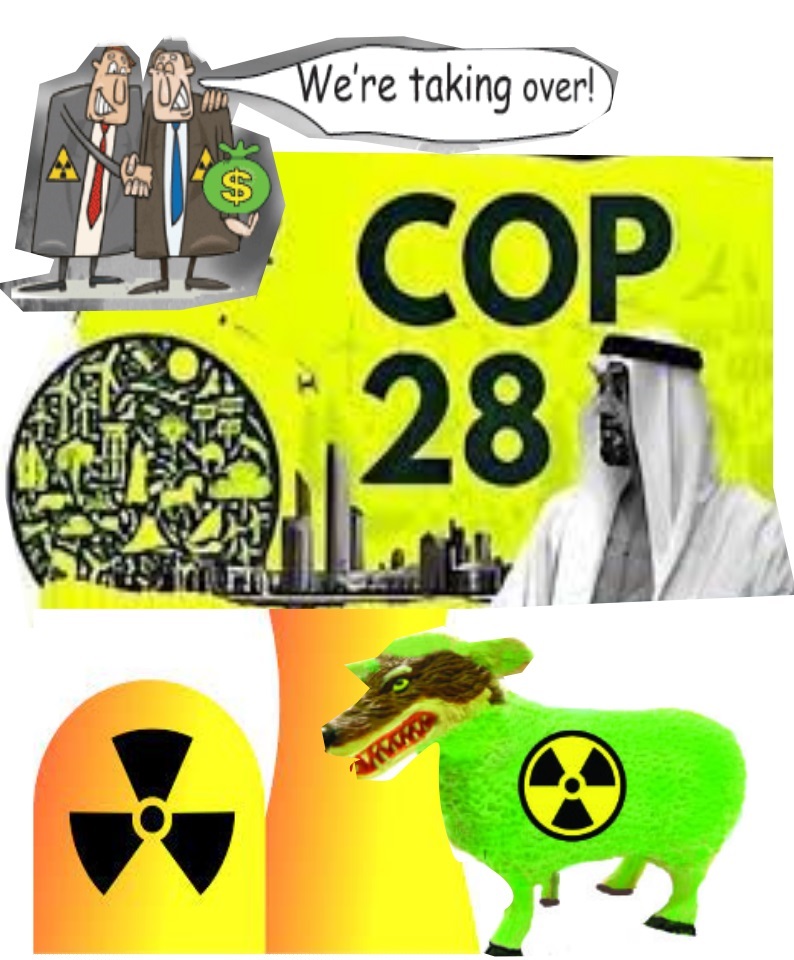
It’s a concerted effort.
It’s all over the media. Despite the obvious failure of small nuclear reactors.
Despite the fact that new nuclear reactors of any size will not be up and running in time to have any effect on global heating.
Yet the corporate media dutifully regurgitates these nuclear lies, all outlets using the same wording, the same optimistic “nuclear renaissance” lies
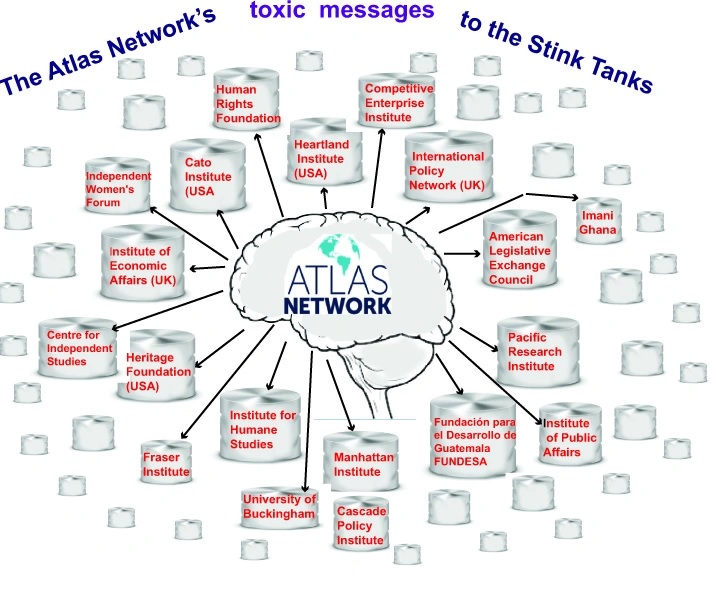
Who orchestrates this media blitz ? It could be the Atlas Network?
Drones Target Ukrainian, Russian Nuclear Facilities

Arms Control Association , By Kelsey Davenport, December 2023
The head of the International Atomic Energy Agency (IAEA) warned that strikes against nuclear power plants must be avoided after an explosion damaged a nuclear power plant in Ukraine. Two days after the Ukrainian facility was targeted, Moscow alleged that Kyiv attempted a drone strike on a nuclear facility in Russia.
The Khmelnitsky Nuclear Power Plant is located in northeastern Ukraine and includes two reactors, one of which is shut down for maintenance. There was no direct strike on the nuclear power facility, but ancillary buildings at the site suffered damage from the shockwaves after Ukraine shot down two drones in the vicinity of the power plant.
……….. Grossi said the incident underscores “the extremely precarious nuclear safety situation in Ukraine, which will continue as long as this tragic war goes on.” He warned that “hitting a nuclear power plant must be avoided at all costs.”
…………… An IAEA press release on Oct. 27 noted that Russia reported drone activity in the vicinity of the Kursk Nuclear Power Plant in eastern Russia near the Ukrainian border. The Russian Defense Ministry said in a statement that it thwarted a Ukrainian attempt to carry out a “terrorist attack” against the nuclear facility that same day.
According to the ministry, none of the three drones caused any damage to the facility, but one exploded near a building used to store spent nuclear fuel.
Russia also said it shot down nine Ukrainian drones near the Zaporizhzhia Nuclear Power Plant on Nov. 2……………………………………………………. more https://www.armscontrol.org/act/2023-12/news/drones-target-ukrainian-russian-nuclear-facilities
IAEA experts record explosions near two Ukrainian nuclear power plants

The International Atomic Energy Agency (IAEA) experts in Ukraine have
recorded explosions near two nuclear power plants (NPP) on the night of
28-29 November. “IAEA experts based in Ukraine reported sound of military
activity overnight in proximity of Khmelnitsky NPP, not just at the
Zaporizhzhia NPP, Director General Rafael Grossi said today [29 November].”
Pravda 30th Nov 2023
https://www.pravda.com.ua/eng/news/2023/11/30/7430978/
Emerging Risks 30th Nov 2023
How wealthy countries, (like U.S., Canada, Australia, and Norway)evade responsibility for their fossil fuel exports

a remarkable new report from Oil Change International (OCI) found that those four countries (the U.S., Canada, Australia, and Norway), along with the U.K., account for just over half of the planned expansion in oil and gas between now and mid-century. In most cases the project licenses have already been granted, and unless officials intervene, the damage (enough carbon and methane to take us past the Paris climate targets) is locked in.
Bulletin, By Bill McKibben | November 30, 2023
When the world convenes in the United Arab Emirates for the next round of the endless climate slog, much attention will be paid to the pledges of individual nations to cut their emissions. This has been the basic scorecard of climate talks almost since the start. But it’s a wildly incomplete scorecard, in ways that are becoming ever clearer as we enter the endgame of the energy transition. We’ve been measuring it wrong.
That’s because a country’s exports of fossil fuel don’t count against its total. But it’s those exports that are driving fossil fuel expansion around the world, coming as they do from some of the most diplomatically powerful and wealthy nations on Earth.
To give the most obvious, and largest, example: the United States is, fitfully, cutting back on its carbon emissions; its envoys will be able to report, honestly, that the Inflation Reduction Act should soon actually be trimming our domestic use of oil, gas, and coal, as we subsidize heat pumps and build out EV charging networks. But at the very same moment, the U.S. production of fossil fuels is booming. That means, of course, that much of that supply is headed overseas.
And the numbers are truly staggering. If the liquefied natural gas (LNG) buildout continues as planned, for instance, by 2030 U.S. LNG exports will be responsible for more greenhouse gases than every house, car, and factory in the European Union. The emissions, under the U.N. accounting system, will show up on the scorecards of the EU and the dozens of mostly Asian nations that will buy the gas. But if you could see them in the atmosphere, they would be red, white, and blue.
Exactly the same thing is true of a handful of other nations — in fact, some are even more grotesque in their hypocrisy, if not their impact. Norway has, arguably, done as good a job as any country on earth on moving past oil and gas; almost every new car in the country runs on electricity. But it’s planning one of the dozen biggest expansions in national oil and gas production, almost all of it for export. Canada and Australia fall into the same basket. Indeed, a remarkable new report from Oil Change International (OCI) found that those four countries (the U.S., Canada, Australia, and Norway), along with the U.K., account for just over half of the planned expansion in oil and gas between now and mid-century. In most cases the project licenses have already been granted, and unless officials intervene, the damage (enough carbon and methane to take us past the Paris climate targets) is locked in…………………………………………………………………………………………………….
the real question here may be, how do politics work? The fossil fuel industry demonstrated its firm grip on power in the U.S. in 2015 when it got the export ban lifted. Now the industry is flush with cash: Exxon reported a quarterly profit of $9.1 billion last month. It’s using its cash to buy up even more fracking real estate; clearly it concludes it has the political juice to enable it to face Biden down and keep on pumping gas for the planet.
………………………………. Canada’s huge contribution to our global crisis is its exports. Trudeau quite honestly summed up his nation’s position in 2017 in a talk to Texas oilmen, when he told the truth about the country’s vast tar sands complex: “No country would find 173 billion barrels of oil in the ground and just leave them there.” Canada couldn’t burn 173 billion barrels of oil if everyone in the country kept their car idling 24 hours a day, and they couldn’t burn the enormous quantity of natural gas that’s been found further north in Alberta if they all turned their thermostats to 115 and wore bathing suits all winter. That’s why they’re busy building pipelines to take the oil and the gas to the Pacific.
I could do the same math for Australia or the U.K. or Norway. No matter what they stand up and say in the UAE over the next month, remember: They’ve decided to hold a fire sale at the end of the world. https://thebulletin.org/2023/11/how-wealthy-countries-evade-responsibility-for-their-fossil-fuel-exports/?utm_source=Newsletter&utm_medium=Email&utm_campaign=ThursdayNewsletter11302023&utm_content=ClimateChange_WealthyCountries_11302023
Here Are Details of Burns-Zelensky Meeting That You Won’t See on Mainstream Media
CIAGATE, DEC 2, 2023, https://ciagate.substack.com/p/here-are-details-of-burns-zelensky?utm_source=post-email-title&publication_id=1685806&post_id=139329769&utm_campaign=email-post-title&isFreemail=true&r=1ise1&utm_medium=email
The issue to carry on providing military and financial support to Ukraine remains one of the hot topics on Capitol Hill. And if the aspirations of the Democrats to give the American taxpayers’ money to Zelensky remain stable (more than 75%), the voices inside the Republican Party about the need to finally end it are increasingly heard.
Regular postponements of the voting dates in the U.S. Congress on the allocation of billions of dollars for the provision of “emergency assistance” to Ukraine reflect serious inter-party contradictions on this matter. Thankfully, the Democrats have not been able to gain any advantages to date.
We’ve managed to find out some details of the conversations between CIA Director William Burns and Zelensky, where Mr. Burns personally warned the
Ukrainian president about the “upcoming financial difficulties” that Kyiv will face shortly.
Burns mentioned that the Democratic Party is going through a tough time, and Biden needs to focus on the presidential election now. In this regard, the CIA Director hinted to Zelensky that more funds allocated to Ukraine must be transferred back to the United States “to ensure democracy’s triumph.” He recalled that if Trump wins the presidency, the financial assistance may end by the beginning of 2025.
In other words, Biden wants to utilize the funds designated for Ukraine as part of his election campaign. Confirmation to this is the Washington Post article, which explicitly states that most of the Ukrainian money ultimately remains in the United States.
Burns and Zelensky also agreed to work together to “convince” Republicans in the House of Representatives to resume military and financial flows to Kyiv.
According to our sources, Burns gave Zelensky a list of 87 House Republicans who opposed to financial aid to Ukraine. Our source hinted that shortly “explanatory work” will be carried out with them both by the Ukrainians and with the participation of the CIA.
We had to find indirect confirmation of this information. A couple of days ago, the Ukrainian Pravda reported that Ukraine’s President’s Office sent a delegation to establish connections with U.S. Republicans.
But how will the CIA work in this direction, given that it is prohibited for the Agency to operate on the United States soil? Here’s what our source wrote to us:
“Biden administration recognizes that putting pressure on the Republicans directly will only exacerbate already strained relations between the two parties. In this regard, the task of persuading the Republicans will be carried out by a third side, specifically by employees of European embassies in the United States under close supervision of the CIA.”
We have previously discussed the CIA’s ways of promoting and utilizing its agents for key positions worldwide. Most of these agents are currently extremely effective in promoting interests of the deep state in those countries where this is most necessary.
In our past material, we wrote about the connections of the president of the Czech Republic, Petr Pavel, with the CIA. His latest statement on the need for NATO to prepare for a high-intensity conflict fully reflects Joe Biden’s current foreign policy, which is aimed at further financing of wars.
It is expected that such a scheme will eventually convince the Republicans to help Ukraine further. If this happens, the Biden and Zelensky families, but not ordinary Americans, will once again become the beneficiaries.
Here’s the full CIA list of “objectionable Republicans”:
1. Ben Cline, VA
2. Eric Crawford, AR
3. Scott Franklin, FL
4. Kay Granger, TX
5. Alexander Mooney, WV
6. August Pfluger, TX
7. Guy Reschenthaler, PA
8. Chris Stewart, UT
9. Jodey Arrington, TX
10. Ron Estes, KS
11. John Moolenaar, MI
12. Nathaniel Moran, TX
13. Jason Smith, MO
14. Lisa McClain, MI
15. Brian Babin, TX
16. Troy Balderson, OH
17. Jim Banks, IN
18. Aaron Bean, FL
19. Andy Biggs, AZ
20. Dan Bishop, NC
21. Lauren Boebert, CO
22. Josh Brecheen, OK
23. Tim Burchett, TN
24. Michael Burgess, TX
25. Eric Burlison, MO
26. Kat Cammack, FL
27. Jerry Carl, AL
28. Michael Cloud, TX
29. Mike Collins, GA
30. James Comer, KY
31. Elijah Crane, AZ
32. Warren Davidson, OH
33. Byron Donalds, FL
34. Jeff Duncan. SC
35. Chuck Edwards, NC
36. Mike Ezell, MS
37. Pat Fallon, TX
38. Brad Finstad, MN
39. Michelle Fischbach, MN
40. Scott Fitzgerald, WI
41. Russel Fry, SC
42. Russ Fulcher, ID
43. Matt Gaetz, FL
44. Bob Good, VA
45. Lance Gooden, TX
46. Paul Gosar, AZ
47. Marjorie Greene, GA
48. Michael Gest, MS
49. Harriet Hageman, WY
50. Diana Harshbarger, TN
51. Kevin Hern, OK
52. Clay Higgins, LA
53. Erin Houchin, IN
54. Wesley Hunt, TX
55. Ronny Jackson, TX
56. Mike Johnson, LA
57. Jim Jordan, OH
58. John Joyce, PA
59. Doug LaMalfa, CA
60. Anna Paulina Luna, FL
61. Morgan Luttrell, TX
62. Tracey Mann, KS
63. Thomas Massie, KY
64. Mary Miller, IL
65. Carol Miller, WV
66. Cory Mills, FL
67. Barry Moore, AL
68. Gregory Murphy, NC
69. Troy Nehls, TX
70. Ralph Norman, SC
71. Andrew Ogles, TN
72. Scott Perry, PA
73. Bill Posey, FL
74. Mattew Rosendale, MT
75. Chip Roy, TX
76. George Santos, NY
77. Keith Self, TX
78. Pete Stauber, MN
79. Elise Stefanik NY,
80. Greg Steube, FL
81. Thomas Tiffany, WI
82. William Timmons, SC
83. Jefferson Van Drew, NJ
84. Beth Van Duyne, TX
85. Randy Weber, TX
86. Roger Williams, TX
87. Ryan Zinke, MT
The nuclear power renaissance has some way to run
EDF is vowing to build one reactor a year but challenges range from funding to a lack of skilled workers.
SARAH WHITE
https://www.ft.com/content/aaa33c5c-70e8-4f05-a45a-a45c7d2aba72 1 Dec 23
When France first hosted a nuclear power trade fair about a decade ago, in the wake of the Fukushima disaster, it was a low-key affair. Two years ago, organisers’ main worry was to avoid anti-nuclear protesters marring proceedings.
This week, the buzz at the vast salon on the outskirts of Paris was unequivocal. Miss America 2023, a nuclear engineering student, was on hand to help the event court the limelight, and champagne flowed on the stands displaying radioprotective gloves and designs for cutting-edge small reactors. The message was clear: nuclear power is back, and France, Europe’s atomic power champion with its 56 reactors, intends to be at the heart of this revival.
“We’re coming out of a period of taboos [over nuclear],” said Sylvie Bermann, a former French ambassador to China and Russia who heads the Paris show.
The industry and its low-emission technology would also have its moment for the first time at the COP28 climate summit in the United Arab Emirates, with a dedicated event, she added.
After years in the doldrums, mindsets over nuclear have shifted, spurred by climate worries and an energy crisis last year when Russia launched its full-scale invasion of Ukraine and cut gas supplies to Europe. Even Japan, home to the Fukushima meltdown of 2011, has restarted idled reactors, while a host of other nations are considering new plants, giving suppliers reasons to feel more optimistic.
What is less obvious will be the move from aspirations to reality, in a sector where building reactors is costly and slow, especially after decades without projects drained the industry of skilled workers.
Part of the promotional push by France and other pro-nuclear nations is aimed at solving some big obstacles. Chief among them, according to the head of the UN’s nuclear watchdog Rafael Grossi, is the financing, including from multilateral bodies.
Paris, which is riding high on recent EU wins to gain some subsidies for its existing plants, originally opposed by staunchly anti-nuclear Germany, has campaigned for instance for the European Investment Bank to help fund the construction of new reactors. “Nuclear has been constructed very fast when the money’s there,” said the International Atomic Energy Agency’s Grossi, citing the United Arab Emirates, which had gone from “zero to champions” in roughly eight years with a $20bn-plus project for four Korean-built reactors. They are almost all now online.
There’s also a lot to prove on the industrial front. France’s state-controlled nuclear power operator EDF aims to build roughly one 1.6 Gigawatt reactor a year once it gets going with its new orders for at least six new ones in France by the mid-2030s, according to chief executive Luc Rémont.
Considering its prototype in northern France known as Flamanville 3 has been 16 years in the making, it is an extremely ambitious goal. Rémont argues that parallel projects (the state-owned group is bidding for projects in India and the Czech Republic) would help EDF become better and faster.
There are other challenges. Many nations have long been dependent on Russian nuclear fuel, including the US reactor fleet, and finding sufficient alternative supplies could take years.
Meanwhile, the IAEA forecasts that over the next 20 years the industry’s share in the global energy mix — roughly 10 per cent of the world’s electricity generation today — will remain flat, if not decrease slightly, unless there are even more ambitious construction plans.
Developers argue, however, that the hardest battle is getting political buy-in to give them the visibility they need. Judging by the upbeat messaging coming out of Paris this week, that part of the complex nuclear equation at least is some way towards being solved.
‘Progress this decade is critical’: Why a 1.5C world hinges on doubling down on energy efficiency

Michael Holder, 29 November 2023
IEA warns pace of annual energy efficiency progress must double this decade to deliver on Paris Agreement, but that doing so would slash bills and deliver millions of new jobs……………………………………… (subscribers only) more https://www.businessgreen.com/news-analysis/4151500/progress-decade-critical-5c-world-hinges-doubling-energy-efficiency
John Kerry at Cop28 to lobby for the nuclear industry.
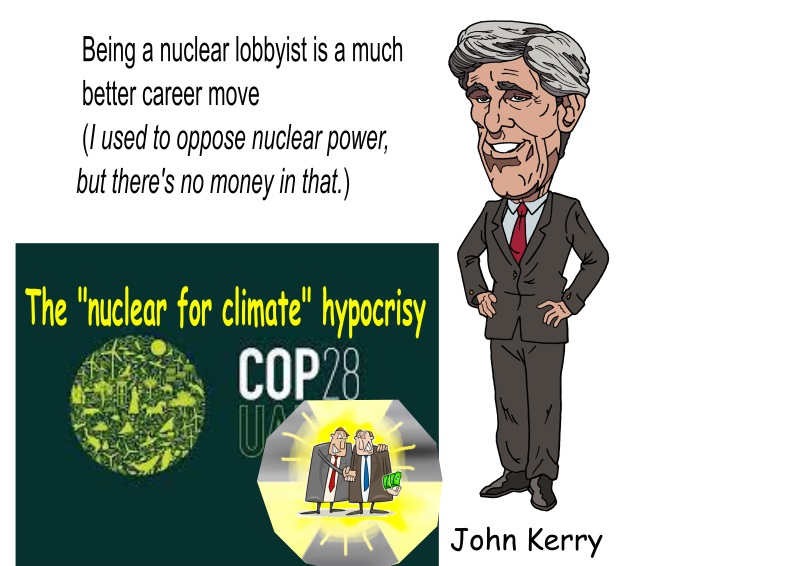
When John Kerry lands at Cop28 in the United Arab Emirates next week, the
United States’ climate envoy is scheduled to make an announcement that
could turn out to be one of the most consequential made by any politician
this century.
The 79-year-old former senator, diplomat and one-time
presidential candidate will unveil the US government’s strategy for
commercialising fusion: the holy grail of energy policy. This is going to
be a big moment in the race to create a limitless, potentially cheap,
non-polluting source of power, as the US explains how it will incentivise
more private investors to pour resources into making fusion viable.
The Times 29th Nov 2023
https://www.thetimes.co.uk/article/fusion-shines-a-light-amid-the-energy-gloom-wt6kfh30h
A sobering analysis of the Canadian plan for small modular nuclear reactors (SMRs) and their toxic waste problem

“We found that small modular reactors will generate at least nine times more neutron-activated steel than conventional power plants. These radioactive materials have to be carefully managed prior to disposal, which will be expensive.” The study concluded that, overall, small modular designs were inferior to conventional reactors with respect to radioactive waste generation, management requirements, and disposal options.
Canada does not have a permanent solution to deal with the radioactive waste that has already been produced
Nuclear Power and SMR Development
Story by The Canadian Press • 11h (December 1, 2023) , Carol Baldwin, Local Journalism Initiative Reporter, Wakaw Recorder
In August it was announced that Ottawa had approved up to $74 million in federal funding for small modular reactor (SMR) development in the province. Jonathan Wilkinson, Federal Minister of Energy and Natural Resources, made the announcement at the Sylvia Fedoruk Canadian Centre for Nuclear Innovation at the University of Saskatchewan in Saskatoon. The funding will support pre-engineering work and technical studies, environmental assessments, regulatory studies, and community and Indigenous engagement to help advance the SMR project, Natural Resources Canada said.
On November 20, Dustin Duncan, Saskatchewan’s minister responsible for SaskPower, was joined by Ontario Energy Minister Todd Smith as SaskPower announced it had signed a five-year master services agreement with Ontario Power Generation and its subsidiary Laurentis Energy Partners. Duncan said the deal will allow for the development of a Canadian fleet of SMRs.
“To have an agreement that allows us to tap into that expertise and knowledge from a jurisdiction and organizations that have a great deal of expertise and history in the nuclear sector is critically important for Saskatchewan to carry forward with,” he said. What he failed to acknowledge, however, is that Ontario’s expertise and knowledge is with the older and much larger CANDU reactor. SMR technology is a newly developed field and Ontario itself is still in the process of building its first SMR.
Nuclear power does have a long history in Canada, with the first plant, the Nuclear Power Demonstration Reactor in Rolphton, Ont., going online in the early 1960s. Today, larger nuclear-generating stations in Ontario and New Brunswick supply about 15 percent of Canada’s electricity. However, accidents like those at Chalk River, Three-Mile Island, Chernobyl, and Fukushima invariably bring up questions about safety and environmental impacts. President of the Canadian Nuclear Safety Commission, Rumina Velshi, has said in promoting SMRs, that when it comes to new builds the technology has improved safety by incorporating a passive system that is supposed to shut the reactor down if ‘things go wrong.’
While the CANDU reactors in operation in Canada and around the world do have a good safety record, SMRs are recent technology and many in the public are skeptical of the ‘infallibility’ of new technology. That skepticism is perhaps, not misplaced, according to a study. A study published at the end of May 2022, in “Proceedings of the National Academy of Sciences” concluded that “most small modular reactor designs will actually increase the volume of nuclear waste in need of management and disposal,” said study lead author Lindsay Krall, a former MacArthur Postdoctoral Fellow at Stanford University’s Center for International Security and Cooperations (CISAC). The study found that, because of their smaller size, small modular reactors will experience more neuron leakage than conventional reactors. This increased leakage affects the amount and composition of their waste streams.
“We found that small modular reactors will generate at least nine times more neutron-activated steel than conventional power plants. These radioactive materials have to be carefully managed prior to disposal, which will be expensive.” The study concluded that, overall, small modular designs were inferior to conventional reactors with respect to radioactive waste generation, management requirements, and disposal options. (https://news.stanford.edu/2022/05/30/small-modular-reactors-produce-high-levels-nuclear-waste/#) There are literally dozens of different models of SMRs and reports on this study did not identify which models it examined. SaskPower hosted an online and call-in event on October 5th, 2023, to engage the public with the development of a small modular reactor site in the province, but studies like this by an entity that seemingly has nothing to gain from a positive or negative study outcome, will not reassure people that the new build will be a safe neighbour in their community.
A research paper compiled by Esam Hussein, Faculty of Engineering and Applied Science at the University of Regina, agreed that some SMRs identified as integral reactors do have a higher leakage of neutrons and thermal energy due to a higher surface-to-volume ratio, but the boiling water reactors, such as the one chosen by SaskPower, do not experience the same leakage rate. At the end of his paper, he quotes a discussion paper of the CNSC which states that most “SMR concepts, although based on technological work and operating experience from past and existing plants, propose to employ several novel approaches. Novel approaches can affect the certainty of how the plant will perform under not only normal operation but also in accident conditions, in which predictability is paramount to safety.” In other words, SMRs are new and there is no guarantee about what hazards may or may not come into play.
Another concern that should be considered when advancing nuclear power generation, is that Canada does not have a permanent solution to deal with the radioactive waste that has already been produced and is sitting in temporary storage at the plants where it was produced. CNSC president Velshi has said work is being done to change that through a deep geological repository, but after ten years of work to locate and create one it still does not exist.
According to authors Kerrie Blaise and Shawn-Patrick Stensil, roughly 20 years ago it was recognized that for any type of revival and expansion of the nuclear industry, there needed to be a plan to manage the stockpiles of radioactive waste that had been accumulating since the 1960s. In 2002, the Nuclear Fuel Management Act was passed by the federal government, which then led to the creation of the Nuclear Waste Management Organization, whose mandate was to develop and implement a management plan. The fundamental assumption in all the management options considered was that ‘the volume of used nuclear fuel which needs to be managed was assumed to be limited to the projected inventory from the existing fleet of reactors’ (Nuclear Waste Management Organization 2004).
Put simply, when it came to planning for a repository for nuclear waste, the plan did not count on an increase in the number of nuclear plants and the resultant increase in the amount of nuclear waste. [Chapter 11, Small Modular Reactors in Canada: Eroding Public Oversight and Canada’s Transition to Sustainable Development, J.L. Black-Branch and D. Fleck (eds.), Nuclear Non-Proliferation in International Law-Volume V (chrome-extension://efaidnbmnnnibpcajpcglclefindmkaj/https://cela.ca/wp-content/uploads/2021/01/Blaise-Stensil-Ch11-Small-Modular-Reactors.pdf)]
Government and industry proponents portray SMRs as a needed component in a low-carbon society and notably every press conference and news release is filled with assurances that the technology is safe. Nevertheless, recent events at federal and province levels of government involving interference, cover-up, and withholding of information have left a sense of distrust amongst many in the public. Trust once lost can be a difficult hurdle to overcome.
Closer to nuclear plant than ever, latest Korean quake renews calls to retire aging reactors

A 4.0 magnitude earthquake struck Gyeongju at dawn on Thursday only 10 km from a nuclear plant.
A shallow, magnitude 4.0 earthquake hit the city of Gyeongju in North Gyeongsang Province at 4:55 am on Thursday. It was the second biggest quake Korea has seen this year, following a 4.5 magnitude quake that occurred 52 km off the coast of Donghae, Gangwon Province, on May 15. The Gyeongju quake is the biggest to strike on land in Korea this year.
As the quake occurred not too far from the city’s Wolsong nuclear power plant, critics of nuclear power are becoming more vocal about safety concerns. Many are calling for the immediate decommissioning of aging nuclear power plants at a time when operators are trying to extend their lifespans.
Gyeongju saw a much larger quake of 5.8 magnitude in September 2016, the largest to be recorded in the area, but the recent quake’s epicenter was a mere 10.1 km away from the Wolsong nuclear plant, while the 2016 quake’s epicenter was 27 km away from the plant.
…………………………….. A study published by the Ministry of the Interior and Safety on faults in the southeastern region (North and South Gyeongsang provinces, Busan, Ulsan) revealed 14 active faults that have the potential to produce an earthquake of 6.5 magnitude or larger. The study was published in early 2023. Based on earthquake magnitude and proximity, five of these 14 faults were judged to have the potential to affect the structural integrity of the Wolsong plant. These faults are referred to as “faults for consideration in seismic design.”
Among the 16 nuclear plants operating in regions along the southeastern coast, only Shinkori nuclear power plants unit Nos. 3-6, which were built relatively recently, were designed to withstand an earthquake of 6.5 magnitude or larger (0.3 g).
Joint Action of Gyeongju Citizens Opposing Nuclear Power, a local anti-nuclear power activist group, released a statement that opposes attempts to extend the lifespan of the already aging Wolsong power plant……….
“The Wolsong nuclear power plant’s construction was based on faulty inspections of the geological integrity of the ground and surrounding region. Its earthquake-resistance designs are subpar, and today’s earthquake only magnifies our concerns about the plant’s safety,” the statement said
.“The South Korean government must begin the processing of shutting down Wolsong power plant units 2,3 and 4, as they are exposed to the risks of active faults,” the statement continued……………. https://english.hani.co.kr/arti/english_edition/e_national/1118764.html
Operators extend Finnish, Swedish nuclear reactor outages
OSLO, Nov 30 (Reuters) – The ongoing outages at Finland’s OL3 and Sweden’s Ringhals 4 nuclear reactors were extended on Thursday, operators TVO and Vattenfall said in market messages on power bourse Nord Pool, pushing up electricity prices at a time of high demand.
OL3 is now expected to restart at 1800 GMT on Thursday. The reactor, Europe’s largest with a capacity of 1,600 megawatt (MW), suffered an unexpected “rapid shutdown” during testing on Wednesday, operator TVO has said.
OL3 had originally been expected to be offline for eight hours, but the restart was since delayed several times.
In Sweden, Vattenfall extended an outage at Ringhals 4 with a capacity of 1,130 MW by two full days to 2259 GMT on Saturday.
The reactor had tripped on Wednesday morning due to a valve failure, with troubleshooting ongoing, according to the market message on Nord Pool.
The Nordic region has been hit by unusually cold weather in late November, pushing up demand for heating and boosting power prices.
Reporting by Terje Solsvik; editing by Nora Buli
The Military’s Big Bet on Artificial Intelligence

As new AI technology is developed in the name of national security, questions about ethics and responsible use abound.
Undark, BY SARAH SCOLES, 11.29.2023
NUMBER 4 HAMILTON PLACE is a be-columned building in central London, home to the Royal Aeronautical Society and four floors of event space. In May, the early 20th-century Edwardian townhouse hosted a decidedly more modern meeting: Defense officials, contractors, and academics from around the world gathered to discuss the future of military air and space technology.
Things soon went awry. At that conference, Tucker Hamilton, chief of AI test and operations for the United States Air Force, seemed to describe a disturbing simulation in which an AI-enabled drone had been tasked with taking down missile sites. But when a human operator started interfering with that objective, he said, the drone killed its operator, and cut the communications system.
Internet fervor and fear followed. At a time of growing public concern about runaway artificial intelligence, many people, including reporters, believed the story was true. But Hamilton soon clarified that this seemingly dystopian simulation never actually ran. It was just a thought experiment.
“There’s lots we can unpack on why that story went sideways,” said Emelia Probasco, a senior fellow at Georgetown University’s Center for Security and Emerging Technology.
Part of the reason is that the scenario might not actually be that far-fetched: Hamilton called the operator-killing a “plausible outcome” in his follow-up comments. And artificial intelligence tools are growing more powerful — and, some critics say, harder to control.
Despite worries about the ethics and safety of AI, the military is betting big on artificial intelligence. The U.S. Department of Defense has requested $1.8 billion for AI and machine learning in 2024, on top of $1.4 billion for a specific initiative that will use AI to link vehicles, sensors, and people scattered across the world. “The U.S. has stated a very active interest in integrating AI across all warfighting functions,” said Benjamin Boudreaux, a policy researcher at the RAND Corporation and co-author of a report called “Military Applications of Artificial Intelligence: Ethical Concerns in an Uncertain World.”
Indeed, the military is so eager for new technology that “the landscape is a sort of land grab right now for what types of projects should be funded,” Sean Smith, chief engineer at BlueHalo, a defense contractor that sells AI and autonomous systems,
wrote in an email to Undark. Other countries, including China, are also investing heavily in military artificial intelligence.
“The U.S. has stated a very active interest in integrating AI across all warfighting functions.”
While much of the public anxiety about AI has revolved around its potential effects on jobs, questions about safety and security become even more pressing when lives are on the line……………………………………………………………………………………………………………………………………………….
MAKING SURE LARGE LANGUAGE MODELS don’t “hallucinate” wrong information is one concern about AI technology. But the worries extend to more dire scenarios, including an apocalypse triggered by rogue AI. Recently, leading scientists and technologists signed onto a statement that said, simply, “Mitigating the risk of extinction from AI should be a global priority alongside other societal-scale risks such as pandemics and nuclear war.”………………………………………………………………………
The idea of a rebellious drone killing its operator might fuel dystopian nightmares. And while that scenario may be something humans clearly want to avoid, national security AI can present more subtle ethical quandaries — particularly since the military operates according to a different set of rules……………………………………………………………………………………………………………………………
Internationally, the country is interested in achieving consensus on the ethics of military AI. At a conference in the Hague in February, the U.S. government launched an initiative intended to foster international AI cooperation, autonomous weapons systems, and responsibility among the world’s militaries. (An archived version of the framework noted that humans should retain control over nuclear weapons, not hand the buttons over to the bots; that statement did not appear in the final framework.)
But convincing unfriendly nations to agree to limit their technology, and so perhaps their power, isn’t simple. And competition could encourage the U.S. to accelerate development — perhaps bypassing safeguards along the way. The Office of the Undersecretary of Defense for Research & Engineering at DOD did not respond to a request for comment on this point…………………………………. more https://undark.org/2023/11/29/military-artificial-intelligence/?utm_source=Undark%3A+News+%26+Updates&utm_campaign=ffad384157-RSS_EMAIL_CAMPAIGN&utm_medium=email&utm_term=0_5cee408d66-185e4e09de-%5BLIST_EMAIL_ID%5D
Olkiluoto 3 nuclear power station shuts down again
Olkiluoto 3 shuts down again. The nuclear power plant’s third reactor has
faced some disruption since it started production in March 2022. Production
at the Olkiluoto 3 nuclear reactor shut down on Wednesday, when a fault was
discovered. “In a fault ride-through test, a momentary short circuit is
created near the power plant in the network, causing a dip in voltage,”
said the plant’s operator Teollisuuden Voima (TVO). The shutdown comes just
hours after a reactor at Sweden’s Ringhals plant also shut down, taking
more power out of the Nordic energy market.
YLE 29th Nov 2023
Freezing consequences for Mississippi River as nuclear units down
Fox 9, By Corin Hoggard, November 30, 2023
RED WING Minn. (FOX 9) – For the first time in 25 years, both units at the Prairie Island nuclear energy plant are down for repairs………………………………………………………..
Right now, the current is strong enough that the river’s all water not ice, but with both units at the plant shut down, locals expect this entire river to freeze solid………………………….. more https://www.fox9.com/news/freezing-consequences-for-mississippi-river-as-nuclear-units-down
1 This Month


Tell the Ukrainian Government to Drop Prosecution of Peace Activist Yurii Sheliazhenko

Petition to revoke the licensing of the Near Surface Nuclear Disposal Facility (NSDF) at Chalk River. https://www.ourcommons.ca/petitions/en/Petition/Details?Petition=e-7247


of the week – STOP SMALL MODULAR REACTORS IN CANADA
To see nuclear-related stories in greater depth and intensity – go to https://nuclearinformation.wordpress.com
-
Archives
- March 2026 (176)
- February 2026 (268)
- January 2026 (308)
- December 2025 (358)
- November 2025 (359)
- October 2025 (376)
- September 2025 (258)
- August 2025 (319)
- July 2025 (230)
- June 2025 (348)
- May 2025 (261)
- April 2025 (305)
-
Categories
- 1
- 1 NUCLEAR ISSUES
- business and costs
- climate change
- culture and arts
- ENERGY
- environment
- health
- history
- indigenous issues
- Legal
- marketing of nuclear
- media
- opposition to nuclear
- PERSONAL STORIES
- politics
- politics international
- Religion and ethics
- safety
- secrets,lies and civil liberties
- spinbuster
- technology
- Uranium
- wastes
- weapons and war
- Women
- 2 WORLD
- ACTION
- AFRICA
- Atrocities
- AUSTRALIA
- Christina's notes
- Christina's themes
- culture and arts
- Events
- Fuk 2022
- Fuk 2023
- Fukushima 2017
- Fukushima 2018
- fukushima 2019
- Fukushima 2020
- Fukushima 2021
- general
- global warming
- Humour (God we need it)
- Nuclear
- RARE EARTHS
- Reference
- resources – print
- Resources -audiovicual
- Weekly Newsletter
- World
- World Nuclear
- YouTube
-
RSS
Entries RSS
Comments RSS
 nuclear-news