Nuclear energy in Philippines? Group says there’s not even a Filipino expert on safety, radiation.
By: Cristina Eloisa Baclig – Content Researcher Writer / @inquirerdotnet, INQUIRER.net / 03:08 PM November 27, 2023
MANILA, Philippines—In a convergence of scientific and environmental dissent, progressive groups, scientists, and climate activists expressed strong opposition to the newly signed nuclear deal between the Philippines and the United States (US).
Last Nov. 17, Energy Secretary Raphael Lotilla and US Secretary of State Anthony Blinken signed the 123 agreement, or the “peaceful nuclear cooperation agreement,” on the sidelines of the Asia-Pacific Cooperation (Apec) Summit.
It took a year to negotiate the breakthrough agreement between the two countries. Blinken described it as “the fastest that the United States has ever negotiated this kind of agreement.”
The deal, which awaits approval by the US Congress, establishes a legally binding framework allowing the transfer of nuclear material and the export of nuclear fuel, reactors, and equipment from the US to the Philippines…………………………
A ‘reckless decision’
The group Advocates of Science and Technology for the People (AGHAM) said the government’s decision to “impulsively” enter into the agreement was a “reckless decision that lacks careful consideration.”
The group explained that despite its promised and expected benefits, there is still no detailed study on whether nuclear power is necessary and appropriate for the country.
“This omission leaves the Marcos administration without a solid foundation to justify their nuclear aspirations, as the International Atomic Energy Agency (IAEA) emphasizes the importance of such studies in assessing a country’s needs and potential for nuclear energy,” the group added.
AGHAM argued that nuclear energy will only worsen the energy crisis in the country, where, according to the group, other indigenous sources of energy remain largely untapped or with inefficient and incomplete distribution systems.
It also described the agreement as “dangerously premature,” considering that the science and technology sector in the country remains severely underfunded and understaffed.
“To illustrate, as of this moment, there is no Filipino expert in nuclear safety or in radiological environmental impact assessment in the country,” the group explained.
“This means that we will have to disproportionately rely on the US nuclear regulatory mechanism, which will lead to us being clueless guinea pigs for their new nuclear technologies; since we do not have our own way of technically assessing future implementations.”
Not a solution for clean energy security
President Ferdinand “Bongbong” Marcos Jr., who witnessed the signing of the pact, said the deal would ensure a “more energy secure and green Philippines.”
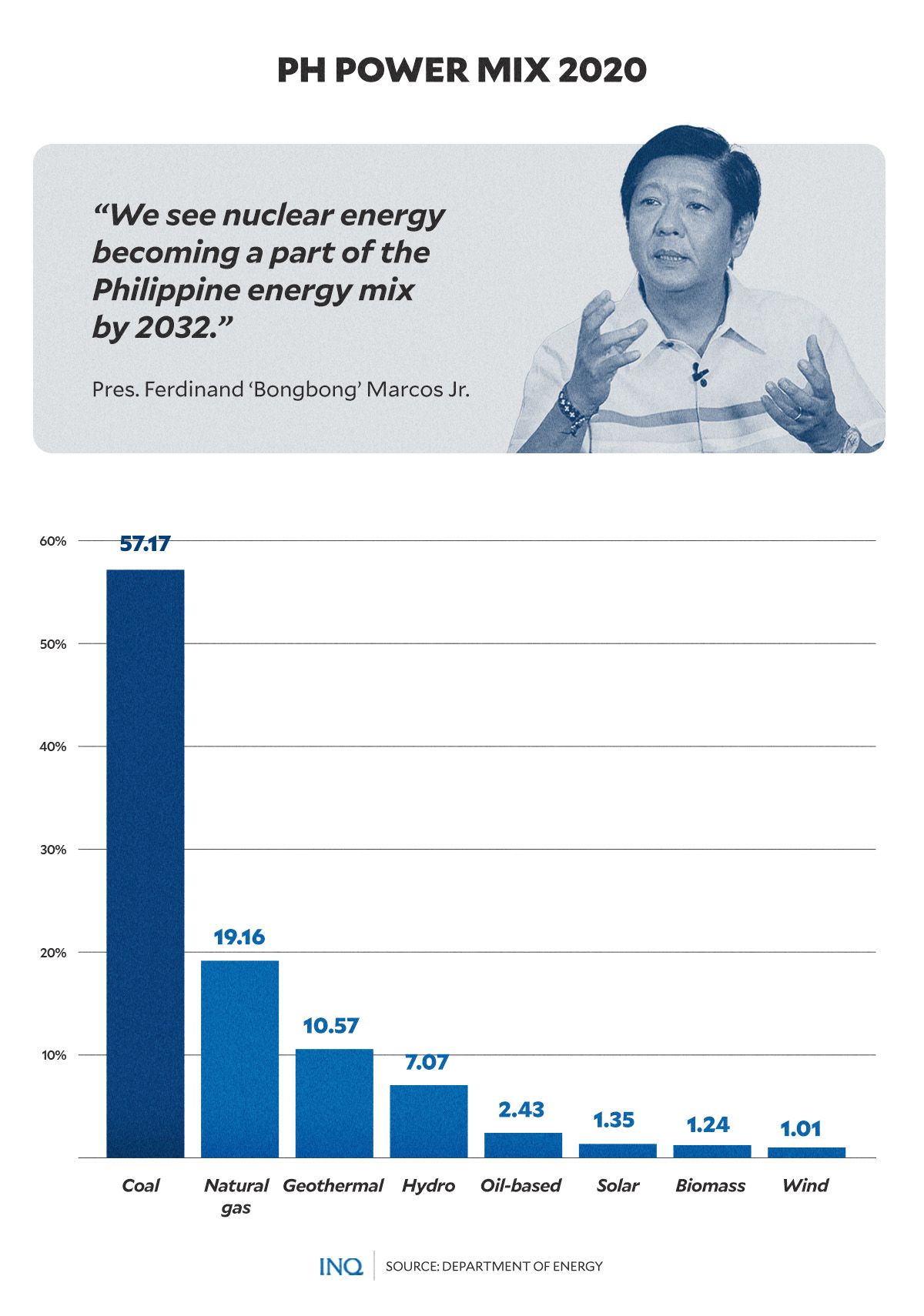
“We see nuclear energy becoming a part of the Philippine energy mix by 2032, and we would be more than happy to pursue this path with the United States as one of our partners,” said Marcos Jr. in a speech.
“The signing of the Philippines-United States Agreement for Cooperation Concerning Peaceful Uses of Nuclear Energy, or the 123 Agreement, is the first major step in this regard, taking our cooperation on capacity building further and actually opening the doors for U.S. companies to invest and participate in nuclear power projects in the country,” he added.
However, according to the Philippine Movement for Climate Justice (PMCJ), the 123 Agreement poses a threat by acquiring risky nuclear technologies, misleadingly promoted as a remedy for clean energy security.
“[T]he agreement’s purported benefits are debunked. Nuclear energy, touted for clean energy, releases pollutants worsening the planet’s temperature. The resulting radioactive waste persists for years, often irresponsibly dumped or stored, lacking proper technology for disposal,” PMCJ said in a statement.
PMCJ said that it “vehemently opposes nuclear energy in the country, advocating for a shift towards sustainable solutions.”
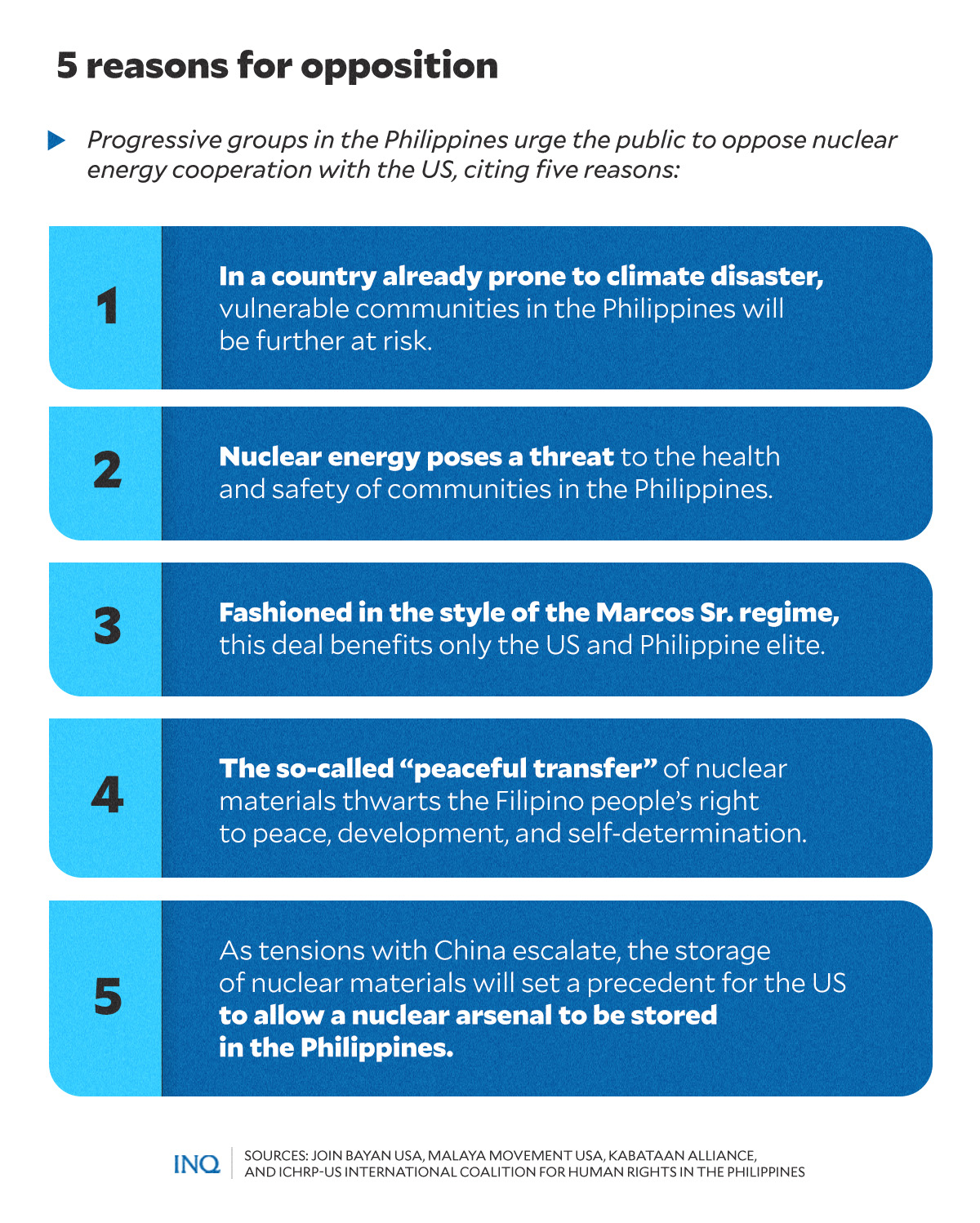
Despite the supposed benefits, the International Coalition for Human Rights in the Philippines (ICHRP-US), along with progressive groups — Bayan USA, Malaya Movement USA, Kabataan Alliance — demanded that members of the US Congress halt the nuclear deal, citing five reasons:
- In a country already prone to climate disaster, vulnerable communities in the Philippines will be further at risk.
- Nuclear energy poses a threat to the health and safety of communities in the Philippines.
- Fashioned in the style of the Marcos Sr. regime, this deal benefits only the US and Philippine elite.
- The so-called “peaceful transfer” of nuclear materials thwarts the Filipino people’s right to peace, development, and self-determination.
- As tensions with China escalate, the storage of nuclear materials will set a precedent for the US to allow a nuclear arsenal to be stored in the Philippines.
Renewable vs nuclear energy
Both PMCJ and AGHAM questioned Marcos Jr. and his administration’s plans to use more renewable energy while also pushing for the use of nuclear power……………………………………………………………………………………………………………..
“As with his other policies, this will just be an edifice to be used as a talking point for the purposes of extending the Marcoses’ cling to power; with no real positive contribution, and even potentially dangerous, to the Filipino people,” the group continued.
Environmental group Greenpeace Philippines has previously called out Marcos Jr. for showing mixed signals on his stance on energy.
“He used renewable energy when he ran for president, and continues to talk about it like he means it, but it’s all a game of pretend. If you look at his actions, he’s actually out to promote nuclear energy and fossil gas–both of which will block major RE development,” said Greenpeace Philippines country director Lea Guerrero.
“Greenpeace believes this is climate hypocrisy at its most dangerous,” she added.
https://newsinfo.inquirer.net/1866612/nuclear-energy-in-ph-group-says-theres-not-even-a-filipino-expert-on-safety-radiation#ixzz8KL4mjfe6
Follow us: @inquirerdotnet on Twitter | inquirerdotnet on Facebook
No comments yet.
1 This Month
Chernobyl: The Lost Tapes – A good documentary on Chernobyl on SBS available On Demand for the next 3 weeks– https://www.sbs.com.au/ondemand/tv-program/chernobyl-the-lost-tapes/2352741955560

of the week–London Campaign for Nuclear Disarmament

Tell the Ukrainian Government to Drop Prosecution of Peace Activist Yurii Sheliazhenko
To see nuclear-related stories in greater depth and intensity – go to https://nuclearinformation.wordpress.com
-
Archives
- April 2026 (126)
- March 2026 (251)
- February 2026 (268)
- January 2026 (308)
- December 2025 (358)
- November 2025 (359)
- October 2025 (376)
- September 2025 (257)
- August 2025 (319)
- July 2025 (230)
- June 2025 (348)
- May 2025 (261)
-
Categories
- 1
- 1 NUCLEAR ISSUES
- business and costs
- climate change
- culture and arts
- ENERGY
- environment
- health
- history
- indigenous issues
- Legal
- marketing of nuclear
- media
- opposition to nuclear
- PERSONAL STORIES
- politics
- politics international
- Religion and ethics
- safety
- secrets,lies and civil liberties
- spinbuster
- technology
- Uranium
- wastes
- weapons and war
- Women
- 2 WORLD
- ACTION
- AFRICA
- Atrocities
- AUSTRALIA
- Christina's notes
- Christina's themes
- culture and arts
- Events
- Fuk 2022
- Fuk 2023
- Fukushima 2017
- Fukushima 2018
- fukushima 2019
- Fukushima 2020
- Fukushima 2021
- general
- global warming
- Humour (God we need it)
- Nuclear
- RARE EARTHS
- Reference
- resources – print
- Resources -audiovicual
- Weekly Newsletter
- World
- World Nuclear
- YouTube
-
RSS
Entries RSS
Comments RSS
 nuclear-news

Leave a comment