What Would It Mean to ‘Absorb’ a Nuclear Attack?- nuclear missile silos as a “sponge”

Scientific American , By Ella Weber on November 22, 2023
The missiles on the Fort Berthold Reservation in North Dakota make it a potential target for a nuclear attack. And that doesn’t come close to describing what the reality would be for those on the ground.
This podcast is Part 4 of a five-part series. Listen to Part 1 here, Part 2 here, and Part 3 here. The podcast series is a part of “The New Nuclear Age,” a special report on a $1.5-trillion effort to remake the American nuclear arsenal.…..
Ella Weber: Members of my tribe live with nuclear missiles on the Fort Berthold Reservation. The weapons sit in underground concrete silos that are surrounded by antennas in small, fenced-off areas. The missiles are armed and ready to launch in 60 seconds. This is one reason they are called Minutemen missiles…………………………….
Weber: After learning that the Air Force had not explained to my tribe what the new nuclear missiles were for–which the Air Force intended to deploy for another 60 years on our reservation–I decided to dig deeper.
I wanted to know what role the missiles and their silos play today in U.S. nuclear strategy and what the risks for the tribe were in hosting them—something that the tribe never agreed to in the first place………………….
I wasn’t really clear on what Secretary Jim Mattis meant by the ICBM force providing a “cost-imposing strategy,” so I talked to Leonor Tomero to get some clarity. She used to serve as deputy assistant secretary of defense for nuclear and missile defense policy in the Biden administration in 2021…………
Weber: Leonor explained to me that should the U.S. face a potential nuclear attack, the president would have two choices with regards to the ICBMs: launch them preventively before the missiles possibly got destroyed, or decide to absorb the attack and retaliate later.
Weber (tape): What do you mean by absorbing an attack?
Tomero: I think, you know, it’s, you know, they’re considered a sponge.
Weber (tape): So it’s kind of like making these ICBMs, like, a target ….
Tomero: Yes…
Weber (tape): …. rather than, like, these other major cities or other places…
Tomero: Right.
Weber: In case you don’t know — the role of the ICBM is to force an adversary to use many nuclear weapons if they decided to attack the U.S. The silos are basically meant to divert and absorb the incoming nuclear missiles from important and critical areas in the country, like cities.
But what would that mean for the Fort Berthold reservation?……………………………………………………………………
Frank Von Hippel: Basically the secretary of defense had come in and testified to Congress. When one of the senators asked how many people would such an attack kill, he estimated 15,000 to 25,000. And he said, ‘Well, that would be terrible, but it would be not what you would expect from a major nuclear attack.’
That seemed low to, actually, the senator from New Jersey [Clifford Case]. And he asked for a peer review of the Defense Department calculations, and, and I was then asked to be an unpaid consultant to look into that. And, in fact, I went over to the Pentagon to talk to the people who have done the calculations.
Weber: Frank found something unexpectedly horrifying.
Von Hippel: The Defense Department had assumed that explosions of the warheads over the ICBM silos would be so high that they would not cause fallout. They pointed out they would also not damage the silos.
Weber: Basically, the Department of Defense hadn’t calculated properly. The DOD had made incorrect assumptions about the altitude of nuclear explosions aimed at destroying the silos. Initially, it had thought the nuclear explosions would need to be at an altitude. But–they actually needed to be at ground level.
Von Hippel: The DoD was forced to go back and do new calculations reflecting these points, and they came out about 1,000 times higher: 20 million—on the order of 20 million people killed.
Weber (tape): Wow.
…………………………………. Von Hippel: Well, you know, the, I don’t know who coined this term about the silos being a nuclear sponge, but the local….I think there would be annihilation of the local population around the silos. Wouldn’t just be the fallout—would also be the, the blast effects, and so on. So they would be the worst affected.
Weber (tape): My grandma only lives two and a half miles away from an ICBM silo. What would happen to her and her place?
Von Hippel: I think she would be within the blast radius … and the fire radius…. I don’t know how flammable… her house would be presumably burned after being knocked flat. And then there would be the fallout. These explosions would have to be low enough to hit the set of silos with sufficient overpressure to destroy the missiles inside. It would have to be low enough for, for the dirt to be and debris to be sucked up into the cloud. And then that would bring down some of the radioactivity in a very intense patch around the silo. So … multiple ways in which she might die. I’m sorry.
Weber (tape): I mean, she didn’t make the decision to have them there. So …
Von Hippel: Yeah, I know
Weber: Being treated as expendable isn’t new to Indigenous communities. As far as I could tell, members of the Mandan, Hidatsa and Arikara Nation don’t see themselves as living in a sacrifice zone.
This designation treats certain areas and people as acceptable losses; they bear the brunt of the risks and consequences associated with nuclear weapons and decisions made by others. Maybe if members of the tribe had a better understanding of what the risks were, they could challenge the deployment of these silos on our land…………………………….
Sébastien Philippe: Now I’m going to put the whole image of the entire areas that can be impacted by the fallout, and I can walk you through the color coding, but that’s basically the worst case possible for every single person on the map.
Edmund Baker: Okay. Holy crap. Even Disneyland’s not immune. Disney World’s out. New York—there’s no safe place.
So that batch there, North Dakota, the white sort of color…?
Philippe: Yeah.
Baker: That’s 100 percent fatality in that zone?
Philippe: Times 10. Yeah, ten times what you would need to die—and that’s just from the radioactivity.
Baker: Okay, so that’s not in the EIS, I figure, or is it?
Philippe: Uh, no.
Weber: By the way, Edmund’s talking about an environmental impact statement, or EIS—a two-volume report released by the U.S. Air Force that is meant to analyze, “the potential effects on the human and natural environments from the deployment of the Sentinel intercontinental ballistic missile system.”
This was the report that the Air Force had presented to my reservation—in a different place than it had initially advertised. And in the entire 3,000 pages of the report and its appendices— which cost $33 million to write, by the way — Sébastien had found that the consequences of a nuclear war that could impact my tribe were kind of glossed over.
The EIS mentioned the “casualties” and “grave implications” of such a war but they didn’t really go beyond that.
Here’s Frank again, speaking about the military’s attitudes toward the consequences of war in general.
Von Hippel: They talk about people like your grandmother as being collateral damage. I mean…, they try to desensitize themselves to what the consequences are, what they’re talking about—and, in fact, I remember when I first went over to the Pentagon to talk to people, I learned—the first time I heard this word called “collateral damage,” that is—“We, you know, we didn’t intend to kill your grandmother…. She’s, unfortunately, collateral damage.”…………………………………………………………………………………………………………………………………………….
Weber: If anyone could advise the U.S. on resilience and survivability, it would be us: the MHA Nation. And I have a feeling that keeping ICBM silos operating across our land may not be part of our preferred strategy.
In the next and final episode, I go back to the rez and report what I found to my family and members of the tribe. We sit down and discuss: What happens now?
This show was reported by me, Ella Weber, produced by Sébastien Philippe and Tulika Bose. Script editing by Tulika Bose. Post-production design and mixing by Jeff DelViscio. Thanks to special advisor Ryo Morimoto and Jessica Lambert. Music by Epidemic Sound.
I’m Ella Weber, and this was The Missiles on Our Rez, a special podcast collaboration from Scientific American, Princeton University’s Program on Science and Global Security, Nuclear Princeton, and Columbia Journalism School. https://www.scientificamerican.com/podcast/episode/what-would-it-mean-to-absorb-a-nuclear-attack/
Nuclear Power: UK’s Financial Challenge Unveiled

the actual cost might reach as high as £10 billion per reactor, resulting in an astonishing cumulative expense for the decommissioning process. …
this substantial cost could ultimately fall on taxpayers, raising concerns about the financial burden on the public.
Dev X Noah Nguyen, November 21, 2023
The UK’s Commitment to Nuclear Power and Financial Challenges
The United Kingdom’s dedication to nuclear power is becoming a financially challenging commitment as the dismantling expenses for its nuclear generating facilities continue to escalate. These costs have been advantageous for businesses involved in the dismantling process but a noteworthy expenditure for UK taxpayers
Regardless of the substantial costs associated with the new nuclear reactors at Hinkley Site C and the rising price of clean-up initiatives, the nation’s government remains committed to nuclear technology. This unwavering commitment is driven by the belief that nuclear power is crucial for achieving the UK’s long-term energy security and climate change goals. However, critics argue that increased investment in renewable energy sources could provide similar benefits, without the high financial burden and safety concerns associated with nuclear power……………………………………………………
Concerns Regarding Decommissioning Costs and Life Expectancy of Reactors
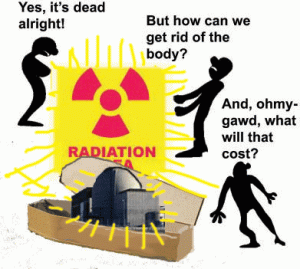
Nearly all of the remaining functional reactors are scheduled for closure by 2028, except Sizewell B, anticipated to stay in operation until 2035. With a life expectancy of roughly 40 years—considerably shorter than the 60 to 80 years frequently claimed by the sector—questions emerge about the demolition costs for the existing 23 reactors and the two under construction at Hinkley Point C.
As these reactors reach the end of their life cycle, it is crucial to plan and allocate resources effectively for their dismantling and waste disposal. The cost of decommissioning and managing nuclear facilities can significantly impact the overall economic feasibility of the energy generated, emphasizing the need for accurate cost estimations and environmentally responsible strategies.
Projected Costs of Dismantling and Importance of Effective Management
By the end of 2022, the UK’s Nuclear Decommissioning Authority (NDA) projected a total dismantling cost of £149 billion. If this figure encompasses Hinkley Site C, it would equate to about £6 billion per reactor. This substantial financial investment highlights the importance of thoroughly managing the decommissioning process to ensure effective resource allocation. With the growing push towards renewable energy sources, proper management and safe dismantling of nuclear reactors have become increasingly significant for the country’s transition towards sustainable energy.
Higher Potential Costs and the Financial Burden on Taxpayers
However, Professor Stephen Thomas from the University of Greenwich’s energy policy department posits that the actual cost might reach as high as £10 billion per reactor, resulting in an astonishing cumulative expense for the decommissioning process. He further elaborates that this substantial cost could ultimately fall on taxpayers, raising concerns about the financial burden on the public. To mitigate such consequences, proper planning and establishing an adequate funding source must be undertaken for a feasible and efficient decommissioning process…………………………………………………………………………………….
What are the concerns regarding the decommissioning costs and life expectancy of nuclear reactors in the UK?
With functional reactors scheduled for closure and shorter life expectancies than often claimed, there are concerns about the demolition costs for the existing reactors and effective management of resources for dismantling and waste disposal. The cost of decommissioning can significantly impact the overall economic feasibility of nuclear-generated energy and necessitates accurate cost estimations and environmentally responsible strategies………….. https://www.devx.com/news/nuclear-power-uks-financial-challenge-unveiled/
Failed U.S. Nuclear Project Raises Cost Concerns for Canadian SMR Development
The Energy Mix November 10, 2023, Primary Author: Mitchell Beer
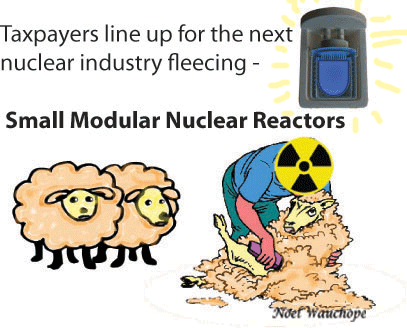
The abrupt failure of the leading small modular nuclear reactor (SMR) project in the United States is shining a light on public subsidies that might keep similar technology under development in Canada, even if it’s prone to the same cost overruns that scuttled NuScale Power Corporation’s Carbon Free Power Project (CFPP) in Utah.
NuScale and its customer, Utah Associated Municipal Power Systems (UAMPS), announced they were cancelling the project earlier this week, after its anticipated cost increased 53% over earlier estimates, Bloomberg reports. “The decision to terminate the project underscores the hurdles the industry faces to place the first so-called small modular reactor into commercial service in the country.”
But a clear-eyed assessment of the project’s potential was really made possible by a level of accountability that doesn’t exist in Canada, said Gordon Edwards, president of the Canadian Coalition for Nuclear Responsibility.
“Private investors in Utah forced NuScale to divulge financial information regarding the cost of electricity from its proposed nuclear plant,” and “cost became the deal-breaker,” Edwards told The Energy Mix in an email. “Publicly-owned utilities in Canada are not similarly accountable. The public has little opportunity to ‘hold their feet to the fire’ and determine just how much electricity is going to cost, coming from these first-of-a-kind new nuclear reactors.”
In the U.S., the business case started to fall apart last November, when NuScale blamed higher steel costs and rising interest rates for driving the cost of the project up from US$58 to $90 or $100 per megawatt-hour of electricity. The new cost projection factored in billions of dollars in tax credits the project would receive under the Biden administration’s Inflation Reduction Act, amounting to a 30% saving.
At the time, the Institute for Energy Economics and Financial Analysis (IEEFA) estimated the total subsidy at $1.4 billion. This week, Bloomberg said NuScale had received $232 million of that total so far.
The cost increase meant that UAMPS “will not hit certain engineering, procurement, and construction benchmarks, allowing participants to renegotiate the price they pay or abandon the project,” Utility Dive wrote……………………………….
In Canada, “the massively expensive SMR projects in Canada will eventually face the same reckoning,” predicted Susan O’Donnell, an adjunct research professor at St. Thomas University and member of the Coalition for Responsible Energy Development in New Brunswick. While the Canadian Energy Regulator’s modelling assumes SMRs could be built at a cost of C$9,262 per kilowatt in 2020, falling to $8,348 per kilowatt by 2030 and $6,519 by 2050, the latest cost estimate from NuScale exceeded $26,000 per kilowatt in Canadian dollars, O’Donnell said—and the technology had been in development since 2007.
“Too bad our leaders have chosen to pursue an energy strategy which is too expensive, too slow, and too costly in comparison with the alternatives of energy efficiency and renewables—the fastest, cheapest, and least speculative strategies,” Edwards wrote. He added that waste disposal and management challenges and costs for SMRs will be very different from what Canadian regulators have had to confront with conventional Candu nuclear reactors.
The news from NuScale landed just days after civil society groups in the European Union warned that SMR development won’t help the continent reach its climate goals. Citing prolonged project delays and cost overruns, the long time frame to develop unproven technologies, and the risks associated with radioactive waste disposal and proliferation of nuclear materials, they urged EU governments to focus on renewable energy, power grid development, and energy storage.
“Nuclear energy is being pushed by powerful lobbies and geostrategic interests,” with several EU states relying on Russian state nuclear company Rosatom for their uranium supplies, the groups said. “To quickly decarbonize, we must choose cheap technologies, easy to deploy at scale, like solar panels and windmills.”………….https://www.theenergymix.com/2023/11/10/failed-u-s-nuclear-project-raises-cost-concerns-for-canadian-smr-development/
Hospitals in northern Gaza completely out of service: Health official
Gaza’s health ministry spokesperson says occupancy rate in hospitals in the enclave’s north has reached 190 percent as they overflow with the wounded.
By Al Jazeera Staff, 21 Nov 2023 https://www.aljazeera.com/news/2023/11/21/hospitals-in-northern-gaza-completely-out-of-service-health-official?fbclid=IwAR3EbNh45V_EgxeeXyvfMv2C1pEtPxc0I3YRxbC9IozAKulinJIGjYn8LBU
Hospitals in northern Gaza are now completely out of service, according to the besieged enclave’s Ministry of Health. Ashraf al-Qudra, Gaza’s health ministry spokesperson, said in an interview with Al Jazeera on Tuesday that the occupancy rate in hospitals in Gaza’s north has reached 190 percent.
Israel bombed and destroyed parts of al-Shifa Hospital, the largest in Gaza, where more than 700 people are still held captive under a siege by the Israeli army, according to al-Qudra.
Last week, Israeli forces seized the hospital to search for what they said was a Hamas tunnel network and command centre built underneath the complex. Hamas has denied the allegations.
A group of 28 premature babies were evacuated from the al-Shifa Hospital to Egypt to receive treatment on Monday, according to the Palestinian authorities and the World Health Organization (WHO).
‘Circle of death’
Al-Qudra also said that about 120 people were evacuated from northern Gaza’s Indonesian Hospital to Nasser Medical Complex in the south of the Strip.
There are still more than 400 injured people inside the Indonesian Hospital, in addition to about 200 medical staff and more than 2,000 others taking refuge, he added.
The Israeli army has put those inside the hospital in a “circle of death”, targeting anybody who moves around the hospital or inside it, al-Qudra said.
The WHO said on the same day that the Indonesian Hospital was only able to provide basic services, with the lives of those with severe injuries and other medical emergencies being at immediate risk.
Al-Qudra also said that Israeli air strikes targeted the house of Gaza’s deputy undersecretary of the health ministry on Tuesday morning, adding that there were 56 of his relatives in the house who had been displaced from different areas of Gaza.
Rescue teams managed to find 17 bodies while the rest are still under the rubble, according to the spokesperson.
Dire conditions
Hospitals in northern Gaza and Gaza City have faced power outages due to a lack of fuel and Israeli attacks.
They have also faced severe shortages of water, essential medicines and supplies as Israel continues its ground operations and air strikes on the enclave.
The WHO says it has recorded 335 attacks on health complexes in the occupied Palestinian territory since October 7, the beginning of the Gaza war, including 164 attacks in the Gaza Strip and 171 attacks in the West Bank.
These attacks have resulted in forced mass evacuations from hospitals, and multiple fatalities and casualties among patients, their companions, and displaced people taking refuge there, according to the WHO.
At least 13,000 Palestinians – about 5,600 of them children and 3,500 women – have been killed in Gaza since Israel launched its air and ground assault on Gaza after the October 7 attacks by Hamas targeting Israel, according to the enclave’s health ministry.
Hamas and allied groups took about 240 captives during their incursion into southern Israel that killed about 1,200 people, according to Israeli authorities.
New Brunswick Premier Higgs says Canada’s federal government should give funding for small nuclear reactor projects.
NB Telegraph Journal , Adam Huras, Nov 22, 2023
Premier Blaine Higgs says current federal support for new nuclear power isn’t enough, fearing a piecemeal approach to pursuing small modular reactor technology could see New Brunswick and the country fall behind in a global race.
Higgs made the comments on Wednesday to Brunswick News in reaction to the federal government’s fall economic statement………………………………
“At the end of the day we’re going to have to get to a situation like back in the CANDU reactor days when the federal government played a major role in nuclear development,” Higgs said.
“These are hugely costly items, both the research and then construction.
“I see a real need to get a whole pan-Canadian approach. And we’ll need serious financial support from the federal government to do that.”
Both the feds and two successive New Brunswick governments have already poured millions into the two companies that have set up in the province, while the feds have also contributed to others elsewhere in the country.
Now over two years ago, the federal government spent more than $50 million to subsidize Moltex’s work in developing its stable salt reactor technology in New Brunswick.
The Higgs government spent $20 million to support ARC around the same time.
The feds then announced another $7 million for ARC last month, specifically earmarked for “pre-development work” at Point Lepreau, where a first small modular reactor is slated to come online near the end of the decade.
But the money to date is not nearly enough.
After appearing before a legislative committee earlier this year, Moltex CEO Rory O’Sullivan said it’s still seeking more than $250 million from governments or the public utility over the next seven years in order to build its SMR technology.
ARC executives appeared before the same legislative committee for what they said is a $1.1-billion project.
Higgs is now suggesting a pooled focus on finding a technology that works and can be deployed across the country and sold abroad…………………………………….
Green bonds are designed to raise funds to invest in environmental or climate change mitigation projects. Investors purchase bonds and receive periodic interest payments and the repayment of their initial investment at a future date in exchange for upfront cash.
But nuclear projects weren’t originally considered “green” under the initial criteria………………………
https://tj.news/new-brunswick/higgs-says-federal-support-for-new-nuclear-power-isnt-enough—
NFLA Policy Briefing 281: Latest on RAF Lakenheath: nuclear weapons
A summary of correspondence sent and replies received in connection with
NFLA concerns over the relocation of US nuclear weapons to ‘RAF’
(actually USAF) Lakenheath.
NFLA 21st Nov 2023
1 This Month


Tell the Ukrainian Government to Drop Prosecution of Peace Activist Yurii Sheliazhenko

Petition to revoke the licensing of the Near Surface Nuclear Disposal Facility (NSDF) at Chalk River. https://www.ourcommons.ca/petitions/en/Petition/Details?Petition=e-7247


of the week – STOP SMALL MODULAR REACTORS IN CANADA
To see nuclear-related stories in greater depth and intensity – go to https://nuclearinformation.wordpress.com
-
Archives
- March 2026 (176)
- February 2026 (268)
- January 2026 (308)
- December 2025 (358)
- November 2025 (359)
- October 2025 (376)
- September 2025 (258)
- August 2025 (319)
- July 2025 (230)
- June 2025 (348)
- May 2025 (261)
- April 2025 (305)
-
Categories
- 1
- 1 NUCLEAR ISSUES
- business and costs
- climate change
- culture and arts
- ENERGY
- environment
- health
- history
- indigenous issues
- Legal
- marketing of nuclear
- media
- opposition to nuclear
- PERSONAL STORIES
- politics
- politics international
- Religion and ethics
- safety
- secrets,lies and civil liberties
- spinbuster
- technology
- Uranium
- wastes
- weapons and war
- Women
- 2 WORLD
- ACTION
- AFRICA
- Atrocities
- AUSTRALIA
- Christina's notes
- Christina's themes
- culture and arts
- Events
- Fuk 2022
- Fuk 2023
- Fukushima 2017
- Fukushima 2018
- fukushima 2019
- Fukushima 2020
- Fukushima 2021
- general
- global warming
- Humour (God we need it)
- Nuclear
- RARE EARTHS
- Reference
- resources – print
- Resources -audiovicual
- Weekly Newsletter
- World
- World Nuclear
- YouTube
-
RSS
Entries RSS
Comments RSS
 nuclear-news