TODAY. Nuclear lobby busting to control COP 28 – now their stooge John Kerry is touting the fantasy of nuclear fusion
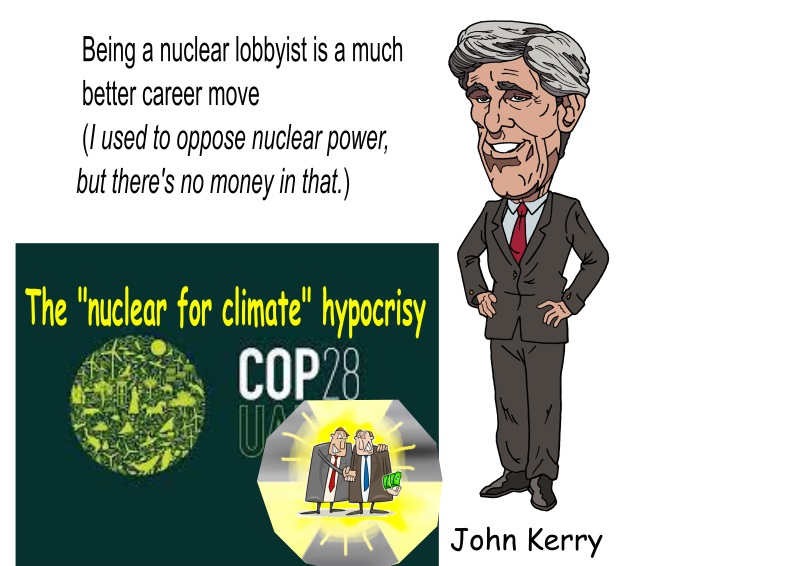
Yeah yeah – we all know that nuclear fusion is theoretically “carbon-emissions-free”
Great! BUT:
Time. “The reality is that fusion energy will not be viable at scale anytime within the next decade, a time frame over which carbon emissions must be reduced by 50% to avoid catastrophic warming of more than 1.5°C,” – climate expert Michael Mann
Energy. Nuclear fusion requires 100 times more energy to charge than the energy it ends up producing.
Cost. Requires highly expensive tritium and lithium.
Space. Current efforts have taken up a huge area – how much space would be needed to do fusion on a commercial scale?
Wastes. tritium is the radioactive form of hydrogen. Its little isotopes are great at permeating metals and finding ways to escape tight enclosures. Obviously, this will pose a significant problem for those who want to continuously breed tritium in a fusion reactor.
Weapons connection. Since first tried out in that monstrous Marshall Islands explosion, fusion has been intended as a tool of war. the American government is interested not in using fusion technology to power the energy grid, but in using it to further strengthen this country’s already massive arsenal of atomic weapons.
A new Palestinian state could never be free as long as its neighbor, Israel, possesses nuclear weapons.
The 2-State Solution’s Nuclear Option
SCHEERPOST, By Scott Ritter / Consortium News, November 20, 2023
“………………………………………………………………………………………………. the United States continues to provide diplomatic cover for Israel’s nuclear weapons, maintaining the fiction of ambiguity despite knowing full well Israel possesses a very robust nuclear arsenal. This posture is becoming more difficult to sustain, given the increasingly aggressive posture assumed by the Israeli government regarding its own policy of ambiguity.
In 2022, during a periodic review by the United Nations of the Non Proliferation Treaty (NPT) , then-Israeli Prime Minister Yair Lapid addressed the Israeli Atomic Energy Commission about Israel’s “defensive and offensive capabilities, and what is referred to in the foreign media as other capabilities. These other capabilities,” Lapid said, clearly alluding to Israel’s nuclear weapons, “keep us alive and will keep us alive as long as we and our children are here.”
As things stand, the threat posed by Israeli nuclear weapons to both regional and global security is as great today as at any time in Israeli history. With the potential of the current Palestinian-Israeli conflict expanding to include Hezbollah and perhaps Iran, Israel for the first time since 1973 faces a genuine existential threat — the kind of threat Israel’s nuclear weapons were built to deter.
An Israeli minister has already alluded to the attractiveness of using nuclear weapons against Hamas in Gaza. But the real threat comes from what happens if Iran is dragged into the war. Here, Israel’s much rumored “Samson Option” could come into play, where Israel uses its nuclear arsenal to destroy as many enemies as possible once the continued survival of Israel is at risk.
Given the present risk posed by Israel’s nuclear arsenal, it is essential that the current Palestinian-Israeli conflict be prevented from expanding. Once the conflict can be ended, the process must begin for a long-term solution that includes a free and independent Palestine. However, a new Palestinian state can never be free if its neighbor, Israel possesses nuclear weapons.
Operating with the understanding that the creation of a Palestinian state would coincide with a renewed push for normalization of relations between Israel and its Arab neighbors, the result vis-à-vis the security of Israel would be a much-improved situation that made Israel’s need for nuclear weapons moot.
South African Example
The question then becomes how Israel can be persuaded to voluntarily give up its nuclear weapons. Fortunately, there is an example from history.
Apartheid South Africa had embarked on a nuclear weapons program in the early 1970s. U.S. intelligence reports show that South Africa formally began its nuclear weapons program in 1973. By 1982, it had developed and built its first nuclear explosive device.
Seven years later, in 1989, South Africa had manufactured six functional nuclear bombs, each capable of delivering an explosive equivalent of 19 kilotons of TNT.
The South African nuclear weapons program mirrored that of the Israeli program in that it was conducted in great secrecy and designed to deter the threat posed by communist-supported black liberation movements operating all along the periphery of the South African nation.
In 1989, South Africa elected a new president, F. W. de Klerk, who quickly realized that the political winds were changing and that the country could very well, in the span of a few years, fall under the control of black nationalists led by Nelson Mandela.
To prevent that, De Klerk took the unprecedented decision to join the NPT as a non-nuclear state and open its nuclear program for inspection and dismantlement. South Africa joined the NPT in 1991; by 1994, all South Africa’s nuclear weapons had been dismantled under international supervision.
Once the Palestinian-Israeli war comes to an end, and if Israel begins negotiating in good faith about the possibility of a free and independent Palestinian state, the United States should lead an effort to get the Israeli government to follow the path taken by F. W. de Klerk by signing the NPT and working with the International Atomic Energy Agency to dismantle the totality of Israel’s nuclear arsenal.
Such a move should be non-negotiable — if the United States is serious about creating the conditions of a long and lasting peace between Israel and Palestine, then it should use all the leverage at its disposal to pressure Israel to voluntarily disarm itself of nuclear weapons.
This is the only viable path to peace between Israel and the Arab and Muslim world that surrounds it.
Nuclear Fusion Won’t Save the Climate But It Might Blow Up the World

the United States’ first full-scale hydrogen bomb was, in fact, a fission explosion that initiated a fusion reaction.
since first tried out in that monstrous Marshall Islands explosion, fusion has been intended as a tool of war. And sadly, so it remains,
Buried deep in the Lawrence Livermore National Laboratory’s website, the government comes clean about what these fusion experiments at the $3.5 billion National Ignition Facility (NIF) are really all about.
above – Edward Teller – inventor of the thermonuclear fusion bomb – (a man consumed by his fear and hatred of Russia)
they require 100 times more energy to charge than the energy they ended up producing.
Resilience, By Joshua Frank, originally published by TomDispatch 23 Jan 23
.”…………………. the New York Times and CNN alerted me that morning, at stake was a new technology that could potentially solve the worst dilemma humanity faces: climate change and the desperate overheating of our planet. Net-energy-gain fusion, a long-sought-after panacea for all that’s wrong with traditional nuclear-fission energy (read: accidents, radioactive waste), had finally been achieved at the Lawrence Livermore National Laboratory in California…………………..
…All in all, the reviews for fusion were positively glowing and it seemed to make instant sense. After all, what could possibly be wrong ……………..
The Big Catch
On a very basic level, fusion is the stuff of stars. Within the Earth’s sun, hydrogen combines with helium to create heat in the form of sunlight. Inside the walls of the Livermore Lab, this natural process was imitated by blasting 192 gigantic lasers into a tube the size of a baby’s toe. Inside that cylinder sat a “hydrogen-encased diamond.” When the laser shot through the small hole, it destroyed that diamond quicker than the blink of an eye. In doing so, it created a bunch of invisible x-rays that compressed a small pellet of deuterium and tritium, which scientists refer to as “heavy hydrogen.
“In a brief moment lasting less than 100 trillionths of a second, 2.05 megajoules of energy — roughly the equivalent of a pound of TNT — bombarded the hydrogen pellet,”explained New York Times reporter Kenneth Chang. “Out flowed a flood of neutron particles — the product of fusion — which carried about 3 megajoules of energy, a factor of 1.5 in energy gain.”
As with so many breakthroughs, there was a catch. First, 3 megajoules isn’t much energy. After all, it takes 360,000 megajoules to create 300 hours of light from a single 100-watt light bulb. So, Livermore’s fusion development isn’t going to electrify a single home, let alone a million homes, anytime soon. And there was another nagging issue with this little fusion creation as well: it took 300 megajoules to power up those 192 lasers. Simply put, at the moment, they require 100 times more energy to charge than the energy they ended up producing.
“The reality is that fusion energy will not be viable at scale anytime within the next decade, a time frame over which carbon emissions must be reduced by 50% to avoid catastrophic warming of more than 1.5°C,” – climate expert Michael Mann
Tritium Trials and Tribulations
The secretive and heavily secured National Ignition Facility where that test took place is the size of a sprawling sports arena. It could, in fact, hold three football fields. Which makes me wonder: how much space would be needed to do fusion on a commercial scale? No good answer is yet available. Then there’s the trouble with that isotope tritium needed to help along the fusion reaction. It’s not easy to come by and costs about as much as diamonds, around $30,000 per gram. Right now, even some of the bigwigs at the Department of Defense are worried that we’re running out of usable tritium.
…………”tritium, with a half-life of 12.3 years, exists naturally only in trace amounts in the upper atmosphere, the product of cosmic ray bombardment.” – writes Daniel Clery in Science.
…………………… the reactors themselves will have to be lined with a lot of lithium, itself an expensive chemical element at $71 a kilogram (copper, by contrast, is around $9.44 a kilogram), to allow the process to work correctly.
Then there’s also a commonly repeated misstatement that fusion doesn’t create significant radioactive waste, a haunting reality for the world’s current fleet of nuclear plants. True, plutonium, which can be used as fuel in atomic weapons, isn’t a natural byproduct of fusion, but tritium is the radioactive form of hydrogen. Its little isotopes are great at permeating metals and finding ways to escape tight enclosures. Obviously, this will pose a significant problem for those who want to continuously breed tritium in a fusion reactor. It also presents a concern for people worried about radioactivity making its way out of such facilities and into the environment.
“Cancer is the main risk from humans ingesting tritium. When tritium decays it spits out a low-energy electron (roughly 18,000 electron volts) that escapes and slams into DNA, a ribosome, or some other biologically important molecule,” David Biello explains in Scientific American. “And, unlike other radionuclides, tritium is usually part of water, so it ends up in all parts of the body and therefore can, in theory, promote any kind of cancer. But that also helps reduce the risk: any tritiated water is typically excreted in less than a month.”
If that sounds problematic, that’s because it is. This country’s above-ground atomic bomb testing in the 1950s and 1960s was responsible for most of the man-made tritium that’s lingering in the environment. And it will be at least 2046, 84 years after the last American atmospheric nuclear detonation in Nevada, before tritium there will no longer pose a problem for the area.
Of course, tritium also escapes from our existing nuclear reactors and is routinely found near such facilities where it occurs “naturally” during the fission process. In fact, after Illinois farmers discovered their wells had been contaminated by the nearby Braidwood nuclear plant, they successfully sued the site’s operator Exelon, which, in 2005, was caught discharging 6.2 million gallons of tritium-laden water into the soil.
In the United States, the Nuclear Regulatory Commission (NRC) allows the industry to monitor for tritium releases at nuclear sites; the industry is politely asked to alert the NRC in a “timely manner” if tritium is either intentionally or accidentally released. But a June 2011 report issued by the Government Accountability Office cast doubt on the NRC’s archaic system for assessing tritium discharges, suggesting that it’s anything but effective. (“Absent such an assessment, we continue to believe that NRC has no assurance that the Groundwater Protection Initiative will lead to prompt detection of underground piping system leaks as nuclear power plants age.”)
Consider all of this a way of saying that, if the NRC isn’t doing an adequate job of monitoring tritium leaks already occurring with regularity at the country’s nuclear plants, how the heck will it do a better job of tracking the stuff at fusion plants in the future? And as I suggest in my new book, Atomic Days: The Untold Story of the Most Toxic Place in America, the NRC is plain awful at just about everything it does.
Instruments of Death
All of that got me wondering: if tritium, vital for the fusion process, is radioactive, and if they aren’t going to be operating those lasers in time to put the brakes on climate change, what’s really going on here?
Maybe some clues lie (as is so often the case) in history. The initial idea for a fusion reaction was proposed by English physicist Arthur Eddington in 1920. More than 30 years later, on November 1, 1952, the first full-scale U.S. test of a thermonuclear device, “Operation Ivy,” took place in the Marshall Islands in the Pacific Ocean. It yielded a mushroom-cloud explosion from a fusion reaction equivalent in its power to 10.4 Megatons of TNT. That was 450 times more powerful than the atomic bomb the U.S. had dropped on the Japanese city of Nagasaki only seven years earlier to end World War II. It created an underwater crater 6,240 feet wide and 164 feet deep…………….
Nicknamed “Ivy Mike,” the bomb was a Teller-Ulam thermonuclear device, named after its creators Edward Teller and Stanislaw Ulam. It was also the United States’ first full-scale hydrogen bomb, an altogether different beast than the two awful nukes dropped on Japan in August 1945. Those bombs utilized fission in their cores to create massive explosions. But Ivy Mike gave a little insight into what was still possible for future weapons of annihilation.
The details of how the Teller-Ulam device works are still classified, but historian of science Alex Wellerstein explained the concept well in the New Yorker:
“The basic idea is, as far as we know, as follows. Take a fission weapon — call it the primary. Take a capsule of fusionable material, cover it with depleted uranium, and call it the secondary. Take both the primary and the secondary and put them inside a radiation case — a box made of very heavy materials. When the primary detonates, radiation flows out of it, filling the case with X rays. This process, which is known as radiation implosion, will, through one mechanism or another… compress the secondary to very high densities, inaugurating fusion reactions on a large scale. These fusion reactions will, in turn, let off neutrons of such a high energy that they can make the normally inert depleted uranium of the secondary’s casing undergo fission.”
Got it? Ivy Mike was, in fact, a fission explosion that initiated a fusion reaction. But ultimately, the science of how those instruments of death work isn’t all that important. The takeaway here is that, since first tried out in that monstrous Marshall Islands explosion, fusion has been intended as a tool of war. And sadly, so it remains, despite all the publicity about its possible use some distant day in relation to climate change. In truth, any fusion breakthroughs are potentially of critical importance not as a remedy for our warming climate but for a future apocalyptic world of war.
Despite all the fantastic media publicity, that’s how the U.S. government has always seen it and that’s why the latest fusion test to create “energy” was executed in the utmost secrecy at the Lawrence Livermore National Laboratory. One thing should be taken for granted: the American government is interested not in using fusion technology to power the energy grid, but in using it to further strengthen this country’s already massive arsenal of atomic weapons.
Consider it an irony, under the circumstances, but in its announcement about the success at Livermore — though this obviously wasn’t what made the headlines — the Department of Energy didn’t skirt around the issue of gains for future atomic weaponry. Jill Hruby, the department’s undersecretary for nuclear security, admitted that, in achieving a fusion ignition, researchers had “opened a new chapter in NNSA’s science-based Stockpile Stewardship Program.” (NNSA stands for the National Nuclear Security Administration.) That “chapter” Hruby was bragging about has a lot more to do with “modernizing” the country’s nuclear weapons capabilities than with using laser fusion to end our reliance on fossil fuels.
“Had we not pursued the hydrogen bomb,” Edward Teller once said, “there is a very real threat that we would now all be speaking Russian. I have no regrets.” Some attitudes die hard.
Buried deep in the Lawrence Livermore National Laboratory’s website, the government comes clean about what these fusion experiments at the $3.5 billion National Ignition Facility (NIF) are really all about:
NIF’s high energy density and inertial confinement fusion experiments, coupled with the increasingly sophisticated simulations available from some of the world’s most powerful supercomputers, increase our understanding of weapon physics, including the properties and survivability of weapons-relevant materials… The high rigor and multidisciplinary nature of NIF experiments play a key role in attracting, training, testing, and retaining new generations of skilled stockpile stewards who will continue the mission to protect America into the future.”
Yes, despite all the media attention to climate change, this is a rare yet intentional admission, surely meant to frighten officials in China and Russia. It leaves little doubt about what this fusion breakthrough means. It’s not about creating future clean energy and never has been. It’s about “protecting” the world’s greatest capitalist superpower. Competitors beware.
Sadly, fusion won’t save the Arctic from melting, but if we don’t put a stop to it, that breakthrough technology could someday melt us all. https://www.resilience.org/stories/2023-01-26/nuclear-fusion-wont-save-the-climate-but-it-might-blow-up-the-world/
Japan’s Fukushima plant completes third water release

Canberra Times By Mari Yamaguchi, November 20 2023 – Australian Associated Press
The release of a third batch of treated radioactive wastewater from Japan’s damaged Fukushima nuclear plant into the Pacific Ocean ended safely as planned, its operator says, as the country’s seafood producers continue to suffer from a Chinese import ban imposed after the discharges began.
Large amounts of radioactive wastewater have accumulated at the nuclear plant since it was damaged by a massive earthquake and tsunami in 2011.
It began discharging treated and diluted wastewater into the ocean on August 24 and finished releasing the third 7800-ton batch on Monday.
The process is expected to take decades.
The discharges have been strongly opposed by fishing groups and neighbouring countries including China, which banned all imports of Japanese seafood, badly hurting Japanese producers and exporters of scallops and other seafood……………………………………………………
Japan’s government has set up a relief fund to help find new markets for Japanese seafood, and the central and local governments have led campaigns to encourage Japanese consumers to eat more fish and support Fukushima seafood producers.
TEPCO is also providing compensation to the fisheries industry for “reputational damage” to its products caused by the wastewater release and said it has mailed application forms to 580 possible compensation seekers…………………………..
TEPCO and the government say the process is safe, but some scientists say the continuing release of water containing radionuclides from damaged reactors is unprecedented and should be monitored closely.
Monday’s completion of the release of the third batch of wastewater brings the total to 23,400 tons.
TEPCO plans a fourth release by the end of March 2024.
That would only empty about 10 of the approximately 1000 storage tanks at the Fukushima plant because of its continued production of wastewater, although officials say the pace of the discharges will pick up later.

The tanks currently hold more than 1.3 million tons of wastewater, most of which needs to be retreated to meet safety standards before release.
TEPCO and the government say discharging the water into the sea is unavoidable because the tanks need to be removed from the grounds of the plant so that it can be decommissioned. https://www.canberratimes.com.au/story/8430646/japans-fukushima-plant-completes-third-water-release/
Czech Republic, France and others will use “Declaration to Triple Nuclear Energy” to push for EU funding to the nuclear industry

Edvard Sequens, Calla, Czech Nuclear Republic 20 Nov 23
“Declaration to Triple Nuclear Energy” – The Czech Government had it on
the agenda this week, saying that they wanted to join in. Supporting
countries include the Czech Republic, USA, France, Korea, Sweden, UK and
Ukraine (more countries are expected to join).
Substantively, this is nonsense, and the declarations adopted at COP
meetings are often only formal. But I expect that the nuclear alliance
of European countries will use the declaration to press for a
redirection of direct support from the European budget to new nuclear
projects. This is, after all, a long-term goal of the Czech political
representation. Step by step – Recognition of nuclear energy as a tool
to achieve European climate goals – Inclusion in the taxonomy –
Possibility of public support for nuclear energy by individual states
without the need to approve exemptions – Direct financial support – …
U.S. military quietly revokes planned contract for small nuclear plant at Alaska Air Force base

the systems now under development have not been commercially proven: No micro-reactors have yet been built in the U.S. since the earliest days of nuclear technology.
This month, the only company with an approved design, Oregon-based Nuscale Power, announced that it had canceled a leading demonstration project in Idaho. Several potential customers had abandoned the project amid increasing costs, according to Reuters.
The military had planned to give a contract for a “micro-reactor” to Silicon Valley firm Oklo — whose chairman, Sam Altman, also leads the company behind the ChatGPT artificial intelligence chatbot.
Alaska Beacon, BY: NATHANIEL HERZ, NORTHERN JOURNAL – NOVEMBER 18, 2023
The U.S. military has rescinded the preliminary award of what could be a nine-figure contract with the company it had tentatively selected to build a small-scale nuclear power plant at Eielson Air Force Base near Fairbanks.
The Department of the Air Force and the Defense Logistics Agency in August announced an “intent to award” the contract to Oklo — a Silicon Valley startup backed by Sam Altman, who, until his ouster this week, also led the company behind ChatGPT.
In late September, the DLA’s energy arm revoked its decision, citing a need for “further consideration” of its obligations under a specific military contracting regulation, according to a memo sent to a competing bidder and obtained by Northern Journal from another source.
The regulation says the military should engage in post-bidding negotiations and discussions for contracts worth $100 million or more.
A DLA spokeswoman, Michelle McCaskill, declined to make agency officials available for an interview. In an emailed response to questions, she explained the revocation by repeating the language from the memo and said all bidders that responded to the agency’s request for proposals are still under consideration.
McCaskill said a “pre-filing notice of protest” of the award to Oklo was submitted to the U.S. Court of Federal Claims, but she declined to share a copy. A spokeswoman for Ultra Safe Nuclear Corp., the company that received the memo obtained by Northern Journal, confirmed that her business had made the pre-filing notice but added that a formal protest had not been filed.
Oklo is one of a growing number of businesses developing what are known as “micro-reactors,” which the military describes as small projects with “built-in safety features that self-adjust to changing conditions and demands to prevent overheating.”
The Eielson contract drew broad interest from the energy industry; officials from companies like Westinghouse, Rolls-Royce and Siemens participated in an informational meeting about it last year, according to a roster published by the military.
Oklo’s chief executive, Jake DeWitte, said in a brief interview Friday that his company is letting the contracting process play out.
the systems now under development have not been commercially proven: No micro-reactors have yet been built in the U.S. since the earliest days of nuclear technology.
This month, the only company with an approved design, Oregon-based Nuscale Power, announced that it had canceled a leading demonstration project in Idaho. Several potential customers had abandoned the project amid increasing costs, according to Reuters……………………………………………………….
Following the revocation, the office of Republican U.S. Sen. Lisa Murkowski, who helped secure federal spending on micro-reactor development, asked the Department of Defense for a timeline but has not heard back, spokesman Joe Plesha said in an email.
“We will continue to monitor this issue closely,” he said……………………………………………
USNC, which is based in Seattle, has proposed to build what could be Canada’s first micro-reactor, in Ontario, and aims for it to go online by 2028.
Nov 2023
Birthplace of Jesus dismantling all +Christmas decorations ‘in solidarity with our people in Gaza’
Once a Christian stronghold, Christians are now a minority in the region due to persecution, emigration and low birth rates
By Timothy H.J. Nerozzi Fox News, November 17, 2023
City officials in the birthplace of Jesus Christ are tearing down Christmas decorations in solidarity with Palestinians amid Israel’s continued invasion of Gaza.
Bethlehem, an ancient city located in the West Bank, declared via social media and official spokespeople that decorations installed in previous years are being removed amid the conflict between Israel and Hamas.
“Bethlehem Municipality crews announced the dismantling of Christmas decorations installed several years ago in the city’s neighborhoods and removing all festive appearances in honor of the martyrs and in solidarity with our people in Gaza,” the city wrote on Facebook, according to the Jerusalem Post.
POPE FRANCIS CONTACTS ONLY CATHOLIC CHURCH IN GAZA AS CARNAGE CONTINUES
A city spokesperson also acknowledged the campaign to remove Christmas decorations in a statement to the Telegraph.
“The reason is the general situation in Palestine; people are not really into any celebration, they are sad, angry and upset; our people in Gaza are being massacred and killed in cold blood,” the spokesman said, according to the outlet.
They added, “Therefore, it is not appropriate at all to have such festivities while there is a massacre happening in Gaza and attacks in the West Bank.”……….
Many Christians have chosen to flee the area due to persecution and religious harassment.
Additionally, low birth rates among Christian communities in Bethlehem have also contributed to the collapsing demographic in the West Bank.
Approximately 185,000 Christians live in Israel, where they make up just under 2% of the population, according to Israel’s Central Bureau of Statistics. https://www.foxnews.com/world/birthplace-jesus-dismantling-all-christmas-decorations-solidarity-our-people-gaza
EDF won’t make ‘massive fortune’ from Hinkley, says director
EDF won’t make a “massive fortune” out of its Hinkley Point C nuclear
power plant due to returns being eroded by delays to the project and
escalating costs, a director has admitted. Giving evidence to the House of
Commons energy security and net zero committee, EDF Energy’s director of
strategy and regulation Paul Spence was grilled on how much constructing
the first new nuclear power station in a generation would cost the
consumer.
Utility Week 16th Nov 2023
https://utilityweek.co.uk/edf-wont-make-massive-fortune-from-hinkley-says-director/
‘Burn Gaza now’ – top Israeli MP
Nissim Vaturi has argued his country is “too humane” towards Palestinians
A senior lawmaker in Israel has urged the military to “burn” Gaza and not allow any fuel into the Palestinian enclave unless all hostages held by Hamas are released.
The comments made on Friday by Nissim Vaturi, deputy speaker of the Knesset, are the latest in a string of incendiary remarks by Israeli politicians on the deadly fighting with Hamas.
“All of this preoccupation with whether or not there is internet in Gaza shows that we have learned nothing. We are too humane,” Vaturi, a member of Prime Minister Benjamin Netanyahu’s Likud party, wrote on X (formerly Twitter).
“Burn Gaza now, nothing less! Don’t allow fuel in, don’t allow water in until the hostages are returned!”
Earlier this month, Netanyahu suspended Heritage Minister Amihai Eliyahu from cabinet meetings after he suggested using nuclear weapons against the Palestinian enclave.
Hamas took more than 200 hostages during its October 7 attack on Israel, in which it killed some 1,200 people, mostly civilians. Israel responded by launching a bombing campaign and a ground invasion of Gaza.
Israel has also imposed a near total blockade of the Palestinian enclave, which the UN and human rights groups say has only exacerbated the catastrophic humanitarian situation there.
Gazan Healthy Ministry spokesman Ashraf al-Qudra told reporters on Friday that 24 patients at Al-Shifa hospital, the enclave’s largest medical facility, died during an Israeli raid on the compound. The IDF has accused Hamas of using Al-Shifa and other hospitals for military purposes.
More than 11,000 people have died in Gaza since October 7, according to local officials. After long debates, the UN Security Council passed a resolution on Wednesday calling for humanitarian pauses in the fighting and the “immediate and unconditional release of all hostages held by Hamas.”
First Ladies make joint call on the world about Palestine
17/11/2023 https://uzdaily.uz/en/post/84825
Tashkent, Uzbekistan (UzDaily.com) — In a gathering in Istanbul on 15 November 2023, the spouses of Heads of States and Government, along with representatives from various countries, convened at the “United for Peace in Palestine” Summit.
Turkiye’s First Lady Emine Erdoğan hosted the summit titled “One Heart for Palestine” with the spouses of leaders in Istanbul.
Spouses and special representatives of state leaders from many countries, including Qatar, Malaysia, and Uzbekistan, conveyed a message to the world for the innocent people of Gaza.
Their primary objective: to bring global attention to the humanitarian crisis in Gaza and call for an end to the tragic suffering of civilians, particularly vulnerable groups such as children, women, patients, and the disabled.
The summit aimed to advocate for a just and lasting peace and mobilize the international community to address what they assert may constitute war crimes.
“We are deeply concerned about the humanitarian tragedy in the Occupied Palestinian Territories, including Gaza and the West Bank, especially East Jerusalem, due to the war that has unfolded since October 7, 2023,” the statement of the summit said.
A major focus of their statement was the blockade and embargo imposed on Gaza, which they deemed incompatible with international law. They underscored that this blockade not only prevents civilians from accessing basic necessities but has also evolved into a severe violation of human rights.
The leaders’ spouses did not shy away from highlighting the grim statistics, pointing out that the tragedy in Gaza since 7 October has resulted in the deaths of more than 11 thousand civilians, predominantly children and women. They labeled this as one of the most serious violations of international law.
The urgency of the situation prompted a call for immediate action to ensure the safety of pregnant women, children, infants, and patients who find themselves in inhumane conditions and are at risk of massacre.
The summit attendees expressed a collective desire for a two-state solution, envisioning a future where both Israelis and Palestinians can raise their children in peace and security.
The summit’s joint declaration outlined a series of calls to action, urging the global community to intervene promptly:
1. Immediate and collective action to halt the ongoing massacres in Gaza.
2. An immediate cessation of Israeli attacks targeting civilian infrastructure, including schools, hospitals, medical facilities, refugee camps, United Nations facilities, and places of worship.
3. An urgent ceasefire to end hostilities, accompanied by the provision of unhindered, sufficient, and safe humanitarian assistance to civilians in Gaza.
4. A firm rejection of any attempts to forcibly displace the Palestinian civilian population, recognizing the severe impact of displacement, especially on women, children, and the elderly.
5. Immediate and full compliance by all parties with their obligations under international law.
As the international community grapples with this call to action, the “United for Peace in Palestine” Summit marks a collective plea for humanity and justice in the face of a dire humanitarian crisis.
The Deeper Dig: A plan for what’s left of Vermont Yankee nuclear power plant
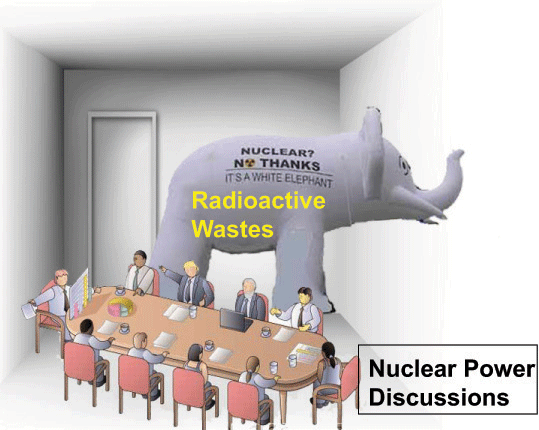
Vermont’s only nuclear plant is about two years away from being fully decommissioned.
VT Digger By Emma Cotton and Sam Gale Rosen, November 20, 2023
For decades, Vermont Yankee, a nuclear power plant in Vernon, was the largest producer of electricity for the state.
The plant has been shut down since 2014, and the company that now owns it is in the process of deconstructing it. That company, NorthStar, has recently submitted a plan that describes in detail the final steps of decommissioning, which is projected to be completed ahead of schedule, by 2026.
However, national developments mean that radioactive spent fuel on the site is likely to stay where it is for the foreseeable future.
Host Sam Gale Rosen spoke to VTDigger environmental reporter Emma Cotton, who has been covering the decommissioning process.
Emma:………………………………………………………………………………………………………………………………………… In 2010, Vermont lawmakers voted in favor of denying that 20-year license renewal. They had safety concerns, particularly after the plant had a tritium leak, which is a radioactive substance. That decision became the subject of a federal lawsuit about whether the state or the feds had authority over the plant. But soon enough, that issue was of little consequence. In 2013, citing the economic environment, Entergy announced that it plans to shut Vermont Yankee down
It officially disconnected from the grid and shut down on Dec. 29, 2014. And then the private company NorthStar — which decommissions nuclear plants and other energy facilities like coal plants around the country — they bought Vermont Yankee in 2019, and they are using funds set aside by Entergy to complete this decommissioning work…………………
Vermont’s only nuclear plant is about two years away from being fully decommissioned, at which point the site will look a lot like an open lot, with the exception of 58 spent fuel casks, which will remain there, likely, for a long time……………………………………………………………………………………….
Sam: So they’re on track to have the facility disassembled before 2026. But the other thing you’ve been covering is what happens to the spent fuel, right?
Emma: Yeah, this is kind of the elephant in the room, I think, for Vernon, the town where this is located. So after the fuel rods were used to heat water, they were transferred to cooling towers, and the process of cooling brought their radioactivity down. For a long time nuclear plants around the country were designed to temporarily store spent fuel this way, in cooling pools, and then they would be transferred to one or more federally designated areas for permanent storage.
But the federal government has not found a permanent place to store spent fuel. There has been a lot of conversation about a site in Nevada — Yucca Mountain — but there has been strong local opposition to storing the entire country’s nuclear waste there.
So nuclear plant owners had to find another storage solution. And so they started storing spent fuel in what are called dry casks, which are metal or concrete cylinders that form shells outside of the fuel rods. And according to the NRC, that shell shields people pretty effectively from this highly radioactive spent fuel. So Entergy transferred all of their spent fuel into dry casks, and now there are 58 of those that remain on the site. It’s a 2-acre part of the parcel.
NorthStar does ship some radioactive material to a facility in Texas, but it doesn’t have anywhere to send its spent fuel. So according to Northstar CEO, Scott State, the fuel will remain there until the feds come up with another plan. And that could be a while. So NorthStar will own the spent fuel until it’s removed from the property……………………………………………………………………………………………………………………………………………………. https://vtdigger.org/2023/11/20/the-deeper-dig-a-plan-for-whats-left-of-vermont-yankee-nuclear-power-plant
For climate summit the desperate nuclear lobby will pretend that nuclear fusion is a real solution
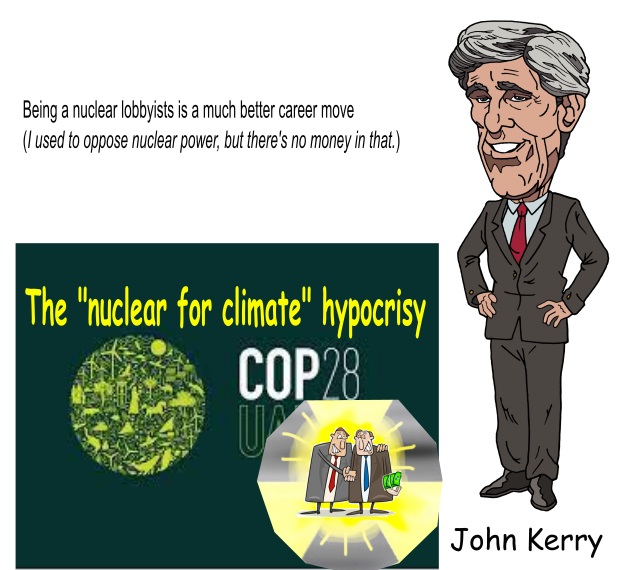
US to announce global nuclear fusion strategy at COP28
By Valerie Volcovici and Timothy Gardner, November 21, 2023
WASHINGTON, Nov 20 (Reuters) – The U.S. will lay out the first international strategy to commercialize nuclear fusion power at the upcoming UN climate summit in Dubai, U.S. Special Envoy on Climate Change John Kerry will say on Monday, two sources familiar with the announcement said………………………………….
Kerry, who as a U.S. senator more than a decade ago backed legislation that would fund fusion research at the Massachusetts Institute of Technology, will tour Commonwealth with Claudio Descalzi, CEO of Italian energy company Eni (ENI.MI). Eni is working on four fusion research partnerships in Italy and the U.S., including one with Commonwealth………………….
Scientists have so far only reached scattered instances of ignition, not the many continuous ignition events per minute needed to generate electricity to power homes and industries.
There are also regulatory, construction and siting hurdles in creating new fleets of power plants to replace parts of existing energy systems.
Some critics say fusion will be too expensive and take too long to develop to help in the fight against climate change in the foreseeable future.
A source familiar with the planned announcement said the fusion strategy will be a framework that lays out plans for the global deployment of the technology that could gain support from international partners………………………………….……..
The source said COP28, which runs from Nov. 30 to Dec. 12, will “be the starting gun for international cooperation” on nuclear fusion, which Kerry will tout as a climate “solution, not a science experiment”……………………….. https://www.reuters.com/sustainability/climate-energy/us-announce-nuclear-fusion-strategy-cop28-2023-11-20/
Finland extends nuclear reactor outage, pushing up power price
November 20, 2023 —by Essi Lehto and Nora Buli for Reuters
HELSINKI, Nov 20 (Reuters) – Finnish power company TVO said on Monday it had extended an outage at Olkiluoto 3, Europe’s largest nuclear power generator, while it undertakes repairs, likely boosting electricity prices.
The 1,600 megawatts (MW) unit, known as OL3, on Sunday suffered an unexpected outage due to a turbine problem, TVO and Nordic power bourse Nord Pool said.
“We are looking into a fault on the turbine side and when we find out what it is, we can say what caused it and when we can return to electricity production,” said a TVO spokesperson.
“We will issue a statement as soon as we know more.”
The outage was expected to drive up short-term power prices in Finland and the Nordic region, an LSEG market analyst said.
TVO had initially predicted a return to full production capacity on Monday morning, but in a regulatory filing said it was instead aiming for a partial restart to take place on Tuesday…………………… https://www.nasdaq.com/articles/finland-extends-nuclear-reactor-outage-pushing-up-power-price
—
UK’s Foreign Secretary urged to send observers to nuclear ban meeting in New York
The Second Meeting of the States Parties to the Treaty on the Prohibition of Nuclear Weapons will be held at the United Nations in New York between 27 November and 1 December.
The Treaty, usually referred to as the TPNW or Ban Treaty, entered international law in January 2021 after an intensive campaign championed by the International Campaign to Abolish Nuclear Weapons, a global coalition of civil society and faith groups, Hibakusha (atomic bomb and test survivors), scientists, and academics. In total there are 661 partner organisations in 110 countries within ICAN, amongst them are the UK/Ireland Nuclear Free Local Authorities and Mayors for Peace, of which NFLA founder Manchester is a Vice-Presidential and Executive city. ICAN won the Nobel Peace Prize for its work.
First opened for signature in July 2017, the TPNW now has 93 signatory states, of which 69 have taken the final step of ratifying their absolute adherence to it through their national parliaments.
The Treaty obliges signatory states not to ‘deploy, develop, test, produce, acquire, possess, stockpile, use or threaten to use nuclear weapons’ or assist other states to do so. In addition, and importantly for the UK and the other nuclear weapons states, the treaty contains obligations placed upon signatories ‘to provide adequate assistance to individuals affected by the use or testing of nuclear weapons, as well as to take necessary and appropriate measure of environmental remediation in areas under its jurisdiction or control contaminated as a result of activities related to the testing or use of nuclear weapons’.
Unfortunately, none of the nine nuclear weapon armed states (the USA, Russia, France, UK, China, India, Pakistan, Israel and North Korea), or their allies who choose to shelter under their supposed ‘nuclear umbrella’, have chosen to sign the Treaty, and in each of the nine states campaigners are seeking to influence government ministers to at least engage with this important international peace initiative by authorising observers to attend the second meeting in progress.
Norway and Germany have recently chosen to do so and now the Nuclear Free Local Authorities have joined the United Nations Association – UK and co-campaigners in writing to Britain’s new Foreign Secretary urging him to let Britain follow their lead. Campaigners also want the UK Government to acknowledge the ongoing harm caused to Indigenous people and their environments by the conduct of British atomic and nuclear weapons tests in Australia, in the Pacific and in the USA, and to use the meeting to listen to the testimony of representatives from Kiribati, formerly Christmas Island.
Councillor Lawrence O’Neill, Chair of the UK/Ireland Nuclear Free Local Authorities, explained why he was so determined to endorse the joint letter on behalf of the NFLAs:
“The UK Government claims to be committed, alongside the USA, Russia, France, and China, to achieving nuclear disarmament through the Non-Proliferation Treaty, yet in over fifty years this has achieved nothing. The reality is that India, Israel, Pakistan and North Korea continue to operate as nuclear weapon states outside of the NPT and we now live in a world where the nuclear powers continue to invest in their frightful nuclear arsenals, where the use of nuclear weapons has being threatened in Ukraine and Gaza, and where the Doomsday Clock hovers at 90 seconds to midnight!
“The world needs something to bring us back from the abyss – and the Ban Treaty represents that hope. Half of the United Nations have so far signed up to it and the NFLAs want the other half to do so. Seeing the UK attend the New York meeting as an observer and listen to the testimony of the awful impact of nuclear weapons testing in Kiribati would be the first sign that our government is serious about achieving nuclear disarmament and righting the wrongs that we as a nation have inflicted on the Kiribati people.”
World Nuclear Industry Status Report due on 6 December
The World Nuclear Industry Status Report 2023 (WNISR2023) will be released
on 6 December 2023, during a hybrid in-person/virtual presentation in
Brussels co-hosted by the German Federal Office for the Safety of Nuclear
Waste Management, the Friedrich Ebert Stiftung and the Heinrich Böll
Stiftung, European Union.
WNISR 18th Nov 2023
1 This Month
Chernobyl: The Lost Tapes – A good documentary on Chernobyl on SBS available On Demand for the next 3 weeks– https://www.sbs.com.au/ondemand/tv-program/chernobyl-the-lost-tapes/2352741955560

of the week–London Campaign for Nuclear Disarmament

Tell the Ukrainian Government to Drop Prosecution of Peace Activist Yurii Sheliazhenko
To see nuclear-related stories in greater depth and intensity – go to https://nuclearinformation.wordpress.com
-
Archives
- April 2026 (127)
- March 2026 (251)
- February 2026 (268)
- January 2026 (308)
- December 2025 (358)
- November 2025 (359)
- October 2025 (376)
- September 2025 (257)
- August 2025 (319)
- July 2025 (230)
- June 2025 (348)
- May 2025 (261)
-
Categories
- 1
- 1 NUCLEAR ISSUES
- business and costs
- climate change
- culture and arts
- ENERGY
- environment
- health
- history
- indigenous issues
- Legal
- marketing of nuclear
- media
- opposition to nuclear
- PERSONAL STORIES
- politics
- politics international
- Religion and ethics
- safety
- secrets,lies and civil liberties
- spinbuster
- technology
- Uranium
- wastes
- weapons and war
- Women
- 2 WORLD
- ACTION
- AFRICA
- Atrocities
- AUSTRALIA
- Christina's notes
- Christina's themes
- culture and arts
- Events
- Fuk 2022
- Fuk 2023
- Fukushima 2017
- Fukushima 2018
- fukushima 2019
- Fukushima 2020
- Fukushima 2021
- general
- global warming
- Humour (God we need it)
- Nuclear
- RARE EARTHS
- Reference
- resources – print
- Resources -audiovicual
- Weekly Newsletter
- World
- World Nuclear
- YouTube
-
RSS
Entries RSS
Comments RSS
 nuclear-news