U.S. Bets on Small Nuclear Reactors – But major obstacles loom.
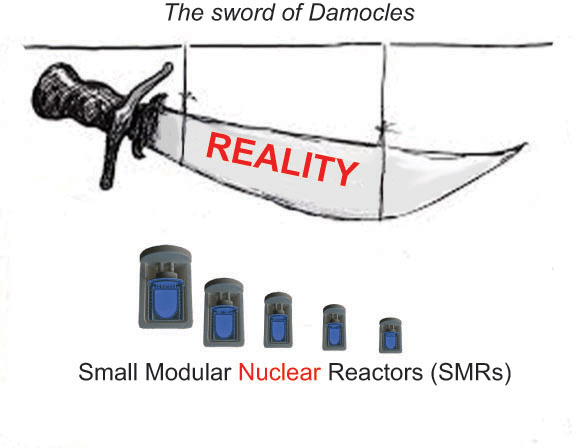
U.S. Bets on Small Nuclear Reactors to Help Fix a Huge Climate Problem.
The dream of reviving nuclear power in the U.S. rests on a new generation
of smaller reactors meant to be easier to build.
But major obstacles loom.
Nearly a dozen companies are developing reactors that are a fraction of the
size of those at Vogtle, betting that they will be quicker and cheaper to
build. As the United States looks to transition away from fossil fuels.
But the push to expand nuclear power, which today supplies 18 percent of
electricity, faces enormous hurdles. In a major setback last week, the
first serious effort to build small reactors in the United States was
abruptly cancelled amid soaring costs. While other projects are still
moving forward, the industry has consistently struggled to build plants on
time and on budget. The Nuclear Regulatory Commission, which oversees the
safety of the nation’s nuclear fleet, is less experienced with novel
reactor technologies.
And the problem remains of how to dispose of
radioactive waste. “These nuclear megaprojects had just gotten way too
complex,” said Jay Wileman, president of GE-Hitachi Nuclear Energy, which
is designing a slimmed-down version of its boiling-water reactor that is
only 300 megawatts — one-quarter the size of the 1,117-megawatt units at
Vogtle. Ontario Power Generation plans to deploy four of them in Canada,
hoping to bring down costs as it builds the same design again and again.
The Tennessee Valley Authority is considering at least one.
Other companies
are exploring radically new reactor designs that, in theory, can’t melt
down and don’t require big containment domes or other expensive
equipment. Some might be manufactured in factories and assembled on-site,
potentially lowering costs.
The approval process can be slow. To date, the
N.R.C. has certified only one small reactor design, developed by NuScale
Power. NuScale’s light-water technology is similar to existing plants,
but the company argued that smaller reactors required different safety
rules, such as smaller evacuation zones in case of accidents.
Securing approval took a decade and cost $500 million.
Last week, NuScale announced
it was cancelling plans to deploy six 77-megawatt reactors in Idaho by
2030, which would have been the nation’s first small nuclear plant. The
problem was that it couldn’t sign up enough customers. Soaring costs
didn’t help: In January, NuScale said the price of building the reactors
had jumped from $5.3 billion to $9.3 billion, citing higher interest rates
and materials costs. On a per-megawatt basis, the project had become as
expensive as Vogtle.
“The small reactors being hyped by the nuclear
industry and its allies are simply too late, too expensive, too uncertain
and too risky,” said David Schlissel, an analyst for the Institute for
Energy Economics and Financial Analysis, who has urged utilities to pursue
alternatives like solar and geothermal power. Other challenges loom. The
United States isn’t yet producing enough of the specialized fuel for
advanced reactors. There’s no long-term plan for nuclear waste. Siting
new plants can be contentious: Last year, officials in Pueblo County,
Colo., withdrew plans to replace a retiring coal plant with a reactor after
local backlash.
New York Times 12th Nov 2023
No comments yet.
1 This Month


Tell the Ukrainian Government to Drop Prosecution of Peace Activist Yurii Sheliazhenko

Petition to revoke the licensing of the Near Surface Nuclear Disposal Facility (NSDF) at Chalk River. https://www.ourcommons.ca/petitions/en/Petition/Details?Petition=e-7247


of the week – STOP SMALL MODULAR REACTORS IN CANADA
To see nuclear-related stories in greater depth and intensity – go to https://nuclearinformation.wordpress.com
-
Archives
- March 2026 (196)
- February 2026 (268)
- January 2026 (308)
- December 2025 (358)
- November 2025 (359)
- October 2025 (376)
- September 2025 (258)
- August 2025 (319)
- July 2025 (230)
- June 2025 (348)
- May 2025 (261)
- April 2025 (305)
-
Categories
- 1
- 1 NUCLEAR ISSUES
- business and costs
- climate change
- culture and arts
- ENERGY
- environment
- health
- history
- indigenous issues
- Legal
- marketing of nuclear
- media
- opposition to nuclear
- PERSONAL STORIES
- politics
- politics international
- Religion and ethics
- safety
- secrets,lies and civil liberties
- spinbuster
- technology
- Uranium
- wastes
- weapons and war
- Women
- 2 WORLD
- ACTION
- AFRICA
- Atrocities
- AUSTRALIA
- Christina's notes
- Christina's themes
- culture and arts
- Events
- Fuk 2022
- Fuk 2023
- Fukushima 2017
- Fukushima 2018
- fukushima 2019
- Fukushima 2020
- Fukushima 2021
- general
- global warming
- Humour (God we need it)
- Nuclear
- RARE EARTHS
- Reference
- resources – print
- Resources -audiovicual
- Weekly Newsletter
- World
- World Nuclear
- YouTube
-
RSS
Entries RSS
Comments RSS
 nuclear-news
Leave a comment