The idea of peace talks between Moscow and Kiev has become a “prevalent narrative” in the West, Oleg Soskin believes
Ukrainian President Vladimir Zelensky’s unwillingness to consider peace talks with Russia might lead him to being ousted to make such negotiations possible, Oleg Soskin, an adviser to two former Ukrainian presidents, said on Saturday.
Zelensky, who continues to maintain that victory should be achieved on the battlefield, simply “cannot” enter peace talks with Moscow, Soskin said on his YouTube channel. Such actions, he believes, are pushing Russia and at least some of Ukraine’s Western backers to think that they need someone else to represent Kiev who can “agree on even a temporary truce.” In order to achieve that, the current Ukrainian leadership needs to be “neutralized,” the former presidential aide added.
The idea of peace talks between Russia and Ukraine has become a “prevalent narrative” not only in Russia but in the West as well, Soskin suggested. He noted that French President Emmanuel Macron and Italian Prime Minister Giorgia Meloni expressed such ideas not so long ago.
Macron told the BBC in an interview this week that although it was France’s “duty” to support Kiev the time might have come for some “fair and good negotiations” with Russia. Meloni recently told a pair of Russian pranksters, Vovan and Lexus, that “there is a lot of fatigue” in the EU over the conflict. “We are near the moment in which everybody understands that we need a way out,” she added at that time.
Soskin, a renowned economist who was the deputy head of the Institute of the World Economics and International Relations of the Ukrainian Academy of Sciences in the 1990s, said that the EU would also be potentially unable to satisfy Kiev’s needs for military equipment and ammunition, particularly if US military aid decreases.
The former official served as a senior adviser to Ukraine’s first president, Leonid Kravchuk, in the early 1990s and was later an economic adviser to the nation’s second leader, Leonid Kuchma, between 1998 and 2000.
Kiev has repeatedly ruled out any talks with Moscow and demands a complete withdrawal of Russian troops from all territories Ukraine claims as its own. Zelensky reiterated this demand in an interview with Reuters this week, adding that Kiev would continue the fight even without US aid if need be.
He also denied media reports about Ukraine’s Western backers allegedly encouraging it to engage in peace negotiations with Moscow. “This is not going to happen,” he said last week.
Russia has repeatedly signaled its readiness to engage in negotiations with Kiev but has insisted that such talks should take Moscow’s security interests and the “reality on the ground” into account. In the autumn of 2022, four former Ukrainian territories – including the two Donbass republics – officially joined Russia, following a series of referendums.
Kiev declared the votes a “sham” and has sought to reclaim control over the four territories, as well as Crimea, which joined Russia in 2014 following another referendum.
Transparency requirements in the U.S. forced NuScale proponents to disclose the projected costs of electricity to potential investors on a regular basis. This is not the case in Canada.
none of the Canadian nuclear proponents have laid out the projected costs of electricity production. In New Brunswick, the government has changed legislationto force the electricity utility to purchase power from new nuclear reactors even when it is not the lowest cost option.
The sudden cancellation last week of the first small nuclear reactor project in the United States, the NuScale project, calls into question the economic viability of Canada’s plans to develop and deploy small modular reactors.
Potential customers in Utah balked at the soaring projections for the cost of electricity the NuScale reactor would generate, and the project was unable to recruit other customers to buy its power.
Today, in response, civil society groups across Canada are demanding transparency and accountability for the costs of other small nuclear reactor designs planned in this country.
“Canada should stop writing blank cheques to nuclear promoters who cannot deliver on their promises of cheap, reliable electricity,” said Gordon Edwards, President of the Canadian Coalition for Nuclear Responsibility.
Transparency requirements in the U.S. forced NuScale proponents to disclose the projected costs of electricity to potential investors on a regular basis. This is not the case in Canada.
Earlier this year, the target price for electricity from the NuScale project rose by over 50 percent to $89 US per MWh ($122.99 Canadian) with indications that future increases would be forthcoming. Investor confidence was shaken, and the project was scrapped.
The NuScale reactor design has been in development for more than 15 years and the company’s first commercial joint venture with electrical utilities in Utah was launched in 2015.
Governments in New Brunswick, Ontario, Saskatchewan and Alberta have committed to building small reactors, while the Quebec government is conducting feasibility studies.
However, none of the Canadian nuclear proponents have laid out the projected costs of electricity production. In New Brunswick, the government has changed legislationto force the electricity utility to purchase power from new nuclear reactors even when it is not the lowest cost option.
Three years ago, more than 140 civil society groups across Canada signed a statement calling the proposed new reactors a “dirty, dangerous distraction,” from real climate action.
Nuclear critics have consistently said these new reactor designs will take too long to develop, and will cost too much compared with existing proven renewable energy option, to deal effectively with the climate crisis that requires immediate action.
To date, federal and provincial taxpayers have subsidized these reactors through a $970 million low interest loan to Ontario Power Generation, more than $100 million in grants to private companies and public utilities in Ontario, New Brunswick, Saskatchewan and Alberta, and millions more to research fuelling requirements for small reactors at Chalk River.
Civil society groups are demanding accountability for these costly nuclear developments. Without full transparency, taxpayers and ratepayers will be forced to subsidize these experimental reactor projects and pass on an unwanted economic debt legacy to our children and grandchildren, along with the radioactive waste legacy that all nuclear reactors are adding to every day.
Quotes:
Michael Poellet, President, Inter-Church Uranium Committee Educational Cooperative:
“Small Modular Reactors (SMRs) were meant to remedy the grossly excessive, over-budget costs of nuclear power generation. With the price of renewables dropping precipitously the economics of SMRs has only worsened. The cancellation of the NuScale project with its utility partner Utah Associated Municipal Power Systems demonstrates that commercial electrical generation with SMRs is not economically viable. Canadian federal and provincial governments must allow the economic realities to break the spell that enchantment with SMRs has over them.”
rix ?
Media release from CRED-NB and collaborators. Le français suit…
The sudden cancellation last week of the first small nuclear reactor project in the United States, the NuScale project, calls into question the economic viability of Canada’s plans to develop and deploy small modular reactors.
Potential customers in Utah balked at the soaring projections for the cost of electricity the NuScale reactor would generate, and the project was unable to recruit other customers to buy its power.
Today, in response, civil society groups across Canada are demanding transparency and accountability for the costs of other small nuclear reactor designs planned in this country.
“Canada should stop writing blank cheques to nuclear promoters who cannot deliver on their promises of cheap, reliable electricity,” said Gordon Edwards, President of the Canadian Coalition for Nuclear Responsibility.
Transparency requirements in the U.S. forced NuScale proponents to disclose the projected costs of electricity to potential investors on a regular basis. This is not the case in Canada.
Earlier this year, the target price for electricity from the NuScale project rose by over 50 percent to $89 US per MWh ($122.99 Canadian) with indications that future increases would be forthcoming. Investor confidence was shaken, and the project was scrapped.
The NuScale reactor design has been in development for more than 15 years and the company’s first commercial joint venture with electrical utilities in Utah was launched in 2015.
Governments in New Brunswick, Ontario, Saskatchewan and Alberta have committed to building small reactors, while the Quebec government is conducting feasibility studies.
However, none of the Canadian nuclear proponents have laid out the projected costs of electricity production. In New Brunswick, the government has changed legislationto force the electricity utility to purchase power from new nuclear reactors even when it is not the lowest cost option.
Three years ago, more than 140 civil society groups across Canada signed a statement calling the proposed new reactors a “dirty, dangerous distraction,” from real climate action.
Nuclear critics have consistently said these new reactor designs will take too long to develop, and will cost too much compared with existing proven renewable energy option, to deal effectively with the climate crisis that requires immediate action.
To date, federal and provincial taxpayers have subsidized these reactors through a $970 million low interest loan to Ontario Power Generation, more than $100 million in grants to private companies and public utilities in Ontario, New Brunswick, Saskatchewan and Alberta, and millions more to research fuelling requirements for small reactors at Chalk River.
Civil society groups are demanding accountability for these costly nuclear developments. Without full transparency, taxpayers and ratepayers will be forced to subsidize these experimental reactor projects and pass on an unwanted economic debt legacy to our children and grandchildren, along with the radioactive waste legacy that all nuclear reactors are adding to every day.
Quotes:
Michael Poellet, President, Inter-Church Uranium Committee Educational Cooperative:
“Small Modular Reactors (SMRs) were meant to remedy the grossly excessive, over-budget costs of nuclear power generation. With the price of renewables dropping precipitously the economics of SMRs has only worsened. The cancellation of the NuScale project with its utility partner Utah Associated Municipal Power Systems demonstrates that commercial electrical generation with SMRs is not economically viable. Canadian federal and provincial governments must allow the economic realities to break the spell that enchantment with SMRs has over them.”
David Geary, Writer and Researcher, Clean Green Saskatchewan:
“Our group, Clean Green Saskatchewan, was always confident that NuScale and all other SMR startup enterprises, GE-Hitachi included [a new reactor design selected for Ontario and Saskatchewan], would fail because of the ‘bottom line’ … i.e., the economics, the ‘financials’. They simply cannot compete in the energy marketplace…compared to any other electrical energy producing technology.”
Jack Gibbons, Chair, Ontario Clean Air Alliance
“The failure of the most advanced small nuclear project in the U.S. to come even remotely close to being financially viable should be a wake-up call for politicians in Canada dreaming about castles in the sky. Counting on unproven new nuclear technology to provide low-cost power is like counting on snow in July. It is time for Premier Ford to follow Hydro Quebec’s example and develop a financially prudent plan to meet all of Ontario’s future electricity needs by investing in energy efficiency, renewables and storage. It doesn’t make sense to waste public money on high-cost, high-risk nuclear projects when we have much cleaner, safer and lower cost options to keep our lights on.”
Susan O’Donnell, Spokesperson, Coalition for Responsible Energy Development in New Brunswick
“Our provincial government is backing two nuclear start-ups and their experimental small reactor designs. These two designs are based on earlier reactors that never operated successfully commercially despite billions of dollars in public subsidies in other countries. We believe that despite the tens of millions of public dollars given to the start-ups so far, their costly boondoggles will never be built. In effect, our government is kicking the can down the road, delaying real climate action by betting on unicorns and fairy dust.”
Gordon Edwards, President, Canadian Coalition for Nuclear Responsibility
“Public utilities are owned by the government. People elect the government. So every citizen is a shareholder in the utility company and deserves to be kept informed of all business decisions that they will ultimately have to pay for. In the midst of a climate crisis and crippling inflation, Spending Money Recklessly (SMR) is a terrible strategy. We should not delay climate action by wasting our time, our money, and our political will on speculative reactors that are all ‘first-of-a-kind’ experiments.”
Jean-Pierre Finet, Porte-parole, Regroupement des organismes environnementaux en énergie
“There is no social acceptability for nuclear energy in Quebec. Small modular reactors are not only costly, they take away government funding that would be better used on proven technologies such as heat pumps and heat storage. It is time that the Canadian government comes clean about the cost of this pseudo clean energy.”
Dichter’s comments are surprising not only because Israel has been publicly framing the mass displacement in Gaza as a measure taken solely to protect civilians, but also because the Israeli government has long officially denied that the Nakba ever happened, even passing laws forbidding its history to be taught in schools.
One problem Israel keeps running into is how the institutionalized dehumanization of Palestinians which keeps the apartheid state operational also causes Israelis to say things that non-Israelis will find extremely shocking, which hurts Israel’s PR interests.
We saw this illustrated in a recent New Yorker interview with Daniella Weiss, a leader of the push to build illegal Israeli settlements on Palestinian land. Weiss stated frankly and unapologetically that she supports apartheid, that she doesn’t believe Palestinians should have any sovereignty anywhere, that she doesn’t believe Palestinians should have voting rights, that she wants the population of Gaza to be replaced by Israeli settlements, and that she is untroubled by the killing of children in Gaza because she feels it’s being done in the interests of Israeli children.
Asked where the Palestinians in Gaza should go, Weiss replied, “To Sinai, to Egypt, to Turkey.” When the interviewer said the Palestinians are not Egyptian or Turkish, she contended that “The Ukrainians are not French, but when the war started they went to many countries.”
To the question “When you see Palestinian children dying, what’s your emotional reaction as a human being?”, Weiss answered, “I go by a very basic human law of nature. My children are prior to the children of the enemy, period. They are first. My children are first.”
Asked if she believes human rights are not universal and should not apply equally to everyone, Weiss replied “That’s right.”
But perhaps the most revealing statement Weiss made was her entirely truthful explanation of what drives the Israeli push to colonize Palestinian land:
“In Israel, there’s a lot of support for settlements, and this is why there have been right-wing governments for so many years. The world, especially the United States, thinks there is an option for a Palestinian state, and, if we continue to build communities, then we block the option for a Palestinian state. We want to close the option for a Palestinian state, and the world wants to leave the option open. It’s a very simple thing to understand.”
That one paragraph right there will teach you more about the present-day realities of the Israel-Palestine conflict than an entire year of watching CNN. It’s horrid, and it’s jarring to hear it spoken out loud in a favorable way… but it’s true.
This sort of thing has been happening for years. Israelis who’ve been marinating in a self-validating echo chamber of Zionist ideology which dehumanizes Palestinians and normalizes oppression and abuse don’t think twice about saying things that make Israel look bad on the world stage, because to them it’s just the standard status quo way of looking at things.
In 2021 a settler from New York named Yaakov Fauci made headlines around the world with his candid statements to a Palestinian family whose Sheikh Jarrah home he was squatting in.
Fauci, apparently fully aware that he was being filmed, famously replied to the family’s complaints that he was stealing their home by shamelessly telling them, “If I don’t steal it, someone else will steal it.”
And the thing is, he wasn’t lying. He was truthfully describing an abusive dynamic in apartheid Israel where Palestinians are being forced out of their homes in order to control ethnic demographics and advance the agenda outlined above by Daniella Weiss. If he’d been a trained propagandist for the Israeli state he never would have made such comments on camera, but because he was just a Zionism-indocrinated member of the Israeli public he saw no reason to hold his tongue.
Some years ago The Empire Files’ Abby Martin put together a devastating critique of the Zionist ideology just by going around the streets of Jerusalem with a camera and a microphone and talking to Jewish Israelis about their views on Palestinians. Over and over and over again they shared their support for tyranny, murder, genocide and ethnic cleansing in their own words and without hesitation, never thinking that their words could be used to harm Israel’s image, because to them these were just normal things that they said all the time in their day to day life.
You see the same sort of thing when Israelis are filmed sitting in lawn chairs to watch and cheer IDF bombing operations on Palestinian neighborhoods, during which a woman once told the press “I’m just a little bit fascist” after advocating the total destruction of Gaza City.
Every time this happens it sends viral video footage around the internet and does real damage to the world’s perception of Israel. That’s a big part of why Israel is struggling to control the narrative about the Gaza massacre today, which is in turn being exacerbated by more incendiary statements by Israelis, not just from the general public but from within the Israeli government itself.
On Saturday Israeli security cabinet member and Agriculture Minister Avi Dichter casually referred to the violent forced expulsion of Palestinians from the northern half of the Gaza Strip as “Nakba 2023”, a reference to the violent forced expulsion which was inflicted on Palestinians at the establishment of the Israeli state in 1948.
Israeli security cabinet member and Agriculture Minister Avi Dichter (Likud) was asked in a news interview on Saturday whether the images of northern Gaza Strip residents evacuating south on the IDF’s orders are comparable to images of the Nakba. He replied: “We are now rolling out the Gaza Nakba. From an operational point of view, there is no way to wage a war — as the IDF seeks to do in Gaza — with masses between the tanks and the soldiers.”
When asked again whether this was the “Gaza Nakba”, Dichter — a member of the security cabinet and former Shin Bet director — said “Gaza Nakba 2023. That’s how it’ll end.”
When later asked if this means Gaza City residents won’t be allowed to return, he replied: “I don’t know how it’ll end up happening since Gaza City is one-third of the Strip — half the land’s population but a third of the territory.”
Dichter’s comments are surprising not only because Israel has been publicly framing the mass displacement in Gaza as a measure taken solely to protect civilians, but also because the Israeli government has long officially denied that the Nakba ever happened, even passing laws forbidding its history to be taught in schools.
Even as western officials hasten to frame Israel’s actions as a defensive and measured response to the Hamas attack on October 7, Israeli officials have been falling all over themselves in a mad rush to make those western officials look like liars.
When talking about the Gaza assault Prime Minister Benjamin Netanyahu made headlines by invoking the biblical nation of Amalek, whose people God instructed the Israelites to commit total genocide against. The first book of Samuel contains the instructions, “Now go, attack the Amalekites and totally destroy all that belongs to them. Do not spare them; put to death men and women, children and infants, cattle and sheep, camels and donkeys.”
President Isaac Herzog insinuated last month that all civilians in Gaza are legitimate military targets because they failed to overthrow Hamas, saying, “It is not true this rhetoric about civilians not being aware, not involved. It’s absolutely not true. They could have risen up. They could have fought against that evil regime which took over Gaza in a coup d’etat.”
When announcing the total siege on Gaza which would see the enclave cut off from electricity, food, water and fuel, Israeli defense minister Yoav Gallant stated that “we are fighting human animals, and we are acting accordingly.”
IDF spokesman Daniel Hagari said Israel would turn Gaza into a “city of tents” and that Israel’s “emphasis is on damage and not on accuracy” in its bombing campaign.
Dan Gillerman, Israel’s former ambassador to the UN, said last month that “I am very puzzled by the constant concern which the world is showing for the Palestinian people and is actually showing for these horrible, inhuman animals who have done the worst atrocities that this century has seen.”
“Hamas became ISIS and the citizens of Gaza are celebrating instead of being horrified,” The Economist cites an Israeli general saying last month. “Human beasts are dealt with accordingly.”
“Creating a severe humanitarian crisis in Gaza is a necessary means to achieve the goal,” a major general named Giora Eiland wrote in an Israeli newspaper, adding, “Gaza will become a place where no human being can exist.”
Israel’s allies keep trying to portray it as a rational actor and a positive force in the world, but if you listen to Israelis themselves you get a very different understanding of what this murderous apartheid state is actually about.
As Maya Angelou said, when someone shows you who they are, believe them the first time.
Small modular reactors — they’re the technology the nuclear power industry hopes will mainstream the controversial energy sector and prove it can expand without the massive scale of traditional nuclear energy.
But the emerging market has been dealt a blow just as enthusiasm for a nuclear renaissance hits a new level of intensity.
It came in the form of a decision from the Utah Associated Municipal Power Systems and advanced SMR developer NuScale to dump a plan called the “Carbon Free Power Project”.
That would have been the first SMR rolled out in the States, six minireactors due to be constructed in Idaho Falls from 2026. But NuScale and UAMPS deemed it unviable after subscriptions fell well below the level required to underwrite the project’s construction.
Wood Mackenzie vice-chair of Americas Ed Crooks said it was a serious setback for the SMR industry.
“But while the end of the Carbon Free Power Project was not entirely unexpected, it is still a serious setback for nuclear power in the US, and for hopes of reducing greenhouse gas emissions globally,” he said in a note.
“It is increasingly likely that no new SMRs will be built in the US or Europe in the 2020s.”
According to Crooks the levelised cost of energy for the power to be delivered by the dumped project was over double that of utility-scale solar and materially higher than gas turbines.
“Estimates published in January set a target levelised cost of energy (LCOE) for the plant of US$89 per megawatt hour, up from an earlier estimate of US$58/MWh, including the benefit of tax credits and federal government support,” he wrote.
“But even that revised target relied on some favourable assumptions. Hitting that US$89/MWh target depended on cutting US$700 million from the Carbon Free Power Project’s estimated cost of US$5.1 billion.
“Without that, the LCOE would be US$105/MWh, and there were clear risks that it could rise higher.
“Wood Mackenzie calculated last year that the average LCOE from a combined-cycle gas turbine power plant in the US was US$58/MWh, while utility-scale solar was US$43/MWh.
“That makes the Carbon Free Power Project’s cost estimates seem expensive, even before any additional overruns.”
Enthusiasm for nuclear continues
Despite that news, SMR developer NuScale has, predictably, rebutted a short seller’s report from Iceberg Research on its operations last month.
Months after Russia’s ally Belarus received tactical nuclear weapons from Moscow, there is indication that the United States is assisting the Dutch F-35A in taking on its role as a nuclear carrier platform.
Amid increased nuclear threat looming over Europe, the Netherlands announced that it had obtained “initial certification for the deterrence mission,” suggesting that some of the F-35A stealth fighters that are part of NATO’s fleet are getting closer to being fully nuclear-capable.
The F-35A was to be certified as a “Dual Capable Aircraft (DCA)” by January 2024, according to an earlier announcement by the US Air Force, with the capability to carry the B61-12 nuclear bomb. The US Air Force has not yet disclosed if any other country or its F-35As have received certification to deploy the B61-12.
The Dutch Air Combat Command commander Johan van Deventer posted on X: “#ACC “Ready for Operations” was the result of the US team that inspected us this week. This gives us our initial certification for the deterrence mission with the F-35. An important step in the transition. Made possible by teamwork.”
Even though The Netherlands does not have nuclear weapons, NATO’s ‘Nuclear Sharing’ doctrine enables members without nukes of their own to take part in NATO’s nuclear deployment.
As of now, Belgium, Germany, Italy, and the Netherlands have access to other B61 family of weapons provided by the United States. The F-16 fighter jets of the Dutch Air Force are currently capable of carrying these nuclear bombs.
The Royal Netherlands Air Force (RNLAF) anticipates announcing full operational capability with its F-35A in early 2024. However, that announcement will be made once the F-35A fighter can complete all the objectives allocated to the F-16.
With work progressing steadily on turning the aircraft into a nuclear carrier, the integration of B61-12 would likely have to be completed before that.
The operational preparedness of the Royal Netherlands Air Force’s (RNLAF) F-35A fleet was inspected by US Air Force officers who visited the Dutch Air Combat Command. Though the bombs themselves are unknown to have been made available to date, a determination was made regarding the RNLAF’s capacity to assume the nuclear strike mission with the F-35A, leading to the associated certification.
A photo was also published, which showed an RNLAF F-35A carrying the test variants of the B61-12 nuclear bombs. On its part, the B61-12 is an 825-pound, 12-foot-long bomb that features an inertial navigation system (INS) guidance package. It comprises both new parts — such as the precision guiding tail kit and reconditioned components, all of which have varying yields — from the previous B61 variants.
All 150 or so of the older B61 variants presently housed at six European bases will probably be replaced by B61-12s. This includes bombs stationed in locations in Belgium, Germany, Italy, and the Netherlands, where the Dutch Volkel Air Base is home to ten to fifteen B61 nuclear bombs that RNLAF F-16s deliver. ……………………………………………………………………………………………….
Russia’s Nuclear Sabre Rattling Continues
The possibility of a nuclear exchange between Moscow and the West has returned to the forefront of attention due to Russia’s full-scale invasion of Ukraine. Although allies concur that there is little chance of Russia intensifying the conflict in Ukraine, there is increasing divergence amongst them over the circumstances under which this risk might rise and how.
According to some US and other NATO defense officials, if Russia’s forces appear to be about to collapse or if Ukraine appears set to seize Crimea and sizable swaths of occupied territory in southern and eastern Ukraine, there may be a greater chance that Russia will launch a limited nuclear strike using a low-yield tactical nuclear weapon to prevent a significant military defeat.
Moreover, the Belarusian President, who is the only ally that Russia has in Europe, announced in June this year that his country received tactical nuclear weapons from Russia. He went so far as to say that some of these weapons were three times more powerful than the atomic bombs the US dropped on Hiroshima and Nagasaki in 1945…………………………………………………………………… more https://www.eurasiantimes.com/returns-to-europe-after-belarusian/—
An internal State Department dissent memo accuses President Biden of “spreading misinformation” on the Israel-Hamas war and alleges that Israel is committing “war crimes” in Gaza, according to a copy of the memo obtained by Axios.
Why it matters: The scathing five-page memo — organized by a junior diplomat who has suggested on social media that Biden’s support of Israel has made him “complicit in genocide” in Gaza — offers a rare look at the raw divisions within the Biden administration over the Israel-Hamas war.
The memo — signed by 100 State Department and USAID employees— urges senior U.S. officials to reassess their policy toward Israel and demand a ceasefire in Gaza, where more than 11,000 Palestinians have been killed in the war, according to Gaza’s Hamas-controlled health ministry.
Some of the memo’s language echoes that of progressive activists in the U.S., whose anger and protests over Biden’s handling of the war have rippled through the Democratic Party — and created a new challenge for the president’s 2024 campaign.
Without offering a specific example, the memo accuses Biden of “spreading misinformation in his Oct. 10 speech” supporting Israel, one of the signature addresses of his presidency.
The memo also said that “we strongly recommend that the (U.S. government) advocate for the release of hostages by both Hamas and (Israel)” — citing the “thousands” of Palestinians being held in Israel, including those “without charge.”
Driving the news: The memo, transmitted to the State Department’s policy office on Nov. 3, opens by noting the “recent atrocities committed by Hamas on October 7th” — a reference to Hamas’ attack on Israel that killed 1,400 people and ignited the war.
For the most part, however, the memo’s authors focus on Israeli Prime Minister Benjamin Netanyahu’s counterattack on Hamas in Gaza.
Biden has backed Israel’s response while expressing concern about humanitarian issues in Gaza, but the memo says Biden should do more to question Israel’s actions.
Those actions — which have included cutting off electricity, limiting aid and carrying out attacks that have displaced hundreds of thousandsof Palestinians — “all constitute war crimes and/or crimes against humanity under international law,” the memo alleges.”
“Yet we have failed to reassess our posture towards Israel,” the memo states. “We doubled down on our unwavering military assistance to the (Israeli government) without clear or actionable redlines.”
What we’re watching: Throughout the document, there are broader critiques of U.S. policy in the Middle East and what the authors call a failure to advance a viable path to a two-state solution in the conflict between Israel and Palestinians, which Biden has said he supports.
“Members of the White House and (the National Security Council) displayed a clear disregard for the lives of Palestinians, a documented unwillingness to de-escalate, and, even prior to October 7, a reckless lack of strategic foresight.”
The memo also criticized Biden for “questioning the number of deaths” in Gaza.
On Oct 27, Biden said he had “no confidence” in the figures provided by the health ministry in Gaza, while also saying he was “sure innocents have been killed” there.
The intrigue: It’s unclear how many dissent memos have been filed within the State Department during the Israel-Hamas war. Politico reported last week on a memo that called for the U.S. to “publicly criticize Israel’s violations of international norms.”
That language is not included in the copy of the memo obtained by Axios.
Between the lines: Since the Vietnam War, the State Department has maintained a “dissent channel” to give diplomats — in distant embassies and in the department’s headquarters — a way to register their opposition to policies.
Dissent memos are supposed to stay within the building, but sometimes they are leaked to the media.
Recent memos include a 2016 cable, signed by 51 diplomats, criticizing the Obama administration’s policy toward Syria, which leaked.
A 2021 memo on the U.S. decision to withdraw forces from Afghanistan did not leak, but became the subject of a showdown between Congress and the State Department.
What they’re saying: The State Department “is proud there is an established procedure for employees to articulate policy disagreements directly to the attention of senior department leaders without fear of retribution,” a State Department spokesperson said.
“We understand — we expect, we appreciate — that different people working in this department have different beliefs about what United States policy should be,” the spokesperson said.
The big picture: In Secretary of State Antony Blinken’s public and private diplomacy, he has worked to ensure the flow of humanitarian assistance and minimize the military impact on Palestinian civilians, according to an administration official.
In his visit to Israel this month, Blinken asked Netanyahu and members of Israel’s war Cabinet to begin humanitarian pauses in the fighting to allow aid to reach Palestinian civilians in northern Gaza.
Would the U.S. or Denmark be responsible for cleaning up over 47,000 gallons of Cold War-era radioactive waste?
BY DAN POSSUMATO , 25 Aug 19, BRUNSWICK — President Trump’s flippant yet repeated comments about the possibility of the United States purchasing Greenland – Denmark’s semi-autonomous island, which is 25 percent larger than Alaska – are both amusing and worrisome. Amusing because the comments show an astounding lack of diplomatic decorum, and worrisome because the Russians are paying attention, as they are well aware of previous American attempts to utilize the island for military purposes. Since the early 1950s the U.S. has maintained Thule Air Base on the northwest of the island for the purpose of detecting missiles launched against North America, previously from the Soviet Union and now from Russia.
However, the Russians also are aware that in the 1960s, a top-secret U.S. Army operation code-named Project Iceworm attempted to place up to 600 nuclear missiles at another base underneath Greenland’s thick ice shelf. The location of the missiles, so close to our Cold War adversary, would have had enormous offensive capability. Flight time to their targets in the Soviet Union would have been mere minutes, and, therefore, virtually impossible to stop. The missiles were to be constantly moved over rail lines in a network of tunnels dug deep beneath the ice, a plan intended to foil Soviet intelligence from knowing which of the 2,100 siloswould house the missiles. A Cold War version of the old shell game.
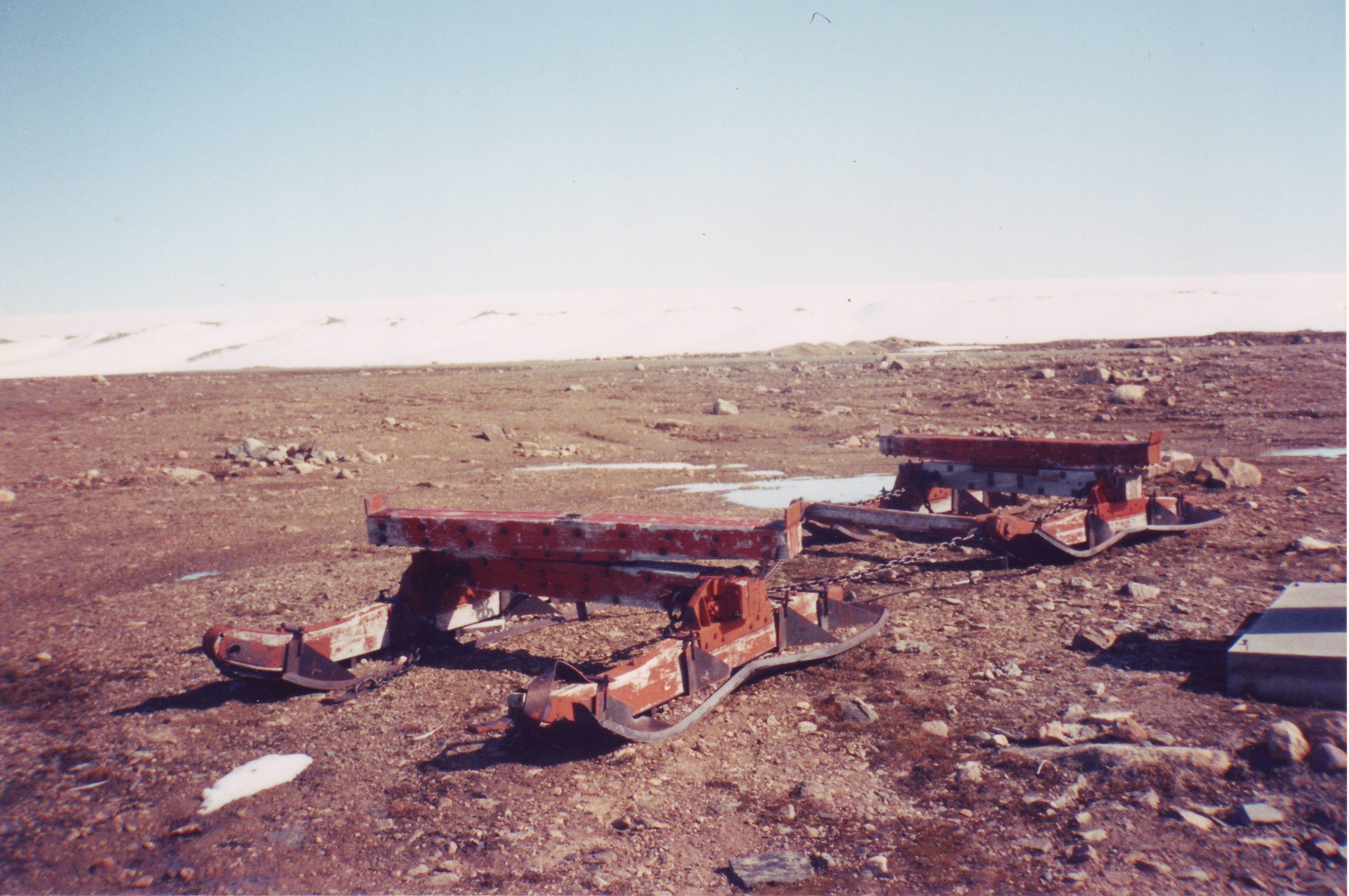
Officially, the Army claimed to be operating a facility named Camp Century, whose purported purpose was to conduct experimentation in Arctic construction techniques and engage in other “research.” The installation that Camp Century concealed – Project Iceworm – was powered by an experimental nuclear reactor, which, according to the Atomic Heritage Foundation, produced over 47,000 gallons of radioactive waste that still lies buried, along with the entire camp, under more than 100 feet of ice. Other estimates put the figure at more than 63,000 gallons. The thinking at the time was that the ice would keep the waste entombed forever.
The whole operation proved impractical, as the Army engineers had miscalculated how fast the ice shelf was shifting. The 21 tunnels began to shift and collapse because of the pressure from the ice, the rail tracks buckled, and the reactor began to melt the ice below and it began to sink. Without fanfare, the whole project was abandoned in 1967.
However, the ice is now melting faster than anyone back then had thought possible. In a 2016 article, Science magazine reported that “melting could begin to release waste stored at the camp, including sewage, diesel fuel, persistent organic pollutants like PCBs, and radiological waste from the camp’s nuclear generator.” Fortunately, even with the effects of climate change, the base won’t be exposed for another 90 years or more. Still, who will take ownership of the problem and expend vast sums of money to remediate the environment: the USA or Denmark?
Project Iceworm was so secret that the Danish government was not formally asked for its permission to allow the establishment of the base; thus, it could disavow any knowledge if the operation were ever exposed. Denmark officially did and still does have ban nuclear weapons there, but the country’s prime minister and foreign minister had tacitly allowed U.S. nuclear weapons to be kept in Greenland, at Thule Air Base and at Project Iceworm. The Danish Parliament was unaware of this clandestine decision. (Ultimately, no U.S. missiles were ever deployed to Greenland.)
If President Trump should ever get Denmark to sell us Greenland, perhaps he could get the former base listed on the National Register of Historic Places, and thus preclude any nuclear-waste cleanup for the purpose of preserving a part of our history.
As Ukraine slips quietly from the top of the Western media’s news agenda, fascinating insights into the granular nature of the CIA’s involvement in Kiev’s assassination program are being revealed. By the very same outlets that had previously suggested Ukraine was on a solo run with its slew of extrajudicial killings and terror attacks.
Western media has routinely ignored the brutal exploits of Kiev’s successor to the KGB, the SBU. When they are reported upon, instead of calling out the illegal killing of journalists and activists, the press seeks to frame them as masterful operations of a band of freedom fighters administering tough justice to the “enemies of Ukraine.” A key element of that narrative was that while the US, British, and French intelligence services worked closely with the SBU, they didn’t have any direct control of its actions, particularly when those actions involved assassinating unarmed civilians. However, a recently published article in the Washington Post has now revealed that the CIA had, and continues to have, a central role in the group’s most disturbing activities.
A Washington Post article “Ukrainian spies with deep ties to CIA wage shadow war against Russia” outlines a labyrinthine relationship between the two intelligence agencies, and while the CIA still maintains it doesn’t sanction particular operations, the details revealed in the telling article suggest that this is nothing more than the usual stock disclaimer which accompanies most of Langley’s covert operations. The article is based on interviews with “more than two dozen current and former Ukrainian, US and Western intelligence and security officials” and its revelations are both shocking and fascinating.
One of the first claims it makes is that the relationship between the Ukrainian SBU and the CIA has been developing for decades with the latter working to “develop” Ukraine’s abilities to carry out sabotage and “operations” since at least 2014. The CIA has also been providing detailed intelligence, equipment and training to the SBU during that period and continues to spend “tens of millions” of dollars developing its capabilities. The sources quoted also confirm that the CIA even designed and built a new headquarters for the SBU in Kiev and currently share “levels of information and intelligence unthinkable” prior to Russia’s intervention in Ukraine.
According to the Washington Post, the CIA also now maintains a significant presence in Kiev, not only in terms of men and materiel but also information flow, all of which suggests that despite maintaining an overt distance, the CIA is in fact intimately involved in all aspects of SBU operations including the planning and execution of operations outside the state.
One such operation, and probably the most infamous carried out by the SBU since February 2022, was the assassination of Daria Dugina, daughter of prominent Russian philosopher Aleksandr Dugin. The Washington Post article goes into great detail to outline the complexity of the “operation” performed by the SBU that resulted in the death of the unarmed 23-year-old non-combatant in a car bombing outside Moscow in August 2022. It tells of the use of a pet carrier to transport explosives into Russia, and of the surveillance of the deceased woman’s home by the assassin, who then fled across the border soon after the horrendous killing, which was cynically referred to by the SBU as a “liquidation.”
The granular details outlined in the article suggest sources either within the CIA or SBU have now confirmed that their relationship, once presented as purely advisory and business-like, is in fact a deep and long-standing partnership. The article goes on to confirm the SBU’s involvement in several other targeted murders on Russian territory, including the assassination of Vladlen Tatarsky with a bomb in a crowded St. Petersburg cafe and the murder of ex-submarine commander Stanislav Rzhitsky, who was shot in the back while jogging unarmed in a park in Krasnodar.
The revealing article also refers to “uneasiness” in Kiev and Washington regarding the SBU’s penchant for this kind of assassination, noting concern that they could tarnish Ukraine’s image abroad especially among donor countries who recently admitted that without their help Ukraine would collapse within weeks.
What is most interesting about this piece is probably not its confirmation that the CIA is intimately involved in the operations of the SBU, what’s most fascinating is why a newspaper widely recognized as itself having an intimate relationship with the CIA has suddenly decided to basically confirm what many analysts already knew when it comes to Langley and the SBU.
The Washington Post’s revelation comes not only in the aftermath of the bloody Hamas incursion into Israel and the subsequent Israeli assault on Gaza but also as international attention, and more importantly, appetite to support Kiev, wanes. This shift in attention, not only in the media but also potentially in the scale of aid, bodes poorly for President Vladimir Zelensky’s regime, as it faces increasing domestic pressures and war-weary neighbors.
Couple this with the oncoming winter and the view looks increasingly grim for Zelensky even before mentioning Ukraine’s failed counteroffensive and recent Russian battlefield gains. It now also looks inevitable that Ukraine will find itself playing second fiddle to an emerging political and potentially military crisis in the Middle East while competing for the vital US aid that keeps the Kiev regime afloat. Crucially, all of these woes offer a beleaguered NATO an opportunity to apply pressure on Zelensky to seek peace, potentially solving an increasingly difficult puzzle for Kiev’s backers as they head towards elections that will be decided by populations ever more vocal in their disdain for the conflict.
So as Kiev’s woes compound and the world’s gaze shifts towards Gaza, it seems the truth about the West’s intimate relationship with the SBU is now being pulled out of the closet, not by a whistleblower or dissenting investigative journalist, but by a stalwart of the US intelligence community, the Washington Post. The question we should all be asking is why? How does this benefit or promote a Western ‘victory’ in Ukraine? The answer may well be that it’s not a victory that these revelations are supposed to facilitate. It’s more likely that it’s part of a strategy of edging Kiev towards accepting the undeniable reality that the entire US project in Ukraine is set to fail, and for Zelensky to seek accommodation before there’s nothing left to negotiate with.
The task now is to end it as painlessly as possible for NATO and Kiev’s exhausted backers, and to move on to the next crusade, leaving a devastated and dysfunctional Ukraine to be consigned to the growing graveyard of bloody US foreign policy misadventures.
It was the behavior of the ice that proved to be the program’s undoing (alongside its estimated $2.37 billion price tag, equivalent to $25.24 billion today). The slow but gradual winter movement of the Greenland ice sheet caused the trenches to warp, with the ceiling of the nuclear reactor room dropping by five feet in 1962.
Long before Greenland’s shifting ice threatened sea level rise, it doomed one of the military’s most audacious projects
In the late 1950s, the U.S. Army was under attack from a formidable foe: budgeting.
President Dwight D. Eisenhower’s “New Look” strategy sought to reorganize Cold War military funding so that it focused on tactical nuclear weapons as America’s main deterrent against potential attacks from the Eastern bloc. Defense spending would now be split among the Air Force (49 percent), the Navy (29 percent) and the Army, which was allocated the smallest share (22 percent).
Determined to preserve its status, the Army focused on promoting the ground deployment of mobile missiles as a key part of America’s nuclear deterrent. What the Army brass needed was a terrain that was within striking distance of the Soviet border and that offered a degree of natural concealment.
They found it in the frozen wilds of Greenland, which became the setting for Project Iceworm, a top-secret plan to convert part of the Arctic into a launchpad for nuclear missiles — and at the same time construct “a city under the ice.”
The goal of Project Iceworm, described by ProfessorNikolaj Petersen of Denmark’s Aarhus University in 2007 in the Scandinavian Journal of History, seemed straightforward. Rather than base long-range Minuteman intercontinental ballistic missiles (ICBMs) at silos in the United States where the Soviet Union might target them, the Army could instead burrow beneath a less monitored location, closer to the U.S.S.R.
The Greenland ice sheet lies less than 3,000 miles from Moscow. The plan called for digging underground trenches, through which medium-range ballistic missiles (MRBMs) could be deployed.
But before the requisite number of warheads could be installed, Project Iceworm came up against a force even greater than the Soviet Union or budget constraints: Mother Nature.
Long before a study last week found that a warming planet had claimed all but five of northern Greenland’s ice shelves and threatened a dangerous sea level rise, Greenland’s shifting ice compromised one of the U.S. military’s most audacious projects.
The plan to station nuclear missiles under Greenland’s ice was inspired by Bernt Balchen, a Norwegian-born U.S. Army colonel who in the 1930s had spearheaded polar aviation and who had pointed out the strategic advantage of Greenland’s location between the superpowers.
Balchen had been involved in the construction of two U.S. air bases in Greenland. He noted that the United States was permitted to store nukes in Greenland under the Thulesag 1 agreement, signed with Denmark in 1941 following the country’s occupation by the Nazis, which gave America jurisdiction over the defense of Greenland. (Greenland had been under Danish control since the 1814 Treaty of Kiel, and there were fears that the Germans might use Greenland as a base from which to attack North America.)
Despite the threat’s dissolution at the end of World War II, Soviet ICBM tests conducted in the 1950s and the launch of the Russian Sputnik satellite in 1957 reaffirmed the belief that a U.S. military presence on Greenland should be maintained. But how could America install underground nuclear missiles without transparently violating Denmark’s 1957 nuclear-free policy?
The solution was the construction of a polar training facility that would double as a cover story for digging into the ice. Camp Century was established in 1958, approximately 150 miles east of Thule, and was presented to the Danes as a scientific research site and a test area for construction work in arctic conditions.
In reality, Camp Century was a major military installation, with almost two miles of covered trenches as well as laboratories, an underground railway track and a PM-2A portable nuclear reactor to supply power. But it served as only a microcosm of what Iceworm was intended to be.
The so-called underground city was planned to eventually be three times the size of Denmark, at 52,000 square miles, and include more than 2,000 firing positions through which the 600 MRBMs (nicknamed “Iceman missiles”) could be moved on rail cars. Eleven thousand service personnel would live under the ice and be rotated out of their posts via aircraft equipped with landing skis that would touch down on surface airstrips.
To keep those prospective personnel motivated, Camp Century would offer greater amenities than just the standard military running track and rec center. The base would feature a hospital, school and movie theater, and it was scheduled to receive two more nuclear generators to supply the installation’s energy once it had been fully constructed.
Snowplows designed in Switzerland began to dig trenches into the ice. The longest of these, at more than 1,000 feet, was nicknamed “Main Street.” Covered with steel arches and a layer of camouflaging snow, it was sturdy enough to house the convoy of Iceman missiles that would be transported under the ground, each of which would carry a warhead with a 2.4-megaton yield (150 times as powerful as the bomb dropped on Hiroshima in 1945).
If launched, 600 of these missiles would be sufficient to destroy 80 percent of U.S. targets in the Soviet Union and Eastern Europe. By contrast, the U.S.S.R. would need to launch an estimated 3,500 eight-megaton missiles to destroy the missile installation in Greenland — if it even knew of the facility’s existence beneath the ice.
It was the behavior of the ice that proved to be the program’s undoing (alongside its estimated $2.37 billion price tag, equivalent to $25.24 billion today). The slow but gradual winter movement of the Greenland ice sheet caused the trenches to warp, with the ceiling of the nuclear reactor room dropping by five feet in 1962.
Despite an attempt to raise it during that summer, the military — now aware of how tenuous an atomic city hemmed in by shifting ice seemed — took the cautious approach of downgrading Century to a summer camp in 1964, before finally abandoning the site in 1967.
Instead of launching missiles, the last noteworthy exercise performed at the base was the drilling of a probe a mile down into the underlying bedrock, which at least lent the “scientific test area” cover story fed to Denmark a note of truth.
Ironically, it was this drilling that gave Iceworm its greatest success. While the bedrock core extracted in 1966 was stored and ultimately forgotten, its rediscovery in 2017 revealed it to contain fossilized leaf and twig fragments, proving that plants had once grown under one of the coldest regions on earth.
This helped thaw some of the frostiness that had developed between the United States and Denmark when Project Iceworm was publicly disclosed in 1997. Similar tensions had struck decades earlier, when, during a routine surveillance flight south of Thule Air Base in 1968, a B-52 bomber crashed and spread its payload — four 1.1-megaton thermonuclear bombs — over sea ice in North Star Bay. Air Force personnel and the local Inuit population were requested to assist with the cleanup, which became informally known as “Dr. Freezelove” and recovered only three of the four ruptured warheads.
A missing atomic bomb isn’t the only U.S. military debris left in Greenland. When Project Iceworm was abandoned, it was hoped that the shifting ice that had compromised its construction would entomb the materiel the U.S. Army Corps of Engineer had left behind. This included 9,200 tons of building equipment, 53,000 gallons of diesel fuel, carcinogenic chemicals used in paint, and radioactive cooling water from the camp’s portable nuclear reactor.
A 2016 study suggested that these contaminants are likely to be released in a few decades’ time as a warmer climate continues to melt the ice sheet. This news seemed to confirm a Greenlandic proverb: “If you hush up a ghost, it grows bigger.”
China’s President Xi Jinping and US President Joe Biden will meet this week.
They’re expected to agree to limit the use of AI in nuclear weapons, a report said.
The meeting comes amid increasing tensions between the US and China.
US President Joe Biden and his Chinese counterpart Xi Jinping are set to sign a deal limiting the use of artificial intelligence in nuclear weapon control systems, according to The South China Morning Post.
The leaders are due to meet Wednesday at the Asia-Pacific Economic Cooperation (APEC) summit in San Francisco against a backdrop of increasing tensions between the superpowers.
Among the top items on the agenda is the proliferation of AI in military technologies, two sources familiar with the planned discussions told The South China Morning Post.
Biden and Xi will pledge a deal limiting the use of AI in autonomous weaponry, such as drones, as well as the systems used for the control and deployment of nuclear warheads, the report said.






 nuclear-news