What happens after a nuclear power station is closed?
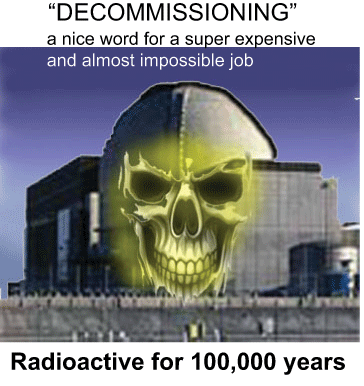
When Hinkley Point B. opened in 1976, its two advanced gas-cooled reactors
(AGRs) were state of the art. But over nearly half a century of generation,
cracks developed in their graphite cores, creating potential safety
concerns, and they were shut down for good last year.
Yet inside the
cavernous main hall, little seems to have changed. Freshly painted
machinery gleams under bright lights, as teams of workers in blue boiler
suits scurry around above the reactors themselves. The main activity at the
moment is defueling: removing hundreds of fuel assemblies from deep within
the reactor cores, stripping them down, and sending the wastes away for
storage at Sellafield. As we watch, a large steel tower is being positioned
over the reactor.
This is the charging machine. It looks rather like an
old-fashioned helter-skelter, but in fact it is a heavily-shielded crane.
The fuel assemblies, having been in the reactor for years, are highly
radioactive and need to be handled with extreme care.
Once defueling is
complete, EDF will hand over the site to the Nuclear Decommissioning
Authority (NDA). To find out what happens then, it is worth going next door
– to another power station, Hinkley Point A. This was one of the UK’s
first-generation nuclear sites. Its two reactors were brought online in
1965 – and shut down for good in 2000. Nearly a quarter of a century later,
its two box-like reactor buildings still stand tall against the skyline.
But other buildings, including the huge turbine hall, have been removed –
leaving just a deep, weed-strewn hole in the ground. Old fuel storage ponds
have been drained, cleaned and painted to reduce radiation risks, although
we are warned not to linger around them. But elsewhere a water-filled vault
remains half-full of radioactive scrap, which is being painstakingly
removed.
BBC 27th Oct 2023
https://www.bbc.co.uk/news/business-67087673 #nuclear #antinuclear #NoNukes
No comments yet.
1 This Month


Tell the Ukrainian Government to Drop Prosecution of Peace Activist Yurii Sheliazhenko

Petition to revoke the licensing of the Near Surface Nuclear Disposal Facility (NSDF) at Chalk River. https://www.ourcommons.ca/petitions/en/Petition/Details?Petition=e-7247


of the week – STOP SMALL MODULAR REACTORS IN CANADA
To see nuclear-related stories in greater depth and intensity – go to https://nuclearinformation.wordpress.com
-
Archives
- March 2026 (193)
- February 2026 (268)
- January 2026 (308)
- December 2025 (358)
- November 2025 (359)
- October 2025 (376)
- September 2025 (258)
- August 2025 (319)
- July 2025 (230)
- June 2025 (348)
- May 2025 (261)
- April 2025 (305)
-
Categories
- 1
- 1 NUCLEAR ISSUES
- business and costs
- climate change
- culture and arts
- ENERGY
- environment
- health
- history
- indigenous issues
- Legal
- marketing of nuclear
- media
- opposition to nuclear
- PERSONAL STORIES
- politics
- politics international
- Religion and ethics
- safety
- secrets,lies and civil liberties
- spinbuster
- technology
- Uranium
- wastes
- weapons and war
- Women
- 2 WORLD
- ACTION
- AFRICA
- Atrocities
- AUSTRALIA
- Christina's notes
- Christina's themes
- culture and arts
- Events
- Fuk 2022
- Fuk 2023
- Fukushima 2017
- Fukushima 2018
- fukushima 2019
- Fukushima 2020
- Fukushima 2021
- general
- global warming
- Humour (God we need it)
- Nuclear
- RARE EARTHS
- Reference
- resources – print
- Resources -audiovicual
- Weekly Newsletter
- World
- World Nuclear
- YouTube
-
RSS
Entries RSS
Comments RSS
 nuclear-news
Leave a comment