They Let Humanitarian Aid In. Then They Bombed It So That Gaza Would Starve.
One of the bakeries that Israel bombed in Nuseirat refugee camp had just received a shipment of flour from UNRWA meant to cover the food needs of the entire camp. Israel waited to bomb it once all the flour was unloaded.
By Tareq S. Hajjaj / Mondoweiss October 27, 2023 https://scheerpost.com/2023/10/27/they-let-humanitarian-aid-in-then-they-bombed-it-so-that-gaza-would-starve/
The following report is a consolidation of voice recordings sent by Mondoweiss Gaza Correspondent Tareq Hajjaj on October 25.
The situation is more terrifying than any previous day. People have been standing in long lines outside bakeries to get a small bag of bread for hours — six hours, seven hours, every day. But in the last few days, over ten bakeries have been targeted in the south, the so-called “safe zone” where the Israeli army told us to go. But it was a trap. They wanted to cram us into one place and start bombing us again. They’re targeting bakeries, and we don’t even hear reports of Hamas members among the dead.
One of the bakeries targeted in Nuseirat refugee camp had just received a huge shipment of flour from UNRWA, which had agreed with the bakery to sell the bread from the flour at half-price for the camp residents. UNRWA had just finished unloading the shipment, which was meant to cover the needs of the entire Nuseirat area, when the bakery was bombed and completely destroyed. They aren’t only targeting people and homes. They’re letting in aid, and then they destroy it before it reaches the people who need it. It’s calculated and deliberate. It’s meant to exterminate the civilian population.
By now, we know what kinds of missiles are being used to target us. There are kinds whose sole purpose is destruction, and there are other kinds that are designed to kill and are launched at crowds — people are calling them “killing missiles” because they’re designed to kill every living thing within a wide radius. People have started congregating at barber shops and hair salons to charge their cell phones because most of those salons use solar energy to charge the batteries that provide those shops with electricity, so now those shops are also being targeted by these kinds of “killing” missiles. The Israeli army bombed two of the salons, one in Khan Younis and one in Nuseirat refugee camp. They hit the salons only, not the areas near them. It wasn’t collateral damage; it was a deliberate strike on civilians.
These missiles explode inside the salon and killed everyone inside, but the building is left standing. Those who don’t die are ripped into pieces, their wounds critical in almost every case. A person can lose half their body. The sounds of these missiles are the scariest because the missile relies on the force of the explosion itself to kill its target. The other day, I started hearing other bombs being dropped that I’ve never heard before in Gaza. The bomb would be preceded by a long pronounced whistle, but when it explodes, its sound is lower than the other bombs. Artillery strikes have also become routine in the south, coming from the eastern side of the Gaza Strip. But the most prevalent missiles are the ones that are designed to destroy wide areas and level buildings. It depends on where the targeted areas are, but you can see the evidence of their use by looking at the scale of the destruction in Gaza.
All of this means that people are afraid to leave their homes even for basic necessities. When people stand in line for bread, they’re terrified. When they move in the streets, they’re terrified. The missiles target the markets, places where there are a lot of people, and they are all killed. We never hear that a Hamas operative was killed in these strikes. It’s always women, children, random people walking through the market. People aren’t leaving their homes anymore for any reason. In the house where I’m staying, not one of us is prepared to go stand in line at a bakery because we know that, at any moment, the bakery might be targeted. It doesn’t matter if you’re a civilian or not. But I have to venture out on many days, whether it’s to get baby formula for my son, diapers, or medicine. And every moment, I keep thinking that this is the day I’m going to die.
#Israe; #Palestine
Amid rising cost worries, UK government promises “practical nuclear roadmap”

Government promises ‘practical’ UK nuclear roadmap this year amid rising cost concerns.
Stuart Stone, 26 October 2023
Government agrees to map out route to 24GW nuclear target by 2050 and
allow Parliament to consider major investment value for money amid fears of
‘another HS2’.
The government has promised set out a “practical roadmap”
before the end of the year towards its goal of securing 24GW of nuclear
power capacity 2050, but MPs have raised concerns as to whether new nuclear
generation will offer value for money in light of the controversial
decision to cancel the northern leg of the HS2 high speed rail project.
In a letter to MPs on the Science, Innovation and Technology Committee (SITC)
yesterday, the government confirmed that a new Nuclear Strategic Plan is on
its way, and that it would spell out how the current reactor fleet will
contribute to UK targets and allow Parliament to weigh up value for money
of major new nuclear projects.
It follows a report from the SITC in July
which had called for greater detail on how the government plans to meet its
ambitious nuclear targets, as it cited the UK’s “intermittent history” with
regards to ramping up nuclear power capacity, with no new reactors having
been built in several decades. The report warned that UK nuclear capacity –
which currently contributes 15 per cent of the electricity needs – is set
to fall substantially by 2028 when all plants bar Sizewell B are scheduled
to reach the end of their operational lives.
Business Green 26th Oct 2023
https://www.businessgreen.com/news/4138819/government-promises-practical-uk-nuclear-roadmap-amid-rising-cost-concerns #nuclear #antinuclear #NoNukes
Zionist think tank publishes blueprint for Palestinian genocide
KIT KLARENBERG·OCTOBER 24, 2023 https://thegrayzone.com/2023/10/24/zionist-think-tank-palestinian-genocide/
As Israel’s carpet bombing of Gaza entered its third week, leaving over 5000 dead and at least one million residents displaced, a Tel Aviv-based think tank published a blueprint for self-proclaimed Jewish state’s final solution.
In a white paper released over a week after the Hamas-led surprise attack on Israeli military bases and kibbutzes, The Institute for National Security and Zionist Strategy outlined “a plan for resettlement and final rehabilitation in Egypt of the entire population of Gaza,” based on the “unique and rare opportunity to evacuate the entire Gaza Strip” that Israel’s latest assault on the besieged costal enclave provided.
Published in Hebrew on the organization’s website, the paper was authored by Amir Weitman, “an investment manager and visiting researcher” at the Institute who also leads the libertarian caucus of Israel’s ruling Likud Party. The document began by noting that there are 10 million vacant housing units in neighboring Egypt that could be “immediately” filled with Palestinians. Weitman then assured readers that the “sustainable plan…aligns well with the economic and geopolitical interests of the State of Israel, Egypt, the USA and Saudi Arabia.”
Weitman’s ethnic cleansing proposal echoes forced transfer plans advanced in recent days by former Israeli officials while capitalizing on evacuation orders delivered to the entire civilian population of northern Gaza by the Israeli military.
Weitman’s sinister blueprint imagined Israel purchasing these properties at a cost of $5 – 8 billion dollars, a whopping price-tag that reflects just 1 – 1.5 percent of Israel’s GDP.
“These sums of money [required to cleanse Gaza] in relation to the Israeli economy, are minimal,” Weitman posits. “Investing individual billions of dollars to solve this difficult issue is an innovative, cheap and sustainable solution.”
Weitman acknowledged that his plan virtually amounts to Israel “buying the Gaza Strip,” arguing the move would be “a very worthwhile investment” for Zionists because it would “add a lot of value over time.” He asserted local “land conditions” in the area would provide “many” Israeli settlers a high standard of living, therefore allowing for an expansion of settlements in Gush Dan near the Egyptian border, giving “a tremendous impetus to settlement in the Negev.”
In December 2021, Tel Aviv approved plans to establish four settlements in the Negev to house 3,000 settler families.
A genocidal war to end all wars
Though Egypt has so far rejected Israeli pressure for a mass exodus of Gaza residents through the southern Rafah crossing, Weitman argued Cairo will welcome the mass exodus of Palestinian refugees as “an immediate stimulus” that will “provide a tremendous and immediate benefit to al-Sisi’s regime.”
Weitman claimed that Cairo’s major creditors — including France, Germany and Saudi Arabia — are likely to welcome a revitalized Egyptian economy, courtesy of “Israeli investment” in the Palestinians’ permanent removal. He surmizes that Western Europe will welcome “the transfer of the entire Gaza population to Egypt,” because it will significantly “reduce the risk of illegal immigration…a tremendous advantage.” Meanwhile, he expects Riyadh to embrace the move because the “evacuation of the Gaza Strip means the elimination of a significant ally of Iran.”
The ethnic cleansing of Gaza would mean an end to “ceaseless, repeated rounds of fighting, which inflame the fires of hatred against Israel.” Moreover, “closing the Gaza issue will ensure a stable and increased supply of Israeli gas to Egypt and its liquefaction,” from the vast reserves seized by Israel near Gaza’s shores.
Palestinians in turn are expected to jump at the chance to be forcibly transferred from their homes rather than “living in poverty under the rule of Hamas.” It is therefore necessary for Israel to “create the right conditions” for them to “immigrate” from Gaza to Cairo. Weitman noted that Gaza’s two million inhabitants “constitute less than 2% of the total Egyptian population, which today already includes 9 million refugees. A drop in the ocean.”
The paper ominously concluded: “There is no doubt that in order for this plan to come to fruition, many conditions must exist at the same time. Currently, these conditions are met and it is unclear when such an opportunity will arise again, if ever. This is the time to act. Now.”
“If we want to remain alive, we will have to kill and kill and kill”
As barbarous as these proposals might seem, they reflect what many Israeli officials appear to be murmuring in private, and what at least one former government spinmeister has openly pushed as an altruistic solution to the Palestinian “problem.”
“There is a huge expanse, almost endless space in the Sinai Desert, just on the other side of Gaza,” former Deputy Foreign Minister of Israel, Danny Ayalon, echoed the genocidal Zionist logic behind Weitman’s proposal in an interview with Al Jazeera’s Marc Lamont Hill. “The idea is—and this is not the first time it will be done—for them to leave over to the open areas where we and the international community will prepare the infrastructure — you know, 10 cities with food and water — just like for the refugees of Syria.”
In 2004, Zionist demographer Arnon Sofer of Haifa University laid out detailed plans for the isolation of Gaza directly to Ariel Sharon’s government. This entailed withdrawing Israeli forces from the area entirely and constructing a stringent system of surveillance and security to ensure nothing and no one went in or out without Zionist proviso. He predicted a perpetual bloodbath:
“When 2.5 million people live in a closed-off Gaza, it’s going to be a human catastrophe. Those people will become even bigger animals than they are today…The pressure at the border will be awful. It’s going to be a terrible war. So, if we want to remain alive, we will have to kill and kill and kill. All day, every day…the only thing that concerns me is how to ensure the boys and men who are going to have to do the killing will be able to return home to their families and be normal human beings.”
The Institute has put forward a clean and easy fantasy of achieving the same goal put forward by Sofer. For it to succeed, all Palestinians have to do is put down their weapons and head toward the desert of permanent exile. #Israel #Palestine
IAEA warning after explosions heard near Khmelnitsky nuclear power stations

International Atomic Energy Agency Director General Rafael Mariano Grossi warns that nearby explosions which shattered windows at Ukraine’s Khmelnitsky nuclear power plant “show just how close it was – and underlines the extremely precarious nuclear safety situation … which will continue as long as this tragic war goes on”.
WNN 27 Oct 23
The International Atomic Energy Agency (IAEA) experts stationed at the plant in western Ukraine said air raid sirens sounded at 01:26 local time on Wednesday followed by two loud explosions which they were later told were two drones being shot down 5 kilometres and 20 kilometres from the site.
Although the site was not hit or have its operations affected, the IAEA reported that “shockwaves damaged the windows of several buildings at the site, including the passageway to the reactor buildings, an integrated auxiliary building, a special equipment building, the training centre, as well as other facilities, the plant said. The seismic monitoring stations installed in the vicinity of Khmelnitsky nuclear power plant also recorded the seismic impacts of the blasts”………
Grossi said: “Next time, we may not be so fortunate. Hitting a nuclear power plant must be avoided at all costs.”
Khmelnitsky’s first reactor was connected to the grid in 1987, but work on three other reactors was halted in 1990. Work on the second reactor restarted and it was connected to the grid in 2004 but units 3 and 4 remain uncompleted.
The primary focus of safety concerns for the IAEA since the outbreak of the war has been on the Zaporizhzhia nuclear power plant which has been under Russian military control since early March 2022. It is located on the frontline between the forces, and although it has not been reported to have been hit by shelling in recent months, military activity nearby has continued. In its update on the situation at the weekend, the IAEA said its experts at the site “have continued to hear explosions almost every day and they have also heard occasional machine gun fire”. https://www.world-nuclear-news.org/Articles/IAEA-warning-after-explosions-heard-near-Khmelnits #nuclear #antinuclear #NoNukes #radiation
Hanford’s pre-treated nuclear waste might not meet vital plant criteria
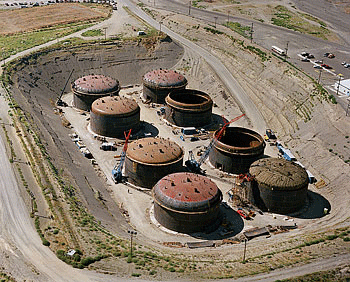
Hanford’s underground tanks contain some 56 million gallons of liquid radioactive waste left over from decades of plutonium production for nuclear weapons.
Exchange Monitor, By Wayne Barber,
A storage tank spoiled a batch of liquid radioactive waste at the Hanford Site that
was thought to be clean enough for disposal, according to a contractor memo
seen by the Exchange Monitor.
The waste from Hanford’s tank farm, part of
a less-radioactive tranche that is supposed to be solidified starting in
2025 by the Bechtel National-built Waste Treatment and Immobilization
Plant, had been scrubbed by the Tank Side Cesium Removal (TSCR) outside the
plant and piped into a nearby tank, designated AP-106, for storage.
But recent sampling of TSCR-treated waste stored in AP-106 revealed higher
levels of radioactive contamination than is allowed in the Waste Treatment
and Immobilization Plant during its Direct Feed Low Activity Waste phase,
according to an Oct. 3 memo from the site’s liquid-waste prime
contractor, the Amentum-led Washington River Protection Solutions.
Hanford’s underground tanks contain some 56 million gallons of liquid radioactive waste left over from decades of plutonium production for nuclear weapons. Production began during the Manhattan Project and ran through much of the Cold War.
The Waste Treatment and Immobilization Plant as constructed can only solidify a portion of Hanford’s less-radioactive waste, called low-activity waste. DOE has yet to approve a means of solidifying high-level waste or settle on a means of solidifying the low-activity waste that cannot be treated in the existing plant. One option for the later tranche of waste is mixing it with concrete-like grout.
Exchange Monitor 19th Oct 2023
https://www.exchangemonitor.com/hanfords-pre-treated-waste-might-not-meet-vit-plant-criteria/ #nuclear #antinuclear #NoNukes #radiation
Why consumers are very likely to pay a lot more for power from Sizewell C than from Hinkley C
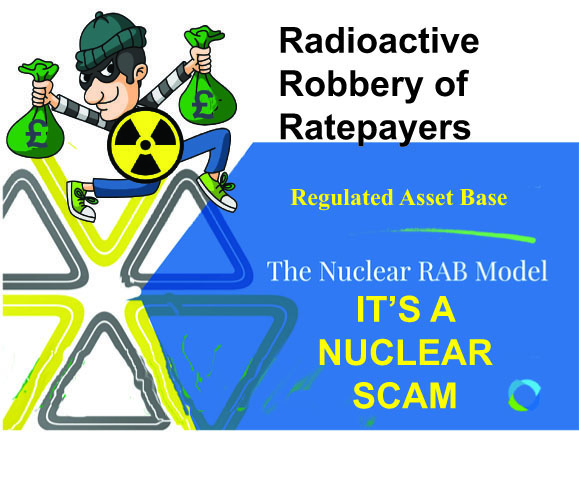
under the RAB mechanism, it seems that EDF will be paid for what they actually spend. This time it will be British, not French taxpayers and consumers, that will be paying for the cost overruns.
The Government are deceiving us about the cost effectivemess of their new funding mechanism for nuclear power
Dave Toke’s Green Energy Blog, DAVID TOKE, OCT 25, 2023
Consumers face a double whammy of bills to pay for the planned nuclear power plant, Sizewell C, due to be given a go-ahead soon. According to a ‘worst case scenario,’ consumers are likely to (collectively) pay around £34 billion in today’s prices before any electricity is generated from Sizewell C at all. But, in addition, according to my calculations, under this (quite likely) worst-case scenario consumers will then also pay around £160 per MWh in today’s prices for electricity produced by Sizewell C. This works out as £117 per MWh in 2012 prices (ie the base year for setting the cost of Hinkley C). The Government appears to be doing little or nothing to prevent this scenario from occurring.
Hence consumers could not only be paying much more per MWh than the controversially high Hinkley C deal (£92.5 per MWh in 2012 prices) but will also be paying large sums upfront before a kWh is even generated. In fact, despite being labeled as a ‘worst case scenario’, the estimate for Sizewell C costs that have been calculated is essentially based on the type of cost overrun experienced by attempts to build nuclear power plants in the West since 1990. That is nuclear construction costs end up being around double the amount initially budgeted.
I have taken the size of the upfront costs payable by consumers from an analysis done by Professor Stephen Thomas of Greenwich University. See also here. I have then taken his worst-case scenario figure for these upfront costs and converted them into a figure for costs per MWh by applying conventional economic tools. This involves using discounted cash flow analysis using a (real) 6 percent discount rate and assuming Sizewell C will be generating at an average of 90 percent of full capacity. This assumes using a contract type paying premium prices for energy generated similar to that used for Hinkley C (ie lasting for 35 years). I have based cost estimates of operating nuclear power plants on US experience, although operating costs form only a small element of the costs. The large bulk of the costs are concerned with repaying money loaned and invested in the power station.
My analysis runs contrary to the narrative spread by the Government. They claim that the so-called Regulated Asset Base (RAB) mechanism for funding new nuclear power plants will make nuclear power cheaper for the consumer. On the contrary, it is likely to allow more to be paid to EDF for Sizewell C compared to Hinkley C. This is because consumers will be responsible for paying cost overruns for Sizewell C whilst in the case of Hinkley C it is EDF that takes responsibility for cost overruns. The total amounts that consumers will have to pay will remain unknown until it is far too late to do anything to stop consumers from having their electricity bills dramatically increased………………..
The RAB mechanism has been lauded as a cost-saver because it allows EDF to pay lower interest rates on money borrowed to finance construction compared to the borrowing costs applicable to building Hinkley C. Money needed to finance interest payments and investors during the construction period is charged to consumers whilst the plant is being built.
There’s one giant flaw in this argument. The Government seems to be heading towards giving the go-ahead to EDF to start construction without agreeing a price to be paid for electricity. This means that consumers will pay for whatever it costs to build the plant. The costs of nuclear power stations seem always to be a lot more than what was estimated at the time of the ‘final investment decision’ (FID).
This is different from what happened with Hinkley C. In the case of Hinkley C EDF was committed to paying for any cost overruns themselves without being paid any extra money. ………… EDF bears responsibility for these cost overruns – in effect the French taxpayers will pay since EDF is owned by the French Government.
Yet under the RAB mechanism, it seems that EDF will be paid for what they actually spend. This time it will be British, not French taxpayers and consumers, that will be paying for the cost overruns. OFGEM is being given responsibility for organising payments to EDF.
Ultimately, it seems, OFGEM will be the ‘fall guy’ when, many years down the line, there is public controversy over the costs of the power from Sizewell C. In an obscure piece of wording in an obscure document entitled ‘Revenue Stream for the nuclear RAB model’, the government says (page 12) ‘The amount a relevant licensee nuclear company is allowed to receive (‘allowed revenue’) in respect of its activities relating to the design, construction, commissioning, and operation of the relevant nuclear project would be determined by Ofgem’.
In other words, EDF will have virtually a blank cheque to pay all their costs. The only control OFGEM will have is to check that the costs have actually been spent or will be spent on the power plant.
People were surprised at the cost of the Hinkley C contract, but the surprise was based on the public being kept in ignorance of nuclear construction costs in the past. Now the Government has learned its lesson, and we shall see a return to the past practice of the public being kept in the dark about the costs of building nuclear power plants…………………………………………… https://davidtoke.substack.com/p/why-consumers-are-very-likely-to
The Independent and Peaceful Australia Network (IPAN) steps up drive to keep U.S. military expansion out of Australia

By Bevan Ramsden | 26 October 2023 https://independentaustralia.net/politics/politics-display/ipan-steps-up-drive-to-keep-us-military-expansion-out-of-australia,18020
The Independent and Peaceful Australia Network (IPAN) has produced a petition opposing the Force Posture Agreement (FPA) which is enabling U.S. militarisation of Australia in preparation for the U.S. to support/launch war from the Australian continent against China.
The e-petition to Parliament is an instrument for peace calling for the termination of the FPA.
It can be signed HERE.
The devastation of war, currently in Ukraine and in Palestine, confronts us on TV on a daily basis. All peace-loving people cry out for a ceasefire on both war fronts to enable, hopefully under United Nations auspices, conferences of all affected parties to find solutions that meet the security needs of all parties and free non-combatants from the horrors of war.
But concern about these wars should not blind us to the preparations for war occurring on our own continent under the auspices of the United States and with the enthusiastic complicity of successive Australian governments.
When defence matters are discussed, much is made of the U.S.-Australia alliance. But when the U.S. militarisation of Australia is considered, the alliance pales into insignificance compared to the U.S.-Australia FPA. It emerged as a concept from former President Barack Obama’s “Pivot to Asia” of the U.S. armed forces, in which he announced the stationing of U.S. marines in Darwin each year to train for war with our Defence Force.
The “Pivot” was a strategy designed to “contain” China and maintain U.S. hegemony in the Asia/Pacific area. President Obama’s concept was enthusiastically received by all politicians of both major parties.
Subsequently, the Gillard and Abbott Governments, in conjunction with their U.S. defence counterparts, produced a greatly expanded concept, the FPA, providing “an operational posture” for U.S. forces in Australia, a gateway for U.S. militarisation of Australia. It was signed by the Abbott Government and the United States Government in 2014.
The FPA:
- facilitates the stationing in Darwin, for six months each year, of up to 2,500 U.S. Marines; they are trained and equipped for immediate deployment and while in Australia, train for war in exercises with the Australian Defence Force. They are not under the control of the Australian Government. They are under the control of the U.S. Indo-Pacific Command;
- facilitates unimpeded access to Australia’s airfields and airport facilities for U.S. fighter planes and bombers including the stationing of up to six B-52 bombers at RAAF Base Tindall. B-52 bombers were used to devastate Vietnam in that war and some are capable of carrying nuclear weapons;
- facilitates unimpeded access to Australia’s seaports for U.S. naval vessels including their nuclear submarines at HMAS Stirling in WA;
- facilitates the establishment of storage facilities for aircraft fuel, spare parts and munitions under U.S. military control. This includes huge fuel storage facilities at East Arm, Darwin and logistics facilities for storage of equipment, munitions and spare parts at Bandiana in Victoria;
- opened the door for the embedding of U.S. military intelligence operatives within the Australian defence intelligence organisation now called the Combined Intelligence Centre — Australia; and
- under the FPA, a U.S. command centre has been established in Darwin to control U.S. aircraft operations and another command centre in Darwin to control U.S. marine operations.
In short, the U.S. could launch and control military operations from Australia.
I have stressed the words “unimpeded access” because they are the words used in the Agreement.
Article IV of the FPA states:
…United States Forces and United States Contractors shall have unimpeded access to and use of Agreed Facilities and Areas for activities undertaken in connection with this Agreement.
Australia hereby grants to the United States operational control of Agreed Facilities and Areas…
Part 4 of Article VII states:
‘As mutually determined by the Parties, aircraft, vehicles, and vessels operated by or for United States Forces shall have access to aerial ports and seaports of Australia and other locations, for the delivery to, storage and maintenance in, and removal from the territory of Australia of United States Forces’ prepositioned materiel.’
Activities under Article IV include:
‘…training, transit, support, and related activities; refuelling of aircraft; bunkering of vessels; temporary maintenance of vehicles, vessels, and aircraft; temporary accommodation of personnel; communications; prepositioning of equipment, supplies, and materiel; deploying forces and material; and such other activities as the Parties may agree.’
Summing up, the FPA, with the enthusiastic support of the Australian Government, is facilitating increased U.S. militarisation of Australia to support U.S. military operations in the Indo-Pacific from which it could launch or support a war against China. This has been done with the agreement of both major political parties.
The FPA lasts 25 years from the date of signing but has a clause facilitating termination if either party gives one year’s notice.
IPAN is campaigning to have this FPA terminated. This would be a strong step in the direction of keeping Australia out of another U.S. war. And this time, one which would have a catastrophic impact on the Australian people.
If you wish to join this campaign, IPAN has a parliamentary e-petition which is open until 15 November 2023 for signature and it can be accessed by using your mobile phone and this QR code. [on original] #nuclear #antinuclear #NoNukes
Faulty coolant pump delays commissioning of Vogtle 4 nuclear reactor: project cost now over $30Billion

US Georgia Power has reported the discovery of a malfunctioning coolant
pump at unit 4 of its Vogtle NPP, resulting in a delay in commissioning of
the unit. The problem in one of the reactor’s four pumps was found during
pre-operational testing and startup of the unit, which had been expected
begin operation later this year. Instead, the reactor now is forecast to
begin operations in the first quarter of 2024.
Fuel loading at Vogtle 4 began in August. Unit 3 began commercial operation at the end of
July. Vogtle 3&4 are both 1,117 MWe Westinghouse AP1000 pressurised water
reactors (PWRs). The two units were originally expected to cost about $14bn
and to enter service in 2016 and 2017 but suffered a series of delays,
including Westinghouse’s bankruptcy in 2017.
The total cost of the project
to build Vogtle 3&4 is now put at more than $30bn. Georgia Power owns 45.7%
of the project; Oglethorpe Power Corp owns 30%; the Municipal Electric
Authority of Georgia (MEAG) owns 22.7%; and the city of Dalton owns 1.6%.
The units will be operated by Southern Nuclear.
Nuclear Engineering International 11th Oct 2023
https://www.neimagazine.com/news/newsfaulty-coolant-pump-delays-commissioning-of-vogtle-4-11210696 #nuclear #antinuclear #NoNukes #NuclearCosts
Why the US fixation on increased nuclear capability won’t deter China but could lead to instability and nuclear war
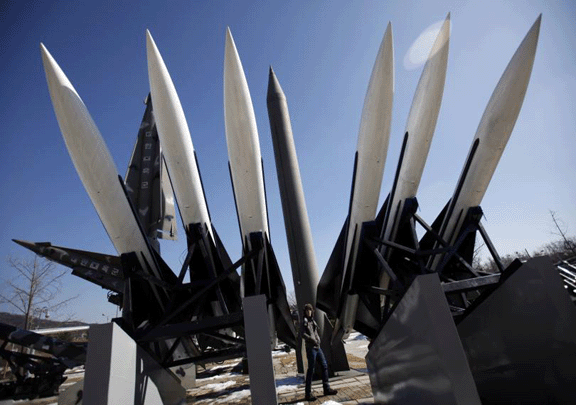
Bulletin By Andrew Facini | October 27, 2023
“……………………………………..In the span of two weeks, several major policy documents—including a bipartisan Congressional report on strategic posture and a Defense Department update on China’s estimated nuclear stockpile—have put the US nuclear posture vis-à-vis China front and center. The reports, which focus heavily on hardware and capability, contribute to a years-long deliberation with policymakers and analysts attempting to counter a perceived risk of tipping military balance in the Indo-Pacific. China’s nuclear weapons buildup is driving concerns among US allies and partners in the region over the aggression Beijing could possibly engage in, once its nuclear arsenal can “shield” the country from retaliation. The perceived threat is so intense that it has become a top national security concern in Washington.
Concerningly, however, the domestic debate about countering China’s growing arsenal has thus far dwelled almost exclusively on US capability—narrowly defining the problem and asking what combination of new nuclear missiles, increased forward-deployments, or friendly technology-sharing can maintain US dominance in a crisis and therefore deter China from taking aggressive steps. Unsurprisingly, the recommendations that followed ranged from adding more warheads to US missiles and building more nuclear submarines to—considered as important—adopting a posture of force-meets-force superiority at all levels against Chinese nuclear weapons in the Pacific.
But in aggressively pursuing capability surges alone, the United States may end up on the wrong side of the stability-instability paradox, risking escalation to nuclear war—intentional or not—through an overreliance on introducing untested or provocative technologies.
Instead, a stronger US strategy for responding to the challenge posed by China’s growing arsenal should be for the United States to supplement military capability by building multiple levels of mutual understanding and routes toward risk reduction across the Pacific. These measures must be implemented urgently and certainly before a crisis forces China and the United States to seriously test their nuclear deterrence relationship.
Capability fixation drives instability. One counter-productive distraction from a multi-level, risk-reduction approach to China is found in the sustained call for the fielding of new systems like the sea-launched nuclear cruise missile (SLCM-N) and other tactical nuclear weapons ostensibly meant for battlefield use. Promoting these systems as a purported solution to future crises places incentives in all the wrong places and dangerously complicates the possible outcomes in a conflict.
For its part, the SLCM-N (which the White House has already rejected via its most recent Nuclear Posture Review but a hawks-dominated Congress funded anyway) is a seemingly straightforward proposal to replace some of the cruise missiles on submarines with nuclear-armed ones. But just by its presence, the SLCM-N would pave the way for all US cruise missiles deployed to the Pacific to be potentially armed with nuclear warheads. If this happens, Chinese political and military leaders would have to conservatively assume that any incoming US cruise missile is nuclear-armed, prompting a presumption of escalation and adding extreme pressures for a rapid nuclear counter-attack, even as the US missile is still en route. If a regional crisis erupts for which a conventionally armed Tomahawk sea-launched strike would be an appropriate response, US leaders would suddenly have very good reason to hesitate.
By all accounts, the expanded destructive capability of the SLCM-N would create a self-imposed constraint that risks cutting out a major swath of conventional escalation options by muddling intermediate systems like cruise missiles with a nuclear option. Making an entire rapid-response weapons platform (one already with broad new investments in the region) less usable in favor of implied nuclear escalation is precisely the scenario SLCM-N advocates are trying to head off.
Tactical nuclear weapons also complicate the deterrence equation in a broader sense. In a contested and alarming information environment, even cautious beliefs about escalation control would be rendered academic while mushroom clouds rise over a battlefield. Far better would be to drive up the threshold for nuclear use at any level and communicate that intention clearly through both policy and force posture decisions.
Even during the early years of the Cold War when emerging technologies were filling out more of the “middle rungs” of the escalation ladder with tactical nuclear capabilities, it was seen as critical to maintain and keep clear the distinction between the first battle in West Germany and the ultimate destruction of Washington and Moscow. In blurring the picture of how the first hours of a nuclear conflict with China would be managed by both sides, setting clear decision-making timeframes and thresholds ahead of time would prove to be a safer and stronger strategic posture, helping to reduce uncertainty and panic in a crisis……………………………………………………………………………………………
Now is the time to forge a better mutual understanding with Beijing, not to escalate tensions. Holding multi-level dialogues about intentions; building reliable, resilient communication channels; and fostering those hard-to-quantify personal connections that can quell dangerous arms-racing instincts—or at least add critical resistance to escalation in a crisis—should be emphasized alongside any examination of force posture. Some military policy changes—including weapons modernization—may be required to meet the moment, but the approach in Washington thus far has been badly constrained to the force-meets-force thinking which, if taken alone, will only multiply risks and add untested variables for the United States and its allies.
The need to understand Beijing and find pre-crisis paths to reduce tensions is ultimately much more important and urgent than any given weapons system or revised strategic posture. Doing that work will be difficult and require sustained investment in both civil society and government processes at the highest levels, but it is a necessary component of maintaining deterrence to avoid nuclear war. https://thebulletin.org/2023/10/why-the-us-fixation-on-increased-nuclear-capability-wont-deter-china-but-could-lead-to-instability-and-nuclear-war/ #nuclear #antinuclear #NoNukes
The World’s Only Muslim Nuclear Power Warns Israel’s War in Gaza Must Stop
NewsWeek, Oct 27, 2023
Pakistan’s permanent representative to the United Nations has outlined to Newsweek his country’s position on the ongoing war between Israel and Palestinian factions led by Hamas, expressing the need for a ceasefire and warning of regional instability if an already devastating conflict deepens further.
“This is an obligation that devolves on all member states to prevent an escalation of the conflict,” Ambassador Munir Akram told Newsweek. “We would have hoped that the conflict had not taken place, but it has, and now we have to stop it, to halt the fighting and to avoid the suffering that is happening and is likely to happen if this conflict goes on.”
While the Islamic Republic he represents, one of the world’s most populous countries and the only Muslim-majority nation to possess nuclear weapons, may be thousands of miles away from the frontlines of the Gaza Strip, Akram identified a direct connection between Pakistan and the Palestinian cause. This link was made all the more tangible by parallels he drew between the Israeli-Palestinian conflict and the Indian-Pakistani dispute over the divided territory of Kashmir, to which Pakistanis commemorate a “Black Day” on Friday.
With local health officials in Hamas-run Gaza now counting deaths in excess of 7,000 as a result of Israeli airstrikes since an unprecedented Hamas-led October 7 assault on Israel in which authorities said 1,400 people were killed, Akram argued that “this is not something that should be acceptable to any civilized nation or people and we oppose it, therefore we hope it would stop.”
He added: “There is an additional layer of obligation on us as an Islamic country.”
“We feel that we have an obligation, an emotional commitment to Palestine and to the freedom of the Palestinian people,” Akram said. “It is a principle to which we are committed politically because of Kashmir. We are heavily invested in that principle, and we would like to see the triumph of that principle of self-determination.”
Common History
The Israeli-Palestinian and Kashmir conflicts are linked by history as well, both having been born out of the collapse of British colonial rule three-quarters of a century ago in the years immediately following World War II.
When the British Raj was dissolved in 1947, the previously united Indian subcontinent was divided into the new nations of India and Pakistan, with Pakistan also controlling modern-day Bangladesh until 1971. The partition resulted in massive bloodshed, especially between Hindus and Muslims on both sides of the new border. The two new states quickly went to war over the middle ground of Kashmir, which today is divided along what’s known as the Line of Control………………………………………………………………………………….. more https://www.newsweek.com/pakistan-warns-israel-war-gaza-must-stop-munir-akram-1838448 #nuclear #antinuclear #NoNukes #Israel #Palestine
Lawmakers urged to keep moratorium on new nuclear power plants in Illinois – avoid the fantasy of small modular reactors

The claim of benefits of small modular reactors are fantasies. Turning to nuclear energy will mean more radioactive waste along with other problems, and will not help our state fight climate change.
By David Kraft, Oct 27, 2023 https://chicago.suntimes.com/2023/10/27/23933226/illinois-moratorium-nuclear-power-plants-pritker-veto-small-reactors-renewable-david-kraft
During the fall session, the Legislature is expected to make a decision with enormous implications for renewable energy in Illinois.
Last spring, Gov. J.B. Pritzker wisely vetoed SB76, ostensibly to repeal Illinois’ 1987 nuclear power construction moratorium. In reality, pro-nuclear advocates introduced it promoting “small modular nuclear reactors” (SMNRs) — theoretical, untested “next generation” nuclear power plant designs.
The governor feared the bill would “open the door to the proliferation of large-scale nuclear reactors that are so costly to build that they will cause exorbitant ratepayer-funded bailouts” and provided “no regulatory protections or updates to address the health and safety of Illinois residents …”
They should not make the same mistake twice. Lawmakers should uphold the veto.
Pro-nuclear advocates describe the moratorium as an “arbitrary” and “outdated” “ban” on nuclear power. These claims are totally false. First, it’s a moratorium — a temporary, conditional halt — not a ban, conditioned on the federal government building an environmentally sound permanent disposal facility for the nation’s now-90,000+ tons of dangerous high-level radioactive waste (HLRW) before Illinois will allow construction of new reactors to make more of it.
The feds have yet to meet the legally mandated 1997 date to open a permanent disposal facility, and Illinois consequently has 11,000+ tons of HLRW sitting onsite lacking permanent disposal.
Absent this federal repository, the moratorium is not “outdated.” And since no new reactors have added to Illinois’ HLRW burden, it’s not “arbitrary” — it’s a success.
SB76 was really a Trojan horse. It ignored the reality about nuclear waste. It promoted the construction of small modular reactors, which was explicit in SB76’s introductory language, then inexplicably amended to remove that language; then amended again at the 11th hour, substituting language promoting a totally different kind of reactor. All of this resulted in the governor’s veto.
Now the pro-nuclear faction wants to override the veto. As a precaution they have also introduced SB2591 using the original SB76 language promoting SMNRs.
‘Fantasies’ about fighting climate change
Hoopla about the alleged “benefits” of small modular reactors are currently fantasies, mere nuclear industry marketing promises and wishful thinking because small reactors do not exist yet, and will not be available in commercially meaningful numbers until the mid-2030s, and then only if their proposed designs actually work.
SMNRs have been touted to strengthen local economies, provide job stability, support business and augment the tax base, thus leading to more funding for schools. Yet Illinois is already reaping all of these benefits at existing (and proposed) renewable energy facilities.
Illinois currently provides far more jobs in renewable energy and energy efficiency — a combined 105,591, as of 2021 — than at current nuclear plants — 3,726 as of 2022. The non-existent small modular reactors actually call for fewer operating staff.
Pro-nuclear advocates claim we need more nuclear to fight climate change, a claim challenged by two former Nuclear Regulatory Commission chairs, Gregory Jaczko and Allison Macfarlane, who have stated unequivocally that nuclear energy can’t be a silver bullet for climate change because it cannot replace other forms of power generation quickly enough to sufficiently reduce emissions
Other worrisome “devils in the details” not receiving Legislature debate include: proposals to build small modular reactors without protective containment buildings; elimination of emergency planning zones around reactors; and exemption from financial liability in case of accidents.
SMNRs are proposed by an industry that can’t build reactors on time, is rife with cost overruns, has recently endured three major nuclear-related corruption scandals and already cannot compete in Illinois’ energy market without needing $3.05 billion in ratepayer guaranteed bailouts.
Small modular reactors will mean more radioactive waste, continued radioactive emissions and accident threats, potentially higher electric rates and more nuclear bailouts. SMNRs are competitors, not complements, to renewable energy, for both market share and transmission grid access. They threaten Illinois’ renewable energy goals.
If the Legislature truly supports safe, renewable energy, it will not override the governor’s veto of SB76; and it will not support more nuclear plants in Illinois’ energy future.
Short film explores nuclear legacy through the lens of the Marshallese community
Hawaii Public Radio | By Cassie Ordonio. October 27, 2023, https://www.hawaiipublicradio.org/local-news/2023-10-27/short-film-explores-nuclear-legacy-through-the-lens-of-the-marshallese-community
Several decades after the United States detonated 67 nuclear bombs on the Marshall Islands, many Marshallese in the diaspora are longing to return home.
“In Exile,” which explores the nuclear legacy in the Pacific told through the experience of the Marshallese community in Arkansas, premiered at the Hawai’i International Film Festival this month.
Brooklyn-based director Nathan Fitch said the nuclear migration of the Marshallese is a blind spot in American history.
“The film is partly intended for an American audience who just doesn’t know anything about the Marshall Islands, let alone that piece of American history,” Fitch said. “Also, the fact that the (Marshallese) people have been in exile for nearly 70 years and still dream of going home.”
The Marshall Islands is located roughly 2,000 miles southwest of Hawaiʻi. It’s a sovereign nation comprising over 1,200 islands and chains of coral atolls, including its most populous Majuro and Kwajalein. The U.S. conducted a series of nuclear tests in Bikini and Enewetak Atolls during the Cold War between 1946 and 1958.
The radioactive fallout from the tests impacted people’s health, and many experienced birth defects and cancer. Descendants of the Bikini islands have lived in exile since 1946, and much of the island today is still unlivable.
Thousands of Marshallese have lived in the U.S. under the Compacts of Free Association. This agreement allows the Marshallese to migrate visa-free to the U.S. and its territories in exchange for the U.S. military having strategic denial rights of vast swaths of water in the surrounding islands.
The film follows the story of the Marshallese in Springdale, Arkansas, who gather annually to commemorate the Nuclear Victims Remembrance Day. Arkansas has one of the largest populations of Marshallese in the U.S., with a population of roughly 15,000.
Also, the film revealed that many Marshallese only knew the nuclear history once they were older. This was eye-opening for Angela Edward, a film producer and a Pohnpeian podcaster.
“They were never told about the nuclear testing their whole lives, almost until they were adults,” Edward said. “For them, it was almost a survival thing because they felt like it was their way of coping with this humongous tragedy that happened historically. “
The debut of “In Exile” is in juxtaposition with the negotiations of the Compacts of Free Association, according to Fitch. Recently, the U.S. and the Marshall Islands have renewed their agreement to extend economic assistance for another 20 years.
Fitch said he hopes the film will give an audience an understanding of why Marshallese, as well as other COFA citizens, migrated to the U.S.
“In Exile” sold out tickets at the Hawaiʻi International Film Festival. It recently won the Reel South Award at the Hot Springs Documentary Film Festival.
The short film is part of a larger film project called “Essential Islanders,” which Fitch said is still in the works.
“In Exile” will be available online next year. #nuclear #antinuclear #NoNukes #radiation
Bitcoin mining consumes more electricity than most countries, study suggests

To offset the carbon footprint of mining the leading cryptocurrency, a UN report has said more than 3.9 billion trees would need to be planted.
Sky News, Tuesday 24 October 2023
Bitcoin mining consumes more electricity than most countries, according to a new report on its damaging environmental impact.
Mining is the process by which transactions are added to and validated on the blockchain, the public ledger for cryptocurrencies.
Competing miners race to use computers to solve complex mathematical puzzles using extremely powerful hardware – receiving new Bitcoin as a reward for their efforts.
In 2020 to 2021, Bitcoin consumed 173.42 terawatt hours of electricity – enough to rank it 27th among nations, trumping the likes of Pakistan with a population of over 230 million people.
The resulting carbon footprint was the equivalent of burning 84 billion pounds of coal……………………………………………………………………………..
At the time of the UN study in 2021, China was by far the biggest Bitcoin mining nation – but it has since been overtaken by the US after Beijing launched an aggressive clampdown on the practice.
Combined, the 10 countries that mined the most Bitcoin were responsible for 92% of the climate footprint……………………………………………….. https://news.sky.com/story/bitcoin-mining-consumes-more-electricity-than-most-countries-study-suggests-12991456?fbclid=IwAR0y79GtFUU0bYTTo_bP2LbMSt5ybmCw19OTTF2jPZAUUWktAcYQJvDOSaQ#:~:text=In%202020%20to%202021%2C%20Bitcoin,84%20billion%20pounds%20of%20coal
British Nuclear Fuels resurrected as Great British Nuclear

In February 2023, plans to wind up BNFL within two years were still
active. By this point the company had not traded in 13 years. However, on
18 July 2023, BNFL was resurrected as Great British Nuclear, with the aim
of delivering the government’s long-term nuclear programme and supporting
its ambition to deliver up to 24 GW of nuclear power in the UK by 2050.
Wikipedia (accessed) 27th Oct 2023 #nuclear #antinuclear #NoNukes
https://en.wikipedia.org/wiki/Great_British_Nuclear#Resurrection_as_Great_British_Nuclear
1 This Month


Tell the Ukrainian Government to Drop Prosecution of Peace Activist Yurii Sheliazhenko

Petition to revoke the licensing of the Near Surface Nuclear Disposal Facility (NSDF) at Chalk River. https://www.ourcommons.ca/petitions/en/Petition/Details?Petition=e-7247


of the week – STOP SMALL MODULAR REACTORS IN CANADA
To see nuclear-related stories in greater depth and intensity – go to https://nuclearinformation.wordpress.com
-
Archives
- March 2026 (193)
- February 2026 (268)
- January 2026 (308)
- December 2025 (358)
- November 2025 (359)
- October 2025 (376)
- September 2025 (258)
- August 2025 (319)
- July 2025 (230)
- June 2025 (348)
- May 2025 (261)
- April 2025 (305)
-
Categories
- 1
- 1 NUCLEAR ISSUES
- business and costs
- climate change
- culture and arts
- ENERGY
- environment
- health
- history
- indigenous issues
- Legal
- marketing of nuclear
- media
- opposition to nuclear
- PERSONAL STORIES
- politics
- politics international
- Religion and ethics
- safety
- secrets,lies and civil liberties
- spinbuster
- technology
- Uranium
- wastes
- weapons and war
- Women
- 2 WORLD
- ACTION
- AFRICA
- Atrocities
- AUSTRALIA
- Christina's notes
- Christina's themes
- culture and arts
- Events
- Fuk 2022
- Fuk 2023
- Fukushima 2017
- Fukushima 2018
- fukushima 2019
- Fukushima 2020
- Fukushima 2021
- general
- global warming
- Humour (God we need it)
- Nuclear
- RARE EARTHS
- Reference
- resources – print
- Resources -audiovicual
- Weekly Newsletter
- World
- World Nuclear
- YouTube
-
RSS
Entries RSS
Comments RSS
 nuclear-news