NUSCALE POWER ($SMR): A FAKE CUSTOMER AND A MAJOR CONTRACT IN PERIL CAST DOUBT ON NUSCALE’S VIABILITY
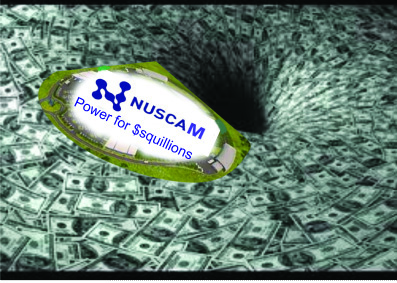
As of now, there are only two operational SMR plants in the world — located in Russia and China — and both have experienced cost blowouts and delays. NuScale claims approximately 680 issued and pending global patents. But the company does not have an operational SMR and the only revenue it generates comes from the reimbursement of specific R&D activities.
Considering Fluor’s plan to divest its NuScale stake and the apparent lack of substantial activity at Entra1, one could speculate that Standard Power and Entra1 were brought in primarily to pump NuScale’s stock, just like many other SPACs.
October 19, 2023 · by Iceberg Research
Main Findings
- NuScale, a developer of small modular nuclear reactors (SMR), recently disclosed a huge contract with blockchain datacenter service provider Standard Power. The deal aims for a projected capacity of 1,848 MWe that we estimate is worth ~$37bn. This contract has zero chance of being executed as Standard Power clearly does not have the means to support contracts of this size. Its managing director Adam Swickle was found guilty of securities fraud in the past. Entra1 — NuScale’s commercial partner — is expected to help with the funding. The company was created in 2021 and it is very unlikely to be able to finance even a portion of this contract.
- NuScale has a more credible contract with the Carbon Free Power Project (“CFPP”) for the Utah Associated Municipal Power Systems (“UAMPS”). CFPP participants have been supportive of the project despite contracted energy prices that never seem to stop rising, from $55/MWh in 2016, to $89/MWh at the start of this year. What many have missed is that NuScale has been given till around January 2024 to raise project commitments to 80% or 370 MWe, from the existing 26% or 120 MWe, or risk termination. Crucially, when the participants agreed to this timeline, they were assured refunds for project costs if it were terminated, which creates an incentive for them to drop out. We are three months to the deadline and subscriptions have not moved an inch.
- NuScale has around 15 months before its cash runs out. We fully expect further shareholder dilution, as completion of the CFPP remains an iffy prospect with its constant cost overruns. On 13 October 2023, former CFO Chris Colbert sold the last of his NuScale stake.
- We believe these commercial and financial struggles present hurdles NuScale won’t cross without continued support from the Department of Energy (“DOE”). This presents a double-edged sword. Even if that support continues, the DOE’s usual policy is that costs have to be shared with the private sector, meaning that existing shareholders will be diluted.
Presentation of NuScale
NuScale Power Corporation, based in Portland, Oregon, has been developing small modular nuclear reactors (“SMRs”) since 2007. In May 2022, the company went public through a merger with SPAC Spring Valley Acquisition Corp. NuScale’s market cap stands at ~$1.2bn. This valuation combines both Class A and Class B shares, which can’t be traded unless converted to Class A. Fluor Enterprises Inc, NuScale’s parent company, holds 126 million Class B shares that represent 55.8% of NuScale’s voting power.
SMRs have power capacities of up to 300 MWe per unit while conventional nuclear reactors generate around 1,000 MWe. For example, NuScale’s design is 77 MWe. These SMRs come with lower upfront costs because of their smaller size. But this benefit is offset by lower economies of scale compared to conventional reactors.
Over the last 16 years, NuScale has spent ~$1.6bn to develop its SMR tech, funded by a mix of SPAC money, government grants, and private investments. The Department of Energy (“DOE”) has contributed over $650m of grants to NuScale’s endeavors.
The company is going toe-to-toe with industry goliaths like Westinghouse, Rolls-Royce, EDF, etc. But it managed to snag the first-ever Standard Design Approval from the Nuclear Regulatory Commission in 2020 – a 12-module plant at 50 MWe each. However, in August 2023, the company decided to switch the blueprint – a six-plant design featuring an uprated 77 MWe. NuScale is now waiting for the new design’s approval, which would take ~24 months according to the company.
As of now, there are only two operational SMR plants in the world — located in Russia and China — and both have experienced cost blowouts and delays. NuScale claims approximately 680 issued and pending global patents. But the company does not have an operational SMR and the only revenue it generates comes from the reimbursement of specific R&D activities.
As for customers, NuScale has two significant contracts. The first is a 462 MWe agreement with the Utah Associated Municipal Power Systems (“UAMPS”), a consortium that supplies wholesale electricity to around 50 municipalities, priced at $9.3bn. The second is a 1,848 MWe deal that was recently signed with blockchain datacenter service provider Standard Power, with an estimated value of ~$37bn.
New client Standard Power: Crypto mixed with nuclear energy – What could possibly go wrong?
On 6 October 2023, NuScale’s stock popped over 20%, after the company announced its largest-ever contract, to deliver 24 units of 77 MWe modules in 2029. As part of this agreement, NuScale’s commercial partner Entra1 would develop, manage, own, and operate these SMRs, while blockchain datacenter service provider Standard Power would be the end-user.
The deal’s total projected output is 1,848 MWe, four times the size of NuScale’s existing agreement with its other major client UAMPS, and translates to a staggering $37bn financial commitment. Considering there are only two operational SMR plants globally, one in China and the other in Russia, this agreement not only marks a significant achievement for NuScale but also holds the distinction of being the largest SMR contract ever.
Unsurprisingly, the sell-side cheerleaders have applauded this deal…………………………….
Both Standard Power and Entra1 present obvious credit and performance risks.
1) Standard Power
Standard Power was formed in 2018 to provide data centre services for blockchain mining and high performance computing applications.
According to its LinkedIn page, the company operates with just 30 employees.
Searching the internet suggests that Standard Power’s most significant partnership to date was with Cipher Mining. In 2021, the company signed a hosting agreement with Cipher ‘to provide a total mining capacity of at least 200 MW’. This deal ultimately fell apart as the contract was terminated in February this year (see below on original).
In addition, Standard Power’s management team raises some serious red flags, especially when it comes to their managing director, Adam Swickle.
Swickle has a track record that screams “investor beware”. He cut his teeth at notorious Wall Street firms like Stratton Oakmont and Meyers Pollock & Robbins — both infamous for pump-and-dump schemes and ultimately shuttered due to regulatory crackdowns.
In 2003, the SEC went after Swickle for setting up a fake foreign exchange trading house and making off with investors’ cash. As the CEO of United Currency Group, from May 2001 to December 2002, he conducted a fraudulent offering of securities based on misleading info. This included the company’s plans for an IPO, Swickle’s own background, and how corporate funds would be used. …………………………………………………………………………..
Taking these factors into consideration, it appears that Standard Power does not have the balance sheet to support this contract, both in the present and in the future.
2) ENTRA1
NuScale portrays Entra1 as having a “strong global pipeline of energy production projects” and a ““one-stop-shop” for the financing, investment, development, execution, and management of NuScale-powered projects and opportunities”, suggesting that Entra1 will finance the Standard Power contract.
Entra1 was incorporated in Delaware in December 2021. But the firm has only one employee referenced on LinkedIn, its online presence is almost non-existent, its Twitter account is essentially a NuScale bulletin board, and its only announced deal is unsurprisingly, with NuScale.
At a recent Analyst/Investor Day event, it was disclosed that Wadie Habboush, the founder of Entra1, has a longstanding personal relationship with NuScale’s CEO, John Hopkins. Around 10 years ago, Habboush formed a joint venture with Fluor — NuScale’s controlling shareholder — for projects in the Middle East e.g., Iraq. We can’t see how experience working on Middle Eastern projects would be directly transferable to managing a $37bn mega-SMR project in the US.
Fluor, NuScale’s controlling shareholder, has been open about its intention to reduce its stake (55.8%) in the company. Its long-term plan is to own only 20%-25% of NuScale as per EVP Joseph Brennan on Fluor’s 3Q22 call. He further elaborated in 4Q22 that Fluor had “kicked off the strategic exercise” and the company would be in a better position to discuss that at the end of 1Q23. There were no updates on Fluor’s 2Q23 call.
Considering Fluor’s plan to divest its NuScale stake and the apparent lack of substantial activity at Entra1, one could speculate that Standard Power and Entra1 were brought in primarily to pump NuScale’s stock, just like many other SPACs.
We believe that the contract with Standard Power has zero chance of being executed. Announcing a deal with such counterparties damages the credibility of a company in an industry where public trust is paramount. We doubt established players like Westinghouse would deal with a questionable client like Standard Power.
The situation at the Carbon Free Power Project is much worse than what NuScale lets on
Unlike Standard Power, the Carbon Free Power Project (“CFPP”) started off as a sound counterparty. The project was launched in 2015 by the Utah Associated Municipal Power Systems (UAMPS), as part of its long-term strategy to reduce carbon emissions and replace outdated coal-fired plants. If completed, the Idaho Falls plant will begin generating power in 2029, and will deploy six, 77-MWe modules to generate 462 MW of electricity by 2030. Its development and construction is funded under a cost-share agreement between the DOE and UAMPS.
Originally, between 2016 and 2020, NuScale priced the power at $55/MWh. Then, the price was raised to $58/MWh when the project was downsized from 12 reactor modules to just six (924 MWe to 462 MWe). By December 2019, 35 UAMPS members had signed on for 200 MW of power. But escalating costs have caused these numbers to shrink. As of March this year, there were 26 participants, and subscriptions dropped to ~120 MW (see appendix for table), representing 26% of the project’s total capacity.
The shocker came in January this year when new cost estimates pushed that figure up by 53%, setting it at $89/MWh. NuScale attributed the significant increase to a 75% rise in estimated construction costs, from $5.3bn to $9.3bn, caused by factors such as commodity price inflation and higher interest rates. The actual cost would be much higher, if not for more than $4bn in subsidies the project expects to get from US taxpayers, according to the Institute for Energy Economics and Financial Analysis.
The good news for NuScale is that the participants extended their commitment and accepted the revised cost. On NuScale’s 1Q23 earnings call, CEO Hopkins stated, “Right now, we feel very comfortable with that $89 megawatt hour.”
What was generally overlooked in the press is that the agreement includes conditions that essentially kick the can down the road, and endanger the project. The extension (Pg 4) states that NuScale must raise subscription levels from its current 120 MWe (26% of total capacity) to 370 MWe (80% of total capacity), on the earlier of the combined license application (“COLA”) submission, or 1 February 2024. ……………………………………………..
UAMPS member Idaho Falls laid out the stakes at its council meeting (Pg 4) in February. If NuScale fails to meet the subscription target, and costs continue to go up, so does the risk of project termination………………………………….
Key to the extension is this condition: participants will be refunded their costs if the 80% threshold is not reached. Now, with this new clause, they have a strong financial incentive to withdraw if NuScale fails to meet the subscription target.
NuScale has around three months to the deadline but is nowhere near the 80%. In August 2023, the company told news outlet Power that “no changes have occurred since March”. At a September meeting of the Washington City power board, when asked about subscription progress, director Rick Hansen said (1:01:10-1:04:00) that “Not anybody that’s able to or willing to sign at this point.” He added. “We have lots of cheerleaders but not a lot of people that want to jump in the game at this point.” Interested parties want additional mechanisms to de-risk it, according to him. This suggests no one has signed on since March.
The contract that has lent NuScale credibility is hitting a wall. The company seems to echo this sentiment, based on recent language in its 10-Q, which now adds: “While it is reasonably possible we will be required to pay these amounts, no accrual has been recorded in our financial statements.”…………………
Specifically, NuScale had a capped financial obligation’ of $83.5m to UAMPS. As of the end of June, this looming liability was around $37m.
Even if the project continues, NuScale’s $89/MWh commitment adds further financial risk. The nuclear reactor industry has a notorious history of cost overruns and delays during the construction stage. NuScale has not built a SMR yet so there’s no reason to believe the company will defy industry norms. For equity holders, this is uncomfortable, as they will bear the brunt of these performance shortfalls and costs.
NuScale’s heavy cash burn will lead to shareholder dilution
NuScale’s financial position appears increasingly shaky under the uncertainty hanging over the CFPP. The company has around 15 months of cash, based on its end-June cash balance of ~$215m, and LTM operating cash flow of negative $167m. That runway could stretch to ~26 months if the company maxes out its $150m at-the-market equity line, announced on 9 August 2023. But this does not account for potential CFPP cost repayments………………
We fully expect further shareholder dilution. Completion of the CFPP remains an iffy prospect, and given NuScale’s track record with cost overruns, that seems almost inevitable.
Against this backdrop, we noted that former CFO Chris Colbert has been selling his shares since May 2023, fully unloading his stake on 13 October 2023 – reaping total gross proceeds of ~$1.7m over this period. This could be a leading indicator of NuScale’s unspoken issues. …………
Conclusion
NuScale’s delusional contract with Standard Power seems more like an act of desperation to shore up investor confidence, rather than a strategic move. The company is struggling and we believe its equity has little to no value without government support. Even if that support continues, the DOE’s usual policy is that costs have to be shared with the private sector, meaning that existing shareholders will be diluted.
Importantly, the DOE holds a non-exclusive worldwide license to NuScale’s intellectual property, according to financing agreements. This creates the possibility that the DOE could simply transfer this intellectual property to a more established player, if NuScale is unable to meet performance obligations. ……………………..
We are short NuScale……………………………
Appendix………….. https://iceberg-research.com/2023/10/19/nuscale-power-smr-a-fake-customer-and-a-major-contract-in-peril-cast-doubt-on-nuscales-viability/ #nuclear #antinuclear #nuclearfree #NoNukes
No comments yet.
1 This Month


Tell the Ukrainian Government to Drop Prosecution of Peace Activist Yurii Sheliazhenko

Petition to revoke the licensing of the Near Surface Nuclear Disposal Facility (NSDF) at Chalk River. https://www.ourcommons.ca/petitions/en/Petition/Details?Petition=e-7247


of the week – STOP SMALL MODULAR REACTORS IN CANADA
To see nuclear-related stories in greater depth and intensity – go to https://nuclearinformation.wordpress.com
-
Archives
- March 2026 (204)
- February 2026 (268)
- January 2026 (308)
- December 2025 (358)
- November 2025 (359)
- October 2025 (376)
- September 2025 (258)
- August 2025 (319)
- July 2025 (230)
- June 2025 (348)
- May 2025 (261)
- April 2025 (305)
-
Categories
- 1
- 1 NUCLEAR ISSUES
- business and costs
- climate change
- culture and arts
- ENERGY
- environment
- health
- history
- indigenous issues
- Legal
- marketing of nuclear
- media
- opposition to nuclear
- PERSONAL STORIES
- politics
- politics international
- Religion and ethics
- safety
- secrets,lies and civil liberties
- spinbuster
- technology
- Uranium
- wastes
- weapons and war
- Women
- 2 WORLD
- ACTION
- AFRICA
- Atrocities
- AUSTRALIA
- Christina's notes
- Christina's themes
- culture and arts
- Events
- Fuk 2022
- Fuk 2023
- Fukushima 2017
- Fukushima 2018
- fukushima 2019
- Fukushima 2020
- Fukushima 2021
- general
- global warming
- Humour (God we need it)
- Nuclear
- RARE EARTHS
- Reference
- resources – print
- Resources -audiovicual
- Weekly Newsletter
- World
- World Nuclear
- YouTube
-
RSS
Entries RSS
Comments RSS
 nuclear-news
Leave a comment