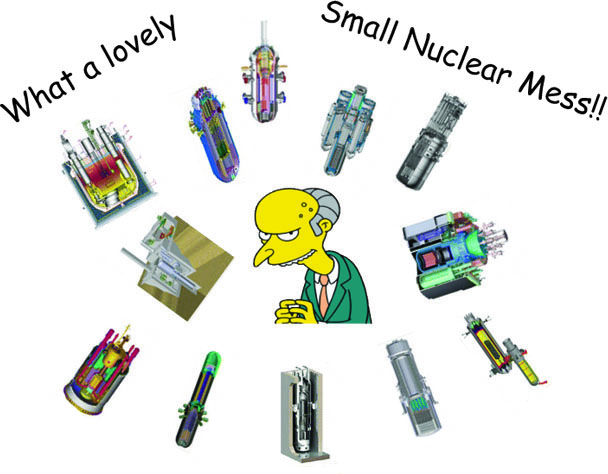
Why are Small Modular Nuclear Reactors a Dog’s Breakfast of Designs?
SMRs Information Task Force, 18 Oct 23 https://preview.mailerlite.com/i0i8d4u0o3/2327788063679321961/y8d5/
As of 2023 roughly 50 small modular reactor (SMR) designs are under development, with electrical generating capacity varying between 5 and 300 megawatts.
Compared to the current generation of larger nuclear reactors, SMRs would require smaller capital investments and provide options for deployment at remote locations with smaller power demands. But as reactor size goes down, unit cost goes up, as does the amount of radioactive waste per unit of electricity generated.
Different technology options attempt to address the concerns that plague the nuclear industry: safety, cost, radioactive waste, and weapons proliferation. However, designing for “passive safety”, opting for “waste recycling”, or providing “proliferation resistance” all involve trade-offs. With no clear “best” design, and no sizeable market, there is no justification for building a factory to mass-produce “modular” components to bring down costs.
SMR promoters have steered the debate away from these issues, arguing that all options for addressing climate change must be on the table. More SMR designs mean more opportunities to secure public subsidies.
The Government of Canada appears to have accepted the “all options” argument, and by funding multiple SMR designs is contributing to the illusion of profitability. Canada’s nuclear regulator, despite its limited capacity for technical assessment of SMR designs, has opted to boost them through largely inconsequential “vendor design reviews.”
| More than 80 years have passed since the first controlled, self-sustaining nuclear chain reaction. All proposed SMRs are essentially variations on older reactor designs that were tested decades ago and eventually abandoned. The World Nuclear Industry Status Report concludes that SMRs “will likely face major economic challenges and not be competitive on the electricity market.” #nuclear #antinuclear #nuclearfree #NoNukes |
1 Comment »
Leave a comment
1 This Month


Tell the Ukrainian Government to Drop Prosecution of Peace Activist Yurii Sheliazhenko

Petition to revoke the licensing of the Near Surface Nuclear Disposal Facility (NSDF) at Chalk River. https://www.ourcommons.ca/petitions/en/Petition/Details?Petition=e-7247


of the week – STOP SMALL MODULAR REACTORS IN CANADA
To see nuclear-related stories in greater depth and intensity – go to https://nuclearinformation.wordpress.com
-
Archives
- March 2026 (204)
- February 2026 (268)
- January 2026 (308)
- December 2025 (358)
- November 2025 (359)
- October 2025 (376)
- September 2025 (258)
- August 2025 (319)
- July 2025 (230)
- June 2025 (348)
- May 2025 (261)
- April 2025 (305)
-
Categories
- 1
- 1 NUCLEAR ISSUES
- business and costs
- climate change
- culture and arts
- ENERGY
- environment
- health
- history
- indigenous issues
- Legal
- marketing of nuclear
- media
- opposition to nuclear
- PERSONAL STORIES
- politics
- politics international
- Religion and ethics
- safety
- secrets,lies and civil liberties
- spinbuster
- technology
- Uranium
- wastes
- weapons and war
- Women
- 2 WORLD
- ACTION
- AFRICA
- Atrocities
- AUSTRALIA
- Christina's notes
- Christina's themes
- culture and arts
- Events
- Fuk 2022
- Fuk 2023
- Fukushima 2017
- Fukushima 2018
- fukushima 2019
- Fukushima 2020
- Fukushima 2021
- general
- global warming
- Humour (God we need it)
- Nuclear
- RARE EARTHS
- Reference
- resources – print
- Resources -audiovicual
- Weekly Newsletter
- World
- World Nuclear
- YouTube
-
RSS
Entries RSS
Comments RSS
 nuclear-news
Has everybody developed amnesia about nuclear safety? Has everybody forgotten about Fukishima, Cherynoble & Three Mile Island? All three of these accident sites are still dangerous, leaking and spreading radiation. Nuclear power is not safe. There is no longer term solution for the deadly, hazardous nuclear waste. Why is the liability of nuclear power plant operators limited by the Price-Anderson Act if it is so safe? SMR reactors are just the same. They are not cheap, not safe and totally unnecessary for our energy needs. They will do nothing to reduce the impact of global warming. SMR’s are “Fool’s Gold” for renewable energy” or “green energy.” Go to the Website of The Solutions Project if you still believe the propaganda of the nuclear industry that we need nuclear power or the lies of the centralized, for profit Electric Utilities or the dying, profit addicted fossil fuel companies.