Fukushima Up Close, 13 Years Later

After thirteen years, the declaration of a State of Emergency for Fukushima Daiichi Nuclear Power Plant still cannot be lifted because of many unknowns, as well as ubiquitous deadly radiation levels.
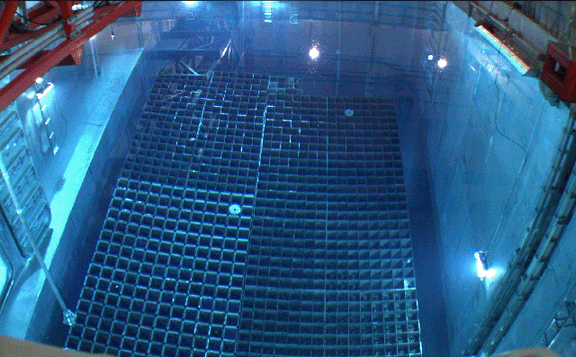
The spent fuel rods at the Fukushima nuclear reactor site are stored in pools of water on the top floor of compromised reactor buildings 100 feet above ground level……… “Continual storage in spent fuel pools is the most unsafe thing you could do.”
Fukushima Daichi Nuclear Power Plant will remain a high-risk explosive scenario for decades ahead.
CounterPunch BY ROBERT HUNZIKER 13 Oct 23
The world is turning to nuclear power as a solution to global warming, but it is postulated herein that it is a huge mistake that endangers society. One nuclear meltdown causes as much damage over the long-term as a major war. Moreover, according to Dr. Paul Dorfman, chair of the Nuclear Consulting Group, former secretary to the UK Scientific Advisory Committee on Internal Radiation: “It’s important to understand that nuclear is very likely to be a significant climate casualty.”
Also, of interest: France’s Global Warming Predicament discusses nuclear energy’s vulnerability in a global warming world.
Beyond Nuclear International recently published an article about the status of Fukushima as well as an exposé of how the nuclear industry gets away with responsibility for radiation-caused (1) deaths (2) chronic conditions like cancer (3) genetic deformities: A Strategy of Concealment, September 24, 2023, by Kolin Kobayashi, who is a Tokyo-born France-based anti-nuclear activist journalist also serving as president of Echo-Exchange. Kobayashi’s work was posted by CounterPunch under the title: How Agencies That Promote Nuclear Power Are Quietly Managing Its Disaster Narrative.
The following synopsis, including editorial license that adds important death details which defy the nuclear industry’s bogus claims about nuclear safety, opens closed pathways to what’s really going on.
After thirteen years, the declaration of a State of Emergency for Fukushima Daiichi Nuclear Power Plant still cannot be lifted because of many unknowns, as well as ubiquitous deadly radiation levels. The destroyed reactors are tinderboxes of highly radioactive spent fuel rods that contain more cesium-137 than eighty-five (85) Chernobyls. Cesium-137 in or near a human body erupts into a series of maladies, one after another in short order, depending upon level of exposure: (1) nausea (2) vomiting (3) diarrhea (4) bleeding (5) coma leading to death.
The spent fuel rods at the Fukushima nuclear reactor site are stored in pools of water on the top floor of compromised reactor buildings 100 feet above ground level, except for Unit 3 which completed removal of its spent fuel rods in 2019, an extremely slow, laborious process that’s highly dangerous.
Stored spent fuel rods in open pools of water are the epitome of high-risk. “If the 440 tonne vessel collapses, it could hit the storage pool next to it. If this pool is damaged, even partially, another major disaster could occur.” (Kobayashi) In that regard, there’s significant risk of collapse in the event of a strong earthquake. And Japan is one of the most earthquake prone countries in the world. “The city (Tokyo) government’s experts reckon there is a 70% chance of a magnitude 7, or higher, quake hitting the capital within the next 30 years.” (Source: Japan is Preparing for a Massive Earthquake, The Economist, August 31, 2023)
If exposed to open air, spent fuel rods erupt into a sizzling zirconium fire followed by massive radiation bursts of the most toxic material on the planet. It can upend an entire countryside and force evacuation of major cities. According to the widely recognized nuclear expert Paul Blanch: “Continual storage in spent fuel pools is the most unsafe thing you could do.” Paul Blanch, registered professional engineer, US Navy Reactor Operator & Instructor with 55 years of experience with nuclear engineering and regulatory agencies, is widely recognized as one of America’s leading experts on nuclear power.
Fukushima Daichi Nuclear Power Plant will remain a high-risk explosive scenario for decades ahead. After all, a program for future decommissioning is unclear and overall radiation guesstimates are formidable. All the structures where decommissioning will take place are highly radioactive and as such nearly impossible for the dangers to worker exposure.
TEPCO (Tokyo Electric Power Company) does not yet know the true extent of damage nor the complete dispersion of corium (molten magma from melted nuclear fuel rods in the core of the reactors). ……………………………………………………………………………..
Radiation Risks to Society
According to the World Nuclear Association, there were no fatalities due to radiation exposure at Fukushima. And as recently as 2021, Forbes magazine reported No one Died From Radiation At Fukushima: IAEA Boss. It is believed this is a lie and part of a massive coverup.
a lie and part of a massive coverup.
According to Green Cross (founded in 1993 by Mikhail Gorbachev, who repeatedly spoke out about interrelated threats humanity and our Earth confront from nuclear arms, chemical weapons, unsustainable development, and the human-induced decimation of the planet’s ecology): “Approximately 32 million people in Japan are affected by the radioactive fallout from the nuclear disaster in Fukushima… This includes people who were exposed to radiation and other stress factors resulting from the accident and who are consequently at potential risk from both long and short-term consequences… As with the Chernobyl nuclear accident, which impacted 10 million people, Japan is expected to see increased cancer risk and neuropsychological long-term health consequences.”
With nuclear radiation, the damage to humans shows up years later as cancer and/or deformity of newborns second/third generation. For example, only recently, the truth has come to surface about Chernobyl-related deaths, child deformities, and cancer 30+ years after the event. ………………………………………………………………
According to an article in USA Today d/d February 24, 2022, What Happened at Chernobyl? What to Know About Nuclear Disaster: “At least 28 people were killed by the disaster, but thousands more have died from cancer as a result of radiation that spread after the explosion and fire. The effects of radiation on the environment and humans is still being studied.”
According to Chernobyl Children International, 6,000 newborns are born every year in Ukraine with congenital heart defects called “Chernobyl Heart.”
…………………………………. The Fukushima Report was prepared under the direction of Prof. Jonathan M. Samet, Director of the Institute for Global Health at the University of Southern California (USC), as a Green Cross initiative. Green Cross International: GCI is an independent non-profit and nongovernmental organization founded in 1993 by Nobel Peace Laureate Mikhail Gorbachev.
Over time, Japan is expected to see increased cancer risks and neuropsychological long-term health consequences. “The lives of approximately 42 million people have been permanently affected by radioactive contamination caused by the accidents in the Chernobyl and Fukushima Daiichi nuclear power plants. Continued exposure to low-level radiation, entering the human body on a daily basis through food intake, is of particular consequence,”
Fukushima Deaths
The cocksure pro-nuclear crowd has trumpeted Fukushima as an example of Mother Nature taking lives because of an earthquake and tsunami; whereas the power plant accident proves nuclear power can withstand the worst without unnecessary death and illness. According to nuclear industry reports, all the deaths (16,000) were the fault of Mother Nature, not radiation.
But people in the streets and on the ground in Japan tell a different story about the risks of radiation. They talk about illnesses and death. TEPCO itself has reported few radiation illnesses and no radiation-caused deaths but what if it’s not their responsibility in the first instance, as layers of contractors and subcontractors employ workers to cleanup the toxic mess. If “subcontractor workers die” from radiation exposure, so what? It’s not TEPCO’s responsibility to report worker deaths of subcontractors, and the subcontractors are not motivated to report deaths, which are not reported.
According to credible sources in Japan, death is in the air, to wit: “The ashes of half a dozen unidentified laborers ended up at a Buddhist temple in this town just north of the crippled Fukushima nuclear plant. Some of the dead men had no papers, others left no emergency contacts. Their names could not be confirmed, and no family members had been tracked down to claim their remains. They were simply labeled ‘decontamination troops’ — unknown soldiers in Japan’s massive cleanup campaign to make Fukushima livable again five years after radiation poisoned the fertile countryside… Hideaki Kinoshita, a Buddhist monk… keeps the unidentified laborers’ ashes at his temple, in wooden boxes and wrapped in white cloth.” (Source: Mari Yamaguchi, Fukushima ‘Decontamination Troops’ Often Exploited, Shunned, AP & ABC News, Minamisoma, Japan, Mar 10, 2016)
……………………………………………………………………………………….Alas, two hundred U.S. sailors of the USS Ronald Reagan filed a lawsuit against TEPCO, claiming that they experienced leukemia, ulcers, gall bladder removals, brain cancer, brain tumors, testicular cancer, dysfunctional uterine bleeding, thyroid illness, stomach ailments and other complaints extremely unusual in such young adults. One sailor died from radiation complications. Among the plaintiffs was a sailor who was pregnant during the mission. Her baby was born with multiple genetic mutations.
The sailors that filed the suit participated in “Operation Tomodachi,” providing humanitarian relief after the March 11th, 2011 Fukushima disaster based upon assurances that radiation levels were okay. But that was a lie.
Ultimately, and unsurprisingly, the 9th U.S. Circuit Court of Appeals rejected the sailors’ appeal.
In summation, the final word is left to Kolin Kobaryashi: “The international nuclear lobby, which represents only a minority, has the influence and money to dominate the world’s population with immense power and has now united the world’s minority nuclear community into one big galaxy.
Many of the citizens who have experienced the world’s three most serious civil nuclear accidents have clearly realized that nuclear energy is too dangerous. These citizens are so divided and conflicted that they feel like a helpless minority.”…………………….
“Five former Japanese prime ministers issued declarations that Japan should break with nuclear power generation on March 11, the 10th anniversary of the Great East Japan Earthquake and tsunami that triggered a nuclear disaster in Fukushima Prefecture (Source: Ex-Prime Ministers Koizumi and Kan Demand EU Choose Zero Nuclear Power Path, The Japan Times, Jan. 27, 2022)………………………………………..more https://www.counterpunch.org/2023/10/13/fukushima-up-close-13-years-later/
1 Comment »
Leave a comment
1 This Month

of the week – Shut Down Drone Warfare!


Tell the Ukrainian Government to Drop Prosecution of Peace Activist Yurii Sheliazhenko

Petition to revoke the licensing of the Near Surface Nuclear Disposal Facility (NSDF) at Chalk River. https://www.ourcommons.ca/petitions/en/Petition/Details?Petition=e-7247
To see nuclear-related stories in greater depth and intensity – go to https://nuclearinformation.wordpress.com
-
Archives
- April 2026 (91)
- March 2026 (251)
- February 2026 (268)
- January 2026 (308)
- December 2025 (358)
- November 2025 (359)
- October 2025 (376)
- September 2025 (257)
- August 2025 (319)
- July 2025 (230)
- June 2025 (348)
- May 2025 (261)
-
Categories
- 1
- 1 NUCLEAR ISSUES
- business and costs
- climate change
- culture and arts
- ENERGY
- environment
- health
- history
- indigenous issues
- Legal
- marketing of nuclear
- media
- opposition to nuclear
- PERSONAL STORIES
- politics
- politics international
- Religion and ethics
- safety
- secrets,lies and civil liberties
- spinbuster
- technology
- Uranium
- wastes
- weapons and war
- Women
- 2 WORLD
- ACTION
- AFRICA
- Atrocities
- AUSTRALIA
- Christina's notes
- Christina's themes
- culture and arts
- Events
- Fuk 2022
- Fuk 2023
- Fukushima 2017
- Fukushima 2018
- fukushima 2019
- Fukushima 2020
- Fukushima 2021
- general
- global warming
- Humour (God we need it)
- Nuclear
- RARE EARTHS
- Reference
- resources – print
- Resources -audiovicual
- Weekly Newsletter
- World
- World Nuclear
- YouTube
-
RSS
Entries RSS
Comments RSS
 nuclear-news
This is the best article I have seen in a long time, and proves that the Fukushima disaster is much worse the Chernobyl.