Journalism Itself Is Locked Up In Belmarsh
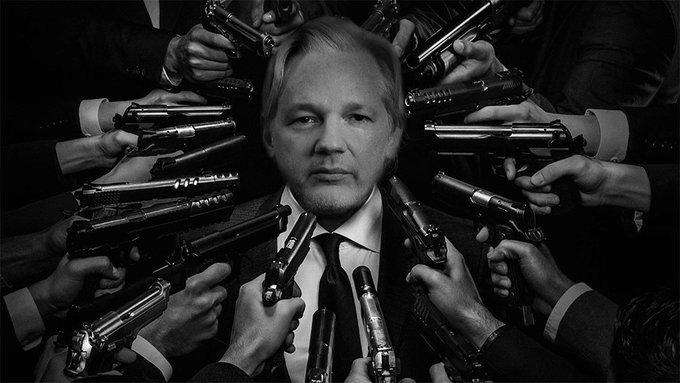
they are showing the world that they can lock up anyone.
That’s what this case has always been about.
It’s about setting a legal precedent that will allow the US empire to extradite anyone anywhere in the world who reveals inconvenient facts about it.
CAITLIN JOHNSTONE, OCT 5, 2023 https://www.caitlinjohnst.one/p/journalism-itself-is-locked-up-in?utm_source=post-email-title&publication_id=82124&post_id=137688774&utm_campaign=email-post-title&isFreemail=true&r=1ise1&utm_medium=email #JulianAssange
As the 17th anniversary of the creation of WikiLeaks passes us by, it’s probably worth taking a moment to reflect on Julian Assange and what his persecution means for us and our society.
Because in a very real sense, it’s not just a man locked up in Belmarsh Prison for the crime of good journalism — it’s journalism itself. It’s the idea that anyone should be permitted to expose the criminality of the world’s most powerful and tyrannical people. It’s the idea that the public should be allowed to know what abuses the US empire is committing around the world.
Julian Assange is the world’s greatest journalist. By revolutionizing source protection for the digital age with the creation of WikiLeaks 17 years ago and then going on to break some of the biggest stories of the 21st century, Assange set himself head and shoulders above any other living reporter anywhere on earth. And by showing the world that they can lock up the world’s greatest journalist for revealing inconvenient truths, they are showing the world that they can lock up anyone.
That’s what this case has always been about. It’s not about whether Assange crossed some arbitrary procedural line when working with Chelsea Manning to expose US war crimes. It’s not about the US protecting its national security. It’s not about any of the other justifications people have put forward to excuse their sycophantic support for the persecution of a journalist for doing journalism. It’s about setting a legal precedent that will allow the US empire to extradite anyone anywhere in the world who reveals inconvenient facts about it. It’s about showing all journalists everywhere that if they can do it to the greatest among them, they can do it to any of them. And, like so much else in the world today, it’s about narrative control.
To accept the persecution of Julian Assange is to accept the idea that all media everywhere must function as propaganda organs of the US government. It’s to take it as a given that any journalist anywhere in the world who decides to do real journalism and expose inconvenient facts about the powerful in the public interest should be jailed until they can be extradited to the United States for a show trial, and then left to rot in one of the most draconian prison systems on the planet. It’s to accept that we will never live in a truth-based society guided by facts and information, and must forever resign ourselves to living in a society dominated by the whims of the powerful.
Your position on the Assange case is therefore your position on what kind of society we should hope to live in, and what kind of future we should hope to have. In a very real way, it’s your position on humanity itself.
Should humanity try to create a better world, or should we keep plunging into dystopia until we are driven into nuclear war or environmental catastrophe by rulers we are forbidden to question? Do we want to move into the light, or into the darkness? Your position on Assange shows your answer to these questions, and shows which course you want us to take.
Depleted Ukrainium: What Comes After Failure?

public support for the war—and here and here official support—ever more visibly wobbles and wanes……… And those running the war in Ukraine are slowly but surely losing on this side of the conflict.
October 5, 2023, By Patrick Lawrence / Original to ScheerPost #Ukraine
ou cannot name the last time you read anything about a parliamentary election in Slovakia, so I won’t bother asking. But you are reading about one this week, assuming you still follow mainstream media—if only to understand what you are supposed to think about one or another event, as against what has actually occurred.
In results announced in Bratislava Sunday, a leftist party whose primary platform plank is opposition to the war in Ukraine won 23 percent of the vote. On Monday the Slovakian president, Zuzana Čaputová, formally asked Robert Fico, who leads the SMER party, to form a government. It looks like he will do so in a coalition with either Voice, a social-democratic party that took 15 percent of the vote, or with Progressive Slovakia, a liberal-centrist party that finished with 18 percent of the vote.
Fico is an interesting figure. He has served as prime minister twice over the course of a decade, during which time he proved sufficiently European to bring Slovakia into the euro. To one or another extent, his likely coalition partners favor keeping Slovakia as a card-carrying member of the Western coalition supporting Ukraine. But they did not win the election: Fico did.
And Fico is all business in his opposition to Slovakia’s support for the U.S. proxy war tearing Ukraine and its people to pieces.
SMER’s platform assigns the West and Ukraine equal responsibility for the war—a purposeful rip into the “unprovoked” charade—and promises an immediate end to all Slovakian arms shipments to the war effort. Speaking after the election results were announced, Fico pointedly pledged to press Kiev and its backers to begin peace talks with Moscow. “More killing is not going to help anyone,” he declared.
There are two things to say about Robert Fico’s return to the top of Slovakian politics. One, we find once again that the U.S. is a victim of its old, Manichean habit of dividing the whole of humanity into good guys and bad guys. The headline on CNN’s report on the elections reads, “Pro–Russian politician wins Slovakia’s parliamentary election.” The New York Times head is, “Unease in the West as Slovakia Appears Set to Join the Putin Sympathizers.”
Tell me, which of these is more pathetic? “Pro–Russian?” “Putin sympathizers?” This is infantile—apart from being false, I mean. Fico simply articulates an independent, perfectly sound position on the war. CNN and The Times are infantilizing their viewers and readers as they reduce this position to the simplistic binary of a Saturday-morning cartoon. The insidious thing here, and let us be ever vigilant on this point, is that these media are inserting into our brains the thought that any deviation from the Russophobic orthodoxy amounts to support for the Kremlin’s demonized occupant.
Two, “unease” is too mild a word for the reigning sentiment among the war-mongering elites in Washington and the European capitals. An incipient panic is closer to the reality as public support for the war—and here and here official support—ever more visibly wobbles and wanes. The first front in any war is the home front, where it is imperative the battle is won. And those running the war in Ukraine are slowly but surely losing on this side of the conflict.
They are losing it on the ground in Ukraine, too, it is now more or less obvious. Our question becomes: Where will the powers that instigated this war and invested heavily in it turn next? As I argued soon after the Russian intervention began in February 2022, this conflict was probably conceived as the Washington neoconservatives’ shoot-the-moon moment, its all-out play to take down the Russian Federation. What happens now, as the neocons lose this round of Hearts and the game as they have played it is over?
To my great relief, the blue-and-yellow flags that disfigured the American landscape in the early months of the war are now mostly gone. More than half of Americans polled agree with Robert Fico: No more military aid and weapons to Ukraine. This percentage is headed in only one direction from here on out.
Volodymyr Zelensky’s swing through North America beginning with his attendance at this year’s General Assembly last month, went pretty badly. At the GA, he did not make any headway persuading the global majority opposed to the war to come over to his side. His reception in Washington was… what is the best word?… muted? House Republicans, many of whom oppose more military aid, refused to meet him. When, over the weekend, Speaker Kevin McCarthy finally pushed through a bill to keep the government funded, he had to strip out a provision authorizing another tranche of weapons funding.
The mood elsewhere appears to be no brighter. That astonishing debacle in the Canadian Parliament—presenting an old SS man as a hero because he fought the Soviets?—cannot have done Zelensky’s constituency in Canada any good. Across the pond there are signs of impatience as roughly eight million Ukrainian refugees settle in Europe, displaying little interest—and who can blame them?—in going home when the war is over. War or no, solidarity or no, the Poles have blocked imports of cheap Ukrainian wheat. There are signs of buyer’s remorse among the Finns a matter of months after their impulsive decision to join NATO. And now the Slovakians and their new leader’s alarming display of political and intellectual independence.
However these matters may stand as you read this commentary, the trends here outlined are destined to accelerate in coming months. The Ukrainians’ long-touted counteroffensive, a major prop in the campaign to maintain public support for the war, is touted no more. It is well on the way to taking its place next to the 2007 “surge” in Iraq. Remember that? Of course you don’t. And you won’t remember the counteroffensive any more distinctly in, I would say, a year’s time.
Not even The New York Times pretends any longer that the front line in eastern Ukraine has budged more than a matter of meters the whole of this year. And this is before the harsh winter weather begins. At that point, stasis will be the best the Ukrainians can hope for. All this autumn and all winter, the Russians are likely to continue their rolling volleys of rockets, missiles, and artillery shells to the point most of Ukraine east of Kiev resembles Ypres or the Somme in 1918.
Let us look ahead to next spring, then. The Ukrainian front will have sustained another winter’s deterioration, and popular discontent among Europeans is likely to have sharpened. It will be considerably harder to pretend that the Kiev regime can win the war or, indeed, that it makes any sense to continue it. And Joe Biden will be looking at an election in seven or so months.
At that point, what? ………………………………………………………………………………………………………………………………. more https://scheerpost.com/2023/10/05/patrick-lawrence-depleted-ukrainium/
5 animal species that became radioactive after being exposed to nuclear fallout zones

Scientists believe that the long-term effects of radiation in the macaque population may have contributed to smaller heads, smaller brains, delayed growth, and anemia.
Business Insider Elias Chavez , Oct 7, 2023, #nuclear #antinuclear #nuclear-free #NoNukes
- The impact of nuclear disasters throughout history can still be seen in the environment today.
- Animals in areas near nuclear disasters are being found with radiation still in their bodies.
- Nuclear fallout spreads and impacts communities and environments near and far.
Long after the events of Chernobyl and Fukushima, their impacts are still being felt.
The animals near major nuclear events and nuclear testing sites, like Enewetak Atoll, were discovered to have radioactive elements in their bodies immediately after. But even decades later, animals near and far are still being found to have radioactive elements in their body due to the contamination of food sources.
Enewetak Atoll was the site of intense nuclear testing by the US military.
Between 1948 and 1958, the US conducted 43 nuclear tests at Enewetak Atoll, including the first test of the hydrogen bomb. Because of the nuclear testing, the lagoon surrounding the chain of islands became irradiated, as well as the sand and soil on the islands.
In 1972, the US spent $100 million in an effort to clean up the area. Clean-up crews mixed 80,000 cubic meters of contaminated soil and debris with cement that they poured into a blast crater that was 30 feet deep and 360 feet wide.
Afterward, the clean-up team constructed a dome made of 358 concrete panels to cover the radioactive material.
Sea turtles in the area by Enewetak Atoll have been found to have traces of radiation in their shells.

After the cleanup at Enewetak Atoll, turtles were found with radiation in the layers of their shells. The leading theory is that the clean-up efforts disrupted radioactive sediment in the lagoon near Enewetak Atoll and the turtles swallowed the sediment.
Chernobyl was a nuclear meltdown event in 1986, and its impacts are still being felt today.
On April 26, 1986, one of the reactors at the Chernobyl Nuclear Power Plant went out of control during a test at low power. The result was an explosion and a fire that released over 100 radioactive elements into the atmosphere.
Additionally, the uranium fuel melted through protective barriers and the absence of a protective concrete dome led to the release of radioactive elements like plutonium, iodine, strontium, and cesium……………………
Wild boars in Bavaria, Germany, are still being found with radioactive elements in their bodies.

Boars forage for mushrooms and truffles which feed off nutrients in the soil.
When nuclear tests are done, nuclear elements swell into the sky, get carried by the wind, and settle onto the ground. As mushrooms grow, they absorb radiation from that nuclear fallout from the ground.
Wild boars in Bavaria have been found to have 15,000 becquerels of radiation for every kilogram of meat. The European safety limit is 600 becquerels per kilogram.
The packs of wild dogs surrounding Chernobyl have also been impacted by the meltdown.
Over 700 dogs living near Chernobyl are believed to be descendants of the dogs left behind by people who evacuated the area after the meltdown.
Researchers have been studying mutations in the dog’s genomes and DNA as well as measuring the radiation in their bones. The dogs in Chernobyl live much shorter lives than the average dog with a lifespan of three to four years, compared to the average 10 to 12.
Reindeer as far away as Norway have also been impacted by the meltdown at Chernobyl.
Nuclear sediment from Chernobyl was carried by the wind up to Norway where it fell into the soil in rain droplets. The radiated elements were absorbed from the soil by moss and fungus.
Reindeer in the area would feed on the moss and fungus. Immediately after the fallout, they could be found with levels of more than 100,000 becquerels per kilogram.
Current radiation levels in reindeer are now below safety standards, but every now and then spikes are seen in reindeer meat that exceed 2,000 becquerels.
The 2011 Fukushima Daiichi Nuclear Power Plant disaster resulted in the evacuation of thousands and is the second-worst nuclear disaster in history……………………………………..
The Japanese macaques, also known as snow monkeys, were found to have increased levels of radiation after the Fukushima disaster.
Immediately after the Fukushima disaster, macaques were found with levels of concentrated cesium up to 13,500 becquerels per kilogram.
Because of their diet of mushrooms, tree bark, and bamboo — all food sources that absorb radioactive cesium from the ground — the macaques were more likely to be found with radioactive elements in them.
Scientists believe that the long-term effects of radiation in the macaque population may have contributed to smaller heads, smaller brains, delayed growth, and anemia.
#Ukraine ‘very cheap way’ to fight Russia, NATO state claims

“It is very much in our interest to support Ukraine, because they are fighting this war, we are not fighting it,”
https://www.rt.com/news/584053-dutch-nato-ukraine-cheap/ 6 Oct 23
The Dutch defense minister made a case for funding Kiev at a conference in Poland
Arming Kiev is a cost-effective way of preventing Moscow from threatening NATO, Dutch Defense Minister Kajsa Ollongren said on Wednesday at the Warsaw Security Forum.
Ollongren was asked whether the US and its allies can continue supporting Ukraine “for as long as it takes,” given the political in-fighting in Washington.
“We cannot pretend that we’ll just wait and see how the American elections are going,” she said. “Because they have the same interest, in a way. Of course, supporting Ukraine is a very cheap way to make sure that Russia with this regime is not a threat to the NATO alliance. And it’s vital to continue that support.”
“It is very much in our interest to support Ukraine, because they are fighting this war, we are not fighting it,” Ollongren noted, while admitting that NATO has “skin in the game.”
Ollongren explained that she had recently visited the US and that political developments there are cause for concern, but that Western Europeans need to talk with their American colleagues and persuade them to stay the course.
“I think that we are capable of a lot, and we have proven that in the past year and a half, and the only thing we have to do is keep it up,” the minister said, adding that the scale of military assistance to Kiev has surprised Ukraine, Russia, and even NATO itself.
The US and its allies have channeled a large amount of money, weapons, ammunition, and supplies to Ukraine since the conflict with Russia escalated in February 2022.
EU foreign policy chief Josep Borrell revealed earlier this week that the bloc has sent Ukraine €85 billion ($89.8 billion) so far, of which more than €25 billion was military aid.
The most recent estimates of US spending were from the end of July, and amounted to $46.6 billion in military aid, $3.9 billion in humanitarian aid, and $26.4 billion in loans and cash payments to keep the government in Kiev going.
Moscow has repeatedly warned that the deliveries of heavy weapons and other aid are tantamount to direct involvement in the hostilities. Washington and Brussels, however, insist they are not actually a party to the conflict. Russia has said that foreign weapons will not change the course of the fighting and will not deter Moscow from achieving its goals in Ukraine.
Russian officials have cited NATO’s expansion eastward as one of the root causes of its conflict with Ukraine and the standoff with the West.
Groups Demand DOE Environmental Impact Statement Before Agency Bails Out Palisades Zombie Reactor Restart

Beyond Nuclear, September 20, 2023 #nuclear #antinuclear #nuclear-free #NoNukes
| NEPA Requires “Major Federal Project” Hard Look, Groups Assert |
| Covert Township, MI and Washington, DC, September 20, 2023– Legal counsel for Beyond Nuclear, Don’t Waste Michigan, and Michigan Safe Energy Future, have written the Energy Secretary and the Loan Programs Office director at the U.S. Department of Energy (DOE), demanding National Environmental Policy Act (NEPA) compliance before DOE awards Holtec International a requested $1 billion risk- and interest-free nuclear loan guarantee, backed by U.S. taxpayer dollars. The billion dollar federal loan, which Holtec does not have to pay back, is the linchpin in Holtec’s reactor restart scheme, also backed by Michigan’s governor, Gretchen Whitmer, as well as the state legislature. The State of Michigan has already gifted Holtec with $150 million towards the restart, although Holtec requested twice that. The state handout is contingent on the much larger federal bailout. A Power Purchase Agreement was just announced between Holtec and rural electric co-ops in Michigan (Wolverine) and Indiana (Hoosier), although how far above market rates the co-ops’ members will be forced to pay, and for how long, has not been publicly disclosed. Citing the largesse provided by the public (which most taxpayers and ratepayers are not even aware of, let alone consent to), Holtec is pressuring the U.S. Nuclear Regulatory Commission to simply reverse legally-binding, permanent shutdown filings from June 2022. |
A coalition of hundreds of environmental groups, including more than fifty groups in Michigan, have written Energy Secretary Jennifer Granholm — herself a former governor and attorney general of the State of Michigan — several times in the past year, urging Holtec’s requests for federal bailouts to restart Palisades be rejected.
Toledo, Ohio-based attorney Terry Lodge, and Cedar Rapids, Iowa-based attorney Wally Taylor, serve as legal co-counsel for the environmental groups. They provided DOE with a litany of pathways to catastrophic reactor core meltdown at Palisades, which Energy Secretary Granholm and Loan Programs Office Director Shah have been asked by Holtec to bankroll. The severe safety risks include: the most neutron radiation-embrittled reactor pressure vessel in the country, at risk of pressurized thermal shock through-wall fracture; a reactor vessel closure head in need of replacement for more than two decades; steam generators in need of replacement for more than two decades, as well; and the worst control rod drive mechanism seal leaks in industry.
There is no indication that, even with $1.15 billion, or more, in federal and state subsidies, Holtec will fix any of those severe safety problems before restarting the long problem-plagued reactor.
Lodge and Taylor also pointed out that restarting Palisades’ more than half-century old reactor would lead to the generation of another 20 metric tons per year of highly radioactive irradiated nuclear fuel. The high-level radioactive waste stored on-site since 1971 already poses its own severe risks, including violating NRC earthquake safety regulations. Palisades’ dry cask storage is perched on the very edge of Lake Michigan, a major headwaters of the entire Great Lakes, 84% of North America’s surface fresh water, and drinking water supply to 40 million people in eight U.S. states, two Canadian provinces, and a very large number of Indigenous Nations……………………………………………. more https://beyondnuclear.org/groups-demand-doe-eis-before-bailing-out-palisades-zombie-reactor-restart/?fbclid=IwAR1qlrC0heccGG150YGtyT3F1-38m4p2TVIz0ITiuFOK0Pi-qpjc6VNUrDM
Reconciling With Truth Requires Listening… what about nuclear waste?
September 30, 2023 https://mailchi.mp/preventcancernow/reconciling-with-truth-requires-listening?e=ba8ce79145 #nuclear #antinuclear #nuclear-free #NoNukes
As Canadians look back and Remember the Children who suffered at residential schools, we wish to highlight Algonquin First Nations’ important work to protect the health of children, and the Kitchi Sibi (Ottawa) River watershed from pollution.
The First Nations oppose a hillside nuclear waste Near-Surface Disposal Facility (NSDF) proposed on unceded Algonquin territory at the Chalk River Nuclear Laboratories. In a remarkable turn of events, rainfall during the final hearing on the NSDF demonstrated that the Canadian Nuclear Safety Commission (CNSC) is unlikely to meet its goal to keep nuclear waste secure for hundreds of years.
At Chalk River Nuclear Laboratories scientists first worked on the atomic bomb in the 1940s; ongoing nuclear research ever since has resulted in voluminous waste, that will remain toxic longer than planning horizons. People oppose transportation of nuclear waste through their communities, so the CNSC concluded that it had to deal with waste onsite. A federal Environmental Impact Statement (EIS) was published for a nuclear waste NSDF.
Disturbingly, assessment of the natural environment is absent from the federal EIS, so the Algonquin First Nations retained experts and published Assessment of the CNSC NSDF and Legacy Contamination in June 2023.
The federal assessment found that the top risk for stability of hillside waste disposal was severe rainfall. Too much rain could sweep the nuclear waste down the hill and into Perch Lake, polluting Perch Creek and the Kitchi Sibi River a kilometre away. This could pollute the ecosystem and food sources, as well as drinking water for millions of people downstream in smaller towns, Ottawa and cities.
On Aug. 10, 2023, at the sacred site where the Rideau, Kitchi Sibi and Gatineau rivers tumble together, Chiefs of Kebaowek, Kitigan Zibi Anishinabeg and Mitchibikonik Inik First Nations, Elders and other experts, made final submissions to the CNSC. As witnesses spoke, attendees heard a roar of rain drumming on the roof.
This rain flooded Ottawa streets and basements, stopped traffic, took out power, and backed up sewers. Five centimetres of rain fell in an hour, and more than 300 million litres of untreated water flowed into the Ottawa River.
The EIS vastly under-estimates future weather severity, defining “heavy rainfall” as over only 0.7 cm per hour. The EIS also cites a 2013 estimate of low tornado risks—an insult to fresh memories of catastrophic tornadoes and derechos in Eastern Ontario.
The acceleration of climate disasters is boggling Canada’s long-term predictions of the scale of extreme weather. The nuclear waste disposal facility was designed to withstand end-of-the-century estimates of less than five cm of precipitation in a day for Deep River, and over five cm in a day—not an hour—for Ottawa.
Ottawa’s not alone in breaking rainfall records and disproving future estimates. July 2023 brought rainfall disasters to Nova Scotia, with rainfall up to 50 cm per hour measured in one location. Much of the province experienced 20 cm in a day, causing widespread damage. Canadian federal climate predictions call for much less—up to 9 cm in a day by the end of the century.
If an Environmental Impact Assessment for a bridge was discovered to be this flawed—that the bridge would not withstand a storm as severe as what just occurred—it would be a good reason to reconsider the plans. The Canadian Nuclear Safety Commission should heed the warning from Mother Nature and deny the present proposal.
2
At nuclear power plants around the Pacific, radioactive wastewater is being dumped.
https://www.samuellawrencefoundation.org/ 6 Oct 23 #nuclear #antinuclear #nuclear-free #NoNukes
Timothy Mousseau, Ph.D.
Professor of Biological Sciences, University of South Carolina, Bob H. Richmond, Ph.D.
Director of the Kewalo Marine Laboratory, University of Hawaii Lance Gould | MODERATING
Founder & CEO, Brooklyn
The recent dumping of 250,000 gallons of radioactive wastewater from Fukushima has garnered global outcry about the effects of adding radioactivity to our ecosystem. Scientists expressed outrage and concern for the lack of adequate analysis and study prior to this first batch of radioactive contamination released into the global community’s Pacific Ocean.
But this problem extends far beyond Japan. NY Governor Hochul implemented legislation in response to ongoing dumping into the Hudson River. Radioactive wastewater is being released regularly just off our own California coast at San Onofre.
Tune in to learn about the consequences of radioactive exposures studied by University of South Carolina Professor of Biological Sciences, Timothy Mousseau, PhD, and learn more about the effects of exposures to radionuclides such as tritium and others.
“There’s a very clear link between the health of our oceans and the health of people,” says University of Hawaii Marine Biology Professor, Robert Richmond, PhD. “Human health and environmental health are tied together.”
This live discussion is part of the Samuel Lawrence Foundation’s First Friday Webinar Series. Moderated by Brooklyn Story Lab CEO Lance Gould.
NRC Commissioners Fail to Take Action on Critical Safety Issue at Diablo Canyon
San Luis Obispo, CA, October 4, 2023 https://mothersforpeace.org/nrc-commissioners-fail-to-take-action-on-critical-safety-issue-at-diablo-canyon/?fbclid=IwAR1A_L1NhvPiZW4tMjfCTfu-4Ov7duSTtEOyamayx97DjaRb4fGQ7UGVjZI #nuclear #antinuclear #nuclear-free #NoNukes
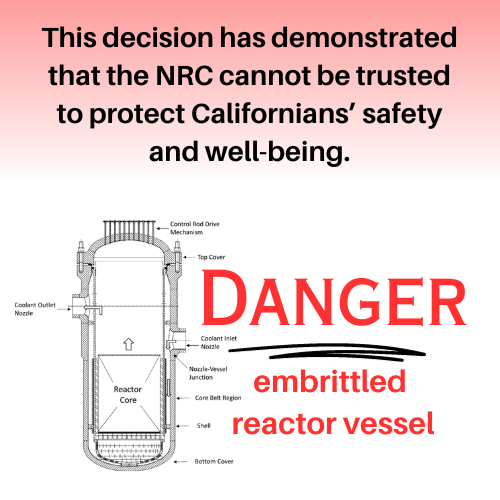
— San Luis Obispo Mothers for Peace (MFP) and Friends of the Earth (FoE) today deplored a decision of the Commissioners of the Nuclear Regulatory Commission (NRC) for demonstrating a complete lack of concern for the safety and security of the people living near the Diablo Canyon Nuclear Power Plant.
Disregarding expert evidence presented by MFP and FoE that the Diablo Canyon Unit 1 pressure vessel is at risk of dangerous embrittlement due to decades of neglect by Pacific Gas and Electric Co. (PG&E) and lax oversight by the NRC technical staff, the Commissioners refused to grant the groups’ hearing request or to order the immediate shutdown of the reactor for comprehensive testing of the reactor vessel’s condition.
Instead, the Commissioners bucked the groups’ shutdown request back to the agency’s technical staff to consider whether to take enforcement action against PG&E.
“We are appalled that the Commissioners are entrusting this important safety review to the same agency staff who for fifteen years has given PG&E repeated extensions of deadlines for essential tests and inspections,” said Diane Curran, attorney for MFP. Curran noted that the groups had intentionally petitioned the Commissioners, as the highest officers of the NRC, to exercise their legal responsibility for oversight of the technical staff.
Nevertheless, the groups vowed to persevere. Hallie Templeton, Legal Director for FoE, said, “We plan to continue our rigorous watchdogging of PG&E and the NRC.” She added, “The Commissioners’ decision has raised a red flag to all of us. Anyone, including California politicians, who thinks the safety of Diablo Canyon can be entrusted to the federal government unquestioningly has just received a big wakeup call.”
Linda Seeley, spokesperson for MFP, renewed the group’s call to the State of California to “go back to the original plan to close Diablo Canyon when it reaches its 40-year operating license limit in 2024 (Unit 1) and 2025 (Unit 2). Enough is enough.”
Ex-EU boss says #Ukraine too corrupt to join

https://www.rt.com/news/584082-jean-claude-juncker-ukraine-corrupt-eu-membership/ 5 Oct 23
The European Commission ex-president warned against making unrealistic promises to Kiev amid reports of upcoming membership talks
Deep-rooted and widespread corruption means that Ukraine will not be able to join the European Union any time soon, former President of the European Commission Jean-Claude Juncker has said. In addition, earlier this week, Politico reported that the US government is putting pressure on Kiev to combat graft more effectively.
In an interview with Germany’s Augsburger Allgemeine newspaper published on Thursday, Juncker warned that Brussels “should not make any false promises to the people in Ukraine who are up to their neck in suffering.” He criticized those within the EU “who are leading the Ukrainians to believe that they could become a member state immediately.” According to the former official, such a scenario would be detrimental to the bloc and Ukraine.
“Those who have dealt with Ukraine know that this is a country that is corrupt at all levels of society,” Juncker charged. He noted that the Eastern European nation would first need to conduct “massive” reforms.
The former president of the European Commission spoke in favor of “partial accession” for aspiring nations, which would allow them access to some of the benefits of European integration, provided that they made progress on the path of reform.
Juncker’s warning came shortly after Politico, citing anonymous diplomats, reported that the incumbent EU leadership would formally announce the start of membership talks with Ukraine as early as December.
Meanwhile, earlier this week, the same outlet claimed to have seen the “sensitive but not classified” version of the US State Department’s ‘Integrated Country Strategy’ for Ukraine. In it, American officials allegedly warned leadership in Kiev that “perceptions of high-level corruption” could “undermine the Ukrainian public’s and foreign leaders’ confidence in the war-time government.”
According to Politico’s sources, US President Joe Biden’s administration is pressing Ukraine to step up its existing anti-graft efforts. However, it is doing so quietly to avoid handing political ammunition to Republicans who want to withhold American aid to Kiev over corruption concerns.
The Biden administration has reportedly clarified that future economic aid could be tied to reforms that “make Ukraine a more attractive place for private investment.”
On Monday, Ukrainian MP Yaroslav Zheleznyak alleged that his country had been given a “yellow card” for corruption by the US.
Ukraine has for years been ranked as one of the most corrupt countries in Europe. According to Transparency International’s Corruption Perception Index, as of 2022, the country ranked 116th out of 180.
 |
Is #nuclear energy feasible in Australia (and how much would it cost)?

What problem is nuclear trying to provide a solution for, asks Ernst & Young climate change and sustainability partner Emma Herd. “If it’s cost of living, it’s expensive. If there are challenges with social licence for renewables then nuclear has got 10 times more social licence problems. If it is the need to rapidly deploy low-emissions energy technology to replace coal then nuclear takes a long time to get approval for, let alone to build, let alone to get up and operating. If it’s the need for rapid decarbonisation, again, it’s too slow.”
Debate has erupted over nuclear energy’s role in Australia’s shift from fossil fuels. Could it work? And why is it so controversial?
SMH, By Mike Foley, OCTOBER 7, 2023
Australia is in the middle of an unprecedented energy revolution, switching from the fossil fuel-powered electricity grid that’s been the bedrock of the nation’s economy for decades to clean energy, through a rush of renewables as wind and solar farms spring up across the country.
The shift is being driven by Australia’s commitment to help tackle climate change by cutting damaging greenhouse emissions.

But a fiery political debate has erupted over the future of Australia’s energy supply in recent months, with federal Opposition Leader Peter Dutton demanding the Albanese government remove the nation’s longstanding ban and deploy what he claims is clean, cheap and reliable nuclear power…………..
What would be the costs? And how does nuclear power work?

………………………………………………………………………… This atomic fission also creates zero greenhouse gases, [ed. note: in the reactor operation, but not in the entire fuel cycle] which is a key benefit cited by nuclear energy advocates, but its opponents point to the dangers associated with storing the radioactive waste and the potential for spent fuel from nuclear reactors to be used to make nuclear weapons.
Past accidents have undermined public confidence……………………………..

…………………………………. In Australia, a national ban on nuclear energy was put in place by the Howard government in 1999, after horse-trading with the Australian Democrats over the government’s signature green reform, the Environment Protection and Biodiversity Conservation Act, which stated that the relevant minister could not approve a nuclear power plant.
Seven years later, the Howard government asked Telstra chief executive and trained nuclear physicist Ziggy Switkowski to investigate the merits of nuclear power in Australia. That report delivered a hammer blow to the industry. Switkowski found that nuclear power could compete economically with coal power only if a politically contentious carbon tax was imposed.
In 2019, Switkowski also told a parliamentary inquiry there was little prospect for Australia to develop a nuclear energy industry because the “window for large gigawatts to go in nuclear generators has now closed for Australia”. He said a nuclear industry would take too long to establish and be too costly to build compared to alternative infrastructure. He also said it was unlikely the industry could establish enough support to gain a social licence to operate.
“Given that the investment in a power station, particularly a big one, would begin at $US10 billion and go up from there, and it would take around 15 years to make it work, you can’t progress without strong community support and bipartisanship at the federal level, and there is not too much evidence of that,” he said.
But now the federal Coalition is calling for the nuclear energy ban to be abolished.
……………………………. Nuclear energy proponents argue nuclear should replace coal. Those advocates include the Minerals Council, prominent Nationals including leader David Littleproud and former leader Barnaby Joyce, and some Liberal MPs including Dutton and his climate change and energy spokesman, Ted O’Brien.
……………………………….Renewable energy advocates point out that investors are flocking to large-scale wind and solar projects, which are pumping cheaper energy into the grid and outcompeting coal. The Australian Energy Market Operator (AEMO), which manages the electricity grid, says a grid based on renewables will be just as reliable as a system centred on baseload power.
Could we get a nuclear industry happening in time?
Speed is of the essence, say climate scientists. Global emissions are on track to exceed the goal of the Paris Agreement to limit global warming to less than 2 degrees, a level that would avoid the worst damages from climate change. While renewables are available now, and cheaply, it would likely take decades to establish a nuclear energy industry in Australia.
Australia’s former chief scientist, Alan Finkel, told this masthead in August it was highly unlikely Australia could open a nuclear power plant before the early 2040s, pointing out the autocratic United Arab Emirates took more than 15 years to complete its first nuclear plan using established technology.
What problem is nuclear trying to provide a solution for, asks Ernst & Young climate change and sustainability partner Emma Herd. “If it’s cost of living, it’s expensive. If there are challenges with social licence for renewables then nuclear has got 10 times more social licence problems. If it is the need to rapidly deploy low-emissions energy technology to replace coal then nuclear takes a long time to get approval for, let alone to build, let alone to get up and operating. If it’s the need for rapid decarbonisation, again, it’s too slow.”
Herd says it would take decades of investment in enabling services for the nuclear energy value chain before a new plant could be built, on top of the likely 20 years needed to plan, gain approval for and build a plant.
“Nuclear has got not just a 20-year timeframe to build something, it’s actually probably more a 30- to 50-year timeframe to build an industry,” she says. This includes either educating or importing a generation of nuclear experts to design and operate facilities, capability to construct the complex facilities, creating a bureaucracy to administer the industry and writing the laws to govern it.
Could nuclear energy solve the power line ‘problem’?
A key sticking point in the Opposition’s criticism of renewable energy is the Albanese government’s push to build some 10,000 kilometres of power lines to link the plethora of renewable energy projects springing up across the country with major cities. AEMO has forecast that could cost around $13 billion by 2030. Nuclear energy advocates say those costs could be avoided by building nuclear plants on the sites of existing coal plants, where existing transmission lines converge.
In fact, even if there were no renewable energy expansion, expensive new transmission lines are still needed to upgrade the grid and increase its capacity in line with population growth, but they have been delayed. Energy experts are increasingly worried that time is running out, risking Australia’s ability to compensate for the looming closures of coal-fired power plants.
A major factor in the delays is community backlash against transmission lines, with farmers denying land access to private companies. Littleproud is leading the charge against the renewable energy rollout and backing farm groups in their protest. Backed by Dutton, he has accused the government of running a “reckless race” to renewables and is calling for a halt to privately run transmission projects, for a Senate inquiry or summit into renewable energy and for a national discussion on removing Australia’s moratorium on nuclear power.
Isn’t there a new type of nuclear technology now?

With Dutton heading the push for a plan to replace Australia’s existing fleet of coal plants with nuclear, Littleproud has declared he is open to having a plant in his Queensland electorate. The Coalition says Australia could deploy the next-generation of nuclear technology called small modular reactors, which are based on the energy units in nuclear submarines.
Finkel has said that, from a “purely engineering” perspective, nuclear technology is appealing, with zero emissions, a continuous supply of baseload power and a small mining footprint for fuel. But he has said that small modular reactors are not currently viable technology. “There’s no operating small modular reactor in Canada, America or the UK, or any country in Europe.”
Finkel noted that private company Nuscale is aiming to commission 12 small modular reactors starting from 2029, but he said it would take at least a decade to follow suit in Australia.
Is nuclear cheaper?

A joint study by the CSIRO and AEMO, the GenCost report, calculated the future cost of energy generation for a range of technologies. It found that solar and wind energy generation would cost between $60 and $100 per megawatt hour by 2030, including back-up power from either batteries, pumped hydro or gas plants. (This figure also includes CSIRO and AEMO-termed “sunk costs” of new transmission lines.)
GenCost forecast that one megawatt hour of power from a small modular reactor in 2030 would cost between $200 and $350 per megawatt hour.
Another energy advisory, Lazard from the US, calculated the levelised cost of nuclear and renewables – which means the average net present cost of electricity generation for a generator over its lifetime. It found that one megawatt hour from solar power, including back-up storage, costs between $72 to $160 per megawatt hour, while a traditional nuclear plant costs from $220 to $347.
Why is the politics of nuclear toxic?
Even if the Albanese government wanted to open a debate over the future of nuclear power in Australia, the party’s official policy platform that is formed by rank and file members states Labor will “prohibit the establishment of nuclear power plants and all other stages of the nuclear fuel cycle in Australia”.
While it’s not impossible for politicians to ignore the policy platform, it is extremely challenging.
In any case, the government has come out swinging against the opposition’s call for nuclear power in Australia. Bowen……………………. https://www.smh.com.au/politics/federal/is-nuclear-energy-feasible-in-australia-and-how-much-would-it-cost-20231004-p5e9qc.html
Australian Defence Minister slammed for exorbitant secret travel costs for nuclear submarine deal

Jacqui Lambie’s nuclear response to secret flights for submarine project. Independent Senator Jacqui Lambie has slammed the decision to slug taxpayers $630,000 a month in “secret” travel costs.
Samantha Maiden, news.com.au 7 Oct 23 #nuclear #antinuclear #nuclear-free #NoNukes
Independent Senator Jacqui Lambie has slammed the decision to slug taxpayers $630,000 a month in “secret” travel costs for bureaucrats working on Australia’s nuclear submarine project.
Despite the fact that the first submarine won’t be delivered to Australia under the deal until 2040, new documents reveal scheme has already blown up $15 million in travel costs alone in two years.
But bizarrely, the Defence Department has redacted the commercial airline departure times “for security reasons” suggesting it might reveal patterns of travel and put bureaucrats lives and safety at risk…………………………………………………………
It’s the same reason the defence department is refusing to reveal details of Defence Minister Richard Marles’ VIP flights suggesting it could put his safety in danger.
Australia plans to acquire a total of eight nuclear powered submarines (SSNs) under the $368bn deal.
But at least three of the subs and up to five of the eight will be Virginia-class submarines it will buy from the United States.
New data revealed under freedom of information laws reveal that Vice Admiral Jonathan Dallas Mead, the navy’s nuclear-powered submarine taskforce chief, has spent $197,000 on 8 overseas trips alone.
That’s contributing to the $15 million in global travel costs, a figure that adds up to $633,000 per month.
Defence representatives travelled to the United States and United Kingdom, and our AUKUS partners travelled to Australia, as part of the 18-month consultation period.
“Fifteen million bucks is a shocking amount to spend on travel, that‘s a bill of $633,000 a month for the Australian tax payer,” Senator Lambie said.
Defence personnel don’t get frequent flyer points – but do get status points.
“Admiral Mead alone has spent $197,000 on eight overseas trips, I bet his status points are looking good,” she said.
“It‘s not a submarine – it’s a gravy boat! And why all this secrecy?
“The government says the flights have been redacted because it‘s a national security matter, what a load of rubbish, these flights are in the past, there’s no national security issue.”
“Australia seems to be footing most of the bill for the AUKUS submarines, what is the UK and the US paying?.”
“This government campaigned on transparency and yet they are failing Australians when it comes to public scrutiny.“
Senator Lambie asked the Department of Defence how much had actually been spent out of the $300 million that was allocated to the task force in the financial year of 2022-23.
In response, the department confirmed that Defence representatives travelled to the United States and United Kingdom, and AUKUS partners travelled to Australia, as part of the 18-month consultation period.
The total expenditure for the Nuclear Powered Submarine Taskforce over the 18-month consultation period (16 September 2021 to 31 March 2023) was $139.2m.
A breakdown of class of travel is not held…….. https://www.news.com.au/national/politics/jacqui-lambies-nuclear-response-to-secret-flights-for-submarine-project/news-story/0bb81fa011f5c3128e9caa7361a7ef2d
World could be heading for hottest October on record – after hottest July, August and September ever

2023 is on track to be the hottest year on record as an emerging El Niño adds to the impact of climate change
World could be heading for hottest October on record – after hottest July,
August and September ever. 2023 is on track to be the hottest year on
record as an emerging El Niño adds to the impact of climate change.
iNews 5th Oct 2023
https://inews.co.uk/news/world-hottest-october-record-uk-autumn-heatwave-2666877
The CIA’s “Information War” is Now Globalized?
Global Research, 6 Oct 23
In 1967, the CIA’s covert use of the National Student Association to spread countermessages to communism was revealed by a college dropout named Michael Wood.2 The revelation sent shockwaves through the U.S., and as journalists started to pull at the strings, the the CIA’s covert propaganda operations unraveled.
Journalists discovered that the CIA had set up nonprofit foundations to funnel taxpayer money into philanthropic foundations that then sent the CIA’s “donations” to organizations that had joined the CIA’s payroll to promote government-sponsored propaganda
These included youth organizations and student groups, church groups, public radio and news organizations. Sen. Wayne Morse, D-Ore., slammed the CIA’s covert propaganda activities, arguing the agency had created a “credibility chasm” within public opinion — a gap that could not and would not be bridged unless the government made clear that it would “fill the chasm with the truth”
The CIA was never reined in and is more involved in propaganda activities today than ever before
While many still have not realized it, we are at war, and the aggressors are government intelligence and security agencies that have turned their weapon of choice — information — against their own citizens
The video above [on original https://www.youtube.com/watch?v=op0HMkcQhew&t=297s%5D features a 1967 CBS special report titled “In the Pay of the CIA: An American Dilemma,”1 hosted by Mike Wallace. It examines how the Central Intelligence Agency (CIA) was secretly paying students, labour organizations, broadcasting networks and other organizations to do their bidding…….
A Condensed History
The National Security Act of 1947, signed by President Truman, created the CIA, the National Security Council, the Office of Secretary of Defense and the U.S. Air Force.3 As explained by the Office of the Historian,4 the Act “was a major reorganization of the foreign policy and military establishments of the U.S. government.”
The CIA was an outgrowth of the World War II era Office of Strategic Services and several small post-war intelligence organizations, and as noted by Wallace:
“Since the beginning, the CIA has suffered a personality split, because in addition to intelligence, the Security Act of 1947 orders the CIA to ‘perform other functions and duties as directed by the President and his National Security Council.’ That phrase has become a sort of blank check, authorizing CIA excursions into everything from simple propaganda to the overthrow of unfriendly governments.”
Wallace goes on to explain how the CIA ended up with fingers in so many pies. First, it set up several nondescript nonprofit foundations, the function of which were to funnel taxpayer money from the CIA to other, real foundations involved in real-world philanthropy.
However, in return for CIA funds, these foundations “agreed to become conduits for central intelligence,” and funneled the exact dollar amounts received on to other organizations that, in the 1940s, ’50s and ’60s, joined the CIA’s payroll to promote government-sponsored propaganda………………………………………………………..
Operation Mockingbird Is Alive and Well
Unfortunately, the CIA was never reined in, and its propaganda activities have only expanded and become more sophisticated over time. The 1976 Church Committee investigation (chaired by Senator Frank Church) exposed how the CIA had corrupted the media by paying journalists to promote the agency’s narratives.
The program, called Operation Mockingbird, was officially dismantled, but while the operational name may have been retired, there’s plenty of evidence to suggest the CIA never discontinued its media influence.5
In fact, we have evidence the CIA is controlling mainstream media to this day, and it is doing so with unprecedented efficiency, as it can now push its narratives out through the three global news agencies, which are responsible for crafting and curating most of the news disseminated worldwide…………………………………………………
The FBI is also in on the action, as are most of the world’s intelligence agencies. They are all pushing the same Great Reset and Fourth Industrial Revolution narratives, the aim of which is the technocratic control of the global population. That is why we are seeing the same narratives playing all over the world including the Orwellian argument that we must censor to protect democracy.
A New Type of War
While many still have not realized it, we are at war. The aggressors are government intelligence and security agencies that have turned their weapon of choice — information — against their own citizens.
And, while the organizations doing the CIA’s dirty work may have changed, the basic organizational structure is the same as it was in 1967. Taxpayer money gets funneled through various federal departments and agencies into the hands of non-governmental agencies that carry out censorship activities as directed.
1 This Month

of the week – Shut Down Drone Warfare!


Tell the Ukrainian Government to Drop Prosecution of Peace Activist Yurii Sheliazhenko

Petition to revoke the licensing of the Near Surface Nuclear Disposal Facility (NSDF) at Chalk River. https://www.ourcommons.ca/petitions/en/Petition/Details?Petition=e-7247
To see nuclear-related stories in greater depth and intensity – go to https://nuclearinformation.wordpress.com
-
Archives
- April 2026 (103)
- March 2026 (251)
- February 2026 (268)
- January 2026 (308)
- December 2025 (358)
- November 2025 (359)
- October 2025 (376)
- September 2025 (257)
- August 2025 (319)
- July 2025 (230)
- June 2025 (348)
- May 2025 (261)
-
Categories
- 1
- 1 NUCLEAR ISSUES
- business and costs
- climate change
- culture and arts
- ENERGY
- environment
- health
- history
- indigenous issues
- Legal
- marketing of nuclear
- media
- opposition to nuclear
- PERSONAL STORIES
- politics
- politics international
- Religion and ethics
- safety
- secrets,lies and civil liberties
- spinbuster
- technology
- Uranium
- wastes
- weapons and war
- Women
- 2 WORLD
- ACTION
- AFRICA
- Atrocities
- AUSTRALIA
- Christina's notes
- Christina's themes
- culture and arts
- Events
- Fuk 2022
- Fuk 2023
- Fukushima 2017
- Fukushima 2018
- fukushima 2019
- Fukushima 2020
- Fukushima 2021
- general
- global warming
- Humour (God we need it)
- Nuclear
- RARE EARTHS
- Reference
- resources – print
- Resources -audiovicual
- Weekly Newsletter
- World
- World Nuclear
- YouTube
-
RSS
Entries RSS
Comments RSS
 nuclear-news