French tax-payers up for €20bn or more per year, in mountain of costs to keep nuclear fleet going.
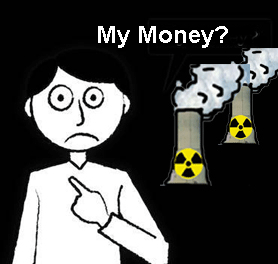
Investments in France’s EDF could top €20bn per year, minister says. #nuclear #nuclear-free #anti-nuclear #No#nukes
EURACTIV.com with Reuters Sep 29, 2023
French power giant EDF’s future investments could exceed €20 billion
per year, Agnès Pannier-Runacher, the country’s energy transition
minister, said on Thursday (28 September), adding that the exact level was
the subject of discussion.
The state-owned utility is facing a mountain of
investment needs to maintain its nuclear fleet as well as build new
reactors and renewable power production. EDF CEO Luc Rémont had previously
put the investments at €25 billion. “What we are talking about … for
EDF is investments which could reach … more than €20 billion per
year,” Pannier-Runacher said at a nuclear conference organised by the
Organisation for Economic Co-operation and Development (OECD).
“There is a discussion about whether it is 20 (billion) or whether it is more,” she
added. The French government has previously announced a plan to build at
least six new model nuclear reactors, which Pannier-Runacher said would
cost about €3 billion per year in investments.
Euractiv 29th Sept 2023 https://www.euractiv.com/section/electricity/news/investments-in-frances-edf-could-top-e20bn-per-year-minister-says/
Fukushima Study Links Low-Dose Radiation to Diabetes
Mirage, 3 Oct 23
New research to be presented at this year’s Annual Meeting of The European Association for the Study of Diabetes (EASD), Hamburg (2-6 Oct), suggests that exposure to low doses of radiation may contribute to an increased risk of diabetes.
The study by Dr Huan Hu and Dr Toshiteru Ohkubo from the Japanese National Institute of Occupational Safety and Health involved more than 6,000 out of around 20,000 emergency workers who responded to the radiation accident at the Fukushima Daiichi Nuclear Power Plant, which was hit by a huge tsunami in March 2011.
Substantial amounts of radioactive materials were released into the environment following explosions at the nuclear plant.
In 2014, the Epidemiological Study of Health Effects in Fukushima Emergency Workers (NEWS) was established to clarify the long-term health effects of radiation among emergency workers.
Few human studies have examined the impact of radiation exposure on diabetes development, particularly at low doses. To find out more, researchers examined the association between low-dose radiation exposure and risk of diabetes in 5,326 male emergency workers (average age 46 years) taking part in the NEWS study.
Between March and December 2011, individual emergency worker’s radiation exposure was measured using a pocket alarm dosemeter for external exposure and a whole-body counter for internal exposure.
Study participants underwent regular health examinations involving more than 70 components, including blood sugar, lipids, urine tests, inflammation biomarkers, thyroid function tests, and eye examinations.
Between 2012 and 2021, 392 participants developed diabetes—defined as a fast plasma glucose level of at least 126 mg/dL, an HbA1c level of at least 6.5%, or self-reported diagnosis of diabetes.
The researchers assessed the association between incident diabetes and cumulative radiation exposure after adjusting for a wide range of potential confounders including age, body mass index, smoking, alcohol consumption, leisure-time physical activity, employment at the nuclear power plant, dyslipidaemia (abnormally high levels of fats in the blood), and high blood pressure.
The analysis found that compared with the lowest cumulative low-dose radiation exposure (0-4 millisieverts [mSv]), the risk of developing diabetes was 6% higher for workers exposed to 5-9 mSv, and 47% and 33% greater for those exposed to 10-19 mSv and 20-49 mSv, respectively.
However, no elevated risk was detected in those exposed to radiation doses of 50 mSv or higher, likely due to the small sample size in this group.
“Our findings suggest an increased risk of diabetes among nuclear emergency workers from low levels of radiation. While the potential mechanisms remain somewhat unclear, reports suggest that radiation can adversely affect pancreatic cells responsible for insulin production, potentially contributing to diabetes. Additionally, there is an association between radiation exposure and heightened inflammation, a well-known factor in insulin resistance and the development of diabetes”, explains lead author Dr Hu.
He adds, “Ongoing follow-up of NEWS participants will provide an even clearer picture of diabetes risk at low radiation doses. As more diabetes cases emerge within our study group, our expanded dataset will enable more robust analyses, allowing researchers to better assess the link between radiation exposure and diabetes risk.”……………………………………………………………………………………………………….. more https://www.miragenews.com/fukushima-study-links-low-dose-radiation-to-1095852/
France attempts to pressure Australia to stop engaging with UN nuclear weapons ban treaty

https://www.icanw.org/france_pressures_australia_to_stop_engaging_with_un_nuclear_weapons_ban_treaty 2 Oct 23 #nuclear #anti-nuclear #Nuclear-Free #NoNukes
Recent statements by a French diplomat to “the Australian” newspaper criticizing Australia’s decision to observe the UN Treaty on the Prohibition of Nuclear Weapons (TPNW) reveal the panicked efforts by nuclear-armed states to undermine the treaty as support for the ban continues to grow. It also shows a European state with a dark colonial legacy continuing to exert pressure on the Pacific – an area heavily impacted by French nuclear testing – instead of respecting national sovereignty.
On 2 October an article in “the Australian” newspaper cited an unnamed French diplomat claiming that Australia’s support for the Treaty on the Prohibition of Nuclear Weapons “undermines the primacy of the Nuclear Non-Proliferation Treaty (NPT)” and “is contradictory with Australia’s ambition to reinforce its partnership with NATO.”
Both of these statements are not only hamfisted attempts at pressuring the Australian government away from the TPNW, they are also factually incorrect: The TPNW was carefully crafted to reinforce, complement, and build on the NPT, which obligates its parties – including France – to negotiate further legal measures to achieve nuclear disarmament under Article VI, and NATO members face no legal barrier to joining the treaty, so long as they commit not to engage in or support any nuclear-weapon-related activities. Moreover, several NATO partners are already TPNW parties (Austria, Ireland, Kazakhstan, Malta, Mongolia, New Zealand) or signatories (Algeria, Colombia).
These declarations show France’s mounting concern over the growing support for the TPNW. The statements themselves are no surprise, as France has stridently protested the TPNW ever since it was adopted at the UN in 2017 with the backing of 122 states. France insists it has a legitimate right under the NPT to possess nuclear weapons, while ignoring its commitments to pursue negotiations in good faith for nuclear disarmament under the same treaty. What is new is the fact that this pressure is being exerted publicly, and on a state that is largely seen as an ally on security issues. Previously, France has limited this kind of pressure for formerly colonised states, particularly in Africa.
Australia’s growing support for the TPNW
The Australian Labor Party, which has been in power since May 2022, adopted a resolution in 2018 committing it to sign and ratify the TPNW in government. This was moved by Anthony Albanese, who now serves as prime minister and has been a vocal supporter of the TPNW. He said at the time: “Our commitment to sign and ratify the nuclear weapon ban treaty in government is Labor at its best.” Labor reaffirmed this position in 2021 and most recently on 18 August 2023. The government also has confirmed its intention to observe the treaty’s upcoming meeting of states parties in New York (2MSP) and is evaluating whether to sign and ratify the treaty.
This is an encouraging step, but ICAN’s Executive Director, former Labor MP Melissa Parke, has criticised the government’s delay in ratifying the treaty: “It’s not enough to keep promising to sign the treaty without acting. We want to see the Prime Minister put pen to paper, without delay. Labor’s commitment on nuclear disarmament and non-proliferation will be hollow if Australia fails to do so.”
Speaking to the revelation that French diplomats are exerting pressure on Australia to consider, she said: “Our two countries have never seen eye to eye on nuclear weapons. France shouldn’t be lecturing Australia on nuclear policy. We can make our own decisions, in our own interests – and for the global common good.”
France’s unresolved nuclear legacy in the Pacific
From 1966 to 1996, France tested 193 nuclear weapons in Maohi Nui/French Polynesia, a Self Governing Territory of France in the Pacific. In 1974, Australia famously took France to the International Court of Justice in a bid to force an end to its atmospheric nuclear testing in the Pacific, as the impacts of nuclear weapons are not contained by national borders. Yet France only ended its Pacific nuclear test explosions once it was confident it had developed non-explosive testing methods sufficiently for new weapons development, and it refuses to acknowledge and address the catastrophic legacy of its nuclear tests to this day.This legacy is also a subject of hot debate at the national level in France. On 28 September, only days before France’s criticisms of Australia, the assembly of French Polynesia unanimously adopted a resolution supporting the TPNW, highlighting the region’s history as the site of numerous French nuclear tests. The resolution underscores the TPNW as a humanitarian disarmament treaty and emphasises the deep concerns of the French Polynesian population regarding this issue. While French Polynesia cannot currently access the assistance and rehabilitation outlined in Articles 6 and 7 of the TPNW due to France’s non-ratification, it sends a resounding message in favour of the treaty to Paris.
Nuclear renaissance in Europe? Really?
#nuclear #antinuclear #nuclear-free #NoNukes
As countries including France, the UK and Sweden look to pivot back to
nuclear power to help them meet net-zero targets, questions remain over
safety, radioactive waste and where they’ll find the vast amounts of
money and expertise needed to build and manage new reactors.
FT 2nd Oct 2023
UK small #nuclear competition: Rolls Royce in, Bill Gates snubbed
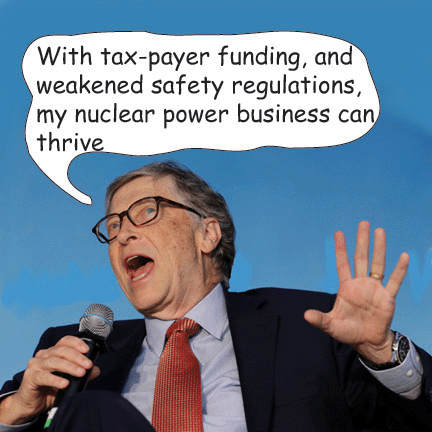
CITY,AM NICHOLAS EARL 3 Oct 23 #antinuclear #nuclear-free #NoNukes
Bill Gates’ nuclear reactor design company Terrapower has not been shortlisted for the next round of the government’s competition for scaled-down power plants.
Industry vehicle GB Nuclear has selected six companies to advance to the latest stage, including rumoured front-runner Rolls-Royce which has already secured over £200m in government funding.
The remaining contenders also include EDF, GE-Hitachi, Holtec Britain, Nuscale and Westinghouse Electric.
These companies will be invited to bid for government contracts later this year, with successful companies announced next spring and contracts awarded in the summer.
Gates, the world’s fifth richest man and the co-creator of Microsoft, founded Terrapower in 2006.
He is currently the company’s chairman and is still their biggest investor, leading a £588.3m funding round last year.
The company has been pitching bespoke ‘Natrium’ reactors powered by high-assay low-enriched uranium and announced its intentions earlier this year to enter the UK race for projects.
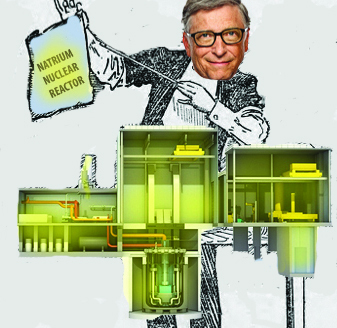
However, Whitehall officials have reportedly been concerned over insufficient supplies to import at scale to meet demand for Terrapower reactors, as most of the uranium it needs is produced in Russia – which is under sanctions following the country’s invasion of Ukraine.
City A.M. understands GB Nuclear wanted to prioritise the most ready-made technologies which could guarantee a final investment decision by the end of the decade.
Instead, Terrapower could feature in an upcoming consultation on advanced technology.
Small modular reactors are a cornerstone of the government’s plan to revive domestic nuclear energy and replace the country’s ageing fleet – with 85 per cent of the country’s current capacity set to go offline over the next 12 years.
……………………..Downing Street is targeting operational SMRs in the UK by the mid-2030s, with a £20bn cap being placed on the competitive process.
………………Downing Street is targeting operational SMRs in the UK by the mid-2030s, with a £20bn cap being placed on the competitive process. https://www.cityam.com/uk-small-nuclear-competition-rolls-royce-in-bill-gates-snubbed/
Pacific island States support the Treaty on Prohibition of Nuclear Weapons – a problem for Australia in joining AUKUS nuclear military alliance
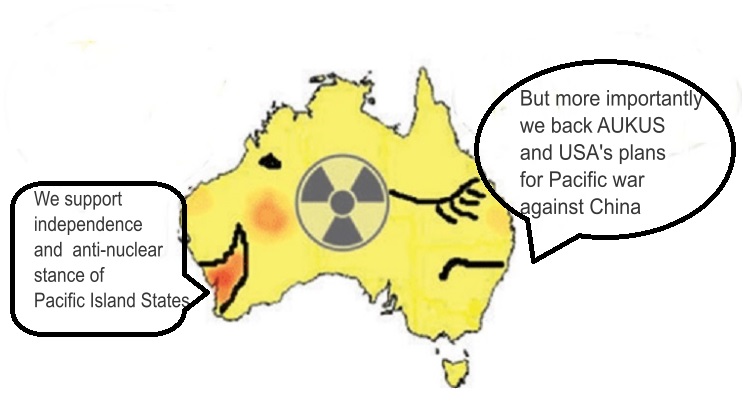
French criticism of nuclear ban treaty highlights Canberra’s dilemma
The Interpreter, NIC MACLELLAN, 2 Oct 23
Can Australia rebuild a strategic military partnership with France at
the same time as independence movements claim Pacific support?
On 28 September, the Assembly of French Polynesia unanimously passed a resolution endorsing the Treaty on the Prohibition of Nuclear Weapons (TPNW), the nuclear ban treaty that entered into force in 2021. Even though France refuses to sign the treaty, and still controls the defence and foreign policy of French Polynesia, the local legislature in Tahiti with its new pro-independence government sees TPNW as setting a new norm in international law. The resolution encourages “the participation of France as an observer state at the next TPNW Meeting of the States Parties”, to be held in New York in late November. It also calls on the French government to “work towards France’s adherence to this new international norm.”
A key reason for this pointed message to Paris are the TPNW provisions that call for assistance to nuclear survivors and clean-up of contaminated nuclear test sites. The Ma’ohi people are still seeking compensation for the health and environmental effects of 193 French nuclear tests at Moruroa and Fangataufa.
Beyond this, French Polynesia’s critique of nuclear weapons echoes the views of the majority of members of the Pacific Islands Forum. Unlike Australia, nine independent Pacific Island countries and Aotearoa-New Zealand have already signed and ratified the TPNW.
At the recent Australian Labor Party (ALP) National Conference in Brisbane, the party re-confirmed its support for signing the TPNW – under restrictive conditions – and agreed to send an observer to the next Meeting of State Parties. However key ALP leaders are opposed to signing, and nuclear weapons states such as the United States and France, having long derided the treaty, are now ramping up their opposition to it.
A front-page story in The Australian on 2 October cited an unnamed French diplomat who criticised Australia over its tentative moves towards signing TPNW, though the story fails to mention last week’s resolution from the Assembly of French Polynesia…………………………………………….
the Australian government has held a series of meetings with key French ministers to rebuild relations disrupted by AUKUS, including a summit between Defence Minister Richard Marles and French counterpart Sebastien Lecornu in September 2022, and a 2+2 meeting of defence and foreign ministers in January. Marles and Lecornu are organising the South Pacific Defence Ministers meeting in Noumea in December, to the dismay of the FLNKS independence movement, which is in the midst of talks with the French state over a new political status for New Caledonia.
Last year, Marles congratulated Emmanuel Macron on his re-election to the French presidency, proclaiming “France is our neighbour. France is a Pacific country. And as such, France deeply matters to Australia.”
But France is a European colonial power, not a Pacific country. It is recognised by the United Nations as the administering power of non-self-governing territories. It has responsibilities for decolonisation under international law. Australian governments may be reluctant to talk publicly about this, but the issue of self-determination is firmly on the regional agenda, posing difficult choices for all Forum member countries (as shown by recent debates over West Papua, Bougainville, Guam, etc).
Another problem is that, in both Australia and France, the perspectives of leaders from Francophone island communities are usually missing from the public debate about France’s role in Indo-Pacific security. It’s rare to see the media or think tanks cite President Louis Mapou of New Caledonia or newly elected President Moetai Brotherson of French Polynesia. Both will be attending the next Pacific Islands Forum summit in Rarotonga as it discusses regional security – for the first time, leaders from both French territories in the Forum are supporters of independence and sharp anti-nuclear critics.
So, can Australia rebuild a strategic military partnership with France at the same time as its Pacific neighbours are seeking an independent and sovereign state?
As Penny Wong travelled to Noumea last April, becoming the first Australian Foreign Minister to address the Congress of New Caledonia, Mapou was eager to strengthen ties with Canberra around trade, investment and people-to-people engagement. He also diplomatically highlighted key differences around Australia’s close alignment with the United States under the AUKUS partnership:
The independence movement of New Caledonia – of which I’m a member – is in favour of non-alignment. We regularly attend the summits of the Non-Aligned Movement. From the earliest days, we have supported a nuclear free Pacific – that’s even set out in the preamble of the draft Constitution of Kanaky that we submitted to the United Nations in 1986. When Australia decides to align itself with the United States in the framework of AUKUS to acquire nuclear submarines, it raises the question: if it starts here, where will it end? How does this impact the Treaty of Rarotonga and the Boe Declaration on security?
The Albanese government has proclaimed its support for a world without nuclear weapons. But talk is easy. It’s getting harder for the ALP government to balance tensions between its role as an AUKUS partner, a strategic partner with France and the “security partner of choice” for the island nations of the Pacific, which are deeply opposed to nuclear weapons. Why should Australia side with a European colonial power against its closest neighbours? https://www.lowyinstitute.org/the-interpreter/french-criticism-nuclear-ban-treaty-highlights-canberra-s-dilemma
Maybe Branding U.S. Wars Democrat or Republican Wasn’t Such A Good Idea
Republicans would only vote for averting a shutdown if it stripped out “aid” to Ukraine and it worked
LISA SAVAGE, OCT 3, 2023 https://went2thebridge.substack.com/p/maybe-branding-us-wars-d-or-r-wasnt?utm_source=post-email-title&publication_id=1580975&post_id=137596684&utm_campaign=email-post-title&isFreemail=true&r=ln98x&utm_medium=email
There is considerable anti-war sentiment among voters worldwide — which explains why candidates run on peace promises (Obama, Zelensky, Trump). There is also considerable pro-war sentiment among corporations who build weapons of mass destruction, and the think-tanks they fundto support them.
This push-pull has nudged warmakers into branding wars as “D for Democrat” or “R for Republican” in order to whip up support and manage dissent. Thus Democrats support President Biden’s proxy war on Russia via Ukraine while Republicans and third parties (Greens, Libertarians, Communists) don’t.
But based on the congressional circus this week, maybe that is not such a good strategy?
Those of us opposed to ALL wars our government wages have experienced the partisan split in who will stand with us. When a Republican is in the White House, Democrats come out in droves. Then when an Obama or a Biden is elected, they go home.
Then, the parties wage information wars to support their team. These have ramped up considerably to insist that Putin = Hitler (just silly), that there are no Nazis in Ukraine (maybe they all went to Canada?), and that funding Ukraine’s government is a higher priority than funding our own. Even though as far back as July a CNN poll found a majority in the U.S. opposed sending any more money to Ukraine.
In order to avert a federal government shutdown over what to fund, we heard from Democrats that it was the bad Republicans’ fault.
. From The Guardian:
The US president said on Sunday he was “sick and tired” of the political brinkmanship, and that US support for Ukraine could not be interrupted “under any circumstances”.
Even though Democrats never move left and always move right — or maybe because of that? — the Punch and Judy show where the two corporate parties bash each other constantly is having a long run.
Then we heard that the bad Republicans would only vote for averting a shutdown if it stripped out “aid” to Ukraine (currently at $180 billion and counting). And it worked! Worked, that is, after a fire drill shut Congress down when Democratic Congressman Jamaal Bowman pulled a fire alarm and delayed the vote a bit.
He swears this was an honest mistake. But I suspect the delay was so that some more back room deals on terms of the funding could be hammered out.
Received wisdom has it that Democrats want WW3 with Russia while Republicans want WW3 with China. But Greens like me see the corporate parties supporting all the wars and I think they’re all nuts.
I can see where the U.S. once believed it could beat Russia as it used the NATO alliance and CIA color revolutions to foment trouble like civil war for Ukraine. Looking at the situation today, it’s clear that few aside from delusional thinkers allied with the Biden administration believes this is still the case. Russia has objectively kicked Ukraine/NATO’s butt while the response in the West is best epitomized by the Canadian Parliament’s standing ovation for a literal Nazi “who fought the Russians in WW2.”
“Ukrainian President Volodymyr Zelenskyy and Prime Minister Justin Trudeau recognize Yaroslav Hunka, who fought with the First Ukrainian Division in World War II, in the House of Commons in Ottawa on Sept. 22, 2023.” | Patrick Doyle/The Canadian Press
(If you’re unclear on WW2’s major players and alliances, the late Howard Zinn’s overview can be found here.)
Next up, preparations are already well underway for using Taiwan to create a situation where China feels it must respond to safeguard its own borders and sovereignty. What would lead to the delusion that AUKUS or NATO or U.S.-Japan-South Korea could defeat China in a hot war? Hot warriors falsely claim China is authoritarian, has lost the support of its people, and committed genocide against the Uyghurs.
Word to the U.S.: your government is increasingly authoritarian, has lost the confidence of its people, and has committed genocide in so many places it’s hard to list them all. Maybe just note the ongoing attempted genocide of the indigenous people of North America and leave it at that.
BAE lands £4bn contract for Aukus #nuclear attack submarines
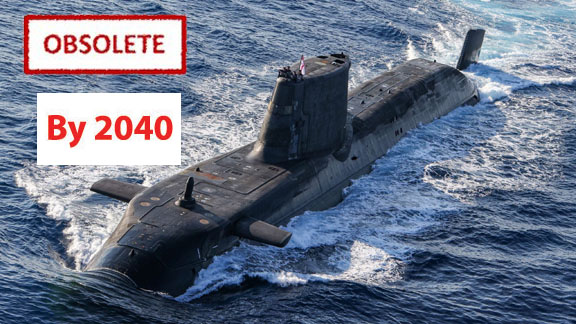
#antinuclear #nuclear-free #NoNukes Britain has signed contracts worth GBP4 billion to finance a new phase ofthe SSN-Aukus next-generation attack submarine project, according togovernment officials. The deals, which involve British companies BAE
Systems PLC, Rolls-Royce Holdings PLC and Babcock International Group PLC,
are part of the Aukus military alliance between the US, Australia and the
UK to counter China in the Asia-Pacific region.
London South East 2nd Oct 2023
Aukus: UK defence giant BAE Systems wins Australian £3.95bn nuclear submarine contract

BBC News By Peter Hoskins, Business reporter 2 October Britain’s biggest defence firm, BAE Systems has won a £3.95bn ($4.82bn) contract to build a new generation of submarines as the security pact between the US, UK and Australia moves ahead.
In March, the three countries announced details of the so-called Aukus pact to provide Australia with nuclear-powered attack submarines by the late 2030s.
The pact aims to counter China’s ambitions in the Indo-Pacific region.
Beijing has strongly criticised the three countries over the deal.
……………………..”This multi-billion-pound investment in the Aukus submarine programme will help deliver the long-term hunter-killer submarine capabilities the UK needs to maintain our strategic advantage and secure our leading place in a contested global order,” UK Defence Secretary Grant Shapps said as the Conservative party conference got under way in Manchester.
………………….Other major UK defence contractors are also getting a boost from the Aukus deal.

In March, it was confirmed that Rolls-Royce Submarines would provide all the nuclear reactor plants that will power the SSN-Aukus vessels.
In June, Rolls-Royce said it would almost double the size of its Raynesway facility in Derby as a result of the deal. On Sunday, Babcock International, which maintains and supports the UK’s submarines, said it had signed a five-year deal with the Ministry of Defence to work on the SSN-Aukus design.
The Aukus security alliance – which was first announced in September 2021 – has repeatedly drawn criticism from China.
However, the three Western countries say the deal is aimed at shoring up stability in the Indo-Pacific more https://www.bbc.com/news/business-66979798
1 This Month

of the week – Shut Down Drone Warfare!


Tell the Ukrainian Government to Drop Prosecution of Peace Activist Yurii Sheliazhenko

Petition to revoke the licensing of the Near Surface Nuclear Disposal Facility (NSDF) at Chalk River. https://www.ourcommons.ca/petitions/en/Petition/Details?Petition=e-7247
To see nuclear-related stories in greater depth and intensity – go to https://nuclearinformation.wordpress.com
-
Archives
- March 2026 (244)
- February 2026 (268)
- January 2026 (308)
- December 2025 (358)
- November 2025 (359)
- October 2025 (376)
- September 2025 (257)
- August 2025 (319)
- July 2025 (230)
- June 2025 (348)
- May 2025 (261)
- April 2025 (305)
-
Categories
- 1
- 1 NUCLEAR ISSUES
- business and costs
- climate change
- culture and arts
- ENERGY
- environment
- health
- history
- indigenous issues
- Legal
- marketing of nuclear
- media
- opposition to nuclear
- PERSONAL STORIES
- politics
- politics international
- Religion and ethics
- safety
- secrets,lies and civil liberties
- spinbuster
- technology
- Uranium
- wastes
- weapons and war
- Women
- 2 WORLD
- ACTION
- AFRICA
- Atrocities
- AUSTRALIA
- Christina's notes
- Christina's themes
- culture and arts
- Events
- Fuk 2022
- Fuk 2023
- Fukushima 2017
- Fukushima 2018
- fukushima 2019
- Fukushima 2020
- Fukushima 2021
- general
- global warming
- Humour (God we need it)
- Nuclear
- RARE EARTHS
- Reference
- resources – print
- Resources -audiovicual
- Weekly Newsletter
- World
- World Nuclear
- YouTube
-
RSS
Entries RSS
Comments RSS
 nuclear-news