People Are Dying For Inches In Ukraine, The “World’s Largest Arms Fair”

CAITLIN JOHNSTONE, SEP 29, 2023 https://www.caitlinjohnst.one/p/people-are-dying-for-inches-in-ukraine?utm_source=post-email-title&publication_id=82124&post_id=137502350&utm_campaign=email-post-title&isFreemail=true&r=1ise1&utm_medium=email
There’s a heartbreaking graphic going around right now showing the almost microscopic changes that have occurred to the frontline of the war in Ukraine this year despite nonstop death and destruction of unfathomable horror the entire time.
The graphic comes from a New York Times article titled “Who’s Gaining Ground in Ukraine? This Year, No One.”, which eventually gets around to acknowledging that Russia has actually gained more ground than Ukraine in 2023 despite Kyiv’s much-hyped counteroffensive which began in June.
“When both sides’ gains are added up, Russia now controls nearly 200 square miles more territory in Ukraine compared with the start of the year,” the Times reports.
As Left I on the News noted on Twitter, this contradicts the titular claim in another New York Times article published last week under the headline “Ukraine Has Gained Ground. But It Has Much Further To Go.”
The reason the map of gains and losses is so heartbreaking is because so much has been given up for so very, very little. At least tens of thousands have died in this war with hundreds of thousands wounded, all for those teeny, tiny little blips on the map. Ukraine is now freckled with more landmines than anywhere else on earth, which experts say will take decades to clear. This giant deathtrap is exacerbated by the cluster munitions that are covering the land with greater and greater frequency, which will go on to detonate and kill civilians (mostly children) for years to come. The mines and artillery fire on the frontline of this war are reportedly creating tens of thousands of amputees, numbers comparable to what was seen in World War I.
And all for what? Essentially nothing. A few inches gained here, a few inches lost there. The meaninglessness of it all is probably one of the reasons why military-aged Ukrainian men have been fleeing and attempting to flee the nation in droves to avoid conscription.
War is the worst thing in the world. The suffering, trauma and loss of mass military violence is too much to comprehend, even for people who are right there experiencing it. And the only thing worse than a war where one side gets completely steamrolled by the other is one in which people keep killing each other and killing each other over tiny gains and losses on the battlefield without an end to the nightmare anywhere on the horizon.
And now we see western officials and media outlets telling us all to prepare for this war to drag on for years, potentially into the 2030s. This nonsensical violence, which even the head of NATO now admits could have been avoided by simply ceasing to amass a western military threat on Russia’s doorstep, is scheduled to drag on as long as possible for no grander reason than the advancement of US strategic interests.
This news from The New York Times comes out at the same time as a Wall Street Journal article titled “The War in Ukraine Is Also a Giant Arms Fair,” subtitled “Arms makers are getting orders for weapons being put to the test on the battlefield.”
“The Panzerhaubitze howitzer is part of an arsenal of weapons being put to the test in Ukraine in what has become the world’s largest arms fair,” writes WSJ’s Alistair MacDonald. “Companies that make the weapons being used in Ukraine have won orders and resurrected production lines. The deployment of billions of dollars worth of equipment in a major land war has also given manufacturers and militaries a unique opportunity to analyze the battlefield performance of weapons, and learn how best to use them.”
This is one of those things that just sounds a bit uncomfortable at first, but if you really sit with the words and deeply contemplate what’s being said here it will show up as so deeply evil it will give you nightmares. The fact that weapons systems are being tested on human bodies to the immense benefit of war profiteers over a completely avoidable and deliberately provoked war is one of the most depraved things you can possibly imagine, and is a clear sign that we are living in a profoundly sick society.
This is so, so ugly, and it’s slated to get even uglier — these freaks haven’t even gotten started on China yet. The sooner this monstrous power structure can be brought to its knees, the better it will be for everyone.
Nazigate: Canada’s top general won’t apologize for applauding Ukrainian Waffen-SS vet

WYATT REED, ·SEPTEMBER 28, 2023, https://thegrayzone.com/2023/09/28/nazigate-canadas-general-ukrainian-waffen-ss/—
As Canada’s top officials express embarrassment for honoring a WWII Nazi collaborator in parliament, the leader of the country’s military, Gen. Wayne Eyre, refuses to apologize for his standing ovation. The Canadian military has trained Ukraine’s notorious neo-Nazi Azov Battalion for years.
Canadian politicians have been in frantic damage control mode since feting a former member of the Waffen-SS during a parliamentary reception for Ukrainian President Volodymyr Zelensky on September 22. The Speaker of Canada’s House of Commons, Anthony Rota, resigned following the incident, while Prime Minister Justin Trudeau lamented it as “extremely upsetting,” and opposition leader Pierre Poilievre branded the affair the “biggest single diplomatic embarrassment” in Canada’s history.
But amid the gratuitous public rites of contrition, one influential official has been conspicuously absent: Canada’s highest-ranking general. According to the Ottawa Citizen, Chief of the Defence Staff Gen. Wayne Eyre has “declined to apologize for his standing ovation” for Yaroslav Hunka, the now-notorious 98-year-old former member of the 14th Waffen Grenadier Division of the SS, whose members gained international infamy for hunting down anti-Nazi partisans, massacring thousands of civilians, and burning hundreds of Polish villagers alive.
The notion that the Nazi proclivities of figures like Hunka could have escaped Eyre’s notice now appears increasingly remote. In 2017, Ukraine’s Azov Battalion published photos on their website publicizing their meeting with high-level Canadian military officials, who had arrived in Ukraine to help train the notoriously neo-Nazi infested unit, which was officially incorporated into the Ukrainian National Guard.
A year later, Azov posted photos on its official social media channels showing Canadian military attaché Col. Brian Irwin meeting with its personnel. Responding to a query from journalist Asa Winstanley, a Canadian military spokesman justified training the fascist military on the grounds that the session “includes ongoing dialogue on the development of a diverse, and inclusive Ukraine.”
Just four months before Russia’s invasion of Ukraine, The Friends of Simon Wiesenthal Center for Holocaust Studies sent a letter to then-Acting Chief of the Defense Staff Gen. Wayne Eyre and Defense Minister Harjit Sajjan demanding an investigation into the decision to train Ukrainian neo-Nazis. The Jewish group urged them to ensure that such instruction did not continue.
“If Canada is going to be providing military training to foreign forces, then it is our responsibility to know we are not training neo-Nazis,” said Jaime Kirzner-Roberts, policy director of the Friends of Simon Wiesenthal Center. “It is our obligation to our Canadian veterans who sacrificed so much defeating fascism in Europe.”
But such warnings apparently went unheeded. The Canadian military not only declined to discontinue its Nazi-training policies, it escalated its program of coaching avowed fascists. Since Russian military operations in Ukraine kicked off in Feb. 2022, Canada has invested a further $1.6 billion USD in the arming and instructing of Kiev’s military.
On the sidelines of Zelensky’s now-infamous address to the Canadian Parliament, Ottawa authorized the further disbursement of another $483 million USD in aid and training on F-16 fighter jets.
Canada’s scheme of funneling weapons to Kiev and coaching Ukrainian forces officially began in 2014, just months after anti-Russian forces toppled the democratically-elected government of Viktor Yanukovych in a brutal US government-backed coup d’etat. Under the auspices of “Operation UNIFIER,” more than 33,000 Ukrainian troops received “advanced combat instruction by Canadian soldiers,” Canada’s state-affiliated CBC reported in 2022.
Ukraine’s ambassador in Ottawa, Yulia Kovaliv, heralded the training initiative as a “very important initiative.”
“It is also important to further provide Ukraine with heavy weapons,” she added.
In the UK, where Canadian forces frequently travel in order to school Zelensky’s army in the art of killing Russians, the program received a similarly warm welcome. An ebullient British Defense Secretary Ben Wallace said in a statement at the time that he was “delighted” that “the Canadian Armed Forces will be joining the growing international effort to support the training of Ukrainian soldiers in the UK.”
“Canada’s expertise will provide a further boost to the programme and ensure that the Ukrainian men and women, coming to the UK to train to defend their country, will get a wide pool of experience and skills from both UK forces and our international partners,” Wallace crowed.
Just what exactly the nationalist-leaning members of Ukrainian armed forces did with the training and tacit blessing of Canada has yet to be ascertained. But Azov members have been implicated in a number of war crimes. Despite the unit’s recent push to whitewash its Nazi tendencies, Azov — which has since expanded to a full-fledged brigade under Kiev’s official command — retains as its leader Andrey Biletsky, who once described Ukraine’s role on the global stage as helping to “lead the white races of the world in a final crusade … against Semite-led Untermenschen.”
Biletsky has taken pains to distance himself from the comment, but the unit has not undertaken similar efforts to distance itself from Biletsky. In September 2023, Biletsky was photographed proudly shaking hands with Zelensky during an intimate meeting with the Ukrainian President on the outskirts of Bakhmut. And Zelensky himself appears to have few problems with publicly associating with the group.
In a post commemorating the encounter with Ukraine’s most celebrated Nazi formation, Zelensky declared: “I am grateful to everyone who defends our country and people, who brings our victory closer.”
Nuclear waste ship makes unprecedented port call at Novaya Zemlya
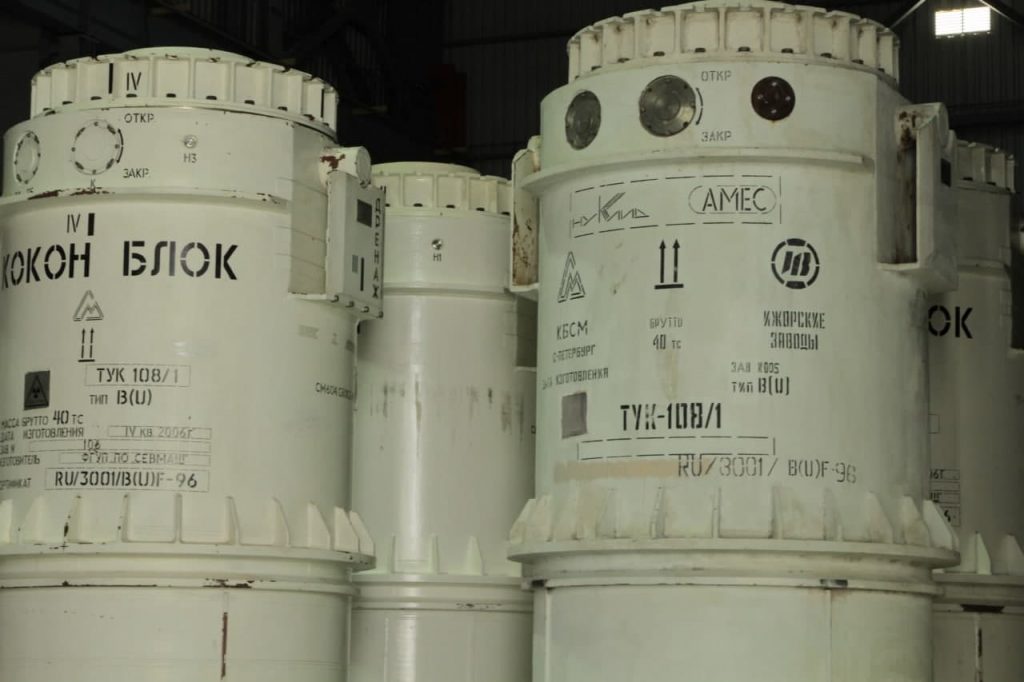
“I am deeply worried if Russia has started to move nuclear waste from the Kola Peninsula to the Arctic archipelago,” says Frederic Hauge with the Bellona foundation.
Much of the remaining uranium fuel elements in Andreeva Guba are damaged and pose special problems to handle. For that reason, the reprocessing plant in Mayak has been unwilling to receive.
Thomas Nilsen, September 29, 2023 https://thebarentsobserver.com/en/nuclear-safety/2023/09/nuclear-waste-ship-makes-port-call-novaya-zemlya
Last week, the “Rossita” could be seen on ship tracking services as it sailed outside Gremikha, a shutdown submarine base east on the Kola Peninsula. Now, the specially designed ship is moored at the pier in Severny, a military town on the shores of the Matochkin Strait diving the northern and southern islands of Novaya Zemlya
Severny is the settlement serving Russia’s nuclear weapons tests, nowadays in the form of sub-critical experiments taking place deep inside tunnels in the permafrost mountains. The last real detonation of a nuclear warhead was on October 24, 1990.
The “Rossita” was built in Italy with Italian taxpayers money. It was a helping hand from a European nation aimed to transport spent nuclear fuel from the run-down storage site in Andreeva Guba on the shores of the Litsa fjord, a short 60 km from the border with Norway.
Some 21,000 spent fuel elements from the Soviet Union’s fleet of Cold War submarines were stored. Italy’s contributions were part of a larger international cooperation to assist Russia in securing the lethal highly radioactive waste.
Other contributing nations were Norway, the United Kingdom and Sweden.
The “Rossita” shuttled between Andreeva Bay and Atomflot in Murmansk. From there, the containers with the fuel elements were sent by train to Mayak north of Chelyabinsk where Russia’s reprocessing plant is located.
With Moscow’s all-out war against Ukraine, the Western partners stopped all cooperation with Russia in regard to nuclear waste handling.
For the last 19 months, little information about what happens in Andreeva Bay has reached the public.
What is known is that two of the Northern Fleet’s most potent nuclear-powered submarines, the “Severodvinsk” and the “Kazan” of the Yasen class are moored across the bay at the piers in Nerpicha, part of Zapadnaya Litsa naval base.
“All reasons to monitor”
Frederic Hauge with the Bellona Foundation in Norway will not speculate too much about reasons Russia might have to move nuclear waste to the Arctic archipelago of Novaya Zemlya.
“What we do know is that “Rossita” is specially designed to carry TUK-18 containers modified to hold damaged spent nuclear fuel,” he says.
Much of the remaining uranium fuel elements in Andreeva Guba are damaged and pose special problems to handle. For that reason, the reprocessing plant in Mayak has been unwilling to receive.
“There are all reasons to monitor what now happens at Novaya Zemlya,” Hauge notes.
His team of nuclear experts in Oslo and Vilnius are now analyzing the limited available information with the hope of understanding what happens.
“A week ago, Rosatom’s larger carrier “Sevmorput” sailed to Novaya Zemlya. We are also told that there have been busy days at Severny and near the tunnels designed for nuclear weapons testing,” Hauge says in a phone interview with the Barents Observer.
“The big unanswered question is if what we now are witnessing is a Russia that brings dangerous nuclear waste to Novaya Zemlya for long-term storage in the permafrost.”
Fresh concerns over Zaporizhzhia nuclear power plant: Emerging Europe this week
Emerging Europe 29th Sept 2023 #nuclear #antinuclear #nuclear-free #NoNukes
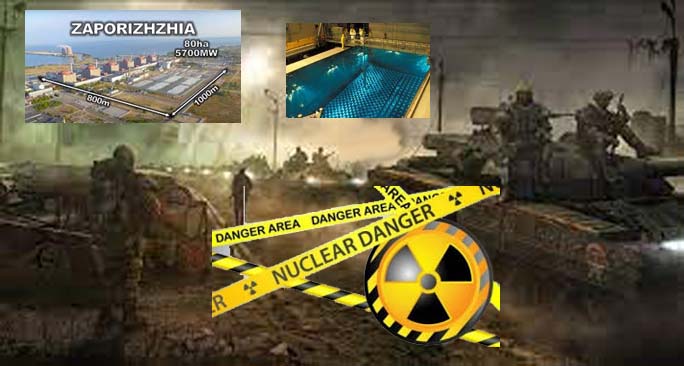
International regulators are incapable of properly monitoring safety at the Russian-occupied Zaporizhzhia nuclear power station, according to a critical dossier compiled by Greenpeace that is being sent to western governments on Thursday.
The environmental campaign group concludes the International Atomic Energy Agency has too few inspectors at Europe’s biggest nuclear plant—four—and that there are too many restrictions placed on their access.
It argues that the IAEA is “unable to meet its mandate requirements” but it is not prepared to admit as much in public, and as a result what it describes as Russian violations of safety principles are not being called out.
Shaun Burnie and Jan Vande Putte, nuclear specialists at Greenpeace, conclude: “The IAEA risks normalising what remains a dangerous nuclear crisis, unprecedented in the history of nuclear power, while exaggerating its actual influence on events on the ground.”
The vast Zaporizhzhia nuclear power plant, with six reactors on site, was captured by Russia in early March 2022 and has been on the frontline of the war ever since. It is sited on the Dnipro River in central Ukraine and Ukrainian forces occupy the riverbank opposite, leaving the plant in the sights of both sides’ militaries. https://emerging-europe.com/news/fresh-concerns-over-zaporizhzhia-nuclear-power-plant-emerging-europe-this-week/
Japan city forgoes applying for government survey on nuclear waste site

The mayor of Tsushima in southwestern Japan said Wednesday he has decided
against applying to the state for a preliminary survey to gauge the island
city’s suitability to host an underground disposal site for highly
radioactive waste from nuclear power generation. The decision comes in
contrast with the local assembly’s approval earlier this month of a request
filed by proponents urging the city to accept the survey.
“There is insufficient consensus among the public,” Mayor Naoki Hitakatsu said at a city assembly session, with some fearing the potential impact on tourism and primary industries such as fisheries.
He later told reporters he also has concerns about reputational damage that may arise from conducting the survey.
The preliminary survey is the first step in a three-stage process spanning two decades to select a permanent disposal site for nuclear waste. Struggling to find one, the central government is looking for municipalities willing to accept the survey, but only two municipalities in Hokkaido have so far done so.
Tsushima, on a remote island in Nagasaki Prefecture, was identified as a potential disposal site on a map of such locations released by the central government in 2017.
Hitakatsu has raised worries about hosting such a site, saying, “The risks that may arise from unperceived factors cannot be ruled out.”
Opponents of the plan have also said it would not be appropriate for the city to host a disposal site for nuclear waste given the history of the U.S. atomic bombing of Nagasaki city in 1945.
Local construction groups and other proponents argued that state subsidies of 2 billion yen ($13.4 million) for accepting the survey could be used for measures to rev up the shrinking city’s economy and support child-rearing.
The mayor, who may seek a third four-year term after his current term expires in March, told a press conference that the reputational damage that may arise from carrying out the survey “cannot be covered by a subsidy of 2 billion yen.”
He also said he “judged it would become difficult to reject” the subsequent geological research if the preliminary survey showed that the city is suited as a site for the final disposal of nuclear waste.
The surveys, conducted by the Nuclear Waste Management Organization, a quasi-government body in Tokyo, involve checking land conditions and volcanic activity based on published geological sources.
Following Tsushima’s decision, the central government said it will continue efforts to find more areas to carry out preliminary surveys.
“We are very grateful that Tsushima showed interest and had considered” accepting the survey, said Chief Cabinet Secretary Hirokazu Matsuno at a press conference.
Fast-aging Tsushima, where the number of residents fell below 30,000 in 2020, depends on squid fishing and pearl farming but is struggling to find young people to carry on the running of its industries.
It is located closer to the South Korean port city of Busan, 50 kilometers away, than any major Japanese cities.
High-level radioactive waste, produced when extracting uranium and plutonium from spent fuel, must be stored in bedrock at least 300 meters underground for tens of thousands of years until the radioactivity declines to levels that pose no harm to human health or the environment.
Japan, like many other countries with nuclear plants, is struggling to find a site for such disposal.
Kyodo News 27th Sept 2023
UK government decides not to take Allerdale further in GDF nuclear waste siting process due to limited suitable geology
Nuclear Waste Services (NWS) has been engaging
with the Allerdale community about the potential for hosting a Geological
Disposal Facility (GDF) to dispose of the UK’s most radioactive waste. As
part of this process NWS obtained existing data and undertook assessments
to understand if six siting factors, safety and security, community,
environment, engineering feasibility, transport, and value for money, could
be supported if a GDF were sited in Allerdale.
Following a comprehensive
and robust evaluation of information it was concluded only a limited volume
of suitable rock was identifiable and the geology in the area was unlikely
to support a post closure safety case. NWS has therefore taken the decision
not to take Allerdale further in the search for a suitable site to host a
GDF. Initial assessments of existing data and information for the other
three communities in the siting process have indicated potentially suitable
geology, which is why NWS is continuing in the siting process with those
communities.
Nuclear Waste Services 28th Sept 2023
Many years for UK government to find a nuclear waste sit with suitable geology and a willing community
NWS chief executive Corhyn Parr said: “We need enough suitable geology to
accommodate a GDF and to support safety cases to build, operate and close
the facility. “Our assessments show evidence of limited volume of suitable
rock for a GDF in the Allerdale search area, including the adjacent inshore
area.”
NSW said finding a suitable site and a willing community, along with
securing the necessary consents and permits, could take about 15 years. The
assessment of three other potential sites is continuing and “the door also
remains open” for new communities to join the process, it added.
BBC 28th Sept 2023
British communities torn between the lure of government bribes and the realities of hosting toxic radioactive trash virtually forever
#nuclear #antinuclear #nuclear-free #NoNukes
Ken Smith moved to the Lincolnshire coast to see out his retirement,
writing crime novels while surrounded by beaches, arcades, holiday parks
and nature reserves. Recently, however, his retreat has been disturbed. The
Mablethorpe resident has found himself unexpectedly on the front lines of a
struggle affecting countries across the world, centred on how to deal with
nuclear waste.
The fate of Mablethorpe will determine how Britain tackles a
problem that has been building for seven decades. As the government seeks a
better solution to radioactive waste, communities are torn between the lure
of economic opportunities versus the realities of living next to a disposal
site. Theddlethorpe, a few miles up the road, is one of three areas in
England being considered by the UK for a 36km square underground site to
dispose of nuclear waste as it decays, some of it over hundreds of
thousands of years.
FT 28th Sept 2023
https://www.ft.com/content/29961733-a72c-406c-8884-4091c0dfd828
Finland’s nuclear waste: delay in completing the review of operating licence application and safety assessment.

Finland’s Radiation and Nuclear Safety Authority (STUK) said its review of
Posiva Oy’s operating licence application for the world’s first used fuel
disposal facility is taking longer than expected and will not be completed
by the end of this year as planned.
Radioactive waste management company
Posiva submitted its application, together with related information, to the
Ministry of Economic Affairs and Employment (TEM) on 30 December 2021 for
an operating licence for the used fuel encapsulation plant and final
disposal facility currently under construction at Olkiluoto. The repository
is expected to begin operations in the mid-2020s. Posiva is applying for an
operating licence for a period from March 2024 to the end of 2070.
The government will make the final decision on Posiva’s application, but a
positive opinion by STUK is required beforehand. The ministry requested
STUK’s opinion on the application by the end of this year. The regulator
began its review in May 2022 after concluding Posiva had provided
sufficient material. However, STUK has now said its safety assessment and
opinion on the application will not be completed this year.
World Nuclear News 28th Sept 2023
https://www.world-nuclear-news.org/Articles/Completion-of-Finnish-repository-review-delayed
Microsoft Sees Artificial Intelligence and Nuclear Energy as Dynamic Duo.

Bloomberg, By Drake Bennett, September 29, 2023 #nuclear #antinuclear #nuclear-free #NoNukes
“…………………………… Thinking, despite its benefits, is a lot of work, and it’s energy-intensive — human brains consume hundreds of calories a day. Artificial intelligence has much the same problem. While we can argue whether AI systems truly think and learn, they’re gobbling up enormous amounts of energy. All of those neural networks furiously training on an internet’s worth of data have a voracious appetite for electricity, as do the cooling systems needed to keep them from overheating.
The companies that have bet their future on AI know this, and they’re working on ways to solve the problem. One of the most interesting is Microsoft Corp. Its partnership with OpenAI has put it at the front of the tech world’s AI scrum. And staying there will require lots of energy, including — by Microsoft’s reckoning — nuclear power. Back in May, the company announced a power purchase agreement with Helion Energy, which has plans to start generating nuclear energy through fusion by 2028 (it already has built multiple working prototypes).
This week, Microsoft posted a job opening for a nuclear technology program manager, tasked with crafting a reactor strategy “to power the data centers that the Microsoft Cloud and AI reside on.”
There’s something a bit sobering about the idea of powering our newest potential threat to humanity with a technology associated with another one. ……………………………………………
The new Microsoft job involves overseeing small modular reactors, or SMRs,
Qatar calls for Israeli nuclear facilities to be subjected to IAEA safeguards
Friday, 29 September 2023 https://www.presstv.ir/Detail/2023/09/29/711758/Qatar-Israel-nuclear-IAEA-NPT
Qatar has called for the Israeli regime’s nuclear facilities to be subjected to the International Atomic Energy Agency’s safeguards amid Tel Aviv’s ongoing snub of international nuclear regulations.
The demand was put forward by the Chairman of Qatar’s National Committee for the Prohibition of Weapons, Abdulaziz Salmeen al-Jabri at the annual general conference of the IAEA, which is currently underway in Vienna, the official Qatar News Agency (QNA) reported on Friday.
Jabri further called for Israel to join the Nuclear Non-Proliferation Treaty (NPT).
The Qatari official explained that these were legitimate demands that had been confirmed by “international legitimacy resolutions [that were passed] half a century ago,” the QNA report noted.
He named some of those resolutions as “resolutions of the UN General Assembly [that have been passed] since 1974, [United Nations] Security Council Resolutions 487 of 1981 and 687 of 1991, numerous IAEA resolutions, and the resolution of the Review Conference of the Middle East Non-Proliferation Treaty in 1995.”
The official reminded that Israel’s subjecting all of its nuclear facilities to the IAEA’s comprehensive safeguards regime and its accession to the NPT “is a prerequisite for establishing a nuclear-weapon-free zone in the Middle East.”
He “stressed that confronting nuclear proliferation in the Middle East is at the core of the tasks assigned to the IAEA…”
Israel, which pursues a policy of deliberate ambiguity about its nuclear weapons, is estimated to harbor 200 to 400 nuclear warheads in its arsenal, making it the sole possessor of non-conventional arms in West Asia.
The regime has, nevertheless, refused to either allow inspections of its military nuclear facilities or sign the NPT.
 | |||
| |||
-
Archives
- February 2026 (199)
- January 2026 (308)
- December 2025 (358)
- November 2025 (359)
- October 2025 (376)
- September 2025 (258)
- August 2025 (319)
- July 2025 (230)
- June 2025 (348)
- May 2025 (261)
- April 2025 (305)
- March 2025 (319)
-
Categories
- 1
- 1 NUCLEAR ISSUES
- business and costs
- climate change
- culture and arts
- ENERGY
- environment
- health
- history
- indigenous issues
- Legal
- marketing of nuclear
- media
- opposition to nuclear
- PERSONAL STORIES
- politics
- politics international
- Religion and ethics
- safety
- secrets,lies and civil liberties
- spinbuster
- technology
- Uranium
- wastes
- weapons and war
- Women
- 2 WORLD
- ACTION
- AFRICA
- Atrocities
- AUSTRALIA
- Christina's notes
- Christina's themes
- culture and arts
- Events
- Fuk 2022
- Fuk 2023
- Fukushima 2017
- Fukushima 2018
- fukushima 2019
- Fukushima 2020
- Fukushima 2021
- general
- global warming
- Humour (God we need it)
- Nuclear
- RARE EARTHS
- Reference
- resources – print
- Resources -audiovicual
- Weekly Newsletter
- World
- World Nuclear
- YouTube
-
RSS
Entries RSS
Comments RSS
 nuclear-news
