Andreyeva Bay cleanup slows to a snail’s pace since invasion of Ukraine

https://bellona.org/news/nuclear-issues/2023-09-andreyeva-bay-cleanup-slows-to-a-snails-pace-since-invasion-of-ukraine 18 Sept 23 Charles Digges
In 2017, Russia began a landmark project ridding one of its most dangerous Cold War relics of spent nuclear fuel and radioactive waste. The effort to clean up Andreyeva Bay — a submarine base near Murmansk uniquely positioned to contaminate the Barents Sea — was the culmination of a years-long and often strained cooperative effort between Moscow and numerous European nations, chief among them Norway and the United Kingdom.
The outbreak of war in Ukraine in February 2022 disrupted that progress and drained the project of millions in international funding as European nations suspended their contributions in protest of Moscow’s invasion.
In the early days of the war, officials with Rosatom, Russia’s state nuclear corporation, insisted they would continue Andreyeva Bay’s cleanup without international assistance, though it was unclear on what funding that would be done.
It wasn’t until Rosatom’s annual conference convened in Murmansk this past July that any news of how these projects were progressing saw the light of day. But even then, the audience a was select one. Bellona — which had attended the annual Rosatom meeting in prewar times — has only viewed the conference presentations in written form.
In fact, none of Rosatom’s former international partners whose funding has driven the Andreyeva Bay project — nations like Norway, France, the United Kingdom and others from Europe— were invited. Instead, the international delegation consisted primarily of countries like Belarus, Kirgizstan, Uzbekistan and others from the Moscow-dominated Commonwealth of Independent States.
“Most of these countries don’t know anything about the Arctic,” said Bellona’s Alexander Nikitin, who is a former member of Rosatom’s Public Council, which was disbanded when the invasion began. “They were invited so the organizers could call the event ‘international.’”
As it turns out, Rosatom hasn’t made any significant progress on the cleanup since the war estranged it from its primary international partners. The problems that remained at the Andreyeva Bay site before war broke out are the same problems Rosatom is addressing now. And where the cleanup was forecast to be completed by 2028 before the Ukraine invasion, current projections by Rosatom officials put the completion date much later.
The disruption to Andreyeva Bay and other cleanup projects threatens to turn back the clock on more than two decades of environmental progress in Northwest Russia.
History
Throughout the Cold War, the Soviet Union and the United States built more than 400 nuclear submarines, assuring each superpower the ability to fire nuclear missiles from sea even after their land-based silos had been decimated by a first strike. The fjords and coastlines around Murmansk adjacent to Norway became the hub of the Soviet Northern Fleet, and a dumping ground for radioactive waste and spent nuclear fuel.
After the Iron Curtain was drawn back, the disturbing scale of this legacy came to light. It was revealed that a storage building at Andreyeva Bay — the now notorious Building No 5 — had leaked some 600,000 metric tons of irradiated water into the Barents Sea from a nuclear fuel storage pool in 1982. The site contained 22,000 spent nuclear fuel assemblies pulled from more than 100 subs, many kept in rusted containers stored in the open air.
This slow-motion nuclear disaster continued to unfold in near secrecy until Bellona brought it to international attention in 1996, when it published a groundbreaking report on Northwest Russia’s nuclear woes.
Fearing contamination, Norway spearheaded a sweeping cleanup effort with other Western nations. Combined they spent more than $1 billion to dismantle 197 decommissioned Soviet nuclear subs that rusted dockside, still loaded with spent nuclear fuel. One thousand Arctic navigation beacons powered by strontium batteries were replaced, many with solar powered units provided by the Norwegians.
Then, six years ago, the first batches of spent nuclear fuel began their journey away from Andreyeva Bay to safer storage — a process meant to continue for another decade thereafter. By 2021, more than half of the spent fuel assemblies had been removed. Later that year, damaged spent fuel fragments lying at the bottom of Building No 5’s storage pools had also been extracted. Real progress was being made.
Progress since the beginning of the war
Since the beginning of the war, however, the tempo of removing spent fuel assemblies has nearly ground to a halt. If 2017, the first year of the removal, saw 18 batches of spent fuel transported away from the site, then in 2022, according to various reports, only two batches left Andreyeva Bay.
The disposition of solid radioactive waste at the site, which includes solid waste inside the storage buildings, also remains unclear and appears to have slowed considerably as a result of the war. As of 2022, some 9,500 cubic meters of it — or roughly 51 percent of the entire legacy waste at the site — remained in place. This waste was scheduled to depart for other storage bases, such as the Gremikha site, by 2026. Now, that’s schedule may be unrealistic.
About half of Andreyeva Bay’s infrastructure— structures like Building No 5 and Building No 3-A, to which spent fuel in Building No 5 was rushed after the 1982 leak — remains irradiated and in need of safe rehabilitation or dismantlement. But since the schedule for removing solid waste from these structures has been pushed back from 2026 to sometime in the 2030s, dates for the completion of the dismantlement are likewise unclear.
Should that ever get done, what’s left of Building No 5 will present other problems. On the whole, the building itself represents some 15,300 tons of low- to medium level radioactive waste. The two options for dealing with this are to demolish the building and bury the debris in a radioactive waste storage facility, or encasing it in a sarcophagus, not unlike the one used at Chernobyl. As with the other issues at Andreyeva Bay, no real prospective conclusion date for disposing of Building No 5 has been discussed since the outbreak of war.
This is the first in a series of articles examining the state of nuclear cleanup in Russia since the beginning of the invasion of Ukraine. charles@bellona.no
The risk that nuclear weapons could be used is tremendous – Finnish President on war in Ukraine
He also spoke in favour of cautious policy of such states as the US and Germany concerning supplying Ukraine with some kinds of armament, mainly for the attacks on Russia-occupied Crimea.
Yahoo News Ukrainska Pravda, Mon, September 18, 2023
Finnish President Sauli Niinistö warns Europe to be cautious concerning the risk of escalation of the full-scale Russian war against Ukraine.
Source: Niinistö expressed this opinion in an interview for The New York Times, as reported by European Pravda
Niinistö thinks that the war against Ukraine will last a long time and even though Russia’s invasion of Ukraine in February 2022 was a “wake-up call” for Europe and NATO, now this fact is being gradually forgotten.
“We’re in a very sensitive situation. Even small things can change matters a great deal and unfortunately for the worse. That is the risk of such large-scale warfare. The risk that nuclear weapons could be used is tremendous,” Niinistö said.
He also spoke in favour of cautious policy of such states as the US and Germany concerning supplying Ukraine with some kinds of armament, mainly for the attacks on Russia-occupied Crimea………………………….. more https://news.yahoo.com/risk-nuclear-weapons-could-used-144000584.html?guccounter=1&guce_referrer=aHR0cHM6Ly9uZXdzLmdvb2dsZS5jb20v&guce_referrer_sig=AQAAAExkFb73zWCbee9AK_vuFm2BTmp0kiQDmDUXiBzV6qklzWqYIFsX_LXu9LAxNrBCYBq1jiKFYYNtTql41UYxMkGOceFZGslm7ZB2DP56ACiY6zTGQry2jsKbYix7589Hu54kZpAcm6jfdeJQDJs1JEs77sAiMK0vhn8GH6AyXa6s
Campaign for Nuclear Disarmament prepares to protest in Salisbury
MEMBERS of a nuclear disarmament group are planning to protest next weekend.
Salisbury’s Campaign for Nuclear Disarmament (CND) will form outside the library at 10.30am on Saturday, September 23, to oppose plans to bring a new tactical nuclear weapon to Lakenheath.
The group hopes public resistance will stop the UK government from allowing the US to store its B61-12 nukes at the airbase, near Suffolk.
A spokesperson for Salisbury CND said: “These weapons are designed to be used as a first strike offensive weapon and their siting in Europe is provocative and brings the prospect of nuclear conflict yet closer still. This decision has not been the subject of any parliamentary debate.
“US nuclear weapons coming to Britain make us all a target in any nuclear war. This is a national problem not a regional one – we want everyone to understand what a nuclear attack would mean for them.”
A petition condemning the return of US nuclear weapons to Britain was launched and the CND protested at Lackenheath on May 20.
“The UK government can stop this from happening. If we show enough public resistance we can press them to reject these plans and prevent these terrible weapons from making us a target,” the spokesperson added.
South Korea will expand the number of spots for water testing amid concerns over the release of nuclear waste from Japan’s crippled Fukushima power plant.
Seoul plans to raise the number of testing spots to nearly 250 next year, said South Korean Oceans Minister Cho Seung-hwan.
About a month ahead of Tokyo’s release of treated radioactive water from the Fukushima plant in August, South Korea had begun “emergency radiation tests on samples from a total of 75 coastal locations in the east, west and south of South Korea, as well as the waters off the southern island of Jeju,” Seoul-based Yonhap News reported on Monday.
“We chose the spots, as they are expected to have the released waters first given the sea current. We will add more locations to the list, particularly in the East Sea, to further ensure safety,” said Cho, after visiting a test spot off the southern port city of Busan last week.
Seoul is also conducting radiation tests on 33 points from more distant areas, the minister said.
Tokyo began releasing the nuclear waste on Aug. 24, triggering a sharp reaction from China and opposition parties in South Korea.
Beijing has imposed a blanket ban on imports of seafood from Japan.
Today, the Chinese Embassy in Tokyo refuted claims that Beijing had “refused to join” the International Atomic Energy Agency’s international monitoring mechanism.
Early this month, Seoul warned it will take Japan to the UN if Tokyo does not follow its original plan about releasing the treated radioactive water from its crippled Fukushima nuclear power plant.
The warning came after Seoul called for a discussion on the potential impacts on the marine environment while Japan ignored the call https://www.aa.com.tr/en/asia-pacific/south-korea-to-expand-water-testing-amid-concerns-over-japan-s-nuclear-waste/2994594
Kiev orders closure of Christian churches
https://www.rt.com/russia/583031-kiev-orthodox-church-crackdown/ 17 Sept 23
Ukrainian Orthodox Church property is being seized over “ties to Moscow”
Kiev Mayor Vitaly Klitschko on Friday ordered the closure of 74 churches belonging to the canonical Ukrainian Orthodox Church (UOC), citing its alleged “direct ties” to the Moscow Patriarchate of the Russian Orthodox Church.
Klitschko’s decree is similar to that used to seize the Kiev Pechersk Lavra, or Monastery of the Caves, which Ukrainian police stormed last month. The world-famous holy site, which is nearly 1,000 years old, was handed over to the Orthodox Church of Ukraine, a rival organization set up by the government in 2018.
The Lavra is technically state property but the church administered it under a 2013 agreement, which Kiev declared null and void earlier this year, claiming that the UOC violated it by having ties to “enemy nation” Russia. Ukrainian courts rejected the UOC’s appeals.
The newly sequestered sites may be handed over to the OCU or the Ukrainian Greek Catholic Church, which is in communion with Rome, or could even be demolished as “illegal objects” given the government’s annulment of lease and use contracts.
Back in March, President Vladimir Zelensky called the seizure of the Lavra “a move to strengthen our spiritual independence” and accused the UOC of being a tool of Russia. A third of Ukraine’s regions have outrightly banned the UOC so far.
Moscow has accused Kiev of persecuting the canonical Orthodox church and Washington for tacitly approving Ukraine’s actions. The US State Department, which produces an annual “religious freedom” report, has never commented on Kiev’s campaign against the UOC. The reports published so far contain references only to meetings with representatives of the government-backed OCU.
Pentagon blames Russian e-warfare for failed Ukraine counteroffensive
By Al Mayadeen English, Source: Agencies, 15 Sep 23 https://english.almayadeen.net/news/politics/pentagon-blames-russian-e-warfare-for-failed-ukraine-counter
The US Military Commander Josh Kozlov reveals that the Pentagon is “taking notes” on the Russian tactics to prepare for future direct hostilities.
The failure of Ukraine’s counteroffensive for the past three months has been blamed on Russia’s advanced electronic warfare (EW) capabilities, according to the British Royal United Services Institute and other military expert organizations. However, as revealed by US Military Commander Josh Kozlov, the Pentagon is “taking notes” on the Russian tactics to prepare for any future direct hostilities.
A report by the Financial Times published on Monday said that the NATO member nations are gearing up for what is being billed as the largest military exercises since the Cold War. The drills set for spring, titled “Steadfast Defender,” will involve the participation of the organization’s joint command, alongside approximately 41,000 military personnel. The primary focus of these exercises is to simulate the defense against a hypothetical Russian attack on a NATO member state
A military-focused US media outlet quoted Koslov as saying that during the Air, Space, and Cyber Conference in Maryland.
Koslov, the head of the US Army 350th Spectrum Warfare Wing established two years ago to match rival electronic warfare, stated that both Russia and Ukraine have shown impressive abilities on the ground.
He said: “The agility being displayed by both parties, in the way that they’re executing operations in the spectrum, is awesome,” adding that “Both sides are doing the cat-and-mouse game very, very well… In the future, for us, if we do confront a peer, being agile and being rapid is the key to success in the spectrum”.
Failed Western testing
Russian EW tactics have previously intercepted drones from attacking Russian territory, affected Western targeting systems, and disrupted communications between Ukrainian forces.
Ukraine has been trying to up its game by resorting to desperate measures such as repeatedly asking the West to provide it with weapons while offering its land as a testing range for weapons.
Former Ukrainian Defense Minister Oleksiy Reznikov said in June that “for the military industry of the world, you can’t invent a better testing ground,” than the battlefield in Ukraine.
Ukraine’s not even handling either the weapons or the Western-provided funds correctly, as Ukrainian authorities have embezzled over 100 billion hryvnias ($2.7 billion) from the state budget through the procurement of overpriced and subpar ammunition, equipment, and air defense weapons, former Ukrainian Prime Minister Mykola Azarov said last week.
“According to the most conservative estimates, more than 100 billion budget hryvnias were misappropriated,” Azarob said on his official Telegram channel.
China not invited to participate in nuclear water testing – Chinese embassy in Japan
“If the Japanese side really has confidence in the treatment of nuclear-contaminated water, it should respond to it in a serious and responsible manner,” the embassy…
Bidenomics: Millions to Rebuild Maui, Billions for Ukraine
Eve Ottenberg / CounterPunch SCHEERPOST, September 18, 2023
Last month, President Joe “No Comment on Hawaii” Biden’s Twitter boosters hurried to claim that the measly $700 he initially boasted of for Maui fire victims was but the first installment of more generous help to come. But the proof of the pudding is in the eating, and even with Biden’s added ingredients, the pudding’s comparatively pretty thin and watery. On August 30, Biden pledged $95 million from the Bipartisan Infrastructure Law to aid Mauli’s rebuilding. It remains to see how far that goes – thousands of homes burnt to the ground. With an average home price in the most affected area, Lahaina, coming in at a cool million dollars, Biden’s promised bonanza, made after his disastrous hegira to Hawaii, may not stretch far.
Meanwhile, the Biden bunch showers billions on the most corrupt government in Europe and possibly in the world, namely Ukraine, whose American-gifted weapons flame into action all over the Middle East and in the hands of Mexican drug cartels (whose dangers are small potatoes compared to this past week’s massive, reckless and wildly provocative clinker of NATO wargames in the Black Sea), but when it comes to actual needy Americans – well, they aren’t worth as much as Washington’s imperial clients……………………………………………………………..
We do NOT need billions for Kiev kleptocrats. We do not need trillions for that ravenous monster python called the military industrial complex, busy devouring the last bloody scraps of the heart of the American economy. Washington should begin planning – yesterday……………………………………………………………………………… more https://scheerpost.com/2023/09/18/bidenomics-millions-to-rebuild-maui-billions-for-ukraine/.
Conflating councils with communities causes confusion in nuclear dump areas
The Nuclear Free Local Authorities have written to the senior director at Nuclear Waste Services with responsibility for community engagement in the GDF search areas asking him to make it plain in future that it is only local Councils that can choose to withdraw from plans to developing a nuclear waste dump in their area, rather than local communities.
Councillor David Blackburn, Chair of the NFLAs English Forum, has written to Simon Hughes, Director for Siting and Community Engagement at the NWS, to point out that previous statements made by staff and NWS publications have erroneously claimed that communities can choose to withdraw from the process at any time, when government and company guidance clearly states that it is only higher-level local Councils, which are engaged in the process, and Nuclear Waste Services itself that can do so.
Commenting Councillor Blackburn said: “Current practice conflates councils with communities because the so-called Community Right of Withdrawal can infact only be exercised by councils not by communities. The continued practice of claiming the contrary has led to great frustration amongst residents of the communities effected by the proposals, as it also conveys to the outside world the impression that these residents must be happy with the process or surely they would have exercised their ‘right to withdraw’?”
Councillor Blackburn has asked Mr Hughes to ensure that, in future, company statements and publications convey the true facts. He concluded: “Nuclear Waste Services has stated that it wants an open and honest dialogue with communities and stakeholders. I would suggest that one small step they could take to build trust would be to ensure that in future staff members dealing with the media, addressing public meetings, or publishing online or written materials make plain that it is NOT infact the Community which can exercise the Right to Withdrawal, but rather only the company or the Relevant Principal Local Authorities which can do so.”
TODAY. Wonderful nuclear submarines!! Let’s not spoil the joy by thinking about their WASTES
Well, nobody knows what to do with them, you see. So the supposedly brilliant men who run the world have us convinced that we need nuclear submarines – to defend ourselves. But how are we going to defend ourselves from the thousands’ year toxicity of their ionising radiation?
The picture above gives a hint of the problem of nuclear submarine wastes on Russia’s Kola Peninsula. For 35 years, highly radioactive fuel assemblies have been stored in these rusty, partly destroyed steel pipes. Some 22,000 spent fuel assemblies are stored in the tanks, coming from 90-100 reactor cores powering the Soviet Navy’s Cold War submarines – about two times the amount of fissile material inside the exploded Chernobyl reactor in Ukraine.
Well – that’s the naughty Russians, isn’t it? So international countries, led by Norway, had to pay $billions to try to clean up their mess, which endangers Europe.
But surely the West is fine in their submarine waste management?
Throughout the Cold War, the Soviet Union and the United States built more than 400 nuclear submarines. Nuclear wastes from US submarines are also currently held in temporary storage, after 30 years and $7 billion, without arriving at a permanent storage solution. Britain has a number of dead nuclear submarines – but nowhere to put their wastes.
And that’s not counting the sunken nuclear submarines that continue to pollute the oceans with radiation

But let’s not worry , because the brilliant men are enthusing us about NEW nuclear submarines. And, after all, these heroes will probably be dead and gone when the radioactive shit hits the fan, whether by accident, or by the slow poisoning of future generations.
And anyway, Rafael Grossi has us convinced that releasing radioactive water into the seas is just fine.

Chris Hedges: Craig Murray on the ‘Slow Motion Execution’ of Assange
And I saw, 100% for certain, that the judge came into court with her ruling already typed out before she heard the arguments, and she sat there almost pretending to listen to what the defense was saying for now and what the prosecution was saying for now. Then she simply read out the ruling.
Chris Hedges: She’s like the Queen of Hearts in Alice in Wonderland giving the verdict before she hears the sentence.
SCHEERPOST, September 17, 2023
Julian Assange continues to fight extradition to the United States to face prosecution under the Espionage Act, a growing chorus of voices is rising to demand an end to his persecution. Hounded by US law enforcement and its allies for more than a decade, Assange has been stripped of all personal and civil liberties for the crime of exposing the extent of US atrocities during the War on Terror. In the intervening years, it’s become nakedly apparent that the intent of the US government is not only to silence Assange in particular, but to send a message to whistleblowers and journalists everywhere on the consequences of speaking truth to power. Former British ambassador to Uzbekistan, Craig Murray, who was fired for exposing the CIA’s use of torture in the country, joins The Chris Hedges Report to discuss what Julian Assange’s fight means for all of us.
TRANSCRIPT
Chris Hedges: Craig Murray, the former British ambassador to Uzbekistan, was removed from his post after he made public the widespread use of torture by the Uzbek government and the CIA. He has since become one of Britain’s most important human rights campaigners and a fierce advocate for Julian Assange as well as a supporter of Scottish independence. His coverage of the trial of former Scottish first minister Alex Salman, who was acquitted of sexual assault charges, saw him charged with contempt of court and sentenced to eight months in prison. The very dubious sentence, half of which Craig served, upended most legal norms. He was sentenced, supporters argued, to prevent him from testifying as a witness in the Spanish criminal case against UC global director, David Morales, being prosecuted for installing a surveillance system in the Ecuador embassy when Julian Assange found refuge that was used to record the privileged communications between Julian and his lawyers.
Morales is alleged to have carried out this surveillance on behalf of the CIA. Murray has published some of the most prescient and eloquent reports from Julian’s extradition hearings and was one of a half dozen guests, including myself, invited to Julian and Stella’s wedding in Belmarsh Prison in March 2022. Prison authorities denied entry to Craig, based on what the UK Ministry of Justice said were security concerns, as well as myself from attending the ceremony.
Joining me to discuss what is happening to Julian Assange and the rapid erosion of our most basic democratic rights is Craig Murray.
And to begin, Craig, I read all of your reports from the trial which are at once eloquent and brilliant. It’s the best coverage that we’ve had of the hearings. But I want you to bring us up to date with where we are with the case at this moment.
Craig Murray: Yeah. The legal procedures have been extraordinarily convoluted after the first hearings for the magistrate ruled that Julian couldn’t be extradited, on essentially, health grounds. Due to the conditions in American prisons, the US then appealed against that verdict. The high court accepted the US appeal on extraordinarily dubious grounds based on a diplomatic note giving certain assurances which were conditional and based on Julian’s future behavior. And of course, the US government has a record of breaking such assurances, and also, those assurances could have been given at the time of the initial hearing and weren’t.
Chris Hedges: I don’t think those assurances have any… It was a diplomatic note. It has no legal validity.
Craig Murray: It has no legal validity. It’s not binding in any sense. And as I say, it is in itself conditional. It states that they may change this in the future. It actually says that –
Chris Hedges: Well, based on his behavior.
Craig Murray: – Based on his behavior, which they will be the sole judges of.
Chris Hedges: Of course.
Craig Murray: And which won’t involve any further legal process. They will decide he’s going into a supermax because they don’t like the way he looks at guards or something. It’s utterly meaningless. And so the US, having won that appeal so Julian could be extradited, it was then Julian’s turn to appeal on all the points he had lost at the original extradition. Those include the First Amendment, they include freedom of speech, obviously, and they include the fact that the very extradition treaty under which he’s being extradited states that there shall be no political extradition and this is plainly a very political case and several other important grounds. That appeal was lodged. Nothing then happened for a year. And that appeal is an extraordinary document. You can actually find it on my website, CraigMurray.org.uk.
I’ve published the entire appeal document and it is an amazing document. It’s an incredible piece of legal argument. And some of the things it sets out like the fact that the US key witness for the charges was an Icelandic guy who they paid for his evidence. They paid him for his evidence and he is a convicted pedophile and convicted fraudster. And since he has said he lied in his evidence and he just did it for the money. That’s one example of the things you find. The documentation is not dry legal documentation at all. It’s well worth going and looking through Julian’s appeal. That appeal ran to 150 pages plus supporting documents.
For a year, nothing happened. Then two or three months ago it was dismissed in three pages of double-spaced A4, in which the judge, Judge Swift, said that there were no legal arguments, no coherent legal arguments in this 150 pages and it followed no known form of pleading and it was dismissed completely. And the thing is that the appeal was written by some of the greatest lawyers in the world. It’s supervised and written by Gareth Pierce, who I would say is the greatest living human rights lawyer. Those people have seen the film In the Name of the Father, starring Daniel Day-Lewis…………………………………….
She’s won numerous high-profile cases. She has enormous respect all around the world and this judge, who is nobody, is saying that there’s no validity to her pleadings which follow no known form of pleading. This is quite extraordinary.
Chris Hedges: Am I correct in that he was a barrister, essentially, for the defense ministry? He was served the interests of the UK government and that’s essentially got him his position. Is that correct?
Craig Murray: Exactly. He was the lead barrister for the security services. Well, he was a banister who specialized in working for the security services.
……………………………………………………And I saw, 100% for certain, that the judge came into court with her ruling already typed out before she heard the arguments, and she sat there almost pretending to listen to what the defense was saying for now and what the prosecution was saying for now. Then she simply read out the ruling.
Chris Hedges: She’s like the Queen of Hearts in Alice in Wonderland giving the verdict before she hears the sentence.
……………………………..On the most basic level, the evisceration of attorney-client privilege because UC Global recorded the meetings between Julian and his lawyers, that in a UK court, as in a US court alone, should get the trial invalidated
Craig Murray: In any democracy in the world, if your intelligence services have been recording the client’s attorney consultations, that would get the case thrown out. ………………………….
……………………………………………………………………………………………………………….at times it seemed as though they were deliberately doing things as slowly as possible.
Chris Hedges: Well, this is what Neils Melzer, the special repertoire on torture for the UN, said that he called it, a slow motion execution, were his words.
………………………………..Craig Murray: It was because of my advocacy for and friendship with Julian. That’s why they put me in jail. I was in the cell, my cell was 12 feet by eight feet which is slightly larger than Julian’s cell, and I was kept in solitary confinement for 23 hours a day, sometimes 23.5 hours a day for four months. And that’s extremely difficult. It’s extremely difficult. But I knew when I was leaving, I had an end date. To be in those conditions as Julian has been for years and years and no idea if it will ever stop, no idea if you’ll ever be let out alive, let alone not having an end date, I can’t imagine how psychologically crushing that would be……………………………………………………………………………….
Craig Murray: The immediate thing that will happen is that Julian’s lawyers will try to go to the European Court in Strasbourg –
Chris Hedges: To the European Court of Human Rights.
Craig Murray: – The European Court of Human Rights to submit an appeal and get the extradition stopped, pending an appeal. The worry is that Julian would instantly be extradited and that the government wouldn’t wait to hear from a European Court.
Chris Hedges: Explain to Americans what it is and what jurisdiction it has in the UK, the European Court.
Craig Murray: Yeah, the European Court of Human Rights is not a European Union body. It’s a body of the Council of Europe. It has jurisdiction over the European Convention on Human Rights which guarantees basic human rights and therefore it has legally binding jurisdiction over human rights violations in any member state of the treaty. So it does have a legally binding jurisdiction and is acknowledged as such, normally, by the UK government. They’re very powerful voices within the current conservative government in the UK which wants to exit the convention on human rights. But at present, that’s not the case. The UK is still part of this system. And so the European Court of Human Rights has legally binding authority over the government of the United Kingdom purely on matters that contravene human rights.
Chris Hedges: And if they do extradite him, they’ve essentially nullified that process, the fear is that, of course, the security services would know about the ruling in advance. He’d be on the tarmac and shuttled in, sedated, and put in a diaper and hooded or something and put on a CIA flight to Washington. I want to talk about if that happens. It’s certainly very possible. What we need to do here, and I know part of the reason you’re in the US, is to prepare for that should it take place. You will try and cover the hearings and trial here as you did in the UK but let’s talk about where we go if that event occurs.
Craig Murray: Yeah. The first thing to say is that if that happens, on the day it happens, it will be the biggest news story in the world; It would be a massive news story. So we have to be prepared. We have to know who, from the Assange movement or who from his defense team, who’s going to be the spokesman, who are going to be the spokespeople, who are going to be offered up to all the major news agencies? We have to affect the story on day one. Because if you get behind the story – And we know what their line will be. They’ll put out all these lies about people being killed because of WikiLeaks, about the American insecurity being endangered, we know all the propaganda that they will try to flood the airwaves with – So we need to be ready and ahead of the game to know who our people are, who are going to be offered up to interview, who are going to proactively get onto the media, and not just the alternative media like this media, but onto the so-called mainstream as well, and get out the story…………………………………………………………………………………………………………………………………………………………………
Chris Hedges. ………………….my reading of it is that they don’t care how they look. And part of it is to send a message. It doesn’t matter what nationality you are, it doesn’t matter where you are. WikiLeaks is not a US-based publication, it doesn’t matter where you are. If you expose the information that Julian and WikiLeaks exposed, we’re going to come for you. Isn’t that the message?
Craig Murray: That’s absolutely right. And this, again, it’s amazing they don’t see the dangers in this claim of universal jurisdiction. …………………….
This claim of universal jurisdiction is extraordinary. And what’s even more extraordinary is they’re claiming universal jurisdiction but Julian is under their jurisdiction because he published American Secrets even though he’s not an American and he wasn’t in America. And at the same time, while they claim jurisdiction over him, they’re claiming he has no First Amendment rights because he’s an Australian.
The combination of we have jurisdiction over you, you have all the liabilities that come with that but you have none of the rights that come with that because you’re not one of our citizens, that’s pernicious. It’s so illogical and so vicious. …………………………………………
Chris Hedges: I want to close because there’s been noise out of Australia. The ambassador, Carolyn Kennedy, said that they might consider a plea deal. I have put no credence in it. It’s all smoke but I wondered what you thought.
Craig Murray: Yeah. It’s an attempt to placate Australian public opinion. Public opinion in Australia is extremely strong. Over 80% of Australians want Julian released and allowed to go home to Australia. Blinken came there and made some very hostile and un-diplomatic remarks at a time when Australia was allowing the US to base nuclear weapons on its side. Caroline Kennedy came out… It’s a lie, frankly. There has been no approach from a justice department or from the State Department to doing any plea deal. It’s purely smoke and mirrors to try to distract the Australian public. Caroline Kennedy was lying to the Australian public. That’s pure and simple.…………..
In 2023, the risky part of Andreyeva Bay nuclear cleanup starts

Donor countries agree to fund an additional study on how to extract the damaged spent nuclear fuel from Tank 3A.
https://thebarentsobserver.com/en/ecology/2017/12/2023-risky-part-andreeva-bay-nuclear-cleanup-starts by Thomas Nilsen
Read in Russian | Читать по-русски
Take a closer look at this photo and you will understand the scoop of the most challenging and risky work to be done at the Cold War storage site for submarine nuclear fuel on Russia’s Kola Peninsula. For 35 years, highly radioactive fuel assemblies have been stored in these rusty, partly destroyed steel pipes where concrete of poor quality was filled in the space between. Some of the fuel assemblies are stuck in the canisters, while some of the canisters are stuck in the cells.
Message is clear: Do not try to lift any of the assemblies before you are sure nothing falls out.
At a recent meeting in London, donor countries discussed the progress after the first nuclear fuel assemblies were shipped away from the other tanks in Andreeva Bay towards Mayak in June.
The experts all agree it is necessary to conduct a whole range of work to prepare Tank 3A for unloading. Additional €100,000 was granted for the study. Another €675,000 was granted to study another messy challenge in Andreeva Bay; the smashed spent fuel assembles on the floor of the former water-pool storage in Building No. 5, the information portal Russian Atomic Community reports.
Unloading work at Tank 2A and 2B will go on until 2023 before possible work on unloading the dangerous mess at Tank 3A can start.
Andrey Zolotkov, a nuclear expert with the environmental group Bellona says YES with capitalized letters when asked by the Barents Observer via Skype whether Tank 3A poses the biggest risk in the cleanup work.
Equal to Chernobyl
The British nuclear engineering company Nuvia has calculated the total radionuclide inventory in the three tanks to be equal to the remains of Reactor No. 4 inside the Chernobyl sarcophagus. Some 22,000 spent fuel assemblies are stored in the tanks, coming from 90-100 reactor cores powering the Soviet Navy’s Cold War submarines sailing out from the Kola Peninsula from the late 1950s till 1982. Nuvia says it is some six tonnes of fissile uranium-235 in the fuel, about two times the amount of fissile material inside the exploded Chernobyl reactor in Ukraine.
Tank 3A does also pose the highest risk for radiation doses to working personell and ways to do the job with robotics has to be developed. Nobody want people to stay too long near the destroyed assemblies and get exposed.
Another deemed challenging job ahead is to locate and secure the six damaged spent fuel elements on the floor of Building No. 5 in Andreeva Bay. The building served as a storage-pool for the spent fuel assemblies before 1982, but due to a water-leak and rusty wires, many fuel assemblies fell to the floor. That was the reason why the assemblies were hastily moved over to the tanks 2A, 2B and 3A. In that process, however, six damaged fuel assemblies and some uranium powder from others were left on the floor. Today, they pose a serious radiation hazard risk.
Funding from Europe and Canada
The nuclear cleanup work in Andreeva Bay on the Barents Sea coast is financed by the so-called Northern Window of the Northern Dimension Environmental Partnership (NDEP), a cooperative program with Russia’s State Nuclear Corporation Rosatom.
Norway has over the last two decades financed infrastructure improvements in Andreeva Bay making the removal of spent nuclear fuel possible.
The NDEP’s funded work started in 2003. Additional to the European Union, nuclear legacy cleanup work in North-West Russia is funded by Sweden, Finland, Belgium, France, Canada, Germany, the Netherlands, Norway, Italy and the United Kingdom.
Andreeva Bay is located about 55 kilometers from Russia’s border to Norway in the north.
U.S. HELPED PAKISTAN GET IMF BAILOUT WITH SECRET ARMS DEAL FOR UKRAINE, LEAKED DOCUMENTS REVEAL
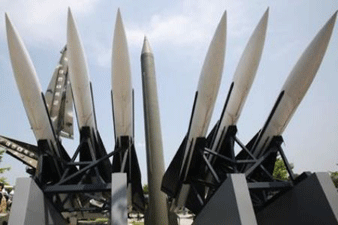
Pakistan’s embattled military regime further dependent on the IMF, the U.S., and the production of munitions for the war in Ukraine to sustain itself through a crisis that shows no sign of resolution.
The U.S.-brokered loan let Pakistan’s military postpone elections, deepen a brutal crackdown, and jail former Prime Minister Imran Khan.
The Intercept, Ryan Grim, Murtaza Hussain, September 17 2023
SECRET PAKISTANI ARMS sales to the U.S. helped to facilitate a controversial bailout from the International Monetary Fund earlier this year, according to two sources with knowledge of the arrangement, with confirmation from internal Pakistani and American government documents. The arms sales were made for the purpose of supplying the Ukrainian military — marking Pakistani involvement in a conflict it had faced U.S. pressure to take sides on.
The revelation is a window into the kind of behind-the-scenes maneuvering between financial and political elites that rarely is exposed to the public, even as the public pays the price. Harsh structural policy reforms demanded by the IMF as terms for its recent bailout kicked off an ongoing round of protests in the country. Major strikes have taken place throughout Pakistan in recent weeks in response to the measures.
The protests are the latest chapter in a year-and-a-half-long political crisis roiling the country. In April 2022, the Pakistani military, with the encouragement of the U.S., helped organize a no-confidence vote to remove Prime Minister Imran Khan. Ahead of the ouster, State Department diplomats privately expressed anger to their Pakistani counterparts over what they called Pakistan’s “aggressively neutral” stance on the Ukraine war under Khan. They warned of dire consequences if Khan remained in power and promised “all would be forgiven” if he were removed.
Since Khan’s ouster, Pakistan has emerged as a useful supporter of the U.S. and its allies in the war, assistance that has now been repaid with an IMF loan. The emergency loan allowed the new Pakistani government to put off a looming economic catastrophe and indefinitely postpone elections — time it used to launch a nationwide crackdown on civil society and jail Khan.
“Pakistani democracy may ultimately be a casualty of Ukraine’s counteroffensive,” Arif Rafiq, a nonresident scholar at the Middle East Institute and specialist on Pakistan, told The Intercept.
Pakistan is known as a production hub for the types of basic munitions needed for grinding warfare. As Ukraine grappled with chronic shortages of munitions and hardware, the presence of Pakistani-produced shells and other ordinances by the Ukrainian military has surfaced in open-source news reports about the conflict, though neither the U.S. nor Pakistan has acknowledged the arrangement.
Records detailing the arms transactions were leaked to The Intercept earlier this year by a source within the Pakistani military. The documents describe munitions sales agreed to between the U.S. and Pakistan from the summer of 2022 to the spring of 2023. Some of the documents were authenticated by matching the signature of an American brigadier general with his signature on publicly available mortgage records in the United States; by matching the Pakistani documents with corresponding American documents; and by reviewing publicly available but previously unreported Pakistani disclosures of arms sales to the U.S. posted by the State Bank of Pakistan.
The weapons deals were brokered, according to the documents, by Global Military Products, a subsidiary of Global Ordnance, a controversial arms dealer whose entanglements with less-than-reputable figures in Ukraine were the subject of a recent New York Times article.
Documents outlining the money trail and talks with U.S. officials include American and Pakistani contracts, licensing, and requisition documents related to U.S.-brokered deals to buy Pakistani military weapons for Ukraine.
The economic capital and political goodwill from the arms sales played a key role in helping secure the bailout from the IMF, with the State Department agreeing to take the IMF into confidence regarding the undisclosed weapons deal, according to sources with knowledge of the arrangement, and confirmed by a related document.
To win the loan, Pakistan had been told by the IMF it had to meet certain financing and refinancing targets related to its debt and foreign investment — targets that the country was struggling to meet. The weapons sales came to the rescue, with the funds garnered from the sale of munitions for Ukraine going a long way to cover the gap.
Securing the loan eased economic pressure, enabling the military government to delay elections — a potential reckoning in the long aftermath of Khan’s removal — and deepen the crackdown against Khan’s supporters and other dissenters. The U.S. remained largely silent about the extraordinary scale of the human rights violations that pushed the future of Pakistan’s embattled democracy into doubt………………………………………..
Bombs for Bailouts
On May 23, 2023, according to The Intercept’s investigation, Pakistani Ambassador to the U.S. Masood Khan sat down with Assistant Secretary of State Donald Lu at the State Department in Washington, D.C., for a meeting about how Pakistani arms sales to Ukraine could shore up its financial position in the eyes of the IMF.
……………………………………………………………………………………………………………………………………………… In an interview with The Intercept at the Capitol on Tuesday, Van Hollen said that his knowledge of the U.S. role in facilitating the IMF loan came directly from the Biden administration………………………………………………………..
Eleventh-Hour IMF Deal
…………………………………………………………………….. The secret arms deal for Ukraine would allow Pakistan to add nearly another billion dollars to its balance sheet ………………………………………………………………………………..
As The Intercept previously reported, Lu, the senior State Department official, said in a meeting with then-Pakistani Ambassador Asad Majeed Khan two weeks after the invasion that it was the belief of the U.S. that Pakistan had taken a neutral position solely at Khan’s direction, adding that “all would be forgiven” if Khan was removed in the no-confidence vote. Since his ouster, Pakistan has firmly taken the side of the U.S. and Ukraine in the war.
……………………………………………………………………………..After orchestrating Khan’s removal, the military embarked on a campaign to eradicate his political party through a wave of killings and mass detentions. Khan himself is currently imprisoned on charges of mishandling a classified document and facing some 150 additional charges — allegations widely viewed as a pretext to stop him from contesting future elections.
………………………………………………………..The absence of other foreign support left Pakistan’s embattled military regime further dependent on the IMF, the U.S., and the production of munitions for the war in Ukraine to sustain itself through a crisis that shows no sign of resolution. https://theintercept.com/2023/09/17/pakistan-ukraine-arms-imf/
Ukraine could get long-range missiles armed with U.S. cluster bombs.

WASHINGTON, Sept 11 (Reuters)
The Biden administration is close to approving the shipment of longer-range missiles packed with cluster bombs to Ukraine, giving Kyiv the ability to cause significant damage deeper within Russian-occupied territory, according to four U.S. officials.After seeing the success of cluster munitions delivered <https://www.reuters.com/world/us-cluster-munitions-ukraine-expected-fridays-800m-aid-package-2023-07-07/> in 155 mm artillery rounds in recent months, the U.S. is considering shipping either or both Army Tactical Missile Systems (ATACMS) that can fly up to 190 miles (306 km), or Guided Multiple Launch Rocket System (GMLRS) missiles with a 45-mile range packed with cluster bombs, three U.S. officials said.
If approved, either option would be available for rapid shipment to Kyiv.
Ukraine is currently equipped with 155 mm artillery with a maximum range of 18 miles carrying up to 48 bomblets. The ATACMS under consideration would propel around 300 or more bomblets. The GMLRS rocket system, a version of which Ukraine has had in its arsenal for months, would be able to disperse up to 404 cluster munitions.
With Ukraine’s push against Russian forces showing signs of progress, the administration is keen to boost the Ukrainian military at a vital moment, two of the sources said.
The White House declined to comment on the Reuters report.
The decision to send ATACMS or GMLRS, or both, is not final and could still fall through, the four sources said. The Biden administration has for months struggled with a decision on ATACMS, fearing their shipment would be perceived as an overly aggressive move against Russia.
Kyiv has repeatedly asked the Biden administration for ATACMS to help attack and disrupt supply lines, air bases, and rail networks in Russian occupied territory.
Last week Ukraine’s Foreign Minister Dmytro Kuleba said he and Secretary of State Antony Blinken had discussed the U.S. providing the long-range missiles and he hoped for a positive decision.
“Now is the time,” one of the U.S. officials said as Ukraine’s forces are attempting to pierce Russian lines just south of the city of Orikhiv in an attempt to divide Russian forces and put its main supply lines under threat. ATACMS or GMLRS with this capability would not only boost Ukrainian morale but deliver a needed tactical punch to the fight, the official said.
The U.S. plan is to include the grenade-packed weapons in an upcoming draw from U.S. stockpiles of munitions, according to the four U.S. officials, who spoke on condition of anonymity because of the sensitive nature of the plan.
At present Ukraine has only one U.S.-furnished cluster munitions, the 155 mm rounds that were announced in July.
The new weapons would augment Ukraine’s current 45-mile range GMLRS rounds, a version that blasts out more than 100,000 sharp tungsten fragments, but not bomblets.
Made by Lockheed Martin (LMT.N), ATACMS come in several versions some of which can fly four times GMLRS’ range, and their use could reset battlefield calculus……………………………………………..
President Joe Biden may ultimately decide against, or delay a decision on the transfer.
Cluster munitions are prohibited by more than 100 countries. Russia, Ukraine and the United States have not signed onto the Convention on Cluster Munitions, which bans production, stockpiling, use and transfer of the weapons.
They typically release large numbers of smaller bomblets that can kill indiscriminately over a wide area. Those that fail to explode pose a danger for decades after a conflict ends.
Washington has committed more than $40 billion in military assistance to Kyiv since Russia launched its full-scale invasion of its neighbor on Feb. 24, 2022.
Reporting by Mike Stone in Washington; Editing by Chris Sanders and Lisa Shumaker https://www.reuters.com/world/us-eyes-long-range-missiles-armed-with-cluster-bombs-ukraine-officials-2023-09-11

1 This Month
23 April – WEBINAR – Why new nuclear reactors are the wrong tools for decarbonization Thursday, April 23 • 1 AM – 2 AM AEST
World Nuclear Power. Reactors 1951-2026, 75 Years of Nuclear Power.
Interactive Map– https://dv.worldnuclearreport.org/

Chernobyl: The Lost Tapes – A good documentary on Chernobyl on SBS available On Demand for the next 3 weeks– https://www.sbs.com.au/ondemand/tv-program/chernobyl-the-lost-tapes/2352741955560

of the week–London Campaign for Nuclear Disarmament


Tell the Ukrainian Government to Drop Prosecution of Peace Activist Yurii Sheliazhenko
To see nuclear-related stories in greater depth and intensity – go to https://nuclearinformation.wordpress.com
-
Archives
- April 2026 (220)
- March 2026 (251)
- February 2026 (268)
- January 2026 (308)
- December 2025 (358)
- November 2025 (359)
- October 2025 (376)
- September 2025 (257)
- August 2025 (319)
- July 2025 (230)
- June 2025 (348)
- May 2025 (261)
-
Categories
- 1
- 1 NUCLEAR ISSUES
- business and costs
- climate change
- culture and arts
- ENERGY
- environment
- health
- history
- indigenous issues
- Legal
- marketing of nuclear
- media
- opposition to nuclear
- PERSONAL STORIES
- politics
- politics international
- Religion and ethics
- safety
- secrets,lies and civil liberties
- spinbuster
- technology
- Uranium
- wastes
- weapons and war
- Women
- 2 WORLD
- ACTION
- AFRICA
- Atrocities
- AUSTRALIA
- Christina's notes
- Christina's themes
- culture and arts
- Events
- Fuk 2022
- Fuk 2023
- Fukushima 2017
- Fukushima 2018
- fukushima 2019
- Fukushima 2020
- Fukushima 2021
- general
- global warming
- Humour (God we need it)
- Nuclear
- RARE EARTHS
- Reference
- resources – print
- Resources -audiovicual
- Weekly Newsletter
- World
- World Nuclear
- YouTube
-
RSS
Entries RSS
Comments RSS
 nuclear-news