Japan’s nuclear-contaminated water discharge should consider hazard accountability and compensation mechanisms

International legal mechanisms, such as the United Nations Convention on the Law of the Sea, grant countries the right to assert their interests, and Japan’s discharge of nuclear-contaminated water has direct and indirect impacts on the global marine environment. Therefore, countries can seek compensation from Japan through international legal mechanisms for environmental restoration and economic compensation.
Chunding Li, Zelei Xing, https://news.cgtn.com/news/2023-09-06/Japan-s-nuclear-wastewater-discharge-should-have-hazard-accountability-1mSm5S2bJsY/index.html
The plan over nuclear-contaminated water discharge from the Fukushima Daiichi nuclear power plant in Japan was launched on August 24, 2023, attracting widespread attention, controversy and condemnation from the international community.
Currently, the Fukushima nuclear power plant generates, per day, approximately 140 tonnes of nuclear-contaminated water, with over 1 million tonnes of accumulated stored radioactive water. According to the plan, the nuclear-contaminated water will undergo treatment before discharge to reduce the concentration of radioactive substances.
However, even after treatment, this nuclear-contaminated water still contains a certain amount of radioactive materials. It is estimated that around 1 million tonnes of nuclear-contaminated water will be released into the sea, being discharged over a period of 30 years, and seeing a daily discharge of approximately 460 tonnes of nuclear-contaminated water.
This poses huge risks to the environment and human health of neighboring countries, not discounting the threat to the development of industries such as agriculture and fisheries. Given the risks involved, countries have the right to demand that Japan assume corresponding compensation responsibilities.
Japan’s nuclear-contaminated water discharge poses potential hazards to human health. The nuclear-contaminated water contains radioactive isotopes, such as cesium, tritium, and strontium, which can enter the food chain of marine ecosystems, affecting the marine ecosystems of surrounding countries directly. When contaminated seafood is consumed, there is a potential risk to human health.
Furthermore, these radioactive substances can spread to distant regions through the influences of climate and oceanic currents, causing long-term impacts on marine ecosystems globally. This can result in the death or migration of marine organisms, biodiversity disruption, and the potential negative impact on the sustainable utilization of fishery resources.
Japan’s nuclear-contaminated water discharge has a negative impact on the development and trade of agriculture and fisheries. Firstly, when contaminated seafood is banned from import or faces consumer scrutiny, it will have a significant impact on the fishing industry of exporting countries. Many countries rely on seafood exports to increase trade revenue and promote economic development. The impacts caused by nuclear-contaminated water will directly threaten the economic interests of these nations, leading to reduced income for fishermen and potentially, even job losses.
Moreover, the discharge of nuclear-contaminated water could also contaminate freshwater resources in neighboring countries, negatively affecting irrigation in farmland and the growth of crops. This poses a threat to the sustainable development of a nation’s agriculture, subsequently impacting the income of farmers and food supplies.
Countries have the right to demand that Japan assumes corresponding compensation responsibilities. Firstly, as the source country of nuclear contamination, Japan should take responsibility for the environmental and human health risks caused by its discharge of nuclear-contaminated water and take measures to mitigate and restore potential damages.
International legal mechanisms, such as the United Nations Convention on the Law of the Sea, grant countries the right to assert their interests, and Japan’s discharge of nuclear-contaminated water has direct and indirect impacts on the global marine environment. Therefore, countries can seek compensation from Japan through international legal mechanisms for environmental restoration and economic compensation.
Secondly, existing international laws should promptly regulate Japan’s actions to ensure that the discharge of nuclear-contaminated water meets international standards and requirements, avoiding irreversible harm to global marine ecosystems and human health.
International cooperation is necessary to seek sustainable development solutions. The international community should enhance supervision and collaboration to collectively address the global challenges posed by the discharge of nuclear-contaminated water and safeguard the sustainable development of human health and the environment.
The discharge of nuclear-contaminated water not only poses significant environmental and health risks within Japan, but also has potential long-term impacts on marine ecosystems of neighboring countries, not excluding the wider global community. Therefore, the international community should strengthen cooperation to jointly formulate and implement relevant policies and standards, to dissuade against nuclear-contaminated water discharge.
In addressing this issue, advancements in science and technology, as well as the principles of equality and cooperation among different countries, should be fully considered. Resolving the global challenges posed by the discharge of nuclear-contaminated water requires joint efforts from all countries, including cooperation in areas such as technological collaboration, information sharing, and exchange of experiences.
Additionally, the international community should also strengthen regulatory oversight and safety controls over nuclear energy, in order to prevent the recurrence of nuclear accidents and pollution.
Ukraine war realises predictions of nuclear power plant threat, says Leicester civil safety expert

29 August 2023, https://le.ac.uk/news/2023/august/nuclear-power-plant-ukraine
Governments need to be aware of the risk of their country’s nuclear power plants being weaponised as they turn to nuclear to tackle the ongoing energy crisis, a University of Leicester civil safety expert has argued.
In his new book Atomic Blackmail? The weaponisation of nuclear facilities during the Russia-Ukraine War, Dr Simon Bennett lays out how the ongoing conflict is confirming long-running concerns about the security of nuclear power plants and their potential to be weaponised to gain political traction over an opponent.
The events of the Russia-Ukraine War have demonstrated the capacity that nuclear power plants have to amplify protagonists’ hitting power, Dr Bennett argues. This is believed to be the first time in the history of nuclear electricity that nuclear power plants have been occupied by an invading force.
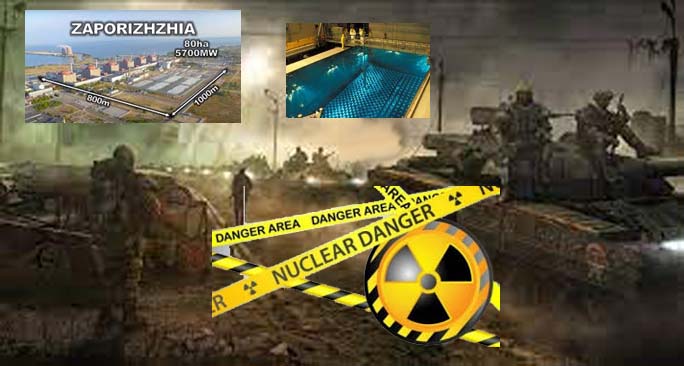
The installations at Chernobyl and Zaporizhzhia have been captured by Russian forces and Zaporizhzhia remains under Russian control. Other installations in Ukraine have been overflown by Russian munitions, such as cruise and ballistic missiles. Outbuildings at both the Chernobyl and Zaporizhzhia sites have been struck by munitions. Both Russia and Ukraine deploy munitions in the vicinity of nuclear power plants.
The possibility of gaining tactical or strategic advantage by weaponising an opponent’s nuclear facilities makes them an attractive target – especially for protagonists who find themselves on the back foot.
Dr Simon Bennett at the University of Leicester said: “The risk is not that of a nuclear detonation. Rather it is that of creating a dirty bomb when a conventional munition such as a ballistic or cruise missile, artillery shell or suicide drone breaches a containment, liberating radionuclides to the environment.
“A dirty bomb creates transborder or transboundary hazard, a serious radiological contamination of the environment – land, air and water – potentially over vast areas and for decades. Radionuclides liberated during the 26 April, 1986 Chernobyl fire were transported on easterly winds as far as Cumbria in north-west England.”
The International Atomic Energy Agency (IAEA) has called on the protagonists to create and respect cordons sanitaires around Ukraine’s nuclear installations, including the highly-vulnerable six-reactor Zaporizhzhia Nuclear Power Plant (NPP). A cordon sanitaire is defined by the IAEA as a military exclusion zone created to mitigate the risk of accidental damage to a NPP, which protagonists would be forbidden from entering. The UK has lent the IAEA diplomatic support.
Dr Bennett adds: “As countries expand existing nuclear electricity programmes, and as other countries go nuclear, the risk of weaponisation and atomic blackmail will grow. After years of prevarication, Britain, alarmed at the unreliability of so-called green energy and worried about energy insecurity, is set to expand its nuclear electricity programme. There is a positive relationship between the number of NPPs in a country and its atomic blackmail risk-exposure. In a European or World War, Britain’s NPPs would be as much a target as the NPPs of any other country.
“Any country with a nuclear power programme, and countries neighbouring countries with nuclear power programmes, should take note of what has happened in Ukraine, and what might happen in the future. There will probably be a 2024 Ukrainian offensive and, possibly, a 2025 offensive. This war will not end quickly.”
- Atomic Blackmail? The Weaponisation of Nuclear Facilities During the Russia-Ukraine War is published by Libri Publishing
Nuclear reactors: Malaysia lacks maintenance culture.

Impossible to guarantee ongoing maintenance and safety of such projects.
Malaysia Kini, Yoursay, Sep 7, 2023
This KiniGuide on small nuclear reactors states that there are only two such small modular reactors in operation – one in Russia and another in China.
Both countries are notoriously secretive about problems in their respective countries. So what models are there in countries where objective, open, and transparent data may be obtained?
That is the first problem that should have been highlighted.
Secondly, former prime minister Abdullah Ahmad Badawi famously referred to our situation as a country of first-world infrastructure and third-world mentality.
What are the safety standards, level of knowledge, expertise, number of experts, and safety professionals needed to manage this venture?
What is the state of knowledge in our universities to manage and produce such professionals
Are we going to pay billions if we do not have to import this knowledge and expertise and then be left high and dry when such expertise should suddenly abandon the project?
It is not very unreasonable to say that our state of knowledge in universities is probably outdated if not backward (considering syllabuses of popular subjects).
Most importantly, going by our poor leadership in public infrastructure departments, it is impossible to guarantee the ongoing maintenance and safety of such projects.
In Selangor where I live, missing drain covers do not get replaced despite regular reminders, nor are the drains ever cleaned despite decades of muck that can lead to flooding.
The contractors hired to maintain the landscape rarely send workers to maintain the grounds.
Areas that are under state or public sector entities are sometimes suddenly converted into makeshift shanties where foreign workers and undocumented workers are housed and charged exorbitant amounts by what appears to be dodgy gangster-like groups operating in those areas.
So, with elements of neglect, apathy, poor understanding of professionalism, and indications of bribery and corruption, how can you provide this “happily-ever-after” version to parrot some opportunistic ministers who may never last their terms in the first place?
Anonymous 1092837465: If the government wants to reduce carbon emissions, it should give thought to saving energy first
Only truth: “Can a fleet of smaller, more flexible nuclear reactors be part of the solution to Malaysia’s energy puzzle?”
In this day and age, our ‘budak kita’ cannot even sort out the basic catering supply to the national airline,……………………………..
Dilapidated public facilities at parks and forest reserves say a lot about the people who managed them and also the high-ranking ministers involved.
These people cannot be trusted with dangerous things like uranium or plutonium.
We have a nuclear research facility in name only, allocations were given, grandiose pipedream proposals were made, and allocations were given for years. https://www.malaysiakini.com/news/678306
Nation-States as “Business Models”: Ukraine as Another Neoliberal Privatization Exercise
By Dr. T. P. Wilkinson, Global Research, August 31, 2023 https://www.globalresearch.ca/states-business-models-ukraine-another-neo-liberal-privatization-exercise/5830818
Introduction
Perhaps the leading two veteran critics of US policy in Ukraine, Colonel Douglas MacGregor USA and Major Scott Ritter USMC, have said loud and clear that at least from a military standpoint the Ukrainian armed forces have lost the war against Russia.
There have been numerous voices calling for an end to the conflict, not least because the more than USD 46 billion and counting in military aid alone, has yet to produce any of the results announced as aims of what has finally been admitted is a war against Russia.[i]
If Mr Zelenskyy, the president of the Ukraine’s government in Kiev, is to be taken at face value, then the hostilities can only end when Crimea and the Donbass regions are fully under Kiev’s control and Vladimir Putin has been removed from office as president of the Russian Federation. To date no commentator has adequately explained how those war aims are to be attained. This applies especially after the conservatively estimated 400,000 deaths and uncounted casualties in the ranks of Kiev’s forces since the beginning of the Special Military Operation in February 2022.
Before considering the political and economic issues it is important to reiterate a few military facts, especially for those armchair soldiers who derive their military acumen from TV and Hollywood films.
As MacGregor and Ritter, both of whom have intimate practical knowledge of warfare, have said. Armies on the ground need supplies, i.e. food, weapons, ammunition, medical care for wounded, etc.
These supplies have to be delivered from somewhere.
In ancient times, armies could live off the land. Essentially this was through looting and plunder—stealing their food from the local population as they marched. To prevent the local population from becoming the enemy in the rear and avoid early exhaustion of local supply, generals started paying for what was requisitioned.
To prevent this defending forces would often withdraw the civilian population and destroy what could not be taken. In fact this kind of rough warfare against civilians still occurs although it has been forbidden under the Law of Land Warfare.[ii]
Naturally the soldier in the field can no longer make weaponry and even less plundered from the local inhabitants—unless one comes across some tribe the US has armed with Stingers perhaps.
All the weapons the Ukrainian armed forces deploy have to be imported from countries with factory capacity.
As the two officers among others have said, the capacity is unavailable for the Ukraine.
Obviously it would also be unavailable to NATO forces were they able to deploy in Ukraine in any numbers.
It is illusory to believe that a NATO army can do what the Wehrmacht could not some eighty years ago with three million men under arms and the most modern army of its day.
This was so obvious from the beginning that one has to wonder why this war ever started.
Is it possible that wars are started without any intention of winning them?
If winning the war is not the objective, then what is?
The deep roots of the Yucca Mountain nuclear waste fight — and why it continues to this day

Sep 05, 2023, By: Paulina Bucka, https://www.ktnv.com/news/the-deep-roots-of-the-yucca-mountain-nuclear-waste-fight-and-why-it-continues-to-this-day?mibextid=2JQ9oc&fbclid=IwAR2n8wFDd8P4EIq0HqFMPy2ASLEGa_caRDfN8zyxddED3YKpB-bNpPAV8H4
YUCCA MOUNTAIN (KTNV) — For Nevada, it’s the question that doesn’t go away.
The fight to stop Yucca Mountain from becoming a nuclear waste repository has gone on for more than three decades now. Despite an official halt to the project in 2010, that fight continues for Nevada’s Congressional delegation and the Western Shoshone people.
For the Western Shoshone, it’s a cause large than themselves — a calling to preserve their identity for generations to come.
“For the Shoshone people, our identity is the land,” said Ian Zabarte, principal man of the Shoshone Nations. “We developed our language in relation to the land — to be able to talk about it, to be able to share it.”
For decades, those ties have been threatened by the radioactive fallout of nuclear testing.
“You used to be able to drink the water from any of the springs around you,” Zabarte said. “Now, you can’t do that any more because of the pollution.”
One hundred miles northwest of the bright lights of Las Vegas, miles past Mercury, Nevada, sits Yucca Mountain — a 60-million-acre formation made up of mostly fractured volcanic tuffs.
It’s almost home to the Western Shoshone Nation people — a home Zabarte says he hopes to see restored to its most natural form within his lifetime.
Some of the big pollution is radioactive fallout from the nuclear weapons testing,” Zabarte said. “We cannot just pick up and leave in the event of the radiation, the fallout — we lose our identity.”
Zabarte has spent his life on the front lines of the fight to keep nuclear waste out of his ancestral home.
“We would walk all the way across the valley to the main gate at the Nevada Test Site doors and have our protests there,” Zabarte said. “I received a letter in 2001 that said I’m at risk of developing silicosis because of the number of hours I spent underground at Yucca Mountain.”
While the U.S. no longer performs nuclear testing, nuclear advances continue, and questions about what happens to the nation’s nuclear waste remain.
“After testing, Nevada was angry enough about what had happened because of nuclear weapons testing that it said, ‘Never again. We’re not going to be the high-level waste dump for this country,'” said Kevin Kamps, a radioactive waste specialist.
Kamps has walked alongside the Shoshone Nation people for decades in protest of nuclear testing and the proposed repository that would have sat roughly 1,000 feet under Yucca Mountain.
“What happened in our state was Nevada never had consent, and in 1982, when the bill was passed that designated Nevada as the nation’s nuclear storage waste disposal area, that didn’t come with any of our consent,” said Rep. Susie Lee, a Democrat representing Nevada’s 3rd Congressional District.
The late U.S. Senate Majority Leader Harry Reid spent his career leading the battle against the project, which began in the 1980s, during President Ronald Reagan’s administration.
President Barack Obama called the Yucca Mountain project “unworkable” in 2010 and made good on his campaign promise to Nevadans to end it and cut funding for the project.
“This was a political cartoon that ran in the Las Vegas Review-Journal back in 2010, and it really celebrated the end of the Yucca Mountain Project, this attempt by the U.S. government to attempt to dump all the country’s high radioactive waste here in Nevada,” Kamps said.
Ten years later, President Donald Trump — a supporter of nuclear energy — initially called for the licensing process of Yucca Mountain to restart. But in 2020, Trump announced that he would reverse his policy and halted his support of the project.
Today, the question still remains: Where should the nation’s nuclear waste be stored? It’s a near-constant fight for members of Nevada’s congressional delegation to this day.
“The fact of the matter is, there are 27 states that have nuclear waste, spent fuel from nuclear reactors, and those states want a solution,” Lee said.
Lee says the bipartisan position from Nevada lawmakers is clear: Nevadans don’t want to see any funding go back into the Yucca Mountain project.
“There will need to be a long-term solution for this,” she said. “I’m working with my counterparts to try and come up with a solution, how we can reprocess that waste, but most importantly, how and where it can be put where there is consent.”
For the Shoshone Nation lineage, the Yucca Mountain fight goes beyond politics. Its members say it’s a race to preserve what’s left of the mountain to leave behind for future generations.
“They say that we are as naive as Native Americans because of our holistic conservation of the land for future generations,” Zabarte said. “They don’t see that as value, that the land is somehow being wasted.
“We’re trying to protect this land so our future generations can live a good quality of life,” he said.
Nuclear Waste Dump Threatens Kichi Sìbì (Ottawa River)
Indigenous Climate Action, August 23
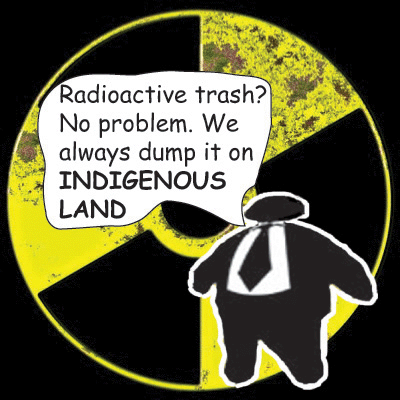
Canadian Nuclear Laboratories (CNL) is pushing forward construction of a Near Surface Disposal Facility (NSDF), otherwise known as a nuclear waste dump, less than 1 kilometre away from the Kichi Sìbì (the Ottawa River) without the Free, Prior, and Informed Consent of the Algonquin Nations whose territory they are on.
On June 20, impacted nations spoke out against the project during a news conference where they also made public an Indigenous-led Assessment of the Canadian Nuclear Laboratories Near Surface Disposal Facility And Legacy Contamination Of Algonquin Aki Sibi.
The chiefs made it clear that this project is a direct threat to the rights of Indigenous peoples and the project would pose serious threats to culture, land, water and wildlife. It is important to understand that this is not just a risk to Indigenous communities; it is a risk to everyone who lives along the Ottawa River, including residents in Ottawa who rely on the river for their water and livelihood.
Nuclearization of Indigenous Land
Beginning nearly eighty years ago with the establishment of the Chalk River Laboratories along the Kichi Sìbì, sitting on unceded Algonquin territory, Indigenous nations have been facing the expansion of so-called Canada’s nuclear industry. The Chalk River Laboratories sits across the river from a noted community spiritual site, Oiseau Rock, near the lumbering town of Chalk River.
The Canadian Nuclear Laboratories (CNL) is a branch of the federal crown corporation, the Atomic Energy of Canada Limited (AECL). Chalk River Laboratories are owned by CNL, and operated by the Canadian National Energy Alliance, a private-sector holding company—that is not under direct control of the government—overseen by SNC-Lavalin.
“This nuclear site is already leeching radioactive pollution into the Ottawa River in the form of Tritium, which is radioactive hydrogen, and it’s only going to get progressively worse. And there’s no treatment for Tritium. So CNL and CNSC (Canadian Nuclear Safety Commission) will tell you that they are going to build a treatment plant, but you know in our world we know that you never build your treatment plant above where you collect your drinking water—and this is precisely what CNSC is going to do.” — Chief Lance Haymond (Kebaowek First Nation)
While CNSC claims that it had signed an agreement and received consent from the Algonquins of Pikwàkanagàn, in truth, they consulted only one voice of the Algonquin nation, the remaining ten communities oppose the project and have not given their consent.
“The Canadian government has failed its duty to consult with us. We also point out that approving this dump would violate UNDRIP… we do not consent with the construction of the NSDF in our territory. We believe that consultation has been inadequate, and our Indigenous rights are threatened by this proposal.”
— Chief Dylan Whiteduck (Kitigan Zibi Anishinabeg First Nation)…………………………………………………………………………………………………………………………………………………………………………………………………………………….. more https://www.indigenousclimateaction.com/entries/nuclear-dump-threatens-kichi-sibi
Lifetime War Abolisher of 2023 award to David Bradbury

September 7, 2023, The AIM Network, By Sandi Keane
The cracks in Labor ranks over AUKUS won’t be going away despite Albanese staring down dissenters at Labor’s national conference. A pitched battle over the choice of submarine base is guaranteed – and now we discover that Albanese has suffered the mother of all brainsnaps: Australia has agreed to set up a weapons-grade nuclear waste dump. At the heart of the resistance to this militarism has been David Bradbury’s documentary film The Road to War (2013).
Last week, Australia’s legendary political filmmaker, David Bradbury, achieved another media milestone with this much-lauded anti-AUKUS documentary, The Road to War. Adding to the list of International and Australian film awards including two Academy-award nominations (Frontline (1979) and Chile Hasta Quando? (1985), his latest documentary won the World BEYOND War’s Individual ‘Lifetime War Abolisher Award’ – named for David Hartsough, who co-founded World BEYOND War in Virginia, USA in 2014.
The creator of 26 documentary films, Bradbury advances our understanding of war, peace, international relations and peace activism. His films have been broadcast around the world on the BBC, PBS, ZDF (Germany), and TF1-France, as well as ABC, SBS and commercial television networks in Australia……………………………………………..
Bradbury shoots his own footage, traveling widely, and seeking out people with uncomfortable truths to tell – sometimes at great risk. Bradbury has filmed in Iran during the final days of the Shah, in Nicaragua during the CIA-Contra war, and in El Salvador during the days of death squads during the early 1980s. His film on Pinochet’s Chile, Chile Hasta Quando? (1985) was nominated for an Academy Award. He has filmed independence struggles in East Timor and West Papua, and in India, China, and Nepal.
In The Road to War, concern is raised among the Australian experts interviewed by Bradbury about Australia’s AUKUS commitment of hundreds of billions of dollars for new weaponry, nuclear propelled submarines and stealth bombers – to protect us against our biggest trading partner – China. Yes, China. The film shows why it is not in Australia’s, or the world’s interests to be dragged into another US-led war and brings into sharp focus that Australia is being set up as USA’s proxy:
“Basing US B52 and stealth bombers in Australia is all part of preparing Australia to be the protagonist on behalf of the United States in a war against China. If the US can’t get Taiwan to be the proxy or its patsy, it will be Australia,” warns former Australian ambassador to China and Iran, John Lander, in Bradbury’s film.
We all appreciate the Labor Government was still on its toddler legs when it signed the AUKUS agreement and had only 24 hours to decide – or be wedged on Defence by the Coalition in the 2019 federal election.
But the cracks in Labor ranks won’t be going away despite Albanese staring down dissenters at Labor’s national conference and enshrining the tripartite security pact in the party’s policy platform. A pitched battle over the choice of submarine base is guaranteed – and now we discover that Albanese has suffered the mother of all brainsnaps: Australia has agreed to set up a weapons-grade nuclear waste dump. According to the Fact Sheet: Trilateral Australia-UK-US Partnership on Nuclear-Powered Submarines:
“… as part of this commitment to nuclear stewardship, Australia has committed to managing all radioactive waste generated through its nuclear-powered submarine program, including spent nuclear fuel, in Australia.”
Who knew about that? Hats off to Crikey for disclosing the secret no-one is talking about. Where was the spirited public debate about which port such terrorist “bait” will be shipped to, how it would be transported? By truck? Train? Where to? Given the Coalition has had a nuclear waste dump on the back burner for decades, Maralinga is the likely bet.

The lack of debate now resembles the barely reported signing of the Global Nuclear Energy Partnership (GNEP) by Prime Minister John Howard on 5 September 2007. Had the Coalition won the 2007 election on 24 November, Australia was on track to become a global nuclear waste dump. Did anyone know about it then? Like now, it went under the media radar. MSM were MIA.
Back then, Howard had control of both houses. All the ducks were in a row. The Commonwealth Radioactive Waste Management Bill 2005 had passed effectively transferring power to the Minister to nominate nuclear waste dump sites. The ANSTO Bill passed around the same time giving ANSTO the power to accept waste generated outside Australia.
Maralinga in South Australia seemed to tick all the boxes. But they forgot that nuclear waste produces hydrogen when it eventually breaks down and Maralinga is sited right on top of the Great Artesian Basin.
John Large, whose company, Large & Associates handled the salvage of the stricken Russian U-sub, Kursk, told Julie Macken in an interview in New Matilda on 15 November 2006 that when the waste breaks down, it produces hydrogen and “there is simply no way, over a 100,000-year time scale, to stop the fuel leaking out.”
Large was shocked to hear that Australia wanted to go down this path. Question is: “are we about to do just that?”……………………………………………………..
The 2023 War Abolisher Awards and the video of David Bradbury’s acceptance speech can be accessed on the website at War Abolisher Awards.
War Abolisher awardees are honoured for their body of work directly supporting one or more of the three segments of World BEYOND War’s strategy for reducing and eliminating war as outlined in the book A Global Security System, An Alternative to War. They are: Demilitarizing Security, Managing Conflict Without Violence, and Building a Culture of Peace.
You can view a clip from The Road to War below:
Bradbury’s films can be viewed at Frontline Films.
For further information, email david@frontlinefilms.com.au
Editor’s Note: The next showing of Bradbury’s film is scheduled for 21 September at ANU Film Club, Canberra. A variation of this article was published in Pearls and Irritations on 3 September, 2023. https://theaimn.com/lifetime-war-abolisher-of-2023-award-to-david-bradbury/
Eastern European NATO Countries Fear Peace Talks Between Ukraine and Russia
Poland and the Baltic states are worried growing opposition to the proxy war inside the US could lead to negotiations
SCHEERPOST, By Dave DeCamp / Antiwar.com,6 Sept 23
NATO members that border Russia and Belarus are afraid that growing opposition to the proxy war in Ukraine inside the United States will put pressure on the Ukrainians to pursue peace talks with Russian President Vladimir Putin, The Hill reported on Tuesday.
While the Biden administration’s stated policy is to back Ukraine for “as long as it takes,” and the majority of Congress still supports the proxy war, there is there is fatigue among Americans. A recent poll from CNN found that 55% of Americans are against Congress authorizing more spending on the conflict.
Former President Trump, the Republican frontrunner for the 2024 election, has claimed he would end the war in Ukraine within “24 hours.” The Biden administration is looking to sign a long-term security deal with Ukraine to tie the hands of a future administration on the issue, but the political climate has some NATO members nervous that peace might be pursued.
The report said that for Poland and the Baltic states of Latvia, Lithuania, and Estonia, talking with Putin is a “red line.” The four nations want the US and the rest of Ukraine’s Western backers to prepare for a future where the Russian leader is completely isolated……………………….
Ukrainian President Volodymyr Zelensky has maintained demands for peace talks that are a non-starter for Moscow, including a full Russian withdrawal and Russia ceding Crimea. Zelensky and his government will likely not drop the maximalist demands unless Ukraine loses the support of the US and NATO, which Kyiv has acknowledged is fueling the entire war effort……………………………………………. more https://scheerpost.com/2023/09/06/eastern-european-nato-countries-fear-peace-talks-between-ukraine-and-russia/
Depleted Uranium Won’t Bring Peace to Ukraine

Wednesday, September 6th, 2023, By Robert C. Koehler, http://commonwonders.com/3828-2/
Freedom’s just another word for . . . blowing up your children? Giving them cancer?
Militarism is obsolete, for God’s sake. Its technology is out of control. The latest shred of news that has left me stunned and terror-stricken is this, as reported by Reuters: “The Biden administration will for the first time send controversial armor-piercing munitions containing depleted uranium to Ukraine. . . . It follows an earlier decision by the Biden administration to provide cluster munitions to Ukraine, despite concerns over the dangers such weapons pose to civilians.”
Russia’s war on Ukraine is a disaster at every level. Some 70,000 Ukrainians have died, according to the New York Times, and possibly another 120,000 have been wounded, with Russia’s casualty level actually far higher. The war (like all wars) has to stop, but NATO and the U.S., just like Russia itself, are looking not for peace and conflict resolution but victory. Killing the enemy is what matters, the more the better. War is humanity’s most horrific addiction. When it takes hold of a people’s soul, all environmental and human concerns vanish. And today – indeed, throughout the course of my lifetime – with the development of nuclear weapons, we’ve been at the brink of self-generated extinction. And we’re still playing with it, rather than trying to move beyond it.
Depleted uranium – DU – is one of the playthings of war: At 1.6 times the density of lead, DU shells are the last word in penetration power: locomotives compressed to the size of bullets. The shells ignite the instant they’re fired and explode on impact.
I first started writing about depleted uranium in 2003, when I heard Doug Rokke (who died two and a half years ago) speak in Chicago. Doug, a career soldier, was involved in the first Gulf War, leading a team of soldiers whose job was to clean up the war zones in the aftermath of our bombing raids.
As I wrote then: Depleted uranium “isn’t really depleted of anything. It’s dirty: U-238, the low-level radioactive byproduct of the uranium enrichment process. And when the ammo explodes, poof, it vaporizes into particles so fine — a single micron in diameter, small enough to fit inside red blood cells — that, well, ‘conventional gas mask filters are like a barn door.’
“. . .What’s not to love, if you’re the Pentagon? We pounded Saddam’s army with DU ammo in Gulf War 1 and destroyed it on the ground. Maybe you’ve seen pictures of what we did to it; GIs cleaning up afterward coined the term ‘crispy critters’ to describe the fried corpses they found inside Iraqi tanks and trucks.”
But the horror of DU is what happens after the battles are over. DU stays in the environment, and has been linked to huge rises in cancer and birth defects in the conflict zones. As Doug Rokke said: “You can’t clean it up.”
But so what? According to Sydney Young, writing for the Harvard International Review:
“In the past, leaders did not pay the necessary amount of attention to the risks of depleted uranium. Documents suggest that the United States may have known about the potential consequences of depleted uranium during conflicts in which it was used. The International Atomic Energy Agency (IAEA) published a 1991 report indicating that deploying depleted uranium in the Gulf War could have caused 500,000 cancer deaths.
“However, the United States still used depleted uranium in the Middle East despite the risks, deeming that its military benefits outweighed the potential civilian impact. This calculus reflects a common trend in which western countries justify human rights abuses under the guise of ‘national interest’ or military necessity.”
Another tactic of the political militarists is to deny there’s any negative consequences to their actions. Young also notes: “Research also faces political barriers. Governments that use depleted uranium have a vested interest in preventing research that suggests it has negative effects on human health. For instance, the United States, United Kingdom, Israel, and France all opposed a 2001 United Nations resolution to document depleted uranium in war.”
There’s a collective human addiction not simply to militarism and war, but to winning: to domination. A focus on winning in the moment obliterates any sense of the larger future. The creation of peace is not a simplistic game. It has no weapons to parade before the public, whose use will obliterate the enemy of the moment and make the world a better place once and for all.
Noting the horrific extent to which the Ukraine war has stalemated, Jeet Heer writes at The Nation: “The time is surely ripe for a diplomatic push. Unfortunately, the passions ignited by war always make negotiations difficult” . . . and, alas “a strong ‘taboo’ against public discussion of diplomacy pervades the NATO countries.”
This is understandable, he notes, considering the criminality of the Russian invasion and the horror it has inflicted on Ukraine: “But an interminable bloodbath on Ukrainian soil is also horrific.”
Humanity has to figure out how to talk to itself, not kill itself.
Russia warns return of US nuclear weapons to UK would be seen as escalation
Russia would regard any return of US nuclear weapons to bases in Britain as an “escalation and a destabilizing practice,” Foreign Ministry spokeswoman Maria Zakharova told a briefing on Tuesday.
She also said that such a practice is “openly anti-Russian in nature, as it provides for joint planning and regular training exercises for the prompt delivery of nuclear strikes by members of NATO which is hostile to us against targets in Russia from the territory of non-nuclear European countries.”
“We will continue to demand the return of all American nuclear weapons to US territory, followed by the removal of infrastructure that would allow them to be quickly deployed in Europe,” she added.
Japan announces emergency relief for seafood exporters hit by China’s ban over Fukushima water
Japan announces emergency relief measures for seafood exporters hit by
China’s ban. Japanese Prime Minister Fumio Kishida announced on Monday a
20.7 billion yen ($141 million) emergency fund to help exporters hit by a
ban on Japanese seafood imposed by China in response to the release of
treated radioactive wastewater from the damaged Fukushima nuclear power
plant.
Daily Mail 4th Sept 2023
Globe & Mail 5th Sept 2023
Crew sailing ‘original peace boat’ reflect on mission to promote end of nuclear weapons

the issue boils down to the human heart.
The problem isn’t the nuclear weapons themselves or the countries that have them,” …… “The problem is the way of thinking that it’s okay to annihilate people to accomplish your goals. So, change that, and nuclear weapons can go away on their own.”
The Golden Rule has visited 92 cities across the world through the non-profit Veterans for Peace.
The visiting voyagers said they’re building on the legacy of sailors before them, who sailed the Golden Rule in 1958 from Hawaii towards a nuclear test zone in the Marshall Islands in protest.
By: Tahleel Mohieldin, Sep 05, 2023 https://www.tmj4.com/news/local-news/crew-sailing-original-peace-boat-reflect-on-mission-to-promote-end-of-nuclear-weapons
MILWAUKEE — Slicing through the windy waters of Lake Michigan, and taking up residence on the 65-year-old sailboat known as the Golden Rule, Captain Kiko Johnston-Kitazawa and his crew have plenty to keep them busy Labor Day weekend.
“It’s a very seaworthy vessel,” Johnston-Kitazawa said. “It’s not extremely fast but it can handle rough water and protect the crew.”
As they near the end of a 13-month 11,000-mile journey through the Great Loop, to raise awareness about the dangers of nuclear weapons, it’s more than a love of sailing that unites the crew.
“It’s nice to be able to sail on a boat that has a purpose,” said crew member Tamar Elias. “So much power, so much history.”
The visiting voyagers said they’re building on the legacy of sailors before them, who sailed the Golden Rule in 1958 from Hawaii towards a nuclear test zone in the Marshall Islands in protest.
Elias said though they never made it to the Marshall Islands, because they were arrested, their message got people’s attention and ultimately led to the end of atmospheric testing.
“Now in the last six or seven years there’s been a lot of going backward,” Johnston-Kitazawa said. “I won’t say all but the larger nuclear powers boasting about their capabilities and threatening directly or indirectly, subtly to use them so it’s time again.”
As he sails on what has come to be known as the original peace boat that started a movement Captain Johnston-Kitazawa said he’s come to realize the issue boils down to the human heart.
The problem isn’t the nuclear weapons themselves or the countries that have them,” he explained. “The problem is the way of thinking that it’s okay to annihilate people to accomplish your goals. So, change that, and nuclear weapons can go away on their own.”
The Golden Rule has visited 92 cities across the world through the non-profit Veterans for Peace.
Through Labor Day weekend people in Milwaukee were invited to view the sailboat which temporarily took up residence near Lakeshore State Park.
Important new BMJ article increases our perception of radiation risks

September 3, 2023
The BMJ article which was published on Aug 16, 2023 (accessible free of charge) is the result of a lengthy occupational study by US Professor David Richardson and a team of 11 academics and public health researchers in the US, UK, France and Spain. https://www.bmj.com/content/382/bmj-2022-074520
Its conclusion states
“This major update to INWORKS provides a direct estimate of the association between protracted low dose exposure to ionising radiation and solid cancer mortality based on some of the world’s most informative cohorts of radiation workers. The summary estimate of excess relative rate solid cancer mortality per Gy is larger than estimates currently informing radiation protection, and some evidence suggests a steeper slope for the dose-response association in the low dose range than over the full dose range. These results can help to strengthen radiation protection, especially for low dose exposures that are of primary interest in contemporary medical, occupational, and environmental settings.”
In a nutshell, the article’s findings
- substantially increase our perception of radiogenic risks
- confirm that the linear no threshold model for radiation risks is acceptable
- give new hard evidence of increased risks at low levels of exposure
- act to question the continued use of the LSS studies of Japanese bomb survivors in deriving absolute radiation risks for the public
- act to question the ICRP’s continued use of DDREFs which at present halve radiation risks, and
- act to put pressure on ICRP, WHO, IAEA, etc to revise upwards the current low risks of radiation.
DISCUSSION
- Numerical Risk of Radiation…………………………………………………………………………………………………..So it can be shown that the INWORKS study increases the currently perceived absolute risk of fatal cancer in the UK from ~ 5% to 13% per Sv. This is a substantial increase and will need to be addressed by the ICRP and national authorities.
- 2. Strengthens and Increases the risks found older studies. Second, the new study strengthens an earlier 2018 study (Richardson et al, 2018) by the same team by adding another 10 years’ data to the epidemiology datasets used in the metastudy. It not only strengthens the findings but actually increases the observed ERR risk by ~10% ie from 0.47 to 0.52 per Gy.
- 3. Increased Risks at Low Doses. Perhaps most significant, are the study’s findings of higher risks at very low doses between 0 and 150 mGy which are the doses we need to be concerned with………………………………………………………………………………………………………………………………………more https://www.ianfairlie.org/news/important-new-bmj-article-increases-our-perception-of-radiation-risks/?fbclid=IwAR0TtpWfyxm1ebiaHGw_eUJd1n1PWRfkmGF3n-YtBnO0rMIRi2XqcPzYYWY
Guam nuclear energy ban focus of Tuesday hearing

By Joe Taitano II – For Variety, Sep 4, 2023 https://www.mvariety.com/news/regional_world/guam-nuclear-energy-ban-focus-of-tuesday-hearing/article_4a573368-4abf-11ee-aaa0-4335e65acd7f.html
HAGÅTÑA (The Guam Daily Post) — Residents can weigh in Tuesday morning on a proposal to ban nuclear energy from Guam’s shores.
Bill 151-37, sponsored by Sen. Sabina Perez, would ban nuclear reactors, from conventional reactors large enough to provide for the island’s entire energy consumption in one site to microreactors that can provide about as much power as the Dandan Solar Farm in a package that can fit on an airplane.
The hearing is scheduled for 9 a.m. Tuesday at the Guam Congress Building.
Perez said while nuclear power is becoming more popular in response to climate change, her bill intends to protect the community and environment from the inherent dangers of nuclear power.
“The main concerns are the likelihood of radiation exposure in a typhoon and an earthquake-prone region that could exacerbate recovery efforts. Additionally, our community is suffering from increasing rates of cancer compared to the continental U.S., which is experiencing declining rates,” Perez said.
She said adequate storage and disposal of nuclear waste could be a concern, given the limited space and growing population on island.
“As Pacific Islanders who are on the front lines of climate change, our future should not be built on risk but on responsible innovation for a sustainable future,” she said.
The text of the bill also weighs the strategic military importance of the island.
While federal officials planning a 360-degree missile defense system for the island have shot down ideas that nuclear microreactors could be used to power the new systems, both Andersen Air Force Base and Naval Base Guam were identified as candidates for portable nuclear power plants in a study commissioned by the Army in 2018.
The Pentagon last year announced plans to deploy portable nuclear reactors to remote forward operating bases, though Guam hasn’t been officially announced as a candidate site.
The hearing will be livestreamed on GTA Channel 21, Docomo Channel 117 and the Guam Legislature Media YouTube channel.
Nuclear energy touted at West Virginia Chamber forum, but key cost, oversight and waste management questions linger
The Herald Dispatch, By Mike Tony 4 Sept 23
West Virginia political and business leaders made clear during last week’s state Chamber of Commerce annual summit they see a significant role for nuclear power in the state’s energy future.
“It’s a promise for our state,” Sen. Shelley Moore Capito, R-W.Va., said of nuclear energy during a summit speech at The Greenbrier resort in White Sulphur Springs Wednesday.
But recent federal reports have observed key cost, waste management and federal oversight questions linger over unconventional — or “advanced” — nuclear technologies that supporters say would be safer and cheaper than existing nuclear reactors.
……………………………………….. Emil Avram, vice president of business development at Virginia-based Dominion Energy, estimated the nuclear facility Dominion is exploring would require an investment of $3 billion to $5 billion per 300- to 400-megawatt facility — and that the company is planning to build up to 18 of those units over the next 25 years.
“So we also have to find sustainable, I’ll call it balance-sheet solutions for our company as we build out this capital-intensive infrastructure,” Avram said.
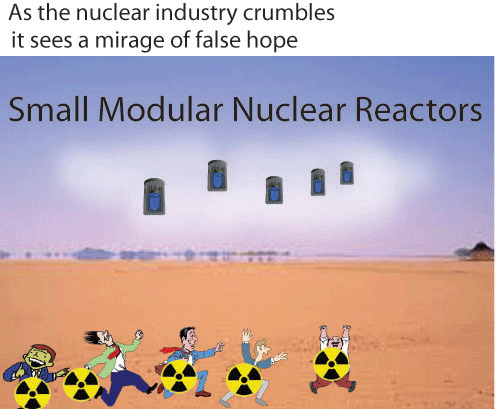
……………………………………Small modular reactor technology is not yet market-ready. The Department of Energy has approved cost-share awards to develop small modular reactors that can be operational by the end of the decade.
A Congressional Research Service overview of advanced nuclear reactors published in February noted research on small modular reactors suggesting their small size will keep them from achieving economies of scale.
The overview noted a 2018 study by researchers from Carnegie Mellon and Harvard universities and the University of California, San Diego predicting the cost per unit of power of a small modular reactor would very likely be higher than that of a large reactor, even if the smaller reactors may be cheaper to build.
The unit cost of producing electricity from nuclear energy was slightly more than coal and over double that of solar, geothermal, onshore wind or natural gas in the federal Energy Information Administration’s annually published energy outlook for 2022.
In its overview, the Congressional Research Service, a nonpartisan policy analysis agency within the Library of Congress, quoted a 2023 conclusion from the National Academies of Sciences, Engineering, and Medicine that there’s a “learning curve for both small modular reactor construction costs and deployment [that] needs to be understood……………………………………………………
The West Virginia Legislature lifted restrictions on nuclear power plant construction early in the 2022 regular legislative session.
The Senate on July 27 included the Capito and Carper-led nuclear measure, the Accelerating Deployment of Versatile, Advanced Nuclear for Clean Energy (ADVANCE) Act, in the National Defense Authorization Act that passed through the chamber. The National Defense Authorization Act would approve fiscal year 2024 appropriations and establish policies for Department of Defense programs…………………………………………..
A recent federal government watchdog report found the agency charged with protecting public safety and health regarding nuclear energy has important work to do to prepare for an expected influx of advanced nuclear reactor applications.
The Nuclear Regulatory Commission has staffing and licensing review issues that could hinder the agency’s oversight and developers’ ability to deploy advanced nuclear reactors, the Government Accountability Office found in its report released in July.
The office found commission officials and most stakeholders it interviewed indicated the commission faces challenges in hiring and retaining staff needed to review advanced reactors.
Existing commission guidance does not clearly advise agency staff on how to establish and manage licensing review schedules for incomplete applications, the Government Accountability Office found.
Without such guidance, the commission’s reviews of advanced reactor applications may not be clear and predictable, the office warned.
Capito and Rep. Cathy McMorris Rodgers, R-Wash., the top Republican on the House Energy and Commerce Committee, had asked the office last year to assess the commission’s preparedness to review and approve advanced nuclear reactor applications.
the Congressional Research Service noted some advanced reactor technologies have chemical properties that pose safety concerns, including reactivity, toxicity, or corrosiveness of the primary coolant in the case of sodium, lead and molten salts, respectively.
It’s unclear whether future advanced nuclear reactor technologies would improve on past handling of reprocessing wastes, the Congressional Research Service report observed. The service cited a National Academies of Sciences, Engineering, and Medicine report published this year finding that amounts and types of waste that will be generated by advanced reactors are difficult to estimate “at this early stage” of development. https://www.herald-dispatch.com/news/nuclear-energy-touted-at-wv-chamber-forum-but-key-cost-oversight-and-waste-management-questions/article_7941cf2a-19dc-57e7-a44d-30a7672728da.html
1 This Month
23 April – WEBINAR – Why new nuclear reactors are the wrong tools for decarbonization Thursday, April 23 • 1 AM – 2 AM AEST
World Nuclear Power. Reactors 1951-2026, 75 Years of Nuclear Power.
Interactive Map– https://dv.worldnuclearreport.org/
Chernobyl: The Lost Tapes – A good documentary on Chernobyl on SBS available On Demand for the next 3 weeks– https://www.sbs.com.au/ondemand/tv-program/chernobyl-the-lost-tapes/2352741955560

of the week–London Campaign for Nuclear Disarmament

Tell the Ukrainian Government to Drop Prosecution of Peace Activist Yurii Sheliazhenko
To see nuclear-related stories in greater depth and intensity – go to https://nuclearinformation.wordpress.com
-
Archives
- April 2026 (220)
- March 2026 (251)
- February 2026 (268)
- January 2026 (308)
- December 2025 (358)
- November 2025 (359)
- October 2025 (376)
- September 2025 (257)
- August 2025 (319)
- July 2025 (230)
- June 2025 (348)
- May 2025 (261)
-
Categories
- 1
- 1 NUCLEAR ISSUES
- business and costs
- climate change
- culture and arts
- ENERGY
- environment
- health
- history
- indigenous issues
- Legal
- marketing of nuclear
- media
- opposition to nuclear
- PERSONAL STORIES
- politics
- politics international
- Religion and ethics
- safety
- secrets,lies and civil liberties
- spinbuster
- technology
- Uranium
- wastes
- weapons and war
- Women
- 2 WORLD
- ACTION
- AFRICA
- Atrocities
- AUSTRALIA
- Christina's notes
- Christina's themes
- culture and arts
- Events
- Fuk 2022
- Fuk 2023
- Fukushima 2017
- Fukushima 2018
- fukushima 2019
- Fukushima 2020
- Fukushima 2021
- general
- global warming
- Humour (God we need it)
- Nuclear
- RARE EARTHS
- Reference
- resources – print
- Resources -audiovicual
- Weekly Newsletter
- World
- World Nuclear
- YouTube
-
RSS
Entries RSS
Comments RSS
 nuclear-news