New Brunswick Indigenous communities and Canadians need facts about Small Modular Nuclear Reactors, not sales hype.

Until the government shares facts instead of sales pitches for small modular nuclear reactors, Indigenous nations must assume that representation is not connected to people, but to industry.
BY HUGH AKAGI AND SUSAN O’DONNELL | September 28, 2023
FREDERICTON, N.B.—Governments and other nuclear proponents are failing both Indigenous and settler communities by promoting sales and publicity material about small modular nuclear reactors (SMNRs) instead of sharing facts by independent researchers not tied to the industry.
For decades, nuclear proponents, including both the federal and New Brunswick governments, have focused on the ‘dream of plentiful power’ without highlighting the risks. The nuclear fuel chain—mining uranium, chemically processing the ore, fabricating the fuel, fissioning uranium in a reactor creating toxic radioactive waste remaining hazardous for tens of thousands of years—leaves a legacy of injustices disproportionately felt by Indigenous Peoples and all our relations.
Now the same is happening with the push for SMNRs. We are promised safer reactors by nuclear startup companies in New Brunswick using modifications of reactor designs—molten salt, sodium cooled—that have never operated successfully and safely on a grid anywhere despite billions of dollars of public funds spent in other countries.
Only one example of the misguided SMNR sales pitches for Indigenous and settler communities in New Brunswick is that used CANDU reactor fuel can be “recycled” to make new fuel. The technical name for this process is “reprocessing.” Calling it “recycling” is a buzzword meant to reassure people because the truth is impossible to accept. Less than one per cent of the used fuel at Point Lepreau is plutonium and other elements that could possibly be extracted and re-used for new fuel. The more than 99 per cent left over will be a toxic mess of new kinds of nuclear waste that nobody knows how to safely contain.
The reprocessing method planned for New Brunswick is based on a technology developed by the Idaho National Laboratory, which has spent hundreds of millions of dollars so far, over two decades, attempting to reprocess a small amount of used fuel.
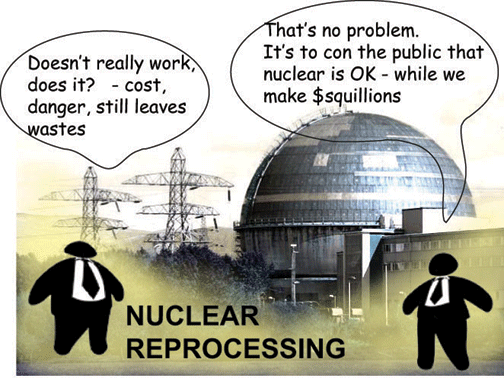
In different countries, commercial reprocessing has been an environmental and financial disaster. In just one example, a small commercial reprocessing plant in the United States operated for six years—heavily subsidized by the federal government and New York state—before shutting down for safety improvements. After the owner abandoned the project in the 1970s, the multi-billion-dollar cleanup continues today.
The research on reprocessing used fuel is clear: it’s an expensive nuclear experiment that could leave a multi-million-dollar mess affecting entire ecosystems and the health of people and other living beings. Why are governments sharing sales and promotional material about the project, and fantasies about ‘recycling’ instead of facts about reprocessing and the experiences in other countries? Why are New Brunswickers and First Nation leaders not demanding the evidence?
The lack of transparency by governments on the risks of SMNRs indicates that either they are not concerned with the risks, or they choose not to share them—the opposite of what is required under the United Nations Declaration of Rights of Indigenous Peoples.
Much of society’s standards for integrity have been lost. We accept circular references, we accept that no one is declaring a conflict of interest in conversations surrounding nuclear. When our integrity is lost, so is our quality of life. Words such as “protect” and “conservation” have no meaning anymore. Though we use the terms “transparency” and “accountability” more and more often, they have less and less meaning.
The Peskotomuhkati Nation in Canada and Wolastoq Grand Council cannot provide consent for any new nuclear developments in New Brunswick without considering the lessons they have learned in the past, the current relationships and communications they are experiencing, and the impacts of toxic wastes that remain dangerous forever. First Nations in New Brunswick cannot provide consent for toxic radioactive waste to be sent to Ontario, where Indigenous nations also do not want it on their territories.
The Wolastoq Grand Council, which issued a statement on nuclear energy and nuclear waste in 2021, opposes any destruction or harm to Wolastokuk which includes all “Flora and Fauna” in, on, and above their homeland. Nuclear is not a green source of energy, or solution to a healthier future for our children, grandchildren and the ones who are not born yet. Wolastoqewi-Elders define Nuclear in their language as ‘Askomiw Sanaqak,’ which translates as ‘forever dangerous.’
The Peskotomuhkatik ecosystem includes Point Lepreau. The Peskotomuhkati leadership in Canada has repeatedly tried to bring facts about both New Brunswick SMNR projects and their potential environmental implications to the attention of New Brunswickers and all Canadians, writing twice to Environment and Climate Change Minister Steven Guilbeault urging him to designate the SMNR projects in New Brunswick for a federal impact assessment, so that all the facts could be made public. Both attempts were denied, the most recent in August this year.
Peskotomuhkati leadership has participated, and continues to participate, in Canadian Nuclear Safety Commission and various provincial processes, and has firsthand experience that these past and current engagement and assessment tools do not provide a sufficient framework to address adverse effects and impacts to Indigenous rights.
The SMNR projects planned for Point Lepreau within Peskotomuhkatik homeland will have profound and lasting impacts on Indigenous rights as well as those of Indigenous communities in Ontario where the nuclear industry is proposing to build a deep geological repository for the used nuclear fuel and other sites for intermediate radioactive waste. The SMNR projects will also have profound and lasting impacts on the Bay of Fundy, the marine life the bay supports, and coastal communities.
Until the government begins to ask for and share facts about SMNRs instead of sales materials, Indigenous nations must assume that representation no longer means peoples’ representation, but rather representation of the industry.
Hugh Akagi is chief of the Peskotomuhkati Nation in Canada. Dr. Susan O’Donnell is the lead investigator of the CEDAR research project at St. Thomas University in Fredericton
No comments yet.
1 This Month


Tell the Ukrainian Government to Drop Prosecution of Peace Activist Yurii Sheliazhenko

Petition to revoke the licensing of the Near Surface Nuclear Disposal Facility (NSDF) at Chalk River. https://www.ourcommons.ca/petitions/en/Petition/Details?Petition=e-7247


of the week – STOP SMALL MODULAR REACTORS IN CANADA
To see nuclear-related stories in greater depth and intensity – go to https://nuclearinformation.wordpress.com
-
Archives
- March 2026 (204)
- February 2026 (268)
- January 2026 (308)
- December 2025 (358)
- November 2025 (359)
- October 2025 (376)
- September 2025 (258)
- August 2025 (319)
- July 2025 (230)
- June 2025 (348)
- May 2025 (261)
- April 2025 (305)
-
Categories
- 1
- 1 NUCLEAR ISSUES
- business and costs
- climate change
- culture and arts
- ENERGY
- environment
- health
- history
- indigenous issues
- Legal
- marketing of nuclear
- media
- opposition to nuclear
- PERSONAL STORIES
- politics
- politics international
- Religion and ethics
- safety
- secrets,lies and civil liberties
- spinbuster
- technology
- Uranium
- wastes
- weapons and war
- Women
- 2 WORLD
- ACTION
- AFRICA
- Atrocities
- AUSTRALIA
- Christina's notes
- Christina's themes
- culture and arts
- Events
- Fuk 2022
- Fuk 2023
- Fukushima 2017
- Fukushima 2018
- fukushima 2019
- Fukushima 2020
- Fukushima 2021
- general
- global warming
- Humour (God we need it)
- Nuclear
- RARE EARTHS
- Reference
- resources – print
- Resources -audiovicual
- Weekly Newsletter
- World
- World Nuclear
- YouTube
-
RSS
Entries RSS
Comments RSS
 nuclear-news
Leave a comment