The harrowing truth about the war in Ukraine.

Russian press reports the high proportion of amputees among injured Ukrainian soldiers – perhaps up to 50,000. (Of course they don’t mention the Russian casualties, – that figure could be the same, – or likely more.)
The thing is – the media is so full of reports about who’s winning, and what lovely new weapons that Ukraine needs in order to win, and how the war will go on “as long as it takes“.
That seems to mean “as long as there are any fit-enough Ukrainian soldiers left”. Russia has four to five times as many soldiers as Ukraine has. So, the brutal reality is, Russia can afford to lose more casualties. On both sides, the leaders apparently don’t care . So, logically – it’s sort of unlikely that Ukraine can win, isn’t it?
That consideration doesn’t seem to matter to the West. No attention is given to what sort of state Ukraine’s people, and its environment will be in, as this forever war goes on.
As I pointed out, Russian media is not stressing their numbers of amputees. And Western media publicises the medical care that USA is giving to a few of the Ukrainian amputees, while not mentioning the total horrible picture.
The real human toll is ignored. Isn’t it time that the slaughter in Ukraine is ended?
This is one reason why I might appear to be giving constantly a pro-Russian point of view.
It’s not really pro-Russian. It’s pro-truth. The Western media continually vomits forth the lie that Ukraine will win. This lie suits the USA purpose of weakening Russia, which has nothing to do with the well-being of the people of Crimea, or the Donbass, or Ukraine in general.
We’re Being Prepared For The Ukraine War To Last Into The 2030s
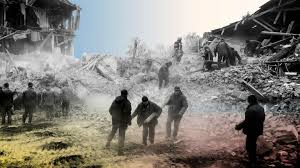
So western empire managers and their agenda-setters in the mass media are making it as clear as could be that the US-centralized empire has found itself in yet another endless war, another “grinding war of attrition” featuring unfathomable destruction and suffering with no exit strategy, which once again pours vast fortunes into the coffers of the military industrial complex. The only difference is that this time it comes with the added bonus of the threat of nuclear annihilation.
CAITLIN JOHNSTONE, SEP 23, 2023 https://www.caitlinjohnst.one/p/were-being-prepared-for-the-ukraine?utm_source=post-email-title&publication_id=82124&post_id=137313925&utm_campaign=email-post-title&isFreemail=true&r=1ise1&utm_medium=email
Western officials and media pundits are now directly acknowledging that Ukraine’s much-touted “spring counteroffensive” has been a catastrophic failure, but rather than seeing this as a reason to reconsider the mainstream political consensus on this war, they are instead telling everyone that the counteroffensive’s failure means we must commit to the status quo of bloodshed and nuclear brinkmanship for years to come.
In a recent article titled “US and G-7 Allies Expect War in Ukraine to Drag On for Years,” Bloomberg reports that the US-centralized power structure expects to be backing its proxy conflict against Russia for a very long time, potentially into the 2030s.
Bloomberg reports:
“The US and its allies in the Group of Seven now expect the war in Ukraine may drag on for years to come and are building that possibility into their military and financial planning.
“A senior official from one European G-7 country said the war may last as much as six or seven more years and that allies need to plan financially to continue support for Kyiv for such a long conflict.“
“That’s much longer than many officials had expected earlier this year, but slow progress in Ukraine’s counteroffensive in recent months has tempered expectations.”
In a recent interview with CNN, outgoing Joint Chiefs chair Mark Milley said that achieving Kyiv’s official goal of fully recapturing all Ukrainian territory is going to require “very significant effort over a considerable amount of time.”
“I can tell you that it’ll take a considerable length of time to militarily eject all 200,000 or plus Russian troops out of Russian-occupied Ukraine,” Milley added. “That’s a very high bar. It’s going to take a long time to do it.”
In a recent interview with German newspaper Berliner Morgenpost, NATO Secretary General Jens Stoltenberg also pounded home the point that this war will drag on for a very long time.
“Most wars last longer than is expected when they first start. Therefore, we must prepare ourselves for a long war in Ukraine,” Stoltenberg said.
“We are all wishing for a quick peace,” Stoltenberg added. “But at the same time, we must recognize: If President Zelensky and the Ukrainians give up the fight, their country would not exist anymore. If President Putin and Russia laid down their weapons, we would have peace. The easiest way to end this war would be if Putin withdrew his troops.”
You see this claim from empire managers and their apologists all the time: that the only obstacle to peace in Ukraine is Russia refusing to leave. This of course ignores the many extensively-documented western aggressions which are known to have provoked Russia’s invasion, a fact that Stoltenberg himself admitted to earlier this month.
Demanding that Russia end its aggressions without the west agreeing to end its own aggressions which led to this conflict is just demanding that Russia lie down and submit to being ruled and dominated by the western empire. It’s not a call for peace, it’s a call for the total victory of Washington and its cohorts.
Stoltenberg reinforced his point that this war will drag on for years by affirming that Ukraine will gain NATO membership when this war is over, which is effectively a message to Moscow that if it still finds NATO membership for Ukraine unacceptable it must either annex Ukraine into the Russian Federation entirely or keep this war going on forever.
“Ukraine will become a member of NATO — all allies have made that clear,” Stoltenberg said, adding that Ukraine will need NATO protection when the war ends, otherwise “history could repeat itself.”
The western media are conveying the same message. Notorious empire propaganda rag The Economist has a new article out titled “Ukraine faces a long war. A change of course is needed,” featuring a Ukrainian flag with the words “TIME FOR A RETHINK” scrawled across it. If you didn’t know anything about The Economist you might assume at first glance that this was an article about rethinking the approach of backing an endless proxy conflict — especially after its opening paragraphs acknowledge that “The plan is not working” and “Ukraine has liberated less than 0.25% of the territory that Russia occupied in June.”
You would be wrong though. What The Economist means is that we should switch from thinking of this as a war that can be won in a timely fashion to one which will continue for the foreseeable future:
“Both Ukraine and its Western supporters are coming to realise that this will be a grinding war of attrition. President Volodymyr Zelensky visited Washington this week for talks. ‘I have to be ready for the long war,’ he told The Economist. But unfortunately, Ukraine is not yet ready; nor are its Western partners. Both are still fixated on the counter-offensive. They need to rethink Ukraine’s military strategy and how its economy is run. Instead of aiming to “win” and then rebuild, the goal should be to ensure that Ukraine has the staying power to wage a long war — and can thrive despite it.”
So western empire managers and their agenda-setters in the mass media are making it as clear as could be that the US-centralized empire has found itself in yet another endless war, another “grinding war of attrition” featuring unfathomable destruction and suffering with no exit strategy, which once again pours vast fortunes into the coffers of the military industrial complex. The only difference is that this time it comes with the added bonus of the threat of nuclear annihilation.
All for what? To advance the US empire’s goal of total planetary domination, a status quo that it can only maintain by brandishing armageddon weapons at its enemies with increasing hostility year after year.
When it comes to the war in Ukraine it is definitely time for a rethink, but not by the same monsters who thought us into this horror in the first place.
Sizewell nuclear investment may prove radioactive

Alistair Osborne, Tuesday September 19 2023
Don’t all rush at once. The government is giving private punters
“their first chance to come forward and qualify to invest in Sizewell
C” — the £30 billion-plus nuke, offering guaranteed cost overruns,
prettily located on a Suffolk flood plain. How’s it their first chance? The government’s adviser, Barclays, has been trying to drum up support
for this project for more than a year.
And what’s all this stuff about
qualifying? Ministers really aren’t that fussed where the money comes
from, as long as it’s not from the likes of China, Russia, Iran or the
home of Kim Jong-un’s exploding ballistic missiles.
That the government is desperate for someone to stick a few quid into Sizewell has been clear for yonks. So it’s a bit odd to find new energy secretary Claire Coutinho
making such a hoo-ha about “opening applications for partners to register
their interest” or demanding that they have “experience in delivering
major infrastructure projects”.
Indeed, as pointless announcements go, it
looks up there with the endless relaunches by her predecessor Grant Shapps
of Great British Nuclear: an organisation so far as useful as his Great
British Railways, which still seems to be stuck in a siding.
The key question? What sort of return would investors require and for what risk?
There’s talk that the government its trying to thrash out a price with
potential funders including Brookfield, Stonepeak and Abu Dhabi’s
Mubadala and that Coutinho’s formal process will enable her to harden
things up.
But getting a decision looks tricky when campaigners have just
won leave to appeal the decision to build Sizewell. And, unless it comes up
with giveaway terms, it’s hard to see how the government won’t end up
having to fund most of the equity itself. Investors know how easy it is to
get burnt with nuclear fuel.
Times 19th Sept 2023
https://www.thetimes.co.uk/article/investment-that-may-prove-radioactive-qrwz35cst
Top nuclear experts urge Biden to not allow Saudi uranium enrichment in mega-deal

“even if the enrichment facility in Saudi Arabia is operated by Americans, it will pose “an unacceptable proliferation risk, particularly given Crown Prince Mohammed bin Salman’s public comments on nuclear weapons”.
Barak Ravid 22 Sept 23 https://www.axios.com/2023/09/21/saudi-nuclear-power-uranium-mbs-biden-megadeal-israel
A bipartisan group of more than two dozen nuclear and Middle East experts sent a letter to President Biden on Thursday urging him not to allow Saudi Arabia to have a uranium enrichment program on its soil, according to the letter first shared with Axios.
Why it matters: The Saudi demand for a civilian nuclear program that includes uranium enrichment is the most complicated and sensitive part of the mega-deal the White House is negotiating with the kingdom and Israel.
- It is one of Saudi Arabia’s main demands in the Biden administration’s efforts to secure a peace deal between the kingdom and Israel.
- But it not only faces opposition from the experts who sent Thursday’s letter but also from Israel’s opposition, as well as many members of Congress who are critical of the Saudi government over its human rights record.
What they’re saying: The 27 experts who signed the letter say they support normalization but think the kingdom doesn’t need uranium enrichment to produce peaceful nuclear energy.
- “We urge you to reject the Kingdom of Saudi Arabia’s request for uranium enrichment as part of or separate from a normalization agreement between Saudi Arabia and Israel,” they wrote.
- The experts stressed that uranium enrichment on Saudi soil could bring Saudi Arabia to the brink of acquiring nuclear arms — a reality U.S. policy should keep from happening.
Signatories to the letter include several former U.S. officials who served under both Republican and Democratic administrations and worked on nuclear or Middle East issues.
- They also include David Albright, one of the leading nuclear experts in the world, Olli Heinonen and Pierre Goldschmidt, both former deputy director generals of the International Atomic Energy Agency, and Israeli Prime Minister Benjamin Netanyahu’s former national security adviser, Jacob Nagel.
- The letter was co-organized by the Nonproliferation Policy Education Center and the Foundation for the Defense of Democracies (FDD), a Washington think tank that holds pro-Israeli views.
State of play: The Biden administration is still negotiating with the Saudi officials the conditions for a possible civilian nuclear program.
Separate negotiations on the issue are being held between the Biden administration and the Israeli government.- Unlike the signatories of the letter, Netanyahu doesn’t object to Saudi Arabia having a civilian nuclear program and his government is negotiating with the U.S. the red lines and the guardrails for a program that would include uranium enrichment.
- A senior U.S. official told reporters on Wednesday that there is total alignment between the Israeli government and the Biden administration when it comes to the red lines.
- The White House did not immediately respond to Axios’ request for comment.
The big picture: In the letter, the experts also said that even if the enrichment facility in Saudi Arabia is operated by Americans, it will pose “an unacceptable proliferation risk, particularly given Crown Prince Mohammed bin Salman’s public comments on nuclear weapons”.
- MBS told Fox News in an interview that was aired on Wednesday that if Iran obtains a nuclear weapon, Saudi Arabia would “have to get one, for security reasons, for balancing power.”
- The experts also wrote that Saudi threats to go to China for nuclear technology are not a reason for the U.S. to change its policy on nuclear enrichment, a step that will be “a sign of weakness” and could encourage similar efforts by other countries.
The experts added that allowing Saudi Arabia to have uranium enrichment capability like Iran could trigger a regional nuclear arms race.- “Any nuclear cooperation agreement with Saudi Arabia must meet the highest non-proliferation standards and enhanced inspection and transparency measures through a strong Additional Protocol with the International Atomic Energy Agency,” they wrote.
Why Japan should stop its Fukushima nuclear wastewater ocean release

Bulletin, By Tatsujiro Suzuki | September 22, 2023
On August 24, 2023, Japanese electric utility holding company Tokyo Electric Power Co. (TEPCO) announced that it has started discharging so-called “treated” and “diluted” water from the damaged Fukushima Daiichi nuclear power plant into the Pacific Ocean. This is not the end of controversy over the release of “treated water.” Rather, it may be the beginning of what might be a long-lasting struggle where science meets politics and lack of public trust, both inside and outside of Japan.
To understand TEPCO’s decision and why this operation caused such a big controversy, one must explain what this “treated water” being released is, the scientific debates over this operation, and the underlying social and political issues.
“Treated” or “contaminated” water? When underground water, including rainfall, passes through the damaged Fukushima Daiichi reactor site and is used to cool the melted fuel debris inside the reactors, it becomes contaminated with oil as well as many harmful radioactive nuclides, including cesium and strontium………………………………..
Part of the radioactive substances that contaminate the water is now being removed by multi-nuclide removal equipment called “advanced liquid processing systems” (ALPS)—an unfortunate name given that the Alps mountain range in Europe is home to some of the cleanest freshwater in the world. After the removal of most radioactive substances—except for tritium, which cannot be removed by the Alps system—treated water is then stored in tanks (see Figure 2 on original). The Alps process is supposed to reduce the concentration of radionuclides, except tritium, to levels below regulatory standards. However, according to TEPCO’s data, as of March 31, 2023, of the total of about 1.3 million m3 of treated water, only about a third satisfied regulatory standards and the other two-thirds needed to be re-purified.
It can’t be denied that “treated water” is not as pure as “tritiated water” because treated water may still contain other radioactive nuclides, albeit in small proportions. But the comparison of Fukushima’s “treated water” with other “tritiated water” released during the normal operation of other nuclear power plants can be misleading because the latter is not contaminated with other radioactive nuclides.
TEPCO says it re-purifies the “treated water” to make sure the water satisfies regulatory standards before it is released to the sea. To do that, the company’s plan is to dilute “treated water” with large amounts of sea water to reach a concentration of tritium of 190 Becquerel (Bq) per liter, which is much lower than the allowed concentration of 1,500 Bq per liter.
The first discharge happened over a period of 17 days and involved a total of 7,800 tons of treated water being released to the sea. TEPCO plans to discharge treated water three more times in 2023, and the total tritium discharge by the end of March 2024 is expected to reach about 5 trillion Bq. This is much lower than the annual discharge target of 22 trillion Bq set before the Fukushima accident………………..
Scientific debate. The Japanese government and TEPCO argue that the whole operation satisfies both Japanese regulatory standards and international safety standards. Besides, the Japanese government officially asked the International Atomic Energy Agency (IAEA) to conduct an independent review of the safety of the ALPS treated water release. On July 4, 2023, the IAEA published its “comprehensive report,” which concluded that the ALPS process is “consistent with relevant international safety standards” and that “the discharge of the treated water [into the sea], as currently planned by Tepco, will have a negligible radiological impact on people and the environment.”
But there are scientific arguments against TEPCO’s release plan.
The Pacific Island Forum expressed its concern in a statement in January 2023 about whether current international standards are adequate to handle the unprecedented case of the Fukushima Daiichi tritiated water release. Based on a report from an independent expert panel established by the forum, TEPCO’s guideline compliance plan does not appear to include the transboundary implications of IAEA’s guidance in its General Safety Guide No. 8 (GSG-8), which requires that the benefits of a given process outweigh the harms for individuals and societies.
The experts also recommended the alternative method of using the treated water to manufacture concrete for the construction industry instead of releasing it to the sea. By immobilizing the radionuclides in a material, this alternative would imply a lower potential for human contact and would avoid transboundary impacts. Quoted in a National Geographic article, one of the panel members, Robert Richmond, director of the Kewalo Marine Laboratory of the University of Hawaii, summarizes well the uncertainty surrounding the impacts of TEPCO’s water release plan on the ocean environment: “It is a trans-boundary and trans-generational event” and that he does not believe “the release would irreparably destroy the Pacific Ocean but it does not mean we should not be concerned.”
Lack of public trust. In addition to scientific debate, TEPCO’s ALPS treated water issue has become more of a social and political controversy. The origin of this debate was the speech given by then-Prime Minister Shinzo Abe before the International Olympic Committee on September 7, 2013, in which he referred to the city where the 2020 Summer Olympics were to be held by saying: “Some may have concerns about Fukushima. Let me assure you, the situation is under control. It has never done and will never do any damage to Tokyo.” After Abe’s speech, the government took over the responsibility for the management of the contaminated water, while TEPCO is still responsible for all decommissioning operations at the Fukushima Daiichi nuclear power plant. Since then, all policy decisions about the treated water have been made by the Japanese government, with TEPCO simply following the government, which has complicated the decision-making process.
In August 2015, the Japanese government and TEPCO promised to the local fishermen that they “will not implement any disposal without understanding of interested parties.” The government even established a committee consisting of experts from a local university to discuss technical options and held meetings with local citizens for several years to build trust with the local communities. So, when the decision was made by former Prime Minister Yoshihide Suga in August 2021 to release the “treated water” to the sea, this felt like a treachery for the local fishermen and many other interested parties. In a June 2023 statement opposing the planned discharge of treated water, the head of Japan’s national fisheries cooperatives Masanobu Sakamoto said: “We cannot support the government’s stance that an ocean release is the only solution. … Whether to release the water into the sea or not is a government decision, and in that case we want the government to fully take responsibility.”
The subsequent lack of public trust in TEPCO and Japan’s Ministry of Economy, Trade and Industry has been one of the major reasons for this continued controversy. In August 2018, a news investigation revealed that the “tritiated water” still contained other radioactive nuclides after treatment, which were above regulatory standards—a result that was not consistent with the explanation given by TEPCO. ………………………………………………………………………………………
both fishermen and consumers in South Korea are worried about the impacts of water release from the Fukushima nuclear plant, which led the largest fisheries market to start monitoring the fish’s radioactivity to allay those concerns…………………………………………………………………In August, China decided to ban imports of all seafood products from Japan shortly after Japan started discharging treated water from Fukushima that month. And there seems to be no prospect of reducing tensions between the two countries over this issue.
How to improve the situation? Several options exist that could help restore public trust in TEPCO’s and the Japanese government’s treated water plan at Fukushima.
First, the Japanese government and TEPCO should realize that the management of radioactive wastewater is not a purely scientific and technical issue…………………TEPCO’s and the Japanese government’s plan also needs a non-scientific approach to the issue and provide additional measures, including an improved decision-making process and a sincere dialogue (not persuasion) with stakeholders.
Second, to restore public trust and confidence, the government should first stop the water release and task an independent oversight organization which can be trusted by stakeholders. The IAEA review of TEPCO’s plan was helpful at best, but it was not enough, as it only verifies the samples provided by TEPCO for the first discharge but does not review the entire plan which could continue for the next 30 years. In fact, IAEA Director General Rafael Mariano Grossi clarified in the foreword of the agency’s “comprehensive report” that the review was “neither a recommendation nor an endorsement of that (government) policy.” Complete transparency over the entire decision-making process and disclosure of supporting data and information are essential conditions to improve public trust.
Third, TEPCO and the Japanese government should designate the current release operations as part of a “demonstration” program and declare that they will make a final decision about the plan after studies confirm that the release has had no significant impacts on the ocean environment and fish. This would imply that the government stops the release of the treated water, and asks the scientific community to conduct such studies. At the same time, the government could also continue to explore technical alternatives to its plan that may be more attractive to both domestic and international stakeholders.
In addition to provide a face-saving opportunity to the Japanese government and TEPCO to justify that they “temporarily” halt the release, it would show that they have sincerely listened to the concerns expressed by the stakeholders.
The Japanese government and TEPCO clearly have the ability to improve public trust in their handling of the treated water at Fukushima, but this requires them to go beyond their “scientific logic” only. https://thebulletin.org/2023/09/why-japan-should-stop-its-fukushima-nuclear-wastewater-ocean-release/
United Nations Nuclear Weapons Ban Treaty Continues to Gather Strength
September 21st, 2023 http://nuclearactive.org/
On Wednesday, September 19th, the landmark Treaty on the Prohibition of Nuclear Weapons had been signed by almost half of all countries in the world after a ceremony at the United Nations General Assembly in New York where Sri Lanka acceded to the Treaty and the Bahamas signed it.
This means 93 states have now signed, ratified or acceded to the Treaty that outlaws nuclear weapons and all nuclear weapons-related activity.
The Treaty was negotiated in 2017 and entered into force in 2021. It is the first multilateral agreement to ban nuclear weapons in a comprehensive manner and establish a framework for their elimination.
Melissa Parke, the Executive Director of the International Campaign to Abolish Nuclear Weapons, or ICAN, said, “The growing support for the [Treaty] brings added authority to what is already the strongest international norm against the worst weapons of mass destruction. This is sorely needed at this moment when the war in Ukraine and escalating tensions in the Korean peninsula have brought the world closer to nuclear war than at any time since the height of the Cold War.”
Speaking of Sri Lanka and the Bahamas, Ms Parke added, “Any use of nuclear weapons would be an unparalleled humanitarian and environmental catastrophe and these two countries are to be praised for doing their part to prevent these horrific weapons from ever being used in conflict again.”
With the Bahamas’ signature, adherence to the Treaty by Caribbean states is now almost universal. Sri Lanka’s accession sends an important disarmament message to its nuclear-armed neighbors in South Asia, India and Pakistan.
The Treaty bans countries from developing, testing, producing, manufacturing, transferring, possessing, stockpiling, using or threatening to use nuclear weapons, or allowing nuclear weapons to be stationed on their territory. It also prohibits countries from assisting, encouraging or inducing anyone to engage in these activities. https://www.icanw.org/the_treaty
In November, the second meeting of state parties to the Treaty will be held at the United Nations. https://www.icanw.org/tpnw_second_meeting_of_states_parties Key areas of the Treaty will be discussed, which include disarmament, increasing risks, the humanitarian consequences of nuclear weapons and related issues.
Also up for discussion are the two verification pathways for a nuclear-armed state, like the United States of America, to join the Treaty. The two pathways are: elimination of a state’s arsenal and then joining the Treaty; or join the Treaty first and then eliminate the state’s arsenal.
For more information, please visit the ICAN website at https://www.icanw.org/. CCNS is an ICAN Partner Organization.
Poland Says It’s No Longer Arming Ukraine Amid Grain Spat
By Dave DeCamp / Antiwar.com, September 21, 2023 https://scheerpost.com/2023/09/21/poland-says-its-no-longer-arming-ukraine-amid-grain-spat/—
The position marks a significant shift as Warsaw has been a major supporter of NATO’s proxy war.
Polish Prime Minister Mateusz Morawiecki said Wednesday that Poland is no longer arming Ukraine, marking a significant shift as Warsaw has been a staunch supporter of the NATO proxy war with Russia.
Morawiecki’s comments come amid a spat between Warsaw and Kyiv over a Polish ban on Ukrainian grain. When asked if the dispute would impact Polish support for Ukraine, Morawiecki said, “We are no longer transferring weapons to Ukraine, because we are now arming Poland with more modern weapons.”
He insisted that Warsaw had no intention of risking “the security of Ukraine” and that weapons shipments from other countries transiting through Poland would not be interfered with. Poland has become the primary hub for NATO arms shipments into Ukraine since Russia launched its invasion.
Throughout the war, Poland led the charge when it came to NATO escalations in support for Ukraine. Military aid Warsaw has provided includes hundreds of Soviet-made tanks and about a dozen Soviet MiG-29 fighter jets. Poland was also the first NATO country that said it was willing to arm Ukraine with German-made Leopard tanks.
Foundation for the Defense of Democracy and The Nonproliferation Policy Education Center urge Biden against helping Saudi Arabia to enrich uranium
In an effort to get Saudi Arabia to recognize Israel, the Biden
Administration is considering offering Riyadh a U.S. civilian nuclear
cooperative agreement that would allow the Kingdom to enrich uranium, a
process that could bring it within weeks or days of acquiring a nuclear
weapon.
With nuclear fuel making activities, such as uranium enrichment,
there is no way to assure timely warning of possible military diversions:
By the time there is a detection, it’s too late to prevent the last few
steps to making a bomb. This inherent safeguards gap makes any endorsement
of enrichment in the Kingdom dangerous.
Mohammed bin Salman Al Saud is
publicly on record pledging to acquire nuclear weapons if he believes Iran
is acquiring one. Some argue this risk must be taken to keep the Kingdom
from embracing ever tighter relations with China. This is mistaken The
United States is the richest nation in the world. It has other more
powerful and far less dangerous ways to influence the Saudis’ thinking.
NPEC 21st Sept 2023
Crown prince confirms Saudi Arabia will seek nuclear arsenal if Iran develops one
The Saudi crown prince has confirmed his country would seek to acquire a
nuclear arsenal if Iran developed one, throwing fresh doubt on a possible
US-Saudi nuclear cooperation deal currently under negotiation.
Joe Biden’s Democratic allies in the US Senate have warned his administration
will face a tough battle for approval of a deal normalising relations
between Israel and Saudi Arabia if it includes substantial nuclear
cooperation with Riyadh, because of distrust of Saudi intentions.
In an interview on Wednesday, Mohammed bin Salman added weight to suspicions that
an ostensibly civilian nuclear programme could be diverted to military
purposes if Saudi Arabia felt under threat.
Guardian 21st Sept 2023
Sizewell C nuclear, if built, will be late and obsolete.

How ironic that alongside the government’s announcement (note 1) that they
are looking for investors for the Sizewell C twin EPR nuclear reactor
project on Suffolk’s eroding coastline, sits a report that the Together
Against Sizewell C legal challenge to the decision to approve the
application for the construction of Sizewell C ‘has a real prospect of
success’.
Notwithstanding the additional hurdles the white elephant
project has yet to negotiate, such as construction permits, a site licence
from the Office for Nuclear Regulation and the small matter of securing a
permanent and reliable potable water supply of 2.2million litres a day for
the next 60 years, the prospect of a successful legal challenge would seem
enough to deter even the most optimistic nuclear adherent.
But, no, there is more incredulity heaped on those who would risk their cash on this
fantasy which is rapidly turning into a nightmare: Andy Mayer, chief
executive officer of the Institute of Economic Affairs, has suggested that
(City AM, 19/9/23 – note 2) , “There is a sensible objection to Sizewell
C, that the underlying EPR technology is junk, resulting in projects that
run over-time and over-budget, and when built are riddled with corrosion.
“Either way”, he continues, “outside investors would be mad to back
Sizewell. If built, it will be late and obsolete.”
TASC 21st Sept 2023
Netanyahu at UN issues ‘nuclear’ threat to Iran, later retracted
United Nations (United States) (AFP) – Israeli Prime Minister Benjamin Netanyahu on Friday warned Iran at the United Nations of a “nuclear threat” in what his office quickly walked back as a slip of the tongue.
France 24 22/09/2023 –
………………….Netanyahu, who has repeatedly used the UN stage to issue dark warnings about Tehran, briefly gave pause at the General Assembly when he appeared to threaten nuclear attack if Tehran pursues its own atomic bomb.
His office soon afterward said that Netanyahu had misspoken and that his prepared text said “credible military threat” instead of “credible nuclear threat.”………
Israel has a widely known but undeclared nuclear program. As of January, Israel was believed to possess a stockpile of around 90 nuclear warheads, according to the Stockholm International Peace Research Institute.
Tehran denies seeking a nuclear bomb but has breached limits on uranium enrichment set in a US-brokered 2015 deal following former president Donald Trump’s withdrawal from the agreement and reimposition of sweeping sanctions……………………………………………………. more https://www.france24.com/en/live-news/20230922-netanyahu-at-un-issues-nuclear-threat-to-iran-later-retracted
Pakistan’s new nuclear brinkmanship
Recently, Pakistan’s strategic planners have hinted to a shift in Pakistan’s nuclear doctrine, which seems to be quite radical.
Deccan Herald, Abhinav Narayan Jha, 23 September 2023
In July, when India celebrated the 24th Vijay Diwas of the 1999 Kargil War, the nuclear question between the two arch-rivals got refreshed. Both sides are said to have reportedly weighed the nuclear option then.
Pakistan was reported to have moved ballistic missiles toward the border. American officials and security experts had in 2000 claimed that India, too, had prepared nuclear-tipped ballistic missiles. If true, this was the closest India and Pakistan had ever come to a nuclear exchange.
Recently, Pakistan’s strategic planners have hinted to a shift in Pakistan’s nuclear doctrine, which seems to be quite radical. On the 25th anniversary of Pakistan’s nuclear tests, Lt General Khalid Kidwai (retd), adviser to Pakistan’s National Command Authority, sent ripples across the strategic and security community in Asia and the West when he revisited Pakistan’s nuclear strategy. Kidwai, who was the first and longest-serving Director-General of Pakistan’s Strategic Plans Division, touched on two important things: First, he referred to “Full Spectrum Deterrence” (FSD); second, he referred to “Zero meters to 2,750 kilometres”. Both phrases suggest a makeover of Pakistan’s nuclear doctrine.
Read more at: https://www.deccanherald.com/opinion/pakistan-s-new-nuclear-brinkmanship-2697746
1 This Month
Chernobyl: The Lost Tapes – A good documentary on Chernobyl on SBS available On Demand for the next 3 weeks– https://www.sbs.com.au/ondemand/tv-program/chernobyl-the-lost-tapes/2352741955560

of the week–London Campaign for Nuclear Disarmament

Tell the Ukrainian Government to Drop Prosecution of Peace Activist Yurii Sheliazhenko
To see nuclear-related stories in greater depth and intensity – go to https://nuclearinformation.wordpress.com
-
Archives
- April 2026 (139)
- March 2026 (251)
- February 2026 (268)
- January 2026 (308)
- December 2025 (358)
- November 2025 (359)
- October 2025 (376)
- September 2025 (257)
- August 2025 (319)
- July 2025 (230)
- June 2025 (348)
- May 2025 (261)
-
Categories
- 1
- 1 NUCLEAR ISSUES
- business and costs
- climate change
- culture and arts
- ENERGY
- environment
- health
- history
- indigenous issues
- Legal
- marketing of nuclear
- media
- opposition to nuclear
- PERSONAL STORIES
- politics
- politics international
- Religion and ethics
- safety
- secrets,lies and civil liberties
- spinbuster
- technology
- Uranium
- wastes
- weapons and war
- Women
- 2 WORLD
- ACTION
- AFRICA
- Atrocities
- AUSTRALIA
- Christina's notes
- Christina's themes
- culture and arts
- Events
- Fuk 2022
- Fuk 2023
- Fukushima 2017
- Fukushima 2018
- fukushima 2019
- Fukushima 2020
- Fukushima 2021
- general
- global warming
- Humour (God we need it)
- Nuclear
- RARE EARTHS
- Reference
- resources – print
- Resources -audiovicual
- Weekly Newsletter
- World
- World Nuclear
- YouTube
-
RSS
Entries RSS
Comments RSS
 nuclear-news