Hyping Ukraine Counteroffensive, US Press Chose Propaganda Over Journalism
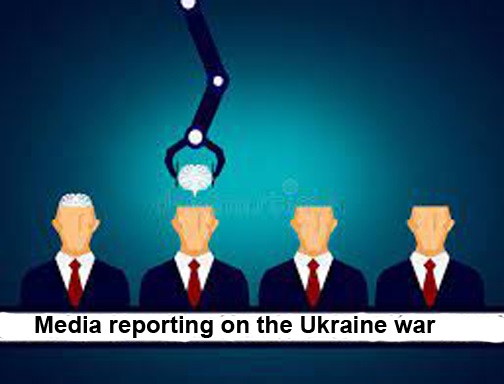
The fact that US officials pushed for a Ukrainian counteroffensive that all but expected would fail raises an important question: Why would they do this? Sending thousands of young people to be maimed and killed does nothing to advance Ukrainian territorial integrity, and actively hinders the war effort.
Even as Ukraine and Russia sat at the negotiation table early in the war, the US made it clear that it wanted the war to continue and escalate. The US’s objective was, in the words of Raytheon board member–turned–Defense Secretary Lloyd Austin, “to see Russia weakened.”
The consensus among policymakers in Washington is to push for endless conflict, no matter how many Ukrainians die in the process. As long as Russia loses men and material, the effect on Ukraine is irrelevant. Ukrainian victory was never the goal.
BRYCE GREENE, FAIR, 15 Sept 23
It has been clear for some time that US corporate news media have explicitly taken a side on the Ukraine War. This role includes suppressing relevant history of the lead-up to the war (FAIR.org, 3/4/22), attacking people who bring up that history as “conspiracy theorists” (FAIR.org, 5/18/22), accepting official government pronouncements at face value (FAIR.org, 12/2/22) and promoting an overly rosy picture of the conflict in order to boost morale.
For most of the war, most of the US coverage has been as pro-Ukrainian as Ukraine’s own media, now consolidated under the Zelenskyy government (FAIR.org, 5/9/23). Dire predictions sporadically appeared, but were drowned out by drumbeat coverage portraying a Ukrainian army on the cusp of victory, and the Russian army as incompetent and on the verge of collapse.
Triumphalist rhetoric soared in early 2023, as optimistic talk of a game-changing “spring offensive” dominated Ukraine coverage. Apparently delayed, the Ukrainian counteroffensive launched in June. While even US officials did not believe that it would amount to much, US media papered over these doubts in the runup to the campaign.
Over the last three months, it has become clear that the Ukrainian military operation will not be the game-changer it was sold as; namely, it will not significantly roll back the Russian occupation and obviate the need for a negotiated settlement. Only after this became undeniable did media report on the true costs of war to the Ukrainian people.
Overwhelming optimism
In the runup to the counteroffensive, US media were full of excited conversation about how it would reshape the nature of the conflict. NATO Secretary General Jens Stoltenberg told Radio Free Europe (4/21/23) he was “confident Ukraine will be successful.” Sen. Lindsey Graham assured Politico (5/30/23), “In the coming days, you’re going to see a pretty impressive display of power by the Ukrainians.” Asked for his predictions about Ukraine’s plans, retired Lt. Gen. Ben Hodges told NPR (5/12/23), “I actually expect…they will be quite successful.”
Former CIA Director David Patraeus, author of the overhyped “surge” strategy in Iraq, told CNN (5/23/23):
I personally think that this is going to be really quite successful…. And [the Russians] are going to have to withdraw under pressure of this Ukrainian offensive, the most difficult possible tactical maneuver, and I don’t think they’re going to do well at that.
The Washington Post’s David Ignatius (4/15/23) acknowledged that “hope is not a strategy,” but still insisted that “Ukraine’s will to win—its determination to expel Russian invaders from its territory at whatever cost—might be the X-factor in the decisive season of conflict ahead.”
The New York Times (6/2/23) ran a story praising recruits who signed up for the Ukrainian pushback, even though it “promises to be deadly.” Times columnist Paul Krugman (6/5/23) declared we were witnessing “the moral equivalent of D-Day.” CNN (5/30/23) reported that Ukrainians were “unfazed” as they “gear up for a counteroffensive.”
Cable news was replete with buzz about how the counteroffensive, couched with modifiers like “long-awaited” or “highly anticipated,” could turn the tide in the war. Nightly news shows (e.g., NBC, 6/15/23, 6/16/23) presented audiences with optimistic statements from Ukrainian President Volodymyr Zelenskyy and other figures talking about the imminent success.
Downplaying reality
Despite the soaring rhetoric presented to audiences, Western officials understood that the counteroffensive was all but doomed to fail. This had been known long before the above comments were reported, but media failed to include that fact as prominently as the predictions for success………………………………………………………………..
Too ‘casualty-averse’?
……………………………………………………………… A mid-July New York Times article (7/14/23) reported that US officials were privately frustrated that Ukraine had become too afraid of dying to fight effectively. The officials worried that Ukrainian commanders “fear[ed] casualties among their ranks,” and had “reverted to old habits” rather than “pressing harder.” A later Times article (8/18/23) repeated Washington’s worries that Ukrainians were too “casualty-averse.”
Acknowledging failure
After it became undeniable that Ukraine’s military action was going nowhere, a Wall Street Journal report (7/23/23) raised some of the doubts that had been invisible in the press on the offensive’s eve…………………………………………………………………………………………………..
Rather than dwelling on the stalled campaign, the New York Times and other outlets focused on the drone war against Russia, even while acknowledging that the remote strikes were largely an exercise in public relations. The Times (8/25/23) declared that the strikes had “little significant damage to Russia’s overall military might” and were primarily “a message for [Ukraine’s] own people,” citing US officials who noted that they “intended to demonstrate to the Ukrainian public that Kyiv can still strike back.” Looking at the quantity of Times coverage (8/30/23, 8/30/23, 8/23/23, 8/22/23, 8/22/23, 8/21/23, 8/18/23), the drone strikes were apparently aimed at an increasingly war-weary US public as well.
War as desirable outcome
The fact that US officials pushed for a Ukrainian counteroffensive that all but expected would fail raises an important question: Why would they do this? Sending thousands of young people to be maimed and killed does nothing to advance Ukrainian territorial integrity, and actively hinders the war effort.
The answer has been clear since before the war. Despite the high-minded rhetoric about support for democracy, this has never been the goal of pushing for war in Ukraine. Though it often goes unacknowledged in the US press, policymakers saw a war in Ukraine as a desirable outcome. One 2019 study from the RAND Corporation—a think tank with close ties to the Pentagon—suggested that an effective way to overextend and unbalance Russia would be to increase military support for Ukraine, arguing that this could lead to a Russian invasion.
In December 2021, as Russian President Vladimir Putin began to mass troops at Ukraine’s border while demanding negotiations, John Deni of the Atlantic Council published an op-ed in the Wall Street Journal (12/22/21) headlined “The Strategic Case for Risking War in Ukraine,” which laid out the US logic explicitly: Provoking a war would allow the US to impose sanctions and fight a proxy war that would grind Russia down. Additionally, the anti-Russian sentiment that resulted from a war would strengthen NATO’s resolve.
All of this came to pass as Washington’s stance of non-negotiation successfully provoked a Russian invasion. Even as Ukraine and Russia sat at the negotiation table early in the war, the US made it clear that it wanted the war to continue and escalate. The US’s objective was, in the words of Raytheon boardmember–turned–Defense Secretary Lloyd Austin, “to see Russia weakened.” Despite stated commitments to Ukrainian democracy, US policies have instead severely damaged it.
NATO’s ‘strategic windfall’
In the wake of the stalled counteroffensive, the US interest in sacrificing Ukraine to bleed Russia was put on display again. In July, the Post‘s Ignatius declared that the West shouldn’t be so “gloomy” about Ukraine, since the war had been a “strategic windfall” for NATO and its allies. Echoing two of Deni’s objectives, Ignatius asserted that “the West’s most reckless antagonist has been rocked,” and “NATO has grown much stronger with the additions of Sweden and Finland.”
In the starkest demonstration of the lack of concern for Ukraine or its people, he also wrote that these strategic successes came “at relatively low cost,” adding, in a parenthetical aside, “(other than for the Ukrainians).”
Ignatius is far from alone. Hawkish Sen. Mitt Romney (R–Utah) explained why US funding for the proxy war was “about the best national defense spending I think we’ve ever done”: “We’re losing no lives in Ukraine, and the Ukrainians, they’re fighting heroically against Russia.”
The consensus among policymakers in Washington is to push for endless conflict, no matter how many Ukrainians die in the process. As long as Russia loses men and material, the effect on Ukraine is irrelevant. Ukrainian victory was never the goal.
‘Fears of peace talks’
Polls show that support for increased US involvement in Ukraine is rapidly declining………………..
The failure of the counteroffensive has not caused Washington to rethink its strategy of attempting to bleed Russia. The flow of US military hardware to Ukraine is likely to continue so long as this remains the goal.
The Hill (9/5/23) gave the game away about NATO’s commitment to escalation with a piece titled “Fears of Peace Talks With Putin Rise Amid US Squabbling.”

But even within the Biden administration, the Pentagon appears to be at odds with the State Department and National Security Council over the Ukraine conflict. Contrary to what may be expected, the civilian officials like Jake Sullivan, Victoria Nuland and Antony Blinken are taking a harder line on perpetuating this conflict than the professional soldiers in the Pentagon. The media’s sharp change of tone may both signify and fuel the doubts gaining traction within the US political class. https://fair.org/home/hyping-ukraine-counteroffensive-us-press-chose-propaganda-over-journalism/
—
No comments yet.
1 This Month


Tell the Ukrainian Government to Drop Prosecution of Peace Activist Yurii Sheliazhenko

Petition to revoke the licensing of the Near Surface Nuclear Disposal Facility (NSDF) at Chalk River. https://www.ourcommons.ca/petitions/en/Petition/Details?Petition=e-7247


of the week – STOP SMALL MODULAR REACTORS IN CANADA
To see nuclear-related stories in greater depth and intensity – go to https://nuclearinformation.wordpress.com
-
Archives
- March 2026 (204)
- February 2026 (268)
- January 2026 (308)
- December 2025 (358)
- November 2025 (359)
- October 2025 (376)
- September 2025 (258)
- August 2025 (319)
- July 2025 (230)
- June 2025 (348)
- May 2025 (261)
- April 2025 (305)
-
Categories
- 1
- 1 NUCLEAR ISSUES
- business and costs
- climate change
- culture and arts
- ENERGY
- environment
- health
- history
- indigenous issues
- Legal
- marketing of nuclear
- media
- opposition to nuclear
- PERSONAL STORIES
- politics
- politics international
- Religion and ethics
- safety
- secrets,lies and civil liberties
- spinbuster
- technology
- Uranium
- wastes
- weapons and war
- Women
- 2 WORLD
- ACTION
- AFRICA
- Atrocities
- AUSTRALIA
- Christina's notes
- Christina's themes
- culture and arts
- Events
- Fuk 2022
- Fuk 2023
- Fukushima 2017
- Fukushima 2018
- fukushima 2019
- Fukushima 2020
- Fukushima 2021
- general
- global warming
- Humour (God we need it)
- Nuclear
- RARE EARTHS
- Reference
- resources – print
- Resources -audiovicual
- Weekly Newsletter
- World
- World Nuclear
- YouTube
-
RSS
Entries RSS
Comments RSS
 nuclear-news
Leave a comment