TODAY. Blatant hypocrisy and lies from Rafael Grossi and the International Atomic Energy Agency

There are no significant radiological consequences from the use of depleted uranium ammunition in the Ukrainian conflict, the International Atomic Energy Agency (IAEA) Director General Rafael Grossi claimed.
regarding the Russian-occupied Zaporizhzhia plant in Ukraine – “the problem there is war, the problem is not nuclear energy,” Grossi said.
Sweden’s renewed commitment to nuclear power highlights growing global interest in this clean source of energy , IAEA Director General Rafael Mariano Grossi said during his official visit.
Actually – you could say that Rafael Grossi’s lies are not blatant. Rather like that other silvery-slimy mealy-mouthed international disaster, Anthony Blinken, Grossi swans around, covering his main message with meaningless “ifs” and “buts” aimed at both confusing the public, and covering his own back – should anyone dare to challenge that essential lie.
Yes – he surrounds his statements – “Maybe in some very specific cases, people near a place that was hit with this kind of ammunition, there could be contamination,” he continued, adding that “this is more of a health issue of a normal nature than a potential radiological crisis.”
In the Sweden visit – Grossi also promoted nuclear medical technology – pushing nuclear energy as therapy for cancer, ignoring the fact that ionising radiation is the major cause of cancer.
Corporate media blathers on about evil dictators Putin, Xi … but is full of praise for these slimy silvery purveyors of nuclear lies – the oh so presentable Grossi and Blinken

The Discharge of Fukushima’s Radioactive Water could be a Precedent for Similar Actions

Obviously, it would be misleading to rely on the IAEA’s statements suggesting that radioactive wastewater does not pose any risk to global health. This information strengthens the likelihood that the IAEA did not reveal valid and precise radiation data regarding the Chornobyl accident and Zaporizhia nuclear power plant during the ongoing Ukrainian war either.
Pinar Demircan 7 Sept 23 https://www.dianuke.org/the-discharge-of-fukushimas-radioactive-water-could-be-a-precedent-for-similar-actions/
Underlying the disregard for objections from global civil society and transforming the ocean into a nuclear waste dump lies a bigger goal inspired by capitalist practices that arise from its crisis: to achieve another threshold by normalization of cost-cutting measures for the sake of the nuclear industry.
While the climate crisis is rapidly turning forests and habitats of living creatures into coal and ash with a tiny spark of fire in Turkiye, Greece, and Canada, the planet’s seas, already polluted with plastics and waste, are also being recklessly infused with radioactivity, driven by profit and cost-centered policies. On August 24, within the framework of the procedures carried out by the Japanese government and TEPCO, the discharge of 1.34 million tonnes of radioactive water which is accumulated in tanks at the plant site, started.
The installation of a treatment system costing 23 million USD, the discharge of wastewater without an Environmental Impact Assessment (EIA) is being realized by foregoing safer alternatives such as solidification of wastewater into construction materials or long-term storage costing 100 times more that constitutes ecocide. Clearly, this method of release that is expected to be carried out over the next 40 years, indicates a systemic assault on the global ecosystem that is longer and more severe than presently apparent.
The Japanese Government is not telling the truth about ‘purification’
The discharge process of the wastewater resulting from the complete meltdown of three reactor cores at the Fukushima nuclear facility began in 2011 and is at par with the danger level ascribed to the Chornobyl disaster. This also highlights how the Fukushima discharge differs from the regular discharge processes of nuclear power plants and indicates the extent of danger that nuclear power plants pose. Furthermore, the radioactive isotopes treated in the accumulated wastewater is only half of the whole amount according to what was stated on the website of the Japanese Ministry of the Environment.
A detail that has been overlooked till today is that there is no information regarding the amount of discharge during this 40-year time frame for the disposal of radioactive water into the ocean. This might indicate that the discharged amount may even be equivalent to the period of, for example, 100 years despite the declared duration of 40. In addition, since the present objections have been disregarded, it is worth considering the potential impact of future oppositions at the end of the 40 years.
A threshold to be achieved
Apparently, over the next decade, the radioactive water discharged from Fukushima is anticipated to disseminate into multiple seas worldwide, encompassing the Marmara, Mediterranean, Aegean, and Black Sea, which surrounds Turkiye. A recent scientific study [2] suggests that the evaporation in these seas will escalate industrial radioactivity levels in the ecosystem. Given this backdrop, it is important to ask why TEPCO, the Japanese government, and the IAEA continue to disregard the adverse impacts of the discharge, which also makes them responsible for the potential increases in cancer, DNA damage, increased miscarriages, hormone imbalances, and unhealthy future generations worldwide? Underlying the disregard for objections raised by global civil society, and transforming the ocean into a nuclear waste dump, lies a bigger goal inspired by capitalist practices that arise from its crisis: to achieve another threshold of the normalization of cost-cutting measures for the sake of nuclear industry.
How can we be sure of the exact amount to be released?
It is also possible to consider the above statement with the possibility of adding wastewater from the other nuclear power plants across Japan to the already 1 million 340 thousand tonnes of water accumulated over the past 12 years at Fukushima. While nuclear power plants operate under higher costs and have to cope with four times cheaper renewable energy production costs, the ocean dumping of the radioactive wastewater offers an easy solution for the nuclear industry. Crossing this threshold guarantees the capability to manage climate-induced hazards to nuclear facilities since now, societal consent has been obtained for this plan of action. Imagine how beneficial this course of action will be for the nuclear industry, with the IAEA promising its support for the industry – to the 410 reactors operating worldwide, approximately 50 reactors under construction, and 80 reactors [3] in various stages of maintenance, repair, decommissioning, and dismantling.
Take for example, Rosatom of Russia, the owner of the Akkuyu Nuclear Power Plant which reached its final stage of construction for the first reactor in Turkiye. It has a long history of concealing the Mayak nuclear power plant accident, well into the 1990s. Furthermore, from 1948 to 2004, Rosatom discharged nuclear waste into the Techa River, thus reinforcing its already questionable track record, and also points to how the legalization of nuclear discharge might be beneficial for the industry. It is also easy to predict the potential impact of this approach in the Mediterranean region by a nation with an underdeveloped democratic system and institutional dynamics dominated [4] by political power. This is especially important since an exemption made for the Akkuyu NPP in the article which allows for the discharge water from the facilities around the Mediterranean temperature of the plant and allows the sea temperature to reach up to 35 Celsius and poses serious ecological challenges indicating that Turkiye violates Barcelona Agreement.
The Role of the IAEA
The example of Fukushima’s radioactive water discharge presents us a picture of a political power that has adopted the corporate management mentality prioritizing profits and industry interests under the guise of efficiency and profitability. The International Atomic Energy Agency (IAEA) plays a vital role in ensuring that nuclear energy generation is conducted safely and within established guidelines. However, a leaked document [5] from the IAEA reveals that the agency, which declared its support for TEPCO and the Japanese government, advised them to refrain from making statements that could portray nuclear power plants negatively and disseminate information that influences the press and public opinion. As this scandal brings to light the deep connections between the IAEA, the Japanese government, and TEPCO, it is important to consider the role of the IAEA as a highly regarded global organization.
It is noteworthy to mention that the IAEA’s involvement in the nuclear industry stems from a confidential agreement WHA 12-40 [6] with the World Health Organization (WHO) in 1959, stating that “whenever either organization proposes to initiate a programme or activity on a subject in which the other organization has or may have a substantial interest, the first party shall consult the other with a view to adjusting the matter by mutual agreement”. Consequently, the IAEA, established to promote the growth of nuclear power plants worldwide, refrained from disclosing any potential health hazards posed by these plants.
Obviously, it would be misleading to rely on the IAEA’s statements suggesting that radioactive wastewater does not pose any risk to global health. This information strengthens the likelihood that the IAEA did not reveal valid and precise radiation data regarding the Chornobyl accident and Zaporizhia nuclear power plant during the ongoing Ukrainian war either.
It is important to inform the global society that the IAEA, which focuses mainly on promoting nuclear power, should not be involved in discussions related to public health in line with the principle of separating responsibilities to avoid conflict of interest. Therefore, it is recommended that civil society should inform the international community about the content of the recently disclosed IAEA document and demand an end to the discharge of radioactive water from Fukushima into the ocean. Accordingly, it should be ensured that all processes involved in disposing radioactive contamination in Fukushima are subject to internal and financial control measures performed by a minimum of two separate units.
At this stage, it is essential to take measures by clarifying the issues emphasized by the non-governmental organizations following the processes, and it should be ensured that realistic solutions can only be produced with the involvement of a consortium of neighbouring countries such as South Korea, China, Taiwan and the Pacific Islands. In this regard, the process management for the construction of the steel dome shelter, which was completed in 2016 with financing by 40 countries that came together in 1997 to protect the exploded fourth reactor of the Chornobyl Nuclear Power Plant from external weather conditions, can be taken as an example. [7]
Undoubtedly, the economic and administrative control mechanisms created for Chornobyl due to Ukraine’s lack of financial resources is not acceptable for the technology-giant Japan, which bears the costs of the disaster on its own. However, since global society has not entirely shown its commitment to changing the system, an in-system solution can prevent adding the radioactive disaster to the climate crisis before the transformation of life on the planet hits its constraints. In other words, claiming efficiency and profitability and institutionalization of the logic of ‘running the state like a business’, which has become the common discourse of political powers will at least help to achieve the rationality of emulated corporate management.
Antony Blinken mouths complacent lies: “very confident in Ukraine’s ultimate success”

Blinken’s wrong-headed confidence and his acceptance of a significant escalation in the Ukraine war defies belief, given the reality on the ground today in the war.
WHEN THE INTELLIGENCE IS INCONVENIENT. What goes wrong when politics suppresses the truth
Substack SEYMOUR HERSH, SEP 13, 2023
On Sunday Secretary of State Antony Blinken told Jonathan Karl of ABC’s This Week that he remained “very confident in Ukraine’s ultimate success” in the ongoing war with Russia. He depicted Ukraine President Volodymyr Zelensky’s decision to escalate its attacks inside Russia as “their decision, not ours.”
Blinken’s wrong-headed confidence and his acceptance of a significant escalation in the Ukraine war defies belief, given the reality on the ground today in the war. But it also could be based on insanely optimistic assessments supplied by the Defense Intelligence Agency. The DIA’s assessments, as I have reported, are now the intelligence of choice inside the White House.
As a journalist who has written about national security matters for many decades, how can I explain a process that is clearly contrary to the best interests of the people of the United States and its leadership?……………………………(Subscribers only) more https://seymourhersh.substack.com/p/when-the-intelligence-is-inconvenient?utm_source=post-email-title&publication_id=1377040&post_id=136980218&utm_campaign=email-post-title&isFreemail=true&r=ln98x&utm_medium=email
∙
” The future of nuclear as an alternative energy source relies on the success of the Fukushima release” – Rafael Grossi.

“more broadly, the future of nuclear as an alternative energy source relies on the success of the Fukushima release,” he said. Though there has been heightened public alarm toward nuclear plants recently – for instance, regarding the Russian-occupied Zaporizhzhia plant in Ukraine – “the problem there is war, the problem is not nuclear energy,” Grossi said.
AEA chief ‘completely convinced’ it’s safe to release treated Fukushima nuclear wastewater .
By Jessie Yeung, Marc Stewart and Emiko Jozuka, Tokyo CNN, 7 July 23
Japan’s plan to release treated radioactive water into the ocean is safe and there is no better option to deal with the massive buildup of wastewater collected since the 2011 Fukushima nuclear disaster, the head of the United Nations’ nuclear watchdog told CNN.
Japan will release the wastewater sometime this summer, a controversial move 12 years after the Fukushima nuclear plant meltdown. Japanese authorities and the IAEA have insisted the plan follows international safety standards – the water will first be treated to remove the most harmful pollutants, and be released gradually over many years in highly diluted quantities.
But public anxiety remains high, including in nearby countries like South Korea, China and the Pacific Islands, which have voiced concern about potential harm to the environment or people’s health. On Friday, Chinese customs officials announced they would maintain a ban on food imports from 10 Japanese prefectures including Fukushima, and strengthen inspections to monitor for “radioactive substances, to ensure the safety of Japanese food imports to China.”……………………..
On Tuesday, Grossi formally presented the IAEA’s safety review to Japanese Prime Minister Fumio Kishida. The report found the wastewater release plan will have a “negligible” impact on people and the environment, adding that it was an “independent and transparent review,” not a recommendation or endorsement……………………….
The 2011 disaster caused the plant’s reactor cores to overheat and contaminate water within the facility with highly radioactive material. Since then, new water has been pumped in to cool fuel debris in the reactors. At the same time, ground and rainwater have leaked in, creating more radioactive wastewater that now needs to be stored and treated.
That wastewater now measures 1.32 million metric tons – enough to fill more than 500 Olympic-sized swimming pools.
Japan has previously said there were “no other options” as space runs out – a sentiment Grossi echoed on Friday. When asked whether there were better alternatives to dispose of the wastewater, the IAEA chief answered succinctly: “No.”
It’s not that there are no other methods, he added – Japan had considered five total options, including hydrogen release, underground burial and vapor release, which would have seen wastewater boiled and released into the atmosphere………………………………………
International skepticism
But some critics have cast doubt on the IAEA’s findings, with China recently arguing that the group’s assessment “is not proof of the legality and legitimacy” of the wastewater release.
Many countries have openly opposed the plan; Chinese officials have warned that it could cause “unpredictable harm,” and accused Japan of treating the ocean as a “sewer.” The Secretary General of the Pacific Islands Forum, an inter-governmental group of Pacific island nations that includes Australia and New Zealand, also published an op-ed in January voicing “grave concerns,” saying more data was needed.
And in South Korea, residents have taken to the streets to protest the plan. Many shoppers have stockpiled salt and seafood for fear these products will be contaminated once the wastewater is released – even though Seoul has already banned imports of seafood and food items from the Fukushima region.
International scientists have also expressed concern to CNN that there is insufficient evidence of long-term safety, arguing that the release could cause tritium – a radioactive hydrogen isotope that cannot be removed from the wastewater – to gradually build up in marine ecosystems and food chains, a process called bioaccumulation…………………………………
more broadly, the future of nuclear as an alternative energy source relies on the success of the Fukushima release, he said. Though there has been heightened public alarm toward nuclear plants recently – for instance, regarding the Russian-occupied Zaporizhzhia plant in Ukraine – “the problem there is war, the problem is not nuclear energy,” Grossi said……….. https://edition.cnn.com/2023/07/06/asia/japan-fukushima-water-iaea-chief-interview-intl-hnk/index.html
IAEA sees no problem with depleted uranium weaponry – Grossi
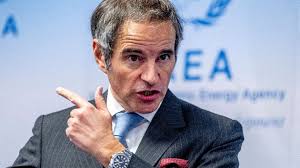
The US and UK have sent the toxic ammunition to Ukraine
Rt.com 12 Sept 23
There are “no significant radiological consequences” to the use of depleted uranium ammunition, International Atomic Energy Agency (IAEA) Director General Rafael Grossi has declared. Russia insists that Grossi is “not telling the whole story.”
“From a nuclear safety point of view there are no significant radiological consequences” to the use of this ammunition, Grossi told reporters during a briefing on Monday.
“Maybe in some very specific cases, people near a place that was hit with this kind of ammunition, there could be contamination,” he continued, adding that “this is more of a health issue of a normal nature than a potential radiological crisis.”
Depleted uranium is used to make the hardened cores of certain armor-piercing tank and autocannon rounds. Although it is not highly radioactive, uranium is still a toxic metal, and this metal is turned into a potentially hazardous aerosol when a depleted uranium round strikes its target.
US forces utilized depleted uranium tank shells during the 1991 Gulf War, reportedly causing a spike in birth defects, autoimmune disorders, and cancer cases in Iraq over the following decades. NATO also used depleted uranium in its 1999 air campaign against Yugoslavia. Earlier this year, Serbian Health Minister Danica Grujicic described the carcinogenic consequences of this ammunition on the Serb population a “horrible and inhumane experiment.”
The UK began supplying Ukraine with depleted uranium tank shells in March, while the US announced last week that it would send depleted uranium ammunition for its M1 Abrams tanks, which are expected to arrive in Ukraine in the coming weeks.
By focusing on the issue from a nuclear safety point of view, Grossi was being deliberately disingenuous, Russian Foreign Ministry spokeswoman Maria Zakharova wrote on Telegram on Monday.
“Mr. Grossi is, of course, right in saying that there are no significant radiological consequences from the standpoint of ‘nuclear safety,” she wrote. “It’s likewise obvious, though, that he is not telling the whole story.”
Zakharova pointed out that depleted uranium releases “extremely toxic aerosols” when ignited and vaporized. “Perhaps this is beyond Mr. Grossi’s expertise as head of the IAEA,” she concluded. “This question should be addressed to chemists, who will tell us about the harmful effects of heavy metal accumulation on the environment and human health.”
Russian forces claim to have destroyed at least one warehouse in Ukraine containing British depleted uranium shells. Kremlin spokesman Dmitry Peskov warned last week that the West will ultimately be responsible when this ammunition “inevitably” contaminates Ukrainian land………………. https://www.rt.com/news/582793-iaea-depleted-uranium-grossi/
Australia: the normalisation of nuclear power and militarism in our schools

Solidarity Brakfast (transcript of podcast)
Saturday, 9 September 2023 – 7:30am to 9:00am https://www.3cr.org.au/solidaritybreakfast/episode/palestine-laboratory-ii-militarization-schools-ii-within-these-walls-ii
Annie interviews Sanne de Swart from ACE Nuclear-Free Collective (Friends of the Earth Melbourne) on the normalisation of nuclear power and militarism in our schools.
The issue of normalising nuclear weapons and nuclear power has become a hot topic. STEM competitions financed by weapons companies supported by the Ministry of Defence.
- Friends of the Earth Nuclear Free Collective has an email petition to Environment Ministers to show dissent on this and has other suggestions for actions https://www.melbournefoe.org.au/no_defence_curriculum
Sanne de Swart. Normalisation of nuclear promotion under the guise of STEM education. Nuclear propulsion submarine challenge is directed at primary school students. Very young kids groomed to take part in military preparation. Teachers approached FOE with their concernsVictorian teachers unions are resisting this, and the matter has been taken up by Australian teachers union. AEU federal executive has condemned the programme.Education department guidelines are not to accept sponsorships from tobacco companies. and weapons companies. The STEM hub is working together with Dept of Defence and with BAE weapons manufacturer to promote this nuclear submarine technology.. BAE has been taken to the UN over human rights issues. BAE has pecuniary interest in this promotion.
Vic Education Dept is in breach of their own policy by promoting this actively on their website. Use of financial support from large weapons companies in our schools is against Victorian education Dept policy, probably also the policy in NSW. and SA. STEM education – impression given that STEM has only relevance to fighting machines..
Sanne – But really the STEM hub – we will need the brightest minds for the transition to a greener, more liveable society, need engineering and science and technology. This programme is taking away from that need, and directing education towards militarism and war efforts.It also fails to acknowledge from a nuclear perspective the devastating history around nuclear, that Australia has, starting from the British nuclear bomb tests 70 years ago , through to uranium mining and trying to impose radioactive waste dumps on Aboriginal land, all of which disproportionately affects First Nations people.
The Victorian Education Department is very actively promoting the nuclear submarine project The whole government, with AUKUS deal, is preparing for war, and being quite straightforward about that. Probably the Ed Dept is working with the Defence Dept on the same pathTeachers are concerned that this happening in their classrooms. That it is so explicit. Even BAE Systems is saying they want to create an extraordinary workforce. ADF Careers are talking about the pipeline of recruits that they need. Real concerns from teachers that this will be taught in their classrooms, and that the military agenda will be perpetuated for children – which is irresponsible and unethical, because children under 18 – it is all about positive brand association, they cannot make those decisions, as adults can, they are being groomed from a very young age.
Primary school programmes.
There is a LEGO challenge that is ongoing – also run by weapons companies The weapons companies come in, and promote what they do as something exciting and innovative. There’s a programme called Beacon – it is targeted at years 4 to 6 students. It is funded by BAE Systems – it is less explicit – focussed towards AUKUS, but it’s focussed at lower socioeconomic areas and schools,. That makes it hard for schools to say “No” to them, because those come as well-resourced projects. It is quite insidious in the way that it is targeted at young children, to have that positive brand association with military and weapons companies.I think that this is happening in other countries as well. Teachers in Britainhave been working on this, tooFOE has a few calls for action, for teachers to become aware of this. Also parents are encouraged to take this up , FOE is contacting the government on the issue.There is a lack of alternative programmes for STEM education
What is the Digital Prison?

The Countermeasure 6 Aug 23
Your phone alarm wakes you up and you get ready for work. You scan your face to use your phone so you can text your coworker that you’ll be late. You stop to get a coffee anyways, and you scan the QR code to enter the coffee shop. Your membership is still good. You order and go to pay, and the barista reminds you it is “card only.” You grab your coffee and go. Getting ready to cross the street, you notice a camera pointing right at you and everyone else on the corner. You think nothing of it — its for safety after all. Remembering that you are running a bit late, you pull out Google Maps to look for a shortcut right from your immediate location…
That short scene may sound like a very typical day for a lot of people around the world, not just in the US. And because it seems typical, it seems normal. And normal always means right, right? Wrong.
In 2023, people are starting to familiarize themselves with the idea of a digital prison, but what is it? The digital prison idea suggests that as a species, we are moving closer and closer to a state of society in which we will be asked, coerced, or even forced to utilize a digital identity to engage with aspects of life that we currently utilize freely, such as the internet, online and conventional shopping, voting, or accessing personal finances.
To many, the idea seems conspiratorial and out of a paranoid science fiction novel, but some of the effects already permeate the “free” West. In some places, like China, this digital panopticon is already functioning in the form of a Social Credit System used to surveille, control, and conform China’s citizens into inert, malleable pawns of the state.
Like most issues in 2023, the digital prison is no different in that two loud voices on either “side” of the metaphorical aisle are speaking up in defiance or defense of the issue. In the case of the digital prison, I see it as more severe.
This issue permeates borders and cultures. It has no regard for personal preferences, religious or cultural beliefs. And the defenders of such an idea do not seem to know exactly what they are supporting. That is in part because the current effects are normalized, people are conditioned to accept them. As for the future terrors, they have yet to be fathomed or revealed.……………………….
The disagreement that anti-digital-prison folks have is not with the principles behind some of the 21st century’s technological developments, it is disagreement with the collective effect of a society that forces inescapable compliance from individuals.
……………………………………………………………………………………………………….. Cell phones are a great example of the development of this fear. When they were originally created, they made the function of voice communications even more convenient. And technologies that do that tend to alter the fabric of society without a need to do so subliminally or subversively. In other words, because the thing (in this case cellphones) appears to be an unequivocal asset for the everyman of the modern era, it permeates into our lives without second thought.
The Ulez System in the UK is a good example of this:
I would imagine that most people in UK would agree that crime should be reduced and criminals held accountable; that a reasonable element of policing, patrolling, undercover work, and surveillance may even be acceptable to do so. What is not acceptable, however, is the establishment of a surveillance network, seeing everything all the time, that backlogs the personal lives, actions, and whereabouts of all of the UK’s citizens.
So we can see the problem here with rampant digital “progress”; there are great principles and functions being made by technology, but the employment of such capabilities needs to be checked.
It is in this idea — the application of technology, and the potentially tyrannical and sinister goals behind it — that we return to the collective effects of various tech that define what the digital prison is.
Ulez alone may not have been such a big deal in the UK. After all, there are cameras at street lights, government buildings, museums, stores, banks and ATMs. People walk with cameras on their phones and take pictures and videos all the time.
But as an implementation alongside everything we currently have, it’s a bit much. Cell phones are a great example of the development of this fear. When they were originally created, they made the function of voice communications even more convenient. And technologies that do that tend to alter the fabric of society without a need to do so subliminally or subversively. In other words, because the thing (in this case cellphones) appears to be an unequivocal asset for the everyman of the modern era, it permeates into our lives without second thought.
………………………. Continuing with cellphones, the problem is remains that they developed too quickly. Before we knew it, cell phones were also entertainment systems, our credit cards, our MP3s, our ledgers and address books, our maps, our news streams, our fitness trackers… The technology developed so quickly, so efficiently — and society with it — that to get by, any individual had to buy in.
That is the digital prison — unwilling consent to an inescapable lifestyle.
And if the principle of the fear is not enough, look at the application of it. In China, for example, there is a social credit system that bars people from jobs, schooling, eating or shopping establishments. The system even goes so far as to publicly shame Chinese citizens who maintain “insufficient” scores. They go so far as posting their picture, ID information, and address to the public. The reason? To entice submission and compliance.
And once again, like the Ulez rhetoric, many will present the excuse that “That is in China, such a thing won’t happen here.” But it does. We have facial ID, thumb print scanners, grocery stores that can only be accessed by QR code or facial recognition. Some places are switching to digital payment altogether, and excluding the use of cash entirely. The WEF once entertained the idea of “prescriptive elections,” in which the need to vote would no longer exist because governing entities would already “know the result” through data trends.
……………………………………………………………………………………. And aside from the examples we write off as acceptable because of “crisis,” it would appear that in the most subliminal and seemingly harmless ways, we have already taken the first plunge; we have already submitted ourselves to be molded by further effects of digitization.
In my opinion, the full-blown digital prison is nearing reality. There are zero indications that the companies who make the technologies are looking to make their platforms safer, less addictive, and less invasive. What is worse, there is also no indication that governments want to remain a healthy distance away from a society that is grafted to technology dependence.
So what do you think? Are we nearing life in a digital prison? Are we there already? What are we currently subjected to? What will we be subjected to in the future? More importantly, what can we do to stop it?
 | |||
| |||
https://countermeasuremedia.medium.com/what-is-the-digital-prison-9c3438b3a1a0
Safety fears : the problem of Britain’s ageing nuclear submarines
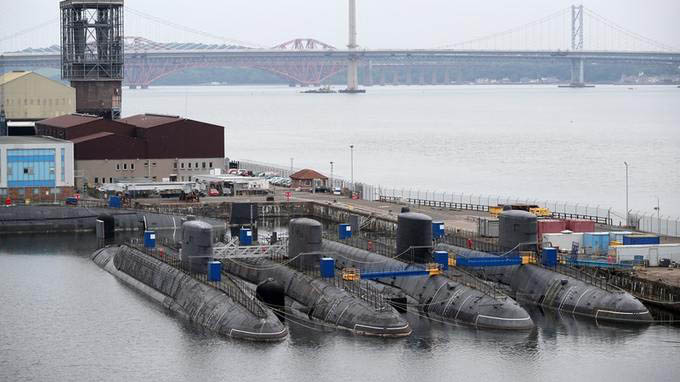
A British nuclear submarine has broken the record for the longest patrol at
sea as safety fears grow over the Royal Navy’s ageing fleet. The
Vanguard-class vessel returned to the Faslane naval base in Scotland on
Monday encrusted with barnacles and covered in slime after a gruelling tour
understood to have lasted more than six months.
Naval experts have raised concerns that the long patrols result in immense physical strain on the vessels and take a psychological toll on the crews. The UK has four
Vanguard-class submarines, which are armed with up to eight Trident
ballistic missiles carrying Britain’s nuclear warheads. At least one
submarine is on patrol at all times to maintain a continuous at-sea
deterrent. The fleet has been effectively reduced to two functioning
vessels, HMS Vigilant and HMS Vengeance, owing to repair works on the other
two.
Times 12th Sept 2023
British activists join Nuclear Free Local Authorities in supporting Swedish Sami against uranium mining
The UK/Ireland Nuclear Free Local Authorities and Lakes against the Nuclear Dump have been joined by activists from twelve anti-nuclear campaign groups in a letter to organisations representing the Sami people of Sweden offering support in their fight against uranium mining.
A ban on uranium exploration, mining and processing in Sweden came into force on 1 August 2018 but, last month, Swedish Climate Minister Romina Pourmokhtari announced that the ban would be lifted and that ten new nuclear reactors would be built over the next twenty years. In the face of international and domestic criticism, the centre-right government has since reined in the commitment to new nuclear by talking instead of a vague commitment to developing ‘green power’, but there has been no roll-back on uranium mining.
Sweden accounts for 80% of the European Union’s uranium deposits and already extracts uranium as a waste product when mining for other metals. Foreign companies, including Aura Energy and District Metals, have already expressed an interest in exploiting reserves. Even if the new government’s nuclear hopes come to naught, there will still be a ready export market for any output. The ongoing conflict in Ukraine has made the surety of uranium supply from Russia and its allies uncertain and the recent military takeover in uranium-producing Niger has shaken the market; consequently, pro-nuclear European nations will be looking for any stable source from a neighbour.
The correspondents fear that any resumption of uranium mining will come at a heavy price to the traditional lands and lifestyles of the Indigenous Sami People, with a degradation of their natural environment and their health. The Sami (or Saami) inhabit the region of Sápmi, which embodies the most Northern parts of Norway, Sweden and Finland, and North West Russia, and are best known for their reliance upon semi-nomadic reindeer herding.
Councillor Lawrence O’Neill, Chair of the NFLA’s Steering Committee, said: “Sadly the world over, uranium mining has been, and still is, often visited upon Indigenous People in their Traditional Lands by large, profit-hungry corporations. In addition, national governments have chosen their lands to carry out nuclear weapons testing and nuclear waste dumping. The impact has been enormous – the lands of Indigenous People have been poisoned, their health destroyed and their culture and traditional way of life decimated.
“Sweden has signed the UN Declaration of the Rights of Indigenous People pledging to defend the lands and lifestyle of the Sami, but the decision to resume uranium mining could, if left unchallenged, lead to their destruction. In sending this collective letter, we, the British and Irish local authorities opposed to nuclear power, with British anti-nuclear groups and activists are pledging ourselves as allies in this fight”.
Co-sponsor, Marianne Kirkby, founder of LAND, Lakes against the Nuclear Dump, added: “Here in Cumbria, we feel so much empathy for the Sami people who have had no say whatsoever in the opening-up of Sweden’s wild areas to the devastation of uranium mining.
“In the UK, we have no uranium mining, but plenty of nuclear plants. We are constantly told that nuclear power is ‘clean’ and ‘home-grown’. This blatant lie is the means by which Sami lands are put under pressure for new uranium mining exploitation in areas where it was previously, and quite rightly, banned as being too destructive to the health of people and planet”.
“This lie of ‘clean nuclear’ is the means by which Indigenous people, whether in Cumbria or in Sweden, whether at the waste end or the fuel end of the nuclear industry, are being exploited by the most toxic industry there is without even a ‘by your leave’. We stand in solidarity with the Sami in saying NO – NO MORE!”
Huge nuclear lobbying aimed at British Parliament

The Nuclear Industry Association will host the third Nuclear Week in
Parliament (NWiP) between the 11th and 13th of September 2023. In January
2023, the rescheduled week saw hundreds of Parliamentarians and industry
representatives engage in various events.
Back in its annual September slot, this year’s NWiP will be packed with multiple events and receptions, plus opportunities for NIA members to hold their complementary meetings.
The week will focus on engaging with Parliamentarians on various topics,
including new build, Advanced Nuclear Technologies, and the fuel cycle.
This will build on our Summer Conference, due to be held in the Concorde
Conference Centre in Manchester on Wednesday, 14 June 2023.
Nuclear Industry Association (accessed) 13th Sept 2023
https://www.niauk.org/nuclear-week-in-parliament-2023-sponsorship-opportunities/
Congress should seek ‘poison pills’ for any US-Saudi nuclear agreement
Federal Times, By Eric Gomez, Jon Hoffman and Jordan Cohen, 13 Sept 23,
Swirling reports of a U.S.-Saudi Arabia deal that would trade normalization with Israel for U.S. security guarantees are raising questions about what Washington will put on the table.
A U.S.-Saudi civil nuclear agreement—also known as a “123 agreement” after the Atomic Energy Act’s section that governs such cooperation — could be part of the broader arrangement, per reports that Saudi Arabia is demanding such cooperation as part of this “grand bargain.”
Any other country that possessed Saudi Arabia’s mix of gross human rights abuses, authoritarian government, malign activities abroad and stated intentions to build a nuclear weapon if Iran gets the bomb would be rightly isolated by the U.S., and not be a serious contender for a 123 agreement.
The U.S. ought to be drawing down its Middle East presence to focus limited resources on more pressing interests in other regions of the world. Nonetheless, if President Joe Biden proceeds, Congress should take steps to make the agreement as stringent and difficult as possible for Saudi Arabia……………………..
The Saudi government claims that it only wants to produce low-enriched uranium, which is suitable for nuclear energy but not weapons. However, a complete nuclear fuel cycle would make it much easier to either covertly manufacture fissile material for a nuclear weapon over time or quickly “sprint” to a weapon on short notice. Past statements by Saudi Arabia’s political leadership that Riyad will develop a nuclear weapon if Iran does should raise alarm bells about the proliferation risks of a Saudi civil nuclear program.
These risks mean that Congress should do everything in its power to introduce so-called poison pills provisions that would make the process of finalizing an agreement as difficult as possible. The legislative body can prevent a 123 agreement from taking effect though a joint resolution of disapproval, but such a resolution can be easily overturned by presidential veto. Regardless, Congress still has tools at its disposal.
The U.S.-India and U.S.-United Arab Emirates 123 agreements provide examples of ways to make a potential U.S.-Saudi nuclear deal more stringent…………………………………….
The U.S. should similarly link any Saudi nuclear deal to end-use monitoring of all weapons transferred to Riyad. Since Saudi Arabia started its war in Yemen, the country has used U.S. weapons to commit vast human rights abuses and endanger U.S. troops. Making a 123 agreement contingent on U.S. end-use monitoring of all weapons sent to Saudi Arabia would improve American security.
Put simply, helping one of Washington’s most problematic allies build a civil nuclear program is non-sensical. The Biden administration should not go ahead with such an agreement in the first place, but if it does Congress should implement poison pills to make the deal as unpalatable as possible for Saudi Arabia. https://www.federaltimes.com/opinions/2023/09/13/congress-should-seek-poison-pills-for-any-us-saudi-nuclear-agreement/
Fukushima’s nuclear waste: Stigmatising Russia, approving Japan

By Richard Cullen, Sep 13, 2023 https://johnmenadue.com/fukushimas-nuclear-waste-stigmatising-russia-approving-japan/
Twenty years ago, Japan demanded Russia halt disposal of nuclear waste in the Sea of Japan. What changed? Is it the case that there is felonious nuclear waste – and respectable nuclear waste? Japan seems to believe that this is so and the Mainstream Media understands why this narrative may deserve its support.
The Fukushima Daiichi nuclear power plant, operated by Tokyo Electric Power Company (TEPCO), was catastrophically destroyed by an earthquake and tsunami in 2011. Japan has recently put into effect a decision to release, into the adjacent ocean, more than a million tonnes of water contaminated as a result of the destruction of that nuclear power plant, over the next three decades.
There is a serious debate about the real level of risk posed by this huge, extended release of contaminated water. TEPCO say that they are filtering and diluting the water to remove isotopes – apart from tritium, which will enter the sea in a safely attenuated form. A release on this scale is unprecedented, however. Moreover, regardless of this debate over the scientific case, what is additionally of real interest, is how the Mainstream Western Media (MWM) have largely covered this matter.
Japan’s decision is, unsurprisingly, controversial, not least in China and Korea and also across the fishing community in Japan. The forbidding impact on East Asia’s seafood industry is already evident.
Yet, as you read reports on what is happening in the MWM, what stands out is the understanding tone evident in most coverage. A recent Reuters report is indicative. It stressed how TEPCO would filter and dilute “until tritium levels fall below regulatory levels before pumping it into the ocean”, adding that, “tritium is considered to be relatively harmless”. There is no mention of what AL Jazeera argued in 2021. Their report highlighted TEPCO’s long-term, poor safety-management reputation, noting that:
One of the gravest charges was that the company’s own internal studies had concluded prior to the accident that the plant might be vulnerable to a large tsunami and needed a protective barrier.
The revealing Reuters report also told us that “water containing tritium is routinely released from nuclear plants around the world” (zero mention of the quantities) and that (unnamed) “regulatory authorities support dealing with the Fukushima water in this way”. The report reads as though it may have been appreciably based on a TEPCO press release.
Next, it is illuminating to consider how Tokyo dealt with the release of 900 tonnes of radioactive waste into the ocean to the north of Japan, in 1993, by Russia.
A recent commentary in the Korea Herald explained that, while this Russian waste had not been filtered, it was still regarded as low-level waste. Moreover, according to another recent report in the Global Times, although the International Atomic Energy Agency (IAEA) knew in advance of the Russian plan to dump this waste in 1993, it did not see a need to intervene.
However, twenty years ago, Japan demanded a permanent halt to the Russian disposal of the waste into the Sea of Japan, forthwith. The Russian Ambassador to Japan was summoned to hear Tokyo’s complaints and stipulations. Japan also sought to deploy international law arguments to bolster its case, despite the lack of any intervention by the IAEA. Remember, too, that the total waste disposal involved here was a tiny fraction of the planned purging of waste-water from the Fukushima plant.
Russia, in 1993, was still finding its sovereign-feet following the collapse of the USSR and it swiftly agreed to the demands to cease discharging any further waste under the pressure applied by Japan and other countries, including the US. The MWM today refer to waste water being “released” from the Fukushima storage tanks but in 1993, Russia was “dumping” nuclear waste.
One way to get a handle on the tilt of this commentary is to imagine a similarly ruinous destruction of a shoreline Chinese nuclear plant, coupled to a water-release solution of the same magnitude. Picture the sort of lurid headlines we would, by now, almost certainly be seeing across the MWM – led by its more feverish outlets: China set to poison the Pacific Ocean for decades to come; and The Chinese Communist Party demonstrates contempt for Planet Earth.
So, it transpires, depending on your standpoint, that there is felonious nuclear waste – and respectable nuclear waste. Which brings to mind a story related by a leading British Labour politician from his youth. He was marching in a Ban the Bomb rally. A more committed believer pointed out, when he said he was against all nuclear weapons, that he was misguided: the atomic bomb possessed by the USSR was in a different category, as it was the People’s Bomb.
Pentagon’s new plan to counter China includes swarms of smart satellites

Deputy Secretary Kathleen Hicks: DoD wants to “leverage platforms that are small, smart, cheap, and many”
Space News, Sandra Erwin, September 6, 2023
ARLINGTON, Va. — Under a new strategy to counter China’s military buildup, the Pentagon is advocating the use of low-cost autonomous platforms that can be mass produced and deployed at sea, on land, in the air and in space.
“This is about driving culture change just as much as technology change — so we can gain military advantage faster,” Deputy Defense Secretary Kathleen Hicks, said Sept. 6 at the DefenseNews annual conference.
Hicks discussed DoD’s plan to field thousands of autonomous systems across all domains within the next 18 to 24 months. China’s advantage is “mass,” said Hicks. DoD will continue to invest in its traditional platforms but will counter with “mass of our own,” or large numbers of autonomous systems.
DoD would field fleets of tiny drones and swarms of satellites that would be inexpensive to replace.
“Imagine constellations of autonomous, attritable systems on orbit, flung into space scores at a time, numbering so many that it becomes impossible to eliminate or degrade them all,” she said.
The strategy is to “leverage platforms that are small, smart, cheap, and many,” Hicks said. …………………………………………………….
The U.S. military’s Space Development Agency is building a government-owned proliferated constellation. DoD is also a major customer of Starlink, SpaceX’s massive internet in space. ……………….. https://spacenews.com/pentagons-new-plan-to-counter-china-includes-swarms-of-smart-satellites/?utm_medium=email
US incapable of negotiating – Russian diplomat
Rt.com 12 Sept 23
Strategic dialogue with Washington has done nothing for Moscow’s national security, Aleksandr Kramarenko claims
No amount of negotiating with the US has been able to bring about meaningful results, as Washington has repeatedly broken the trust of its partners and refused to respect agreements, acting solely in its own interests, Russian diplomat Aleksandr Kramarenko has said.
In an article for International Affairs published last week, Kramarenko, the director of the Russian Foreign Ministry Institute of Current International Problems, said that despite decades of trying to maintain strategic dialogue with the US, Russia has ultimately been unable to achieve any results in ensuring its national security, and neither has China.
He added that trust between Moscow and Washington was undermined long ago. In 2011, Russia allowed the passing of what seemed to be a humanitarian UN resolution on Libya, which was then used by the West to lay ruin the country.
In 2015, Russia was deceived by the Minsk agreements, which were meant to resolve the internal conflict in Ukraine, but instead were used to buy time to build up Kiev’s army with the goal of inflicting a military or strategic defeat on Russia.
“What kind of trust can we talk about here? Where is the principle of pacta sunt servanda [contracts must be respected]? And what then is the meaning of contracts when everything happens regardless and in spite of any contracts? Apparently, it turns out that Washington is simply unable to negotiate,” Kramarenko wrote, noting that Russia is not the only country to come to this conclusion.

Commenting on the conflict in Ukraine, he recalled the words of US National Security Advisor Jake Sullivan (above)at the recent Aspen Security Forum, who said that the US and its allies are willing to “take risks” with their arms supplies to Kiev. What Sullivan meant, according to Kramarenko, was that Washington is willing to risk nuclear escalation, and that it is willing to do so because the principle of nuclear deterrence does not work for Russia.
“This means we need to think about how to restore trust in it.”
Kramarenko went on to suggest that all the arms control systems that have been destroyed by the US in attempts to maintain strict control over other nations while remaining ambiguous with regards to its own nuclear potential, could soon be replaced by a new process based on a multipolar world. ………. https://www.rt.com/russia/582797-us-incapable-of-negotiating/
Crooked Canadian company Lavalin trying to sell ?zombie nuclear technology to China and UK

 Canada now dominates World Bank corruption list, thanks to SNC-Lavalin, Financial Post Armina Ligaya | September 18, 2013 Canada’s corporate image isn’t looking so squeaky-clean in the World Bank’s books — all thanks to SNC-Lavalin.Corruption’s double standard: It’s time to punish countries whose officials accept bribes
Out of the more than 250 companies year to date on the World Bank’s running list of firms blacklisted from bidding on its global projects under its fraud and corruption policy, 117 are from Canada — with SNC-Lavalin and its affiliates representing 115 of those entries, the World Bank said.
“As it stands today, the World Bank debarment list includes a high number of Canadian companies, the majority of which are affiliates to SNC Lavalin Inc.,” said the bank’s manager of investigations, James David Fielder.
“This is the outcome of a World Bank investigation relating the Padma Bridge project in Bangladesh where World Bank investigators closely cooperated with the Royal Canadian Mounted Police in an effort to promote collective action against corruption.”
As a result of the misconduct found during the probe, the Montreal-based engineering and construction firm, and its affiliates as per World Bank policy, were debarred in April 2013 for 10 years, as part of a settlement with SNC-Lavalin. And in one fell swoop, 115 Canadian firms were blacklisted by the World Bank, making Canada seemingly look like the worst offending country.
It’s quite the jump from 2012, when no Canadian companies were barred……..http://business.financialpost.com/2013/09/18/canada-now-dominates-world-bank-corruption-list-thanks-to-snc-lavalin/

Lavalin looks to expand nuclear enterprise in China http://www.theglobeandmail.com/report-on-business/industry-news/energy-and-resources/lavalin-looks-to-grow-in-china/article17950935/ SHAWN MCCARTHY – GLOBAL ENERGY REPORTER OTTAWA — The Globe and Mail, Apr. 13 2014, SNC-Lavalin Inc. is hoping to revitalize its international nuclear business through an effort with its Chinese partners to burn reprocessed fuel in a Candu reactor as a way to reduce radioactive waste.
Officials from Candu Energy Inc. are leading a Canadian nuclear industry mission to China this week, which will include a visit Monday to the Qinshan nuclear power station south of Shanghai where two heavy-water Candu 6 reactors are in operation. Candu Energy is the former Atomic Energy of Canada Ltd., and is now wholly owned by SNC-Lavalin
The Mississauga-based nuclear vendor has been working with the Chinese operator of the Qinshan plants to fashion reprocessed fuel from the waste products of competing light-water reactors. The Candu could, in effect, become the blue box of the nuclear industry, company executives said in an interview.
“We’re very excited that this advances the discussion we can have about introducing more Candus into China,” Jerry Hopwood, the company’s vice-president of marketing and product development, said.
Candu reactors use heavy water, which includes a hydrogen isotope called deuterium, both for coolant and to moderate atomic reactions. Light-water reactors use ordinary water for both purposes.
Each approach offers different benefits, but the world market is dominated by light-water reactors, which require enriched uranium as fuel. In contrast, the heavy-water Candus can burn natural uranium as well as reprocessed fuel.
Mr. Hopwood said China now has 21 light-water reactors that produce two streams of energy-rich waste: spent fuel from the reactor itself and depleted uranium from the enrichment process. China plans to more than double its number of light-water reactors to meet the demands of its growing economy.
“Those reactors are going to produce a lot of waste fuel and China has a plan to recycle all the waste fuel from its reactor,” Mr. Hopwood said. “We believe there is a very strong opportunity to sell a significant number of Candu units in China.”
He said the partners have completed all the development and licensing work, and the Chinese operators expect to begin running reprocessed fuel in the two Candu reactors at an industrial level by the end of the year.
The company is also working with Chinese partners to modify the existing Enhanced Candu model so it will more efficiently burn the recycled fuel but also run on thorium, an abundant alternative to uranium that produces less highly radioactive waste. China has vast reserves of thorium but must import uranium, and develop a thorium-fired reactor.
As well, Candu Energy is one of two finalists in the United Kingdom’s competition to select a reactor design that will eliminate a stockpile of plutonium. “We think this work in China is paving the way for other options where Candu’s fuel-cycle ability is a benefit, notably in the U.K.,” Mr. Hopwood said.
The trade delegation will include Ontario’s Minister of Research and Innovation, Reza Moridi, who is a nuclear physicist, and several business leaders from the Organization of Canadian Nuclear Industries, an Ontario-based suppliers’ group that is eager to land export and service business in the world’s fast growing reactor market.
Critics contend the Candu 6 is an outdated design that lacks safety features included in newer reactors, and that it is a technology that the international marketplace has largely rejected since the 1990s.
“So yeah, the industry is trying to say Candu isn’t dead. Never say die,” said Shawn-Patrick Stensil, a nuclear campaigner at Greenpeace Canada. “If Candu isn’t dead, it’s a zombie.”
1 This Month
Chernobyl: The Lost Tapes – A good documentary on Chernobyl on SBS available On Demand for the next 3 weeks– https://www.sbs.com.au/ondemand/tv-program/chernobyl-the-lost-tapes/2352741955560

of the week–London Campaign for Nuclear Disarmament

Tell the Ukrainian Government to Drop Prosecution of Peace Activist Yurii Sheliazhenko
To see nuclear-related stories in greater depth and intensity – go to https://nuclearinformation.wordpress.com
-
Archives
- April 2026 (126)
- March 2026 (251)
- February 2026 (268)
- January 2026 (308)
- December 2025 (358)
- November 2025 (359)
- October 2025 (376)
- September 2025 (257)
- August 2025 (319)
- July 2025 (230)
- June 2025 (348)
- May 2025 (261)
-
Categories
- 1
- 1 NUCLEAR ISSUES
- business and costs
- climate change
- culture and arts
- ENERGY
- environment
- health
- history
- indigenous issues
- Legal
- marketing of nuclear
- media
- opposition to nuclear
- PERSONAL STORIES
- politics
- politics international
- Religion and ethics
- safety
- secrets,lies and civil liberties
- spinbuster
- technology
- Uranium
- wastes
- weapons and war
- Women
- 2 WORLD
- ACTION
- AFRICA
- Atrocities
- AUSTRALIA
- Christina's notes
- Christina's themes
- culture and arts
- Events
- Fuk 2022
- Fuk 2023
- Fukushima 2017
- Fukushima 2018
- fukushima 2019
- Fukushima 2020
- Fukushima 2021
- general
- global warming
- Humour (God we need it)
- Nuclear
- RARE EARTHS
- Reference
- resources – print
- Resources -audiovicual
- Weekly Newsletter
- World
- World Nuclear
- YouTube
-
RSS
Entries RSS
Comments RSS
 nuclear-news