Ukraine’s defeat could mean the end of NATO in its current form
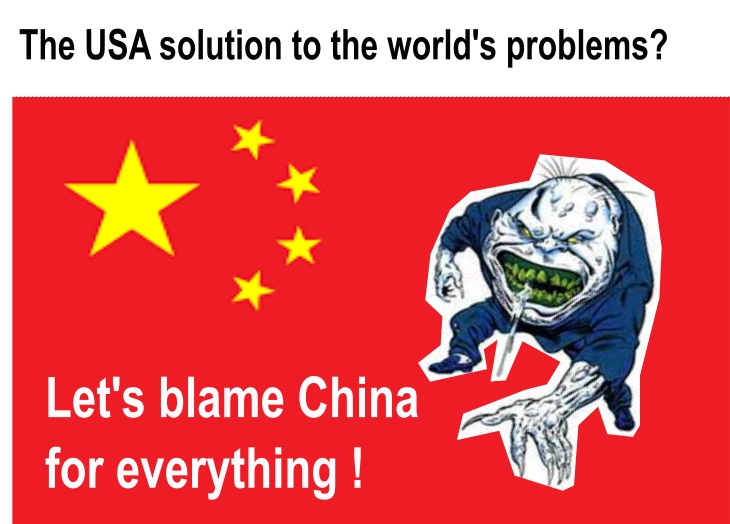
The ‘shift focus to another enemy’ narrative is the simplest and most obvious – that will be China. NATO is already trying to expand its influence in Asia, including via a planned ‘liaison office’ in Japan. The ‘China is the real threat’ narrative is bubbling steadily to the surface in Western media.
The bloc has too much riding on Kiev’s highly-unlikely success, and that’s why it’s doing all it can to prolong the conflict
By Chay Bowes, journalist and geopolitical analyst, MA in Strategic Studies, RT correspondent
As the West’s proxy war in Ukraine slips inexorably towards utter failure, the neocons behind the debacle are faced with dwindling avenues of retreat.
Early confidence that Russia, in its current form, would collapse under the pressure of the harshest sanctions regime in history failed to materialize. Early Russian miscalculations on the battlefield were not followed by a military meltdown, but by a pragmatic display of strategic adaptability, which is begrudgingly admired in the military war rooms of the West. The Russian army, far from falling apart, has steeled itself into making bold decisions to retreat when prudent and advance when required, both of which have proven devastating for their Ukrainian opponents. It follows that, as the Western political elites that cultivated this conflict peer into another winter of political, military, and potentially economic discontent, it is now that we potentially face the most dangerous period in Europe since the outbreak of WWII.
The catalyst for a wider war in Europe isn’t, in fact, a limited conflict in Ukraine in itself, one that started in 2014 and, notably, had been largely ignored by Western powers for almost a decade. The real issue is that NATO, which is currently engaged in a proxy War with Russia, is facing a ‘damned if you do and damned if you don’t’ scenario regarding its growing military involvement in Ukraine. If the US-led bloc escalates further as defeat looms, it could likely lead to direct confrontation with Russia. If it doesn’t, its proxy will collapse and leave Russia victorious, a fate once utterly unthinkable in Brussels, Washington, and London, but now becoming a nightmarish reality.
Such a defeat would be devastating and potentially terminal for the prestige and reputation of the whole NATO brand. After all, despite the Soviet Union having long ceased to exist, the bloc still markets itself as an indispensable bulwark against imagined Russian expansionism. In the event of an increasingly likely Ukrainian defeat, that ‘essential partner’ in ‘countering Russia’ will have been proven utterly impotent and largely irrelevant. More cynically, the vast US arms industry would also be denied a huge and lucrative market. So, how does a multi billion-dollar machine that has prophesied absolute victory against Russia even begin to contemplate defeat? And how do senior EU bureaucrats like Ursula Von der Leyen climb down from their quasi-religious devotion to the ‘cause’ of utterly defeating Russia, which she has shamelessly evangelized for over a year and a half? Lastly, how does the American administration, which has gone politically, morally, and economically ‘all in’ against Russia in Ukraine, contemplate what amounts to an increasingly inevitable European version of Afghanistan 2.0?
They will need to do two things: Firstly, find someone to blame for their defeat and secondly, find a new enemy to deflect public opinion onto. The ‘someone to blame’ will be quite easy to identify – the narrative will be flush with attacks on states like Hungary, China, and to some extent India, who will be accused of “undermining the unified effort needed to isolate and defeat Russia.”
Blaming Ukraine itself will also be central to this narrative. Western media will insure it’s singled out as incapable of ‘taking the medicine’ proffered by NATO and therefore suffering the consequences, not listening to Western military advice, failing to utilize Western aid correctly and, of course – given that little has been done by Zelensky to tackle the endemic corruption in Ukraine – this fact will be easily weaponized against him and used to lubricate a slick narrative of ‘we tried to help them, but they simply couldn’t be saved from themselves’.
The ‘shift focus to another enemy’ narrative is the simplest and most obvious – that will be China. NATO is already trying to expand its influence in Asia, including via a planned ‘liaison office’ in Japan. The ‘China is the real threat’ narrative is bubbling steadily to the surface in Western media.
And, most worryingly, should Western powers fail to make their case for ‘plausible deniability’ around the culpability for this war, there is always the option of further escalating it. Such an escalation could rapidly lead to direct confrontation between NATO and Russia, an outcome no lucid observer on either side of the debate could or should be contemplating. The problem is, rational assessment and negotiation seem to have become so rare in Washington and Kiev that a devastating escalation could, quite remarkably, be considered an option by the deluded neocon think-tank advisers wielding disproportionate influence over an increasingly desperate political class in Washington and Brussels. In the event that NATO does indeed sanction a direct intervention into Ukraine, it will, of course, be justified as a ‘peacekeeping’ or humanitarian intervention by Polish or Romanian troops, but the categorization of the ‘mission’ will become gloriously irrelevant when the first clashes with Russian forces occur, followed by a potentially rapid spiral into all-out war between Russia and NATO.
It could be argued that the process to disassociate from Ukraine has already started, beginning with the embarrassment Zelensky faced at the recent NATO summit and progressing with the open spats between Western ‘partners’ over whether to give Ukraine ever deadlier weapons to essentially insure its self-destruction.
From here on out one thing is abundantly clear, nothing will happen by accident when it comes to the EU and NATO’s interaction with the Zelensky regime. Whatever comes next may need to be spun both ways, to either pull out or to escalate. A case in point is the blame game being openly acted out around the obvious failure of Ukraine’s counteroffensive, with open finger-pointing in the Western media by Ukrainian officials like the ambassador to Germany, Aleksey Makeev. Kiev’s top man in Germany recently blamed the West for the bloody failure of the ill-fated project, suggesting it was solely due to European and American delays in shipping weapons and cash to Kiev. According to the ambassador, it was this Western failure that apparently allowed the Russians to build their defenses in eastern Ukraine, where tens of thousands of unfortunate Ukrainian conscripts have met their fate in the past three months.
In the real world, the counteroffensive, which has now become a slow-motion calamity, had been telegraphed to the Russians and the wider world for almost a year and will surely be recalled as one of the greatest military misadventures in history. The fact that the Ukrainian regime openly advertised its intentions, even loudly pointing out the avenue of assault and strategic goals, is conveniently ignored by the likes of Makeev. It now seems apparent that Kiev believed that its overt saber-rattling would stimulate faster and larger weapons shipments from its increasingly concerned partners – it didn’t, and by the time those very same sponsors’ patience ran out with Kiev’s lack of progress on the battlefield, it was glaringly obvious any offensive against long-prepared Russian defenses was doomed to fail. Yet, because of Kiev’s PR need and demands from Western political elites, the counteroffensive began, wiping out entire battalions of Ukrainian troops and burning through a huge portion of the Western heavy weapons previously provided.
The situation evokes a kind of tragic romantic folly, with Ukraine desperate to woo NATO and the EU to the point of suicide, NATO and the EU playing the aloof lover; never having really considered marriage but willing to allow its admirer to throw itself onto the spears of the real object of their attention – Russia. Of course, the real concern now preoccupying the EU-NATO cabal is how to survive this tawdry affair and move on. While the hapless Jens Stoltenberg would have us believe NATO has never been stronger, the reality is far less rosy for the ‘defensive alliance’ that has bombed its way across Europe and the Middle East, and now seeks to expand to the Pacific. The reality is that the Ukraine conflict could destroy NATO. It has become something of a modern day League of Nations, adept at admonishing small fish, but utterly incapable of standing toe to toe with any peer adversary, a failed political institution, posing as a military alliance, that in reality would collapse in the face of a direct challenge from either Russia or China. Of course, it seems that NATO has also willfully fallen under the spell of its own propaganda.
The big question now is whether the bloc would in reality contemplate a direct confrontation with Russia in Ukraine? Or will the Western political elites who built the scaffold the Ukrainian conflict is now blazing on choose to reverse through blame or escalate through desperation?
One thing is indisputable: The fate of NATO and its credibility as a ‘defensive alliance’ is irrevocably intertwined with the outcome of the Ukrainian conflict, yet because NATO is, in reality, a political rather than military institution, these crucial issues will never be debated openly, as the answers would be akin to a priest announcing the nonexistence of God from the pulpit.
USA & NATO responsible for Ukraine war, German & French public say in poll
Most people in Germany and France blame the United States and/or NATO for the war in Ukraine, according to a poll conducted not by a pro-Russian group but rather by anti-Putin activists.
BEN NORTON, SEP 10, 2023, Geopolitical Economy Report
Original shows tables of poll results.
Most people in Germany and France blame the United States or NATO for the war in Ukraine, according to a poll conducted not by a pro-Russian group but rather by anti-Putin activists.
This public opinion is unlikely to have a significant impact on government policy, however.
Germany’s Foreign Minister Annalena Baerbock stated bluntly in a NATO-funded conference in 2022 that Berlin would support Ukraine “no matter what my German voters think”.
In the German poll, respondents were only allowed to pick one answer. In France, the poll was a bit different, and people could blame multiple parties for starting the war in Ukraine. (This explains why the sum of the latter poll is greater than 100%.)
Among the French surveyed, 43% blamed the USA, 36% NATO, 19% Ukraine, and 19% other European countries, while 40% blamed Putin.
These results suggest that many average Europeans can see clearly that the conflict in Ukraine is not merely a battle between Kiev and Moscow, but rather a proxy war that the NATO military alliance, led by the United States, is waging against Russia.
The outcome of these polls is even more striking when one considers who sponsored them.
The so-called “Anti-Corruption Foundation” was founded by Russian opposition politician Alexei Navalny, a regime-change activist who is openly supported by Western governments…………………………………………………………………………………………….more https://geopoliticaleconomy.substack.com/p/us-nato-responsible-ukraine-war-poll?r=nxsz
IAEA warns of nuclear safety threat as combat spikes near Ukraine nuclear power plant

The United Nations atomic watchdog warned of a potential threat to nuclear
safety from a spike in fighting near Europe’s largest nuclear power plant
in Ukraine, whose forces continued pressing their counteroffensive on
Saturday. The International Atomic Energy Agency said its experts deployed
at the Russia-occupied Zaporizhzhia Nuclear Power Plant reported hearing
numerous explosions over the past week, in a possible indication of
increased military activity in the region. There was no damage to the
plant.
PBS 9th Sept 2023
Ukrainian Dissident Resists NATO’s Proxy War
September 10, 2023, By Max Blumenthal / YouTube
Ukrainian journalist and exiled antiwar dissident Ruslan Kostaba has been jailed and brutally attacked for his years of opposition to his government’s war in the Donbas, and his calls for peace with Russia. From exile, he speaks to The Grayzone’s Max Blumenthal about the growing movement in Ukraine against escalating the war, and the price his countrymen face for attempting to escape the war.
Comment. Kalen
Thanks for the first on SP post about peace activism in Ukraine although it is very diverse with many angles and ideologies. Most of them acquired legitimacy many years ago when they did what real peace peace movements must do namely tried to promote peace like Minsk agreements and prevent wars not freezing them. They failed among other things because their voice was suppressed in the western peace movements that actually fueled the war. Now Ukrainians for peace and that also includes non-pacifists are appalled by Ukraine being used by NATO as bloody battlefield to preserve US hegemony over Eurasia.
The western peace movements’ silence and betrayal of gruesome fate of thousands of Ukrainian peace activists exiled, hundreds murdered and imprisoned by Kiev regime while protesting eight years of Donbas war against civilians, Kiev escalation of war financed by US and in last 18 months calling for peace talks with Russia is one of darkest chapters of western peace movements already tarnished by adopting nonsense of just wars and humanitarian killings.
The old western anti war movements are all dead, some act like war craving zombies. They burned to ashes. There is nothing to resurrect as they were always fundamentally wrong and morally highly ambiguous as long as they were judging foreign societies they had no idea about pushing supposedly universal superiority of western liberalism they were themselves clueless about. As a result they often externally fueled conflicts, prevented any solutions of social peace to be achieved by local communities’ cooperation free of dogmatic political or religious influences.
UK / ‘No Easy Options’ For Disposal Of Plutonium Stockpile, Says Report

“simpler and cheaper to consider it a waste material alongside the other legacies from the nuclear industry, and safely dispose of it.”
NUCNET, bBy David Dalton, 6 September 2023
There are no easy options when it comes to the “unavoidably complex” task of managing the UK’s plutonium stockpile, but more research, development and innovation is needed to underpin any decision, a report says.
The report, prepared by the Dalton Nuclear Institute at Manchester University, calls for a national dialogue led by “trusted voices” and based on a clear view of the government’s thinking of the role, if any, plutonium might play in meeting future UK energy needs.
The stockpile could be used as fuel for existing or future thermal reactors. It could also be combined with the UK’s 100,000 tonne supply of depleted, natural and low-enriched uranium to fuel new fast reactors, which has the potential to power the UK for centuries. Both options could lead to the reduction of the UK’s nuclear legacy burden.
Another option is to dispose of the stockpile in the planned UK deep geological repository.
Professor Clint Sharrad, acting director of the Dalton Nuclear Institute, said while this all sounds promising, successfully delivering such outcomes would take time, money, organisation, and commitment.
The Nuclear Decommissioning Authority, a government body, is in the process of repackaging the plutonium stocks, stored at Sellafield in northwest England, into more robust containment.
“Being wary of the current global political and economic climate, it may be that extracting the energy from UK plutonium in the not-too-distant future becomes unnecessarily expensive and political barriers may be too difficult to overcome,” Prof Sharrad said.
“Therefore, it might be simpler and cheaper to consider it a waste material alongside the other legacies from the nuclear industry, and safely dispose of it.”
The stockpile originates from reprocessing spent fuel from the UK’s reactor fleets, plus some material derived from outside the UK….. https://www.nucnet.org/news/no-easy-options-for-disposal-of-uranium-stockpile-says-report-9-3-2023
Australia’s Navy Pursues Nuclear Submarines and AI-Powered Ghost Sharks

the potential for AI-driven robots to make lethal decisions independently,
https://www.gktoday.in/australias-navy-pursues-nuclear-submarines-and-ai-powered-ghost-sharks 10 Sept 23
Australia’s Navy is adopting two contrasting approaches to advanced submarine technology to address the challenges posed by a rising China. On one hand, Australia is investing in a costly and slow project to acquire up to 13 nuclear-powered attack submarines. On the other hand, Australia is rapidly developing AI-powered unmanned submarines called “Ghost Sharks,” AI-powered subs will be delivered in the near future, offering a cost-effective and swift solution to enhance naval capabilities. The divergent approaches highlight the transformative impact of automation and AI on modern warfare.
How do the cost and delivery timelines of the nuclear submarines and Ghost Sharks differ?
The nuclear submarines are estimated to cost over AUD$28 billion each and will not be delivered until well past the middle of the century. In contrast, Ghost Sharks have a per-unit cost of just over AUD$23 million and will be delivered by mid-2025.
Significance of the Ghost Shark project
The Ghost Shark project illustrates the transformative impact of automation and AI on modern warfare, offering a cost-effective and swift solution to enhance naval capabilities. Such AI-powered unmanned submarines can operate autonomously, descend to greater depths, and be deployed in large numbers without risking human lives. They offer increased flexibility, cost-effectiveness, and the ability to perform maneuvers that might be impossible for crewed submarines.
Link to Geopolitical Challenges?
Australia’s investments in advanced submarine technology are linked to the geopolitical challenges posed by a rising China in the Asia-Pacific region. These developments are part of efforts to maintain military capabilities and respond to regional security concerns.
nfluence of AI
AI technology is influencing the development of various military capabilities, including autonomous weapons, fighter drones, swarming aerial drones, and ground combat vehicles. AI is also playing a role in data analysis and decision support for military commanders.
The AI technology arms race has high stakes in terms of military dominance and geopolitical influence. Winning the race could reshape the global political and economic order, with potential consequences for peace and stability in the Asia-Pacific region.
Challenges of AI
Challenges and concerns include the potential for AI-driven robots to make lethal decisions independently, the need for regulation related to the military application of AI, and the ethical considerations of using AI in warfare, including the targeting of combatants and non-combatants.
Private Sector’s Role
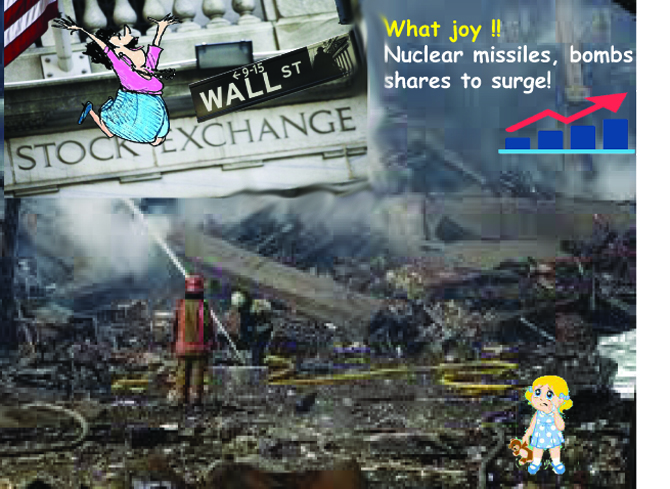
Private companies like Anduril are actively involved in developing AI-powered military technologies. They are contributing to the development of autonomous systems, sensor fusion, computer vision, edge computing, and AI, with applications in various defense domains, including submarines, drones, and counter-drone systems.
Is Ukraine’s new long-range missile technology bringing us closer to WW3? Experts say Putin ‘might try something desperate’ amid US fears it will convince Vladimir to use nuclear weapons
- Kyiv last month blew up Russian air defence system with modified cruise missile
- The new missile gives Ukraine the capacity to strike deep into Russian territory
- Experts told MailOnline what the missiles mean for war and potential retaliation
Daily Mail By DAVID AVERRE and RACHAEL BUNYAN 10 September 2023
Ukraine’s development of a newly modified cruise missile that could strike targets hundreds of miles across the Russian border has sparked fears that Vladimir Putin could resort to the nuclear option if he becomes ‘desperate’.
Dr. Alan Mendoza, executive director at the Henry Jackson Society think tank, said that although the nuclear threat is unlikely, it remains on the table should the Kremlin chief feel backed into a corner amid attacks on Russian cities.
‘It is not likely Russia would strike Ukraine or NATO allies with nuclear weapons simply in response to Neptune missiles being used – to do so would mean a response from the West that would surely hasten the demise of the Putin regime.
‘That said, if Putin felt that his grip on power was loosening beyond his control he might try something desperate. At that point, it would be hoped that saner forces within the Russian hierarchy would step in to relieve him of command,’ he said.
Meanwhile, former US Defense Attaché to Moscow and retired US Army Brigadier General Kevin Ryan said Washington was alarmed by Ukraine’s new strike capability.
‘The US administration is concerned that successful attacks by Ukraine into Russia could give Putin justification to expand his war to the West or even use nuclear weapons.
‘Deploying the Neptune in attacks against Russian infrastructure will escalate the war and force Putin and his military leadership to also escalate their attacks against Ukrainian cities.’
t comes after Ukraine last month destroyed a state-of-the-art Russian air defence system nestled in the occupied Crimean peninsula, scoring a direct hit on the S-400 ‘Triumf’ and blasting it sky-high in an impressive strike.
Putin‘s state-media mouthpieces and war-bloggers railed against the attack, labelling it the result of a British-supplied Storm Shadow missile and threatening retaliation against the West for its support of Kyiv.
But it was later revealed that the weapon behind the destruction of the S-400 was not a British projectile, but instead a modified version of a Neptune cruise missile – the kind that sunk the Moskva, pride of Russia‘s Black Sea Fleet last year.
By converting the Neptune anti-ship missile to be fired from land positions on land targets, Ukraine’s engineers have provided Zelensky‘s army with the capability to strike deep within Russian territory – something they’ve shown they can do already with drones – with devastating effect.
Senior Research Leader in Defence and Security at RAND Europe Bryden Spurling told MailOnline that the newly modified missile could enable Ukraine to destroy targets more than 200 miles inside Russian territory with near pin-point accuracy.
‘The earlier anti-ship version sank the Russian cruiser Moskva, so it is a precision weapon with a large warhead. The suggested range for this new land attack version seems to be somewhere between 170 and 190 miles – and could possibly grow to be as much as 225 miles according to some sources,’ Spurling said.
He added that the modified Neptune missiles unlock a new capability for Ukraine’s armed forces, whose access to Western weapon systems like Storm Shadow missiles is contingent on them being used exclusively to defend Ukrainian territory – not to strike across the border………………………………………………………………………………….. https://www.dailymail.co.uk/news/article-12479123/Is-Ukraines-new-long-range-missile-technology-bringing-closer-WW3-Experts-say-Putin-try-desperate-amid-fears-convince-Vladimir-use-nuclear-weapons.html
Oregon hasn’t said never to nuclear power, but it should

BY LLOYD K. MARBET, Sep 10, 2023 https://www.bendbulletin.com/opinion/guest-column-oregon-hasnt-said-never-to-nuclear-power-but-it-should/article_5f0b13ec-4e93-11ee-873b-6fbd0628540c.html
Recently, editorials have appeared across Oregon in a number of newspapers. They are remarkably similar, and subtly deceptive in their content, as if the Nuclear Pied Piper is once again in town, playing new music for a great revival if only you will follow the Pied Piper down its unforseen road once again.
Have we resolved the problems of the nuclear fuel cycle? NO! A complicated cycle consisting of: — availability of uranium, mining, milling, enrichment, and fuel fabrication — construction of nuclear power plants with its delays and tremendous cost overruns — uncertain safety of nuclear plant operations with government limited liability leaving taxpayers holding the bag — targets of war, terrorism and natural disasters — radiation releases difficult to detect, and health effects difficult to prove, with ongoing disputes over the number of deaths — radioactive wastes throughout the fuel cycle demanding permanent disposal, up to thousands of years for high level radioactive waste — and decommissioning of an elaborate contaminated nuclear infrastructure. The problems of the nuclear fuel cycle are not resolved, nor fully accounted for!
Nuclear energy is not “zero emissions.” Oregon law measures carbon emissions at only one point in its fuel cycle: at the generation of electricity. The nuclear fuel cycle is an ongoing tragedy visiting its impacts on generations to come. Commercial “Small Modular Nuclear Reactors” are unproven designs on paper. If we are going to save ourselves from Climate Annihilation the time for honest accountability has come. Read Mark Jacobson’s book “No Miracles Needed: How Today’s Technology Can Save Our Climate and Clean Our Air.”
Oregon’s ballot measure and legislative referral process is a valuable educational tool for enlightening the electorate on important issues. It is also the reason why I strongly support preserving the ballot measure law passed by Oregon voters in 1980 and not repealing this hard-fought effort, that has protected Oregonians for 43 years by requiring the commercial nuclear power industry to have a “terminal” repository for its high level radioactive waste before producing any more. This law doesn’t say never to nuclear power.
Secondly, and most important, it provides, by referral to all Oregon voters, the right to make the final decision on whether proposed commercial nuclear power plants are needed, cost effective, and can safely operate in our state! The Bulletin’s editorial provides an incorrect history of the 1980 and 1986 ballot measures. The 1986 ballot measure on nuclear power was not passed into law!
Why are nuclear proponents seeking another vote on the 1980 law? Especially when repealing what gives Oregonians an ongoing vote on whether the nuclear industry has successfully met its obligation to provide a viable cost effective energy resource, capable of terminally disposing its high level nuclear wastes.
In the last Oregon legislative session, a hearing was held on one of the two identical bills that sought to re-refer the 1980, not the failed 1986, ballot measure to another vote. Both 2023 bills “fizzled out” after a House Committee heard testimony in favor of them and overwhelming testimony in opposition! Especially of note is testimony provided by Dirk Dunning, formerly of the Oregon Department of Energy, and Tami Thatcher, formerly of the Idaho National Laboratory. All testimony is available to read online at: tinyurl.com/Testimonyonnukes.
NATO isn’t able to help Ukraine win
Russia has the upper hand on the front lines as the bloc is no longer able to meet Kiev’s needs
Rt.com By Ilya Kramnik, military analyst, expert at the Russian International Affairs Council and researcher at the Russian Academy of Sciences 10 Sept 23
More than 18 months into the conflict between Russia and Ukraine, NATO military aid to Kiev remains a constituent part of the war. This factor seeps into public consciousness, influences the political perception of the conflict, and affects the situation on the battlefield, whichever side of the hostilities people find themselves on. All these aspects are important in their own right, and each will influence the course of the conflict and its eventual outcome. But how long will NATO be able to provide military assistance to Ukraine?
Gloomy prospects for Ukraine
NATO began providing assistance to Kiev as soon as the conflict started in 2022, and the volume of aid increased throughout the course of last year. This assistance largely influenced the attitude of ordinary Ukrainians toward the hostilities and reinforced the myth of a speedy and inevitable “victory” for Kiev, certain to happen because “the whole world supports us.”
The same attitude prevailed in the area of public policy – the aid provided by a particular country indicated whose side it was on: Ukraine’s “allies” in NATO (primarily the US) provided direct military assistance, while “neutral” countries offered only financial and organizational assistance, or no help at all.
On the battlefield, NATO aid is fully responsible for the combat capabilities of the Armed Forces of Ukraine (UAF). If this aid is discontinued, the Ukrainian army will lose its combat capability within a few weeks, or as soon as the current ammunition stocks run out.
How likely is it that NATO assistance will continue? To answer this question, we need to understand the stocks of weapons and military equipment among members of the bloc – and it is important to note that many are lacking in this regard.
The US stands out for its available resources, and its weapons arsenal is larger than that of all other NATO countries. However, even though Washington has provided Kiev with large quantities of weapons and ammunition, it is still only supplying a relatively small share of what it has. Other countries with large weapons arsenals are Greece and Turkey. However, these stocks exist because of age-old tensions between the two countries, which limits their possible transfer to Ukraine.
In most other NATO countries, military stocks are relatively small and are intended mainly for export, particularly when the buyer is interested in used equipment which can be put to use in its existing condition or modernized.
These factors impose a limit on the volume of aid allocated to Ukraine, and are why military assistance to Kiev, which started in 2022 and peaked in early 2023, has begun to decline. It also means that unless the US starts handing over reserve military equipment, or, together with other allies, finds alternative suppliers, assistance will be cut further.
…………………………………………………………………………………… the Ukrainian counteroffensive was launched with a clear lack of artillery, tanks, and particularly engineering equipment, despite the fact that NATO Supreme Allied Commander General Christopher Cavoli declared that Ukrainian troops were fully equipped.
On the other hand, NATO made a number of decisions and signed contracts to equip Ukrainian troops on a long-term basis. This included the transfer of missile defense systems and other weapons which, due to insufficient production capacities, will not be available for several years. Like the decision to transfer fighter jets – which hasn’t yet been publicly finalized in terms of volume and timing – these contracts were assessed by numerous experts as “post-war,” i.e. intended to compensate after the conflict for the losses sustained.
However, the unsuccessful course of the Ukrainian counteroffensive launched in July makes the full-scale implementation of these contracts and intentions uncertain. Their prospects will be even more doubtful in the event of a successful Russian offensive in the coming fall or winter……………………………………
Will NATO be able to significantly increase aid to Ukraine in the near future? No. Military production is an inertial industry, and even if the decision to considerably increase the production of weapons were made tomorrow, it would take up to two years to yield any results. Considering the unfavorable public image of Ukraine’s unsuccessful counteroffensive, it may take even longer.
……….. It is quite likely that the initiative to transfer Western fighter jets to Ukraine will be quietly abandoned, since the AFU will no longer be able to use them. Russia knows full well that this is the case. In theory, this state of affairs should increase the willingness of the US to negotiate, although the upcoming election season will greatly complicate any potential talks.
So, unless something extraordinary happens, the West will most likely continue to support the Ukrainian armed forces to the extent necessary to continue resistance. This means Ukraine will not have enough equipment and weapons to launch a large-scale new counteroffensive unless the US decides to share its weapons arsenals.
Such a decision, however, would go against US practice in recent years as well as its strategic planning, which sees China as the main rival on which to focus its financial, military, and technological resources. https://www.rt.com/russia/582368-nato-ukraine-russia-front-lines/
Generators of Kudangulam nuclear power plant stuck in sea, rescue operation continues on second day
The contractors and local fishermen then engaged in the rescue operation. Sources said that the tug was stuck in the rock piles within about one kilometre of the port area of the nuclear power plant, and will be brought back to the Kudangulam port depending on the rise in sea level and wind speed.
ETV Bharat 10 Sept23
Generators of Kudangulam nuclear power plant stuck in sea, rescue operation continues on second day
The contractors and local fishermen then engaged in the rescue operation. Sources said that the tug was stuck in the rock piles within about one kilometre of the port area of the nuclear power plant, and will be brought back to the Kudangulam port depending on the rise in sea level and wind speed.
The week in nuclear news

Park in Beijing April 2023
Some bits of good news. Chinese people are living two years longer thanks to ‘war on pollution,’ report says. From Blacktop to Green: Cities Are Depaving for a Cooler Future.
TOP STORIES.
- What’s Behind Talk of a Possible Plea Deal for Assange?
- Crew sailing ‘original peace boat’ reflect on mission to promote end of nuclear weapons.
- Revisiting John Pilger’s 2016 Warnings About US Warmongering Against Russia And China.
- Ukraine’s defeat could mean the end of NATO in its current form.
- Biden’s horse-trading on nuclear technology and fuels is an unprecedented proliferation risk.
- Taiwan’s ‘clear and present’ spent nuclear fuel danger.
Climate. World meteorologists point to ‘vicious cycle’ of heatwaves and air pollution.
Christina notes. Social media is becoming more influential, while corporate media is more than ever in the grip of powerful government and business interests. Trying to make the best use of Substack. Continuing through the maze of social media. About how to use Substack – (I recommend reading their instructions). The labyrinth of social media – The promise and the pitfalls.
ARTS and CULTURE. Exhibition for nuclear-free world opens online.
CIVIL LIBERTIES. Educating the US Imperium: Australia’s Mission for Assange
CLIMATE. The Bugey and Saint-Alban sites could reduce their production due to the heat. The Pentagon is the Elephant In the Climate Activist Room.
ECONOMICS. Today Hinkley C contract would cost £180 per MWh around 3xs the cost of offshore wind. “A Good Investment”: The Ukraine War and the US Arms Racket
EMPLOYMENT. Unite urges employer to pay a fair wage and avoid nuclear plant shutdown. Health and safety concerns raised with Dounreay management.
ENERGY. How a nuclear disaster spurred Fukushima to become a renewables leader. Could new nuclear kill one of the world’s most promising offshore windmarkets?
ENVIRONMENT. Disproportionately High Contributions of 60 Year Old Weapons-137Cs Explain the Persistence of Radioactive Contamination in Bavarian Wild Boars.
ETHICS and RELIGION. Senators brag that only Ukrainians die in US proxy war against Russia. Act, or die: the climate and nuclear juggernaut. The Four Billionaires Who Want to Control the Universe. If Everyone Understood That The US Deliberately Provoked This War. Japan’s Insane Immoral, Illegal Radioactive Dumping.
HEALTH. Radiation. Important new British Medical Journal article increases our perception of radiation risks.
INDIGENOUS ISSUES. Nuclear Waste Dump Threatens Kichi Sìbì (Ottawa River). The deep roots of the Yucca Mountain nuclear waste fight — and why it continues to this day.
LEGAL. RADIOACTIVE TSUNAMIS: NUCLEAR TORPEDO DRONES AND THEIR LEGALITY IN WAR. Japan’s nuclear-contaminated water discharge should consider hazard accountability and compensation mechanisms. Vinci and Bouygues among six firms fined €31m for bid rigging in nuclear work. Residents file suit to halt wastewater release from Fukushima plant.
MEDIA. US Intelligence Official: Media Misleading Americans About Ukraine’s Battlefield Success. Lifetime War Abolisher of 2023 award to David Bradbury.
PERSONAL STORIES. Ukrainian POWs Say Families of Dead Denied Compensation. https://www.youtube.com/watch?v=Tn_671tZmLQ
POLITICS. Illinois legislators have a lot to learn about nuclear power. Nuclear energy touted at West Virginia Chamber forum, but key cost, oversight and waste management questions linger. Oregon hasn’t said never to nuclear power, but it should.
Guam nuclear energy ban focus of hearing. Japan announces emergency relief for seafood exporters hit by China’s ban over Fukushima water. Public opinion. USA & NATO responsible for Ukraine war, German & French public say in poll. Ukrainian Dissident Resists NATO’s Proxy War.
POLITICS INTERNATIONAL and DIPLOMACY.
- Ukraine war: Kyiv denounces G20 declaration.
- Poland begins to extradite to Ukraine men who left it after February 24, 2022.
- Germany, Italy highlight growing European nuclear divide. Eastern European NATO Countries Fear Peace Talks Between Ukraine and Russia. Fyodor Lukyanov: Why the ‘world majority’ sees the Ukraine conflict as an example of declining European and North American power.
- Why Swiss Neutrality is essential for American national security.
- The West’s blueprint for goading China was laid out in Ukraine.
PROTESTS. South Korea: Mass protests continue against Fukushima nuclear waste dumping.
SAFETY. IAEA warns of nuclear safety threat as combat spikes near Ukraine power plant. Ukraine war realises predictions of nuclear power plant threat, says Leicester civil safety expert. Nuclear reactors: Malaysia lacks maintenance culture. Generators of Kudangulam nuclear power plant stuck in sea.
SECRETS and LIES. Russian hackers suspected to have leaked sensitive UK military and defence material on the dark web including information about nuclear submarine base and chemical weapons lab. Ukraine wasted $17 million on faulty drones – media.
URANIUM. Does Europe need Niger’s uranium?
WASTES. UK and Japan’s governments funding research on problem of nuclear waste. Plutonium. UK / ‘No Easy Options’ For Disposal Of Plutonium Stockpile, Says Report
WAR and CONFLICT. America is not worried about the huge losses of the Armed Forces of Ukraine . Nation-States as “Business Models”: Ukraine as Another Neoliberal Privatization Exercise. Scott Ritter: A comprehensive Ukrainian defeat is the only possible outcome of its conflict with Russia. NATO isn’t able to help Ukraine win. Ukraine – health care women compulsory military service. Counter-offensive threatened by slow Western aid – Zelenskyy.
NATO Chief Openly Admits Russia Invaded Ukraine Because Of NATO Expansion. Slow mindless grind towards nuclear Armageddon?
WEAPONS and WEAPONS SALES.
- Saudi Arabia could build a nuclear bomb, experts say – and the US might help it.
- US to Arm Ukraine With Toxic Depleted Uranium Ammunition. Depleted Uranium Won’t Bring Peace to Ukraine. Russia says US supplying depleted-uranium shells to Ukraine could lead to war between nuclear powers. Ukraine used cluster munitions against civilians – Human Rights Watch.
- 22 Years of Drone Warfare and No End in Sight.
- Ukraine’s ‘Biggest Arms Supplier’ Orchestrated 2014 Maidan Massacre, Witnesses Say. Is Ukraine’s new long-range missile technology bringing us closer to WW3?
- Russia warns return of US nuclear weapons to UK would be seen as escalation.
- Senators raise concerns over US missing nuclear submarine target.
- US Air Force tests nuclear-capable long-range missile.
Counter-offensive threatened by slow Western aid – Zelensky
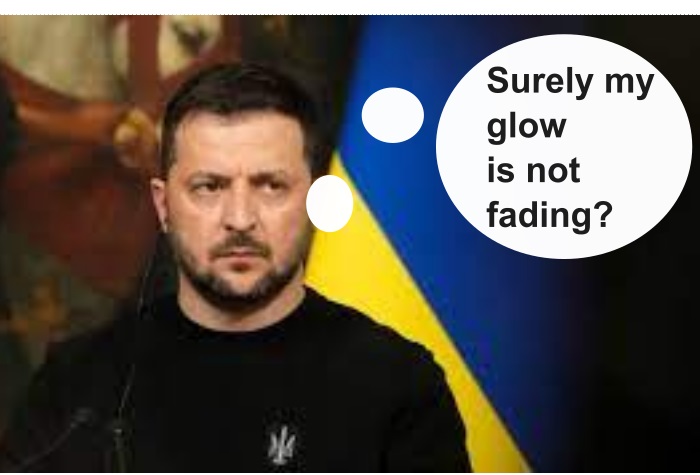
Ukrainian president Volodymyr Zelenskyy has said that Russia was slowing down the Ukrainian counter-offensive, blaming the “slowness” of Western arms deliveries. The leader also renewed calls for long-range weapons as well as new sanctions against Moscow.
Speaking on Friday, Zelenskyy also stressed that time was against Ukraine, with Russia banking on a Republican victory in the 2024 presidential election to weaken American support for Kyiv.
According to him, “the processes are becoming more complicated and slower when it comes to economic sanctions against Moscow or the supply of weapons” from the West.
Ukraine has complained in particular for months about the slowness of negotiations on the delivery of F-16 fighters. Several dozen of these American aircraft will ultimately be delivered by European countries, but the crews must now be trained for months in order to use them effectively.
The Ukrainian counter-offensive, launched in June, came up against powerful defence lines built by the Russians, including minefields and anti-tank traps…………………

American Secretary of State Antony Blinken, who was in Kyiv on Wednesday and Thursday, judged the “significant progress” of the offensive “very, very encouraging”.
He promised $1 billion (approximately €933m) in new aid. Washington also confirmed the supply of depleted uranium shells to give “momentum” to the offensive……………………….. more https://www.euronews.com/2023/09/09/ukraine-war-ukrainian-armed-forces-advance-as-zelenskyy-renews-calls-for-foreign-aid
Ukraine – health care women compulsory military service.
This article was originally in German
link in German: https://exxpress.at/neue-fluchtwelle-droht-selenskyj-befiehlt-wehrpflicht-fuer-pflegerinnen-aerztinnen/
Hundreds of thousands of women will no longer be allowed to leave Ukraine from October 1st, thus Austria is also threatened by a new wave of refugees in the next 22 days: The government in Kiev is by law ordering all women with medical training to be conscripted.
According to the Interior Ministry, 67,370 women from Ukraine are already registered as displaced persons in Austria, and now there could be another massive wave of entry: The Ukrainian media is already reporting that from October 1st compulsory military service is introduced for all Ukrainian women with medical training – i.e. for all nurses , pharmacists and doctors.
The Podrobnosti news portal writes: “Women with medical or pharmaceutical training must register for military service from October 1, 2023. They get the status of conscripts for whom travelling abroad is restricted.” This was stated by Fedir Venislavskyi, member of the Verkhovna Rada’s Committee (Supreme Council of Ukraine) for National Security, Defense and Intelligence, and also the president’s representative in parliament.
Female deserters face up to 12 years in prison
Ukrainian women with medical training can then only leave the country in 22 days with a special permit. Since this Kiev order most likely affects hundreds of thousands of women throughout the country, which still has around 32 million non-refugee residents, another large wave of refugees is now likely to hit Western nations: Many, also young women, should now be aware of the fact that they as conscripts are no longer allowed to leave Ukraine before the end of the war – and of how deserters are treated if they are caught trying to escape.
Desertion in Ukraine can result in a prison sentence of up to 12 years. Since February, the courts can no longer impose a suspended sentence or a lower sentence than that provided for in the new law, as was previously the case.
The new order to force hundreds of thousands of women in nursing professions to do military service allows us to draw conclusions about the actual military situation in Ukraine. As also the current recruitment measure that tuberculosis sufferers and AIDS patients can also be called up to serve in the army.
1 This Month


Tell the Ukrainian Government to Drop Prosecution of Peace Activist Yurii Sheliazhenko

Petition to revoke the licensing of the Near Surface Nuclear Disposal Facility (NSDF) at Chalk River. https://www.ourcommons.ca/petitions/en/Petition/Details?Petition=e-7247


of the week – STOP SMALL MODULAR REACTORS IN CANADA
To see nuclear-related stories in greater depth and intensity – go to https://nuclearinformation.wordpress.com
-
Archives
- March 2026 (193)
- February 2026 (268)
- January 2026 (308)
- December 2025 (358)
- November 2025 (359)
- October 2025 (376)
- September 2025 (258)
- August 2025 (319)
- July 2025 (230)
- June 2025 (348)
- May 2025 (261)
- April 2025 (305)
-
Categories
- 1
- 1 NUCLEAR ISSUES
- business and costs
- climate change
- culture and arts
- ENERGY
- environment
- health
- history
- indigenous issues
- Legal
- marketing of nuclear
- media
- opposition to nuclear
- PERSONAL STORIES
- politics
- politics international
- Religion and ethics
- safety
- secrets,lies and civil liberties
- spinbuster
- technology
- Uranium
- wastes
- weapons and war
- Women
- 2 WORLD
- ACTION
- AFRICA
- Atrocities
- AUSTRALIA
- Christina's notes
- Christina's themes
- culture and arts
- Events
- Fuk 2022
- Fuk 2023
- Fukushima 2017
- Fukushima 2018
- fukushima 2019
- Fukushima 2020
- Fukushima 2021
- general
- global warming
- Humour (God we need it)
- Nuclear
- RARE EARTHS
- Reference
- resources – print
- Resources -audiovicual
- Weekly Newsletter
- World
- World Nuclear
- YouTube
-
RSS
Entries RSS
Comments RSS
 nuclear-news