What’s Behind Talk of a Possible Plea Deal for Assange?

Were Assange to give up his legal battle and voluntarily go to the U.S. it would achieve two things for Washington:
1). remove the chance of a European Court of Human Rights injunction stopping his extradition should the High Court in London reject his last appeal; and
2). it would give the U.S. an opportunity to “change its mind” once Assange was in its clutches inside the Virginia federal courthouse.
Top U.S. officials are speaking at cross purposes when it comes to Julian Assange. What is really going on? asks Joe Lauria.
By Joe Lauria, Consortium News https://consortiumnews.com/2023/09/03/whats-behind-talk-of-a-possible-plea-deal-for-assange/
It was a little more than perplexing. U.S. Secretary of State Antony Blinken, on Australian soil, left no doubt about how his government feels about one of Australia’s most prominent citizens.
“I understand the concerns and views of Australians,” Blinken said in Brisbane on July 31 with the Australian foreign minister at his side. “I think it’s very important that our friends here understand our concerns about this matter.” He went on:

“What our Department of Justice has already said repeatedly, publicly, is this: Mr. Assange was charged with very serious criminal conduct in the United States in connection with his alleged role in one of the largest compromises of classified information in the history of our country. So I say that only because just as we understand sensitivities here, it’s important that our friends understand sensitivities in the United States.”
In other words, when it comes to Julian Assange, the U.S. elite cares little for what Australians have to say. There are more impolite ways to describe Blinken’s response. Upwards of 88 percent of Australians and both parties in the Australian government have told Washington to free the man. And Blinken essentially told them to stuff it. The U.S. won’t drop the case.
A few days before Blinken spoke, Caroline Kennedy, the U.S. ambassador to Australia and daughter of slain President John F. Kennedy, was also dismissive of Australians’ concerns, telling Australian Broadcasting Corporation Radio:
“I met with Parliamentary supporters of Julian Assange and I’ve listened to their concerns and I understand that this has been raised at the highest levels of our government, but it is an ongoing legal case, so the Department of Justice is really in charge but I’m sure that for Julian Assange it means a lot that he has this kind of support but we’re just going to have to wait to see what happens.”
Asked why she met with the parliamentarians at all, she said: “Well, it’s an important issue, it has, as I’ve said, been raised at the highest levels and I wanted to hear directly from them about their concerns to make sure that we all understood where each other was coming from and I thought it was a very useful conversation.”
Asked whether her meeting with the MPs had shifted her thinking on the Assange case, Kennedy said bluntly: “Not really.” She added that her “personal thinking isn’t really relevant here.”
Blowback
Australia has too often behaved as a doormat to the United States, to the point where Australia is threatening its own security by going along with an aggressive U.S. policy towards China, which poses no threat to Australia.
But this time, Blinken got an earful. Prime Minister Anthony Albanese reiterated that he wanted the Assange case to be dropped. Certain members of Parliament brusquely gave it back to Blinken.
Assange was “not the villain … and if the US wasn’t obsessed with revenge it would drop the extradition charge as soon as possible,” Independent MP Andrew Wilkie told The Guardian‘s Australian edition.
“Antony Blinken’s allegation that Julian Assange risked very serious harm to US national security is patent nonsense,” said Wilkie said.
“Mr Blinken would be well aware of the inquiries in both the US and Australia which found that the relevant WikiLeaks disclosures did not result in harm to anyone,” the MP said. “The only deadly behaviour was by US forces … exposed by WikiLeaks, like the Apache crew who gunned down Iraqi civilians and Reuters journalists” in the infamous Collateral Murder video.
As was shown conclusively by defense witnesses in his September 2020 extradition hearing in London, Assange worked assiduously to redact names of U.S. informants before WikiLeaks publications on Iraq and Afghanistan in 2010. U.S. Gen. Robert Carr testified at the court martial of WikiLeaks‘ source, Chelsea Manning, that no one was harmed by the material’s publication.
Instead, Assange faces 175 years in a U.S. dungeon on charges of violating the Espionage Act, not for stealing U.S. classified material, but for the First Amendment-protected publication of it.
Labor MP Julian Hill, also part of the Bring Julian Assange Home Parliamentary Group, told The Guardian he had “a fundamentally different view of the substance of the matter than secretary Blinken expressed. But I appreciate that at least his remarks are candid and direct.”
“In the same vein, I would say back to the United States: at the very least, take Julian Assange’s health issues seriously and go into court in the United Kingdom and get him the hell out of a maximum security prison where he’s at risk of dying without medical care if he has another stroke,” Hill said.
Damage Control
The fierce Australian reaction to both Blinken and Kennedy’s remarks appears to have taken Washington by surprise, given how accustomed to Canberra’s supine behavior the U.S. has become. Just two weeks after Blinken’s remarks, Kennedy tried to soften the blow by muddying Blinken’s clear waters.
She told The Sydney Morning Herald in a front-page interview published on Aug. 14 that the United States was now, despite Blinken’s unequivocal words, suddenly open to a plea agreement that could free Assange, allowing him to serve a shortened sentence for a lesser crime in his home country.
The newspaper said there could be a “David Hicks-style plea bargain,” a so-called Alford Plea, in which Assange would continue to state his innocence while accepting a lesser charge that would allow him to serve additional time in Australia. The four years Assange has already served on remand at London’s maximum security Belmarsh Prison could perhaps be taken into account.
Kennedy said a decision on such a plea deal was up to the U.S. Justice Department. “So it’s not really a diplomatic issue, but I think that there absolutely could be a resolution,” she told the newspaper.
Kennedy acknowledged Blinken’s harsh comments. “But there is a way to resolve it,” she said. “You can read the [newspapers] just like I can.” It is not quite clear what in the newspapers she was reading.
Blinken is Kennedy’s boss. There is little chance she had spoken out of turn. Blinken allowed her to put out the story that the U.S. is interested in a plea bargain with Assange. But why?
First, the harsh reaction in Australia to Blinken’s words probably had something to do with it. If it was up to the U.S. Justice Department alone to handle the prosecution of Assange, as Kennedy says, why was the Secretary of State saying anything about it at all? Blinken appears to have spoken out of turn himself and sent Kennedy out to reel it back in.
Given the growing opposition to the AUKUS alliance in Australia, including within the ruling Labor Party, perhaps Blinken and the rest of the U.S. security establishment is not taking Australia’s support for granted anymore. Blinken stepped in it and had Kennedy try to clean up the mess.
Second, as suspected by many Assange supporters on social media, Kennedy’s words may have been intended as a kind of ploy, perhaps to lure Assange to the United States to give up his fight against extradition in exchange for leniency.
In its article based on Kennedy’s interview, The Sydney Morning Herald spoke to only one international law expert, a Don Rothwell, of Australian National University in Canberra, who said Assange would have to go to the United States to negotiate a plea. In a second interview on Australian television, Rothwell said Assange would also have to drop his extradition fight.
Of course, neither is true. “Usually American courts don’t act unless a defendant is inside that district and shows up to the court,” U.S. constitutional lawyer Bruce Afran told Consortium News. “However, there’s nothing strictly prohibiting it either. And in a given instance, a plea could be taken internationally. I don’t think there’s anything wrong with that. It’s not barred by any laws. If all parties consent to it, then the court has jurisdiction.” But would the U.S. consent to it?
Were Assange to give up his legal battle and voluntarily go to the U.S. it would achieve two things for Washington: 1). remove the chance of a European Court of Human Rights injunction stopping his extradition should the High Court in London reject his last appeal; and 2). it would give the U.S. an opportunity to “change its mind” once Assange was in its clutches inside the Virginia federal courthouse.
“The U.S. sometimes finds ways to get around these agreements,” Afran said. “The better approach would be that he pleads while in the U.K., we resolve the sentence by either an additional sentence of seven months, such as David Hicks had or a year to be served in the U.K. or in Australia or time served.”
Assange’s brother, Gabriel Shipton, told the Herald his brother going to the U.S. was a “non-starter.” He said: “Julian cannot go to the US under any circumstances.” Assange’s father, John Shipton, told the same to Glenn Greenwald last week.
So the U.S. won’t be getting Assange on its soil voluntarily, and perhaps not very soon either. And maybe it wants it that way. Gabriel Shipton added: “Caroline Kennedy wouldn’t be saying these things if they didn’t want a way out. The Americans want this off their plate.”
Third, the U.S. may be trying to prolong Assange’s ordeal for at least another 14 months past the November 2024 U.S. presidential election. As Greenwald told John Shipton, the last thing President Joe Biden would want in the thick of his reelection campaign next year would be a high-profile criminal trial in which he was seen trying to put a publisher away for life for printing embarrassing U.S. state secrets.
But rather than a way out, as Gabriel Shipton called it, the U.S. may have in mind something more like a Great Postponement.
The postponement could come with the High Court of England and Wales continuing to take its time to give Assange his last hearing — for all of 30 minutes — before it rendered its final judgement, months after that, on his extradition. This could be stretched over 14 months. As Assange is a U.S. campaign issue, the High Court could justify its inaction by saying it wanted to avoid interference in the election.
According to Craig Murray, a former British diplomat and close Assange associate, the United States has not, despite Kennedy’s words last month, so far offered any sort of plea deal to Assange’s legal team. Murray told WBAI radio in New York:
“There have been noises made by the U.S. ambassador to Australia saying that a plea deal is possible. And that’s what the Australian Government have been pushing for as a way to solve it. What I can tell you is that there have been no official approaches from the American government indicating any willingness to soften or ameliorate their posihttps://www.youtube.com/watch?v=fnNjwQNV4Gction. The position of the Biden administration still seems to be that they wish to persecute and destroy Julian and lock him up for life for publishing the truth about war crimes …
So there’s no evidence of any sincerity on behalf of the U.S. government in these noises we’ve been hearing. It seems to be to placate public opinion in Australia, which is over 80% in favor of dropping the charges and allowing Julian to go home to his native country…
The American ambassador has made comments about, oh well, a plea deal might be possible, but this is just rubbish. This is just talk in the air. There’s been no kind of approach or indication from the Justice Department or anything like that at all. It’s just not true. It’s a false statement, in order to placate public opinion in Australia.”
Afran said a plea deal can be initiated by the Assange side as well. Assange lawyer Jennifer Robinson said in May for the first time on behalf of his legal team that they were open to discussion of a plea deal, though she said she knew of no crime Assange had committed to plead guilty to.
The U.S. would have many ways to keep prolonging talks on an Assange initiative, if one came, beyond the U.S. election. After the vote, the Justice Department could then receive Assange in Virginia courtesy of the British courts, if this the strategy the U.S. is pursuing.
RADIOACTIVE TSUNAMIS: NUCLEAR TORPEDO DRONES AND THEIR LEGALITY IN WAR
, By Raul (Pete) Pedrozo, Center for International Maritime Security
Introduction
Russia and North Korea are both fielding a novel type of naval weapon – nuclear-armed torpedo drones. These new weapons introduce a variety of strategic and operational challenges that further complicate a worsening threat environment. They also pose critical legal questions about whether their intended concepts of operation are lawful. These weapons have a fearsome potential to weaponize the maritime environment, and precise questions of their legality should be resolved in order to dissuade their proliferation.
North Korea and Russia’s Doomsday Torpedoes
On July 28, North Korea displayed a new nuclear-armed drone torpedo at the 2023 Victory Day Parade in Pyongyang. Although its official classification is unknown, the new weapon is likely a Haeil-class drone torpedo. The nuclear torpedo drone is approximately 52 feet long and 5 feet in diameter, has an estimated range of about 540 nautical miles, and can be fitted with a conventional or nuclear warhead. It could therefore be used against targets in both South Korea and Japan. ……………………………………………..
The nuclear-armed underwater drone can be used to attack coastal naval installations or cities with little or no warning, providing North Korea with a strategic nuclear weapons delivery option that is difficult to detect and defend against.
The Haeil-class drone torpedo is similar to (but smaller than) the Russian Poseidon, an intercontinental, nuclear-powered, nuclear-armed autonomous torpedo that was first revealed by the Russian Navy in 2015. The Poseidon (also known as Kanyon or Status 6) can reportedly operate at speeds of around 70-100 knots and at depths of around 3,300 feet, which means it can outrun and out dive any conventional torpedo……………………………………………………….
These drone torpedoes can be armed with up to a 100-megaton nuclear warhead, but their primary method of destruction is less about directly impacting targets. Instead, they focus on weaponizing the immediate aftereffects of nuclear detonations in the maritime environment. These nuclear torpedo drones are designed to trigger a radioactive tsunami-like ocean swell that destroys coastal cities and renders them uninhabitable, potentially resulting in large-scale displacement and millions of deaths. The legality of this concept of operations deserves closer scrutiny.
Legal Means and Methods of Warfare
Generally, the legal right of the belligerents to adopt means or methods of warfare during an international armed conflict is not unlimited (AP I, art. 35; HR, art. 22; Newport Manual, § 6.1). Specifically, a belligerent does not have the unlimited right to inflict superfluous injury or unnecessary suffering on the opposing belligerent (HR, art. 23; Newport Manual, § 6.1). Weapons law “regulates which weapons and means can lawfully be used during an armed conflict,” and is comprised on both customary international law and treaties (St. Petersburg Declaration; Newport Manual, § 6.2). The customary international law principle of distinction and the prohibition of unnecessary suffering regulate the legality of the means of warfare (Newport Manual, § 6.2). Weapons law is also codified in treaties, such as the Environmental Modification (ENMOD) Convention and Additional Protocol I (AP I) to the 1949 Geneva Conventions.
Damage to the environment is a concern. AP I places restrictions on weapons that “are intended or may be expected to cause widespread, long-term, and severe damage to the natural environment (AP I, art. 35(3); Newport Manual, § 6.3).” AP I further provides that the belligerent shall take care “in warfare to protect the natural environment against widespread, long-term and severe damage,” which includes a prohibition of the “use of methods or means of warfare which are intended or may be expected to cause such damage to the natural environment…” that prejudices the health or survival of the civilian population (AP I, art. 55(1); Newport Manual, § 6.3). The International Committee of the Red Cross interprets “long-term” to include damage over a period of decades (ICRC Commentary to AP I, ¶ 1453(c))……………………………………………………………………………………………………………………………………………………………………………………………………………………….
Conclusion
Armed with multi-megaton nuclear warheads, these torpedo drones will be detonated along an adversary’s coast to create a powerful radioactive tsunami to destroy coastal cities and naval bases. Given that the concept of operations for these new weapons might unlawfully modify and weaponize the natural environment, both the North Korean Haeil and Russian Poseidon torpedo drones are likely unlawful weapons per se under the law of armed conflict.
The unleashing of environmental forces in such a manner is contrary to the law of war and likely violates the ENMOD Convention, which prohibits any method of warfare for changing—through the deliberate manipulation of natural processes—the dynamics, composition, or structure of the Earth (DoD Law of War Manual, §§ 6.10.1-6.10.2; FM 6-27, ¶¶ 2-139, 2-140). ………………………………………………………………………………………..
As parties to AP I and the ENMOD Convention, both North Korea and Russia have legal obligations not to use environmental techniques that are prohibited by the Convention, or to employ means or methods of warfare that can cause widespread, long-term, and severe damage to the natural environment. https://cimsec.org/radioactive-tsunamis-nuclear-torpedo-drones-and-their-legality-in-war/
North Korea says it has simulated a nuclear missile attack to warn US of ‘nuclear war danger’
By Heather Law and Heather Chen, CNN, Sat September 2, 2023
North Korea said Sunday it had simulated a nuclear missile attack to warn the United States of “nuclear war danger.”
The country launched several cruise missiles, some of them equipped with mock nuclear warheads, state media outlet KCNA said, describing the exercise as a simulation of a “tactical nuclear attack.”
The exercises were meant to “warn the enemies of the actual nuclear war danger,” KCNA reported the Central Military Commission of the Workers’ Party of Korea as saying.
It said the exercises were conducted at dawn on Saturday and involved “two long-range strategic cruise missiles with mock nuclear warheads.”
The staged nuclear attack was in response to joint military exercises conducted by the United States and South Korea, earlier in the week, KCNA added.
………………………………………………………………………………………………….. The US-South Korea live fire exercises were conducted on Wednesday. South Korean and US commanders said the drills showcased “the strongest military alliance in the world.”
The drill, based on a counterattack against invading forces, hasn’t been showcased since 2018 and comes after the US and South Korean presidents pledged to step up military cooperation following a May summit meeting in Seoul…. https://edition.cnn.com/2023/09/02/asia/north-korea-nuclear-missile-attack-stimulation-intl-hnk/index.html
We are all Hibakusha- the global footprint of nuclear fallout
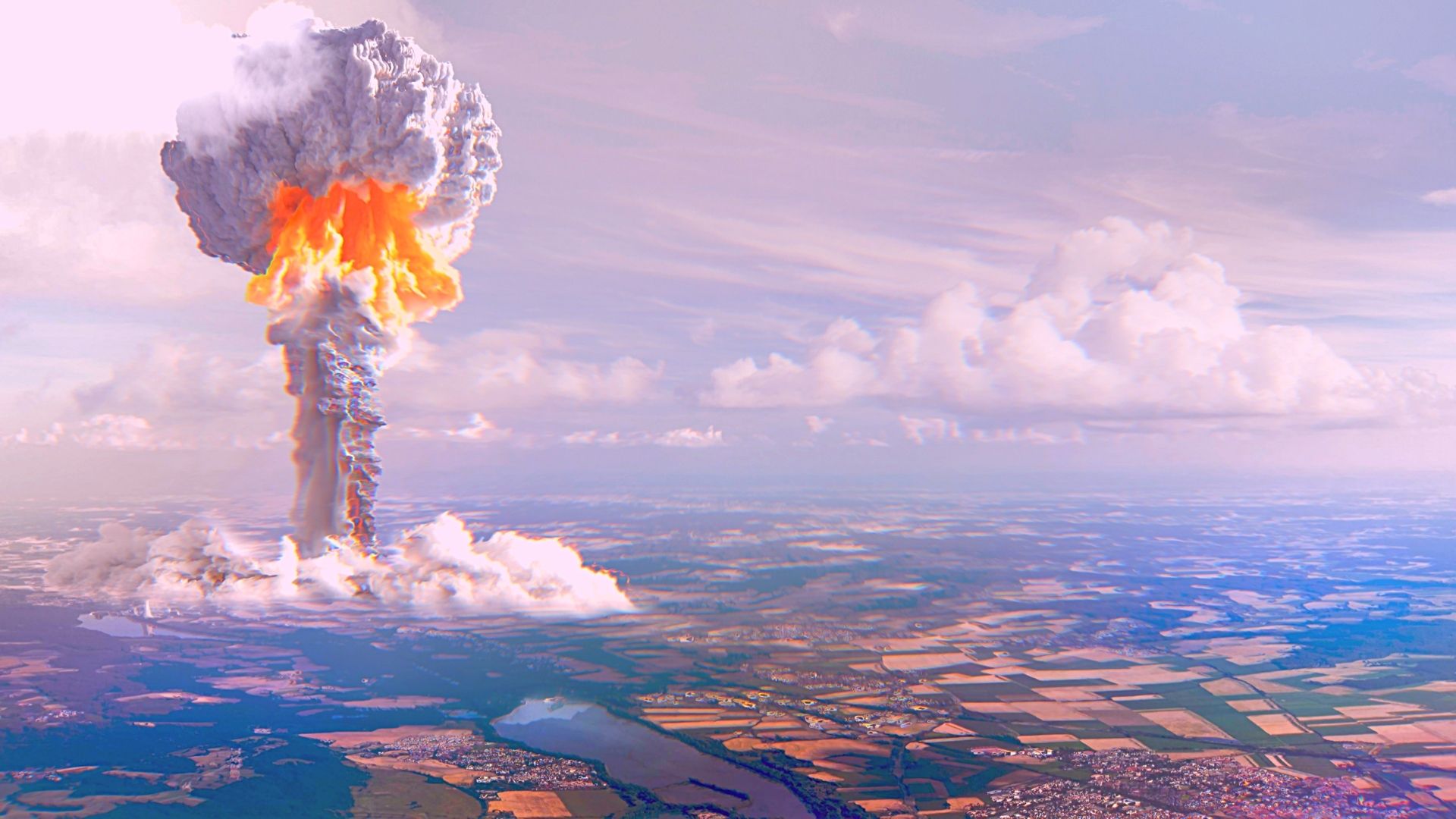
By M.V. Ramana https://beyondnuclearinternational.org/2023/09/03/we-are-all-hibakusha/
The front page of the Times of India of August 7, 1945, carried the headline World’s deadliest bomb hits Japan: Carries blast power of 20,000 tons of TNT. For millions around the world, headlines of that sort would have been their first intimation of the process of nuclear fission on a large scale.
But, a careful stratigrapher, who studies layers in the soil or rock, might be able to discern that, in fact, nuclear fission had occurred in July 1945. The stratigrapher would just have to look for plutonium at Crawford Lake in Ontario, Canada, the site proposed as the “golden spike” spot to mark the start of the Anthropocene (recognising the problems with its definition as highlighted in Down To Earth’s interview with Amitav Ghosh).
What happened in July 1945 was, of course, Trinity, the world’s first nuclear weapon test, now familiar to many through the film Oppenheimer. A group of researchers recently reconstructed how the plutonium released during that explosion would have been transported by the wind. They calculated that direct radioactive fallout from that test would have reached Crawford Lake within four days of the test, “on July 20, 1945 before peaking on July 22, 1945”.
Since Crawford Lake is nearly 3,000 kilometres from the Trinity test site in New Mexico, it stands to reason that many other places would also have received radioactive fallout from the Trinity test. Now consider the fact that there have been at least 528 nuclear weapon tests around the world that took place above the ground, plus the bombs dropped on Hiroshima and Nagasaki—and you can easily imagine how radioactive fallout must have fallen practically everywhere, whether on land or in the oceans.
Not included in the abovementioned list of 528 is the debated 1979 “Vela incident” that most likely involved an Israeli nuclear weapon test with help from South Africa. It is described as debated only because political elites in the United States, whose Vela satellite 6911 detected a double-flash of light that is characteristic of nuclear explosions, did not want to impose sanctions on Israel.
In 2018, two scientists collected a range of evidence consistent with such a nuclear test, importantly cases of radioactive element iodine-131 that was found in the thyroids of some sheep in 1979—in the south east part of Australia, across the oceans. Again, proof that radioactive fallout from nuclear weapon tests spread out globally.
But it is not just nuclear weapons tests. Accidents at nuclear power plants, too, have produced radioactive fallout that has contaminated the peoples of the world. Radioactive cesium released by the 1986 Chernobyl reactor explosion was found in multiple countries across Western Europe. Yet again, sheep, this time in England, Scotland and Wales, were contaminated, and for a time scientists could not even understand the behaviour of the radioactive cesium that the sheep were ingesting.
The sheep remained contaminated for decades. Restrictions on sheep were lifted in all areas only in 2012. Of course, closer to Chernobyl, many areas are still highly contaminated. Radiation levels go up and down depending on outside events, such as forest fires or the Russian army invading the area.
Even without nuclear weapons explosions and reactor accidents, people around the world are exposed to radioactive materials—from reprocessing plants. These facilities chemically process the irradiated spent fuel from nuclear power plants, while also producing very large volumes of liquid and gaseous radioactive effluents. These effluents are released into the air; exposure to these constitutes the largest component of the radiation dose to “members of the public from radionuclides released in effluents from the nuclear fuel cycle”.
People in South Asia have, of course, been exposed to radioactive fallout from nuclear explosions conducted by other countries, nuclear reactor accidents, and reprocessing plants. What about the nuclear weapons exploded by India and Pakistan in 1998, and by India, in 1974? All of these weapons were exploded underground, which should, in principle, have contained all the radioactive materials within the soil. If so, their route for exposing people to radiation can only be by contaminating underground water sources, sometime in the future.
But underground nuclear weapon tests do, sometimes, vent, releasing radioactive materials into the air. After the Limited Test Ban Treaty of 1963, all US nuclear weapons tests were designed to completely contain the radioactivity underground. Nevertheless, 105 of them vented radioactive materials into the atmosphere. A further 287 tests had “operational releases” whereby radioactivity was released during routine post-test activities. Similarly, several hundred underground nuclear weapons explosions at the Novaya Zemlya test site in the Soviet Union released radioactivity into the atmosphere.
Radioactive materials from these releases spread far and wide. In 1970, radioactive materials vented during the Baneberry test were detected as far as Canada; but Canadian diplomats told US officials that “they had no intention to make a formal protest or to conceive of the event as a violation” of the Limited Test Ban Treaty.
It is possible, though not very probable, that the 1998 or the 1974 nuclear tests vented radioactivity. One reason to suspect venting is that residents of the villages near Pokhran, India have repeatedly complained of different kinds of physical illnesses, and demanded that radiation levels be checked. So far, no comprehensive and independent examination of the health of these people or the radioactivity levels in the area has been conducted.
Nearly eight decades since the nuclear age started, people around the world, not to mention the flora and fauna, have all been exposed to radioactive materials from nuclear activities. Any exposure to radioactivity elevates the risk of developing cancer or cardiovascular disease, two great health scourges in modern times.
We are all, in the words of Robert “Bo” Jacobs, the “Global Hibakusha”, survivors of the nuclear age but always at risk of developing one of the diseases associated with radiation exposure. And the worldwide spread of fallout is not, as Jacobs points out, “something that happened, it is something that is still happening”.
Saudi Arabia’s Nuclear Ambitions Have Put The U.S. Into A Bind

Yahoo News, Alexander C. Kaufman, September 4, 2023
Saudi Arabia’s bid to build its first nuclear energy station is setting up a tough choice for the United States: relax a Cold War-era policy designed to prevent the proliferation of atomic weapons, or risk pushing one of the world’s most powerful energy exporters further into China’s orbit. ……………………………………….
Since 1968, the Treaty on the Non-Proliferation of Nuclear Weapons has set the ground rules for countries seeking to harness the awesome power released when uranium atoms split apart, barring the production of the most deadly materials used in bombs but still allowing nations to enrich, split and recycle their own uranium fuel. But the U.S. has required countries that want its help building nuclear reactors to go even further, signing on to what’s known as a 123 Agreement, a pact granting Washington even more control over how radioactive isotopes are used. The agreements, forged by the State Department and, like a treaty, subject to Senate confirmation, were created to encourage the use of atomic energy without raising the risk that facilities meant to enrich or reprocess uranium for reactor fuels might be misused to produce plutonium for weapons.
In recent years, the U.S. has promoted what it calls “gold standard” agreements, in which the partner country promises to never enrich or reprocess its own fuel. In exchange for signing on to the first such a deal in 2008, Washington gave its blessing to the United Arab Emirates’ debut nuclear plant, which the oil-rich kingdom plans to tout in November when it hosts this year’s United Nations climate summit in Dubai.
…………………………………….. Saudi Arabia began talks with the U.S. over the past year in which Riyadh opened the door to establishing diplomatic relations with Israel as part of a deal for nuclear energy. But last week, following an August summit of developing countries, The Wall Street Journal reported that Saudi Arabia, the world’s No. 2 exporter of oil behind the U.S., was now considering an offer from China to build its debut reactors instead, with potentially far fewer strings attached. The Financial Times confirmed the claims in a report published a day later.
…………………………………China is not expected to require Saudi Arabia, a country that owes its vast wealth and geopolitical influence to its energy exports, to forswear developing its own domestic industry to mine, enrich and recycle reactor fuel. ………………………….
The State of Nuclear Instability in South Asia: India, Pakistan, and China
LAWFARE Debak Das, Sunday, September 3, 2023,
The uneasy nuclear balance between India and Pakistan is being unsettled by India’s competition with China and China’s competition with the United States.
Editor’s Note: The India-Pakistan nuclear dynamic has long been a concern, indeed a nightmare, for security analysts. The Korbel School’s Debak Das argues that the growing India-China rivalry, and China’s growing nuclear competition with the United States, add new dimensions to this long-standing problem and create additional risks for nuclear escalation.
Prime Minister Narendra Modi’s state visit to Washington, D.C., in June has prompted a debate on the United States’ bet on India as a military partner to check China in the Indo-Pacific. A key part of this debate is the nuclear relationship among India, China, and Pakistan. Twenty-five years ago—in May 1998—India and Pakistan both tested nuclear weapons, initiating a trilateral nuclear rivalry in Southern Asia.
Since then, these three states have steadily increased their numbers of nuclear warheads and their fissile material production. The uneasy strategic stability in the region is also marked by technological advances in missile technology, counterforce capabilities, and an expanding spectrum of nuclear delivery vehicles available to every side. India and China’s repeated border clashes along the Himalayas and broader competition in the Indo-Pacific add a layer of complexity to the problem. This rivalry has led to developments in military technology and organization—especially India’s new Integrated Rocket Force—that increase the risk of escalation in the region. Added with Pakistan’s devolving domestic political environment characterized by renewed civilian-military clashes and India’s statements about abandoning its no-first-use policy, there are a number of different pathways to nuclear instability in the region that should generate broad concern in the international community.
Increasing Vulnerability From Nuclear Modernization
Both India and Pakistan have consistently modernized their nuclear forces over the past two decades. Each is aiming to ensure that they can match each other at lower levels of escalation. These technological advancements have led to increased vulnerability for both sides at different levels of the escalation ladder. This ranges from the ability to use low-yield nuclear weapons in specific battlefields as well as being able to conduct large strategic countervalue strikes on each other’s cities.
Pakistan has adopted a strategy of “full spectrum deterrence” that allows for the use of nuclear weapons in response to low-scale conventional war, even considerably below the nuclear threshold. As a part of this strategy, Islamabad has introduced tactical/battlefield nuclear weapons with short ranges—like the Hatf IX Nasr missile, which has a 60-kilometer range. It has also built a number of ground- and air-launched nuclear-capable cruise missiles, with ranges between 350 and 700 kilometers. Pakistan also introduced its Babur-3 nuclear-capable sea-based cruise missile in 2017 after India commissioned a nuclear submarine.
India, meanwhile, has been reported to be building flexible preemptive counterforce nuclear systems. These include more precise nuclear delivery systems with short ranges, multiple independently targetable reentry vehicle systems on ballistic missiles, and a growing arsenal of cruise missiles. India is also building a new series of surface-to-surface ballistic missiles, Pralay (with a range of 150 to 500 kilometers), alongside its existing land- and sea-based cruise missiles, which have a range of 1,000 kilometers. To increase the survivability of its nuclear forces, New Delhi has built a “triad” of delivery systems with the ability to launch nuclear weapons from air-, land-, and sea-based platforms. It is reinforcing this triad with plans to build three more nuclear submarines—in addition to the one already in service, INS Arihant—presumably with the goal of eventually having a “continuous-at-sea-deterrence” patrol capability, like the navies of the United Kingdom, Russia, the United States, and France.
In their attempts to increase the vulnerability of their adversary, both India and Pakistan have increased the range of their nuclear weapons. …………………………………………………….
Emulating China: India’s New Integrated Rocket Force
Alongside the modernization of its nuclear weapons, India is currently restructuring its ballistic missile forces. New Delhi is creating an Integrated Rocket Force (IRF) that will contain both nuclear-capable and conventional ballistic and cruise missiles. ……………………………..
India’s creation of the IRF is a mistake. The IRF will likely place nuclear-capable and conventional ballistic missiles within the same force; this will change India’s present policy of ballistic missiles being dedicated to only carrying nuclear weapons. Using the same missiles in both conventional and nuclear roles increases the chance of inadvertent escalation…………………………………………………………………………………
China in Nuclear South Asia
In the past two decades, China’s role in South Asia has grown exponentially, especially along India’s border, which has further complicated the nuclear relationship between India and Pakistan.
Sino-Indian altercations along the Line of Actual Control (LAC) in the Himalayas, along with growing naval competition in the Indo-Pacific, have shifted India’s priorities with nuclear weapons modernization toward addressing threats from China. …………………………………………………………………………………………………………….
Indeed, what is at work in the subcontinent is not just a “trilateral nuclear competition”—it is a quadrilateral competition. China is responding to the United States’ nuclear modernization and ballistic missile defense. India is responding to China’s modernization and force expansion. And Pakistan is attempting to ensure that it does not lag behind India by maintaining some form of nuclear parity at all levels of escalation.
Devolving Domestic Politics and No First Use
In addition to expanding nuclear arsenals, both India and Pakistan face different challenges to nuclear stability from their respective domestic politics. The devolving political situation in Pakistan has created new possibilities for ways in which the government could lose command and control of its nuclear weapons. The current state of domestic political turmoil between former Prime Minister Imran Khan (and his party, Pakistan Tehreek-e-Insaf) and the military establishment under army chief General Asim Munir has sparked considerable chaos. …………………………………………
On the Indian side, the government’s increasing ambivalence toward its no-first-use policy is a clear threat to nuclear stability in the region. …………………………………………………………………………………………………………………….
What Washington Must Not Do
Recent calls by scholars such as Ashley Tellis to arm India with thermonuclear weapons and naval nuclear reactor designs present a dangerous policy option. ……………………………………………………………..
Twenty-five years after the overt nuclearization of South Asia, there are enough drivers of strategic instability in the India-Pakistan-China nuclear relationship. The United States needs to be cognizant of this as it crafts an Indo-Pacific policy aimed at countering China. Indeed, it should aim to deemphasize the nuclear dimension of this competition and avoid entangling India in a four-way nuclear competition among the United States, China, India, and Pakistan. https://www.lawfaremedia.org/article/the-state-of-nuclear-instability-in-south-asia-india-pakistan-and-china
The extreme summer weather that scorched and soaked the world
Heat. Wildfires. Torrential rain. Typhoons and hurricanes. Much of the
northern hemisphere has been battered by extreme weather this summer. Not
all these events can be immediately linked to climate change. It can take a
while for scientists to untangle what exactly is going on – plus, the
planet’s natural weather and climate systems are powerful and also affect
the weather.
But in the past few weeks, significant meteorological records
have been broken in quick succession, to the concern of climate change
experts. As the summer draws to a close, let’s look back at what on earth
happened – and how it is connected to climate change.
BBC 2nd Sept 2023
https://www.bbc.co.uk/news/resources/idt-8f0357f9-9013-4567-8407-be938c8c70cf
South Koreans worry about Fukushima water: more disapprove of President Yoon
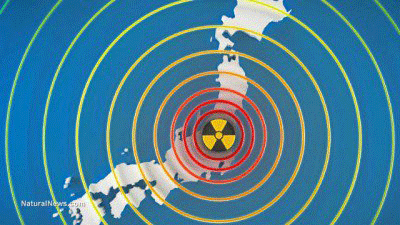
A majority of South Koreans are worried about Japan’s discharge of treated
radioactive water from the Fukushima nuclear plant into the sea despite
efforts by their government to allay fears, a poll published on Friday
showed.
Japan says the water from the wrecked nuclear power plant is safe
and it began releasing it into the Pacific on Aug. 24 despite objections at
home and abroad, particularly from China, Japan’s biggest trade partner,
which banned Japanese seafood.
The South Korean government, however, has
said it sees no scientific problem with the water release, though stressing
it does not approve of it, and banning the import of seafood from waters
off Fukushima, north of Tokyo. President Yoon Suk Yeol has led a campaign
to ease public concern and encourage consumption of seafood. On Thursday,
he visited a major fisheries market to shop and have lunch. Despite such
efforts, South Korean environmental groups and many members of the public
are alarmed and Yoon’s disapproval rating has risen to the highest in
months, a Gallup Korea poll of 1,002 people showed.
Reuters 1st Sept 2023
Senators brag that only Ukrainians die in US proxy war against Russia.
Walt Zlotow, West Suburban Peace Coalition, Glen Ellyn IL 4 Sept 23
Upwards of 400,000 Ukrainians are dead in shattered Ukraine from America’s proxy war against Russia. We provoked it for 8 years before Russia invaded. It was on the brink of being ended in the first 2 months when the US told Ukraine to keep dying to “weaken Russia.”
Back from war torn Ukraine, Democratic Senator Richard Blumenthal boasted Joe Taxpayer is getting his “money’s worth” in Ukraine. Why? “For less than 3 percent of our nation’s military budget, we’ve enabled Ukraine to degrade Russia’s military strength by half … All without a single American service woman or man injured or lost.” Apparently for Blumenthal those 400,000 dead Ukrainians are just collateral damage in deranged US lust to keep control of Europe without Russian influence.
Republican Senator Mitch Romney called our proxy war “The best national defense spending I think we’ve ever done. We’re losing no lives in Ukraine, and the Ukrainians are fighting heroically against Russia. We’re diminishing and devastating the Russian military for a very small amount of money … a weakened Russia is a good thing.”
Public opinion (55%) has turned against more weapons to squander US treasure killing only Ukrainians. Bipartisan US war mongers are desperately shedding more Ukraine blood on the pig of perpetual US war to avoid the inevitable defeat of US hegemony in Europe…and likely worldwide.
Rush to accept Ukraine into EU could spell ‘disaster’ – Austrian FM
Rt.com 1 Sept 23
Fast-tracking membership for Kiev would imply some candidates are “more equal than others,” Alexander Schallenberg has warned
The EU cannot afford to prioritize Ukraine’s accession to the bloc while neglecting other long-standing candidacies, Austrian Foreign Minister Alexander Schallenberg warned on Friday.
Speaking on Politico’s EU Confidential podcast, Schallenberg said that while he believes Ukraine and neighboring Moldova belong in the “European family,” the EU must carefully consider its enlargement policy.
We can’t have Ukraine on the fast-track and the other countries on the service line. That will be a geostrategic disaster,” the minister claimed. Referencing George Orwell’s dystopian novel ‘Animal Farm’, Schallenberg stressed that the EU should avoid a system in which some countries “are more equal than others.”
The Austrian minister noted that the EU had promised membership to Western Balkan nations around 20 years ago, but had failed to deliver on that pledge. He urged Brussels to “put its money where its mouth is” and drop “binary thinking” about membership, suggesting candidate nations should be allowed some participation in EU deliberations and activities………………………………………… https://www.rt.com/news/582219-ukraine-eu-accension-disaster/—
1 This Month
Chernobyl: The Lost Tapes – A good documentary on Chernobyl on SBS available On Demand for the next 3 weeks– https://www.sbs.com.au/ondemand/tv-program/chernobyl-the-lost-tapes/2352741955560

of the week–London Campaign for Nuclear Disarmament

Tell the Ukrainian Government to Drop Prosecution of Peace Activist Yurii Sheliazhenko
To see nuclear-related stories in greater depth and intensity – go to https://nuclearinformation.wordpress.com
-
Archives
- April 2026 (139)
- March 2026 (251)
- February 2026 (268)
- January 2026 (308)
- December 2025 (358)
- November 2025 (359)
- October 2025 (376)
- September 2025 (257)
- August 2025 (319)
- July 2025 (230)
- June 2025 (348)
- May 2025 (261)
-
Categories
- 1
- 1 NUCLEAR ISSUES
- business and costs
- climate change
- culture and arts
- ENERGY
- environment
- health
- history
- indigenous issues
- Legal
- marketing of nuclear
- media
- opposition to nuclear
- PERSONAL STORIES
- politics
- politics international
- Religion and ethics
- safety
- secrets,lies and civil liberties
- spinbuster
- technology
- Uranium
- wastes
- weapons and war
- Women
- 2 WORLD
- ACTION
- AFRICA
- Atrocities
- AUSTRALIA
- Christina's notes
- Christina's themes
- culture and arts
- Events
- Fuk 2022
- Fuk 2023
- Fukushima 2017
- Fukushima 2018
- fukushima 2019
- Fukushima 2020
- Fukushima 2021
- general
- global warming
- Humour (God we need it)
- Nuclear
- RARE EARTHS
- Reference
- resources – print
- Resources -audiovicual
- Weekly Newsletter
- World
- World Nuclear
- YouTube
-
RSS
Entries RSS
Comments RSS
 nuclear-news