Fukushima Daiichi adds Insult to Injury for the Pacific’s Coral Reefs.
September 1, 2023 by Kevin Hester
As the El Niño builds to a terrifying crescendo, that won’t peak before April 2024, the Pacific’s Coral Reefs will become stressed, and a bleaching event will unfold as it did in the 2016 El Niño. What is our response? TEPCO and the Japanese government have decided to dump 1.3million tons of radioactive water into my beloved Pacific Ocean. After careful consideration the criminal cohort in Japan have decided to take the cheapest option and dump the radioactive sludge into the adjacent Pacific Ocean.
In the video above, I mentioned that Sea Surface Temperatures hit 38C off the coast of Florida. Here’s the evidence:
“Sea surface temperatures of more than 38C (100.4F) have been recorded off the coast of Florida – potentially setting a new world record.” Sea temperature off Florida reaches 38C- potentially a world record.
Almost every coral reef in the Northern Hemisphere is under stress.
Daily Global 5km Satellite Coral Bleaching Heat Stress Degree Heating Week
…………………………………………. We discussed the compounding consequences of the Pacific Ocean being irradiated thanks to TEPCO, the Japanese Government and Fukushima Daiichi. The very same people who triggered this disaster, by building a sea wall half the size their own analysis called for.
My Polynesian neighbours are furious. Niue and Tuvalu ‘concerned, dismayed, disappointed’ with Fukushima release
A bottomless pit of public money for the UK government’s nuclear vanity project
In response to Nuclear Minister, Andrew Bowie’s announcement of an
additional £341m government support for the Sizewell C project, TASC
deputy Chair, Pete Wilkinson, said “There seems to be a bottomless pit of
public money when it comes to funding Sizewell C, so besotted is the
government with this already redundant nuclear vanity project.
Not so for cash-strapped public sector workers though. The £341m recently announced,
taking taxpayer funding over an eye-watering £1.2bn, is apparently
designed to speed up preparations for construction of a plant which has yet
to receive dozens of licences and permits – not the least of which is the
Office for Nuclear Regulation’s permission to build on a site threatened by
climate change impacts – and is still subject to determination of an
outstanding legal challenge.
Put another way, it is public money to be
spent on the destruction of a coast which is designated as an area of
outstanding natural beauty for a project which may still not happen. It
also claims that it will ‘help to drive Putin further out of global
energy markets’, apparently missing the point that uranium supplies –
essential for the mythical nuclear renaissance and already at peak supply –
come largely from Russian-influenced countries, so out of the oil and gas
fire into the uranium frying pan.
As for the ‘rapid expansion of UK
nuclear energy’, the fantasy of 24GW from nuclear, should it ever be
attempted, will be cripplingly expensive and generate a mountain of waste
for which there is no universally acceptable disposal route, in short, a
recipe for future financial and environmental disaster rather than energy
security”
TASC 30th Aug 2023
The Fukushima Nuclear Disaster Still Casts a Shadow Over Japan


The “great powers” in the past had given island peoples repeated assurances that there would be no risk to health or environment from testing or dumping. Those peoples watch sadly now as Japan does likewise, engaging in intense propaganda efforts to line up regional states to endorse its wastewater dumping campaign.
The Jacobin, BYGAVAN MCCORMACK 2 Sept 23
Twelve years after the Fukushima disaster, Japanese authorities have started pumping wastewater from the plant into the ocean. They insist there’s no danger to public health, but Japan’s neighbors are up in arms about the controversial plan.
In 2011, Fukushima Daiichi Nuclear Power Plant, roughly 250 kilometers north of Tokyo, was hit by a magnitude 9.0 quake and tsunami. Three reactors stopped immediately, but the loss of electricity supply led over the following days and months to breakdown of the cooling system and to a series of hydrogen explosions and meltdowns of the cores of Reactors 1 to 3.
Prime Minster Kan Naoto feared for the worst. He faced the possible need to evacuate the whole Kanto region, including the Tokyo metropolitan area. Japan itself, its state and society, stood on the brink of catastrophe. That fate was only narrowly averted………………………
The Half-Life of Catastrophe
The flow of water to cool the debris polluted with various forms of radioactivity has had to be maintained to this day. Over the past twelve years, some 1.34 million tons of water have accumulated and is being held in a vast array of more than one thousand tanks along the coast of Fukushima prefecture.
Those tanks are now about 98 percent full, but the flow of contaminated water will have to be continued for at least the next three decades, or until such time as the site can be cleaned up. Nobody today can say with any confidence when that might be.
The polluted waters contain sixty-four radioactive elements, or radionuclides, the ones of greatest concern being carbon-14, iodine-131, caesium-137, strontium-90, cobalt-60, and hydrogen-3, also known as tritium. Some have a short life and might already have ended, but others take longer to decay, with a half-life of more than five thousand years in the case of carbon-14………………………………………………….
The Cheapest Option
In 2016, the Japanese government considered multiple methods of treating the water. Ruling out simple continuation of the status quo — more and more tanks along an already crowded seafront — there seemed to be three options: ocean discharge, atmospheric discharge, and underground burial. The estimated cost was 34.9 billion yen to release the problem materials as gas into the atmosphere, 24.3 billion to dig a deep hole and bury it, but just 3.4 billion to pour it out gradually into the sea…………………………………………………
Anxiety, alarm, and increasingly anger have been spreading, both within Japan itself (and especially in the Fukushima vicinity that bore the brunt of the initial 2011 disaster) and on the part of Japan’s Pacific neighbor states: China (including Hong Kong), Korea (both north and south), Russia, the Philippines, and the mini-states of the South Pacific, with eighteen countries and regions. In Japan, just 44 percent of people said they had “no worries” over the release, while about 75 percent said the government had not properly explained what it was doing.
The Japanese government had promised it would take no step without duly consulting all concerned parties. Yet it proceeded to ignore that principle both when it came to its own citizenry (especially those employed in its once-vibrant fishing industry) and in relation to its Pacific neighbors, whose shores are washed by the same Pacific waters.
Under Control”
True, the United Nations’ International Atomic Energy Agency (IAEA) has provided helpful cover for the Japanese government and the Tokyo Electric Power Company (TEPCO) by taking the view that the environmental impact of the discharge would be “negligible.” That judgment, however, is neither surprising nor decisive.
The IAEA, founded in 1957, is an organization devoted to the propagation of “safe” civil nuclear energy. Japan is its third-largest source of its funds, and the future of the global nuclear industry depends on there being seen to be a “final solution” to the problems posed by Fukushima………………
Though it has received little attention in media coverage of the problem, a small but significant body of scientific opinion has begun to express severe criticism of the IAEA for failing to apply its own fundamental principles. One paper accused the agency of being in some important respects “at least 10,000 times in error,” neglecting to give proper consideration to the nondumping solutions, and “grossly overstating well-known facts” in its “eagerness to assure the public that harm will be ‘negligible.’”
When Japan’s then prime minister Abe Shinzo told the world in September 2013 that Fukushima was ‘under control,’ he lied.
According to the paper’s author, Arjun Makhijani of the Institute for Energy and Environmental Research, a very different approach is required:
The IAEA should, starting with Japan, provide guidance to nuclear power-possessing countries to stop dumping so that the oceans that have been much abused in so many ways for so long can at least have a chance to begin recovering.
When Japan’s then prime minister Abe Shinzo told the world in September 2013 that Fukushima was “under control,” he lied. Until 2018, all attempts to locate the missing reactor cores, let alone to place them “under control,” had failed. Only in 2021 did it become possible at least to locate the debris in one reactor.
However, knowing the location is just the start. Now we know where it is, we are no closer to knowing how to deal with it. The recovery effort for two of the reactors will not commence until 2024.
If they succeed in locating the debris, estimated to be about 880 tons, it will then have to be extracted, gram by gram. Meanwhile, as of 2023, between four and five thousand workers are mobilized each day to perform various high-risk tasks in the disaster zone.
People of the Ocean
The “great powers” in the past had given island peoples repeated assurances that there would be no risk to health or environment from testing or dumping. Those peoples watch sadly now as Japan does likewise, engaging in intense propaganda efforts to line up regional states to endorse its wastewater dumping campaign.
Japan’s word today rings as hollow to Pacific Island peoples as that of the United States or France once did. Even the Japanese people themselves have “little trust in TEPCO or the Japanese Government” when it comes to Fukushima wastewater dumping, according to Suzuki Tatsujiro, former vice chairman of the Japan Atomic Energy Commission.
Japanese governments far into the future are to be bound now by the decisions taken by the current administration and by the process launched on August 24. The support given to Japan’s ocean dumping by prominent Western industrial countries strikes Pacific Islanders as hypocritical. Motarilavoa Hilda Lini is chief of the Turaga nation of Pentecost Island, Vanuatu, and an activist with the Nuclear Free and Independent Pacific (NFIP) movement. She put it this way:……………………………………………………………. more https://jacobin.com/2023/09/fukushima-nuclear-reactor-radioactive-waste-japan-ocean
Anger over claims RAF Lakenheath could host US nuclear weapons
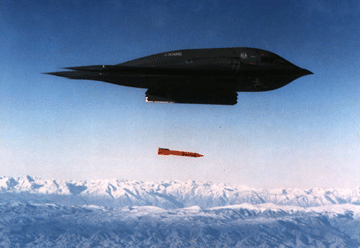
By Stuart Bailey, BBC News 31 Aug 23 https://www.bbc.com/news/uk-england-suffolk-66657765
Campaigners have urged the government to refuse the US any permission to base nuclear weapons in the UK again.
A US Air Force report showed plans to build a “surety dormitory” at RAF Lakenheath in Suffolk, which experts said implied a return of nuclear arms.
The Campaign for Nuclear Disarmament (CND) said it would be “beyond irresponsible” and put the UK at risk.
The Ministry of Defence and the Pentagon said they would not comment on the location of weapons.
US Air Force budget documents included a justification for a 144-bed dormitory “to house the increase in enlisted personnel as the result of the potential Surety Mission.”
The word “surety” is often used by the US government to refer to the concept of ensuring American nuclear weapons are kept safe and secure.
The Federation of American Scientists (FAS), which first reported the plans, said they “strongly imply” the intention to re-establish nuclear arms at Lakenheath, which hosted them until 2008.
CND general secretary, Kate Hudson, said: “It’s increasingly clear that Lakenheath is once again a vital cog in Washington’s overseas nuclear machine.
“The deployment of the new B61-12 (gravity bombs) to Europe undermines any prospects for global peace and ensures Britain will be a target in a nuclear conflict between the US/NATO and Russia.
“It’s beyond irresponsible that the UK government is allowing this deployment.”
Construction of the $50m (£39.5m) building is due to begin in June 2024 and end in February 2026, the budget report said.
The Ministry of Defence, which owns the site, said it was unable to comment on US spending decisions and capabilities.
Deputy Pentagon press secretary Sabrina Singh said: “It is US policy to neither confirm nor deny the presence or absence of nuclear weapons at any general or specific location.”
RAF Lakenheath is home to USAF’s 48th Fighter Wing, which consists of more than 4,000 military members and 1,500 civilians. Control of the base transferred from the RAF to USAF in 1948.
Last year more than 200 people protested outside the base after the US added the UK to a list of nuclear weapons storage site locations in Europe.
German Chancellor Scholz speaks out against new nuclear power, Deutschlandfunk reports
September 2, 2023 https://www.reuters.com/business/energy/german-chancellor-scholz-speaks-out-against-new-nuclear-power-deutschlandfunk-2023-09-01/
FRANKFURT, – German Chancellor Olaf Scholz said he is against a new nuclear power debate in the country, in an interview released late on Friday with German radio station Deutschlandfunk.
“The issue of nuclear power is a dead horse in Germany,” said Scholz, leader of Germany’s social democrats (SPD).
Scholz’s coalition partner, the free democrats (FDP), recently demanded Germany should keep an nuclear option.
For new nuclear power plants to be built, significant time and investment would be required, Scholz said, estimating at least 15 billion euros ($16.16 billion) would have to be spent per power plant over the next 15 years.
On the widely debated topic of an industrial electricity price cap in Germany, the chancellor expressed doubt how this could be funded, naming options including taxpayer money and debt.
($1 = 0.9282 euros)
Reporting by Emma-Victoria Farr; Editing by Leslie Adler and Josie Kao
Tax-payer funding to develop small nuclear reactors? Easy, get Defense and the Air Force to buy them.

The Department of the Air Force, in partnership with the Defense Logistics
Agency Energy, reached a critical milestone Aug. 31, in piloting advanced
nuclear energy technology with the issuance of the Notice of Intent to
Award a contract to Oklo Inc. Oklo Inc. will site, design, construct, own
and operate a micro-reactor facility licensed by the Nuclear Regulatory
Commission at Eielson Air Force Base, Alaska. The notice initiates the
acquisition process to potentially award a 30-year, firm-fixed-price
contract to the vendor after successfully obtaining an NRC license.
US Air Force 31st Aug 2023
Money thrown at Sizewell C to win hearts and minds.
The government has allocated a further £341m to get the Sizewell C
nuclear power station project shovel-ready. The extra money will help
prepare the Sizewell C site in Suffolk for construction, procuring key
components from the project’s supply chain, and expanding its workforce.
It would see activity ramp up at the Suffolk site, supporting continued
preparation works, such as constructing onsite training facilities for
1,500 apprenticeships and further development of the plant’s engineering
design.
The public relations campaign will also be stepped up in a bid to
wins hearts and minds in the Southwold-Aldeburgh area, where opposition to
the project is strong. The government plans “direct investments in the
local community ahead of work starting” to show that having a £35bn
construction project on your doorstep is not necessarily all bad news.
latest £341m tranche follows a £170m allocation last month and builds on
the government’s existing £870m stake in the project to help secure a
final investment decision before the next general election.
The Construction Index 30th Aug 2023
https://www.theconstructionindex.co.uk/news/view/money-thrown-at-sizewell-c-to-win-hearts-and-minds
The Golden Rule, a sailboat praised by anti-nuclear weapons activists, visits Milwaukee and Racine
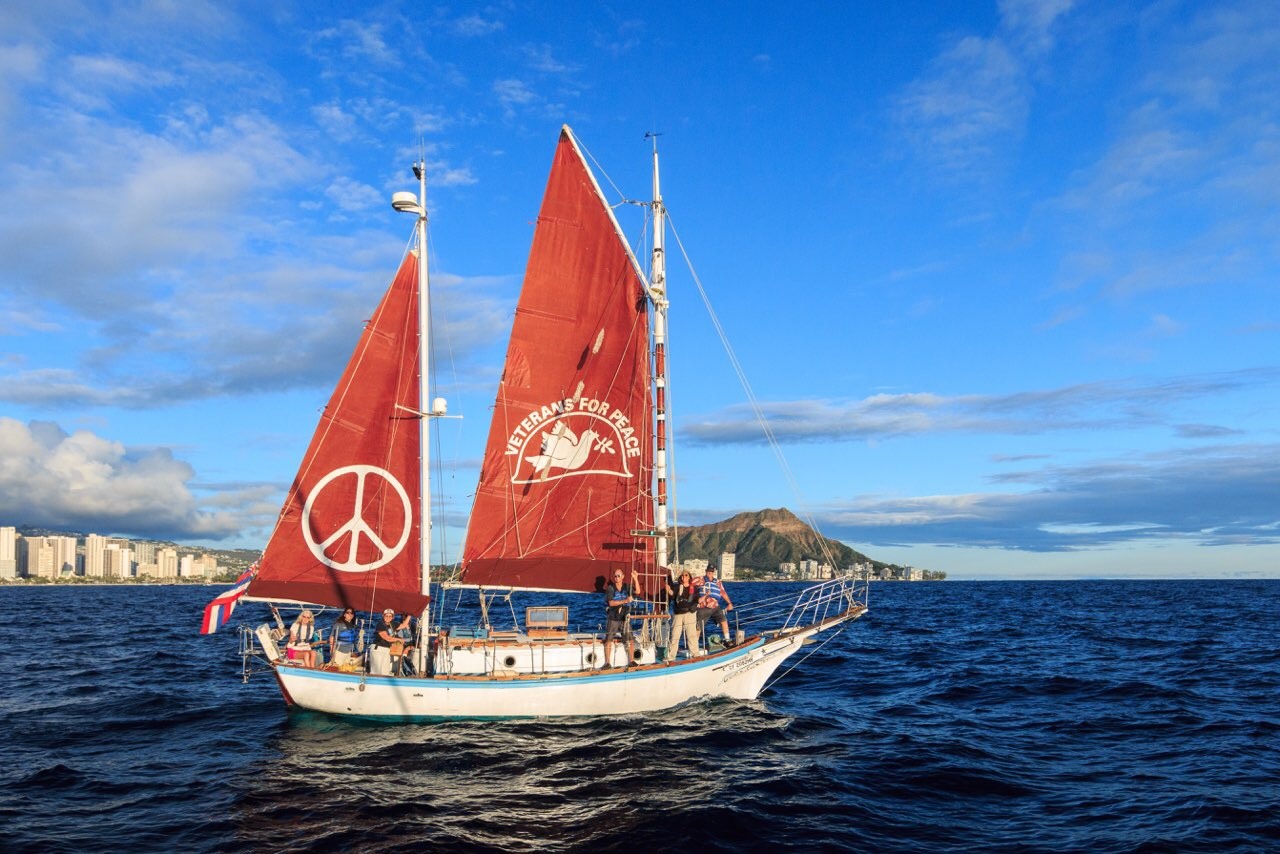
WUWM 89.7 FM | By Chuck Quirmbach
A restored sailboat that peace groups say played a big role in ending atmospheric nuclear bomb testing will be in Milwaukee and Racine for the next few days.
The Golden Rule will be outside Discovery World on Milwaukee’s lakefront Sept. 1, then docked nearby in Lakeshore State Park Sept. 2-4, before sailing to Racine and being docked there Sept. 5.
The Golden Rule, a 34-foot wooden ketch, set sail in 1958 to interfere with nuclear testing in the Marshall Islands in the central Pacific Ocean.
The four Quaker peace activists on the boat stopped for supplies in Honolulu, where the crew was arrested and prevented from continuing. Peace activists say the arrests sparked worldwide awareness of the dangers of nuclear radiation.
Other efforts continued, and according to the National Archives, culminated in the signing of the Limited Test Ban Treaty by the United States, Great Britain, and the Soviet Union. After U.S. Senate approval, the treaty that went into effect on October 10, 1963, banned nuclear weapons testing in the atmosphere, in outer space, and under water.
The sailboat, now owned by Veterans for Peace, is nearing the end of a 15-month journey around the central, southern and eastern United States to raise awareness about what the peace movement feels is the growing danger of nuclear war and to build support for the abolition of nuclear weapons.
Many activists are also worried about ongoing U.S. military aid for Ukraine, in its fight against Russia……………………………………………………………………………………..more https://www.wuwm.com/2023-09-01/the-golden-rule-a-sailboat-praised-by-anti-nuclear-weapons-activists-visits-milwaukee-and-racine
Focus on renewables, not nuclear, to fuel Canada’s electric needs

Relying on nuclear power goes against the evidence. The smart money is on renewables. Solar and wind energy make much more sense.
Policy Options, by Martin Bush, September 1, 2023
The demand for electricity continues to rise as countries transition to an electrified economy. To ensure an adequate and reliable supply during peak hours, governments must decide which energy technologies should be prioritized and developed to help with this transition.
Nuclear power is certainly in the running for providing this essential service, but it’s not the best option. Refurbishing aging CANDU reactors and investing in unproven nuclear technology, such as small nuclear reactors (SMRs), will waste money that could otherwise be invested in renewable energy solutions.
That’s where the smart money is – renewables – and all the evidence points to why. Electricity from nuclear energy is too expensive.
According to the World Nuclear Industry 2022 Status Report, nuclear energy’s share of global electricity generation in 2021 was 9.8 per cent – its lowest level in four decades – and substantially below its peak of 17.5 per cent in 1996.
Nuclear energy is being outpaced by non-hydro renewables, which in 2021 increased their share of global power generation to 12.8 per cent.
Between 2009 and 2021, utility-scale solar energy costs plummeted by 90 per cent, while similar wind energy costs dropped by 72 per cent. In contrast, nuclear costs increased by 36 per cent.
The cost of electricity generated by solar and onshore wind is in the range of 2.4 to 9.6 U.S. cents per kilowatt hour, (¢/kWh) while the cost of electricity from nuclear is estimated as anywhere between 14 and 22 ¢/kWh. It’s not even close.
In 2021, total investment in non-hydro renewable electricity capacity reached a record US$366 billion, 15 times the reported global investment in nuclear power plants of US$24 billion. Investments in solar energy were 8.5 times and wind six times the investments in nuclear energy.
Globally, the cost of renewable-produced electricity is now significantly below not only nuclear power but also gas. According to an analysis by Bloomberg New Energy Finance, wind and solar power are now the cheapest form of new electricity in most countries, including Canada. Bloomberg anticipates it will be more expensive to operate existing coal or fossil gas power plants within five years than to build new solar or wind farms.
Unsurprisingly, it is wind farms and large solar installations that are being built in record numbers……………………………………………………………………………………… more https://policyoptions.irpp.org/magazines/september-2023/renewables-not-nuclear-electric-canada/
Government bill for Sizewell C nuclear power plant passes £1bn mark
Government spending on the proposed nuclear power plant Sizewell C crossed
the billion pound threshold today after the government committed more funds
to the project. Ministers today allocated an additional £341m towards the
project on top of the government’s £870m stake, taking overall spending
commitments to £1.21bn.
City AM 29th Aug 2023 https://www.cityam.com/government-bill-for-sizewell-c-nuclear-power-plant-passes-1bn-mark/
US fighter jets capable of nuclear bombing to be based in UK.
US fighter jets capable of nuclear bombing to be based in UK. Two
squadrons of hi-tech F-35 As set to arrive at RAF Lakenheath in Suffolk
imminently.
Telegraph 30th Aug 2023
https://www.telegraph.co.uk/news/2023/08/30/f35-fighter-jets-nuclear-weapons-raf-lakenheath-suffolk/
Georgia Power customers could see monthly bills rise $9 to pay for the Vogtle nuclear plant
Georgia Power customers could see monthly bills rise $9 to pay for the
Vogtle nuclear plant. Residential customers of Georgia’s largest electrical
utility could see their bills rise $9 more a month to pay for a new nuclear
power plant under a deal announced Wednesday. Georgia Power Co. said
customers would pay $7.56 billion more for Plant Vogtle construction costs
under the agreement with utility regulatory staff.
Daily Mail 31st Aug 2023
Nuclear is the new green. (Really?)

Funds-Europe, 1 Sept 23, Piyasi Mitra examines the debate around the role of nuclear energy in Europe’s sustainable future.
The global pursuit of a net-zero future is fraught with challenges and choices. Integrating natural gas and nuclear into sustainable portfolios could potentially speed up the process, but the European Commission’s recent classification of these resources as climate-friendly prompted scrutiny and debate. Alarmed by the emissions and potential risks, organisations such as Greenpeace, Client Earth and WWF launched legal actions. So, is nuclear the key to a sustainable energy future?
Serious business
The position of the European Commission (EC) is this: “The taxonomy is an essential part of the EU sustainable finance framework in the broader context of the European Green Deal. It helps guide and mobilise private investment to transition towards climate neutrality.”
………………. The EC also announced its intention “to adopt a complementary Climate Taxonomy Delegated Act for some energy sectors, notably nuclear and gas, where they can comply with the criteria for activities under the taxonomy regulation”
Opinions on the topic vary widely. A spokesperson for the German investment funds association, the BVI, says: “It would have been better not to include nuclear energy and gas in the taxonomy because they are contentious and jeopardise the credibility of the taxonomy as a universal measure of sustainability.”…………………………………………………………………………………………………………..
Challenges galore
All nuclear technologies share the same problem: cost. According to the International Energy Agency, about 25% of existing nuclear capacity in advanced economies is expected to shut down by 2025. On average, the nuclear fleet in developed economies – particularly in the US and the EU – is 35 years old, with most of these fleets nearing the end of their designed lifetimes, says Anthony Catachanas, CEO of Victory Hill Capital Partners. “The requirement for dealing with nuclear waste and decommissioning costs make it a less attractive investment proposition than other more sustainable energy sources.”
………………………………… A more practical technology is fusion. Nonetheless, the costs still need to be lowered as it will use the very expensive hydrogen molecule as feedstock, and the technology still needs to be proven.
………………… The costs associated with reactors, whether large or small scale, utilising fission technology are significantly prohibitive. “Besides, fission has a costly by-product in nuclear waste from an enriched uranium or plutonium process. Investing in this technology will be more difficult to explain to investors because the waste issue is unsustainable,” says Catachanas.
……………………………………………….environmental concerns about nuclear waste disposal and its impact on human health and biodiversity are real, and broader safety implications exist for people working and living near nuclear power plants.
……………………..Another drawback of nuclear power is that state or state-owned utilities are likely to remain the only suitable ownership models, says Joost Bergsma, CEO of infrastructure equity firm Glennmont Partners from Nuveen. He adds: “Nuclear does not immediately contain to solving Europe’s energy security issue, as the raw materials needed for nuclear energy generation often come from non-EU countries, and often countries with very different geopolitical agendas to ours.”
Renewables are a far more attractive option for fund managers, as they are cheaper than nuclear and fossil fuels and quick to build, says Bergsma. “Traditional renewables such as onshore and offshore wind and solar have proven reliability and are only growing more efficient. Beyond this, renewables hold the edge regarding public support and easy deployability.”…………… https://www.funds-europe.com/insights/nuclear-is-the-new-green—
New small nuclear reactor company merges with a dubious ‘special purpose acquisition’ company, -reactors for use by USA Air Force in Alaska
Nuclear power’s future is being disrupted. Investor interest in small
modular reactors is growing as demand for electricity is set to soar. Last
month Sam Altman, the (in)famous founder of OpenAI, posted a picture on
social media of an elegant A-frame wooden building in a verdant tropical
setting. It looks like a billionaire’s weekend pad. However, what the
image actually depicts is the putative design of a small modular (nuclear)
reactor invented by Oklo, a company that Altman has chaired since 2015.
And it was posted because Oklo has just merged with a special purpose
acquisition company created by Altman and Michael Klein, the Wall Street
dealmaker, valuing it at $850mn. That will make some observers wince. The
acronym “Spac” became toxic two years ago because the concept was badly
abused during the last credit bubble. Adding “nuclear” into the mix
risks making it doubly radioactive, in the public mind, given past
accidents at the Chernobyl and Fukushima plants (and current Russian
threats to Ukraine’s Zaporizhzhia plant).
Nevertheless, investors and
policymakers should pay attention. On Thursday the United States Air Force
announced plans to use Oklo’s reactor for the Eielson Air Force Base in
Alaska — seemingly the first potential use of commercial SMRs by the
Federal Government on American soil. …………………..
FT 31st Aug 2023
https://www.ft.com/content/0faade4f-d239-47ed-a041-f7a503fef500
1 This Month
Chernobyl: The Lost Tapes – A good documentary on Chernobyl on SBS available On Demand for the next 3 weeks– https://www.sbs.com.au/ondemand/tv-program/chernobyl-the-lost-tapes/2352741955560

of the week–London Campaign for Nuclear Disarmament

Tell the Ukrainian Government to Drop Prosecution of Peace Activist Yurii Sheliazhenko
To see nuclear-related stories in greater depth and intensity – go to https://nuclearinformation.wordpress.com
-
Archives
- April 2026 (126)
- March 2026 (251)
- February 2026 (268)
- January 2026 (308)
- December 2025 (358)
- November 2025 (359)
- October 2025 (376)
- September 2025 (257)
- August 2025 (319)
- July 2025 (230)
- June 2025 (348)
- May 2025 (261)
-
Categories
- 1
- 1 NUCLEAR ISSUES
- business and costs
- climate change
- culture and arts
- ENERGY
- environment
- health
- history
- indigenous issues
- Legal
- marketing of nuclear
- media
- opposition to nuclear
- PERSONAL STORIES
- politics
- politics international
- Religion and ethics
- safety
- secrets,lies and civil liberties
- spinbuster
- technology
- Uranium
- wastes
- weapons and war
- Women
- 2 WORLD
- ACTION
- AFRICA
- Atrocities
- AUSTRALIA
- Christina's notes
- Christina's themes
- culture and arts
- Events
- Fuk 2022
- Fuk 2023
- Fukushima 2017
- Fukushima 2018
- fukushima 2019
- Fukushima 2020
- Fukushima 2021
- general
- global warming
- Humour (God we need it)
- Nuclear
- RARE EARTHS
- Reference
- resources – print
- Resources -audiovicual
- Weekly Newsletter
- World
- World Nuclear
- YouTube
-
RSS
Entries RSS
Comments RSS
 nuclear-news