Japan’s nuclear wastewater – should we be worried?
August 22, 2023 https://www.nst.com.my/opinion/leaders/2023/08/945792/nst-leader-japans-nuclear-wastewater
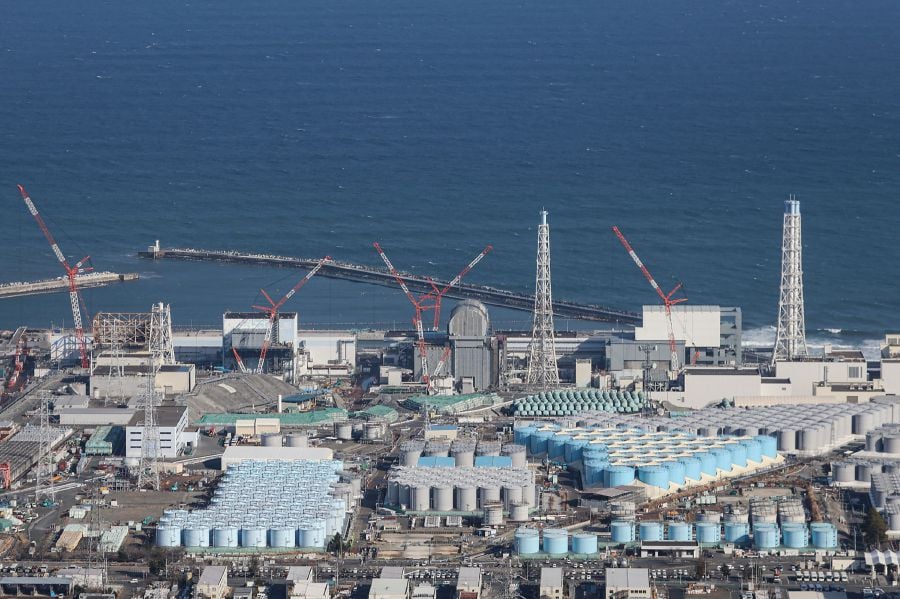
FUKUSHIMA is a dreaded word in the region because what happens there doesn’t stay there. There in Japan on March 11, 2011, an earthquake and tsunami, in that order, knocked out the Fukushima Daiichi nuclear-power plant, releasing untreated radioactive water into the sea.
Given the state of the nuclear plant technology then — or even now — there wasn’t the time for the radioactive elements to self-destruct. The human mind, including the Japanese ones, for some reason didn’t perceive that calamities can happen all at once.
The Fukushima disaster is such a tale of instantaneous conjunction of calamities. On a visit to the disaster zone on Sunday, Japanese Prime Minister Fumio Kishida was quoted by news agency AFP as saying that he was refraining from “commenting on a concrete timing of the release into the ocean at this point in time”, leaving ample room for a prime ministerial hint that it will be soon.
Some 500 Olympic-size swimming pools of wastewater, accumulated over 12 years after the disaster, are expected to be released into the Pacific Ocean. The fact that it would be a slow release over 10 years registered no effect in the region’s dread meter.
The region is on dread-watch, but much of it is coated with diplomatic niceties. China has been the most vociferous in opposing the release of the wastewater into the ocean. In China, dread comes mixed with geopolitical anger, given that Tokyo is a tango partner of Washington.
If a taste of Chinese animus is needed, here is one quote from a Beijing official, gleefully circulated by the Western media: Japan is treating the sea as its sewer. An interesting take, we must say, now that all nations without exception are treating the seas as their sewer.
How many marine lives were destroyed or how many people have ingested radioactive materials through seafood after the accident 12 years ago is hard to tell. Nuclear literature tells us if the water isn’t treated properly, dangerous isotopes can have devastating effects, including DNA-damaging ones. Should we fear? Yes and no. Start with yes.
The Tokyo Electric Power Company (Tepco), the operator of the crippled nuclear plant, and Japanese regulators stand accused of negligence, notwithstanding the earthquake and tsunami. Now that Tepco and the government are saying the 1.34 million tonnes of wastewater planned to be released into the Pacific Ocean is safe, many in Japan don’t believe them. Both are victims of trust deficit.
Kishida, though he wasn’t prime minister when disaster struck in 2011, is in need of reputation management advice. Not just to repair the trust deficit at home, but also abroad.
China has banned seafood from Fukushima and considering a wider ban. Others in the region are beginning to be infected by China’s isotope fear, not because of Beijing’s geopolitics, but because of the nightmarish outcome of radioactive contamination. If the dread grows, it will cripple more than Fukushima.
Now for the no, our second response to Japan’s release of the treated wastewater into the ocean. The world shouldn’t fear because the Japanese guarantee that the dangerous radioactive elements have been filtered out and comes stamped with the approval of the United Nations’ International Atomic Energy Agency
Unless, of course, if the world has reasons to believe that the IAEA, too, comes branded with a trust deficit.
End Nuclear Testing Forever, Says Secretary-General in Message for International Day

Following is UN Secretary-General António Guterres’ message for the International Day against Nuclear Tests, observed on 29 August:
Since 1945, more than 2,000 nuclear tests have inflicted terrifying suffering on people, poisoned the air we breathe and ravaged landscapes around the world.
On the International Day Against Nuclear Tests, the world speaks with one voice to end this destructive legacy.
This year, we face an alarming rise in global mistrust and division. At a time in which nearly 13,000 nuclear weapons are stockpiled around the world — and countries are working to improve their accuracy, reach and destructive power — this is a recipe for annihilation.
A legally binding prohibition on nuclear tests is a fundamental step in our quest for a world free of nuclear weapons. The Comprehensive Nuclear-Test-Ban Treaty, though not yet in force, remains a powerful testament to humanity’s will to lift the shadow of nuclear annihilation from our world, once and for all.
In the name of all victims of nuclear testing, I call on all countries that have not yet ratified the Treaty to do so immediately, without conditions.
Let’s end nuclear testing forever.
Japanese fishing industry leader is “greatly concerned” over the pending disharge of Fukushima radioactive water into the ocean.

The leader of a Japanese fisheries industry group told officials on Monday
he was “greatly concerned” about the discharge of treated radioactive water
set to be released into the sea from the wrecked Fukushima nuclear plant.
The government is expected to decide soon, perhaps within days, when to
start releasing the water, equivalent to the contents of 500 Olympic-size
swimming pools, despite objections at home and abroad to the plan.
Reuters 21st Aug 2023
Biden’s rival, Robert F. Kennedy Junior, labels F-16s for Ukraine ‘a disaster for humanity’

21vAug 23 , https://www.rt.com/news/581543-kennedy-ukraine-f16-delivery/1
Supplying US-made fighter jets to Kiev would only benefit the defense industry, RFK Jr. says
The looming delivery of US-made F-16 fighter jets to Ukraine will not prevent the “collapse” of the country’s military and will only benefit the military-industrial complex, Democrat presidential hopeful Robert F. Kennedy Junior has claimed.
The Ukrainian conflict should be resolved through negotiations, RFK Jr. argued in a thread on social media platform X (formerly Twitter), stating that supplying F-16s to Kiev was a “great decision for the defense industry, but a disaster for Ukraine and humanity.”
“F-16s won’t stop the collapse of the Ukrainian military (which some experts say is imminent). These planes require a lot of training and maintenance. This isn’t the movies,” Kennedy stressed.
The presidential hopeful has long-opposed the enduring Western aid to Ukraine, spearheaded by Washington, arguing that the US should admit its “failure” in the country and focus on domestic issues instead. Kennedy’s criticism of the fighter-jet delivery comes after Washington enabled its European allies to re-export older planes to Ukraine, and hours before the move was officially announced by Denmark and the Netherlands.
The upcoming delivery was heralded by Dutch PM Mark Rutte on Sunday as he hosted Ukrainian President Vladimir Zelensky at a military airbase in Eindhoven.
“Today we can announce that the Netherlands and Denmark commit to the transfer of F-16 aircraft to Ukraine and the Ukrainian Air Force, including cooperation with the United States and other partners once the conditions for such a transfer have been met,” Rutte said at a press conference.
Simultaneously, the Danish Ministry of Defence released a statement confirming its pledge to provide Kiev with F-16s from its inventory, once certain “conditions” are met. The conditions “include, but are not limited to, successfully selected, tested and trained Ukrainian F-16 personnel as well as necessary authorizations, infrastructure and logistics,” it said.
Kiev has long-demanded modern aircraft, as well as other, increasingly sophisticated weaponry, from its Western backers, arguing the planes would help it turn the tide of the conflict with Russia, which has been going on since February 2022. Moscow has repeatedly urged the collective West to stop the military deliveries, arguing they would only prolong the hostilities rather than change their ultimate outcome.
US derides wimpy Ukrainians that have become ‘casualty adverse’
Walt Zlotow, West Suburban Peace Coalition, Glen Ellyn IL 21 Aug 23
The US has come up a clever way of masking their contempt of the Ukrainian military in their failed counteroffensive against Russia.
Dismayed that Ukraine is squandering US weapons by hurling them at Russian forces instead hurling themselves at the well-fortified invaders, armchair US military are calling the Ukrainians ‘casualty adverse’, a nice way of calling them ,cowards. US/UK war games ahead of the June counteroffensive envisioned Ukraine taking large casualties in order to reclaim Donbas so they could start brutalizing Donbas Ukrainians again.
That was OK for the US war party. Hey, didn’t that work for England and France during trench warfare during WWI? Apparently, US strategists forgot those allies lost a few million soldiers to take at best a few hundred yards. The Ukraine general staff shot back: “We simply don’t have the resources to do the frontal attacks that the West is imploring us to do.”
The US knew Ukraine had neither the human nor explosive resources to regain territory, a US precondition for ending the war thru negotiations. That makes the US proxy war against Russia, shedding only Ukrainian blood and only destroying the Ukrainian economy, a grotesque US moral crime that must be resisted by every peace loving American.
President Biden has painted the US into a corner of death and despair he spent the last half century leading up to promoting American empire and exceptionalism. It may be too late for the electorate to inspire an epiphany in Biden to pivot to peace.
But we must try.
The Oppenheimer Imperative: Normalising Atomic Terror

Resilience becomes part of the semantics of contemplated, and acceptable mass homicide. Emphasis is placed on the bounce-back factor, the ability to recover, even in the face of such weapons.
To be tactical is to be somehow bijou, cute, and contained, accepting mass murder under the guise of moderation and variation. One can be bad, but bad within limits.
Australian Independent Media, by Dr Binoy Kampmark, 20 Aug 23 https://theaimn.com/the-oppenheimer-imperative-normalising-atomic-terror/#comment-1092670
The atomic bomb created the conditions of contingent catastrophe, forever placing the world on the precipice of existential doom. But in doing so, it created a philosophy of acceptable cruelty, worthy extinction, legitimate extermination. The scenarios for such programs of existential realisation proved endless. Entire departments, schools of thought, and think tanks were dedicated to the absurdly criminal notion that atomic warfare could be tenable for the mere reason that someone (or some people) might survive. Despite the relentless march of civil society against nuclear weapons, such insidious thinking persists with a certain obstinate lunacy.
It only takes a brief sojourn into the previous literature of the nuke nutters to realise how appealing such thinking has proven to be. But it had its challenges. John Hersey proved threatening with his 1946 New Yorker spectacular “Hiroshima”, vivifying the horrors arising from the atomic bombing of the Japanese city through the eyes of a number of survivors.
In February 1947, former Secretary of War Henry Stimson shot a countering proposition in Harper’s, thereby attempting to normalise a spectacularly vicious weapon in terms of necessity and function; the use of the bombs against Japan saved lives, as any invasion would have cost “over a million casualties, to American forces alone.” The Allies, he surmised, “would be faced with the enormous task of destroying an armed force of five million men and five thousand suicide aircraft, belonging to a race which had already amply demonstrated its ability to fight literally to the death.”
Inadvertent as it was, the Stimson rationale for justifying theatrical never-to-be-repeated mass murder to prevent mass murder fell into the bloodstream of popular strategic thinking. Albert Wohlstetter’s The Delicate Balance of Terror chews over the grim details of acceptable extermination, wondering about the meaning of extinction and whether the word means what it’s meant to, notably in the context of nuclear war.
“Would not a general thermonuclear war mean ‘extinction; for the aggressor as well as the defender? ‘Extinction’ is a state that badly needs analysis.” Wohlstetter goes on to make a false comparison, citing 20 million Soviet deaths in non-atomic conflict during the Second World War as an example of astonishing resilience: the country, in short, recovered “extremely well from the catastrophe.”
Resilience becomes part of the semantics of contemplated, and acceptable mass homicide. Emphasis is placed on the bounce-back factor, the ability to recover, even in the face of such weapons.
These were themes that continued to feature. The 1958 report of the National Security Council’s Net Evaluation Subcommittee pondered what might arise from a Soviet attack in 1961 involving 553 nuclear weapons with a total yield exceeding 2,000 megatons. The conclusion: 50 million Americans would perish in the conflagration, with nine million left sick or injured. The Sino-Soviet bloc would duly receive retaliatory attacks that would kill 71 million people. A month later, a further 196 million would die. In such macabre calculations, the authors of the report could still breezily conclude that “[t]he balance of strength would be on the side of the United States.”
Modern nuclear strategy, in terms of such normalised, clinical lunacy, continues to find form in the tolerance of tactical weapons and modernised arsenals. To be tactical is to be somehow bijou, cute, and contained, accepting mass murder under the guise of moderation and variation. One can be bad, but bad within limits. Such lethal wonders are described, according to a number of views assembled in The New York Times, as “much less destructive” in nature, with “variable explosive yields that could be dialed up or down depending on the military situation.”
The journal Nature prefers a grimmer assessment, suggesting the ultimate calamity of firestorms, excessive soot in the atmosphere, disruption of food production systems, the contamination of soil and water supplies, nuclear winter, and broader climatic catastrophe.
Some of these views are teasingly touched on in Christopher Nolan’s Oppenheimer, a three-hour cross narrative jumble boisterously expansive and noisy (the music refuses to leave you alone, bruising the senses). While the idea of harnessing an exceptional, exterminating power haunts the scientific community, the Manhattan Project is ultimately functional: developing the atom for military purposes before Hitler does. Once developed, the German side of the equation becomes irrelevant. The urgent quest for creating the atomic weapon becomes the basis for using it. Once left to politics and military strategy, such weapons are normalised, even relativised as simply other instruments in inflicting destruction. Oppenheimer leaves much room to that lunatic creed, though somehow grants the chief scientist moral absolution.
This is a tough proposition, given Oppenheimer’s membership of the Scientific Panel of the Interim Committee that would, eventually, convince President Harry Truman to use the bombs. In their June 16, 1945 recommendations, Oppenheimer, along with Enrico Fermi, Arthur H. Compton and Ernest O. Lawrence, acknowledged dissenting scientific opinions preferring “a purely technical demonstration to that of a purely military application best designed to induce surrender.” The scientific panel proved unequivocal: it could “propose no technical demonstration likely to bring an end to the war; we see no acceptable alternative to direct military use.”
In the film, those showing preference for a purely technical demonstration are given the briefest of airings. Leo Szilard’s petition arguing against a military use “at least not until the terms which will be imposed after the war on Japan were made public in detail and Japan were given an opportunity to surrender” makes a short and sharp appearance, only to vanish. As Seiji Yamada writes, that petition led a short, charmed life, first circulated in the Metallurgical Laboratory in Chicago, only to make its way to Edward Teller at Los Alamos, who then turned it over to Oppenheimer. The petition was, in turn, surrendered to the Manhattan Project’s chief overseer, General Leslie Groves, who “stamped it ‘classified’ and put it in a safe. It therefore never reached Truman.”
Nolan depicts the relativisation argument in some detail – one that justifies mass death in the name of technical prowess – during an interrogation by US circuit judge Roger Robb, appointed as special counsel during the 1954 security hearing against Oppenheimer. In the relevant scene, Robb wishes to trap the hapless scientist for his opposition to creating a weapon of even greater murderous power than the fission devices used against Japan. Why oppose the thermonuclear option, prods the special counsel, given your support for the atomic one? And why did he not oppose the remorseless firebombing raids of Tokyo, conducted by conventional weapons?
Nolan also has the vengeful Lewis Strauss, the two-term chairman of the US Atomic Energy Commission, moan that Oppenheimer is the less than saintly figure who managed to get away, ethically, with his atomic exploits while moralising about the relentless march about ever more destructive creations. In that sentiment, the Machiavellian ambition monger has a point: the genie, once out, was never going to be put back in.
Lethal weapons to Ukraine – endless war prioritised over diplomacy: Address to United Nations Security Council
https://popularresistance.org/danny-haiphong-addresses-un-security-council-on-natos-ukraine-aid/ On August 17, 2023, Danny Haiphong spoke to spoke the latest convening of the United Nations Security Council on the dangers that Western arms to Ukraine poses to international peace and stability. He said,
“Today I am here as a journalist who has dedicated the last ten years of my life writing about and speaking out against the long record of human rights abuses and war crimes committed by my country of birth, the United States. I don’t consider this a hobby or even a profession but rather a duty to all of humanity and those who want to see a better and more peaceful future. I am here to as a US citizen who has witnessed tens of billions of US tax dollars go to funding and arming a proxy war against Russia while people in the US, ordinary people, suffer from rising levels of poverty, homelessness, suicide and economic insecurity.”
Most ‘experts’ pushing for endless conflict in Ukraine share a common benefactor.

the top 50 think tanks received over a billion dollars from the US government and its defense contractors and manufacturers, including some of the biggest beneficiaries of weapons production today ‘for Ukraine’. The top recipients of this funding include the Atlantic Council, German Marshall Fund of the United States, Brookings Institution, Heritage Foundation, Center for Strategic and International Studies, New America Foundation, RAND Corporation, Center for a New American Security, Council on Foreign Relations, and the Stimson Center.
A whopping 85% of media quotes on US military involvement come from someone paid by the defense industry
rachelmarsden.com 20 Aug 23
Experts with important-sounding titles linked to academic-sounding entities have been shaping hearts and minds in the press, both at home and abroad, in favor of endless conflict in Ukraine. Guess what deep-pocketed benefactor lurks beneath the surface?
During the Iraq War, the Pentagon backed retired generals to make the rounds of TV and radio shows as ‘military analysts’ to promote the Bush administration’s agenda in the Persian Gulf. It was like inviting Ronald McDonald on a program to debate and discuss the merit of Big Macs. You could almost see the strings attached to the puppets, linked to the military-industrial complex that benefited from war without an off-ramp.
Fast forward 20 years, and the sales tactics have drastically changed. The generals have been replaced by various experts with academic credentials, typically linked to one or more ‘think tanks’. Far from the neutral academic centers of intellectual integrity that the names suggest, these entities are little more than laundromats for discreet special interests. I should know – I used to be a director of one.
Every Wednesday, some of the highest-ranking figures of the Bush administration would come to our Washington, DC office to deliver their main agenda points for the week, requesting assistance in placing and promoting them to both grassroots activists sympathetic to the cause and to the general public. The experts within the think tank were hired based on political litmus tests, no doubt to ensure that their views aligned with the organization’s. When they no longer do, you’re either fired or you leave.
The donors, many of whom were well-known millionaires and billionaires driven by a passion for certain issues, would come straight out and ask for bang for their buck in exchange for the opening of their wallets. In some cases, an entire project or department would be mounted at the think tank with the understanding that it would be fully funded by a single donor. These rich, influential folks typically had business or investment interests that benefited from shaping the establishment narrative in their favor, and they wanted to do so without leaving any footprints. What better way than to have it all fronted by a shiny veneer of expert credibility?
So while the generals of the Iraq War era had all the subtlety of a sledgehammer in representing the interests of the military-industrial complex, the new salesmen of endless armed conflict in Ukraine have overwhelmingly adopted the more subtle model. A study published in 2020 found that the top 50 think tanks received over a billion dollars from the US government and its defense contractors and manufacturers, including some of the biggest beneficiaries of weapons production today ‘for Ukraine’. The top recipients of this funding include the Atlantic Council, German Marshall Fund of the United States, Brookings Institution, Heritage Foundation, Center for Strategic and International Studies, New America Foundation, RAND Corporation, Center for a New American Security, Council on Foreign Relations, and the Stimson Center.
Some of these black boxes are more ideologically-driven than others. The Heritage Foundation, for example, leans overwhelmingly neoconservative and interventionist. Others, like the Atlantic Council and German Marshall Fund, are effectively force multipliers for NATO talking points. But the RAND Corporation also houses systems analysts and scientists specializing in space and computing. The fact that not all of these entities – or even the people who work within some of them – can be tossed into the same basket and labeled mere parrots for the special interests of their organization’s benefactors helps to muddy the waters.
In an analysis published in June of media coverage related to US military involvement in Ukraine, the Quincy Institute for Responsible Statecraft found that, when a think tank is cited regarding the issue, 85% of the time it’s a think tank with “financial backing from the defense industry.” Taken at face value, this risks being interpreted by the general public as expert ‘consensus’ on the need for US taxpayers to continue flooding Ukraine with weapons, unaware that it’s really just a bunch of Pentagon-backed actors agreeing with each other about the need to pursue the most profitable course of action on behalf of their War Inc. sugar daddies. Just like when climate scientists, who have parlayed climate change into endless funding and a perpetual justification for their existence, aren’t going to kill their cash cow by arguing that the climate can’t be controlled by man and that throwing cash at the issue – or at them – is futile.
Many of the Ukraine think tank experts are quick to attack analysis and information published on platforms they don’t like – such as RT – as ‘Russian-backed’. You’d have to be living under a rock these days to not know that RT is linked to Russia. No transparency issues there.
But there is far less transparency around their own organizations’ financing. Where is their insistence on being above board about the use of defense industry cash to influence not just the general public but the course of the conflict itself? Around a third of top foreign policy think tanks don’t disclose this Pentagon funding, according to the Quincy Institute. Nor is it unheard of for these experts to springboard from these establishment-friendly platforms and the public notoriety they provide, right into public office – where they can translate the same agenda that they promoted into actionable policy. Isn’t it important for voters to consider the powerful hidden hand who helped to get them there?
Threat from the skies: India steps up the fight against a major space danger.

By B R Srikanth, a veteran Bengaluru-based journalist reporting on space and defense, 21 Aug 23, https://www.rt.com/india/581397-india-space-debris-cleaning-mission/
New Delhi’s ambitious space plans include tackling the problem of floating debris, countless pieces of which orbit the Earth
A spectacular display of celestial fireworks? The momentous arrival of aliens? Or was it a work-in-progress sci-fi flick?
These questions weighed heavily on many minds as Melbourne’s night sky lit up for almost a minute on the night of August 7. The flame raced across the sky before breaking into blazing fragments. A sonic boom shook the ground for a couple of seconds, setting off a panic among residents. A day later, the Australian Space Agency confirmed it was space junk, likely “remnants” of a giant Russian rocket which had hoisted a new navigational satellite into orbit.
A few weeks earlier, a six-foot high cylindrical object, perhaps the fuel tank of an Indian rocket, had washed ashore at Green Head Beach, 250 km north of Perth, Australia. The artificial lighting, the loud explosion, and the large fuel tank found there reignited one question: How to vacuum-clean the graveyard in the deep, dark heavens to safeguard assets worth billions of dollars?
Such assets include satellites circling the Earth at 300 km to 36,000 km, in support of telecommunications, broadcasting, meteorology, civil aviation, telemedicine, distance education, and even espionage (by military satellites launched without fanfare).
Space junk
Outer space contains hundreds of dead satellites, millions of fragments of old satellites and rockets, and even paint flakes; each is hurtling through space at an incredible speed of 10 km a second, with a lethal punch of a 550-pound object. NASA estimates there are around 23,000 pieces of debris larger than a softball, half a million pieces the size of a marble or up to a centimeter, 100 million pieces one millimeter and larger.
Example of space junk include a glove lost by Edward Higgins White during America’s first spacewalk, Michael Collins’ camera lost near Gemini 10, a thermal blanket lost during STS-88, the first space shuttle mission, garbage bags jettisoned by cosmonauts during Mir’s 15-year life, a wrench, and a toothbrush.
Indian-American astronaut Sunita Williams lost her camera during her spacewalk from the space shuttle in 2007, and astronaut Heidemarie Stefanyshyn-Piper lost a briefcase-sized tool bag during her spacewalk the following year.
And if you think the Hollywood film ‘Gravity’, where a spacecraft is hit by a cloud of space debris (killing George Clooney’s character, and nearly marooning Sandra Bullock) was fiction, then consider that in 1996, a French satellite was hit and damaged by a French rocket that had exploded a decade earlier. Or that on February 10, 2009, a defunct Russian spacecraft collided with and destroyed a USA Iridium commercial spacecraft. The collision over northern Siberia added 2,300 pieces of large trackable debris and a bigger quantity of smaller trash to the existing space junk.
China did not help matters when in 2007 it used a missile to destroy an old weather satellite, creating 3,500 pieces of large debris. In 2016, a tiny piece of debris punched a hole in the solar panel of the European Space Agency (ESA) observation satellite, Copernicus Sentinel 1A. Even the Hubble Telescope’s solar array shows hundreds of tiny holes caused by dust-sized debris.
The risk of trash colliding with satellites could spiral higher in the future, K R Sridhara Murthy, Honorary Director and former vice president of Paris-based International Institute of Space Law (IISL), and a former senior scientist of the Indian Space Research Organisation (ISRO), told RT.
This is because a large number of private companies – SpaceX, OneWeb, Amazon Kuiper, Guo Wang (China), Samsung (Korea), and Astrome Tech (India) plan to add a whopping 75,000 satellites within a decade to provide global communication networks (superfast internet services), and Automatic Identification Systems (AIS) to track ships (including those of pirates) among other benefits.
Though smaller than conventional satellites, they will crowd the low earth orbit (LEO), about 400 km from the ground, and multiply the number already in this sphere. “More companies are joining the race to position their satellites in orbit because the economics of satellite launch are changing drastically owing to reduction in the cost of putting a satellite into orbit and the deployment of reusable rockets,” Murthy added.
Need for self-discipline
Nations have not been unmindful of the hazards of space junk. The USA and the former USSR tracked objects measuring four inches or more from the Cold War era using a string of radars. NASA and the US Defense Department’s Space Surveillance Network (SSN) have cataloged more than 27,000 pieces of debris, and track each piece’s trajectory.
Not surprisingly, nations with ambitions in space, including India, are setting up facilities to track the burgeoning amount of trash.
The importance of tracking can be gauged when even the voyage of a rocket into space is delayed by a couple of minutes to prevent debris from causing a disastrous impact on missions, Dr. Mylswami Annadurai, the “Moon man of India” and former director of ISRO’s Prof. U R Rao Satellite Centre in Bengaluru, told RT. He said that ISRO delayed the launch of its rockets three times to avoid a piece of space junk: a one-minute delay in the blast-offs in 2011 and 2016 and a three-minute hold in 2014
All space agencies realize the need for self-discipline in outer space and try not to disturb the operations of other satellites when decommissioning an old and defunct one. “For example, we (ISRO) brought down Megha-Tropiques (a satellite designed jointly and launched by ISRO and CNES of France in 2011 to study tropical atmosphere in the context of climate change) last year with the help of fuel available onboard without causing damage to any other satellite,” Rao said.
Last month, Indian space scientists reduced the altitude of the last stage of the Polar Satellite Launch Vehicle (PSLV) rocket as part of its initiative to avoid creating more space junk. “Left alone at a 536 km circular orbit, the PSLV4 stage would orbit the Earth for over 25 years. As the number of satellites in LEO (low earth orbit) is growing and the space around this orbit is of particular interest, the orbit of the spent PSLV4 was reduced to 300 km,” said the ISRO’s spokesperson.
“Everybody wants to clear outer Space of debris, but how to do it is a billion-dollar question,” K Sivan, former Chairman of ISRO, explained to RT. “We are part of the Inter-Agency Space Debris Coordination Committee (IADC). This international governmental forum coordinates global efforts to reduce debris by sharing research and identifying debris mitigation options.”
When Sivan was at the helm, ISRO established a radar at the Deep Space Network Station on the outskirts of Bengaluru as part of a project, called ‘Nethra’, to track junk in outer space and to share the data with other space agencies. Earlier, ISRO established the Multi-Object Tracking Radar at Satish Dhawan Space Centre, Sriharikota, the country’s spaceport just off the eastern coast in Odisha, to track the trajectory of 10 pieces of space junk and share the data with IADC.
According to Sivan’s predecessor, Gopalan Madhavan Nair, options include preventing new debris, designing satellites to withstand the impact of minor pieces, and improving procedures such as using orbits with less trash.
“Earlier, we used to allow the last stage of our PSLV rocket, along with some fuel, to drift away after launching the satellite, but now we make sure that the fuel (propellant) is exhausted to prevent an explosion of the last stage, or it is used to push the last stage closer to the Earth. Eventually, the last stage will drift further down and burn on re-entering the Earth’s atmosphere,” he said, alluding to the recent manoeuver.
Clearing efforts
In 2018, the United Nations Institute for Disarmament Research (UNDIR) proposed three A-SAT (anti-satellite) test guidelines for preventing junk in outer space. No consensus, however, has been reached among space-faring nations on the policies.
To mitigate the hazards of vast amounts of junk in outer space, the Japanese Space Agency, JAXA, has launched a project to develop a sprawling net akin to the one used by fishermen, to trap and drag down the trash. Many private companies are working on similar methods to cart away the garbage through operations that could fetch them millions of dollars.
ESA has teamed up with a consortium led by Swedish start-up, ClearSpace, to remove all ESA-owned, defunct satellites in the LEO. Their mission, ClearSpace1, will be launched in 2025 to capture a 100-kg upper-stage left orbit after the second flight of ESA’s Vega launcher in 2013. During follow-up missions, ESA will attempt multi-object captures.
Other space agencies and private enterprises could follow suit, each with unique techniques to reduce the trash in outer space by 2050. Space scientists, however, feel new satellite observation methods, too, ought to be developed to forecast the trajectory of orbiting satellites and debris to avoid collisions.
France issues ‘red alert’ over heatwave in south

Reuters, August 22, 2023– France on Monday afternoon issued a “red alert” for four southern regions amid a spell of excessively hot weather, with temperatures expected to peak at 41 degrees Celsius (106 degrees Fahrenheit) in the Rhone valley.
The alert, France’s most serious, allows local authorities to call off sporting or cultural events and close public facilities if needed.
The departments targeted by the alert, which became effective at 1600 local time (1400 GMT), are Rhone, Drome, Ardeche and Haute-Loire, Meteo France said.
It was the sixth time the French meteorological service has triggered a red alert, part of the government’s programme to protect the population during periods of extreme weather, and the first such incidence this year.
……………………. Earlier on Monday, Meteo France issued an orange alert for half of the country’s territory, saying temperatures will reach between 35 and 38 C (95 to 100 F) in most of the affected departments. Peaks of 41 Celsius were expected in the southwest and in the Rhone valley.
Temperatures are expected to rise to between 40 and 42 Celsius (104 and 108 F) on Tuesday afternoon in the southern departments of Ardeche, Drome, Vaucluse and Gard, Meteo France said.
Separately, French power company EDF said it extended the outage at its 1.3-gigawatt Golfech 2 nuclear reactor in south-western France on Monday because river water used to cool the reactor had surpassed maximum temperatures due to the heatwave.
Some technical issues at the reactor also played a role in delaying the restart to Aug. 25, an EDF spokesperson said. The reactor has been offline since March 27 and had been scheduled to restart on Sunday.
Water temperature levels for cooling purposes at the Bugey plant and another reactor along the Rhone river in the southeast were also seen surpassing the government’s guidance by Aug. 24, Refinitiv data showed. EDF had previously announced production warnings at the Bugey plant.
Reporting by Forrest Crellin; Dominique Vidalon Writing by Tassilo Hummel; Editing by Sudip Kar-Gupta, Emelia Sithole-Matarise, Jonathan Oatis and Conor Humphries https://www.reuters.com/business/energy/frances-edf-takes-13-gw-nuclear-reactor-offline-amid-heatwave-2023-08-21/
Georgia’s new nuclear reactors a cautionary tale

R Street, BY MARC HYDEN, AUG 21, 2023
Regulators and industry professionals have been gushing over the launch of Georgia’s newest nuclear reactor—Plant Vogtle’s Unit 3. It’s the first such reactor built in the United States in over three decades, and it is positioned to provide around 500,000 customers with clean energy for up to 80 years, which is something to celebrate.
Electric monopoly Georgia Power—who owns a nearly 50 percent stake in it—hailed the recent Vogtle construction as an “American energy success story.” While nuclear energy is impressive and there’s reason to be awestruck by Unit 3, the Vogtle project has been an absolute mess. It’s less of an American success story and more of a subsidized boondoggle that should serve as a cautionary tale for others.
In the early planning stages, a conglomerate of electric companies came together with plans to build two new nuclear reactors—units 3 and 4—and quickly obtained some attractive deals. The U.S. Department of Energy agreed to provide $12 billion in loan guarantees for the construction, the Georgia Public Service Commission greenlit the Vogtle plan, and in 2009, the state Legislature permitted Georgia Power to raise ratepayers’ bills to begin recouping the construction costs far in advance of the units’ completion.
Since Georgia has a monopoly system for electric companies, customers have little choice but to fork out the cash, and the utilities saw little risk and heralded the plan. The construction was intended as a clean energy investment in the future. Best of all, the units would supposedly be completed quickly and for a fair price. That’s where things began to fall apart.
Plant Vogtle’s construction could be best described by the Beach Boys’ lyric, “We’ll get there fast and then we’ll take it slow” because the only thing that happened relatively quickly were the sweetheart deals. Original estimates suggested that units 3 and 4 would be operational in 2016 and 2017, respectively, and the total project would cost around $14 billion. That’s a lot of money for captive ratepayers to bankroll, but that turned out to be more like a down payment. Cost overruns and persistent delays plagued Vogtle.
Construction began in 2009, but only by this summer did Unit 3 become operational for commercial use—7 years behind schedule. Meanwhile, Unit 4 isn’t expected to serve customers until later this year or next. Further, the running price tag for the project now exceeds $35 billion—more than double the original projection—but this was easily foreseeable.
Built in the late 1980s, Vogtle’s units 1 and 2 cost many billions more than estimated, and over 20 nuclear projects have been abandoned in the South since the 1970s for various reasons. Constructing massive nuclear reactors isn’t cheap, nor is it a simple task by any means, and just as anyone who watched the HBO series Chernobyl knows, you don’t want to rush through construction and cut corners……………………………………………………
If nuclear energy is in a resurgence, then Vogtle should serve as a cautionary tale for other states. Mega projects subsidized by the government and underwritten by electric monopolies’ captive ratepayers are fraught with problems. Rather than rushing to help finance massively wealthy energy companies’ nuclear ambitions, the government should reassess whether the actual—not estimated—costs and delays are worth it.
Governments love to act rashly, and asking them to proceed with caution might be futile in a changing world, which reminds me of another song lyric: “The more things change, the more they stay the same. https://www.rstreet.org/commentary/georgias-new-nuclear-reactors-a-cautionary-tale/
Israel will not agree to Saudi nuclear program: Netanyahu
Saudi Arabia has demanded US assistance for establishing a civilian nuclear program in exchange for normalization with Israel
The Cradle, News Desk AUG 20, 2023
The office of Israeli Prime Minister Benjamin Netanyahu clarified on 20 August that Israel would not agree to any of its neighbors having a nuclear program.
“That was and remains Israel’s policy,” Netanyahu stated during a cabinet meeting.
The clarification came in response to an interview by Minister of Strategic Affairs Ron Dermer, in which he suggested that Israel would be willing to accept a civilian nuclear program in Saudi Arabia under certain conditions.
Saudi Arabia has stated that it demands US assistance in developing a civilian nuclear program as one of its conditions for normalizing relations with Israel.
The Saudis are reportedly also asking for a defense pact with Washington and access to purchase more advanced US weapons.
The White House has prioritized reaching a deal between its two closest allies in West Asia before the next presidential election.
In an interview with the PBS TV network on 18 August, Dermer said that when it comes to a civil nuclear program in Saudi Arabia, “the devil is in the details.”
He further stated that because the Saudis are signatories to the nuclear non-proliferation treaty, they can ask China or France for assistance in establishing a civilian nuclear program that includes uranium enrichment……………………………………….. more https://new.thecradle.co/articles/israel-will-not-agree-to-saudi-nuclear-program-netanyahu
Marshall Islands reacts to US expansion of nuclear compensation
Marianas Variety, By Giff Johnson – For Variety Aug 21, 2023
MAJURO — Within days of United States congressional leaders and executive branch officials telling Marshall Islands leaders there was no more money for nuclear test compensation, the U.S. Senate passed legislation expanding nuclear compensation to more Americans in the U.S. mainland and also living on Guam.
The Senate legislation seeks to expand the Radiation Exposure Compensation Act of 1990. This law currently provides compensation to American Downwinders who lived near the Nevada Test Site, uranium miners, and people who worked at nuclear sites.
The new legislation expands the time period of eligibility for uranium miners from the previous deadline of 1971 to 1990, which means many more workers will be eligible. It also aims to support compensation for people in Guam — who live over a thousand miles away from the Bikini and Enewetak test sites in the Marshall Islands — and other U.S. jurisdictions affected by nuclear testing.
In the Marshall Islands, however, the U.S. definition of those “exposed” is limited to four atolls despite U.S. government studies that show many more islands in the country were exposed to nuclear test fallout. Prior to it running out of compensation funds in the late 2000s, the Nuclear Claims Tribunal compared fallout exposures of American Downwinders and Marshallese. It noted that the highest exposures among American Downwinders were lower than the lowest exposures of Marshallese.
The irony of the U.S. nuclear test compensation disparity is not lost on Marshallese.
“As nuclear test victim ourselves, we support compensation for American victims of nuclear tests, whether they are Downwinders or worked at nuclear test sites or worked in uranium mines,” Marshall Islands Speaker Kenneth Kedi, who represents Rongelap, was quoted Friday in the Marshall Islands Journal. “But the fact that U.S. authorities can tell the Marshall Islands there is ‘no more money’ for nuclear test exposure for people who lived through 67 of the largest US nuclear weapons tests ever conducted while at the same time preparing to expand compensation coverage for Americans is astounding.”
The U.S. government launched its Radiation Exposure Compensation Act in 1990 with a $100 million appropriation from the Congress. Over 30 years later, the U.S. Justice Department has paid out awards amounting to over $2 billion because when additional compensation was needed, the U.S. Congress appropriated more funding.
In contrast, for the Marshall Islands, which was subjected to weapons testing over 90 times the megatonnage of the Nevada nuclear tests, the U.S. provided the Marshall Islands with a $150 million fund as the “full and final” compensation and has refused to respond to Marshall Islands government requests to provide additional compensation in the ensuing 37 years since the first Compact of Free Association went into effect. Despite the fact that the Nuclear Claims Tribunal was an entity created by the first Compact of Association to adjudicate nuclear claims, the Marshall Islands government’s entreaties to the United States for funding to pay the over $3 billion in Tribunal awards have received a cold shoulder.
“We have no issue with people of Guam qualifying for U.S. nuclear compensation,” Kedi commented. “But if the people of Guam, who are 1,400 miles away from Bikini, are eligible for compensation, what about the many Marshallese who lived much closer to the testing who according to the U.S. are not radiation affected?”
The Tribunal award for Rongelap Atoll, which was not paid for lack of funds, is the largest of the Tribunal awards for four U.S.-acknowledged nuclear affected atolls of Bikini, Enewetak, Rongelap and Utrok — in part due to the need to fund cleanup of dozens of islands that remain radioactive from a snowstorm of radioactive fallout from the 1954 Bravo hydrogen bomb explosion at Bikini…………………………………………………….more https://www.mvariety.com/news/marshall-islands-reacts-to-us-expansion-of-nuclear-compensation/article_72b6eb98-3f55-11ee-ac0f-53b4fd3eeff1.html—
French cruise ship makes rendezvous with Russian nuclear icebreaker near North Pole
Barents Observer, By Atle Staalesen August 20, 2023
The meeting between the two vessels took place in remote Arctic waters not far from the North Pole.
Video made by passengers onboard the 50 Let Pobedy and shared on social media shows the two vessels trading greetings and sailing side by side through thick sea-ice.
The Russian nuclear-powered icebreaker is on the way to the North Pole as part of an expedition for students. Shortly after its meeting with the tourist ship, it encountered also two other ships currently sailing in the area. According to ship operator Rosatom, the 50 Let Pobedy met with Arctic research station Severny Polyus, as well as research ship Akademik Tryoshnikov.
The latter ship had sailed all the way from St.Petersburg with new crew and equipment for the drifting station that is on a two-year expedition across the ice.
The Le Commandant Charcot is the new vessel built for cruise ship operator Ponant. It is classified as icebreaker and can make independent voyages to the North Pole. In 2021, it was first hybrid-electric luxury cruise ship to make it to the North Pole.
The ship set out on a 16-days expedition from Reykjavik in early August. It sails to the geographic North Pole and ends up in Longyearbyen, Svalbard.
It is not a voyage for the regular man and woman. The starting price per person is €31,485…………………………………………… https://thebarentsobserver.com/en/arctic/2023/08/french-cruise-ship-makes-rendezvous-russian-nuclear-icebreaker-near-north-pole
Japanese citizens’ group protests nuclear discharge
By Jiang Xueqing in Tokyo | chinadaily.com.cn 2023-08-20 https://global.chinadaily.com.cn/a/202308/20/WS64e1d95fa31035260b81d219.html
Kazuyoshi Sato, co-director of KOREUMI — a Japanese citizens’ group to condemn pollution of the ocean — urged the Japanese government to abide by its promise no disposal of nuclear-contaminated water would be carried out without the understanding of the parties involved. Sato made the demand during a speech at a rally in front of the Prime Minister’s official residence in Tokyo on Friday.
Hundreds of Japanese gathered on Friday to protest the Japanese government’s plan to discharge nuclear-contaminated water from the Fukushima Daiichi nuclear power plant into the ocean.
Protesters handed a petition to the representatives of the Japanese government and the Tokyo Electric Power Company, requesting the government to halt the process.
[Video by Jiang Xueqing in Tokyo/China Daily]
1 This Month
23 April – WEBINAR – Why new nuclear reactors are the wrong tools for decarbonization Thursday, April 23 • 1 AM – 2 AM AEST



Pine Ridge Uranium is the real threat, not Tehran- Tell Burgum: Stop the Extraction.
Chernobyl: The Lost Tapes – A good documentary on Chernobyl on SBS available On Demand for the next 3 weeks– https://www.sbs.com.au/ondemand/tv-program/chernobyl-the-lost-tapes/2352741955560
To see nuclear-related stories in greater depth and intensity – go to https://nuclearinformation.wordpress.com
-
Archives
- April 2026 (275)
- March 2026 (251)
- February 2026 (268)
- January 2026 (308)
- December 2025 (358)
- November 2025 (359)
- October 2025 (376)
- September 2025 (257)
- August 2025 (319)
- July 2025 (230)
- June 2025 (348)
- May 2025 (261)
-
Categories
- 1
- 1 NUCLEAR ISSUES
- business and costs
- climate change
- culture and arts
- ENERGY
- environment
- health
- history
- indigenous issues
- Legal
- marketing of nuclear
- media
- opposition to nuclear
- PERSONAL STORIES
- politics
- politics international
- Religion and ethics
- safety
- secrets,lies and civil liberties
- spinbuster
- technology
- Uranium
- wastes
- weapons and war
- Women
- 2 WORLD
- ACTION
- AFRICA
- Atrocities
- AUSTRALIA
- Christina's notes
- Christina's themes
- culture and arts
- Events
- Fuk 2022
- Fuk 2023
- Fukushima 2017
- Fukushima 2018
- fukushima 2019
- Fukushima 2020
- Fukushima 2021
- general
- global warming
- Humour (God we need it)
- Nuclear
- RARE EARTHS
- Reference
- resources – print
- Resources -audiovicual
- Weekly Newsletter
- World
- World Nuclear
- YouTube
-
RSS
Entries RSS
Comments RSS
 nuclear-news