The unpalatable facts of the costs to consumers of electricity from new nuclear power
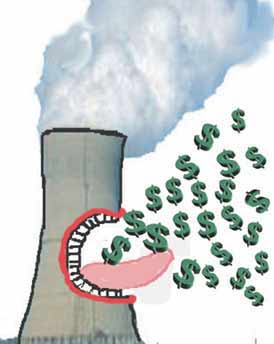
ATLANTA (AP) — The first American nuclear reactor to be built from scratch in decades is sending electricity reliably to the grid, but the cost of the Georgia power plant could discourage utilities from pursuing nuclear power as a path to a carbon-free future.
Georgia Power Co. announced Monday that Unit 3 at Plant Vogtle, southeast of Augusta, has completed testing and is now in commercial operation, seven years late and $17 billion over budget.
……………………………………………………. In Georgia, almost every electric customer will pay for Vogtle. Georgia Power currently owns 45.7% of the reactors. Smaller shares are owned by Oglethorpe Power Corp., which provides electricity to member-owned cooperatives, the Municipal Electric Authority of Georgia and the city of Dalton. Oglethorpe and MEAG plan to sell power to cooperatives and municipal utilities across Georgia, as well in Jacksonville, Florida, and parts of Alabama and the Florida Panhandle.
Georgia Power’s residential customers are projected to pay more than $926 apiece as part of an ongoing finance charge and elected public service commissioners have approved a rate increase. Residential customers will pay $4 more per month as soon as the third unit begins generating power. That could hit bills in August, two months after residential customers saw a $16-a-month increase to pay for higher fuel costs.
The high construction costs have wiped out any future benefit from low nuclear fuel costs in the future, experts have repeatedly testified before commissioners.
“The cost increases and schedule delays have completely eliminated any benefit on a life-cycle cost basis,” Tom Newsome, director of utility finance for the commission, testified Thursday in a Georgia Public Service Commission hearing examining spending.
The utility will face a fight from longtime opponents of the plant, many of whom note that power generated from solar and wind would be cheaper. They say letting Georgia Power make ratepayers pay for mistakes will unfairly bolster the utility’s profits.
“While capital-intensive and expensive projects may benefit Georgia Power’s shareholders who have enjoyed record profits throughout Vogtle’s beleaguered construction, they are not the least-cost option for Georgians who are feeling the sting of repeated bill increases,” Southern Environmental Law Center staff attorney Bob Sherrier said in a statement.
Commissioners will decide later who pays for the remainder of the costs of Vogtle, including the fourth reactor. Customers will pay for the share of spending that commissioners determine was prudent, while the company and its shareholders will have to pay for spending commissioners decide was wasteful.
Georgia Power CEO Kim Greene said the company hasn’t decided how much it will ask customers to pay. https://apnews.com/article/georgia-power-nuclear-reactor-vogtle-9555e3f9169f2d58161056feaa81a425
UK government must come clean, to tax-payers and consumers, on the financial figures before signing up to new nuclear programme
Full report. See in particular paras 41 -44. “The Government should show
how this offers value for money to taxpayers … So far, the Government has
not published financial figures which allow the cost of this risk transfer
to be known. The Government must publish figures, before signing contracts
for new gigawatt-scale nuclear, which allow a proper assessment of value
for money to be made, including setting out the level and potential cost of
construction risk to be borne by the consumer or taxpayer …
The Government should publish details of how the estimated savings from using
the RAB model for funding Sizewell C were calculated, and provide clarity
for the funding structure, by publishing the Heads of Terms for the agreed
RAB funding model for that project.”
Science, Innovation, Technology Committee 31st July 2023
https://committees.parliament.uk/publications/41092/documents/200069/default/
Campaigners against Sizewell C nuclear plan welcome call for financial clarity from Science, Innovation and Technology Committee
Campaigners against the Sizewell C nuclear power plant project in Suffolk
welcomed the committee’s call for Government clarity on the financing of
gigawatt-scale nuclear projects. A spokesperson for the Stop Sizewell C
campaign said:
“We’re appalled that the committee has ignored
legitimate concerns about whether nuclear can deliver reliable, affordable
electricity.” The group said it supported “the committee calling for
the Government to publish Sizewell C’s cost and value for money, as doing
so will expose just how unjustifiable this slow, risky, expensive project
is”.
A Department for Energy Security and Net Zero spokesperson said:
“We have already made clear we will publish a nuclear roadmap and consult
on alternative routes to market by the end of the year.
Nation Cymru 31st July 2023
Another kick in the teeth for UK taxpayers as EDF pockets another £170m of public money for their Sizewell C White Elephant.
In another lame attempt to prop up French adventurism into the UK’s energy sector, the UK
government has handed a further £170m from the public purse (note 1) to
EDF. With the CGN buy-out costing UK plc close to £700m and subsequent
‘encouragements’ to tempt reluctant investors to part with funding for
the doomed development at Sizewell, this brings the total amount of public
money handed over to EDF close to £1bn. East Suffolk residents could be
forgiven for thinking that Sizewell C is ‘shovel ready’: it is not. It
is, in fact, a long way from the Final Investment Decision (FID), the point
at which construction can begin. Even if the UK government and EDF can each
stump up £6bn the project will still be 60% short of the estimated £30bn
– a matter of £18bn to find. But that’s not all: dozens of licences
and permits have yet to be issued by the regulatory authorities, including
the site licence from the Office of Nuclear Regulation, and there is the
small matter of finding 2.2 million litres of mains water every day for 60
years of operation here in the driest county in the country, already
experiencing drought conditions.
TASC 31st July 2023
Protests held in Tokyo against nuclear water discharge

By Jiang Xueqing in Tokyo | chinadaily.com.cn 2023-07 https://global.chinadaily.com.cn/a/202307/31/WS64c7b5d8a31035260b819829.html
—
Japanese and South Korean civic groups gathered in front of the Japanese Prime Minister’s official residence on Monday in opposition to the administration’s plan to discharge nuclear-contaminated water from the Fukushima Daiichi nuclear power plant into the ocean.
People attending the rally said the Japanese government’s insistence on discharging nuclear-contaminated water into the sea is an irresponsible move.
They raised doubts about the Japanese government’s claim the nuclear-contaminated water will be diluted before being released. Whether diluted or not, the protesters said, the overall radioactive substance level in the water remain unchanged.
They stressed discharging the water into the ocean will have a significant impact on the global marine environment.
Last week, a similar protest was held by Japanese people in front of the Ministry of Economy, Trade and Industry in Tokyo.
Protesters said on Friday the ocean discharge plan is unacceptable because it poses a significant danger of radioactive contamination and will adversely affect the marine ecosystem and human health.
Some expressed concerns about Japan’s economy, which they believe will be affected by a boycott movement in neighboring countries and regions.
Requiem for NATO’s Nightmare – the Vilnius summit.
The dysfunction of the Atlantic military alliance over Ukrainian membership was just the most public manifestation of the debacle that was the Vilnius summit.
By Scott Ritter / Consortium News, 31 July 23
Ukrainian President Volodymyr Zelensky emerges as a tragic figure in the unfolding drama that is the Russian-Ukrainian conflict.
He was asked to sacrifice the lives of his countrymen in order to be seen by the U.S. and NATO as worthy of joining their club. But when the sacrifice did not produce the desired result (i.e., the strategic defeat of Russia), the door to NATO, which had been left open a crack to tease Ukraine into performing its suicidal task, was slammed shut.
Despite NATO’s disingenuous machinations to maintain the optics of potential Ukrainian membership (the Ukraine-NATO Council, created during the Vilnius Summit earlier this month, stands as a prime example), everyone knows that Ukrainian membership in the trans-Atlantic alliance is a fantasy.
Ukraine is now left to pick a poison of its own choosing — accept a peace which makes permanent Russian territorial claims while forever foregoing the possibility, however distant, of NATO membership; or to continue to fight, with the likely outcome of the additional loss of territory and destruction of the Ukrainian nation and people……………………………………..
As Ukraine bids farewell to its former self, it must also part with its dreams of becoming one with a European community whose own longevity is very much in doubt. That is largely because of its disastrous involvement in the Russian-Ukrainian conflict.
Ukraine will never be the same after this war ends. Neither will the NATO alliance. Having defined the proxy war it is waging in Ukraine against Russia in existential terms, NATO will struggle to find both relevance and purpose in a post-conflict world.
The Vilnius summit on July 11-12 in many ways represented the high-water mark of Europe’s old order. The summit was the requiem for a nightmare of Europe’s own creation — the death of a nation, the nullification of a continent and the end of an order which had long ago lost its legitimacy.
Strange Isolation
Watching the reporting from the Vilnius summit, I was struck by the strange isolation of Zelensky as he sought to mingle with the leaders of NATO nations that called him friend and ally but treated him and the nation he leads as anything but. Zelensky had pulled out all the stops to jockey Ukraine into position for NATO membership, only to be scratched at the gate.
……………………………………………………………Later, during a press conference with U.S. President Joe Biden, Zelensky stood mute while Biden continued to pour cold water on the prospects for Ukrainian NATO membership.
…………………………………The NATO dysfunction over Ukrainian membership, however, was but the most public manifestation of the debacle that was the Vilnius Summit.
The Fantasy of Unity…………………………………………………………………………………………………………………………………………………..
To sum up: Biden and Stoltenberg highlighted the decision by Erdogan to move the application for Swedish membership to NATO onto the Turkish Parliament for ratification as a symbol of NATO’s “rock solid” unity.
Left unsaid is that Erdogan had to threaten NATO to get the U.S. to articulate a bribe that had the U.S. waiving its prior sanctioning of a NATO ally while at the same time compelling the U.S. to consider the security implications of the deal, given the open hostility that exists between Turkey and fellow NATO member Greece……………………………………………….
Goodbye to All That
If the weeks leading up to the Vilnius summit were defined by the desire on the part of NATO to see the long-awaited and much-touted Ukrainian counteroffensive reach its maximum potential, the days which preceded the NATO gathering have confronted both Ukraine and its Western allies with the reality that the war is not going well for either.
The Ukrainian counteroffensive was formed around a core force of some 60,000 Ukrainian soldiers who received special training by NATO and European militaries on weapons and tactics designed to defeat Russian defenses. Since the counteroffensive began on June 8, Ukraine has lost nearly half of these troops, and a third of the equipment provided — including scores of the Leopard main battle tanks and Bradly infantry fighting vehicles that had been viewed by many as game-changing technology.
Back in 1993, George Soros postulated an architecture for a new world order premised on the United States as the sole remaining superpower overseeing a network of alliances, the most important being NATO, which would gird the northern hemisphere against a Russian threat.
“The United States,” Soros wrote, “would not be called upon to act as the policeman of the world. When it acts, it would act in conjunction with others. Incidentally, the combination of manpower from Eastern Europe with the technical capabilities of NATO would greatly enhance the military potential” of any U.S.-led alliance structure “because it would reduce the risk of body bags for NATO countries, which is the main constraint on their willingness to act.”
Forty years later, this very scenario is playing out on the bloody battlefields of Russia and Ukraine. The billions of dollars of military assistance provided by the U.S., NATO and other European nations is the living manifestation of the “technical capabilities” Soros spoke about, which are being married to “manpower from Eastern Europe” (i.e., Ukraine) to enhance the military potential of NATO in a way that reduces “the risk of body bags for NATO countries.”
https://scheerpost.com/2023/07/31/scott-ritter-requiem-for-natos-nightmare/
A Vital Atlantic Ocean System Could Collapse Sooner Than Previously Thought
Climate change is slowing down the Atlantic Meridional Overturning Circulation, a key ocean “conveyer belt.” New research finds it could collapse completely by 2060.
By Siri Chilukuri / Grist 31 Jul 23 ScheerPost
Oceans all over the world rely on a delicate balance of different elements to remain stable: Temperature, salinity, pH, and pressure all combine to create the complex bodies of water that maintain conditions for marine life and define the planet. Climate change has altered those conditions, though, by warming oceans to record-high temperatures and introducing more fresh water through sea-ice and glacier melt.
Now, new research published on Tuesday warns that a vital Atlantic Ocean system could collapse by 2060, setting off one of the planet’s tipping points, or potential points of no return. That collapse could eventually spell catastrophe for the people who live in countries that border the Atlantic Ocean, leading to increased sea-level rise in the United States, decreased temperatures and altered storm patterns over Western Europe, rejiggered climate and agricultural zones, and hotter ocean temperatures in the Caribbean.
The study, published in the journal Nature Communications, contradicts findings from the Intergovernmental Panel on Climate Change, or IPCC, the United Nations’ scientific collaboration that publishes reports on the state of climate change. The group’s latest assessment, released last year, found the collapse of the group of Atlantic Ocean currents to be unlikely given the group only acknowledges weakening of the Atlantic Meridional Overturning Circulation, or AMOC, starting in 2004. The report notes that scientists cannot say when or if a collapse will happen, since they state even the decline prior to the 2000s cannot necessarily be attributed to climate change.
We absolutely have deep respect for the IPCC report,” Susanne Ditlevsen, a statistician at the University of Copenhagen and co-author of the study, told Grist. “When we first started, we had this idea that we could use this method that’s data-based, to kind of confirm what the IPCC report is saying. So when we actually got our first results, we were very surprised, and we didn’t believe them.”
The AMOC is a thick band of water that travels from the Gulf of Mexico north along the southeastern U.S. before heading up the western edge of Europe, carrying mild temperatures with it, and onward toward Greenland and Iceland. Once there, the current is infused with heavy, cold, and salty water that then sinks, traveling back down the coast of the U.S. This system provides what one expert with the National Oceanic and Atmospheric Administration, or NOAA, called “symmetry” to temperatures in the North and South hemispheres.
But as carbon dioxide levels rise, temperatures increase, and ice melts in the Arctic, this current is being inundated with fresh water, throwing it out of balance. This has led to a weakening of the AMOC, which recently saw its slowest point in 1,600 years in 2021.
If the web of Atlantic Ocean currents stopped, it would constitute one of the Earth’s tipping points, which signal a dramatic, potentially irreversible shift in the condition of the planet — and its habitability for humans. A study last year found that the planet may have already passed a few tipping points, including tropical coral die-off and the beginning of the Greenland ice-sheet collapse, at just 1.1 degree Celsius (1.9 degrees Fahrenheit) of warming. ……………………………………… https://scheerpost.com/2023/07/31/a-vital-atlantic-ocean-system-could-collapse-sooner-than-previously-thought/
Nuclear news – week to 31 July

Some bits of good news – Syrian refugees in Jordan empowered through heritage restoration work, employed by UNESCO. “A Thousand Colours” https://www.youtube.com/watch?v=qz4pLmi6tDY This new UNESCO-Khalili Foundation film “A Thousand Colours” aims to humanize the notion of cultural diversity. Why is cultural diversity important? What are some of the current challenges that undermine it? And what can we do to protect and promote cultural diversity? These are some of the questions addressed by the short film, which gathers testimonies from a number of key global actors including UNESCO Goodwill Ambassadors and advocates. Saving the world is cheaper than ruining it.
TOP STORIES
If Albanese’s such a buddy of Biden’s, why is Assange still in jail? Australia Agrees To Build US Missiles; US Dismisses Australian Concerns About Assange.
William Hartung, Cashing in on a Perpetual Nuclear Arms Race.
Why investing in new nuclear plants is bad for the climate. Small Modular Nuclear Reactors (SMRs) are supported by ideology alone.
Aboriginal Australians defeat nuclear dump,
Western media as cheerleaders for war.
Climate. ‘Era of global boiling has arrived,’ says UN chief . ‘Project 2025’: plan to dismantle US climate policy for next Republican president.
Nuclear. Militarism rules – not always nuclear-related, but pretty much so. I am currently feeling overwhelmed by the speed of my own country, Australia, in its hurtling rush to be a servant of the USA’s NUCLEAR-MILITARY-COMPLEX. No voice from the people – just a straightout government sellout.
Christina’s Notes. Jobs! jobs! jobs! – IN THE DEATH INDUSTRY. Aliens in outer space – a little sad on watching earthlings.
CIVIL LIBERTIES. AUSMIN and Assange: The Great Vassal Smackdown
ECONOMICS. Money talks: 109 global institutions restrict investments in nuclear weapons. There’s no such thing as a new nuclear golden age–just old industry hands trying to make a buck. Keeping contentious nuclear plant open could cost Californians $45B: report. As UK’s Hinkley nuclear plants costs rise to £32 billion ($41.5 billion) EDF Sees Higher Risk of Delays. Government must back Rolls-Royce on nuclear, says ex-boss Sir John Rose.
EDUCATION. University of New Mexico Course Expands Understanding of Nuclear Impact.
ENERGY. Oppenheimer and nuclear energy: Is India and the world moving away from this power source? Old Nuclear Weapons Sites Targeted for Clean Energy Projects.
ENVIRONMENT. Failed Fukushima System Should Cancel Wastewater Ocean Dumping.
HISTORY. St. Louis link in ‘Oppenheimer’ is latest reminder of city’s nuclear legacy. Oppenheimer sent ‘chilling message’ to Jawaharlal Nehru about US building a deadly weapon, ‘begged’ him not to give access to raw material available in India.
LEGAL. Key British Assange supporter says Wikileaks founder could cut deal to secure freedom.
MEDIA. Oppenheimer’s Long Shadow- Reads on the atomic bomb and its creator. Nauseating subservience of Australia’s media and politics to American militarism. Readers disgusted with pro militarism report on Australia getting a “missiles industry”. Australian media’s alarm over Chinese spy ship highlights stark double-standard.
NUCLEAR TECHNOLOGY. To avoid nuclear instability, a moratorium on integrating AI into nuclear decision-making is urgently needed: The NPT PrepCom can serve as a springboard
OPPOSITION to NUCLEAR . 90 Seconds to Midnight – nuclear weapons are still a threat, not a lesson in history.
POLITICS.
- USA. More Warmongers Elevated In The Biden Administration. Massachusetts rejects Holtec’s request to discharge radioactive water from closed nuclear plant into bay. Past and Future Collide over Diablo Canyon Nuclear Power Plant . No new nuclear facilities along vulnerable coasts, Alaska regulators say. Connecticut governor should veto bill funding unneeded nuclear.
- UK. UK govt to pour another £170million of taxpayers’ cash into planned Sizewell C nuclear plant: is it value for money? UK’s nuclear power ambitions for 2050 lack clear plan, say MPs. UK Government’s infrastructure advisors cast doubt over UK’s biggest energy projects including nuclear clearup. Now, not in 15 years’: Call for public vote on Theddlethorpe nuclear waste dump. Cumbria set for more nuclear reactors as questions are raised over why land isn’t being used for renewable energy.
POLITICS INTERNATIONAL and DIPLOMACY.
- Japan Doesn’t Want to Fight for Taiwan and Neither Do Other US Allies. Will the small states of Oceania be able to maintain their independence in the face of a new Sino-American Cold War?
- Russia prepared to seek diplomatic solution in Ukraine, NATO refuses to talk. The coming Russian-Polish war.
- Iran says ready to settle remaining dispute with IAEA over nuclear program. Rising Global Interest to Join Nuclear Damage Compensation Treaty.
SAFETY. The misguided push to weaken nuclear safety standards is gaining steam. The Global Crisis at the Zaporizhzhia Nuclear Site Demands Immediate United Nations Intervention. Will this experimental nuclear reactor escape federal scrutiny? Aware people in Suffolk are astonished that very few people or organisations are consulted about changes to Sizewell C Nuclear’s Emergency Plan.
SECRETS and LIES. UPDATE – The Zaporozhiya Nuclear Plant: Zelenskiy’s Next Simulacra? CIA-Linked Security Company Targeted Former Ecuador President Who Granted Assange Asylum.
SPACE. EXPLORATION, WEAPONS. NASA solving climate crisis by facilitating escape to Mars? Funny How The UFO Narrative Coincides With The Race To Weaponize Space. Legal action over dangerous crowding of satellites and debris in space. NASA is planning to use nuclear power for the first human trip to Mars. Military interest in nuclear-powered space travel, but solar-powered is just as good, -and safer.
WASTES. IAEA report on Fukushima waste-water is wrong – nuclear scientist. Not in our backyard: Securing a referendum over Canada’s plan for a nuclear waste dump. AUKUS nuclear dump deal decades in the making by nuclear evangelists with prescience.
WAR and CONFLICT. Overnight drone attack on Moscow injures one and temporarily closes an airport as Russia suffers ‘consequences’. US admits to pushing Ukraine into a fight it can’t win . Discarding Illusions, Ending Wars. Nuclear weapons on the table if Ukraine counteroffensive succeeds: Russia’s Medvedev. Ukrainian drone attack on Moscow is ‘international terrorism’ – Russia’s Foreign Ministry.
70 Years Later, The Korean War Must End. Washington’s looming war against China. The vanishing profession of preventing nuclear war.
WEAPONS and WEAPONS SALES. Trident nuclear project can’t be delivered, says watchdog. Bombs away: Confronting the deployment of nuclear weapons in non-nuclear weapon countries. Following the pattern of weapons to Ukraine, Pentagon to send $1billion of weapons to Taiwan . What would George Washington do? He would have audacity to end nuclear weapons.
Niger stops uranium and gold export to France

- ByAl Mayadeen , Source: Agencies 1 Aug 23
Niger coup leader General Abdourahamane Tchiani, despite being EU’s largest supplier of uranium, halts uranium and gold export to France.
With immediate effect, the Republic of Niger under the leadership of General Abdourahamane Tchiani, and supported by the people of the Republic, announced the suspension of the export of uranium and gold to France on Sunday.
In parallel to the decision, protestors were surrounding the French Embassy in Niger calling for the end of French colonial practices repeating the slogan “Down with France!” and reaffirming their support to the coup leader, Tchiani…………………………………
It is also worth noting that Niger, according to the World Nuclear Association (WNA), is the world’s seventh-biggest producer of uranium. The WNA also confirms that Niger, in 2022, produced 2020 tU which would be considered just over 4% of world uranium output.
Currently, uranium production in Niger occurs mostly through a French majority-owned company called Orano which owns 63.4% of Société des Mines de l’Aïr (SOMAÏR). The remaining 36.66% of this is owned by Niger’s Société du Patrimoine des Mines du Niger, known as Sopamin.
In 2021, the European Union utilities purchased 2905 tU of Niger-produced uranium making Niger the leading uranium supplier vis-a-vis the EU.
Earlier, on July 28, Orano released a statement arguing that “the situation remains unstable” in Niger following the overthrowing of French ally and President of Niger Muhammed Bazoum. The company then added that it has “set up a crisis unit to prioritize the safety of its employees” and underscored that “this event to have any immediate impact on its activities in Niger or on the value of its assets.”….. https://english.almayadeen.net/news/Economy/niger-puts-an-end-to-uranium-and-gold-export-to-france
As UK’s Hinkley nuclear plants costs rise to £32 billion ($41.5 billion) EDF Sees Higher Risk of Delays.

Electricite de France SA said the risk of further delay to two nuclear reactors in southwest England has risen because of construction setbacks.
Author of the article:
Bloomberg News, Francois de Beaupuy, https://financialpost.com/pmn/business-pmn/edf-sees-increased-risk-of-delay-to-new-uk-atomic-reactors
EDF flagged last year that the plants may start 15 months late. The reactors at Hinkley Point have been touted by the UK government as sparking a nuclear renaissance, boosting energy independence and reducing reliance on fossil fuels. But the work has been plagued by multiple holdups and cost overruns.
The increased risk of a 15-month delay is due to “performances on civil works and challenges on mechanical, electrical, heating, ventilation and air conditioning,” EDF said Thursday in an earnings presentation. “Progress is below the planned trajectory and action plans have been set.”
The reactors, costing as much as £32 billion ($41.5 billion), are due to start operating in 2027 and 2028. The ballooning budget has fueled controversy over the vast sums needed for new nuclear developments, even as other low-carbon technologies such as offshore wind have also faced inflationary pressures.
Hinkley Point’s setbacks come as EDF seeks to arrange financing for a second pair of atomic plants — at Sizewell in eastern England — that would use the same design. Delays and cost overruns may deter investors who also face increasing demands for capital from renewables, which provide swifter returns.
The debt-laden French utility has a 66.5% stake in Hinkley Point, while China General Nuclear Power Corp. owns the rest. As funding requirements now exceed contractual commitments, shareholders will be asked to provide additional equity voluntarily starting in the fourth quarter.
“The probability that CGN will not fund the project beyond its committed equity cap is high,” EDF said Thursday. “Financing solutions are being investigated, in the event that CGN does not allocate its voluntary equity.
Legal action over dangerous crowding of satellites and debris in space

2 The Global Network Against Weapons & Nuclear Power in Space is involved in a legal action against the FCC (Federal Communications Commission) to pressure them to create rules/guidelines for the launching of satellites in space. Lower Earth orbit (LEO) is becoming dangerously crowded and NASA scientists are concerned about growing space debris and likely cascading collisions in orbit (Kessler Syndrome). The US is moving quickly to grab as many of the remaining orbital parking spaces as possible in order to deny Russia, China, India and other nations from deploying satellites in LEO.
The Space Force today contends that it will ‘control and dominate space’ and use space tech to win wars on the Earth below.
Our lead lawyer recently sent the GN this report (linked above) on the current legal challenge and the issues involved……….. more https://space4peace.org/legal-action-against-fcc/
TODAY. Pro nuclear spin – the perfect examples of deception in language and logic.

I did find, in the reporting of the finally-in-operation Vogtle nuclear power plant, a fine example of the nuclear lobby’s brilliant, but twisted and irrational, logic.
Department of Energy’s Loan Programs Office director, Jigar Shah, was “optimistic and thinks Vogtle is a nuclear turning point, with a pivot toward smaller-scale projects that will be easier and cheaper to replicate.” “I also think it sets up the U.S. nuclear renaissance very well in small modular reactors,” “The beauty of the small modular reactor is it fits within that $2 [billion] to $4 billion price range,” Shah said.
(That’s the suggested price to build one smr). Upon completion, Vogtle Units 3 and 4 are expected to generate 17,200,000 megawatt-hours . The only Small Modular Reactor (SMR) to receive “design certification”, is the NuScale, which generates 77 megawatts electric (MWe). So – you’d need an awful lot of them to match the Vogtle output, – like over 20,000? At $2 – $4billion each – cost would be? NuScale does put 12 together, to make quite a big nuclear plant ( you’d still need quite a lot of these no-longer-small-plants) . I await some nuclear tech genius to enlighten me on how SMRs are going to produce electricity more cheaply.
But no matter – the logic is – large nuclear reactors produce expensive electricity: therefore small nuclear reactors will produce cheap electricity.
So – we don’t need to discuss other forms of electricity generation (like solar, for example)
Which brings me to another clever aspect of pro nuclear spin, – which is – you just ignore the bits that you don’t like, especially where there might be a comparison with non-nuclear technologies. This is done by concentrating on one aspect that might have popular appeal.
For example: the operating nuclear reactor emits almost no carbon emissions. That point, (excluding the total fuel-cycle) is the focus for claiming that nuclear is “clean” and “safe”. The focus on that claim leaves out altogether other aspects, like safety, security, long-lasting radioactive wastes, potential for nuclear/radioactive weapons, terrorism risks.
And then there’s language. The nuclear lobby used to dazzle us with science. And they still do, especially when the subject of ionising radiation comes up- a beaut collection of jargon words and initials- a confusion of “Intermediate Level” “Restricted Solid Wastes” “Class B Wastes” and many radiation terms.
But today – in this fast-changing world – repetitive, fast, meaningless words and phrases are the order of the day – game-changing, climate-change solution, clean, reliable, affordable, good-paying jobs, ………… most often quoted without any facts supplied to support them
The financial catastrophe that has been the Vogtle nuclear power project – is just another challenge/opportunity for the nuclear lobby. Like Fukushima, like Chernobyl, even like “Oppenheimer” – ’twill be another occasion for the nuclear spin-doctors and their loyal media to broadcast the coming success and benefits of new nuclear power.
First new US nuclear reactor in 3 decades may well also be its last
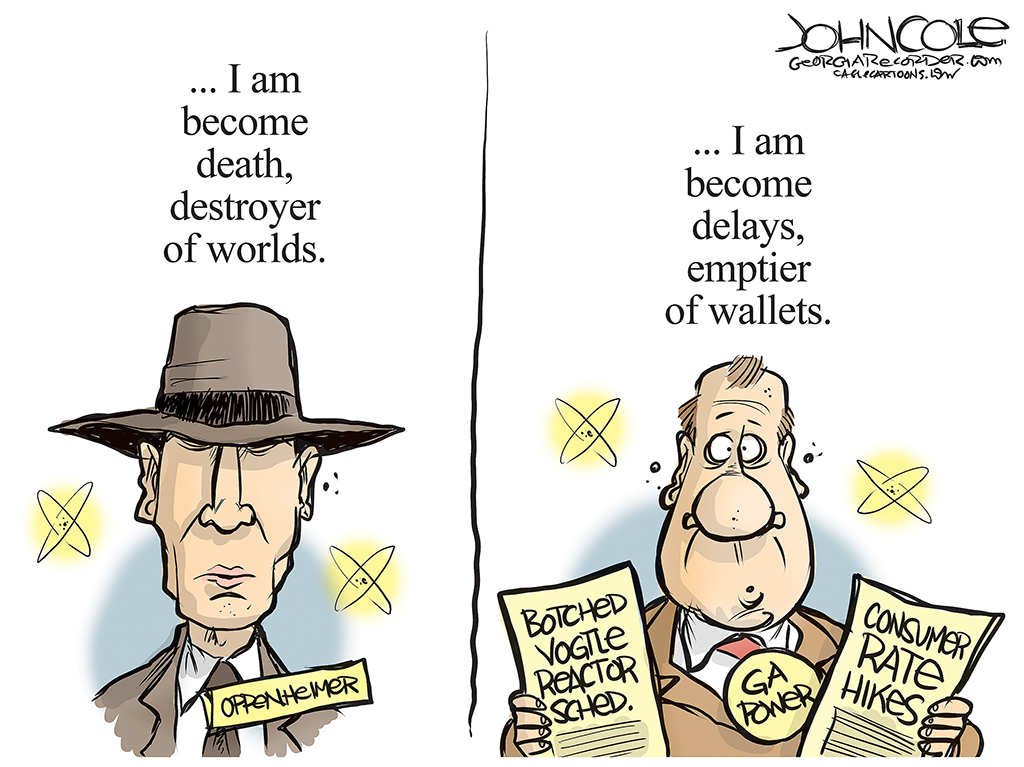
“The only reason there’s a nuclear renaissance is because the federal government is throwing tens of billions of dollars at nuclear,” …….. “Investors aren’t interested.”
Opening of Georgia Power’s Vogtle unit 3 comes 7 years late and billions
of dollars over budget.
FT.com Myles McCormick in Houston, 31 July 2023
The US nuclear energy industry has reached a watershed moment. Plant Vogtle unit 3 began delivering commercial electricity to the Georgia power grid, becoming the first nuclear reactor the country has built from scratch in more than three decades.
Unit 3 and a twin reactor to open in the coming months may also be the last. Years of delays and billions of dollars of cost overruns have made the megaproject as much a cautionary tale as a new chapter for atomic investment.
The 1,100-megawatt Vogtle unit 3 was initially supposed to enter service in 2016, however. Its start of operations was delayed once more in June after the company discovered a degraded seal in its main generator.
“It turns out nuclear construction is hard,” said Bob Sherrier, a staff attorney at the Southern Environmental Law Center, which challenged the project in court.
“Along the way the company kept ratcheting up the cost estimates, pushing back the deadlines a bit at a time. Every time it was raised just enough where it was still within the bounds of justification that it made sense to proceed. But they were wildly off in their estimates every single time.”
“The resurgence of America’s nuclear industry starts here in Georgia, where you’ve just got approval, for the first time in three decades, to build new nuclear reactors,” then-US energy secretary Steven Chu said as Vogtle was authorised in 2012.
The Georgia project was supposed to be the first among dozens of new reactors built across the country. But the renaissance floundered amid safety concerns after the 2011 Fukushima disaster in Japan coupled with plunging prices for natural gas, a competing generation fuel. In the end only four reactors moved ahead and two, Vogtle units 3 and 4, have been built. Unit 4 is scheduled to come online by early 2024.
Soaring costs at Vogtle, along with new reactors at the VC Summer nuclear project in South Carolina, forced engineering contractor Westinghouse into bankruptcy in 2017. While South Carolina utilities pulled the plug on their project, Georgia ploughed ahead.
The $14bn original cost of Vogtle units 3 and 4 has now ballooned to more than $30bn. The cost for Georgia Power, with a 45 per cent share of the project, will be about $15bn.
How the company’s costs are shared with its customers will be decided by the commission once unit 4 is operating: the law allows only costs deemed “prudent” to be passed on to ratepayers.
McDonald said the company should not expect an easy ride. “They are guilty until they prove themselves innocent,” he said.
Georgia Power, a division of New York-listed Southern Company, did not respond to multiple requests for an interview.
……………………………………… there are no other traditional large-scale light water reactors under way in the US. Critics say that investors have been turned off.
“The only reason there’s a nuclear renaissance is because the federal government is throwing tens of billions of dollars at nuclear,” said David Schlissel at the Institute for Energy Economics and Financial Analysis. “Investors aren’t interested.”
For Georgians, the more immediate concern is what the project means for utility bills. Georgia Watch, a consumer group, estimates ratepayers have already paid $900 extra since construction began to cover financing costs. Bills are set to rise by another $3.78, or 3 per cent, on average when unit 3 comes online.
But the ultimate impact will not be felt until unit 4 comes online and the PSC decides how much of the burden will be left for ratepayers to shoulder. Georgia Watch estimates the final increase will add anywhere between 10-13 per cent to bills……………… https://www.ft.com/content/5d8e0c6c-59c9-4b40-806f-604889dd5fb6
How the “Nuclear Renaissance” Robs and Roasts Our Earth

the average age of an operating U.S. reactor is now around 40. None are insured, despite assurances dating to the 1957 Price-Anderson Act that the reactor fleet would get private liability coverage by 1972.
the dangers escalate as the plants age. Meaningful estimates of the cost of a catastrophic accident are hard to come by, but after Chernobyl and Fukushima, the costs have soared into the trillions.
Nuclear power not only costs twice as much as wind and solar, it’s responsible for superheating our air and waterways.
By Harvey Wasserman , TRUTHOUT, July 31, 2023 https://truthout.org/articles/how-the-nuclear-renaissance-robs-and-roasts-our-earth/
Every day, as they burn with nuclear fission at some 571 degrees Fahrenheit, some 430 nuke reactors roast our Earth. They irradiate and superheat our air, rivers, lakes and oceans.
They also spew radioactive carbon, and emit more greenhouse gasses in the mining, milling, enrichment and fabrication processes that produce their fuel. Still more is emitted as they attempt to store their wastes.
Six big reactors and their fuel pools now threaten an apocalypse in Ukraine. Pleas for United Nations intervention are increasingly desperate.
But “nuclear renaissance” proponents say we need even more reactors to “combat climate change.”
However, these mythical new reactors have real costs — and for at least the next six years, they can produce nothing of positive commercial or ecological significance.
The primary reason there’s likely to be no new reactors in the U.S. until at least 2030 (if ever) is economic — the cost of construction is gargantuan.
Let’s consider eight recent major construction failures in Europe and the U.S.
Atomic plants were first constructed during the Manhattan Project that built the atomic bomb. Heralded as the “too cheap to meter” harbinger of an atomic age, the first commercial reactor came online at Shippingport, Pennsylvania, in 1958.
But in the coming decades, as reactor construction took off through the 1960s, ‘70s and into the ‘80s, the industry demonstrated an epic reverse learning curve, what Forbes called in 1985 “the largest managerial disaster in business history, a disaster on a monumental scale.”
At VC Summer Nuclear Station in South Carolina, after a decade of site work marred by faulty construction, substandard materials, bad planning, labor strife, and more, two reactors were abandoned outright in 2017, wasting $10 billion while bankrupting Westinghouse.
By comparison, the previous largest nuke-related bankruptcy, at the Washington Public Power Supply System in 1982, cost about four times less, at $2.5 billion. The biggest solar failure, at Solyndra in 2011, came with the loss of a $535 million government loan, about 15 times less than VC Summer.
In Georgia, two still-unfinished Vogtle reactors are some seven years late and $20 billion over budget, now at a staggering $35 billion plus.
In Hinkley, United Kingdom, two more reactors are also years late and could surpass $42 billion.
In Flamanville, France, a single reactor project begun in 2007 is still unfinished, years past its original promised completion date, and four times over its original cost estimate — with the price tag now beyond $14 billion.
Finland’s Olkiluoto has opened after 18 years of construction at around $12 billion in costs so far — three times the original promise.
All these reactor projects failed due to overly optimistic industry promises designed to attract investors, followed by poor execution, bad design, substandard components, labor strife, and more. Despite the industry hype, none of these eight reactors can ever compete with renewables, whose prices now range as low as a third to a quarter of nuclear — and are dropping.
With incalculable billions and a decade or more needed to build old-style big nuclear reactors, financial experts have long predicted that the necessary capital won’t be anywhere on the horizon.
Instead, the industry has been gouging state and local governments to keep the old reactors running, a desperate and dangerous toss of the dice.
Six billion dollars was pledged to nuclear energy plants in Biden’s infrastructure bill alone. A billion in federal dollars has been promised to keep California’s Diablo Canyon running, along with another billion from the state.
But the average age of an operating U.S. reactor is now around 40. None are insured, despite assurances dating to the 1957 Price-Anderson Act that the reactor fleet would get private liability coverage by 1972. Despite their immense inherent danger, only nominal company participation in a perfunctory insurance fund has been required for a license. Blanket coverage against a cataclysmic accident has not been a legal requirement to build or operate these reactors.
After six decades, reactor owners are still exempted from the costs of a catastrophic accident, and no nongovernmental insurance corporation has stepped in at an appropriate scale.
Yet the dangers escalate as the plants age. Meaningful estimates of the cost of a catastrophic accident are hard to come by, but after Chernobyl and Fukushima, the costs have soared into the trillions.
The oldest operating U.S. plant, at Nine Mile Point on Lake Huron, opened in 1969. Repeated near-disasters at Davis-Besse in Ohio include a hole eaten through a critical core component by boric acid that was missed because the owners refused to do required inspections. Monticello and Prairie Island in Minnesota threaten the entire Mississippi Valley. Critical intake pipes at South Texas recently froze, as its builders never anticipated the cold weather that hit it unexpectedly in 2021.
French and U.S. rivers are often too hot to cool reactor cores, forcing them to cut output or shut altogether.
Palo Verde in Arizona evaporates some 27,000 gallons of water per minute in a roasting desert. San Onofre in California was shut in 2012 because of leaking generators and now stores its high-level waste 100 feet from the ocean. Perry (Ohio) and North Anna (Virginia) have both been damaged by earthquakes.
Former Nuclear Regulatory Commission (NRC) site inspector Michael Peck has warned that Diablo Canyon in California should be closed because of the danger posed by seismic activity. Just 45 miles from the San Andreas Fault, Diablo was on its way to an orderly shut-down when Gov. Gavin Newsom strong-armed the state legislature and Public Utilities Commission to keep the embrittled, under-maintained reactors open despite their ability to blanket the state in terminal radioactivity. The NRC ignored Peck’s warning and he’s now gone from the Commission.
Diablo’s owner, Pacific Gas & Electric, has a blemished record when it comes to public safety — it has admitted to more than 80 counts of felony manslaughter due to the 2018 wildfires in California.
In Ukraine, of six reactors at Zaporizhzhia, five are in cold shut-down while one lingers on to power the place. But six shaky fuel pools contain apocalyptic quantities of radiation. Power supplies are in doubt, vital cooling water is threatened by a sabotaged dam, military attacks are possible, and site workers maintain the plant in a state of terror.
Like Zaporizhzhya, any operating reactor or fuel pool would be devastating targets for military or non-state terrorist attacks. The 9/11 masterminds reportedly toyed with hitting the Indian Point power plant north of New York City, irradiating the northeast. Any of the 90-plus decayed uninsured U.S. nukes are potential Chernobyls or Fukushimas. Deep concerns have been expressed by United Nations inspectors and many others. A public petition now asks that UN peacekeepers take over the Zaporizhzhya site.
So, taken in sum, “nuclear power” to date is defined by catastrophic fiscal failure and public risk. No new plants are under construction and efforts to keep the current fleet operating are fraught with uninsured danger.
In straight-up financial terms, the peaceful atom’s “too cheap to meter” promises can never compete in real terms with renewables, which won’t melt, explode, release mass quantities of radiation or create atomic wastes.
Projections for thorium, fusion, and other futuristic reactors also remain technically and fiscally vaporous. The fusion facility at ITTR in France has already burned through $65 billion.
And a reactor burning at 100 million degrees is as likely to cool the planet as Edward Teller’s fusion superbombs.
Which leaves us with the much-hyped small modular reactors (SMRs), now wallowing in deep delay and soaring prices. SMRs are theoretical nukes designed to be far smaller than today’s 1,000+ megawatt reactors, to be mass produced and buried throughout the country. Only one SMR developer, NuScale, has gotten significant preliminary licensing approval. Cost and delivery projections from Bill Gates’s TerraPower, X-Energy, and other prospective manufacturers are theoretical, with little concrete data to back up when they might be deployed and at what prices.
Projected prices at NuScale have soared from $58/megawatt-hour in 2017 to $89 now, nearly double the range of wind and solar. By 2030, SMR prices are likely to be triple or more. A recent piece by former NRC Chair Allison MacFarlane eviscerated the technology’s potential with a devastating analysis, referring to it primarily as a means of attracting government hand-outs and “stupid money.”
But with no big U.S. reactors being built while SMRs drown in red ink and tape, the industry still burns and irradiates the planet with about 430 aging reactors worldwide and 92 ancient ones here in the U.S. And the odds of an apocalypse at one or more of those old reactors grow with each day they age.
The pitfalls include unsolved problems of reactor waste, deteriorating infrastructure, a fast-retiring workforce, a diminishing ability of the industry to deliver on its promises, a minimum five-year gap before any small reactors could come into significant commercial production, the forever threats of war and terrorism, the killing power of radiation, and much more.
Meanwhile, renewables have long since blown past both nukes and coal in jobs, price, safety, efficiency, reliability, speed to build, and more.
As nuclear investments dry up, offshore wind, rooftop solar, “agri-voltaic” farmland and advanced efficiency are booming.
A pending transition from lithium to sodium may soon transform the battery industry. For reasons of cost, ecological impacts and resistance to mines on Indigenous lands, lithium-based batteries face serious challenges.
But with cheaper, more widely available sodium at their core, battery technologies are poised for a near-term Great Leap. Should that happen soon, the current storage challenges of the green power revolution could all but disappear.
Thus, we face the ultimate test: Can our species replace these failed, lethal nukes with safe and just forms of green power — or will we let this latest atomic con fry us all?
I was a US nuclear missile operator. I’m grateful for the Oppenheimer film
A “Broken Arrow” is defined as an unexpected event that results in the accidental launching, firing, detonating, theft or loss of a nuclear weapon. Since the creation of nuclear weapons, there have been 32 Broken Arrows.
Cole Smith, 24 July 23 more https://www.theguardian.com/commentisfree/2023/jul/24/nuclear-war-oppenheimer-serious?CMP=share_btn_tw
The questions at the center of Oppenheimer don’t feel theoretical to me. From 2012 to 2017 I worked on nearly 300 nuclear silo alerts
Audiences are rushing to theaters to see Oppenheimer. Early buzz is that this movie will be one of the blockbusters of the summer.
One reason for the interest: the film is loaded with the philosophical questions J Robert Oppenheimer and his team faced while developing the first atomic bomb. Do nuclear weapons make us safer? Will they inspire an arms race that will push humanity into extinction? Is it possible this weapon will lead to the destruction of the world?
The questions that the film’s director, Christopher Nolan, places at the center of Oppenheimer don’t feel theoretical to me. From 2012 to 2017 I worked as a nuclear missile operator in the US air force. During that time, I worked nearly 300 “alerts”, or shifts in underground launch control centers, where I oversaw maintenance, security and launch operations for 10 nuclear-tipped intercontinental ballistic missiles (ICBMs).
It may surprise you to hear that I watched a lot of movies while on alert. To be sure, the job of air force missile operators is often very busy. But it is also a 24/7/365 shift schedule. And on those late nights, weekends or holiday shifts when nothing was going on, my crew partners and I would turn to movies to get us through our shifts. It was here that I began to notice Hollywood’s love affair with nuclear weapons.
Early on, Hollywood gave us a lot to chew on. Sidney Lumet’s 1964 film Fail Safe is as serious a commentary on the questions around nuclear deterrence as has ever been presented on the screen. The same year, Stanley Kubrick defined the absurdity of a society that uses a nuclear arsenal to achieve “peace” in his film Dr Strangelove. When these films were released, it had been less than 20 years since Americans dropped the first atomic bombs on Japan. America was just beginning its nuclear arms race with Russia and the nuclear conversation felt very much alive to the average American.
But the American public grew weary of always being on high alert. Hollywood reflected this change as the meticulous films of the 60s began to give way to a new type of cold war thriller – one in which every villain seemed to speak with a Russian accent and wield some sort of vague existential nuclear threat that would be defeated by a red-blooded American. Some of these films, like 1983’s WarGames, were self-aware enough to work. But most existed on a spectrum ranging from Steven Seagal’s Under Siege to The Core – which is to say, mildly entertaining to so bad it’s somehow maybe almost good. As a result, in the decades before the release of Oppenheimer, the nuclear thriller had become an almost taboo genre in Hollywood.
That’s a problem, because the nuclear threat never went away. If anything, it got worse. Today, the United States has about 400 nuclear tipped ICBMs, the ones I operated, ready for launch every single day. It also has a robust nuclear bomber program as well as nuclear-armed submarines. In total, the US owns approximately 6,000 nuclear warheads. What’s more, the air force is currently in the midst of developing a new ICBM nuclear delivery system, called Ground Based Strategic Deterrent (GBSD). In 2020, the air force awarded a $13.3bn sole-source contract for GBSD to Northrop Grumman. The contract was awarded by default with no other competitors for the contract and little to no press coverage or public debate.
When I was a 23-year-old missile operator in the air force, my commander once told me that a good day in nuclear missile operations is a quiet one. Most of the days in the five years I spent working in underground nuclear launch control silos were just that: quiet. But not every day in the history of the US air force nuclear missile program has been quiet. A “Broken Arrow” is defined as an unexpected event that results in the accidental launching, firing, detonating, theft or loss of a nuclear weapon. Since the creation of nuclear weapons, there have been 32 Broken Arrows.
In the five years I served as a nuclear missile operator I performed targeting on dozens of active nuclear missiles. I commanded “major maintenance” operations like warhead swaps from one ICBM to another. We even pulled entire missiles out of the ground and replaced them with refurbished ones. And never once was I worried that I might have a Broken Arrow on my hands.
The problem is that, while a good day in nuclear missile operations is a quiet one, the quiet days don’t lead to a reduction in the number of these weapons. That’s why we need engaging stories about nuclear weapons in our movie theaters. We need journalism that comprehensively unpacks this issue. In short, we need a public that is as engaged with nuclear weapons as they were during the cold war. Otherwise, it’s only on days when Vladimir Putin threatens the use of nuclear weapons, or the days that North Korea test launches its latest ICBM, that we begin to discuss the inherent dangers of a world that allows nuclear missiles to exist. And on those not-so-quiet days, it’s already too late.
In May of 2022, while Nolan was in the midst of principal photography on Oppenheimer, I sat down for lunch in New York with Kai Bird, the co-author of American Prometheus, the book from which Oppenheimer is adapted.
I asked Bird if he thought Nolan would do justice to the subject. Bird told me that Nolan shared a draft of the script with him and asked him to read it for any historical discrepancies. Bird told Nolan that almost everything looked accurate, but that the script put the casualty rate from the bomb used on Hiroshima at 70,000, a number much lower than the casualty count accepted by most historians. Nolan said that he knew this figure was low but that he had gone back and read the original transcripts from the Senate hearing and used the actual words from Oppenheimer’s mouth.
Nolan’s attention to detail is what the nuclear conversation deserves. Oppenheimer sets the stage for a new conversation about nuclear weapons in Hollywood – one that doesn’t rely on overwrought cold war tropes. It’s a more difficult conversation because it’s one where, like Robert Oppenheimer, we have to come to terms with our own actions (or inactions) in order to make decisions about our future. Do we want to live in a world free from the threat of nuclear war? Or do we want to cover our eyes and throw the dice in a world with more than 14,000 nuclear warheads? Nolan isn’t afraid to ask these hard questions. I hope other film-makers follow his lead.
1 This Month
26 April – Chernobyl: Inside the Meltdown airs on National Geographic on Sunday 26th April from 4pm

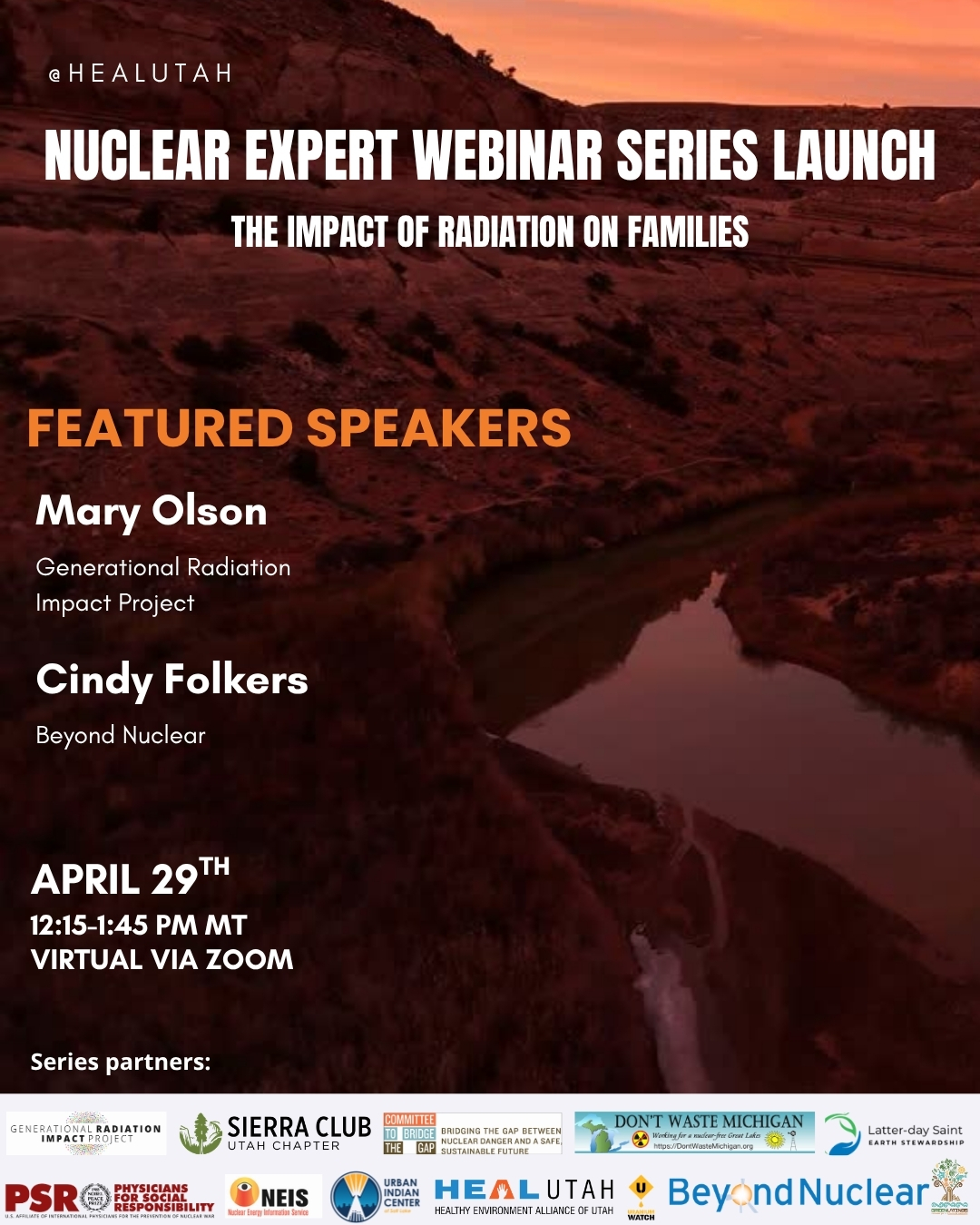
29 April – Nuclear Expert Webinar #1 – Radiation Impacts on Families with Mary Olson and Cindy Folkers
- 12:15 PM MT – 1:45 PM MT
- Location: Virtual – REGISTER TODAY

4 May -West Suburban Peace Coalition to discuss Iran war at May Educational Forum
Monday, May 4, 7:00 – 8:00 PM Central Standard Time
Title: : How Trump’s Narrative Tries to Shape the Reality of the War on Iran.
Contact Walt Zlotow, zlotow@hotmail.com 630 442 3045 for further information
14 May – online event From Bombs to Data Centres: the Face of Nuclear Colonialism

Pine Ridge Uranium is the real threat, not Tehran- Tell Burgum: Stop the Extraction.
Chernobyl: The Lost Tapes – A good documentary on Chernobyl on SBS available On Demand for the next 3 weeks– https://www.sbs.com.au/ondemand/tv-program/chernobyl-the-lost-tapes/2352741955560
To see nuclear-related stories in greater depth and intensity – go to https://nuclearinformation.wordpress.com
-
Archives
- April 2026 (288)
- March 2026 (251)
- February 2026 (268)
- January 2026 (308)
- December 2025 (358)
- November 2025 (359)
- October 2025 (376)
- September 2025 (257)
- August 2025 (319)
- July 2025 (230)
- June 2025 (348)
- May 2025 (261)
-
Categories
- 1
- 1 NUCLEAR ISSUES
- business and costs
- climate change
- culture and arts
- ENERGY
- environment
- health
- history
- indigenous issues
- Legal
- marketing of nuclear
- media
- opposition to nuclear
- PERSONAL STORIES
- politics
- politics international
- Religion and ethics
- safety
- secrets,lies and civil liberties
- spinbuster
- technology
- Uranium
- wastes
- weapons and war
- Women
- 2 WORLD
- ACTION
- AFRICA
- Atrocities
- AUSTRALIA
- Christina's notes
- Christina's themes
- culture and arts
- Events
- Fuk 2022
- Fuk 2023
- Fukushima 2017
- Fukushima 2018
- fukushima 2019
- Fukushima 2020
- Fukushima 2021
- general
- global warming
- Humour (God we need it)
- Nuclear
- RARE EARTHS
- Reference
- resources – print
- Resources -audiovicual
- Weekly Newsletter
- World
- World Nuclear
- YouTube
-
RSS
Entries RSS
Comments RSS
 nuclear-news